Introduction
Br is a rare but important element in the geochemistry of cosmic rocks, terrestrial rocks and the hydrosphere (Vernadsky, Reference Vernadsky1934; Correns, Reference Correns1956; Harlov and Aranovich, Reference Harlov and Aranovich2018). Due to strong incompatibility, the Br content is extremely low in mantle rocks (5.1–22 ppb, Jagoutz et al., Reference Jagoutz, Palme, Baddenhausen, Blum, Cendales, Dreibus, Spettel, Lorenz and Wänke1979) and increases in continental crust, with an average concentration of 2.5 ppm (Vinogradov, Reference Vinogradov1962; Krauskopf, Reference Krauskopf1979). Among igneous rocks, the highest content of Br is observed in alkaline rocks (e.g. haüynophyres, bergalites and phonolites from the Kaiserstuhl Complex, which contain up to 33.5 ppm Br, Wang et al., Reference Wang, Marks, Keller and Markl2014) and carbonatites, particularly in alkali-rich gregoryite–nyerereite carbonatites from the Oldoinyo Lengai volcano (up to 100 ppm, Mangler et al., Reference Mangler, Marks, Zaitzev, Eby and Markl2014). Sodalite-group minerals seem to be a major host for Br in alkaline rocks (e.g. 76 ppm Br in sodalite from the syenite of the Tamazeght alkaline-carbonatite complex, Wang et al., Reference Wang, Marks, Wenzel and Markl2016). Much less Br is present in halogen-rich amphibole-, mica- and apatite-group minerals (Marks et al., Reference Marks, Wenzel, Whitehouse, Loose, Zack, Barth, Worgard, Krasz, Eby, Stosnach and Markl2012; Wang et al., Reference Wang, Marks, Wenzel and Markl2016).
High Br content is observed in sedimentary rocks, particularly in evaporates (50–200 ppm) and marine sediments (up to 100 ppm) (Correns, Reference Correns1956; Kendrick, Reference Kendrick and White2016, Reference Kendrick, Harlov and Aranovich2018; Worden, Reference Worden, Harlov and Aranovich2018). Seawater, meteoric water and formation waters in sedimentary basins are also important reservoirs for the halogens (Kendrick, Reference Kendrick, Harlov and Aranovich2018; Worden, Reference Worden, Harlov and Aranovich2018). Evaporation of seawater, which contains 66 ppm Br on average, in sedimentary basins can lead to the formation of residual Br-rich solution or bittern and crystallisation of Br-bearing minerals, e.g. halite, sylvinite and carnallite (Kurnakov et al., Reference Kurnakov, Kuznetsov, Dzens-Litovskiy and Ravich1936; Fontes and Matray, Reference Fontes and Matray1993; Li et al., Reference Li, Yan, Wang, Liu, Fang and Li2015). Seawater is also home for various marine plants and microorganisms that contain significant amounts of Br, e.g. seaweed (kelp) with 1000–2000 ppm and plankton with 1000–4000 ppm (Correns, Reference Correns1956; Kendrick, Reference Kendrick, Harlov and Aranovich2018).
In terrestrial rocks, Br minerals sensu stricto are extremely rare (Mi and Pan, Reference Mi, Pan, Harlov and Aranovich2018). Bromine is a minor constituent in several dozen minerals, where it partially replaces Cl and I. Only nine minerals are known where Br is a dominant component in at least one symmetrically independent crystallographic site (IMA mineral list, January 2022, Pasero, Reference Pasero2022). Almost all of these form in oxidation zones of various hydrothermal multi-commodity deposits: barlowite, Cu4FBr(OH); bromargyrite, AgBr; eddavidite, Cu12Pb2O15Br2; grechishchevite, Hg3S2BrCl0.5I0.5; kadyrelite, Hg4Br2O; kuzminite, Hg2Br2; kelyanite, (Hg2)6SbBrCl2O6; and vasilyevite, (Hg2)10O6I3Br2Cl(CO3). Only one Br mineral, demicheleite-Br, BiSBr, has been described from volcanic fumaroles of the La Fossa crater, Volcano island, Italy. The latter is an example of a high Br enrichment in active volcanic systems, where the element is fixed in minerals deposited from fumarolic gases, e.g. salammoniac, (NH4)Cl, with 2.0–15.2 wt.% Br (Coradossi et al., Reference Coradossi, Garavelli, Salamida and Vurro1996). High Br content was identified in salammoniac (Bernard, Reference Bernard1985) and sylvite (Africano et al., Reference Africano, Van Rompaey, Bernard and Le Guern2002) formed as the incrustations in silica tubes installed in volcanic fumaroles.
The new Br mineral ermakovite, (NH4)(As2O3)2Br, (IMA2020-054, Karpenko et al., Reference Karpenko, Pautov, Siidra and Mirakov2020, symbol Ekv) was found in sublimates in highly altered coal occurring in the upper reaches of the Kukhi-Malik tract, at the Fan-Yagnob coking coal deposit (Ermakov, Reference Ermakov1935) in the Aini district of the Sogdiiskaya region, Central Tajikistan. The coals in this area are enriched in various metals (Fozilov and Alidodov, Reference Fozilov and Alidodov2017).
However, the Br contents in the Fan-Yagnob coal is unknown and available data for coal from different worldwide occurrences show highly variable Br content from 0.1 to 1620 ppm (e.g. Vassilev et al. Reference Vassilev, Eskenazy and Vassilev2000a, Reference Vassilev, Eskenazy and Vassilev2000b; Spears Reference Spears2005; Peng and Wu Reference Peng and Wu2014). A very high Br content, up to 6900 ppm, was determined from coals at the Beringen mine, Belgium (Block and Dams, Reference Block and Dams1975). The element may occur in different coal components including organic matter (apparently a major host for Br), crystalline and amorphous inorganic constituents and porous solution/fluid (Eskenazy and Vassilev, Reference Eskenazy and Vassilev2001). Burning of coal, e.g. in thermoelectric power stations, results in the formation of different Br-enriched combustion products including solid waste material (bottom and fly ashes), flue-gas desulfurisation residues and waste water and ~90% (up to 97% in laboratory studies) of original Br in coal could be released into the atmosphere (e.g. Vassilev et al., Reference Vassilev, Eskenazy and Vassilev2000b; Sajwan et al., Reference Sajwan, Twardowska, Punshon and Alva2006; Peng and Wu, Reference Peng and Wu2015).
This paper describes the occurrence, physical properties, composition and crystal structure of ermakovite with an origin related to the natural burning of coal. The new mineral is named for Nikolai P. Ermakov (1913–1993), Professor of Mineralogy, head of the thermobarogeochemistry lab and founder of the Earth Science Museum at Moscow State University, Russia. N.P. Ermakov was a participant of the famous Tajik-Pamir expedition in 1933–1934. He was engaged in initial studies of the origin of the underground coal fires at the Fan-Yagnob coal deposit that he called “the factory of minerals” (Ermakov, Reference Ermakov1935).
Occurrence and paragenesis
Kukhi-Malik natural coal fires and origin of the mineral
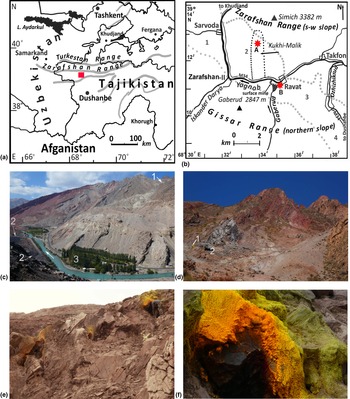
At Kukhi-Malik (also known as Kukh-i-Malek or Kukh-i-Molik) (39°12′25″N, 68°33′59″E), the ermakovite occurs in sublimations from the gases related to a natural extensive underground coal fire of a non-anthropogenic origin known since ca. 1000 BCE. One of the early descriptions of the fires was done by Pliny the Elder (the first century AD): “Flagrat in Bactris Cophanti noctibus vertex” (The summit of Cophant burns in Bactris by night) (Plini the Elder, 1866). To date, the coal fire is distributed over an area of ~0.04 km2 at the top of Kan-Tag Mountain, on the right bank of the Yagnob River (Fig. 1a,b). The geology of the Fan-Yagnob deposit and the origin of the fires have been described in several publications (Ermakov, Reference Ermakov1935; Novikov and Suprychev, Reference Novikov and Suprychev1986). Spontaneous combustion of the coal initiated by self-ignition is considered to be the main cause. More than 40 mineral species have been described in Kukhi-Malik sublimations to date. Several new anhydrous sulfate minerals were reported recently from this occurrence (e.g. Pautov et al., Reference Pautov, Mirakov, Siidra, Faiziev, Nazarchuk, Karpenko and Makhmadsharif2020) and the crystallisation conditions are still insufficiently understood. Sublimates of both active and extinct underground coal fires have been known since ancient times as sources of salammoniac, sulfur, alum and saltpetre. Gas vents (‘fumaroles’) are very abundant at Kukhi-Malik. The temperature of gases varies widely in the range 40–590°C (Novikov et al., Reference Novikov, Suprychev and Babayev1979) and ermakovite crystallises in the temperature range 250–320°C. There are ~40 minerals described to date in sublimations from this area (e.g. Ermakov, Reference Ermakov1935; Nasdala and Pekov, Reference Nasdala and Pekov1993; Mirakov et al., Reference Mirakov, Pautov, Karpenko, Faiziev and Makhmadsharif2019; Pautov et al., Reference Pautov, Mirakov, Siidra, Faiziev, Nazarchuk, Karpenko and Makhmadsharif2020).
Geographical map showing the location (a red rectangle) of the Fan-Yagnob coal deposit (a). A detailed contour-map of the deposit (b). Type locality of ermakovite is shown by ✸A and Ravat kishlak (village) is shown by ✸B. Grey dots mark boundaries of the deposit. 1- Eastern part of the deposit, 2–4 Central part of the deposit: 2 - Kukhi-Malik, 3-Ravat, 4-Dzhizhikrud. A general view of the area from the bank of the Yagnob River (c) (1 - Kukhi-Malik tract with underground coal fires; 2 – lower section of the Fan-Yagnob coal deposit, 3 – Ravat village (white arrow on the river designates the direction of flow). The upper reaches of the Kukhi-Malik tract (d): 1 – gas vents with the rich As–S exhalative mineralisation, where ermakovite was found; 2 – ‘Big Grotto’ gas vent. Three gas vents are located along the fissure in the altered argillites (Big Grotto is at the top right) (e). Enlarged view of Big Grotto with As–S mineral crusts of yellow, orange–yellow and carmine-red colours (f).

Associated minerals
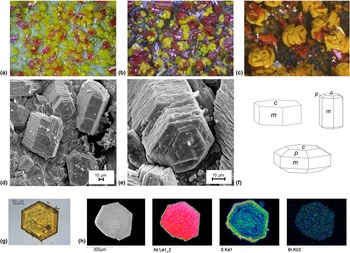
Ermakovite was found in sublimates near the Big Grotto ‘fumarole’. This series of fumaroles is located along a fissure in altered argillites (Fig. 1b–d). Well-crystallised mineral crusts of yellow, orange–yellow and carmine-red colours have a thickness of 1 to 5 mm and mainly consist of sulfur, realgar, salammoniac, bonazziite, alacránite, thermessaite-(NH4), undetermined Al-sulfates and amorphous As-sulfides (Karpenko et al., Reference Karpenko, Pautov, Мirakov, Siidra, Makhmadsharif, Shodibekov and Plechov2021). Ermakovite (Fig. 2) usually forms overgrowths on realgar and bonazziite and is associated closely with amorphous yellow As2S3. Intergrowths of the latter are distributed zonally in ermakovite crystals (Fig. 2g, h).
Yellow ermakovite with red realgar and orange-red bonazziite (FOV 5 mm in (a) and FOV 1 mm in (b)). Multiple twins of ermakovite closely associating with bonazziite (1) and realgar (2) (FOV 2 mm) (c). Ermakovite crystals of prismatic and tabular habit. SEM images (d,e) and ideal crystal drawings (f). Thin section of zoned ermakovite crystal (g) and colour-coded X-ray element distribution maps (h). The sulfur-enriched zone is represented by the admixture of amorphous As2S3.

Appearance, physical and optical properties
Ermakovite typically occurs as tabular or prismatic hexagonal crystals up to 200 μm in maximum dimension (Fig. 2d–f). The following forms were measured using a ZRG-3 goniometer: c (001), m (010) and p (014). Spherulites and multi-twinned intergrowths are very common (Fig. 2a–c). The colour of ermakovite is yellow. Many of the individual crystals are zoned with a transparent yellowish core and semi-transparent yellow rim formed due to the admixture of amorphous As sulfides (Fig. 2h). The streak is white with a yellowish tint. The lustre is sub-adamantine. Ermakovite is very brittle and individual plates are elastic. Cleavage is perfect on (001). The fracture is uneven. Hardness is 1–1½ (VHN = 40 kg⋅mm–2 (38–46 kg⋅mm–2 at 20 g load). A standard set of immersion liquids was used to measure ɛ, and a solution of white phosphorus and methylene iodide with sulfur (‘West liquid’) was used to measure ω. Ermakovite is optically uniaxial (–), ω = 1.960(5) and ɛ = 1.716(3) (589 nm). The mineral is non-pleochroic under the microscope. The density measured by flotation in Clerici solution is 3.64(2) g⋅cm–3. The density calculated based on the empirical formula of the holotype is 3.747 g⋅cm–3. The Gladstone–Dale compatibility index, 1 – (K p/K c) = 0.016, is superior.
The mineral is insoluble in water, HCl, HNO3 and organic solvents (ethanol, iodine methylene, acetone and benzol). In Clerici liquid, a black rim is soon formed after the immersion of the mineral into liquid. The latter is the reason for the difference between the observed and calculated density values.
Infrared and Raman spectroscopy
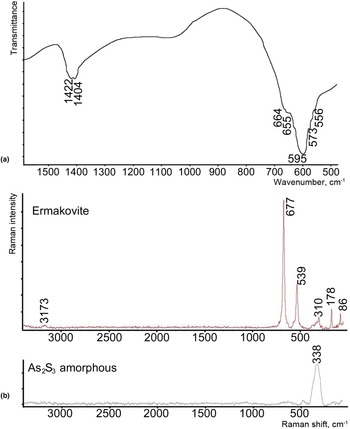
In order to obtain an infrared (IR) absorption spectrum (Fig. 3a), a powdered sample of ermakovite was mixed with dried KBr, pelletised, and analysed using a 75-IR spectrometer. The IR spectrum of an analogous pellet of pure KBr was used as a reference. Obtained spectra demonstrate ammonium bands at 1400–1425 cm–1. The bands in the region 550–700 cm–1 correspond to As–O stretching vibrations of the (AsO3)3– group.
Infrared (a) and Raman (b) spectra of ermakovite and synthetic amorphous As2S3 (c).

Raman spectra were obtained on polished ermakovite samples using a DXR2xi Thermo Scientific Raman Imaging Microscope in the range of 3400 cm–1 to 70 cm–1 using 1 cm–1 resolution, 25 μm pinhole aperture, grating of 1800 lines/mm and scan time of 0.13 s with 15 scans. The excitation source was a laser with a wavelength of 532 nm at 100% power at the sample (10 mW). The spectra were recorded at room temperature. Obtained spectra and Raman maps were processed using Thermo Scientific OMNIC software.
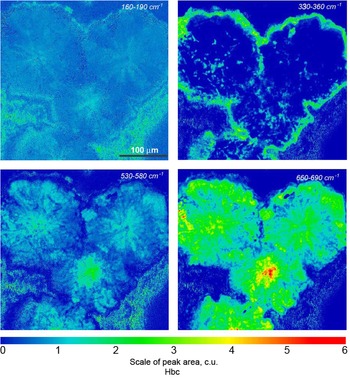
Raman spectra of ermakovite are shown in Fig. 3b. In general, the region from 1000 to 50 cm–1 is similar to those of the previously described natural and synthetic representatives of the MAs(III)4O6X [M = (NH4), K and Na; X = Cl, Br and I] family (Kampf et al., Reference Kampf, Nash and Molina Donoso2020). Bands at 677 and 539 cm–1 can be assigned as As–O stretching and bending vibrations, respectively (Szymanski et al., Reference Szymanski, Marabella, Hoke and Harter1968; Bahfenne and Frost, Reference Bahfenne and Frost2010; Kampf et al., Reference Kampf, Nash and Molina Donoso2020). In the range 320–400 cm–1, Raman spectra of ermakovite exhibit a shoulder due to an impurity of amorphous As2S3, which has a strong band at 338 cm–1 (Fig. 3b). Raman maps were done for several ranges (690–660, 580–530, 360–330 and 190–160 cm–1) to characterise the distribution of amorphous As2S3 throughout ermakovite crystals (Fig. 4). A band at 3176 cm–1 corresponds to the H–N stretching of the ammonium group.
Raman maps of ermakovite polished samples. The peak ranges selected for Raman mapping are labelled.

Chemistry
Crystals of ermakovite were mounted in epoxy resin and polished with MetaDi diamond suspension (Buehler). The composition of ermakovite was studied using a CamScan 4D scanning electron microscope equipped with an Oxford Instruments INCA Energy Dispersive Spectrometer (EDS) and JCXA-733 (JEOL) analyser with a Si–(Li) detector with ATW2 ultrathin window and INCA Energy 350 analysis system (20 kV accelerating voltage, 1 nA electron beam current measured with a Faraday cup and a beam of 25 μm were used for the analysis). BN (NKα), InAs (AsKα), CuSbS2 (SbLα), CuBr (freshly prepared) (BrKα), HgCl (ClKα), CuI (ILα), jadeite USNM (NaKα), SiO2 (OKα) and BaSO4 (SKα) were used as standards. Because ermakovite contains volatile components, the EDS analysis is preferable to wavelength dispersive spectroscopy (WDS). The EDS spectra of ermakovite in the range 0.1–3.3 keV (Supplementary Fig. S1) and WDS spectra of NKα in ermakovite are compared with boron nitride (Supplementary Fig. S2) to demonstrate that the analytical lines do not overlap. The crystals of ermakovite are zoned (Fig. 2 and Fig. 4) with respect to the distribution of sulfur. The central parts of the crystals also reveal heterogeneity in sulfur in the range from 0.24 to 1.78 wt.%. Sulfur is not a minor component of ermakovite and corresponds to the amorphous As2S3 admixture. The average amount of As2S3 admixture from five analyses is 2.02 wt.%. Note that amorphous As2S3 is well-known from coal dump fires at the Kateřina mine, Czech Republic (Sejkora, Reference Sejkora2002; Bonazzi et al., Reference Bonazzi, Bindi, Olmi and Menchetti2003) and exhalative mineral assemblages at La Fossa crater, Volcano, Italy (Garavelli et al., Reference Garavelli, Mitolo, Pinto, Laviano and Vurro2013).
For this reason, sulfur and arsenic content, corresponding to As2S3 stoichiometry, was subtracted and resulted totals normalised to 100%. The results of both initial electron microprobe analysis (EMPA) data and those obtained after the subtraction are given in Table 1. The empirical formula calculated on the basis of (As+Sb) = 4 atoms per formula unit is ((NH4)0.92Na0.01)0.93(As3.94Sb0.06)4.00O6.02(Br0.97Cl0.08I0.01)1.06. The simplified formula is (NH4)(As2O3)2Br. Antimony (up to 2.35 wt.% Sb) partially replaces arsenic in ermakovite. Considerable amounts of Sb (13.1–17.3 wt.%) has been determined in the arsenite torrecillasite, Na(As,Sb)4O6Cl by Kampf et al. (Reference Kampf, Nash, Dini and Molina Donoso2014).
Chemical data (in wt.%) for ermakovite.

Note: 1–5 are local microprobe data (Jeol Superprobe 733); I – initial data; II – normalised data after the extraction of sulfur; 6 – average for 1–5. ‘–’ = not detected.
The ammonium content in ermakovite was confirmed by the Raman and infrared spectra (Fig. 3) and by the presence of the NKα peak in EDS and WDS spectra (Supplementary Fig. S1). The NKα peak does not overlap with other peaks and was used for the quantitative analysis.
Crystallography
Powder X-ray diffraction data were collected using FeKα radiation with a Mn-filter in a RKU–86 camera; Ge was used as an internal standard. The results (in Å for FeKα) are given in Table 2. Unit-cell parameters refined from the powder data are as follows: hexagonal, a = 5.257(1), c = 9.139(4) Å and V = 218.7(1) Å3.
Powder X-ray diffraction data (d in Å) for ermakovite (br = broad). The seven strongest lines are given in bold.

A crystal of ermakovite (Table 3) was mounted on a thin glass fibre for X-ray diffraction analysis using a Bruker APEX II DUO X-ray diffractometer with a Mo-IμS microfocus X-ray tube (λ = 0.71073 Å) operated at 50 kV and 0.6 mA at the Department of Crystallography, St. Petersburg State University. More than a hemisphere of three-dimensional XRD data was collected with frame widths of 0.5° in ω, and a 50 s count time for each frame. Then the collected data were integrated and corrected for absorption using a multi-scan type of model using Bruker software. The structure of ermakovite was solved by direct methods in P3 space group. The obtained structure was transformed into space group P6/mmm by the use of the ADDSYM algorithm incorporated into the program PLATON. No H sites of the ammonium cation were located. The NH4 tetrahedral cation is probably rotationally disordered. A similar problem was reported recently for mauriziodiniite (Kampf et al., Reference Kampf, Nash and Molina Donoso2020) where the published refinement of the NH4:Na ratio also showed similar problems for the determination of the NH4:K ratio. Consequently, the N site was assigned an occupancy of N0.99Na0.01 (Table 4), more consistent with the EPMA. Arsenic and Br sites, having very minor admixtures, were also assigned occupancies closer to EPMA data. Fractional atom coordinates and atomic displacement parameters are listed in Tables 4,5. Selected interatomic distances are given in Table 6. The crystallographic information files have been deposited with the Principal Editor of Mineralogical Magazine and are available as Supplementary material (see below).
Crystallographic data and refinement parameters for ermakovite.

Coordinates and isotropic displacement parameters (Å) of atoms in ermakovite.

* Occupancies assigned to be more consistent with the EPMA data.
Anisotropic displacement parameters (Å) of atoms in ermakovite.

Selected interatomic distances (Å) in ermakovite.

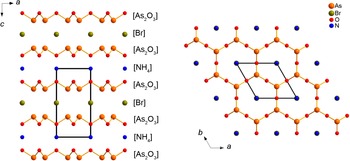
The structure of ermakovite is isotypic with the one reported previously for synthetic (NH4)(As2O3)2Br (Pertlik, Reference Pertlik1988). The crystal structure (Table 4, Fig. 5) contains one symmetrically independent As site, one Br site, one N site and one O site. The sandwich-type structure of ermakovite is based on three types of layers: (1) a honeycomb [As2O3] arsenite layer; (2) an NH4+ layer; and (3) a Br layer. The layer stacking sequence is ⋅⋅⋅NH4–As2O3–Br–As2O3–NH4⋅⋅⋅.
General projections of the crystal structure of ermakovite based on three types of layers: a honeycomb [As2O3] arsenite layer; an NH4+ layer; and a Br layer.

Concluding remarks
Ermakovite is a new representative of the MAs(III)4O6X [M = (NH4), K and Na; X = Cl, Br and I] family (Kampf et al., Reference Kampf, Nash and Molina Donoso2020) (Table 7). Except for torrecillasite, minerals of this family are hexagonal with a sandwich-type structure based on [As2O3]2 layers and originate from different geological environments. Lucabindiite (K,NH4)(As2O3)2(Cl,Br) is known from the sublimates at the La Fossa crater, Vulcano, Aeolian Islands, Italy, whereas torrecillasite, Na[(As,Sb)2O3]2Cl and mauriziodiniite, (NH4)(As2O3)2I were found in the oxidation zone at the Torrecillas mine, Iquique Province, Chile. Ermakovite is the first bromine dominant member of this family. A significant bromine content was previously detected in lucabindiite (3.70–10.31 Br, wt.%) (Garavelli et al., Reference Garavelli, Mitolo, Pinto, Laviano and Vurro2013). A (NH4)(As2O3)2(I,Br) phase was reported from the sublimates extracted from the quartz ampoules installed in the fumaroles at the Momotomba volcano, Nicaragua (Bernard, Reference Bernard1985), but no chemical quantitative analysis was reported. No bromine admixture was detected for mauriziodiniite and torrecillasite (Kampf et al., Reference Kampf, Nash, Dini and Molina Donoso2016, Reference Kampf, Nash and Molina Donoso2020).
Crystallographic data for ermakovite, related minerals and synthetic compounds.

To date, no bromine minerals have been reported previously from the Fan-Yagnob coal deposit. No bromine has been found in salammoniac directly associated with ermakovite. Only 0.18 wt.% Br was found in some salammoniac samples found by Yu.V. Gritsenko in 2019 in gas vents located ~650 metres down the slope from the Big Grotto. The conditions for crystallisation by the means of gas transport reactions are present in a narrow range of thermochemical environments (Symonds and Reed, Reference Symonds and Reed1993). Similar environments yielding mineral assemblages that include various metal–halide species are observed in the fumarole fields of many volcanoes (e.g. Mutnovsky, Russia; Volcano, Italy; Merapi, Indonesia; Zelenski and Bortnikova, Reference Zelenski and Bortnikova2005; Demartin et al., Reference Demartin, Gramaccioli and Campostrini2009, Reference Demartin, Gramaccioli and Campostrini2010; Symonds, Reference Symonds1993). Bromine can be accommodated in sulfide–halides of the demicheleite-type BiSX (X = Cl, Br and I) minerals (Demartin et al., Reference Demartin, Gramaccioli, Campostrini and Orlandi2008, Reference Demartin, Gramaccioli and Campostrini2009, Reference Demartin, Gramaccioli and Campostrini2010) or by halides of NH4, Pb, Bi, Cd and Tl and oxyhalides of the MAs(III)4O6X-type (Coradossi et al., Reference Coradossi, Garavelli, Salamida and Vurro1996; Garavelli et al., Reference Garavelli, Laviano and Vurro1997, 2013). Similar processes take place in active underground coal fires. Ermakovite is the first example of an oxybromide mineral formed in such conditions, accommodating the overwhelming majority of bromine, while the neighbouring salammoniac remains nearly bromine-free.
Acknowledgements
We are grateful to Ian Graham, Anthony Kampf, Peter Leverett and one anonymous reviewer for valuable comments. The authors gratefully acknowledge A.R. Fayziyev for the help and joint field works at the Fan-Yagnob deposit. Yu.V. Gritsenko and Ya.L. Lantcev are thanked for providing samples of Br-bearing salammoniac. Technical support by the SPbSU Resource Center is gratefully acknowledged.
Supplementary material
To view supplementary material for this article, please visit https://doi.org/10.1180/mgm.2022.116
Competing interests
The authors declare none.