Introduction
Hemiuroids (Hemiuroidea Looss, 1899) are a highly diverse group of trematodes that parasitize cold-blooded vertebrates, with marine teleosts and, to a lesser extent, freshwater fishes as their predominant host groups (Gibson Reference Gibson, Gibson, Jones and Bray2002a; Gibson and Bray Reference Gibson and Bray1979). Unlike most trematodes, hemiuroids possess a sinus-sac surrounding the base of the genital atrium. Typically, the hermaphroditic sinus-sac encloses both male and female terminal ducts, which are led by an intromittent copulatory organ (sinus-organ). However, representatives of some families have independently lost these structures. For instance, hirudinellids possess a cirrus and cirrus-sac, though these structures are not homologous with those of other trematode groups (Gibson Reference Gibson, Gibson, Jones and Bray2002a; Gibson and Bray Reference Gibson and Bray1979).
Among the few groups that have colonized freshwater (or brackish) fishes, the derogenids (Derogenidae Nicoll, 1910) are frequently reported in hydrological systems in South America, particularly the halipegine (Halipeginae Poche, 1926) species of Genarchella Travassos, Artigas & Pereira, 1928 and Thometrema Amato, 1968 (Kohn et al. Reference Kohn, Fernandes, Gibson and Fróes1990, Reference Kohn, Fernandes and Cohen2007; Tsuchida et al. Reference Tsuchida, Flores, Viozzi, Rauque and Urabe2021a, Reference Tsuchida, Urabe, Viozzi, Rauque and Floresb). The taxonomy of both genera has been convoluted, with different schemes proposed over time (Gibson and Bray Reference Gibson and Bray1979; Hamann Reference Hamann1986; Kohn and Fernandes Reference Kohn and Fernandes1988; Kohn et al. Reference Kohn, Fernandes, Gibson and Fróes1990). After a critical evaluation of type and vouchers specimens, Kohn et al. (Reference Kohn, Fernandes, Gibson and Fróes1990) recognized the validity of Genarchella, previously considered a synonym of Halipegus (see Gibson and Bray Reference Gibson and Bray1979), and clarified the species composition of both Genarchella and Thometrema. They diagnosed species of Thometrema by having a hermaphroditic duct that extends well outside the sinus-sac, while in Genarchella, the hermaphroditic duct is entirely within the sinus-sac (Gibson Reference Gibson, Gibson, Jones and Bray2002b; Kohn et al. Reference Kohn, Fernandes, Gibson and Fróes1990). The close relationship between representatives of Thometrema and Genarchella suggested by Kohn et al. (Reference Kohn, Fernandes, Gibson and Fróes1990) has been confirmed in recent molecular phylogenetic studies (Bouguerche et al. Reference Bouguerche, Huston, Cribb, Karlsbakk, Ahmed and Holovachov2023, Reference Bouguerche, Huston, Karlsbakk, Ahmed and Holovachov2024; Tsuchida et al. Reference Tsuchida, Flores, Viozzi, Rauque and Urabe2021a, Reference Tsuchida, Urabe, Viozzi, Rauque and Floresb).
Despite the recent efforts to improve our knowledge of the taxonomy of Thometrema, the taxonomic value of morphological characters traditionally used to differentiate the species in the genus (e.g., vitellarium shape) has not been evaluated within a molecular phylogenetic framework. Of the six valid species of Thometrema (WoRMS 2024) – namely T. magnificum (Szidat, 1954), T. overstreeti (Brooks, Mayes & Thorson, 1979), T. bonariense Lunaschi, 1989, T. dissimilis Moravec & Prouza, 2024, T. patagonicum (Szidat, 1956) and T. lotzi Curran, Overstreet & Font, 2002 – only the last two have DNA sequences available for comparison.
During a helminthological survey in the Upper Paraná River (UPR) basin, State of São Paulo, Brazil, derogenids morphologically assigned to Thometrema were collected from a single specimen of the pimelodid Steindachneridion scriptum (Miranda Ribeiro) (Pimelodidae). This large catfish, endemic to the Upper Uruguay and Paraná River basins, is currently classified as Endangered (EN) by the IUCN Red List (Froese and Pauly Reference Froese and Pauly2024; Salvador and Sayer Reference Salvador and Sayer2023).
A thorough morphological evaluation, including the first scanning electron microscopy (SEM) observations for a Thometrema species, along with the assessment of its phylogenetic affinities based on two molecular markers, made it possible to identify our specimens as T. patagonicum, supplement the available descriptions and reassess certain morphological features. This unexpected finding of a trematode previously known only from an endemic percichthyid fish (Percichthyidae) from the Argentinian Patagonia, prompted us to discuss the taxonomic suitability of some morphological traits traditionally used to differentiate species of Thometrema. Additionally, we reassessed the species boundaries within the genus and propose T. overstreeti and T. bonariense as junior synonyms of T. patagonicum.
Materials and methods
Sample collection
A single specimen of S. scriptum was collected in the Paranapanema River, UPR basin, municipality of Salto Grande, State of São Paulo, Brazil. The fish was euthanized by pithing the spinal cord and had its gastrointestinal tract screened for trematodes. Host nomenclature and classification follows Froese and Pauly (Reference Froese and Pauly2024).
The 30 newly collected hemiuroids were placed in saline and gently cleaned of the stomachal debris under a stereomicroscope. The specimens were fixed in a hot (near-boiling) 4% formaldehyde solution; a subset of specimens was fixed under slight coverslip pressure using the same hot fixative. After two weeks, all specimens were transferred to 70% ethanol before further processing. Additionally, three specimens were fixed in 96% molecular-grade ethanol for molecular analyses.
Morphological and ultrastructural data
Specimens were stained with alcoholic chloride carmine solution, dehydrated in an ethanol series and cleared with eugenol (clove oil) in temporary whole-mounts; six specimens (three flattened and three unflattened) were permanently mounted in Canada balsam. Subsequently, the hemiuroids were evaluated by brightfield and differential interference contrast microscopy using a Leica DMLB 5000 (Leica Microsystems, Wetzlar, Germany). Photomicrographs and measurements were performed using the Leica Application Suite software LAS V3. Eggs were teased from two specimens for observation using light microscopy and SEM.
The morphometrical data of flattened and non-flattened species were compared using the t-test or Mann-Whitney test, according to the normality of the data. The significance level used was 5%.
For SEM observations, selected specimens were dehydrated through a graded ethanol series, dried in hexamethyldisilazane, coated with gold and examined in a FEI Quanta 200 scanning electron microscope at the Centro de Microscopia Eletrônica, Instituto de Biociências, Universidade Estadual Paulista ‘Júlio de Mesquita Filho’ (UNESP), Botucatu.
For comparative purposes, we examined photomicrographs of the holotype (USNM #1370289; originally USNPC #74730) and two paratypes (USNM #1370290; originally USNPC# 074731) of T. overstreeti. The type material is currently deposited in the National Museum of Natural History’s Invertebrate Zoology Collection (Smithsonian Institution, Washington, DC). The high-resolution image series was provided by Drs. Anna Phillips and Yolanda Villacampa. Measurements from the digital images were taken using ImageJ software (Schneider et al. Reference Schneider, Rasband and Eliceiri2012).
Voucher specimens were deposited in the Coleção Helmintológica do Instituto de Biociências (CHIBB), UNESP, Botucatu, State of São Paulo (acc. codes CHIBB #10634, #10635), and the Coleção Helmintológica do Instituto Oswaldo Cruz (CHIOC), State of Rio de Janeiro (acc. codes CHIOC #40614a-f), Brazil.
Molecular data
Total gDNA was extracted from three specimens of T. patagonicum using the DNeasy Blood & Tissue Kit (QIAGEN) following the manufacturer’s instructions. PCR amplification of the partial large subunit nuclear ribosomal RNA (28S rDNA; D1–D3 domains) and partial cytochrome c oxidase subunit I (COI mtDNA) was performed following Bedin et al. (Reference Bedin, Alves and Silva2024). PCR products were purified using magnetic beads Agencourt AMPure XP (Beckman Coulter, Inc.), and Sanger sequenced on an Applied Biosystems ABI 3500 DNA genetic analyzer. Contiguous sequences were assembled and inspected for errors using Geneious Prime® v.2024.0.5, and their consensus were submitted to GenBank. Access to the genetic data was granted by the Ministério do Meio Ambiente e Mudança do Clima (SisGen #ABA5101).
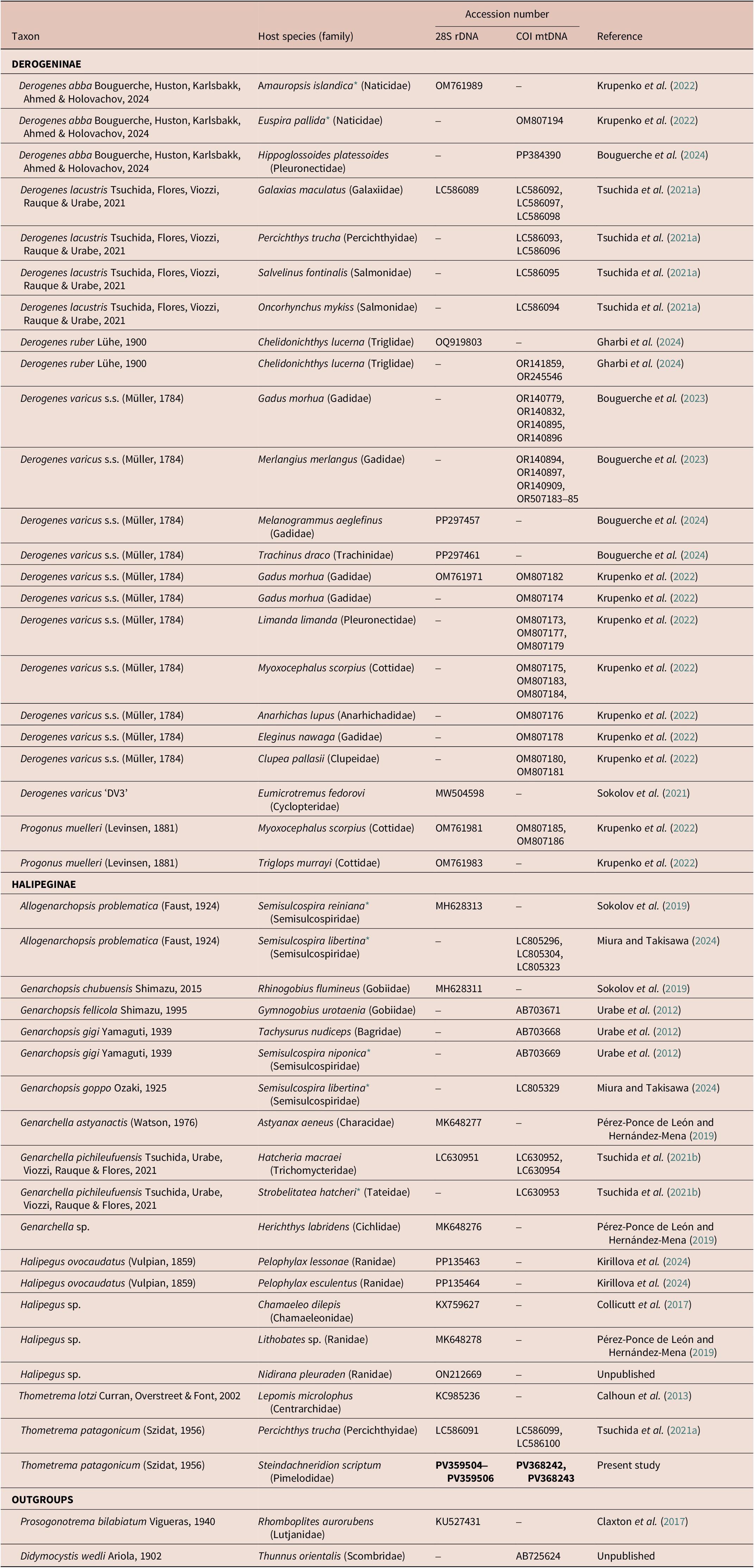
The sequences of T. patagonicum were assembled into two alignments (28S rDNA and COI mtDNA markers), together with selected Derogenidae taxa, but only using unique haplotypes (Table 1); sequences with less than 500 bp were not included. The alignments were built using ‘--auto’ command of MAFFT v7.490 (Katoh and Standley Reference Katoh and Standley2013), implemented in Geneious. Unreliable positions in the alignments were identified and removed using the Gblock web server (https://ngphylogeny.fr/; Dereeper et al. Reference Dereeper, Guignon, Blanc, Audic, Buffet, Chevenet, Dufayard, Guindon, Lefort, Lescot, Claverie and Gascuel2008) with less stringent settings. Outgroups were chosen following Bouguerche et al. (Reference Bouguerche, Huston, Karlsbakk, Ahmed and Holovachov2024).
GenBank accession numbers of DNA sequences of derogenids (Derogenidae) used in the phylogenetic analyses. New sequences are in bold

* Intermediate host
Phylogenetic analyses were performed with the maximum likelihood (ML) and Bayesian inference (BI) criteria using the evolutionary models as implemented in ModelFinder (Kalyaanamoorthy et al. Reference Kalyaanamoorthy, Minh, Wong, von Haeseler and Jermiin2017), IQ-TREE (Trifinopoulos et al. Reference Trifinopoulos, Nguyen, von Haeseler and Minh2016), based on the small sample size corrected Akaike information criterion (AICc); for the BI analyses, the searches were restricted to models allowed by MrBayes v.3.2.7a (Ronquist et al. Reference Ronquist, Teslenko, Van Der Mark, Ayres, Darling, Höhna, Larget, Liu, Suchard and Huelsenbeck2012) using the ‘-mset’ option. The models used were as follows: for the 28S rDNA gene, GTR+F+I+G4 was used in both BI and ML analyses. For the COI mtDNA gene, the BI analysis employed GTR+F+G4, GTR+F+I and GTR+F+I+G4 for the 1st, 2nd and 3rd codon positions, respectively; in the ML analysis, TN+F+G4, TPM3u+F+I and TIM3+F+I+G4 were applied to the 1st, 2nd and 3rd codon positions, respectively.
Since the default parameters of model-based optimality criteria typically treat insertion and deletion events (indels) as missing data, we addressed a 21-nucleotide deletion observed only in the sequence of T. lotzi (positions 608–628 in the alignment of the 28S rDNA gene; see supplementary data) by coding the deletion as a binary character (presence/absence of the gap) as recommend by Ronquist et al. (Reference Ronquist, Huelsenbeck and Teslenko2011). This binary character was included as an additional binary (restriction) data partition in the BI analyses.
The ML trees were generated via IQ-TREE, and clade supports were estimated with 1,000 replicates of the ultrafast bootstrap (UFBoot-Minh et al. Reference Minh, Nguyen and von Haeseler2013) and an SH-aLRT test with 1,000 replicates (Guindon et al. Reference Guindon, Dufayard, Lefort, Anisimova, Hordijk and Gascuel2010). To avoid overestimation of UFBoot, we used a hill-climbing nearest-neighbor interchange (NNI) (Hoang et al. Reference Hoang, Chernomor, von Haeseler, Minh and Vinh2018). BI analyses were performed in MrBayes v.3.2.7a, running two independent MC3 runs of four chains for 10 million generations, sampling tree topologies every 1000th generation, with the first 25% of samples discarded as burn-in. We used Tracer v.1.7.2 (Rambaut et al. Reference Rambaut, Drummond, Xie, Baele and Suchard2018) to check the convergence and mixing of parameters and to confirm that individual effective sample size (ESS) was adequate to provide reasonable estimates of the variance in model parameters. Genetic divergences among taxa were calculated as uncorrected p-distances implemented in MEGA v.11 (Tamura et al. Reference Tamura, Stecher and Kumar2021).
Results
The derogenids from S. scriptum were preliminarily identified as T. overstreeti because they were morphologically compatible with the most recent redescription of this species based on specimens collected from the catfishes Pimelodus maculatus Lacepède and Rhamdia sp. in Southern Brazil (Kohn et al. Reference Kohn, Fernandes, Gibson and Fróes1990). However, a finer morphological comparison between T. patagonicum and T. overstreeti has revealed that they are indistinguishable from each other and should be considered the same species (see Remarks).
Interestingly, some pairs of specimens were found firmly attached to each other by using their ventral sucker. Upon separating them, the injured specimens displayed a large, rounded protuberance on their bodies (well-visible in the SEM images).
Thometrema patagonicum (Szidat, 1956) Lunaschi & Drago, 2001
Synonyms: Genarches patagonicus Szidat, 1956; Derogenes patagonicus (Szidat, 1956) Yamaguti, 1971; T. patagonica (Szidat, 1956) Lunaschi & Drago, 2001–malformed suffix (see Lunaschi and Drago Reference Lunaschi and Drago2001; Szidat Reference Szidat1956; Yamaguti Reference Yamaguti1971).
New synonyms: T. overstreeti (Brooks, Mayes & Thorson, 1979) Lunaschi, 1989; T. bonariense Lunaschi, 1989; T. bonariensis Lunaschi, 1989–malformed suffix.
Synonyms of the former T. overstreeti: Paravitellotrema overstreeti Brooks, Mayes & Thorson, 1979; Halipegus overstreeti (Brooks, Mayes & Thorson, 1979) Kohn & Fernandes, 1988; Genarchella lenti Fábio, 1984; G. genarchella sensu Hamann (Reference Hamann1986); T. rioplatense Lunaschi, 1989.
Type-host and locality: Percichthys trucha (Valenciennes) (Centrarchiformes: Percichthyidae), Limay River or Pellegrini Lake (specific type locality undetermined; Patagonia), Río Negro Province, Argentina (Szidat Reference Szidat1956). The type material includes specimens collected from the largemouth perch P. colhuapiensis MacDonagh (see Lunaschi and Drago Reference Lunaschi and Drago2001); however, the original description mentions no hosts other than P. trucha.
New host and locality: Steindachneridion scriptum (Miranda Ribeiro, 1918) (Siluriformes: Pimelodidae), Paranapanema River (22°57’0.36” S; 49°58’16.05” W; UPR basin), municipality of Salto Grande, State of São Paulo, Brazil (this study).
Site of infection: stomach.
Hosts of the former T. overstreeti: Potamotrygon magdalenae (Duméril), Hoplias malabaricus (Bloch), Pimelodus maculatus, Pi. albicans (Valenciennes), Rhamdia quelen (Quoy & Gaimard), Rhamdia sp., Salminus brasiliensis (Cuvier), Pseudoplatystoma corruscans (Spix & Agassiz), Ps. reticulatum Eigenmann & Eigenmann, Psalidodon fasciatus (Cuvier), Astyanax paraguayensis (Fowler), Megaleporinus obtusidens (Valenciennes), Oligosarcus jenynsii (Günther), Ageneiosus inermis (Linnaeus), Auchenipterus nigripinnis (Boulenger), Luciopimelodus pati (Valenciennes), Sorubim lima (Bloch & Schneider), Zungaro jahu (Ihering) (see Kohn et al. Reference Kohn, Fernandes and Cohen2007; Ostrowski de Núñez et al. Reference Ostrowski de Núñez, Arredondo and Gil de Pertierra2017).
Host of the former T. bonariense: Australoheros facetus, Odontesthes bonariensis (see Ostrowski de Núñez et al. Reference Ostrowski de Núñez, Arredondo and Gil de Pertierra2017).
Distribution: Freshwater systems in Argentina, Brazil, Colombia and Peru (see Kohn et al. Reference Kohn, Fernandes and Cohen2007).
New voucher material: CHIBB #10634, #10635; CHIOC #40614a-f.
New DNA sequences: Three isolates (field code SG29B): partial 28S rDNA (PV359504–PV359506, three identical sequences in their overlapping region; longest is 1,115 bp), and partial COI mtDNA [PV368242, and PV368243, nucleotide divergence 0.5% (4 nt-difference); longest is 849 bp].
Supplemental redescription (Figures 1–3)
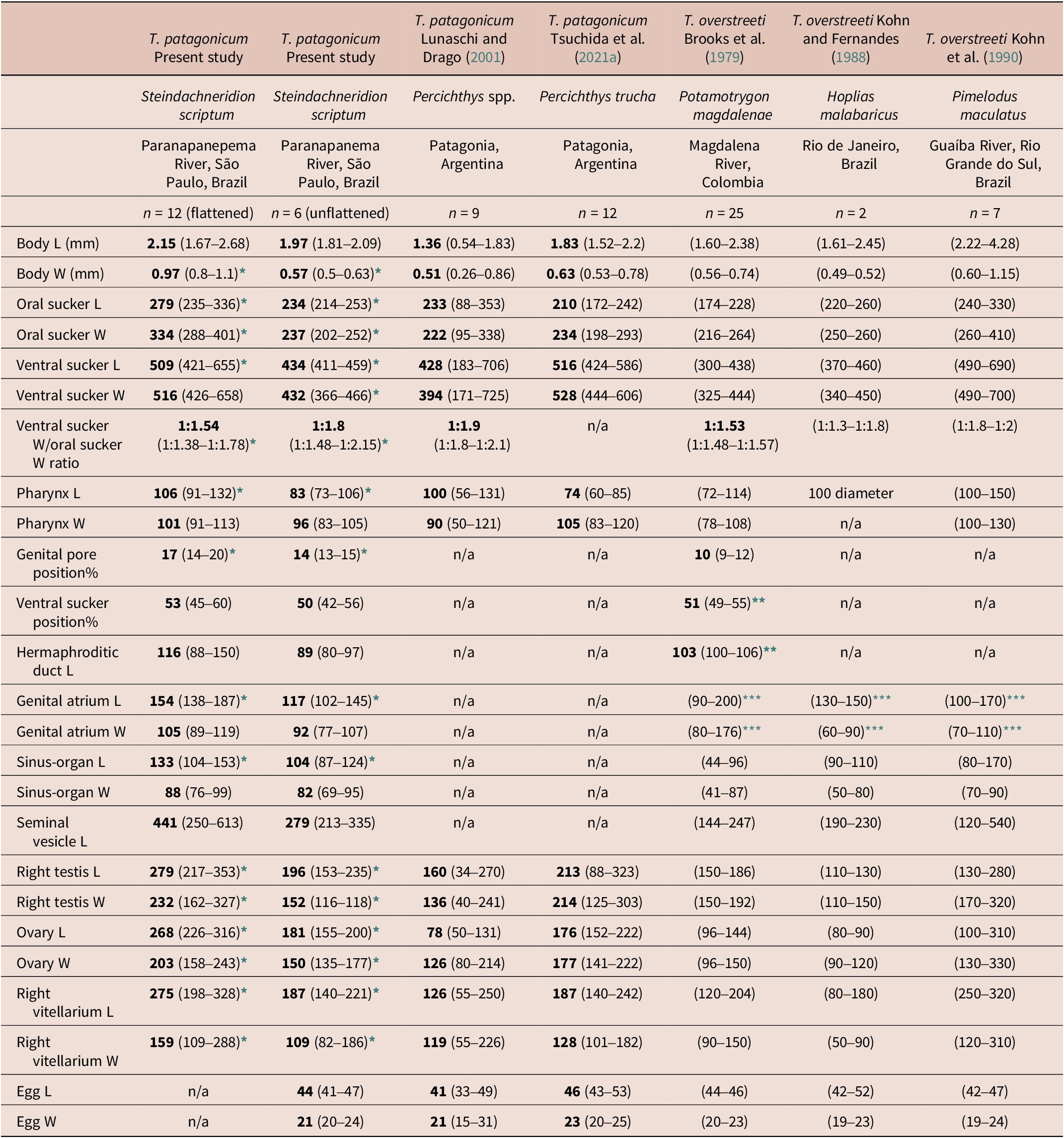
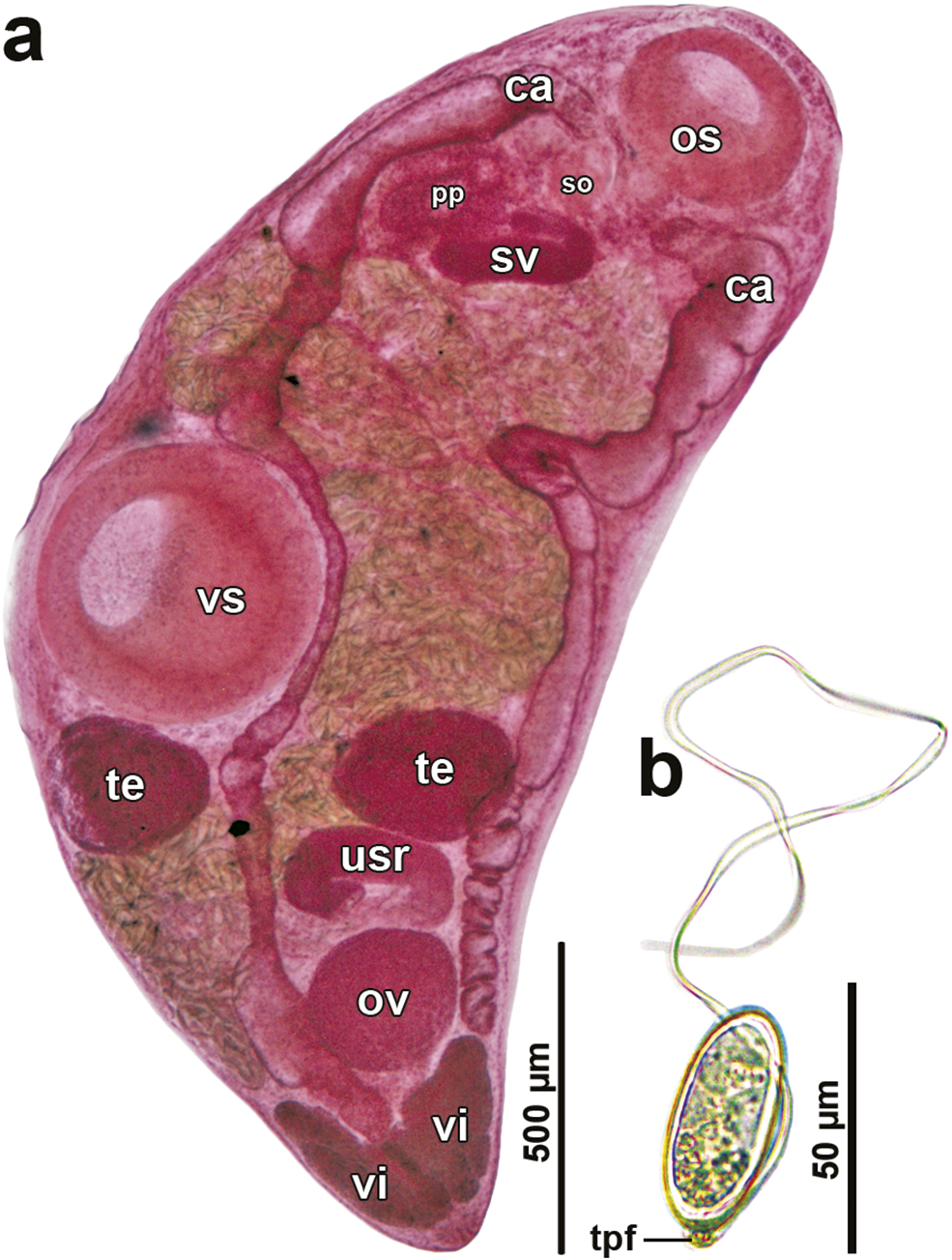
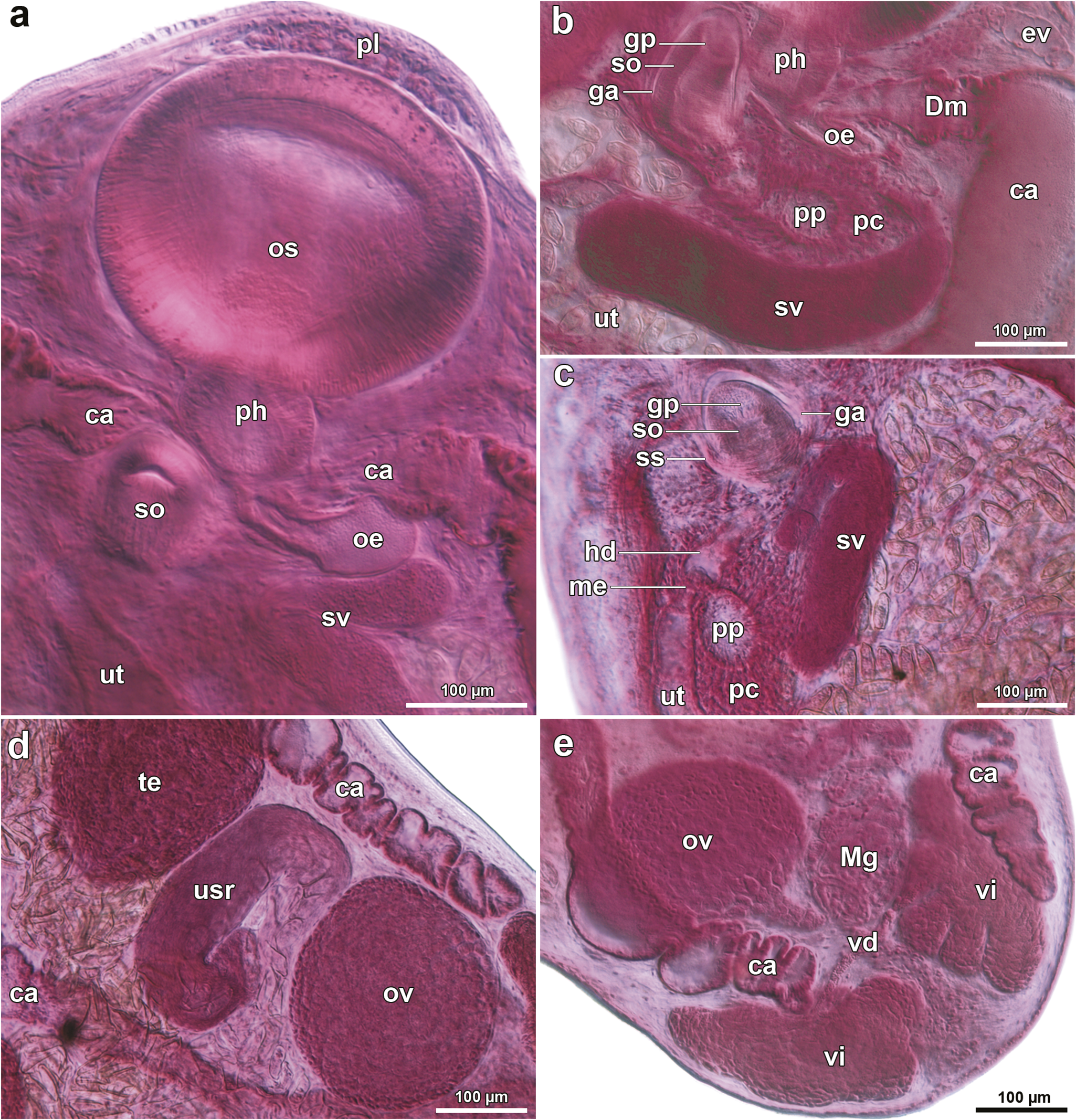
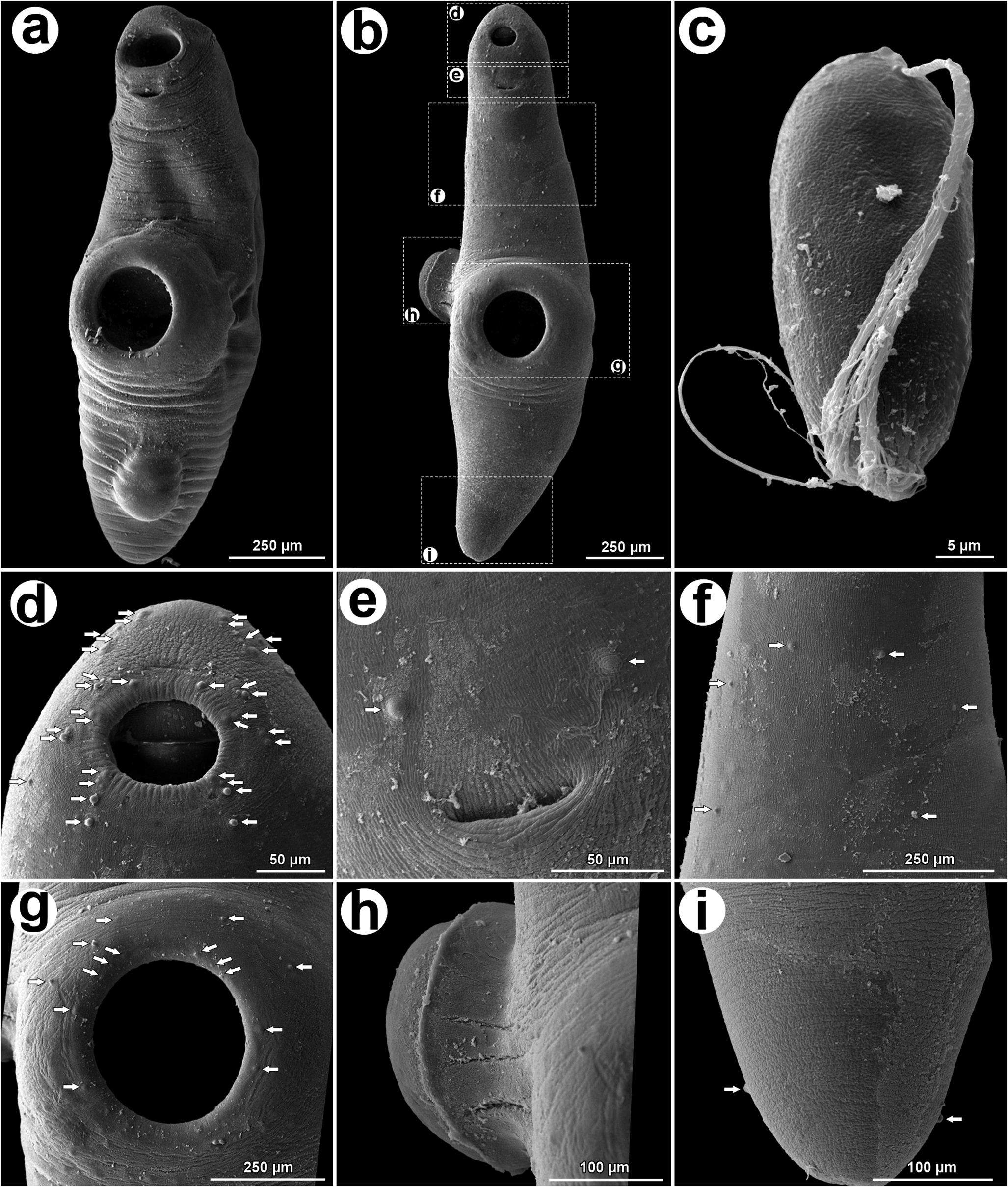
(Based on 12 flattened and six unflattened ovigerous specimens; four unflattened specimens were processed for SEM; eggs were teased from one specimen; selected measurements in Table 2): Derogenidae, Halipeginae. Medium-sized body, elongated; anterior and posterior ends rounded (Figures 1a and 3a, b). Tegument aspinous. Pre-oral lobe short. Oral sucker subterminal, circular (oval in flattened specimens) (Figures 1a and 3a, b). Pre-oral lobe, oral sucker rim, and surroundings bearing c. 17 pairs of dome or knob-like papillae arranged symmetrically (Figure 3d). Prepharynx absent. Pharynx muscular; oesophagus sacciform (Figure 2a, b). Intestinal caeca terminating blindly near posterior end of body; glandular stomach (Drüsenmagen) present (Figures 1a and 2a, b, d, e). Ventral sucker slightly pre- to slightly post-equatorial, circular (Figures 1a and 3a, b, g), bearing c. 8 pairs of dome or knob-like papillae arranged symmetrically (Figure 3g). Few remaining pairs of symmetrical papillae sparsely distributed throughout body (Figure 3e, f, i). Testes two, rounded to elliptical, symmetrical to slightly oblique, posterior to ventral sucker (Figure 1a). Seminal vesicle tubular, elongated, usually recurving, widest near posterior end (Figures 1a and 2a–c). Pars prostatica vesicular, surrounded by dense aggregation of prostatic cells; ejaculatory duct short (Figures 1a and 2b, c). Hermaphroditic duct short (only considering portion external to sinus-sac) (Figure 2c). Sinus-sac small, surrounding base of genital atrium, enclosing cone-shaped, permanent, highly muscular sinus-organ; sinus-organ occupies nearly the entire genital atrium (Figure 2a, b, c). Genital pore horizontally slit-like, median to submedian, opening at pharynx level to posterior margin of oral sucker (Figures 1a, 2a–c and 3a, b, e). Ovary almost spherical to oval, post-testicular, intercaecal (Figures 1a and 2d, e). Mehlis’ gland post-ovarian (Figure 2e); Juel’s organ and Laurer’s canal not observed. Two vitellarium masses entire (irregular surface), slightly to highly lobed (6–8 lobes in each mass; vitellarium near posterior end of body (Figures 1a and 2e). Uterine seminal receptacle present (Figures 1a and 2d). Uterus usually reaching ovary level, sometimes post-ovarian (Figures 1a and 2d, e); distal uterus projecting into short muscular metraterm (Figure 2c). Eggs with long, tufted filaments merging to form a single thread (Figures 1b and 3c). Excretory pore terminal.
Selected measurements of Thometrema patagonicum (Szidat, 1956) and the former T. overstreeti (Brooks, Mayes & Thorson, 1979) from freshwater fishes in South America (mean in bold followed by the range in parentheses; in micrometers unless otherwise stated)

* Significant statistical differences in either t or Mann-Whitney tests, p < 0.05, between flattened and unflattened specimens.
** Measurements taken from the type specimens.
*** Genital atrium measurements including the sinus-sac portion; mentioned as ‘sinus-sac’ in the references above.
The genital pore position is calculated as its distance from the anterior end in relation to the body length, while the ventral sucker position is calculated as the distance from the center of the sucker’s aperture to the anterior end in relation to body length. Abbreviations: L, length; W, width; n/a, not available
Thometrema patagonicum (Szidat, 1956) ex Steindachneridion scriptum (Miranda Ribeiro), from Paranapanema River, municipality of Salto Grande, State of São Paulo, Brazil. (a) Whole-mounted specimen (flattened); (b) Teased egg with tufted filaments merging to form a single, long thread. Abbreviations: ca, caeca; os, oral sucker; ov, ovary; pp, pars prostatica; so, sinus organ; sv, seminal vesicle; te, testis; tpf, tufted polar filament; usr, uterine seminal receptacle; vi, vitellarium; vs, ventral sucker.

Thometrema patagonicum (Szidat, 1956) ex Steindachneridion scriptum (Miranda Ribeiro), from Paranapanema River, municipality of Salto Grande, State of São Paulo, Brazil; flattened specimen. (a, b, c) Anterior body morphology focused on the terminal genitalia; (d, e) Posterior body morphology, including the ovarian complex. Abbreviations: ca, caeca; Dm, Drüsenmagen (glandular stomach); ev, excretory vesicle; ga, genital atrium; gp, genital pore; hd, hermaphroditic duct; me, metraterm; Mg, Mehlis’ gland; oe, oesophagus; os, oral sucker; ov, ovary; pc, prostatic cells; ph, pharynx; pp, pars prostatica; so, sinus organ; ss, sinus-sac; sv, seminal vesicle; te, testis; usr, uterine seminal receptacle; ut, uterus; vd, vitelloduct; vi, vitellarium; vs, ventral sucker.

SEM images of Thometrema patagonicum (Szidat, 1956) ex Steindachneridion scriptum (Miranda Ribeiro), from Paranapanema River, municipality of Salto Grande, State of São Paulo, Brazil; unflattened specimens. (a, b) Whole-body, ventral view (note the blebs caused by conspecifics attack); (c) Teased egg with tufted filaments merging to form a single, long thread; (d) Anterior body showing the symmetrically distributed pairs of papillae (arrows); (e) Detail of the slit-like genital pore, with a pair of papillae close to it (arrows); (f) Region post genital pore showing sparsely distributed pairs of papillae (arrows); (g) Pairs of papillae (arrows) on the ventral sucker rim; (h) Detailed view of the lesion (bleb) caused by powerful ventral sucker suction of a conspecific; (i) Posterior body with a single pair of papillae (arrows).

Remarks
The derogenids from S. scriptum were assigned to Thometrema by having eggs with a ‘single’ filament, vitellarium composed of two similar masses, a small sinus-sac not enclosing the seminal vesicle, and a portion of the hermaphroditic duct external to the sinus-sac (Gibson Reference Gibson, Gibson, Jones and Bray2002b).
Morphological comparison with the six valid species in Thometrema revealed that the newly collected specimens are easily differentiated from the type-species T. magnificum by having, among other features, a much shorter hermaphroditic duct external to the sinus-sac (80–150 μm vs. 400–1,890 μm) (Amato Reference Amato1968; Kohn et al. Reference Kohn, Fróes, Fernandes and Abramson1983; Szidat Reference Szidat1954). They differ from T. lotzi mainly by having a shorter sinus-organ and genital atrium (87–153 μm vs.190–402 μm; and 102–187 μm vs.199–558 μm, respectively) (Curran et al. Reference Curran, Overstreet and Font2002).
Among the remaining species, the new specimens closely resembled T. overstreeti, a species described from a freshwater potamotrygonid stingray in Colombia but widely distributed in freshwater bony fishes across South America (Brooks et al. Reference Brooks, Mayers and Thorson1979; Kohn et al. Reference Kohn, Fernandes and Cohen2007). This species has been reported from 16 distantly related host species, although catfishes (Siluriformes) dominate as the primary host group (Kohn et al. Reference Kohn, Fernandes and Cohen2007; Ostrowski de Núñez et al. Reference Ostrowski de Núñez, Arredondo and Gil de Pertierra2017).
A detailed morphological evaluation, including observation of the type specimens of T. overstreeti, revealed that this species is morphologically indistinguishable from T. patagonicum. Morphometrically, the only significant difference observed between the type material of T. overstreeti and our specimens was the relative distance of the genital pore from the anterior end to the body length (13–20% vs.9–12% in Brooks et al. Reference Brooks, Mayers and Thorson1979). The genital atrium, a highly contractile chamber (see Gibson and Bray Reference Gibson and Bray1979), may account for these differences. For the same reason, the sinus-organ in our specimens occupies nearly the entire genital atrium, whereas in the type material, it occupies c. 50%. Nevertheless, a similar position of the genital pore (at the posterior margin of the oral sucker) was illustrated by Tsuchida et al. (Reference Tsuchida, Flores, Viozzi, Rauque and Urabe2021a) (see their Figure 2).
In the recent redescription of T. patagonica (= T. patagonicum), Tsuchida et al. (Reference Tsuchida, Flores, Viozzi, Rauque and Urabe2021a) distinguished it from T. overstreeti based on the morphology of the terminal genitalia. They reported that T. patagonicum has a shorter hermaphroditic duct compared to T. overstreeti and further differs in the morphology of the prostatic complex. However, they neither provided measurements for the hermaphroditic duct nor discussed which are the differences in the prostatic complex. While the hermaphroditic duct (portion outside the sinus-sac) seems too short in their illustration (see Figure 3 in Tsuchida et al. Reference Tsuchida, Flores, Viozzi, Rauque and Urabe2021a), it measured c. 100 μm (80–150 μm in our specimens) on an illustration of the terminal genitalia observed through sagittal sections of the type material (see Figure 4 in Lunaschi and Drago Reference Lunaschi and Drago2001). Moreover, the prostatic complex of T. patagonica is similar to that of T. overstreeti; that is, the pars prostatica is vesicular, never enclosing the sinus-sac, and surrounded by numerous prostatic cells (Brooks et al. Reference Brooks, Mayers and Thorson1979; Kohn et al. Reference Kohn, Fernandes, Gibson and Fróes1990; Tsuchida et al. Reference Tsuchida, Flores, Viozzi, Rauque and Urabe2021a).
Tsuchida et al. (Reference Tsuchida, Flores, Viozzi, Rauque and Urabe2021a) further distinguished T. patagonicum from T. overstreeti by the vitellarium being almost entire rather than divided into lobed masses. However, the shape of the vitellarium masses varies with developmental stage. In T. lotzi and T. dissimilis, for instance, younger adults may exhibit unlobed vitellarium, whereas older specimens typically display two highly lobed masses (Curran et al. Reference Curran, Overstreet and Font2002; Moravec and Prouza Reference Moravec and Prouza2024). In our specimens, we observed a similarly variable morphology of the vitellarium, consistent with the type material, in which older specimens may have the vitellarium with three or more lobes (see Szidat Reference Szidat1956). Additionally, the former T. rioplatense (synonym of T. overstreeti) was also described as possessing entire or just slightly lobated vitellarium masses (Lunaschi Reference Lunaschi1989).
These findings, along with molecular evidence (see below), led us to consider T. overstreeti a junior synonym of T. patagonicum, corroborating the assumption of Lunaschi and Drago (Reference Lunaschi and Drago2001), who redescribed the latter species. Additionally, and in agreement with Curran et al. (Reference Curran, Overstreet and Font2002), we formally propose T. bonariense as a junior synonym of T. overstreeti (now T. patagonicum). The unlobed vitellarium and the smaller body size of T. bonariense (see Lunaschi Reference Lunaschi1989) are considered here as intraspecific variations of T. patagonicum.
Moravec and Prouza (Reference Moravec and Prouza2024) differentiated T. dissimilis from T. overstreeti and, consequently, from T. patagonicum based on body size, vitellarium shape, ventral sucker position and host spectrum. However, we observed in their illustrations that the main difference between T. dissimilis and the current concept of T. patagonicum proposed herein is the tubular shape of the pars prostatica (see their Figure 2B, D, E, G), as opposed to the vesicular shape commonly described in other species of Thometrema (Brooks et al. Reference Brooks, Mayers and Thorson1979; Curran et al. Reference Curran, Overstreet and Font2002; Kohn et al. Reference Kohn, Fernandes, Gibson and Fróes1990; Tsuchida et al. Reference Tsuchida, Flores, Viozzi, Rauque and Urabe2021a). Their description, although, contradicts the illustrations as the pars prostatica is described as vesicular-shaped. Therefore, this species needs further verification, ideally combining morphological and molecular evidence.
Molecular analyses
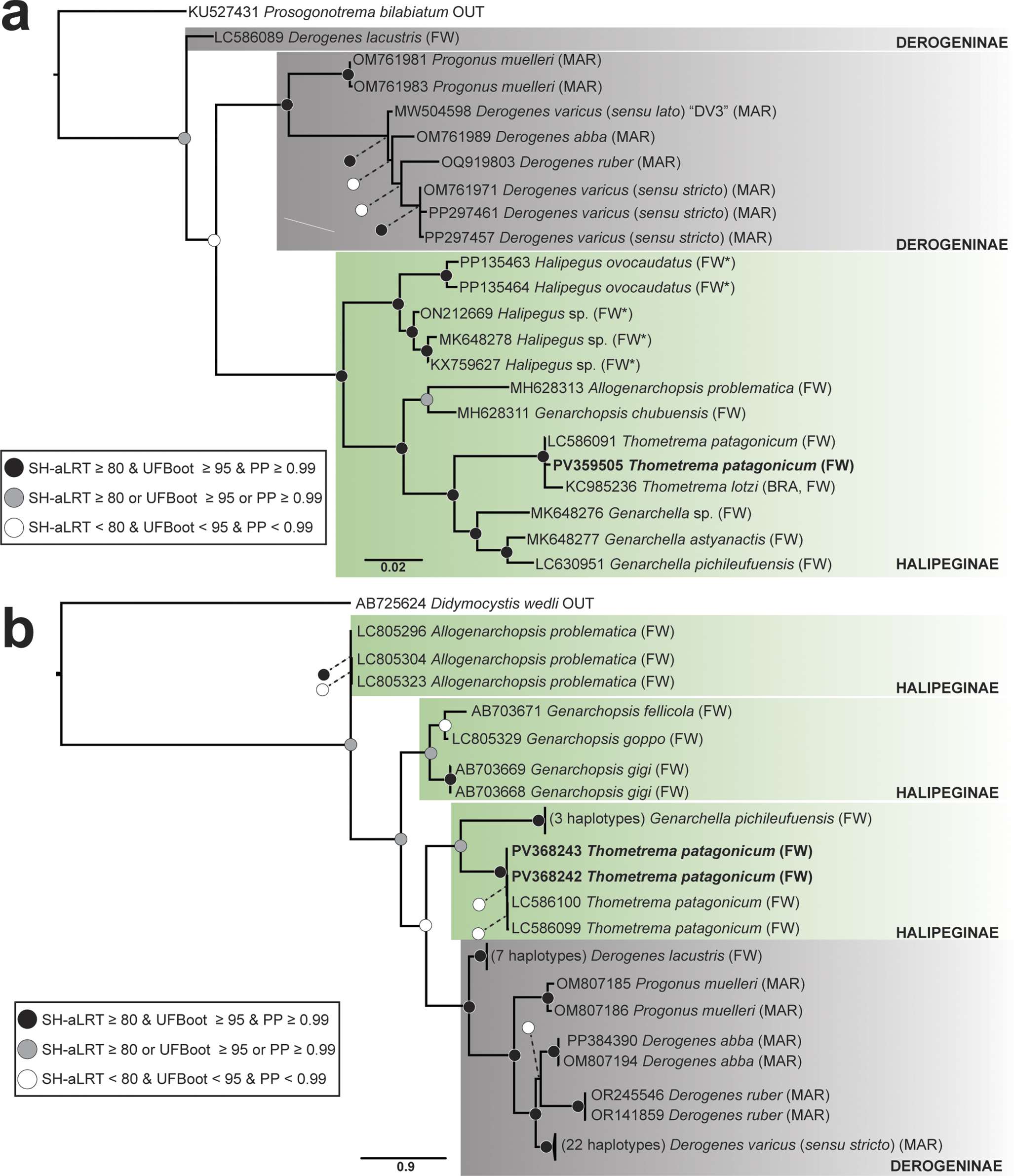
Three 28S rDNA sequences and two COI mtDNA sequences were generated from three specimens of T. patagonicum. The final alignment of 23 sequences using the 28S rDNA dataset of selected hemiuroids encompassed 1,030 nucleotide sites, including 196 parsimony informative ones. The trees generated from the ML and BI analyses were identical in topology. Both show the freshwater halipegines as a monophyletic group, with T. patagonicum isolates clustering in a polytomy along with T. lotzi (Figure 4a). Thometrema representatives are further sister to Genarchella spp. The halipegines are sister (poorly supported) to a group formed by marine derogenines (Derogeninae Nicoll, 1910), and both are sister to one of the few derogenine known from freshwater systems, Derogenes lacustris Tsuchida, Flores, Viozzi, Rauque & Urabe, 2021, commonly found in native and introduced fishes of the Argentinian Patagonia (Tsuchida et al. Reference Tsuchida, Flores, Viozzi, Rauque and Urabe2021a); thus, the monophyly of Derogeninae is not supported in this analysis. Pairwise comparison of the 28S rDNA sequence data revealed 0.6–0.7% (6–7-nt difference) of interspecific divergence within species of Thometrema, while the intraspecific divergence of T. patagonicum was only 0.2% (2-nt difference). The interspecific divergence of the well-defined D. varicus (Müller, 1784) sensu stricto in comparison with congeners was 1.1–8.1% (11–68-nt difference), and the intraspecific divergence for this species was 0.1–0.3% (1–2-nt difference).
Maximum likelihood phylograms of Thometrema patagonicum (new sequences in bold) and selected members of the Derogenidae as inferred from partial 28S rDNA (a), and partial COI mtDNA (b). SH-aLRT, ultrafast bootstrap (UFBoot), and posterior probability (PP) support values are shown at nodes (see inset). Branch length scale bar indicates the number of substitutions per site. Abbreviations: FW, freshwater; FW*, terrestrial with close association to freshwater environments; MAR, marine; OUT, outgroup.

The final COI mtDNA alignment (partitioned by codon position) comprised 50 sequences with 768 positions and 81, 34, 233 parsimony informative sites for the 1st, 2nd and 3rd partitions, respectively. The trees generated from the ML and BI analyses were similar for the interrelationships among terminal taxa, but with the internal nodes of halipegines (non-monophyletic) collapsed in the BI analysis. Isolates of T. patagonicum from the pimelodid S. scriptum in the UPR basin clustered together with those of T. patagonicum from the percichthyid P. trucha in the Argentinian Patagonia, sister to G. pichileufuensis Tsuchida, Urabe, Viozzi, Rauque & Flores, 2021 (Figure 4b). In turn, the clade G. pichileufuensis + T. patagonicum is sister, yet poorly supported, to the monophyletic Derogeninae. Similarly to the 28S rDNA analyses, species of the type genus of the Derogenidae, Derogenes Lühe, 1900, do not form a clade with the inclusion of Progonus muelleri (Levinsen, 1881). Pairwise comparison of the COI mtDNA sequence data suggested that nucleotide distance between the newly collected isolates and published T. patagonicum falls within the intraspecific range of divergence (0.5–1.4%, 4–13-nt difference). In comparison, the intraspecific variation among the 22 isolates of D. varicus (sensu stricto) was 0.1–1.8% (1–12-nt difference), while the interspecific variation among congeners was 15–21.1% (106–151-nt difference).
Discussion
Integrative taxonomic studies, usually combining morphological and molecular evidence, have improved our understanding of species boundaries (intra- and interspecific limits), host associations and geographical distribution of parasites (Scholz Reference Scholz2024). This is particularly true for trematodes, given that challenges such as cryptic diversity on one hand, and high phenotypic plasticity on the other hand, have been reported more often alongside the growing availability of DNA sequences (Cribb Reference Cribb2016; Gagnon et al. Reference Gagnon, Kasl, Preisser, Belden and Detwiler2021; González-García et al. Reference González-García, Andrade-Gómez, Pinacho-Pinacho, Sereno-Uribe and García-Varela2020; Nadler and Pérez-Ponce de León Reference Nadler and Pérez-Ponce de León2011; Pérez-Ponce de León and Poulin Reference Pérez-Ponce de Léon and Poulin2018). Another challenge in studying trematodes is their usual lack of hard structures, which are taxonomically informative for other groups of helminths. Thus, species delimitation mostly relies on the size, shape and distribution of some internal organs, with usually just a few distinguishing characters (Pérez-Ponce de León and Poulin Reference Pérez-Ponce de Léon and Poulin2018). That said, combined with the less comprehensive descriptions for trematodes (Poulin and Presswell Reference Poulin and Presswell2016), it is more difficult to assess the actual diversity of trematodes globally in comparison with other helminths.
In this study, our taxonomic hypothesis was based on critical morphological, ultrastructural (including the first SEM data for Thometrema) and molecular evaluation of derogenids from S. scriptum in the UPR basin. The species assigned to Thometrema was found to be conspecific with T. patagonicum, a species previously known only from the Argentinian Patagonia in endemic percichthyid fishes (Lunaschi and Drago Reference Lunaschi and Drago2001; Tsuchida et al. Reference Tsuchida, Flores, Viozzi, Rauque and Urabe2021a). Without combining multiple pieces of evidence, we would likely maintain our preliminary identification as T. overstreeti based on the geographical distribution, host breadth and the blurry diagnostic features used to differentiate most Thometrema species. Based on our findings, we proposed the synonymization of T. overstreeti and T. bonariense with T. patagonicum.
The morphology of the terminal genitalia appears to be the most important distinguishing feature among Thometrema species, rather than the vitellarium shape and body size (see above). Moreover, authors cannot neglect the procedures for the material fixation. Many descriptions of Thometrema spp. relied on specimens subjected to some degree of flattening (Amato Reference Amato1968; Brooks et al. Reference Brooks, Mayers and Thorson1979; Lunaschi Reference Lunaschi1989; Moravec and Prouza Reference Moravec and Prouza2024).
To address this, we evaluated both flattened and unflattened material, finding significant statistical differences in measurements between the two groups (see Table 2). While flattening may improve our understanding of some features such as the terminal genitalia and ovarian complex, it may also introduce morphological artifacts that hinder species comparisons (e.g., vitellarium lobes not well discernible). Cribb and Bray (Reference Cribb and Bray2010) recommended analyzing only unflattened trematode specimens in taxonomic studies. However, they also emphasized that if flattening is used, a subset of the specimens should remain unflattened for evaluation. For Thometrema spp., and following Cribb and Bray’s recommendation, the measurements should be based only on unflattened specimens, and flattened ones should be used as complementary material for the morphological study, as in Curran et al. (Reference Curran, Overstreet and Font2002) and Tsuchida et al. (Reference Tsuchida, Flores, Viozzi, Rauque and Urabe2021a).
Integrative studies may offer opportunities to reappraise known features and uncover new characters for species differentiation. For example, we identified a potential misinterpretation of the sinus-sac in the literature on Thometrema. What many authors described as sinus-sac, in fact, corresponds to the genital atrium (see Table 2). According to the terminology proposed by Gibson and Bray (Reference Gibson and Bray1979), the sinus-sac is muscular and surrounds the base of the genital atrium (clearly visible in the Figure 2c herein). The genital atrium, in turn, is a chamber lying between the hermaphroditic duct and the genital pore (in Thometrema, it lies between the hermaphroditic duct in the sinus-sac portion and the genital pore) (Curran et al. Reference Curran, Overstreet and Font2002). Additionally, through SEM analysis, we observed symmetrically distributed, dome- or knob-like papillae on the body surface, more numerous in the anterior half of the body, which may aid in distinguishing species within the genus. The SEM analysis also revealed the true morphology of the egg filaments in T. patagonicum, which consists of tufted filaments merging to form a single thread. It is likely that all of the other Thometrema species also exhibit a similar egg morphology, but they should be examined using SEM to clearly observe this feature.
The most comprehensive morphology-based classification of the Derogenidae traditionally recognizes three subfamilies (i.e., Gonocercinae Skrjabin & Guschanskaja, 1955, Derogeninae, and Halipeginae) (Gibson Reference Gibson, Gibson, Jones and Bray2002a). However, a molecular phylogenetic analysis by Sokolov et al. (Reference Sokolov, Atopkin, Gordeev and Shedko2018) revealed that members of Gonocercinae are distantly related to the derogenid clade. Consequently, these authors elevated Gonocercinae to the familial rank as Gonocercidae Skrjabin & Guschanskaja, 1955. While the monophyly of the current scheme for the Derogenidae is usually not under dispute (Ghanei-Motlagh et al. Reference Ghanei-Motlagh, Hernández-Orts, Fast, Whyte, El-Matbouli and Saleh2024; Sokolov et al. Reference Sokolov, Atopkin and Gordeev2021), the monophyly of Derogeninae and Halipeginae was not supported in the 28S rDNA and COI mtDNA analyses, respectively (see Figure 4a, b). Nevertheless, any taxonomic action would be premature as sequence data are available for only a limited number of genera within Derogeninae (2 of 4) and Halipeginae (6 of 17).
Our COI mtDNA analyses provided evidence supporting that the newly collected specimens are conspecific with T. patagonicum. While the intraspecific genetic divergence in trematodes can reportedly reach c. 6% [see Tsuchida et al. (Reference Tsuchida, Flores, Viozzi, Rauque and Urabe2021a) and references therein], the divergence between ours and the Patagonian isolates ranged from 0.5 to 1.4%. We acknowledge that establishing a barcoding gap is usually challenging (Nadler and Pérez-Ponce de León Reference Nadler and Pérez-Ponce de León2011). However, the genetic divergence of 21.1%–21.5% between T. patagonicum and its closest related species in our COI mtDNA tree (G. pichileufuensis) is well beyond the intraspecific range. Moreover, well-characterized marine derogenids exhibit similar nucleotide divergences among their closest relatives (Bouguerche et al. Reference Bouguerche, Huston, Cribb, Karlsbakk, Ahmed and Holovachov2023, Reference Bouguerche, Huston, Karlsbakk, Ahmed and Holovachov2024).
Considering the taxonomic acts proposed in this study, species of Thometrema display striking low (euryxenous) host-specificity, with few exceptions. The type-species, T. magnificum, is known only from loricariid catfishes (Loricariidae; species in three genera) in freshwater, and brackish environments of Southern Brazil and Argentina (Kohn et al. Reference Kohn, Fernandes and Cohen2007; Ostrowski de Núñez et al. Reference Ostrowski de Núñez, Arredondo and Gil de Pertierra2017). The most recently described species, T. dissimilis, is known from its type and only host Hoplerythrinus unitaeniatus (Spix & Agassiz) (Erythrinidae) in the Orinoco River basin, Venezuela (Moravec and Prouza Reference Moravec and Prouza2024); the report of Hoplias malabaricus (Bloch) as a host in the authors’ Figure 2 is a lapsus (F. Moravec, personal communication). In contrast, T. lotzi and T. patagonicum have exceptionally low host-specificity. Thometrema lotzi, the only species not found in South America, parasitizes a diverse range of freshwater and brackish fish species (centrarchids, sciaenids, moronids, ictalurids and lepisosteids) in Southern Mississippi and Louisiana, USA (Curran et al. Reference Curran, Overstreet and Font2002). Similarly, T. patagonicum parasitizes multiple freshwater and brackish fish species (primarily characiforms and siluriforms) across several South American river basins (see above). A low host-specificity is also reported for other groups of derogenids – for example, D. varicus sensu stricto (Bouguerche et al. Reference Bouguerche, Huston, Cribb, Karlsbakk, Ahmed and Holovachov2023), D. lacustris (Tsuchida et al. Reference Tsuchida, Flores, Viozzi, Rauque and Urabe2021a) and H. ovocaudatus (Vulpian, 1859) (Kirillova et al. Reference Kirillova, Kirillov, Chikhlyaev and Shchenkov2024). Curran et al. (Reference Curran, Overstreet and Font2002) argued that the broad host spectrum observed in halipegines and other hemiuroids might be related to the site of infection; while most trematodes infect the intestine, many hemiuroids parasitize the stomach or buccal area.
An intriguing observation in our study was the deep attachment of worms to each other, which may indicate a form of intraspecific interference competition. This behavior is relatively rare in the literature but was recently reported in marine hemiuroids [see Presswell et al. (Reference Presswell, Bennett, Chai and Poulin2023) and references therein]. The lesion observed in the injured specimens was strikingly similar to that described by Presswell et al. (Reference Presswell, Bennett, Chai and Poulin2023), characterized by a bleb – a large, rounded, blister-like protuberance (see Figure 3a, b, h). While physical damage is apparent, experimental studies are needed to assess the extent to which this phenomenon reduces, if at all, the fitness of the attacked individual.
To the best of our knowledge, this is the first report of a helminth parasitizing the endangered S. scriptum. There are alleged reports of Amplicaecum sp. (larvae), Eustrongylides sp. (larvae) and Cucullanus pinnai Travassos, Artigas & Pereira, 1928 (adult) from S. parahybae (Steindachner) collected in the Mogi-Guaçu River, UPR basin (Travassos and Kohn Reference Travassos and Kohn1965). However, this pimelodid is known only from the Paraíba do Sul basin, Eastern Brazil (Garavello Reference Garavello2005). Therefore, the actual host for these nematodes might be either S. scriptum or S. punctatum (Miranda-Ribeiro), which occur in sympatry in the UPR basin (Garavello Reference Garavello2005).
In conclusion, our study proposed rearrangements in the species composition of Thometrema, recognizing only T. magnificum (type-species), T. patagonicum, T. lotzi and T. dissimilis as valid. However, we acknowledge that new molecular data is needed to corroborate the striking low host-specificity of most species, along with their usual broad geographical range, or to identify species complexes that should be untangled using integrative approaches.
Supplementary material
The supplementary material for this article can be found at http://doi.org/10.1017/S0022149X25000355.
Acknowledgements
The authors are indebted to the team members of the Laboratório de Parasitologia de Animais Silvestres (LAPAS) for their invaluable help with the collection and dissection of fish. Thanks are also due to Anna Phillips and Yolanda Villacampa (Smithsonian Institution, Washington, DC) for kindly providing photomicrographs of the holotype and paratypes of T. overstreeti. Special thanks are due to Karin Tsuchida (Japan), Verónica Flores (Argentina) and Blanka Škoríková (Czech Republic) for sharing key literature that was otherwise difficult to access.
Financial support
This study was supported by the São Paulo Research Foundation (FAPESP; #2020/05412-9). PVA was supported by FAPESP (#2021/12593-2), and MBE was supported by PROPG/PROPe – UNESP (Edital #04/2022) and Coordination for the Improvement of Higher Education Personnel (CAPES; #88887.976117/2024-00). RJS was supported by the National Council for Scientific and Technological Development (CNPq; # 311635/2021-0).
Competing interests
The authors declare no competing interests.
Ethical standard
The Instituto Chico Mendes de Conservação da Biodiversidade (ICMBio) authorized the sampling (license #60640-1). The procedures followed the ethical principles in animal research approved by the Comitê de Ética no Uso de Animais (CEUA; license #3294270922) of the Instituto de Biociências, Universidade Estadual Paulista ‘Júlio de Mesquita Filho’ (UNESP), Campus of Botucatu, State of São Paulo, Brazil. In accordance with the Brazilian law, access to the genetic data was granted by the Ministério do Meio Ambiente e Mudança do Clima (SisGen #ABA5101).
Authors’ contribution
Philippe V. Alves, Mariana B. Ebert and Reinaldo J. da Silva contributed to the study’s conception and design, data collection and both morphological and molecular analyses. PVA wrote the first draft of the manuscript, and all authors commented on previous versions. All authors read and approved the final manuscript.
Availability of data and materials
Voucher specimens were deposited in the Coleção Helmintológica do Instituto de Biociências (CHIBB), UNESP, Botucatu, State of São Paulo (acc. codes CHIBB #10634, #10635), and in the Coleção Helmintológica do Instituto Oswaldo Cruz, State of Rio de Janeiro (acc. codes CHIOC #40614a-f), both in Brazil. Newly generated sequences were deposited in the GenBank database (acc. codes PV359504–PV359506, PV368242 and PV368243). Alignments and phylogenetic trees are available in the supplementary material.