





1. Introduction
Intermediate-mass black holes (IMBHs;
 $10^2-10^6{\,\rm M_\odot}$
) are regarded as the missing link between stellar-mass and supermassive BHs (SMBHs), and unveiling their origin and growth is crucial to understanding the assembly of SMBHs across cosmic time (e.g., Volonteri Reference Volonteri2010). Despite their intrinsically low luminosities and limited dynamical influence, which make them difficult to detect, the number of IMBH candidates in both local and high-redshift galaxies is steadily increasing (e.g., Askar et al. Reference Askar, Baldassare and Mezcua2023). Among the various environments, nuclear star clusters (NSCs) are considered particularly promising sites for hosting IMBHs (e.g., Greene et al. Reference Greene, Strader and Ho2020). Their high densities enable the formation of very massive stars through runaway stellar collisions, which may then collapse directly into BHs. In addition, NSCs offer conditions of mass segregation and dynamical friction that enable hierarchical BH mergers; owing to their high escape velocity, BHs can remain bound even after gravitational-wave recoil kicks, and NSCs further supply fuel through tidal disruption events (e.g., Fujii et al. Reference Fujii, Wang, Tanikawa, Hirai and Saitoh2024; Rantala et al. Reference Rantala, Naab and Lahén2024). These properties make NSCs one of the most favourable environments to study the formation and growth of IMBHs. Once BHs enter the IMBH regime, gas accretion becomes a major growth channel. To understand the coupled feeding and feedback of BHs and galaxies, simulations must bridge scales from kpc inflows to sub-0.01 pc accretion discs. To this end, we present the MandelZoom framework (Shin et al. Reference Shin, Sijacki, Smith, Bourne and Koudmani2025), a suite of multi-scale simulations that follow gas inflows from a resolved ISM to the
 $\alpha$
-disc, enabling a self-consistent model of BH, NSC, and galaxy co-evolution.
2. Numerical Setup
We simulate an isolated dwarf galaxy of total mass
 $10^{10}{\,\rm M_\odot}$
, consisting of a dark matter halo, exponential stellar and gaseous discs, and a circumgalactic medium. At its centre, we place a
 $10^4{\,\rm M_\odot}$
BH and embed an NSC with a total mass of
 $3\times10^5{\,\rm M_\odot}$
. The NSCs are modelled with collisionless stellar particles representing old stars that interact only gravitationally. The simulations are performed with the Arepo code (Springel Reference Springel2010; Pakmor et al. Reference Pakmor, Springel, Bauer, Mocz, Munoz, Ohlmann, Schaal and Zhu2016). Radiative cooling and UV background heating are included via the Grackle library (Smith et al. Reference Smith2017). Star formation and feedback follow the model of Smith et al. (Reference Smith, Bryan, Somerville, Hu, Teyssier, Burkhart and Hernquist2021), where individual stars are explicitly sampled from the Kroupa (Reference Kroupa2001) IMF, and feedback channels include photo-ionization, photoelectric heating, and supernovae (SNe). This approach captures the clustered nature of feedback and its regulation of the multiphase ISM.
To capture galactic inflows to the BH accretion scale, we employ the super-Lagrangian refinement scheme (Curtis & Sijacki Reference Curtis and Sijacki2015). Gas cells are progressively refined according to their distance from the BH, reaching a minimum cell size of
 $\lesssim 0.01$
pc in its vicinity. This resolution is sufficient to resolve the self-gravity radius of the accretion disc (
 $r_{\rm SG}\sim0.1-0.2$
pc in our BH system) with thousands of cells, enabling tracking of gas inflows from the ISM to the accretion disc. Following Fiacconi et al. (Reference Fiacconi, Sijacki and Pringle2018), we adopt an
 $\alpha$
-disc model (Shakura & Sunyaev Reference Shakura and Sunyaev1973). At
 $r_{\rm SG}$
, we measure the inflow of mass and angular momentum, ensuring that only circularized gas contributes to accretion. The disc evolves by accreting this material and exchanging angular momentum with the BH through both the gas supply and the Lense-Thirring effect (Bardeen & Petterson Reference Bardeen and Petterson1975), enabling a self-consistent model of BH-disc co-evolution in a galactic environment.
3. From kpc to sub-0.01pc: circumnuclear disc evolution and angular momentum transport by nuclear star clusters
Our simulations reproduce a thermally and dynamically complex multiphase interstellar medium (ISM; see Fig. 1). Cold, dense clumps and filaments form, along which stars are born and emit FUV radiation that ionizes and heats the surrounding gas. As massive stars reach the end of their lifetimes, SN explosions drive shocks and generate large low-density cavities. Thus, the morphology of the ISM is shaped by the continuous interplay between cold star-forming gas and the radiative and mechanical feedback from stellar populations (Smith et al. Reference Smith, Bryan, Somerville, Hu, Teyssier, Burkhart and Hernquist2021). The gravitational potential of the NSC induces frequent orbit crossings and shocks, dissipating energy and removing angular momentum from the gas, thereby promoting the formation of a dense CND with a radius of
 $\sim 7$
pc. Once circularized, the gas loses further angular momentum due to the NSC and is transported onto the
 $\alpha$
-disc, where it delivers mass and angular momentum that drive the evolution of the BH mass and spin through the Lense-Thirring effect. The CND undergoes episodic in-situ star formation. Massive stars emit ionizing radiation and FUV photons and heat the CND before exploding as SNe, whose shocks compress the gas toward the centre. This feedback feedback episode is short-lived but strongly boosts BH accretion. However, the cumulative effect of successive SNe can ultimately disrupt the CND entirely, quenching the BH accretion rate until fresh inflows form a new CND.
Gas surface density maps, zooming from kpc to sub-pc scales. A dense CND forms around the BH and channels gas toward the
 $\alpha$
-disc. The rightmost panel shows a 3 pc slice with the orientations of the BH spin (
 $\mathbf{S}_{\rm BH}$
; black), the
 $\alpha$
-disc angular momentum (
 $\hat{J}_{\alpha\text{-disc}}$
; blue), and the inflowing gas (
 $\hat{J}_{\rm inf}$
; green).

To identify the drivers of angular momentum loss, we compare simulations with and without NSCs (see Fig. 2). In the absence of an NSC, torques are irregular and dominated by stochastic interactions between gas and dark matter, producing no systematic inflow. By contrast, with an NSC, the torque maps reveal a structured torque pattern along the gas distribution. We found that the NSC extracts angular momentum from the CND, enabling the gas to spiral inward toward the BH. As the CND transfers angular momentum to the NSC, the cluster itself begins to spin up and its ellipticity increases.
Gas surface density (left), torque maps (middle), and time-averaged radial torque profiles (right) for runs without (top) and with an NSC (bottom). The presence of the NSC leads to the formation of a dense CND and coherent negative torques that efficiently remove angular momentum from the gas, in contrast to the irregular torques in the noNSC run.

4. Accretion disc and BH mass and angular momentum evolution
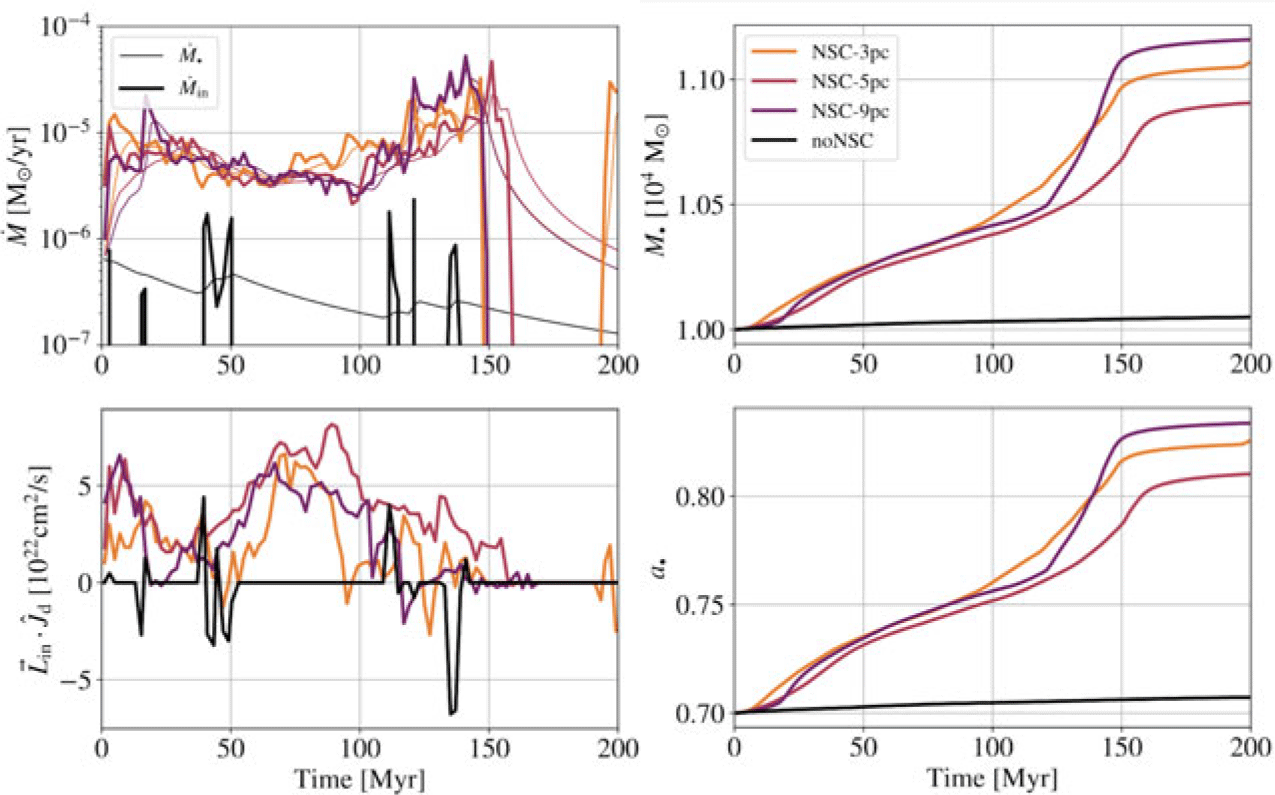
To investigate how gas inflows shape BH growth, we examine the evolution of the accretion disc and the BH’s mass and spin (see Fig. 3). The presence of an NSC sustains inflows to the
 $\alpha$
-disc, with short spikes triggered when stellar feedback compresses gas toward the centre. The BH grows steadily, and the feeding cycle is far more continuous with an NSC than without. Without an NSC, inflows are intermittent and misaligned, yielding negligible spin growth. By contrast, with an NSC, the rotationally supported CND produces structured inflows that keep the BH spin aligned with the disc via the Bardeen-Petterson effect, driving a gradual spin-up from
 $a=0.7$
to
 $\sim0.85$
over 200 Myr. These results highlight the critical role of NSCs in regulating both the mass and spin evolution of IMBHs.
Time evolution of the BH accretion rate (top left), BH mass (top right), angular momentum inflow onto the accretion disc (bottom left), and BH spin (bottom right).

5. Conclusions and Implications
We have presented results from the MandelZoom project (Shin et al. Reference Shin, Sijacki, Smith, Bourne and Koudmani2025), a new suite of multi-scale simulations that follow IMBH growth from a resolved multiphase ISM down to the
 $\alpha$
-accretion disc scale. Our simulations show that NSCs efficiently capture inflowing gas and promote the formation of dense CNDs on parsec scales. In the presence of NSCs, inflows remain coherent with the Lense-Thirring effect ensuring the stable spin growth, while in-situ star formation and feedback regulate both CND structure and BH accretion variability. This study establishes the first self-consistent framework linking galaxy-scale inflows to the joint mass and spin evolution of BHs through an
 $\alpha$
-disc model. Looking forward, extending this framework to incorporate AGN jet feedback (e.g., Bourne & Sijacki Reference Bourne and Sijacki2017; Talbot et al. Reference Talbot, Bourne and Sijacki2021) will be a critical step toward capturing the full range of processes that regulate BH growth.
Acknowledgements
E.S., D.S., and M.A.B. acknowledge support from the Science and Technology Facilities Council (STFC; grant code ST/W000997/1). M.A.B. further acknowledges support from a UKRI Stephen Hawking Fellowship (EP/X04257X/1). S.K. acknowledges support from an 1851 Research Fellowship of the Royal Commission for the Exhibition of 1851 and a Junior Research Fellowship at St Catharine’s College, Cambridge.

 α
 SBH
 α
 J^α-disc
 J^inf


 Open access

