This article focuses on the history of an Afro-descendant family over its seven generations in one region of Minas Gerais. Although it is notoriously difficult to trace families founded by slaves, this one is an exception: it has proved possible to trace this family over a century and a half, and with a remarkable level of detail, because its members mostly stayed in one place. The implications of their permanence go beyond mere genealogy or family reconstitution to challenge long-standing historiographical perspectives. Over the years many scholars have agreed that Brazilian colonial and early imperial society was characterized by the near-constant movement of all segments of the population. New frontiers opened by agriculture, ranching, and mining attracted some members of the elite, but also beckoned the less favored with new opportunities.Footnote 1 This incessant movement has even been touted as an impediment to the advancement of family history in Brazil.Footnote 2
Quitéria Moreira de Carvalho, José Fernandes da Silva, and several of their descendants, however, chose to stay put in the town of São José (present-day Tiradentes). In spite of what the historiography has told us, their experience was not unique. Many families throughout the colonial and provincial periods remained in one place or community over generations. Recent studies based on family reconstitution and inspired by micro-history have uncovered multigenerational stories strongly centered in a single locality or region.Footnote 3 These works invite scholars to reckon with a reality that saw some segments of the population cling to one place and a relatively certain future rather than take their chances on the frontiers. A somewhat elusive middling stratum was one of those segments. As Zephyr Frank has so clearly shown, manumitted Africans and their freeborn and freed descendants in Brazil could prosper as small slaveholders and entrepreneurs up to the termination of the transatlantic slave trade.Footnote 4
Pre-Republican Brazilian historiography has mostly ignored middling social groups, and the notion that permanence contributed to stability for families over several generations has never been explored.Footnote 5 Yet permanence at the family level was a viable survival strategy that could boost families' social standing and respectability within the community. Communal trust built over time could lead to posts and contracts with the local administration. Such trust was developed in several ways. Members of middling families, particularly women, were chosen frequently by other families to stand as godparents to their infants, a mark of respect that further enhanced their standing within and connection to the community. Practicing a mechanical trade, as many of the middling groups did, offered stability and opportunities for socioeconomic mobility, including the possibility of securing service contracts with the local government. Finally, literacy was another mark of middling status and upward social mobility. The family of Quitéria and José illustrates all these pathways to social mobility, from their permanence in one town to the literacy of most of their male family members. The story of their family reveals much about middling social strata and social mobility in pre-Republican Brazil, particularly among Africans and Afro-descendants.
The family narrative, unfolding over 160 years, is centered in the town of São José do Rio das Mortes. Located in the southeast of Minas Gerais, São José was an important center of Brazilian gold mining in the early eighteenth century. Before mid century, the provisioning of domestic markets became the mainstay of the regional economy, and it remained so throughout the nineteenth century, t. As the parish seat and nucleus of municipal administration, São José maintained its urban character over time, sustaining numerous commercial establishments as well as tradesmen and their workshops.Footnote 6 Generation after generation of Quitéria and José’s descendants thus found in this small town an amenable environment in which to maintain a middling social standing and pursue their social and economic ambitions.
The family reconstitution developed in this article is part of a broader research effort that relies on family history to achieve a deeper and more nuanced understanding of how historical tendencies and processes shape a single locality over time. This work has required cross-referencing data derived from diverse primary sources, most often parish archives (especially baptismal, marriage, and burial registers) and other ecclesiastical papers.Footnote 7 A 1795 ecclesiastical census and two municipal census, in 1831 and 1838, list individuals, offering us overviews of the community at different points in time and helping to contextualize socially some of Quitéria and José’s descendants.Footnote 8 Notarial documents, though few in number, illuminate three separate manumission processes that were crucial to the family history, and a small number of wills and probate records yield information about property held by some third- and fourth-generation family members and its eventual transmission to other descendants.Footnote 9 Finally, documents from the municipal council of São José relevant to this family's history; these include fiscal records, lists of local militia members, and accounting records of local public works and council business.Footnote 10
Brief Genealogy of the Moreira da Silva Family
The earliest protagonists of our story were probably captured as young adults in the interior of West Africa. After enduring the rigors of the Middle Passage, the newly enslaved minas (a generic term for West Africans) were transported from their port of disembarkation to the captaincy of Minas Gerais.Footnote 11 They likely arrived in São José in the late 1730s or early 1740s when the demand for slaves in the mining regions was highest and thousands of Africans were being imported annually. They received the names José and Quitéria and, given the difference in their surnames in later documents, were likely sold to different owners. It is unclear how they became a couple, but parish registers indicate that between the late 1740s and 1759 they maintained a consensual relationship that produced four illegitimate children (naturais).Footnote 12 In the baptismal record of their fourth child, the still single Quitéria was listed as forra (freedwoman). In 1764, the formally wed and now free couple José Fernandes da Silva and Quitéria Moreira de Carvalho baptized a fifth son, named for his father.Footnote 13
While the vast majority of Brazilian slaves remained enslaved all their lives, manumission nonetheless did occur—and not so infrequently—right up to abolition in 1888. In Minas Gerais the prosperity of the eighteenth-century gold cycle allowed for easy replacement of freed slaves and shaped a tradition of manumission that continued into the nineteenth century. The vast scholarship on manumission practices in Minas Gerais and the Portuguese empire supports speculation as to how first- and second-generation Moreira da Silvas became free. The consensus is that most manumissions were purchased by slaves themselves. Permitted to carry out independent income-producing activities, they accumulated money or credits which they used to purchase freedom. Buying freedom with payments over time (quartação or coartação), usually several years, became common in the mining economies of Minas Gerais, Goiás, and Mato Grosso, later spreading through the rest of Brazil, and facilitated many self-purchases or purchases of family members. Quitéria likely achieved freedom in this fashion, possibly after accumulating savings earned through some kind of commercial activity. José Fernandes da Silva may have been one of several male slave craftsmen who made money through their trade and applied it to their freedom. On the other hand, Quitéria herself paid outright for the manumission of her two daughters by offering two newly arrived Africans in exchange for her daughters’ freedom.Footnote 14 Later, she and José purchased their oldest son and promptly freed him.Footnote 15
Freedom could also be granted outright, and was often ceded at the baptismal font or in a will. The latter most likely did not occur in Quitéria's case; the presumed date of her manumission preceded her owner's death.Footnote 16 Because José’s owner remains unknown, there is no margin even for speculation in his case. Some grants of freedom were contingent upon further service, usually to surviving heirs. Gratuitous manumissions of female slaves or their offspring occasionally resulted from the sexual relationships white slave owners pursued with the women. Whether these relationships were consensual or forced—a strategy of survival among slave women, or an act of white male dominance—has been much debated. None of the evidence suggests, however, that the manumission of Moreira da Silva family members fit either of these two suppositions.Footnote 17
Of José and Quitéria's five children, four appear in official records as adults. Antônia Moreira da Silva and Joaquim Moreira da Silva eventually married and raised families of their own. Ana Moreira da Silva also married but the couple apparently remained childless. Severino Moreira da Silva was still a bachelor living with his widowed mother in 1795.Footnote 18 Between 1781 and 1815 Antônia and Joaquim baptized six children, four of whom survived to adulthood.Footnote 19 Two of their children are of special interest: Manoel Martins Coimbra was ordained a priest, and Esméria Martins dos Passos married and had children.Footnote 20 Between 1802 and 1808, Esméria and her husband produced the only fourth-generation family members I have been able to trace.Footnote 21 All four of Esméria's children appear as adults in sources dating from the 1820s and beyond and would among them produce some 18 children. However, the only fifth-generation descendants of José and Quitéria who appear as adults in the official documents are the children of Bárbara Patrícia Lopes's consensual union with a member of the local white elite, and of José Vieira Lopes's marriage to his paternal second cousin, Maria José Cupertino.Footnote 22
All eight of Bárbara Patrícia's children survived to adulthood, and several appear prominently in the sources, often designated as pardos (denoting their mixed racial origin).Footnote 23 José Vieira Lopes's only daughter from his first marriage, Maria Madalena Vieira, married in 1827 and the couple had three children.Footnote 24 All five members of Maria Madalena's nuclear family were labeled crioulos (Brazilian-born of solely African ancestry).Footnote 25 Hence, from the fifth generation on the family came to be divided between a pardo and a crioulo branch. Their members maintained close relations, nonetheless.Footnote 26
Between 1844 and 1884, seven of Bárbara Patrícia's children went on to produce 46 sixth-generation family members.Footnote 27 I have thus far been able to identify a total of 49 sixth-generation descendants of José and Quitéria in the sources. Parish registers also include ten marriages involving sixth-generation family members.Footnote 28 Additionally, between 1866 and 1895 the baptisms of 32 seventh-generation infants were recorded.Footnote 29 The seventh generation was certainly larger than this figure suggests, but was not explored because the research project População e Economia da Paróquia de São José do Rio das Mortes established a cutoff date of 1895 for examining baptismal registers.Footnote 30 Therefore, identifying a more complete set of descendants will be possible only in future studies.
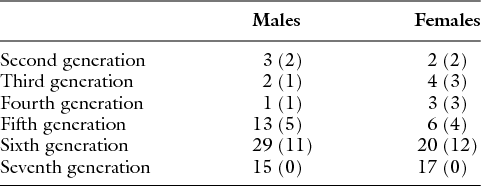
Thus far, I have been able to identify a total of 115 direct descendants of the former slave couple José Fernandes da Silva and Quitéria Moreira de Carvalho. Table 1 presents a simple recapitulation of each generation according to gender and the number of family members who appear as adults in the sources.
Direct descendents of José Fernandes da Silva and Quitéria Moreira de Carvalho, by gender (appearing as adults), 1754–1895

Sources: Arquidiocese de São João del-Rei, Centro de Documentação, Arquivo Paroquial de Santo Antônio de São José do Rio das Mortes, Livros 6. 7, 8, 9, 10, 10A, 11, 11A, 12, 13, 14,15, 16, 17, 20, 21, 22, 24, 25, 26, 27, 28, 76, 77, 78, 79, 80, 81, 82, 83, 84, 85, 86, Óbitos 1860–1932. Manuscript. Arquidiocese de São João del-Rei, Centro de Documentação, Arquivo Paroquial de Nossa Senhora do Pilar de São João del-Rei, Livros 27, 32, 37, 28. Manuscript.
Stability and Status: The First Four Generations
The registers that confirm the presence of José and Quitéria's descendants in São José speak to a sense of belonging, of rootedness. Their prolonged permanence in São José, moreover, lent the family a certain respectability, based on the social standing that José and Quitéria seem to have achieved. A sure sign of Quitéria's local prestige was her appearance in no fewer than 17 baptismal records as the godmother to infants of color from outside the family.Footnote 31 Parish registers, including the 1795 Rol de Confessados (a list of parishioners) offer additional evidence of the family's social standing. According to the Rol, Quitéria and most of her children were slave owners: she owned at least four slaves, her daughter Ana Moreira da Silva owned at least three, and her son Joaquim Moreira da Silva and daughter Antônia Moreira da Silva each owned at least two.Footnote 32 The Rol also reveals that Antônia was married to the alferes (second lieutenant) Joaquim Martins de Souza, described as a crioulo forro (freed black). Joaquim's status as an officer, undoubtedly in the black regiment of the local militia, would also have provided him a fair measure of respect within the community.Footnote 33 Following in her mother's footsteps, daughter Ana became godmother to ten infants from outside the family, and Ana's husband, Pedro da Silva Lourenço, was godfather to seven non-family members, mostly slaves.Footnote 34 Finally, in 1812 son Joaquim, then a widower, became affiliated with the local militia through his marriage to the daughter of a captain (again, most likely in the black regiment). How these first two generations made their living remains unknown. Nonetheless, by the end of the eighteenth century they had laid claim to a middling social position far removed from the impoverished masses, the so-called desclassificados.Footnote 35
Evidence related to the third and fourth generations of this still purely African-descendant family is more robust. In 1819, grandson Manoel Martins Coimbra, then coadjutor of the vicar, began to appear frequently in the parish registers, officiating at baptisms and weddings.Footnote 36 I have not yet found any evidence regarding Manoel's studies or his ordination as a priest. His position as a cleric and spiritual guide to his congregation suggests, nonetheless, personal achievement and respectability in São José. If sources that show us Manoel's path to the priesthood eventually emerge, they may help explain the family's upward social mobility during the first three generations.
By 1831, Manoel and his spinster sister Quitéria Maria were residing together in São José. Each owned slaves, he five and she two.Footnote 37 A year later Manoel passed away, leaving a modest estate of 907$816 (roughly £116.25), not including the four slaves he manumitted in his will.Footnote 38 Quitéria Maria inherited the fifth slave, her brother's half of their jointly owned two-story home on the Rua Direita (equivalent to Main or High Street), and some personal items. The siblings' slave holdings, their shared home located in a prestigious part of town, and Manoel's other possessions qualified them as members of the local middling strata.
A third grandchild of Quitéria and José, Esméria Martins dos Passos, married João Patrício Lopes in 1800; the couple would produce the only fourth-generation members of the family I have been able to trace.Footnote 39 Esméria figured in some of the tax records of the São José municipality, and she made a total of nine payments of a levy imposed on shopkeepers and vendors during 1803 and 1804. Unfortunately, these records do not specify what merchandise she was selling.Footnote 40 Given that João Patrício was later described as a tailor, Esméria likely ran some sort of market attached to his workshop.Footnote 41 In 1804 João Patrício appeared as the owner of the ganguela slave Juliana, who was baptizing her son Gervásio.Footnote 42 Like the rest of the third generation, Esméria and João Patrício were small-scale slaveholders.
João Patrício Lopes was not simply a tailor, however. Registers of payments for his services as town jailer survive for the years 1819 and 1823.Footnote 43 Administering the local jail was surely a part-time job that dovetailed nicely with tailoring. The post of jailer attested, moreover, to João Patrício's modest prestige and trustworthiness in the eyes of the local community. In 1838, João Patrício appeared as “adjunct doorkeeper” of the municipal council. Later that same year he figured simply as doorkeeper, a post he held until his death in 1851.Footnote 44 While not exactly propelling him into the ranks of the local gentry, the doorkeeper post was a prestigious one for a person who was often labeled as crioulo and who clearly descended from slaves.Footnote 45 Moreover, his occupation and activities, like those of other members of his generation, were clearly urban in nature, a characteristic that also marked later generations.
Three of Esméria and João Patrício's sons were, according to the 1831 nominal list, tradesmen like their father. Roque Patrício Lopes, a shoemaker, and Joaquim Simões Lopes, a carpenter, both lived with their parents. Their younger brother José Vieira Lopes, a goldsmith, established a separate household with his wife Maria José Cupertino (a seamstress), their infant son, and a young African slave woman.Footnote 46 The Moreira da Silvas' middling social standing, along with the main occupations of some of their members, suggests that freeborn and freed tradesmen of African descent often held an intermediate position within the prevailing social hierarchy. It also indicates that São José’s urban environment, like that of other cities and small urban centers in nineteenth-century Brazil, was favorable to tradesmen. From early colonial times to the nineteenth century, major ports such as Recife, Salvador, and Rio de Janeiro were hotbeds of craftwork and service-oriented activities. Slaves often practiced trades and provided all nature of services, as did freedmen and free-born African descendants. The workforce overall was predominantly African-descendant, whatever their legal condition. The same characteristics carried over to inland areas, not least Minas Gerais with its relatively dense urban network.Footnote 47 Further evidence of the Lopes brothers' social standing, as well as that of other tradesmen, appears in the 1833 municipal roll of the Guarda Nacional, a unitary militia organization formed to replace the old colonial regiments. As members of the Guarda, Roque, Joaquim, and José ranked among the recognized citizens (cidadãos e votantes) of the town of São José.Footnote 48
More information about this generation's middling status comes from the inheritance papers of José Vieira Lopes's wife, who died in 1838. The couple's modest estate comprised their home, furniture, goldsmithing and gardening tools, a few debts owed to José, and the cabinda slave Catharina and her son Alexandre (appraised respectively at 500$000 and 200$000).Footnote 49 The estimated value of the estate was 964$360 (the equivalent of about £114.90 in 1838). By way of comparison, in the neighboring town of São João del-Rei between 1831 and 1835 some 24 percent of all probated estates were worth up to 1:000$000. Despite legislation requiring that the estates of all deceased go through a process of evaluating the respective assets, families with little or no property rarely initiated the necessary procedures, even when orphaned minors remained behind.Footnote 50 The estates that did go through inventories tended to belong to deceased persons of a middling economic status, largely small slaveholders and homeowners. When compared to the findings for the town of São João, the average value of the Moreira da Silvas probated estates found so far (averaging just under 1:000$000), places them at the threshold of more substantial wealth and points, again, to a respectable if modest economic standing.Footnote 51
Reconstitution of the fourth-generation nuclear families continues the record of the Moreira da Silvas' presence in São José. Roque Patrício Lopes, the oldest of Esméria and João Patrício's sons, married Ana Joaquina Faria in 1835.Footnote 52 A year later, the couple baptized their son Hipólito in the town's mother church. They baptized another son, Zeferino, in August of 1839 in that same venue.Footnote 53 Inexplicably, their family was not included in the nominal list of 1838, even though parish records suggest the couple had not left the São José community.Footnote 54 In fact, Ana Joaquina served as a godmother seven times between 1841 and 1865.Footnote 55 These records suggest that this small family, paternally descended from Quitéria and José, remained in the town of São José for many years, probably for the duration of Roque and Ana Joaquina's lives.Footnote 56
In January of 1834, moving only slightly beyond São José, Joaquim Simões Lopes, the carpenter son of Esméria and João Patrício, married Maria Apolinária de Jesus in the Church of Nossa Senhora do Pilar in the town of São João del-Rei.Footnote 57 Joaquim, it seems, was residing in São João at the time of his marriage and would continue to do so afterwards. In December of 1836, the couple baptized their son Porciano in the same church.Footnote 58 To be sure, the towns of São José and São João were very close to one another and moving between them was done easily. Nonetheless, Joaquim's relocation constituted the first documented example of migration out of São José by a Moreira da Silva descendant. Undoubtedly, Joaquim was attracted by the prosperity and rapid growth of São João during this period.Footnote 59 Still, the migration was so limited in terms of distance that it barely counters the remarkable, multigenerational permanence of the Moreira da Silva family in São José and its proximities.
Fourth-generation out-migrations were not limited to Joaquim's move to neighboring São João. In February of 1840, his brother José Vieira Lopes, then a widower, married Alexandrina Margarida Fernandes in the Church of Santo Antônio in their native town of São José.Footnote 60 Between 1840 and 1851, José and Alexandrina baptized five children, not in São José but in the mother church of São João del-Rei.Footnote 61 José must have reestablished himself as a goldsmith in São João to avail himself of a larger and livelier market. The couple's relocation is further signaled by the fact that none of their children's godparents were recognizable as members of José’s extended family; presumably this is because they were chosen from among the couple's connections in São João rather than those in São José. Moreover, José and Alexandrina's children have not appeared in the São José sources as adults, nor have José’s sons José and Francisco from his previous marriage, who likely accompanied their father on his move to São João. Missing information about fifth-generation black Moreira da Silvas could indicate, therefore, migrations out of the São João/São José region altogether.Footnote 62
A key figure in the Moreira da Silvas' long history in the town of São José was great-great-granddaughter Bárbara Patrícia Lopes. Though she never formally married, Bárbara produced over two-fifths of the family's fifth generation, and all eight of her children appear as adults in the sources. Born in 1802, Bárbara surfaced again in the nominal list of 1831 as an unmarried crioula residing in her cleric uncle Manoel Martins Coimbra's household.Footnote 63 By then, Bárbara had given birth to three sons who had been declared foundlings and sponsored by maternal uncles and aunts.Footnote 64 In 1832 and 1834 two additional boys were baptized as foundlings and they too counted upon maternal relatives as godparents.Footnote 65 In 1836, 1838, and 1841, Bárbara baptized three daughters as a single mother. Each girl's godmother was a maternal relative, while their godfathers were related to Silvestre Albino Fonseca.Footnote 66 White and hailing from a local elite clan, Silvestre was a long-time member of the elected municipal council and eventually municipal judge.Footnote 67 He was also Bárbara's long-standing partner and the father of her children. Their relationship was revealed when two of their grandchildren, wishing to marry each other, requested dispensation from the impediment of consanguinity: Silvestre Albino Fonseca and Bárbara Patrícia Lopes were nonchalantly recorded as their common grandparents.Footnote 68
Silvestre and Bárbara's informal union was likely well known and acknowledged by the São José community much sooner, though. In the nominal list of 1838, Bárbara and six of her children appear living with her spinster aunt Quitéria Maria de Souza. The document described all eight household members as pardos, even aunt and niece who had theretofore always been labeled as crioulas when color was mentioned. Bárbara and Quitéria were partially whitened because of the collective recognition of the respect owed to women who were raising the children of a local luminary. The upward social mobility implicit in that transformation is of considerable significance. Also indicative of their improved social standing was the observation that both women were “vivendo de sua agência” (living of their own agency). This ambiguous occupational description indicated that they relied on the labor of Quitéria Maria's slaves, instead of their own, and perhaps a stipend from Silvestre for their upkeep.
Quitéria Maria must have been fond of and concerned for the well-being of her pardo grandnieces and grandnephews. In 1852 she bequeathed her townhouse to six of Bárbara's children (four of whom were also her godchildren). Until they came of age, however, the house remained under the care of their mother, who inherited the services of Maria, a congo slave, and her daughter Filipa, a crioula slave, for ten and twenty years respectively.Footnote 69 At the very moment the ending of the transatlantic slave trade to Brazil was undermining the future of Brazilian slavery, we have an elderly maiden aunt clinging to the old slave society habit of granting manumissions conditional on service to heirs. Her act, anachronistic though it was, helped to ensure the permanence of yet another generation of her family in the town of São José.
Permanence and Middling Status: The Fifth to Seventh Generations
Despite Quitéria Maria's attempt at perpetuating a dying life style, Moreira da Silva family members, like the majority of the Brazilian population after the 1850s, would no longer be able to afford slaveholding.Footnote 70 Quitéria Maria's will was the last document to attest to any family member's ownership of slaves. This chronology coincides with the steep rise in slave prices and increased concentration of slave property among large rural producers that followed the termination of Brazil's participation in the international slave trade. Much has been written about Brazil's transition from a slave society to one based on contractual labor relations. These studies have focused mostly on the fate of slaves and ex-slaves amid the dismantling of a 300-year-old slave system or, alternatively, the trials and tribulations of the agro-export elite during the crises leading up to and following abolition. Indeed, the post-slave-trade period has inspired the most dichotomous analyses of Brazilian slavery. Middling sectors only rarely appear in studies of these transitional years.
The late nineteenth-century experiences of Moreira da Silva family members who appear in the sources, particularly those from the pardo branch, thus guide us into relatively uncharted historiographical territory. Even in this period of radical change, and given also the protracted decline of São José from the 1820s, the family's permanence in the town of continued to contribute to its stability, middling standing, and upward social and professional mobility.Footnote 71 By then, São João del-Rei had replaced São José as the urban center of the rich agricultural and ranching Rio das Mortes region. São José, once a proud colonial urban center but relegated to small-town rural status as the nineteenth century progressed, would have offered only shrinking options to those seeking an improved social standing, thus tempting its population with migration. Still, the municipal council of São José remained the administrative center of a large territory and the site of various judicial and notarial activities.Footnote 72 Also, São José continued to serve as the seat of an ever diminishing but still important parish with solid links to domestic markets and, ultimately, the world economy. The lives of fifth-, sixth-, and seventh-generation descendants of José and Quitéria shed light on the town's middling strata and the decades leading up to the end of slavery and the Empire.
By the second half of the nineteenth century, the family descended from José Fernandes da Silva and Quitéria Moreira de Carvalho had become a fixture in the São José community. Parish registers reveal numerous marriages and at least 80 baptisms of fifth- and sixth-generation family members. Municipal council records provide something of a socioeconomic record, indicating how members of these generations made a living and maintained their social status. The qualifying list that named 1,847 national guard inductees, for instance, included infantrymen Maximiano Albino da Fonseca and Carlos Albino dos Passos, the two oldest sons of Bárbara Patrícia and Silvestre; both men were listed as tailors.Footnote 73 Additionally, Francisco dos Reis Bittencourt, the couple's youngest son, appeared in the 1860s and early 1870s as a minor municipal council official. Francisco would later purvey kerosene and other oils to local authorities, suggesting he had become a merchant.Footnote 74 Finally, Fortunato Albino da Fonseca, Bárbara's third son, apparently led a protest against the municipal judge's decision to cede a piece of public urban land to an outsider. His signature (large and well-penned) headed a list of a hundred others, including that of his younger brother Martiniano Albino da Fonseca, presented to council members in May of 1861.Footnote 75 His leadership in a community matter underscores the long-standing respectability of the Moreira da Silvas in São José. Taken together, information about the brothers confirms continuity in the family's occupational activities: two fifth-generation pardo brothers were artisans, while other family members held minor public service posts or took up commercial pursuits.
Members of the crioulo branch of the Moreira da Silva family may have also made a living as artisans. Joaquim Marcelino de Almeida, the husband of Maria Madalena Vieira, daughter of José Vieira Lopes and the only fifth-generation adult from the family's crioulo branch to appear in the sources, was a carpenter. Municipal council account books from the 1880s mention payments to him for carpentry work on public buildings.Footnote 76 A part of the world relatively untouched by technological advances, São José was one of several small urban centers where families continued to support themselves through craftwork. Three of the fifth-generation pardo brothers appear in the council papers in other connections. During the 1870s and 1880s Martiniano received payments for blacksmithing services and, in 1892, won a contract for a bridge repair. He also served as temporary court official in 1881 and 1892.Footnote 77 Similarly, Maximiano served twice during 1883 as a temporary court official.Footnote 78 Fortunato, moreover, held contracts for road repair and other public works in 1878 and 1882, supplied water to the local jail in 1878, and served as temporary court official in 1878 and 1887.Footnote 79 Most significantly, from 1881 to 1887 Fortunato served in the same position his grandfather, João Patrício Lopes, had occupied some 40 years earlier: doorkeeper of the São José municipal council.Footnote 80
As the nineteenth century wore on, male members of the Moreira da Silva family continued to exercise craft activities, maintained at least one commercial enterprise, engaged in small-time entrepreneurship, and provided various services to the public to help make ends meet. Also worth noting is that fifth-generation males demonstrated functional literacy, indicated by their dexterous signatures in various papers of the municipal council. Their ability to read and write likely gave them advantages in a society still characterized by widespread illiteracy.Footnote 81 For instance, it may have facilitated their access to contracts and posts with the local government and helped them better organize their work, businesses, and family affairs. During the drawn-out transition toward a society based on free labor, capacities such as literacy or craftwork skills may have been crucial in keeping families financially and socially afloat. At any rate, the Moreira da Silvas' socioeconomic standing experienced little change in the period following the end of the slave trade.
The limited evidence available about four sixth-generation males indicates a certain degree of upward social mobility in which literacy played an important role.Footnote 82 José Maximinano da Fonseca Mattos, Fortunato's son, was contracted by the municipal council to provide maintenance of the local jail, along with other jobs. The family, it seems, continued to successfully tap into a bit of local government patronage.Footnote 83 Francisco Ferreira da Fonseca, Martiniano's son, was identified in his 1888 marriage register as a notary (tabelião), an occupation that, while not one of the liberal professions, was prestigious in the local community.Footnote 84 Joaquim Fonseca, Martiniano's second son, appears in early twentieth-century registers as the town's postal agent.Footnote 85 Finally, in Martiniano's probate records, one of his surviving sons and heirs was Father João Baptista da Fonseca.Footnote 86 A cleric, following in the footsteps of his great-great-uncle Manoel Martins Coimbra, João Baptista embodied the social mobility and stability that had marked this family of Afro-descendants since the late eighteenth century.
Conclusion
The successive generations of the Moreira da Silva family appear to have maintained a remarkably stable middling social position within the town of São José despite the broader changes that inevitably marked this long and challenging historical period. While their experience does not offer a linear story of upward social mobility, it suggests a tenacious grasp on a modicum of social and economic standing and belies the notion that families almost invariably experienced the social environments of the past in cycles of upward or downward mobility. It highlights, moreover, the complex, unreliable, and often unquantifiable nature of markers of social standing such as slave ownership, overall wealth, occupational status, ties to the community and especially to godparents, suffrage status, membership in lay brotherhoods or in the local militia, and participation in aspects of local government.
To be sure, this particular Afro-Brazilian family should not be considered as the norm for the parishioners of São José or the population of Minas Gerais, much less that of Brazil as a whole. Nevertheless, because I have been able to discover records of their experiences and provide a detailed account of them over an extended period of time, the findings are significant. Scholars can no longer ignore the possibility that multiple generations of families could stay put in one place; nor can they deny that permanence may have constituted a long-term family strategy aimed at maintaining social and economic stability. Moreover, such a strategy may have been particularly appealing to families and other groups who found themselves somewhere in the middle of the typical social hierarchy of the prevailing slave society. As a fixture in the town of São José, and through their familiarity within the local community, the Moreira da Silvas were able to maintain and reproduce, generation after generation, the family's respectability and status as townspeople of good standing. Indeed, they were sought out to serve as godparents to infants belonging to a fairly broad range of local social groups.Footnote 87 The literacy of many of their male family members, moreover, suggests an additional social strategy—one deserving of further investigation—that helped Moreira da Silva men secure posts in local government and trusted access to public business.
It seems quite reasonable to assert that, at one point or another, José, Quitéria, and their descendants pretty much exhausted all the possible directions family history could take for Africans and Afro-descendants in eighteenth- and nineteenth-century Brazil. Again, that is not to say that the family can be touted as typical and, in fact, any claim of typicality could not likely be supported by means of the micro-historical approach to family reconstitution employed here. Rather, the approach suggests that the findings cover a very broad range of historical experiences. In doing so, they help us to understand better how families may have navigated changing social and economic realities over a long period of time.