Hallucinations are a complex phenomenon for which an explanation has been sought from a multitude of different perspectives throughout the history of psychiatry and clinical psychology. Explanatory theories of auditory hallucinations have evolved from perceptualist to cognitive (Aleman & Larøi, Reference Aleman and LarØi2008) to the most recent proposals that postulate that voices may be considered a phenomenon with a dissociative basis (Moskowitz & Corstens, Reference Moskowitz and Corstens2008).
Hallucinations, and specifically, auditory hallucinations, have been described in a wide variety of mental disorders. A study using a large sample of Dutch patients by Romme and Escher (Reference Romme, Escher, Haddock and Slade1996) found that auditory hallucinations were present in schizophrenia (53%), affective (28%), dissociative (80%), psychotic (41%), and personality disorders (13%), and others (9%).
However, the presence of hallucinations is not inexorably associated with suffering. According to research in this field, the difference is in the person’s reaction to them. Specifically, request for treatment seems to be strongly related to the level of depression and anxiety caused by the voices, and the contrary, that is, not requesting it, is related to their acceptance and successful incorporation of the voices in existing schemas (Close & Garety, Reference Close and Garety1998; Romme & Escher, Reference Romme and Escher2000).
In fact, it has also been found that more fear and interference in daily life is caused by the voices in patients than in individuals without pathologies (Honing et al., 1998). Thus the importance of studying what factors intervene in the levels of disturbance associated with hearing voices in clinical samples is relevant to the design of adequate psychotherapeutic intervention strategies for diminishing the suffering that persons with voices experience.
In an attempt to understand why voices cause more emotional distress in some people than in others, the beliefs that a person has about them have been examined as one of the relevant variables in studies on hallucinations (Birchwood & Chadwick, Reference Birchwood and Chadwick1997; Chadwick & Birchwood, Reference Chadwick and Birchwood1994, Reference Chadwick and Birchwood1995). According to these studies, the emotional reaction of people who experience hallucinations has to do with their beliefs about them. Different types of beliefs about the voices have been identified, including their identity, purpose and meaning, beliefs about their power (omnipotence) and about the consequences of submitting to or resisting them (Birchwood & Chadwick, Reference Birchwood and Chadwick1997; Chadwick & Birchwood, Reference Chadwick and Birchwood1994; Reference Chadwick and Birchwood1995; Chadwick, Lees, & Birchwood, Reference Chadwick, Lees and Birchwood2000; Close & Garety, Reference Close and Garety1998, and for an extensive review see Mawson, Cohen & Berry, Reference Mawson, Cohen and Berry2010).
The person’s relationship with his voices is another variable that has been studied in recent years for its possible influence on levels of emotional distress. This relationship has been attributed an important role in the interpersonal dimension of hearing voices, and is becoming important in understanding people’s adaptation to their voices for developing valid, scientifically-based therapeutic strategies (Hayward, Berry, McCarthy-Jones, Strauss, & Thomas, Reference Hayward, Berry, McCarthy-Jones, Strauss and Thomas2014). One of the first to study this relationship, including the interpersonal perspective, was Benjamin (Reference Benjamin1989). This author found that people with hallucinations integrate their voices into their daily lives, maintain coherent interpersonal relationships with each of them, and that the social relationship with the voices fulfills an adaptive function. Furthermore, Birchwood, Meaden, Trower, Gibert, and Plaistow (Reference Birchwood, Meaden, Trower, Gilbert and Plaistow2000) found that individuals with voices establish a balance of power and subordination with them that is very similar to those among people in their social setting, and this relationship could be a reflection of the social life of the person who hears them. In this sense, Birchwood et al. (Reference Birchwood, Gilbert, Gilbert, Trower, Meaden, Hay and Miles2004) proposed that the existence of a prior interpersonal schema based on subordination to others influences the state of mood provoked by the voices and also a relating style based on subordination.
One theoretical approach that studies the experience of voices from the interpersonal perspective is Birtchnell’s Relating Theory (Reference Birtchnell2002). From this theoretical framework, it is suggested that social relationships occur on two axes, one of power and another of closeness. Power describes how much influence one has over another. Closeness describes the distance between two people, and therefore, how much intimacy. These two dimensions may be considered two intersecting axes, one of them spanning the characteristics of Powerful and powerless and the other the axis of closeness and distance (Figure 1).
The axes of Birtchnell´s (Reference Birtchnell2002) Relating Theory.

Some published studies exploring the relationship of the person with his voices have been based precisely on the theoretical framework of Birtchnell’s Relating Theory (Reference Birtchnell2002). Vaughan and Fowler (Reference Vaughan and Fowler2004) found that the level of emotional distress of the person who hears voices is associated with a perceived relationship of superiority of the voices and also on their distance. It was also found that both relationships were independent of beliefs about the malevolence or omnipotence of the voices. More recently, Sorrell, Hayward and Meddings (Reference Sorrell, Hayward and Meddings2010) compared the experiences of hearing voices in clinical and nonclinical populations in a cross-sectional design. In this study, it was found that in participants in the clinical sample that heard voices, the level of emotional distress was significantly associated with perception of the voice as dominating and intrusive, the relationship with them being one of distance. The positive correlation between the distress variable and the relationship of the hearer with his voices was no longer significant when beliefs about malevolence and omnipotence were controlled for. This was interpreted by the authors as evidence that beliefs about the voices may mediate between emotional distress and the relationship with the voices. However, this mediating role between the relating style with the voices and distress has not been proven directly. This was the main goal of this study. That is, we wanted to find out the mediating role of beliefs between these two variables based on specific statistical tests for this purpose, such as the multiple mediation method by Preacher and Hayes (Reference Preacher and Hayes2008). Furthermore, to date only emotional stress caused by the voices has been studied, but no research has been done studying the general emotional state or negative affect these people suffer from in their relationship with their voices.
Therefore, this study was intended as a further contribution to the research done to date based on the perspective of hearing voices as an interpersonal process. More specifically, we wanted to see if there is an association between negative affect and the way in which a person relates to his voices, and the mediating role that beliefs about the voices could have in this relationship.
Our study attempts to prove the following hypotheses:
-
• Individuals who perceive their voices to be more dominating and intrusive and those who attempt to relate to their voices by keeping a distance from them, will have higher levels of negative affect (anxiety and depression).
-
• Individuals who relate to their voices more dependently will show lower levels of negative affect (anxiety and depression).
-
• Beliefs about the voices (malevolence and omnipotence) will mediate the relationship between relational factors (perceived dominance and intrusion of the voice on one hand, and distance of the hearer on the other), and negative affect (anxiety and depression).
Method
Participants
All patients with auditory verbal hallucinations and ICD-10 (World Health Organization, 1992) psychiatric diagnoses who were admitted consecutively to the mental health units of the Virgen del Rocío Hospital (Seville), the Sierrallana Hospital (Santander) and the San Carlos Clinical Hospital (Madrid), from June 2012 to December 2013, participated in this study. The criteria for inclusion were a score on the PANSS hallucination item (Kay, Opler, & Lindenmayer, Reference Kay, Opler and Lindenmayer1988) equal to or greater than three points, age 18 to 65, speak fluent Spanish, and have accepted voluntarily to participate in this study. The reasons for exclusion from the study were a history of brain damage, a psychotic disorder caused by use of toxic substances, or abuse and dependence on alcohol or toxic substances at the moment of evaluation.
The final sample consisted of 60 patients, 39 men (65%) and 21 women (35%), with auditory verbal hallucinations. The mean age was 38.3 (s.d. = 10.4, in a range of 18 to 65). Patients had been hearing voices for at least one year, with a mean time hearing voices of 12.52 years (s.d. = 10.1, range 1–40 years). The mean score on the PANSS was 5 points (s.d. = .89, in a range of 3 to 7 points). Patient diagnoses were: schizophrenic disorder (n = 49), schizoaffective disorder (n = 6), unspecified nonorganic psychosis (n = 3) and borderline-type emotional instability personality disorder (n = 2) according to ICD-10.
Instruments
Voice and You (VAY, Hayward et al., Reference Hayward, Denney, Vaughan and Fowler2008)
This scale measures the interrelationship between the person who hears voices and his predominant voice, based on the two axes that represent power and proximity of that relationship. The scale consists of 28 items divided into four subscales: “voice dominance”, “voice intrusiveness”, “hearer distance” and “hearer dependence”. Each item is answered on a four-point Likert-type scale. For this study, we used the 23-item Spanish version of the scale by Perona-Garcelán et al. (Reference Perona-Garcelán, Úbeda-Gómez, León-Palacios, Barros-Albarrán, Escudero-Pérez, López-Jiménez and Hayward2014). This version has adequate psychometric properties, with a Cronbach’s alpha of 0.74 to 0.84 for the various subscales.
Beliefs about Voices Questionnaire (BAVQ, Chadwick & Birchwood, Reference Chadwick and Birchwood1995)
This scale measures the beliefs, emotions and behavior of the person’s response to auditory hallucinations. The items are grouped in five subscales, three on beliefs: “malevolence”, “benevolence” and omnipotence”, and two on emotional and behavioral responses of the voices, “resistance to the voice” and “engagement with the voice”. The version we used for this study was the Spanish adaptation of the original scale by Chadwick and Birchwood (Reference Chadwick and Birchwood1995) by Robles-García, Páez-Agreaz, Zúñiga-Partida, Rizo-Méndez, and Hernández-Villanueva (Reference Robles-García, Páez-Agraz, Zúñiga-Partida, Rizo-Méndez and Hernández-Villanueva2004). It consists of 30 items with a four-point Likert-type answer format (0 = never, 3 = always) and good psychometric properties (reliability 0.84–0.90 for the various subscales).
The Beck Depression Inventory-II (BDI-II, Beck, Steer, & Brown, 1996)
This scale was designed to measure levels of intensity, severity and depth of depression in patients with a psychiatric diagnosis. It is comprised of 21 questions on a 4-point Likert scale, all of which are constructed to provide a means of assessing a specific symptom common among people suffering from depression. In this study we used the Spanish version by Sanz, Perdigón, and Vázquez (Reference Sanz, Perdigón and Vázquez2003). The Cronbach’s alpha found for in this study is 0.94.
The Beck Anxiety Inventory (BAI, Beck & Steer, Reference Beck and Steer1993)
It consists of 21 questions on how the subject had been feeling during the past week, expressed as common symptoms of anxiety. Each question is rated on a 4-point Likert scale. We used the Spanish version by Sanz and Navarro (Reference Sanz and Navarro2003). The Cronbach’s alpha found for the scale in this study is 0.92.
Procedure
The questionnaires were given by three clinical psychologists and a nurse who had previously been trained in administration of the scales. All the participants gave their informed consent in writing and their clinical and demographic information was acquired. The scales were given in the following order: VAY, BAVQ, BDI-II and BAI. All the patients were on pharmacological treatment in their mental health unit when the assessments were completed.
Statistical analysis
To check the first two hypotheses we used the Pearson’s correlation coefficient. For the third hypothesis, we used multiple mediation analysis, in which the three BAVQ belief subscales were the mediating variables. The independent variables were each of the VAY subscales, and the dependent variables were the scores on the BAI and BDI-II.
Mediation was analyzed by directly testing the significance of the indirect effect of the independent variable (X) through mediator (M), quantified as the product of the effects of X on M (a), and the effect of M on the dependent variable (Y), by partialling out the effect of the independent variable (b). We also used Preacher and Hayes’ (Reference Preacher and Hayes2008) SPSS macro with a CI of 95% and 5000 bootstrap samples to estimate the significance of the mediators. Indirect effects (axb) were considered significant when the corrected bias and accelerated confidence interval did not include zero. To establish basic relationships between variables, we computed their correlations. The multiple mediation models were calculated separately for each of the independent variables (VAY subscales).
Results
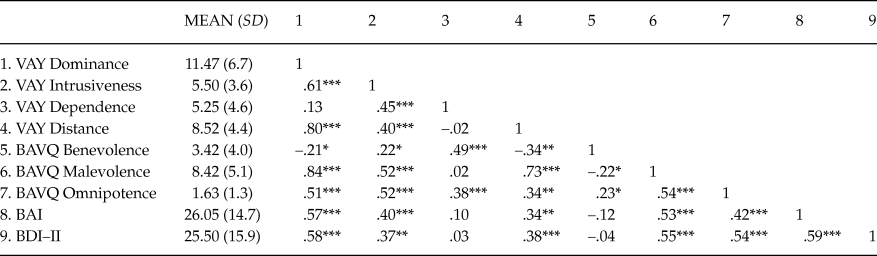
Table 1 shows the means and standard deviations for the variables of interest for testing our hypotheses: the VAY subscales, the BAVQ belief subscales, the BAI and the BDI-II. The bivariate correlations between those scales are also shown.
Bivariate correlations of the VAY and BAVQ subscales, total scores on BAI and BDI-II

*** p < .001
** p < .01
* p < .05.
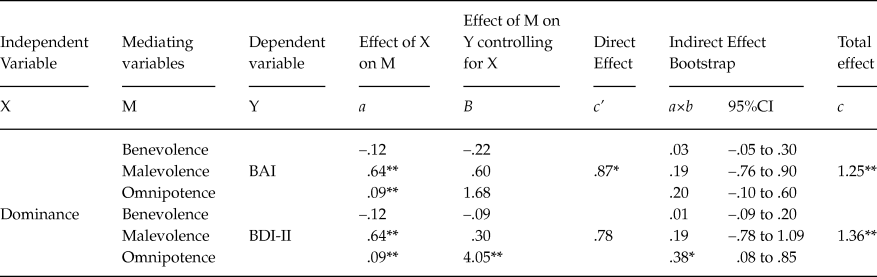
Table 2 summarizes the multiple mediation model in which the independent variable was the VAY Dominance subscale and the dependent variables were the scores on the BAI and the BDI-II. This table shows a significant direct effect between the VAY Dominance subscale and the scores on the BAI (c’ = .87, p < .05), and a significant indirect effect between the VAY Dominance and BDI-II (axb = 0.38, 95% CI: .08 to .85, p < .05), showing full mediation of the BAVQ omnipotence subscale between VAY dominance and BDI-II, explaining 42% of the variance in BDI-II scores.
Summary of the multiple mediation model in which the dependent variables are the scores on the BAI and BDI-II, and the independent variable is the VAY dominance subscale, and the mediating variables are the BAVQ benevolence, malevolence and omnipotence subscales

Note: N = 60. The data are expressed in non-standardized β coefficients based on 5000 bootstraps. a = effect of VAY Dominance on the BAVQ subscales, b = effect of BAVQ subscales on BAI and BDI-II scores, c’ = direct effect; a×b = indirect effect; CI = confidence interval; c = total effect.
* p < .05
** p < .01.
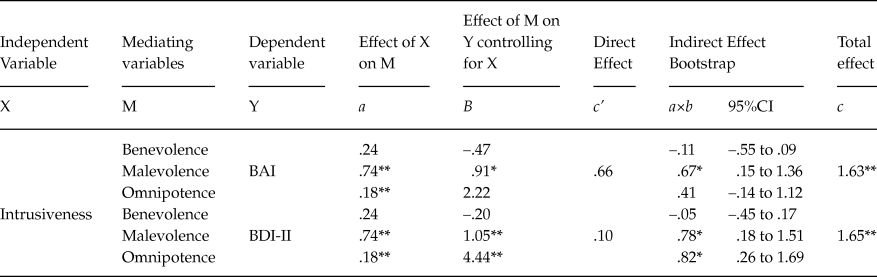
Table 3 shows a summary of the multiple mediation model in which the independent variable is the VAY Intrusiveness subscale. A significant indirect effect between the VAY Intrusiveness and the BAI is observed (axb = .67, 95% CI: .15 to 1.36, p < .05), in which the BAVQ malevolence subscale showed full mediation, explaining 33% of the variance in the BAI scores. We also found a significant indirect effect between the VAY Intrusiveness and the BDI-II for Malevolence (axb = .78, 95% CI: .18 to 1.51, p < .05), and Omnipotence (axb = .82, 95% CI: .26 to 1.69, p < .05), so there is complete mediation by both the BAVQ subscales between VAY Intrusiveness and the BDI-II, explaining 39% of the variance in scores on this scale.
Summary of the multiple mediation model in which the dependent variables are the scores on the BAI and BDI-II, and the independent variable is the VAY Intrusiveness subscale, and the mediating variables are the BAVQ benevolence, malevolence and omnipotence subscales

Note: N = 60. The data are expressed in non-standardized β coefficients based on 5000 bootstraps. a = effect of VAY Intrusiveness on the BAVQ subscales, b = effect of BAVQ subscales on BAI and BDI-II scores, c’ = direct effect; a×b = indirect effect; CI = confidence interval; c = total effect.
* p < .05
** p < .01.
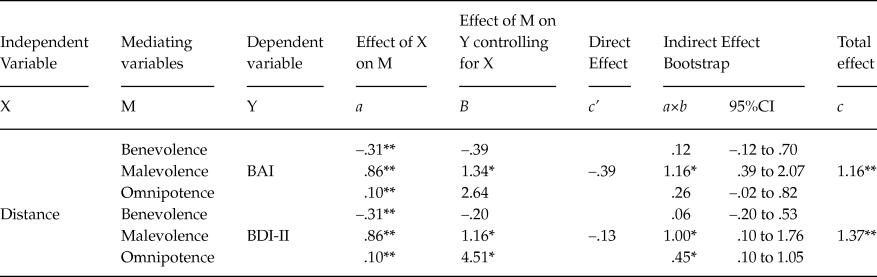
Finally, Table 4 shows a summary of the multiple mediation model in which the independent variable is the VAY Distance subscale. A significant indirect effect is observed between this subscale and the BAI (axb = 1.16, 95% CI: .39 to 2.07, p < .05), in which the BAVQ malevolence subscale functions as a complete mediator, explaining 32% of the variance in the BAI scores. We also found a significant indirect effect between the VAY distance and the BDI-II for malevolence (axb = 1.00, 95% CI: .10 to 1.76, p < .05), and omnipotence (axb = .45, 95% CI: .10 to 1.05, p < .05), so there is full mediation by both the BAVQ subscales between the VAY distance and the BDI-II explaining 34% of the variance in the scores on this scale.
Summary of the multiple mediation model in which the dependent variables are the scores on the BAI and BDI-II, and the independent variable is the VAY Distance subscale, and the mediating variables are the BAVQ benevolence, malevolence and omnipotence subscales

Note: N = 60. The data are expressed in non-standardized β coefficients based on 5000 bootstraps. a = effect of VAY Distance on the BAVQ subscales, b = effect of BAVQ subscales on BAI and BDI-II scores, c’ = direct effect; a×b = indirect effect; CI = confidence interval; c = total effect.
* p < .05
** p < .01.
Discussion
In this article, we have attempted to widen the body of knowledge on auditory verbal hallucinations from an interpersonal perspective (for a review see Hayward, Berry, & Ashton, Reference Hayward, Berry and Ashton2011; Paulik, Reference Paulik2012). As shown by Hayward, Berry, McCarthy-Jones, Strauss, and Thomas (Reference Hayward, Berry, McCarthy-Jones, Strauss and Thomas2014), a possible application of interpersonal models to the study of auditory verbal hallucinations is in understanding the emotional response and adaptation of the person to the voices. This was precisely the purpose of this study.
In regard to our first hypothesis, we found that perceiving the voices as very dominant and intrusive and from a position of distance is associated positively with high levels of anxiety and depression. These results are consistent with those of Vaughan and Fowler (Reference Vaughan and Fowler2004), in which the level of emotional distress of the person who hears voices was found to be associated with a relationship of voice superiority, and another based on distance. Sorrell et al. (Reference Sorrell, Hayward and Meddings2010), using the VAY, also found that the distress caused by the voices was associated with the dominance and distance scales.
In regard to the second hypothesis, based on the study by Hayward et al. (Reference Hayward, Denney, Vaughan and Fowler2008), we expected to find a negative association between a relationship of dependence on the voices and negative affect. However, we did not find such a negative association, our results being consistent with those described by Sorrell et al. (Reference Sorrell, Hayward and Meddings2010), in which no significant association was found between those two variables either, indicating that they are independent of each other. Therefore, a style of relationship with the voices based on dependence does not protect a person from experiencing distress and negative affect.
Finally, our third hypothesis, suggests that the relationship between the relationship with voices variable and negative affect is not direct, but mediated by the beliefs of malevolence and omnipotence about the voices. Our results support this hypothesis, showing with the VAY Intrusiveness and Distance subscales that beliefs about malevolent intentions of the voices mediate the relationship with both anxiety and depression in individuals with voices. But moreover, beliefs about omnipotence of the voices mediate specifically between the three VAY subscales (Dominance, Intrusiveness and Distance) and depression. However, the relationship between VAY Dominance and anxiety is direct and not mediated by beliefs.
We think these results are theoretically consistent and in line with those found by Sorrell et al. (Reference Sorrell, Hayward and Meddings2010), but with regard to negative affect in general and not specific distress caused by the voices. In this sense, the relating style could cause distress in the person as long he maintains negative beliefs about his voices. It is interesting to see how beliefs in omnipotence are more associated with mediation between relating style and depression. This could be explained by the state of defenselessness in which the person finds himself if he believes that the voices are powerful and control events and situations that could occur in his immediate surroundings. The logical response for such persons might be to unsuccessful tempts at distancing and result in feeling of helplessness, hopelessness and depression. Furthermore, this result is also consistent with what we found with regard to the mediating role of malevolent beliefs between the relating style and anxiety, since obviously, if the person thinks he is being pursued or is worried about harm that the voices could do to him, the logical consequence is high levels of anxiety, and therefore, would perceive them as distressful and intrusive and would also try to stay away from them. The perception of a voice as having only malevolent intent may not be associated with such a state of defencelessness, but merely a sense of threat.
With regard to the clinical applications based on these results, one formulation of distress that a patient with voices suffers from could be to consider the beliefs about the voices on one hand and the relating style on the other. With respect to the first, our results show that the relating style is not directly associated with distress, but is mediated by these beliefs. This means that for distress to occur, the person has to negatively value his relationship with the voices. If this does not occur, it is probably less likely that he will feel bad and be affected by them. This is clearly seen in the results with individuals with voices who do not have any psychiatric disorder. Sorrell et al. (Reference Sorrell, Hayward and Meddings2010), for example, found that in this population the subjects usually had a relationship of dependence and closeness with the voices, and this relating style was associated with benevolent beliefs about them. In this context, suffering and distress were very low. Therefore, the therapeutic work with patients with voices must address identification and intervention in those beliefs and evaluations the person has about his relationship with his voices. In this sense, one line of intervention is the one proposed by Birchwood et al. (Reference Birchwood, Gilbert, Gilbert, Trower, Meaden, Hay and Miles2004) with Cognitive Therapy for Command Hallucinations (CTCH). CTCH is based on the perception that superiority and power of the voices reflects the person’s evaluation of its status or social ranking, so the purpose of intervention is to reduce voice-related distress by altering the balance of power between the person and his voices, increasing the person’s power. To do this, the CTCH incorporates working with individuals’ core schema or beliefs which are most likely to give rise to and reinforce negative self-beliefs, beliefs about voices and beliefs about others in the external social world.
For the second, another form of intervention would be to integrate the cognitive work with beliefs and directly modify the person’s relationship with his voices (and with his peers, especially figures of power). In this sense, a very useful resource could be the Relational Therapy developed by Hayward (Paulik, Hayward, & Birchwood, Reference Paulik, Hayward and Birchwood2013). In this type of approach, work is with the beliefs about omnipotence of the voices, and the person is shown that distancing himself from them is not a resource that helps face the voices, but entirely the opposite, increasing distress. He is therefore trained to relate assertively with his voices and also with people in his social world.
Another direction would be to intervene in beliefs from their acceptance. For this, strategies based on a combination of Cognitive Therapy and mindfulness could be of great interest, as in Person-Based Cognitive Therapy (Chadwick, Reference Chadwick2006; Dannahy et al., Reference Dannahy, Hayward, Strauss, Turton, Harding and Chadwick2011). Mindfulness involves developing a relationship with current experience – thoughts, feelings, bodily sensations, voices – in which one brings full awareness to experience and begins to let go of judging these experiences. Typically this ability is achieved through mindfulness meditation practice, in which participants practice paying attention to but not automatically responding to experiences.
Our study has a series of limitations. Among them we should mention that we used a correlational design, and so no causality relationships can be established among the variables, and the conclusions of this study should therefore be taken with caution. Furthermore, in the version of the BAVQ validated for the Spanish population, although it uses a four-point Likert scale (as did the English version by Chadwick et al., Reference Chadwick, Lees and Birchwood2000) as the measure of response, the Omnipotence subscale has only one item, which could affect the validity of our results with respect to that subscale. Finally, the sample size is also a limitation. It would be desirable to achieve larger samples for better statistical power, but the prevalence of patients with voices is low, and their willingness to cooperate in such studies is also low, making it costly and difficult to find samples like the one we have used in this study.