Introduction
Cancer-related fatigue is the most frequently reported and distressing symptom in patients with breast cancer (Mortimer et al. Reference Mortimer, Barsevick, Bennett, Berger, Cleeland, DeVader, Escalante, Gilreath, Hurria, Mendoza and Rugo2010). Breast cancer patients suffer from fatigue not only during cancer diagnosis and treatment, but also months and years after successful completion of therapy (Minton & Stone, Reference Minton and Stone2008; Berger et al. Reference Berger, Gerber and Mayer2012). Evidence has shown that 50% to 90% of breast cancer patients experience fatigue during treatment (de Jong et al. Reference de Jong, Candel, Schouten, Abu-Saad and Courtens2004), whereas up to one-third of breast cancer patients experience significant symptoms of fatigue after treatment completion (Bower et al. Reference Bower, Ganz, Desmond, Rowland, Meyerowitz and Belin2000). Fatigue has a negative impact on the quality of life (Bower et al. Reference Bower, Ganz, Desmond, Rowland, Meyerowitz and Belin2000) and additionally contributes to higher risk of recurrence and lower survival rates (Groenvold et al. Reference Groenvold, Petersen, Idler, Bjorner, Fayers and Mouridsen2007; Groenvold, Reference Groenvold2010). Thus, further understanding the mechanisms of cancer-related fatigue may lead to better treatment and prevention of this often disabling symptom.
Studies have suggested that several psychosocial factors significantly contribute to the development of fatigue in breast cancer patients, including depressive symptoms, sleep problems and perceived stress (Bower, Reference Bower2008; Aboalela et al. Reference Aboalela, Lyon, Elswick, Kelly, Brumelle, Bear and Jackson-Cook2015). Like fatigue, these psychosocial problems are common among breast cancer survivors. For instance, a recent systematic review reported that the frequency of depressive symptoms ranges from 9.4 to 66.1% among breast cancer survivors (Maass et al. Reference Maass, Roorda, Berendsen, Verhaak and de Bock2015). In addition, two large clinical studies demonstrated that approximately 60% of breast cancer women experience significant problems with sleep (Janz et al. Reference Janz, Mujahid, Chung, Lantz, Hawley, Morrow, Schwartz and Katz2007; Yoon et al. Reference Yoon, Malin, Tao, Tisnado, Adams, Timmer, Ganz and Kahn2008). Studies have also indicated that approximately half of breast cancer patients suffer from significant psychological stress related to cancer and its treatment (Matchim et al. Reference Matchim, Armer and Stewart2011). All of these psychosocial variables have been connected to lower quality of life and poor health-related outcomes (Karvinen et al. Reference Karvinen, Murray, Arastu and Allison2013; Palesh et al. Reference Palesh, Aldridge-Gerry, Ulusakarya, Ortiz-Tudela, Capuron and Innominato2013; Mausbach et al. Reference Mausbach, Schwab and Irwin2015). Nevertheless, although depressive symptoms, sleep problems and stress are linked to fatigue, their interrelationship is unclear.
Studies of symptom clusters, a group of at least two or three symptoms that are associated with one another (Kim et al. Reference Kim, McGuire, Tulman and Barsevick2005), have indicated that symptoms of depression, sleep problems and fatigue commonly occur together as a cluster in patients with various cancer diagnoses including breast cancer (Barsevick, Reference Barsevick2007; Xiao, Reference Xiao2010). In attempts to disentangle these interrelationships, studies have conducted mediation analyses in cross-sectional studies and have used longitudinal designs. At least one cross-sectional study has found that sleep problems mediated the relationship between depressive symptoms and fatigue (Banthia et al. Reference Banthia, Malcarne, Ko, Varni and Sadler2009), whereas another cross-sectional study showed that symptoms of depression mediated the influence of sleep problems on fatigue (Huang & Lin, Reference Huang and Lin2009). A study using a longitudinal design found that sleep problems were associated with subsequent fatigue changes, which were associated with subsequent changes in depressive symptoms (Jim et al. Reference Jim, Jacobsen, Phillips, Wenham, Roberts and Small2013). Clearly, identifying how these symptoms ultimately interact to have an impact on fatigue will inform treatment and prevention.
Inflammation has been proposed as a potential biological contributor to fatigue. A growing literature has suggested that inflammation, as represented by peripheral blood concentrations of immune markers including interleukin (IL)-6, IL-1 receptor antagonist (IL-1ra), soluble tumor necrosis factor receptor-2 (sTNFR2) and C-reactive protein (CRP), is a significant risk factor of fatigue before, during and after cancer treatment (Bower et al. Reference Bower, Ganz, Irwin, Kwan, Breen and Cole2011; Orre et al. Reference Orre, Reinertsen, Aukrust, Dahl, Fossa, Ueland and Murison2011; Alfano et al. Reference Alfano, Imayama, Neuhouser, Kiecolt-Glaser, Smith, Meeske, McTiernan, Bernstein, Baumgartner, Ulrich and Ballard-Barbash2012; Torres et al. Reference Torres, Pace, Liu, Felger, Mister, Doho, Kohn, Barsevick, Long and Miller2013; Xiao et al. Reference Xiao, Beitler, Higgins, Conneely, Dwivedi, Felger, Wommack, Shin, Saba, Ong, Kowalski, Bruner and Miller2016), even though mixed results exist (Schubert et al. Reference Schubert, Hong, Natarajan, Mills and Dimsdale2007). Evidence has also indicated that inflammation is associated with other biopsychosocial problems in cancer patients such as depressive symptoms (Torres et al. Reference Torres, Pace, Liu, Felger, Mister, Doho, Kohn, Barsevick, Long and Miller2013; Bouchard et al. Reference Bouchard, Antoni, Blomberg, Stagl, Gudenkauf, Jutagir, Diaz, Lechner, Gluck, Derhagopian and Carver2016; Xiao et al. Reference Xiao, Beitler, Higgins, Conneely, Dwivedi, Felger, Wommack, Shin, Saba, Ong, Kowalski, Bruner and Miller2016), sleep problems (Rogers et al. Reference Rogers, Fogleman, Trammell, Hopkins-Price, Spenner, Vicari, Rao, Courneya, Hoelzer, Robbs and Verhulst2015) and stress (Han et al. Reference Han, Felger, Lee, Mister, Miller and Torres2016). Thus, it is possible that inflammation's association with depressive symptoms, sleep problems and stress can lead to the development of fatigue. In order to identify the significant and meaningful contributors to fatigue, it is important to disentangle the associations among these biopsychosocial variables to ultimately identify which factors are most relevant for management of this symptom.
To explore psychosocial and inflammatory factors associated with fatigue in women with breast cancer, we conducted a cross-sectional study at 1 year after the completion of radiotherapy. Ionizing radiation has been shown to induce an inflammatory response in cells of the innate immune system (Lorimore et al. Reference Lorimore, Coates, Scobie, Milne and Wright2001), and can lead to chronic inflammation through tissue damage and destruction (Formenti & Demaria, Reference Formenti and Demaria2009). Moreover, radiation therapy has been associated with various psychosocial changes, including depressive symptoms, sleep problems, and stress as well as fatigue (Bower, Reference Bower2008; Wang et al. Reference Wang, Shi, Williams, Mao, Cleeland, Komaki, Mobley and Liao2010; Xiao et al. Reference Xiao, Beitler, Higgins, Conneely, Dwivedi, Felger, Wommack, Shin, Saba, Ong, Kowalski, Bruner and Miller2016). The primary objective was to identify the significant risk factors of persistent fatigue at 1 year post-radiation treatment. Additionally, we applied post-hoc analysis for mediation models to examine the interrelationship among fatigue, depressive symptoms, sleep problems, stress and inflammation.
Method
Study design
Subjects were recruited from the Emory University Department of Radiation Oncology from March 2010 to March 2013. After undergoing breast surgery, stage 0–III breast cancer patients who received whole breast radiotherapy were approached for enrollment. All patients were treated with 50 Gy followed by a 10–16 Gy boost given in 2 Gy fractions with 6-megavoltage (MV) photons and/or 18-MV photons using a standard tangential field-in-field technique to promote dose homogeneity. Endocrine therapy was prescribed to patients who were hormone receptor positive and was not initiated until after radiotherapy completion. Some patients also received neo-adjuvant or adjuvant chemotherapy that was completed before radiation treatment. Patients were excluded for co-morbid conditions including uncontrolled cardiovascular, metabolic, pulmonary or renal disease, pregnancy, and history of major psychiatric disorder, such as schizophrenia, bipolar disorder, or substance abuse/dependence as determined by a semi-standardized interview. Patients were assessed at 1 year post-radiotherapy.
All enrolled subjects provided written informed consent, and all study procedures were a priori approved by the Emory University Institutional Review Board.
Psychosocial variables
Fatigue
The Multidimensional Fatigue Inventory (MFI)-20 was used as the primary outcome measure for fatigue. The MFI is a 20-item self-report instrument with five dimensions: general fatigue, physical fatigue, mental fatigue, reduced motivation, and reduced activity (Smets et al. Reference Smets, Garssen, Bonke and De Haes1995). Each dimension includes four items on a one- to five-point scale, and the score for each dimension is the sum of the four items. The total score of the MFI is the sum of the five dimensions, ranging from 20 to 100 (higher scores indicating more fatigue) and was used as the primary dependent variable for analysis in this study. The MFI-20 has well-established validity and reliability (α = 0.84) in cancer patients receiving radiation therapy (Smets et al. Reference Smets, Garssen, Bonke and De Haes1995; Schubert et al. Reference Schubert, Hong, Natarajan, Mills and Dimsdale2007), including breast cancer patients (Torres et al. Reference Torres, Pace, Liu, Felger, Mister, Doho, Kohn, Barsevick, Long and Miller2013). Additionally, a single-item questionnaire (ranged from 0 to 10) was administrated according to National Comprehensive Cancer Network (NCCN) guideline version 2.2015 Cancer-Related Fatigue to capture different levels of fatigue: 0–3, none-mild; 4–6, moderate; 7–10, severe (National Comprehensive Cancer Network, 2015).
Depressive symptoms
Depressive symptom severity was assessed by the Inventory of Depressive Symptomatology Self-Reported (IDS-SR) (Trivedi et al. Reference Trivedi, Rush, Ibrahim, Carmody, Biggs, Suppes, Crismon, Shores-Wilson, Toprac, Dennehy, Witte and Kashner2004). The IDS-SR has 30 items that include all nine criterion symptoms for major depressive disorder (MDD), commonly associated symptoms for MDD, and melancholic and atypical symptom features according to the Diagnostic and Statistical Manual of Mental Disorders, fourth edition (DSM-IV). Each item is scored on a zero- to three-point scale. The total score is the sum of the items with higher scores indicating more severe depressive symptoms. A score of more than 33 points indicates moderate-to-severe depressive symptoms. The IDS-SR has well-established validity and reliability in various populations including cancer patients (Jenkins et al. Reference Jenkins, Carmody and Rush1998).
Sleep problems
The Pittsburgh Sleep Quality Index (PSQI) was used to assess subjective sleep quality and disturbance over the prior month (Buysse et al. Reference Buysse, Reynolds, Monk, Berman and Kupfer1989; Liu et al. Reference Liu, Fiorentino, Natarajan, Parker, Mills, Sadler, Dimsdale, Rissling, He and Ancoli-Israel2009). The PSQI contains 15 multiple-choice items and four write-in items, which generate scores for seven subscales: duration of sleep, sleep disturbance, sleep latency, day dysfunction due to sleepiness, sleep efficiency, overall sleep quality, and medications for sleep. The score for each subscale ranges from 0 (no difficulty) to 3 (severe difficulty). The seven subscale scores are summed to produce a global score ranging from 0 to 21. A PSQI global score greater than 5 is considered to be suggestive of significant sleep disturbance (Buysse et al. Reference Buysse, Reynolds, Monk, Berman and Kupfer1989).
Stress
The Perceived Stress Scale (PSS) is one of the most widely used instruments to assess stress and has been previously used in patients with breast cancer (Winzelberg et al. Reference Winzelberg, Classen, Alpers, Roberts, Koopman, Adams, Ernst, Dev and Taylor2003; Golden-Kreutz et al. Reference Golden-Kreutz, Thornton, Wells-Di Gregorio, Frierson, Jim, Carpenter, Shelby and Andersen2005; Torres et al. Reference Torres, Pace, Liu, Felger, Mister, Doho, Kohn, Barsevick, Long and Miller2013). The PSS is a well-verified questionnaire for measuring non-specific perceived stress that exceeds a person's coping abilities over the past month (Cohen et al. Reference Cohen, Kamarck and Mermelstein1983). A total of 10 items is included in the PSS, and each item is scored by using a five-point Likert scale ranging from 0 to 4: 0 representing never and 4 representing very often. Higher scores reflect greater perceived stress.
Demographic and clinical variables
Demographic and clinical characteristics, including age, body mass index (BMI), race, marital status, smoking history, menopause status, and cancer stage, chemotherapy, hormone therapy, and herceptin treatment, were recorded through chart review to determine their potential impact on fatigue (Barnes et al. Reference Barnes, Flanagan, Brown, Robinson, Brown, McClure, Oxenius, Collier, Weber, Gunthard, Hirschel, Fidler, Phillips and Frater2010).
Laboratory measures
Whole blood drawn after an overnight fast was collected into chilled ethylenediaminetetraacetic acid (EDTA) tubes for the isolation of plasma. Plasma was separated by centrifugation at 1000 g for 10 min at 4°C, and then aliquoted into siliconized polypropylene tubes and stored at −80°C until batched assay.
Immune markers
Immune markers were chosen on the basis of findings from previous research on fatigue and inflammation in cancer patients (Miller et al. Reference Miller, Ancoli-Israel, Bower, Capuron and Irwin2008; Reyes-Gibby et al. Reference Reyes-Gibby, Spitz, Yennurajalingam, Swartz, Gu, Wu, Bruera and Shete2009; Wang et al. Reference Wang, Shi, Williams, Mao, Cleeland, Komaki, Mobley and Liao2010; Lyon et al. Reference Lyon, McCain, Pickler, Munro and Elswick2011; Orre et al. Reference Orre, Reinertsen, Aukrust, Dahl, Fossa, Ueland and Murison2011). Plasma concentrations of the cytokines IL-1β, TNF, IL-10, IL-6 (Human High Sensitivity Cytokine Base Kit A) and their receptors IL-6 soluble receptor (IL-6sr), IL-1ra, sTNFR2 and monocyte chemoattractant protein-1 (Human Premixed Multi-Analyte Kit) were determined using a multiplex enzyme-linked immunosorbent assay (ELISA), according to the manufacturer's protocol (R & D Systems, USA). CRP was measured using standard turbidimetric assay techniques. Inter- and intra-coefficients of variation were reliably <10%. No immune markers were below the limits of assay detection.
Data analysis
Descriptive statistics were used for demographic and clinical variables (continuous variables: mean and standard deviation; categorical variables: frequency and percentages). Generalized linear regression models were employed to assess the impact of each inflammatory biomarker on fatigue (total MFI score) at 1 year post-radiotherapy. Other variables as risk factors included in these regression models included age, BMI, race (white v. non-white), marital status (married or living as married v. single, divorced/separated, or widowed), smoking history (yes v. no), menopause status (pre- v. peri/post-menopause), cancer stage (0 v. I/II v. III), chemotherapy (yes v. no), hormone therapy (yes v. no), herceptin treatment (yes v. no), depressive symptoms, sleep and perceived stress. Only variables (i.e. inflammatory biomarkers and other variables) that showed a significance level of 0.10 on bivariate analyses with fatigue were included in initial regression models. To determine the interrelationship among relevant risk factors, a mediation model using PROCESS SPSS was conducted to examine the association among depressive symptoms, sleep problems, stress, inflammation and fatigue (post-hoc data analysis). All analyses were conducted using SPSS 23 with a significance level of 0.05 and a two-tailed test.
Results
Patient characteristics
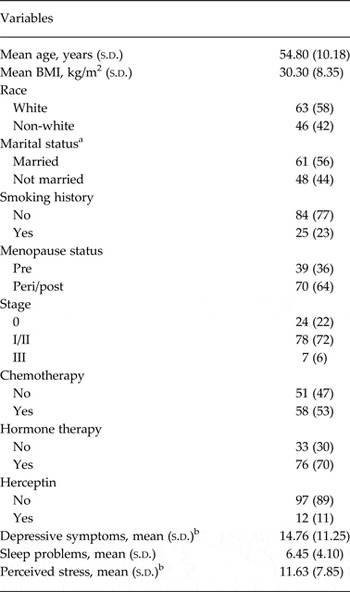
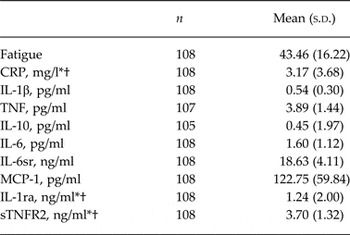
A total of 111 breast cancer survivors were enrolled in the study at 1 year post-radiotherapy. Three of these participants were excluded from data analysis because one of their immune markers was considered an outlier according to the Grubbs’ test. Demographic and clinical characteristics of these 108 survivors are listed in Table 1. The average age was 54.90 (s.d. = 10.19) years. The average BMI was 30.26 kg/m2, with 23% of participants having a BMI below 25 kg/m2, 36% having a BMI between 25 and 30 kg/m2, and 41% with a BMI above 30 kg/m2. Of the participants, 58% were white, 56% married (defined as married or living as married), and 77% without a smoking history. The majority of participants had stage I or II disease (72%), were receiving hormone therapy (70%) and were not on herceptin (89%). Of the participants, 58 (53%) received chemotherapy; among them, 34 received neo-adjuvant chemotherapy, and 24 received adjuvant chemotherapy. The average fatigue scores and inflammatory biomarker concentrations are displayed in Table 2. Overall, almost half of the participants (42%) were experiencing moderate to severe fatigue according to NCCN Guidelines version 2.2015 Cancer-Related Fatigue (National Comprehensive Cancer Network, 2015).
Demographic and clinical characteristics at 1 year post-radiotherapy (n = 108)

Data are given as number of participants (percentage) unless otherwise indicated.
s.d., Standard deviation; BMI, body mass index.
a ‘Married’ includes patients married or living as married; ‘not married’ includes patients single, separated, divorced or widowed.
b Have missing cases: depressive symptoms (one missing case); perceived stress (one missing case).
Fatigue and inflammatory biomarkers at 1 year post-radiotherapy

s.d., Standard deviation; CRP, C-reactive protein; IL, interleukin; TNF, tumor necrosis factor; IL-6sr, IL-6 soluble receptor; MCP-1, monocyte chemoattractant protein-1; IL-1ra, IL-1 receptor antagonist; sTNFR2, soluble tumor necrosis factor receptor 2.
* p < 0.05 for the bivariate associations between the inflammatory biomarker and fatigue.
† p < 0.1 for the bivariate associations between the inflammatory biomarker and fatigue.
Effects of psychosocial variables and inflammation on fatigue
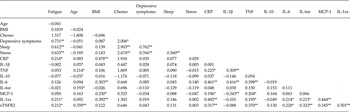
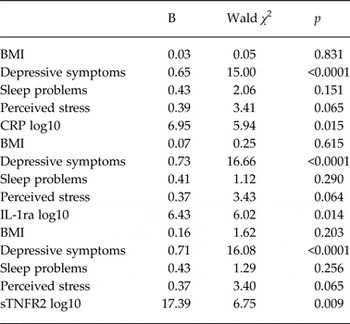
Among the nine inflammatory biomarkers, only CRP, IL-1ra and sTNFR2 showed a relationship with fatigue of p < 0.1, and were therefore entered into separate regression models as potential risk factors of fatigue. Among the 13 other variables, only BMI, depressive symptoms, sleep problems and perceived stress exhibited a relationship with fatigue of p < 0.1, and thus were entered into the final regression models as risk factors (Table 3). The results of the final regression models are depicted in Table 4. CRP, IL-1ra and sTNFR2 were significant risk factors of fatigue controlling for the other variables; the higher the inflammatory biomarkers, the greater the fatigue. Additionally, depressive symptoms were a consistent significant risk factor of fatigue in all models as demonstrated in Table 4; the higher the depression, the greater the fatigue. Although BMI, sleep problems and perceived stress were significant in bivariate associations with fatigue, they were not significant in the multivariate models. Similar results were found when the two fatigue-related items were removed from the IDS-SR depression scale. Of note, there was no significant relationship between fatigue and receipt of chemotherapy, or between inflammation and assessments of stress or sleep (Table 3).
Bivariate associations between key variables a

BMI, Body mass index; chemo, chemotherapy; CRP, C-reactive protein; IL, interleukin; TNF, tumor necrosis factor; IL-6sr, IL-6 soluble receptor; MCP-1, monocyte chemoattractant protein-1; IL-1ra, IL-1 receptor antagonist; sTNFR2, soluble tumor necrosis factor receptor 2.
a t Test was used for chemotherapy, and correlation coefficients were used for all other variables.
* p < 0.05, ** p < 0.01.
† p < 0.1 for the bivariate associations between fatigue and other variables.
Association between inflammatory biomarkers and fatigue at 1 year post-radiotherapy (n = 108)

BMI, Body mass index; CRP, C-reactive protein; IL-1ra, interleukin-1 receptor antagonist; sTNFRII, soluble tumor necrosis factor receptor 2.
Mediation models for the association among psychosocial variables, inflammation and fatigue
Bivariate association analyses showed that depressive symptoms, sleep problems and perceived stress were all significantly associated with fatigue, while the final regression models only demonstrated a significant effect of depressive symptoms. This finding suggested that depressive symptoms may be mediating the association between sleep problems/perceived stress and fatigue. Thus, we conducted post-hoc data analyses by generating mediation models to test the association between these psychosocial measures and fatigue. Tolerance and variance inflation factors of all risk factors in the final regression models varied between 0.25 and 0.99 and between 1.00 and 4.00, respectively, indicating that multicollinearity among risk factors did not bias the results.
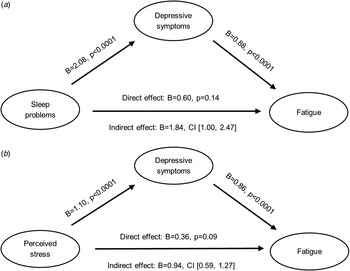
Fig. 1a and b show the findings of the mediation models for sleep problems and perceived stress, respectively. For both mediation models, depressive symptoms were the significant mediators for the association between sleep problems/perceived stress and fatigue (Sobel test: Zs = 5.37, p < 0.0001; Zs = 5.23, p < 0.0001, respectively). As Fig. 1a and b illustrate, the regression coefficient between sleep problems/perceived stress and depressive symptoms was statistically significant, as was the regression coefficient between depressive symptoms and fatigue. When depressive symptoms were not in the models, both sleep problems and perceived stress had a significant effect on fatigue (total effect: B = 2.43, p < 0.0001; B = 1.30, p < 0.0001). However, when depressive symptoms were in the models, both sleep problems and perceived stress demonstrated non-significant effects on fatigue (direct effect: B = 0.60, p = 0.14; B = 0.36, p = 0.09, respectively). The mediating effect of depression on both models was significant [indirect effect: B = 1.83, 95% confidence interval (CI) 1.00–2.47; B = 0.94, 95% CI 0.59–1.27, for sleep problems and perceived stress, respectively]. The effect sizes for both models were relatively large (κ 2 = 0.39, 95% CI 0.22–0.51; κ 2 = 0.38, 95% CI 0.23–0.50, respectively). In order to test whether other potential mediation models better explained the associations among these variables, we tested reverse mediation models with sleep problems and/or perceived stress being the mediator and depressive symptoms being the risk factor. Sobel tests for both mediation models were not significant (Zs = 1.48, p = 0.141; Zs = 1.69, p = 0.09, respectively, for sleep problems and perceived stress).
(a) Depressive symptoms mediated the association between sleep problems and fatigue (n = 107). (b) Depressive symptoms mediated the association between perceived stress and fatigue (n = 107). CI, 95% Confidence interval.

We also tested the mediation effect of inflammation in these models. The inflammatory biomarkers did not show any significant mediating effect on the association between sleep problems or perceived stress and fatigue. Similar results were found when we removed the two fatigue-related items from the IDS-SR depression scale.
Discussion
Our study confirms that at 1 year post-radiotherapy, breast cancer patients exhibit high rates of fatigue according to NCCN guidelines. Fatigue severity was also independently associated with depressive symptom severity and plasma immune markers, specifically, CRP, IL-1ra and sTNFR2. We further found that depressive symptom severity mediated the association between fatigue and sleep problems as well as perceived stress, while inflammation had no effect on these associations. This mediation effect may help explain the complex association among fatigue, depressive symptoms and sleep problems, which have been frequently identified as a symptom cluster in cancer populations without a clear understanding of the associations involved. These data also suggest independent psychosocial and biological pathways to fatigue that can be specifically targeted as part of the treatment and prevention of this symptom.
Effects of psychosocial variables and inflammation on fatigue
Similar findings of an independent effect of inflammation and depressive symptoms on fatigue have been found in breast cancer patients before chemotherapy (Pertl et al. Reference Pertl, Hevey, Boyle, Hughes, Collier, O'Dwyer, Harkin, Kennedy and Connor2013) as well as up to 4 years post-cancer diagnosis (Orre et al. Reference Orre, Reinertsen, Aukrust, Dahl, Fossa, Ueland and Murison2011). However, while these studies solely identified CRP as the immune marker of relevance, our study demonstrated not only CRP but also other inflammatory biomarkers were associated with fatigue including IL-1ra and sTNFR2, which have been associated with fatigue in other studies of breast cancer survivors (Bower et al. Reference Bower, Ganz, Irwin, Kwan, Breen and Cole2011).
As the pathophysiology of depressive symptoms and fatigue is beginning to be revealed, more research is warranted to determine how inflammation leads to different symptom presentations such as depressive symptoms and fatigue. One possibility is that there are different genetic vulnerabilities to the development of specific symptoms. For instance, Bower et al. (Reference Bower, Ganz, Irwin, Castellon, Arevalo and Cole2013) found that single nucleotide polymorphisms (SNPs) of TNF-308 and IL-6-174 were associated with fatigue, while only IL-6-174 was associated with depressive symptoms, and none of these was associated with sleep problems. Another possibility is related to different effects of inflammation on the brain as it relates to the development of symptoms. For example, studies have suggested that inflammation effects on the basal ganglia are most relevant to symptoms of fatigue compared with other cognitive symptoms of depression (Capuron et al. Reference Capuron, Pagnoni, Drake, Woolwine, Spivey, Crowe, Votaw, Goodman and Miller2012; Schaefer et al. Reference Schaefer, Capuron, Friebe, Diez-Quevedo, Robaeys, Neri, Foster, Kautz, Forton and Pariante2012).
Depressive symptoms and fatigue
Women with higher depressive symptom scores were more likely to experience severe fatigue. Although our data showed that only 8% breast cancer patients experienced moderate to severe depressive symptoms, the severity of the depressive symptoms was still a significant risk factor of fatigue that was reported at a moderate to severe level in 42% of our patients. This finding is consistent with previous literature (Ho et al. Reference Ho, Rohan, Parent, Tager and McKinley2015; Xiao et al. Reference Xiao, Beitler, Higgins, Conneely, Dwivedi, Felger, Wommack, Shin, Saba, Ong, Kowalski, Bruner and Miller2016), including our previous study on breast cancer patients undergoing radiotherapy (Torres et al. Reference Torres, Pace, Liu, Felger, Mister, Doho, Kohn, Barsevick, Long and Miller2013). American Diagnostic and Statistical Manual of Mental Disorders (American Psychiatric Association, 1994) also supports the positive association between depression and fatigue by stating that fatigue is a symptom of MDD. However, both depression and fatigue can be distinct symptoms in cancer populations, because they have different trajectories during cancer diagnosis, its treatment and survival phases (Visser & Smets, Reference Visser and Smets1998; Torres et al. Reference Torres, Pace, Liu, Felger, Mister, Doho, Kohn, Barsevick, Long and Miller2013; Schmidt et al. Reference Schmidt, Meynkohn, Habermann, Wiskemann, Oelmann, Hof, Wessels, Klassen, Debus, Potthoff, Steindorf and Ulrich2016). In addition, the fact that certain treatment strategies may only be effective for one of these two symptoms (Jain et al. Reference Jain, Boyd, Fiorentino, Khorsan and Crawford2015; Schmidt et al. Reference Schmidt, Meynkohn, Habermann, Wiskemann, Oelmann, Hof, Wessels, Klassen, Debus, Potthoff, Steindorf and Ulrich2016) further supports that they are distinct. For instance, the antidepressant, paroxetine, was shown to be effective for depressive symptoms but not fatigue in cancer patients (Morrow et al. Reference Morrow, Hickok, Roscoe, Raubertas, Andrews, Flynn, Hynes, Banerjee, Kirshner and King2003).
Inflammation and fatigue
Increasing evidence has shown positive associations between inflammation and fatigue (Schubert et al. Reference Schubert, Hong, Natarajan, Mills and Dimsdale2007; Bower et al. Reference Bower, Ganz, Irwin, Kwan, Breen and Cole2011; Liu et al. Reference Liu, Mills, Rissling, Fiorentino, Natarajan, Dimsdale, Sadler, Parker and Ancoli-Israel2012); however, discrepancies have been observed and which inflammatory biomarkers are most relevant has yet to be established (Schubert et al. Reference Schubert, Hong, Natarajan, Mills and Dimsdale2007). In line with many other studies (Schubert et al. Reference Schubert, Hong, Natarajan, Mills and Dimsdale2007; Bower et al. Reference Bower, Ganz, Irwin, Kwan, Breen and Cole2011; Xiao et al. Reference Xiao, Beitler, Higgins, Conneely, Dwivedi, Felger, Wommack, Shin, Saba, Ong, Kowalski, Bruner and Miller2016), we found that increased CRP, IL-1ra and sTNFR2 levels were significantly associated with increased fatigue. Our study used a multiplex ELISA to test multiple cytokines and their receptors simultaneously. Thus, the significant findings related to CRP, IL-1ra and sTNFR2 indicate that these three inflammatory biomarkers may be more sensitive to cancer-related fatigue, compared with other inflammatory biomarkers in our panels. However, caution needs to be taken because different inflammatory biomarkers could be more relevant at some but not other points during cancer and its treatment trajectory.
The significant association between inflammation and fatigue at 1 year post-radiotherapy indicates that persistent inflammation secondary to cancer and its treatment exists, and consequently leads to fatigue at a long-term follow-up. Nevertheless, the underlying biological mechanisms of persistent inflammation and fatigue are still poorly understood. One potential explanation is that cancer and its treatment might induce epigenetic changes. For example, evidence has shown that DNA methylation changes in certain CpG sites correlated with both increased sTNFR2 and IL-6 in breast cancer patients during the acute phase of chemoradiotherapy (Smith et al. Reference Smith, Conneely, Pace, Mister, Felger, Kilaru, Akel, Vertino, Miller and Torres2014). sTNFR2 and IL-6 were in turn found to correlate with fatigue. Although a direct association between methylation changes and fatigue has yet to be established, this finding provides insight into future studies examining the association between epigenetic changes, inflammation and fatigue at long-term follow-up.
Mediation models for the association among psychosocial variables, inflammation and fatigue
Bivariate association analyses in our data demonstrated positive associations of sleep problems and perceived stress with fatigue. However, these significant associations disappeared once depressive symptoms were introduced into the models. Further Sobel tests or bootstrap analyses showed a significant mediating effect of depressive symptoms on these associations. A similar mediating effect of depressive symptoms on the relationship between sleep problems and fatigue has also been reported (Huang & Lin, Reference Huang and Lin2009). These findings indicate that depressive symptoms not only have a direct impact on fatigue, but also indirectly influence fatigue through sleep problems and perceived stress. This mediating effect helps explain the complex relationship among fatigue, depressive symptoms and sleep problems, which represents a frequently identified symptom cluster in various cancer populations (Illi et al. Reference Illi, Miaskowski, Cooper, Levine, Dunn, West, Dodd, Dhruva, Paul, Baggott, Cataldo, Langford, Schmidt and Aouizerat2012; Doong et al. Reference Doong, Dhruva, Dunn, West, Paul, Cooper, Elboim, Abrams, Merriman, Langford, Leutwyler, Baggott, Kober, Aouizerat and Miaskowski2015; Jain et al. Reference Jain, Boyd, Fiorentino, Khorsan and Crawford2015; Ho et al. Reference Ho, Rohan, Parent, Tager and McKinley2015). Moreover, the mediating effects suggest that interventions for fatigue may be more efficient when considering other symptoms such as stress and sleep problems in addition to depressive symptoms.
Our data did not show a significant mediating effect of inflammation on the association between sleep problems and perceived stress and fatigue. The findings were observed whether we entered depressive symptoms and inflammation as the mediators together or separately into the mediation models. Further data analyses showed that both sleep problems and perceived stress were not significantly associated with inflammatory biomarkers. Similar negative findings have also been reported (Keefer et al. Reference Keefer, Keshavarzian and Mutlu2008; Bower et al. Reference Bower, Ganz, Irwin, Kwan, Breen and Cole2011). Taken together, these results suggest that fatigue, sleep problems and perceived stress do not share common biological mechanisms related to inflammation, as has been hypothesized by previous studies on symptom clusters (Illi et al. Reference Illi, Miaskowski, Cooper, Levine, Dunn, West, Dodd, Dhruva, Paul, Baggott, Cataldo, Langford, Schmidt and Aouizerat2012; Doong et al. Reference Doong, Dhruva, Dunn, West, Paul, Cooper, Elboim, Abrams, Merriman, Langford, Leutwyler, Baggott, Kober, Aouizerat and Miaskowski2015). Future studies examining distinct and/or common mechanisms of these symptoms are warranted.
Conclusions
Despite growing interest in the role of multiple psychosocial factors and inflammation in fatigue in cancer populations, few studies have comprehensively examined the interrelationship among depressive symptoms, sleep problems, stress and inflammation as they relate to fatigue in cancer patients. The current findings confirm the high rate of fatigue at 1 year post-radiotherapy and suggest that depressive symptoms and inflammation are independent risk factors of fatigue. Although sleep problems and perceived stress are not directly associated with fatigue, they show an indirect impact on fatigue mediated by depressive symptoms and not inflammation. Our data also indicate that fatigue, depressive symptoms, sleep problems and perceived stress may not share common biological mechanisms related to inflammation. However, our conclusions need to be taken with caution because of the cross-sectional design, which does not provide sufficient control of baseline inflammation and psychosocial measures. The non-significant results for the association between depressive symptoms/sleep problems/perceived stress and inflammation might be due to the possibility that our population did not meet diagnostic criteria for MDD or sleep disorder, and the stress may not be intense enough at 1 year post-radiotherapy. Overall, future longitudinal studies are needed to verify our findings, and targeted interventions will benefit from further understanding of unique and common biological and psychosocial mechanisms of fatigue.
Acknowledgements
This work was supported by National Institutes of Health (NIH), National Cancer Institute (NCI) grants R21 CA155511 and P30CA138292.
Declaration of Interest
None.