In December 1981 three papers in the New England Journal of Medicine Reference Gottlieb, Schroff and Schanker1,Reference Masur, Michelis and Greene2,Reference Siegal, Lopez and Hammer3 described a newly recognized human disease now known as the acquired immunodeficiency syndrome (AIDS). In May 1983 two papers in Science attributed this syndrome to a virus Reference Gallo, Sarin and Gelmann4,Reference Barre-Sinoussi, Chermann and Rey5 now known as the human immunodeficiency virus type 1 (HIV-1). AIDS was unlike any other human disease in recorded history, and the communities it decimated did not feel afflicted by chance alone. AIDS did not seem natural, and some observers doubted that it was. Suspicions arose, and theories followed with typical elements similar enough to suggest common beginnings, but the earliest chronology has remained vague and the first theorist unidentified.
In July 1983 an article in Patriot, an Indian newspaper, claimed to be quoting a well known but anonymous “American scientist and anthropologist” alleging in a letter-to-the-editor that “[u]nder a contract signed with the Pentagon, CDC [Centers for Disease Control and Prevention] scientists were sent to Africa, specifically to Zaire and Nigeria and later to Latin America, to gather information with a view to identifying highly pathogenic viruses that are not found in European and Asian countries.” In this fake narrative, these viruses were to be delivered to the CDC and the biological-weapons experts at the United States Army Medical Research Institute for Infectious Diseases (USAMRIID) at Fort Detrick, Maryland. Within the samples delivered to them the American scientists were said to have found the AIDS virus, which they then released, allegedly through experiments performed criminally in humans. 6
The United States Department of State (USDoS) described Patriot as having been established by the Soviet security service, the KGB, in 1962 as a disinformation outlet, one the KGB had since then supported, at least indirectly through payment for the placement of advertisements. 7 Western security communities reflexively interpreted this Patriot item, an artfully malicious fugue on ambient conspiratorial themes, as KGB tradecraft. On 30 October 1985, Literaturnaya Gazeta, a quasi-reputable Soviet magazine, reprised nearly verbatim the original Patriot claims as if new and, coming from the press of a nation not aligned in the Cold War, as if unbiased. 8 Six weeks later, 11 December 1985, Literaturnaya Gazeta followed with an interview of a distinguished Soviet virologist suggesting that the AIDS virus might have been to some extent artificial, perhaps even manufactured. Reference Drozdov9
To conspiracy theorists, who may have felt their own ideas affirmed by, or even poached by, this 1983 story and its 1985 retelling and revising, such disinformation was broadly believable. To a susceptible set of ordinarily more sensible people, such disinformation would likewise prove believable, either temporarily or persistently.
Thus began what we called the “HIV-from-Fort-Detrick myth” in a study published in the Fall 2013 issue of Politics and the Life Sciences. Reference Geissler and Sprinkle10 Our main aim was to explicate the role of East Germany’s Ministry for State Security, the Ministerium für Staatssicherheit, the MfS — called collectively, from STAatsSIcherheit, “the Stasi” — and myth principals Jakob and Lilli Segal. We found the Stasi to be less involved and far less successful than claimed and as commonly supposed even by scholars, and we found Jakob Segal to be an independently creative conspiracy theorist rather than an agent taking directions — whether to commence or to continue or to cease his efforts — from the Stasi.
Since 2013 much has transpired. We write now to consider criticisms, to add findings, and to report court rulings. We write also to offer observations on disinformation scholarship and on disinformation-about-disinformation — what we called “disinformation squared” but which citizens of many countries have more recently come to know, resent, and fear as the amplification of “fake news.” Reference Qiu11,Reference Tous, Nakashima and Jaffe12,13,Reference Geissler14,Reference Rosenberg, Savage and Wines15,Reference Nakashima16
Following their Friedliche Revolution [Peaceful Revolution], 1989–90, the people of East Germany (the German Democratic Republic, GDR, or Deutsche Demokratische Republik, DDR) freely elected a new Volkskammer [People’s Chamber] and disbanded the Stasi. Then on 23 August 1990 the Volkskammer voted to join West Germany (the Federal Republic of Germany, FRG, or Bundesrepublik Deutschland, BRD).
Soon thereafter former Stasi officers began boasting that a Stasi department, the Hauptverwaltung Aufklärung[Main Directorate Reconnaissance, the HV A], in cooperation with the KGB, had been responsible for the elaboration and worldwide spread of the HIV-from-Fort-Detrick myth and that Jakob Segal had in essence been the Stasi’s messenger. Reference Bohnsack and Brehmer17 Their claims were later supported and embellished by Thomas Boghardt, historian of the International Spy Museum, a privately owned exhibition in Washington, D.C. Boghardt’s work was published in a journal, Studies in Intelligence, sponsored by the United States Central Intelligence Agency, the CIA, and won the journal’s best-paper-of-the-year award for 2009. Reference Boghardt18
We evaluated the claims of these former Stasi officers, Lieutenant Colonel Günter Bohnsack and Lieutenant Colonel Dr. Herbert Brehmer. Reference Bohnsack and Brehmer17 Our work was based principally on archives held by a key German federal agency, Der Bundesbeauftragte für die Unterlagen des Staatssicherheitsdienstes der ehemaligen Deutschen Demokratischen Republik [the Federal Commissioner for the Records of the State Security Service of the former German Democratic Republic], known by its German acronym, the BStU. Established by statute following reunification, the BStU was responsible for filing, evaluating, and providing citizens access to documents compiled by the Stasi right up until the collapse of the GDR. The BStU has earned an excellent reputation; its publications are highly esteemed and widely quoted. In the mid-1990s one of us (EG), a virologist inside the former East Germany and an active opponent of biological-weapons research East and West, began searching the BStU for documents bearing upon the claims Bohnsack and Brehmer had been making about the Stasi’s role in AIDS disinformation. East Berlin had somehow become central to the HIV-from-Fort-Detrick myth’s propagation, but until 2011 at the earliest — three decades into the AIDS era — the BStU’s own research department showed no interest in how. Reference Müller-Enbergs19
Working almost entirely from primary sources we concluded that the principally involved Soviet-bloc security service had been the KGB, not the Stasi, that the Stasi’s involvement had been marginal, reactive, ambivalent, and ineffectual, and that the Segals, for their own reasons, had transformed and transmitted the myth independently — and, from the Stasi leadership’s perspective, unhelpfully and uncontrollably. Bohnsack and Brehmer were peddling disinformation about disinformation. Reference Geissler and Sprinkle10
After our analysis was published, Douglas Selvage and Christopher Nehring, in a monograph published by the BStU, rejected our findings and claimed they could prove “that there was a ‘true conspiracy’ between KGB and HV A to spread the Fort-Detrick-thesis regarding HIV origin and that a biologist named Jakob Segal had been one of their protagonists serving as their conscious or unconscious multiplier [bewusster oder unbewusster Multiplikator].” Reference Selvage and Nehring20 The authors’ evaluations led them to “contradict the findings of Erhard Geißler and Robert Sprinkle regarding the Stasi’s share in Segal’s assertions.” 21 Specifically they reported that “the HV A was said to be ordered by the KGB to make their own ‘scientific’ contribution to the [AIDS disinformation] campaign” run by the Soviets. 22 Selvage and Nehring were supporting the Bohnsack-Brehmer claims made 24 years previously, and their support had to be taken seriously. Selvage, although an American, was, and remains, employed as a historian, researcher, and project leader at the BStU. Nehring as a graduate student at Heidelberg University had been helpful to us during our study; after graduation he had become Head of Research at the Spy Museum Berlin, a privately owned exhibition “relaunched in July 2016 as the ‘German Spy Museum.”’ 23
Our 2013 contribution was an English-language peer-reviewed paper of 98 journal pages; 663 references (451 unique endnotes plus 212 cross references); and nearly 45,000 main-text words. Our current contribution dips into our prior work only as needed to consider what Selvage and Nehring wrote in their 2014 German-language monograph of 144 main-text pages, 624 footnotes, and, by our estimate, nearly 40,000 main-text words.
Here we report that evaluation of additional primary-source evidence — in the archives of the former East German Ministries of Foreign Affairs, of Health, and of State Security; in the archives of the East German Communist Party, die Sozialistische Einheitspartei Deutschlands [the Socialist Unity Party of Germany or SED]; in the Central Foreign Policy Records of the USDoS; in other collections; and in the recollections of living witnesses — has led us to conclude that our original judgments were correct.
We, along with our critics, must acknowledge an analytical impediment — destruction of documents — better known among historians ancient than modern. Many documents that would have been preserved in the Stasi archives were destroyed purposefully by the Stasi themselves when they realized they would be losers in East Germany’s Peaceful Revolution. Some documents have, literally, been pieced together again, but uncounted others are unknowable. 24 Still, evidence in hand seems likely to withstand negation, whatever scraps remain to be matched.
We proceed now by asking and answering ten research questions.
1. Did the KGB have a logical interest in AIDS disinformation?
Nehring found in the archives of the former Bulgarian state security service, KOMDOS or COMDOS, a memorandum from the KGB describing a disinformation campaign designed to misrepresent the origin of HIV. It was dated 7 September 1985 and marked “Absolutely Secret.” The KGB’s First Main Directorate was writing to Bulgarian counterparts to enlist their assistance. The KGB wrote in the present progressive tense, in Russian, about a new plan, an AIDS disinformation campaign:
Memo #2955
We are undertaking a number of activities related to [AIDS] …. The goal of the activities is the creation of a (beneficial to us) belief abroad that this disease is the result of an out-of-control secret experiment with new types of biological weapons carried out by the U.S. special forces and the Pentagon.
It would be desirable if you could engage in the realization of the said activities through your means in the party, parliamentary, public policy and journalist circles in the Western and developing nations by advancing to the bourgeois press the following theses:
1. First appearing at the end of the 1970s in New York City, by 1985 AIDS has become one of the most dangerous diseases in the world. …[and] has spread far beyond the USA borders: many incidents of AIDS infections were reported practically in every country that imports blood donations from the USA. The World Health Organization declared AIDS to be one of the most dangerous diseases on the planet, noting that it threatens the developing nations the most.
2. The press of developing nations, including India, already noted facts proving the participation of the U.S. special forces and the Pentagon in the creation and quick dispersal in the USA and then in other countries of the AIDS disease. Judging from these reports, and also from the level of interest by the American military in the AIDS symptoms and the speed and geography of its dispersal, the most likely inference is that this most dangerous disease is the result of yet another experiment with new types of biological weapons carried out by the Pentagon. It is confirmed further by the fact that in early phases of the outbreak only certain groups of people were affected – homosexuals, drug addicts, and immigrants from Latin America. The American government immediately accused Haitian immigrants of bringing AIDS into the USA and declared that AIDS is not dangerous to the “normal” portion of the population. Yet in the next two years it was shown that AIDS can be transmitted through saliva and tears, and it turned out that even children can be infected.
3. Indirect evidence of the Pentagon involvement with the development of the AIDS virus is that it was the military itself that has had the most successful results in battling the disease. Military medical centers in the USA, including “USAMRIID — US ARMY MEDICAL RESEARCH INSTITUTE OF INFECTIOUS DISEASES” in Fort Detrick, state Maryland (FORT DETRICK, MD), in the most secretive fashion have developed fairly effective methods for early detection of the disease, its treatment in this early phase, and corresponding medicinal therapies. This will limit the diffusion of AIDS among the US military, drastically lowering fatal outcomes, that, obviously, affect military readiness of the soldiers. At the same time, the Pentagon is not hurrying to share its progress in this realm with the civilian medical institutions, because it is precisely the sick AIDS patients who are in civilian hospitals that the Pentagon specialists are using to study the results of infecting people with AIDS.
Share your thoughts and potential suggestions with us as soon as possible. 25
Six observations may be made here. First, the KGB was initiating “active measures” — the Soviet bloc’s term for disinformation campaigns and other security-service operations — not reviewing them. Second, the KGB did not mention the Stasi, either to say that KOMDOS would be working with them or that KOMDOS would be taking over for them. Third, the Patriot article’s authorship was not illuminated, one way or another. Whether the KGB had composed the article or appropriated it was a question irrelevant to the Soviets’ request to the Bulgarians and was an ambiguity that could not be allowed to color the “theses” to be advanced to the “bourgeois press” through KOMDOS. Fourth, Patriot itself was not mentioned. The “theses” would have seemed less dubious if linked to “the press of developing nations, including India” rather than to a single obscure publication assumed to be a KGB mouthpiece. Fifth, some of the text in this memorandum would reappear 53 days later in the Literaturnaya Gazeta article of 30 October 1985, which itself would repeat nearly word-for-word the allegations already presented in Patriot. 8 Sixth, one superpower, the Soviet Union, was planning surreptitiously to accuse the other superpower, the United States, of violating the Biological Weapons Convention, the BWC, a treaty framed in 1968, signed in 1972, and enforced since 1975. Reference Sims26
Selvage and Nehring have asserted, but have not shown, that the KGB “with the same expectation also in 1985 contacted the HV A.” 22 In support of their assertion they have cited a second memorandum sent from the KGB to KOMDOS. This memorandum was not dated, but its content referred to events as late as 26 October 1986, and it was found in a Bulgarian file marked “Cooperation with the KGB 1987”:
In 1972 at an international conference that took place on banning bacteriological (biological) toxin weapons one of the participants was the United States. Yet, according to international and even American press, the USA is in violation of the 1925 Geneva Convention protocol and, based on a UN conference, secretly continues to develop bacteriological (biological) weapons. Especially the right-wing factions in the Reagan administration and in the Pentagon are relying on bacteriological weapons developed on the basis of new technologies, including genetic ones. At the same time, while the USA is participating in the Geneva talks to agree on a convention to fully and absolutely ban chemical weapons and liquidate any stockpiles, it has adopted a stationary position at the conference, and practically has started a serialized production of binary chemical weapons, threatening to put an end to the talks and the conference.
All of this lends the possibility and a long-overdue opportunity to realize active measures[. We] started to attract our friends to a whole slew of issues related to chemical and bacteriological re-arming of the United States and its allies in NATO. For instance, according to various sources the USA is using Turkish territory to stockpile its chemical weapons.
In this regard, it appears to be prudent to use the means of our friends to move through them materials that unveil the chemical weapons arms race of the US and its allies, including Turkey (i.e. using its territories to store American chemical weapons). Ideally, we would agree on how to use Turkish materials in some cases to prepare the appropriate response measures.
In the past, our activities in this realm have had a decent effect and forced a reaction from our adversary.
The problem of AIDS
A number of measures related to the given problem have been underway since 1985, together with our German, and to some degree, our Czech colleagues. The first phase consisted of the task of inserting into the mainstream media information related to a version [of the myth] about an artificial creation of the AIDS virus and the involvement of the Pentagon through the military-biological laboratory at Ft. Detrick.
As a result of our collective efforts, we succeeded in spreading this version fairly far. Independently of our efforts, the version got picked up by a number of large bourgeois newspapers, including the English “Sunday Express” – which invested the story with additional veracity and authority. Especially well known became the articles and brochures by the author Jacob Segal, a professor of the Humboldt Institute at the Berlin University [sic]. The said version enjoyed significant resonance in African nations that emphatically declared the American theory that the AIDS virus came from African green monkeys to be racist propaganda.
At this time, we are deciding on how to move the related activities into a more practical realm, including gaining concrete political results from using the “laboratory version” in AM [active measures] toward resolving other problems. Accordingly, we are undertaking measures to activate anti-bases [anti-American] sentiments in countries that are home to American military contingents, using the slogan that US soldiers represent especially dangerous carriers of the virus. Showing the inadequacy of the “African version” contributes to anti-American sentiments in countries of that continent [i.e., Africa]. This way the public attention will be drawn toward the dangers of a biological weapons arms race and the necessity of establishing tight international controls of research activities related to biotechnology and genetic engineering.
Since past activities focused on US operational involvement in causing the AIDS pandemic, current activities are preparing scientific explanations to blame the US, with the goal of having the US admit its fault.
We propose that Bulgarian friends could make certain contributions toward the said AM. One proposition is to productively discuss the potential of using friends in Turkish circles and their access to the Turkish public policy circles with the goal of spreading anti-American sentiment opposing American bases in that country. 27
Selvage and Nehring have interpreted this second memorandum as proving that the Stasi and Segal himself had been fully folded into the KGB’s efforts since sometime in 1985 and that Segal’s success had in reality been a Stasi success. Accordingly, they have interpreted “[i]ndependently of our efforts” to mean only (1) that the KGB was not taking credit for having influenced the editorial decisions of “large bourgeois newspapers” 28 — a disclaimer that would likely have been thought superfluous by the Bulgarians and laughable by the editors of those newspapers — and (2) that the achievements listed subsequently had been the work of the Stasi and their messenger, Segal. Selvage and Nehring have supported their interpretation by reference to the former Stasi officers Bohnsack and Brehmer, who we found untrustworthy, and by reference to Boghardt, whose confidence in Bohnsack worked seriously against him. Notably, Boghardt’s exposition of the Segals’ contacts with American diplomats — Bohnsack had persuaded Boghardt these had been Stasi officers impersonating CIA agents pretending to be American diplomats 29 — we proved to have been erroneous. One of the American diplomats had gone on to become United States Ambassador to the Republic of Cyprus and kindly described to us his Segal contacts in detail. 30
Our interpretation of this second memorandum differed sharply from the Selvage-Nehring interpretation. The KGB’s purported purpose was to incriminate the United States and its allies as violators of chemical- and biological-weapons treaties and to do this through “the means of our friends.” The emphasis on Turkey made outreach to “friends” in Bulgaria, which bordered Turkey, self-explanatory. German colleagues were credited, but “the first phase” of their activity related expressly to Segal’s theory, featuring “artificial creation,” not to the theory presented in July 1983 in Patriot and on 30 October 1985 in Literaturnaya Gazeta. Artificial creation did arise in the 11 December 1985 Literaturnaya Gazeta interview, but it would have arisen to most any biologist — and millions of alert non-biologists — over the previous decade; the Asilomar Conference on Recombinant DNA had been assembled near Monterey, California, in 1975 expressly and publicly to consider the implications of such a possibility. Other scientists and conspiracy theorists had already raised it in HIV-origin context; no later than 3 October 1985, Reference Segal31 Segal had begun transforming the myth being propagated by the KGB. As we wrote in 2013,
With [his wife] Lilli’s help, Jakob grasped the myth and embellished it. Or, rather, he grasped a complex outcome — the AIDS pandemic — and proposed to explain the AIDS agent and its depredations as products of a conspiracy: a malicious misadventure disguised as a natural calamity. He would have been offended to hear his explanation called a myth. 32
The KGB did not take credit for the placement of Segal’s theory in “a number of large bourgeois newspapers,” including the London Sunday Express, which published a personal interview of Segal 26 October 1986. Reference Segal33 As we found in our 2013 investigation, that placement was indeed achieved “independently” — when an English physician, John Seale, to whom Segal had written, referred a Sunday Express reporter to Segal. 34 The KGB identified Segal, though less accurately than might have been expected, and acknowledged him as “the author” of the most successful piece of AIDS disinformation, the paper contained in the “Harare pamphlet,” which “enjoyed significant resonance in African nations” after distribution in Zimbabwe in August and September 1986. This paper challenged the presumption — which did prove to have been mistaken — that AIDS had come from African green monkeys rather than, as later shown, from African primates of a different species. 35 Segal’s “laboratory version” of the HIV-from-Fort-Detrick myth outclassed all earlier versions, and the KGB consequently adapted to it.
The KGB knew what it was doing here, but its allegation of arms-control cheating was dangerous, suggesting both high-level approval and integration into broader Soviet policy. Interesting in this respect was an enigmatic Soviet background document submitted to the Second Review Conference of the Parties to the Biological Weapons Convention on 29 August 1986: “In particular, a number of writers do not rule out artificial creation of the [AIDS] virus, and regard it as a potential biological warfare agent. The high fatality rate of the syndrome and the absence of prophylaxis and therapy make AIDS an extremely dangerous disease. However, it seems unlikely that anyone would use a means of overt attack which produces its effects several years after application.” 36
Other than embarrassing its arch rival, what might have been the Soviet Union’s goal? The KGB’s campaign to implicate the United States in a violation of the Convention might have been intended to prepare in advance a self-defense justification for the Soviet Union’s own BWC violations, which were apocalyptic in rationale, vast in scope, massive in scale, and increasingly susceptible to discovery through the national technical means of opposing powers. Reference Leitenberg, Zilinskas and Kuhn37 The KGB knew the Soviet biological-weapons (BW) program intimately, had officers stationed throughout its facilities, and protected it avidly. Milton Leitenberg, first author of the definitive history of the Soviet BW program, Reference Leitenberg, Zilinskas and Kuhn37 has summarized for us the KGB’s role:
[E]very single Soviet BW institute (about 50) in no matter which ministry (five) had a [KGB] “First Department” and a “Second Department” which had instrumental roles in the daily functioning of those institutes. The two Departments were responsible for: on site and portal entry security[;] maintained all “paper records” [—] research paper files and protocols, books in non-Russian languages, foreign journals, etc[;] kept the Fax machines for the entire institute staff[;] routed overseas phone calls[; and] approved of and arranged all trips by institute personnel to conferences or meetings both inside the USSR as well as to other countries[.] There were also KGB staffers on the major Soviet BW research management Councils and Directorates. 38
Motivations aside, however, the AIDS-disinformation campaign might already have been waning. In the Soviet Union now AIDS and its pale companion, tuberculosis, were growing beyond denial. They were incubating among drug-addicted veterans of the Soviet war in Afghanistan and overflowing from prisons into society generally. The Soviets were going to need the help of their enemies. 39 In August 1987 West Germany’s news agency, dpa, when writing on the increasing prevalence of AIDS in the Soviet Union, added, and emphasized in a marginal outtake, this point: “The argument that AIDS had its origin possibly in laboratory experiments of the American security service is mentioned increasingly rarely by Soviet mass media.” 40 Officials of the Health Ministry of the GDR took note, adding this dpa item to its files.
The USDoS had all along been documenting the KGB’s efforts and made its case publicly in October 1987 41 just as Secretary of State George P. Shultz was preparing to confront Soviet General Secretary Mikhail Gorbachev about AIDS disinformation. Reference Shultz42 One week after the Shultz-Gorbachev meeting the Soviet government admitted its role and disavowed its claims. Reference Oberdorfer43,44 In 1992, after the collapse of the Soviet Union, Oleg Kalugin, formerly a KGB general, and Yevgeniy Primakov, head of the Russian Foreign Intelligence Service, admitted, as the memorandum to the Bulgarians would show, that the KGB had indeed fabricated and spread AIDS disinformation. Reference Romerstein45,46
2. Did the KGB direct Jakob Segal?
As early as 1977 Soviet scientists had worried that “genetic weapons” could be developed outside the purview of the Biological Weapons Convention, Reference Milstein and Semeyko47 and concern had continued to mount worldwide. Reference Geissler48 Segal had incorporated this worry. On 3 October 1985, in a note to an East German Communist Party official written 27 days before publication of the first Literaturnaya Gazeta article and 69 days before publication of the second, Segal cited “strong indications that AIDS evolved in the US research center for biological warfare in Fort Detrick by genetic engineering.” Reference Segal31
If the KGB’s entry is dated from the Patriot article, then Segal, like other conspiracy theorists, was making the myth his own without adhering to the KGB “line.” If the KGB’s entry is dated from the first Literaturnaya Gazeta article, as the Bulgarians might have assumed, then Segal was already active and independent in his “line,” which he would continue to follow. If he ever was instructed by the KGB, as Bohnsack and Brehmer claimed and as Selvage and Nehring have not doubted 49 but as we have doubted from an absence of evidence, 50 Segal proved a recalcitrant student.
“To lend ‘scientific credence’ to its disinformation campaign, Moscow has quoted extensively from a report written by a retired East German biophysicist, Professor Jacob Segal,” wrote the USDoS. 51 Often, perhaps, but “extensively” would have been hard, given how different Segal’s version of the myth was from the KGB’s both in fact and, by inference, in motivation.
First, the version of the myth presented in Literaturnaya Gazeta on 30 October 1985, which we believe to have been “the KGB version,” assumed a natural occurrence of HIV or of its ancestors in Africa or South America. 8 That notion, at least in reference to Africa, corresponded with the majority of relevant hypotheses being forwarded in the mid-1980s. Segal, however, was outspoken in his rejection of an African origin for HIV and entitled the Harare pamphlet “AIDS: USA-home made evil; NOT imported from AFRICA.” Reference Segal and Lilli52 Segal joined numerous African doctors in asserting that the AIDS-from-Africa theory was motivated not by scientific evidence but by racial prejudice.
Second, the KGB aimed to implicate the United States, including its public-health scientists at the CDC, in prohibited biological-weapons research and development. Complicit scientists supposedly had taken their samples to be analyzed at the CDC’s Maximum Containment Laboratory as well as at Fort Detrick. The KGB aimed also to complicate relations between the United States and its allies by portraying American military and naval bases as disseminators of infection. Segal, like the KGB, did charge America’s biological-weapons experts within the military medicine establishment but, unlike the KGB, exempted America’s public-health scientists, making no mention of the CDC in any of his papers.
Third, while the KGB was still assuming an entirely natural origin of HIV, Segal was already asserting unnatural alteration through genetic engineering. Reference Segal31
Fourth, in clearest contrast to the KGB, Segal was proud of his hypothesis and wanted scientific credit for stating it and, in his opinion, for demonstrating its plausibility. He proved tireless in seeking this credit and at one point even asked the Partei- und Staatsführung [party-and-state leadership] of the GDR to assist him. Moreover, after the KGB stopped its AIDS disinformation campaign in 1987, Segal kept pushing his same theory. After the government of East Germany in October 1987 joined the United Nations in finding the AIDS agents to be “naturally occurring retroviruses” 53 and then in January 1988 formally dissociated itself from Segal’s assertions, 54 Segal kept pushing his same theory. After discovery of the simian retroviral ancestors of the HIVs, Reference Sprinkle55 Segal kept pushing his same theory. After East Germany and the Soviet Union collapsed and their respective secret services ceased to exist, Segal kept pushing his same theory.
3. Did the Ministry for State Security (MfS) — the Stasi — direct Jakob Segal?
According to Selvage and Nehring, the HV A “was requested by the KGB to provide their own ‘scientific’ contribution to the [AIDS disinformation] campaign.” 56 The result, purportedly, was elaboration and publication of Segal’s version of the myth. Yet we have already seen in the KGB’s memorandum to their Bulgarian counterparts that Jakob Segal had, at least in some respect, been acting “independently.” 27
No later than 3 October 1985 Segal had come to doubt the African origin of HIV and mentioned “strong indications that AIDS evolved in the US research center for biological warfare in Fort Detrick by genetic engineering.” Reference Segal31 A first draft of his thesis was ready by January 1986; Reference Segal and Segal57 Segal’s protégé and sometime co-author Ronald Dehmlow secretly shared parts of this thesis with HA VII/7, the MfS department conducting counter-espionage at Dehmlow’s place of work. 58
On 12 March 1986 copies of a more advanced draft were sent to Professor S. Shibata in Tokyo and to Professor Volkmar Sigusch in Frankfurt am Main. The fate of the draft sent to Tokyo is not known. The draft submitted to Sigusch was supposed to be included in an edited volume. Once he saw it in full, though, Sigusch rejected Segal’s contribution. 59
In May 1986 Segal presented his thesis in a paper, this time written in French, at the University of Tel Aviv. A West German filmmaker, Heimo Claasen, obtained a copy in June 1986. Reference Claasen60 A French version of Segal’s paper was duly filed by the MfS, Reference Jakob and Segal61 but this version had been produced no earlier than the end of August and so was not the version Claasen had obtained.
On 17 June 1986 Segal sent a copy to Dr. Yalla Eballa in Yaoundé, Cameroon, and encouraged further distribution. 62
Two weeks later, on 4 August, Segal dispatched a copy, or copies, of his paper to the United States, where Nicholas Bond, Professor of Psychology, California State University, Sacramento, somehow became a recipient; Bond sent the paper to the United States Department of Defense. The Stasi learned of this dispatch and hastily thought Bond might be one of the Segals’ relatives. The Stasi’s Department IX/C – responsible for external counter-espionage – took note of these events by surveillance of Segal’s correspondence but did not get a copy of the paper. 63
At the Eighth Conference of Non-Aligned Nations, meeting in Harare, Zimbabwe, from 26 August to 6 September 1986, copies of Segal’s paper — his own version of the myth prepared in English for public release — were made available to some number of attendees. Reference Segal and Lilli52 The Harare pamphlet, or “Harare hand-out” as we have also called it, was a “brochure” containing a copy of a typescript attributed to Jakob and Lilli Segal; this typescript’s provenance presumably now included Dr. Eballa’s residence in Cameroon. 64 A copy of this brochure was obtained by Heimo Claasen in the press room of the Harare conference; Claasen now had both a French and an English version. Reference Claasen65 Another copy of this brochure was obtained in 2013 over the Internet from a used-book store in the United States by Douglas Selvage, who kindly sent us a photocopy. 64
On 12 September 1986 Lilli Segal handed to J. M. Koenig of the U.S. Embassy in East Berlin — following Koenig’s request to visit the Segals’ apartment — what was presumably a copy of the paper sent to Dr. Eballa, the English transcript made into a brochure. 30
On 26 October 1986, in an article entitled “Aids sensation,” London’s Sunday Express reported on the myth and published an interview with Segal — and even quoted the U.S. Embassy in East Berlin as confirming that the Segals’ visitors had indeed been American diplomats. Reference Segal33 Segal assumed that publication of this article had been triggered by John Seale, the English physician who, like Segal, had been speculating about the origin of HIV. The Stasi’s Main Department HA II — responsible for counter-intelligence in the GDR — noted, filed, and translated the Sunday Express interview, presumably because it documented the American diplomats’ visit to a private apartment. 66
Since the East German Partei- und Staatsführung did not allow him to publish his allegations in the GDR, Segal spread copies of his draft papers among friends, colleagues, and others who then distributed the work further. One copy found its way to a famous writer and prominent East German dissident, Stefan Heym, who asked Segal to sit for an interview. 67
Since Heym was continuously monitored by the Stasi, the surveilling department, HA XX/9, took note of this plan and suspected that Heym’s intention might be subversive. Therefore they asked another MfS Department, HV A/SWT/XIII, if it could provide information on Heym’s appointed interviewee — Segal — and his current activities. HV A/SWT/XIII was responsible for gathering scientific and technical information, and Jakob and Lilli Segal had been mentioned there. 68 On 7 November 1986, one day before the interview, officers monitoring Heym noted this: “According to evaluations performed by HV A the content of [Segal’s] theses are known and do not contain any content detrimental to the GDR.” 69 Evidently, the MfS was interested in Segal’s activities for state-security reasons, not, as Selvage and Nehring have suggested, for disinformation reasons. 70 This MfS report, which is not mentioned by Selvage and Nehring, continued: “Heym said that he will interview Segal and intends to publish that in Western press media.” 69
Four reputable West German weeklies — Quick, SPIEGEL [Mirror], Stern [Star], and DIE ZEIT [The Time] — each for its own reasons refused to publish Heym’s interview of Segal. 71 West Berlin’s leftist tageszeitung [daily newspaper] — the TAZ or taz — finally published it on 18 February 1987. Reference Heym and Segal72
Why did the TAZ dare to publish Segal’s claims, filling three full pages, after four serious weeklies had refused? Selvage and Nehring have claimed that the Stasi had acted as midwife to the acceptance. 73 They have referred to a TAZ article according to which a Stasi officer had told an editor, Arno Widmann, about a sensational unpublished interview by Stefan Heym. Supposedly in consequence, said the article, Widmann decided to publish the interview — against the advice of Kuno Kruse, science editor at the TAZ. Reference Feddersen and Gast74
Selvage and Nehring have omitted a contrary fact: in 1992 the TAZ, examining its own history in BStU archives, found a Stasi report noting that Widmann had not been told about the interview by a Stasi officer; rather, a Stasi officer had been told about the interview by Widmann. Reference Gast75 Selvage and Nehring have cited this same TAZ article, but in a different context. 76
Following reunification, Arno Widmann became one of the most influential journalists in Germany, and he came to work in a building right next to BStU headquarters, where Selvage was working. But Selvage and Nehring have reported no interview with Widmann. One of us (EG) did interview Widmann. Was Widmann told about the Heym-Segal piece by a Stasi officer? Widmann said he could not remember. Maybe, he suggested, he had been told by Stefan Heym’s colleague and friend Klaus Schlesinger, another East German writer who was also under observation by the Stasi. Reference Widmann77
Anyway, the TAZ itself soon regretted Widmann’s decision and, ten days later, on 28 February 1987 published a straightforward refutation of Segal’s theory entitled “HIV ist kein gentechnologisches Produkt [HIV is not a genetically engineered product].” The author was a leading AIDS expert of the Federal Republic of Germany, Professor Meinhard Koch. Reference Koch78
Selvage and Nehring have reported a simpler series of events and, we expect, have missed some meaning.
They have also reported a simpler version of our prose and, we know for sure, have missed some meaning there. In our 2013 paper’s summary, while discussing the enduring anonymity of the myth’s unidentified first author, its true inventor, we wrote this:
The HIV-from-Fort-Detrick myth was disinformation, but it was not only that. No evidence available to us proves the KGB created it, rather than plagiarized it, but the KGB was certainly near the crime scene, with the Stasi nowhere around. Hints have suggested invention by others — paranoids, cranks, contrarians — and these characters unmistakably mutated the myth as soon as they touched it. But the priority question, the ultimate credit-and-culpability question, remains unanswered. That much set aside, the myth was propagated by figures and organizations ranging from the believably suspected to the clearly responsible. 79
This “first-author-and-true-inventor” paragraph Selvage and Nehring truncated, fore and aft, leaving only this German rendering: “Der KGB war sicherlich in der Nähe des Tatorts, während die Stasi nirgendwo zu sehen war [The KGB was certainly in the vicinity of the crime scene, while the Stasi was nowhere to be seen].” In a footnote with an English back-translation they did at least show an ellipsis at the start: “…the KGB was certainly near the crime scene, while [sic] the Stasi was [sic] nowhere around.” 80 These truncations conveyed a false impression, that we had found the Stasi uninvolved with the myth in any way, when in fact we had found the Stasi’s involvement late, limited, inept, and inconsequential — in sum, unsuccessful. These truncations were not accidental. One of us (RHS) heard and saw them being repeated on Tuesday afternoon 28 October 2014 when Selvage presented Die AIDS-Verschwörung (The AIDS Conspiracy) in Washington, D.C., at the Woodrow Wilson International Center for Scholars. An e-mail complaint Reference Sprinkle81 was followed a month later by an e-mail apology. Reference Selvage82
4. Did the Partei- und Staatsführung of the GDR direct Jakob Segal?
The GDR was not “Stasiland,” a term popularized from the title of a 2003 book. Reference Funder83 Like other Soviet satellite states and like the Soviet Union itself, the GDR was governed by a communist party, the SED, which maintained the GDR as a totalitarian state. The SED did, though, remain subordinate to the General Secretary of the Communist Party of the Soviet Union. Within the GDR this “party-and-state leadership” was commonly, and literally, called Partei- und Staatsführung.
The Stasi was the “Shield and Sword of the Party,” a fact Selvage and Nehring have acknowledged. 84 The Minister of State Security — Erich Mielke was Minister during the period being discussed — was a Member of the Council of Ministers, but his apparatus, the Ministry of State Security, informally the Stasi, was a tool strictly at the party’s command. Reference Münkel85 The Ministry was authorized by “the Council of Ministers …to provide protection, security[,] and justice [for] the GDR under leadership of the SED,” the Ministry’s interests “at any time [having] been determined by the security policy of the leadership of party and state,” as attested by four formerly upper-level Stasi officers. Reference Grimmer, Irmler, Neiber and Schwanitz86 The Stasi’s major actions needed party approval, and any decision could be undone by the party’s leader, with security policy always turning on a “direct axis between the minister and the head of the party.” Reference Gieseke87 As explained by the BStU, the “Ministry of State Security was under the political leadership of the First (later General) Secretary of the SED Central Committee.” Reference Gieseke87
From 1971 until October 1989, when he was forced to resign during the Peaceful Revolution, Erich Honecker was the Secretary General of the Central Committee of the SED and Chairman of the State Council. Selvage and Nehring have claimed that Jakob Segal was supported by one of Honecker’s immediate deputies, 88 Hermann Axen, a man near the very top of the Partei- und Staatsführung. Axen was a member of the Politbüro, the core of the Central Committee (ZK), and chairman of the ZK’s Commission for International Affairs. Among his main interests was disarmament and, thus, maintenance of relations with the United States and enforcement of the BWC.
Selvage and Nehring have included in their BStU monograph a chapter entitled “Research in coordination with ZK Secretary Axen, 1985 until 1986.” 89 Evidence for this top-level support was based on claims of a single inoffizieller Mitarbeiter [unofficial collaborator], an “IM,” and his Führungsoffizier [managing officer], meaning a supervisor “who served as the link between the official MfS employees and their informers.” 90 In their Axen chapter, Selvage and Nehring have cited Axen’s putative collusion with Segal in three contexts. First, Segal had had “former contacts to Axen.” 91 Second, Segal had started his myth-making “in coordination with […] Axen.” And, third, Segal had continued his myth-mongering “in coordination with Axen.” 92 In their monograph’s summary, Selvage and Nehring have gone on to claim that Segal had referred to Axen as his Auftraggeber, his “instructor,” and that “Jacob Segal and perhaps his wife had participated in comprehensive cooperation between KPdSU [Communist Party of the Soviet Union], SED, KGB and MfS to spread the Fort Detrick thesis.” 93 These are bold assertions.
Selvage and Nehring have cited as their source a Stasi second lieutenant, Axel Theisinger, the Führungsoffizier of an IM code-named “Nils.” 58 This “Nils” we know to have been Dr. Ronald Dehmlow, one of Jakob Segal’s coworkers and nominally a co-author of the English version 94 and one German version Reference Segal, Segal and Dehmlow95 of the Segals’ principal HIV-origin manuscript — to which Dehmlow told one of us (EG) that he remembered having made only minimal contributions. 96 Theisinger took Dehmlow’s reports at face value, and Selvage and Nehring, decades on, have done the same. They have believed Dehmlow’s report that “Prof. Segal’s activities are protected (abgesichert) by comrade Axen at home and abroad.” 97 They have credited Theisinger’s conviction that “Segal does AIDS research on behalf of the ZK of the SED, comrade Axen,” 98 and they have concluded, without clarification, that Axen had been Segal’s “instructor.” 28
Was Dehmlow lying to Theisinger? Not necessarily. Segal saw himself not as a myth maker but as a truth finder and habitually assumed that any discerning person — scientist, journalist, politician — would find his intuitions compelling. 99 Segal, an overly self-assured senior professor, may well have given Dehmlow, a young chemist, the impression that Axen was a supporter — and not implausibly so. Segal and Axen did have a point of personal contact. One of Axen’s daughters, her married name Sophia Josifov, had been one of Segal’s students; Segal had supervised her doctoral thesis. Segal himself must have thought Axen well disposed toward him, since in September 1986 Segal wrote to Axen requesting assistance promoting his HIV-origin theory. Axen, though, took no action in Segal’s favor and simply passed Segal’s note to the ZK’s Department of Medical Affairs. 100
Selvage and Nehring have minimized this dismissal, 28 but Axen, truth be told, was not interested in the AIDS myth at all. Indeed, as the Politbüro member responsible for external affairs, Axen had to have favored the GDR’s cosponsorship of United Nations Resolution A/42/8, adopted by consensus 26 October 1987, which asserted that AIDS was “caused by one or more naturally occurring retroviruses of undetermined origin.” 53 In Axen’s view, Segal’s allegations were “totally ridiculous,” as Katrin Teubner, another of Axen’s daughters, has remembered. Reference Geissler101
Was Dehmlow betraying Segal? Again, not necessarily. Invoking Axen’s name would have functioned protectively if Theisinger believed Dehmlow. And believed that Dehmlow believed Segal. And believed in turn that Segal might have been close to Axen. Theisinger would not have had much trouble confirming that Axen had a biologist daughter named Sophia and might have been loathe to probe further without good reason, which he did not have.
5. Did the Partei- und Staatsführung of the GDR embrace Jakob Segal’s theory?
Two members of the Politbüro, Hermann Axen and Kurt Hager, the latter a thinly educated Humboldt University philosophy professor and the chief ideologist of the SED, already knew about the myth, but neither had any interest in spreading it. Such interest was being expressed by only one influential politician, Professor Dr. med. Karl Seidel, a psychiatrist and head of the ZK’s Department of Medical Affairs. After his department had received Segal’s note from Axen, Seidel invited Segal to see him. After meeting Segal, Seidel sent a recommendation to his superior, Hager: “The opinion forwarded by comrade Prof. Segal on the origin and spread of AIDS could be — if it is validated or at least proved in part — regarded as an unmasking of activities of biological warfare by USA imperialism, which is of high political explosiveness.” 102 But Hager did not adopt Seidel’s suggestion that Segal’s allegations could be “regarded as an unmasking” of American biological-warfare activities. On the contrary, Hager prohibited the spreading of the myth in the GDR “since comrade Segal himself concedes [that his idea is] a hypothesis.” 103
In consequence, the myth was not published within the GDR and became known to only a minority of East Germans, among them some officials of the Ministry of Health (MfG), some AIDS experts, and some Stasi officers. Other East Germans gained knowledge about the myth from abroad, since the Politbüro was not able to prevent a Soviet citizen — Jakob Segal — from publishing in other countries, including West Germany.
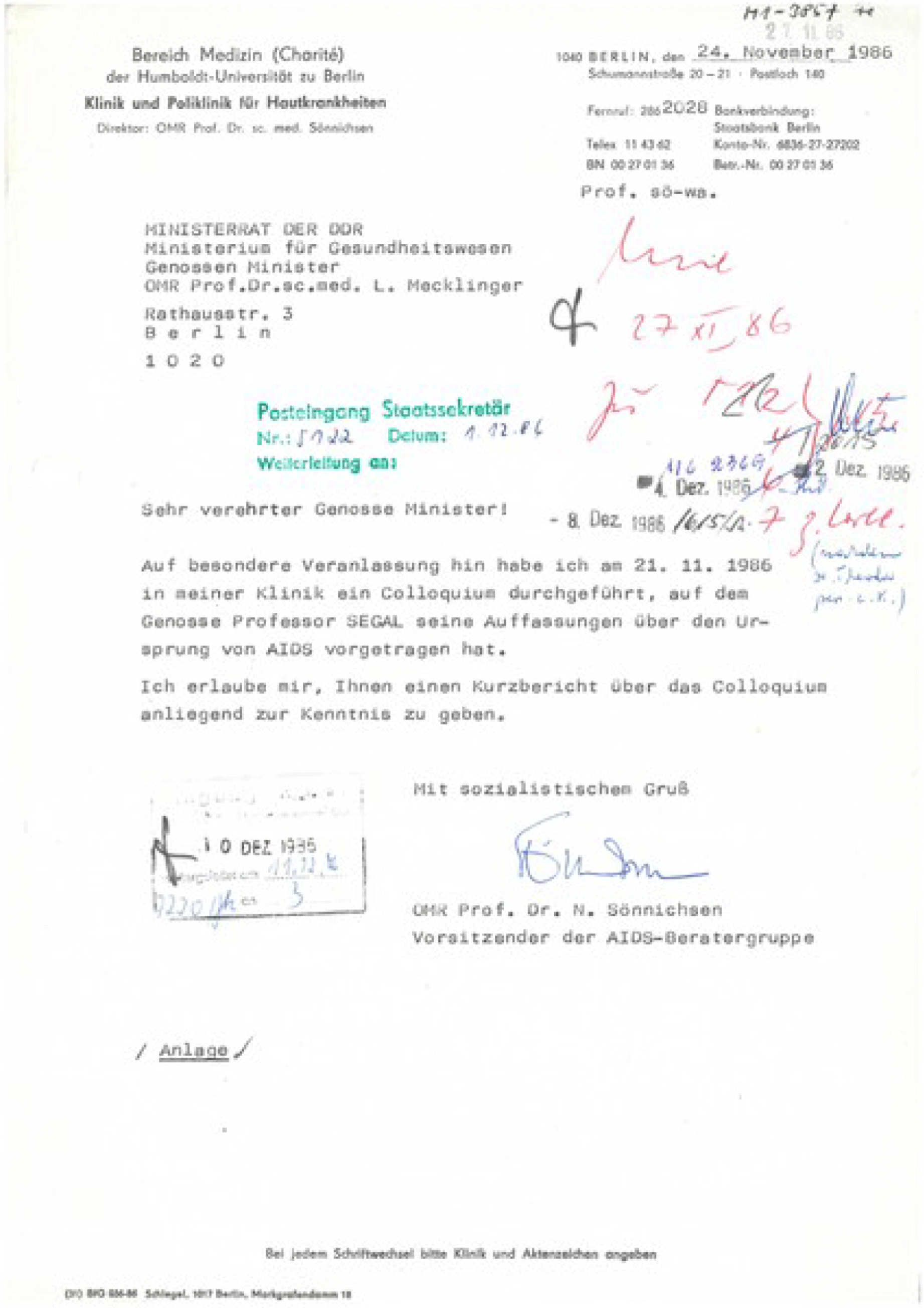
Seidel was not pleased with Hager’s decision and ordered the Health Minister to organize a conference of scientific experts to evaluate Segal’s hypothesis. Reference Sönnichsen104 In consequence, the Health Minister requested Professor Dr. med. Niels Sönnichsen, chair of the AIDS Advisory Group of the Health Ministry, to make arrangements. The conference took place on 21 November 1986. One of us (EG) participated in the meeting and criticized Segal’s claims. Three days later Sönnichsen reported that “with the exception of Segal all participants emphasized that although there might be some signs supporting Segal’s hypothesis direct proofs are missing. …If it is claimed, however, that HIV has been constructed in the USA by genetic engineering for biological warfare purposes, it must be proven beyond doubt. Otherwise it could have only negative consequences for the GDR and the other socialist countries.” Reference Sönnichsen105 Copies of this report came to be filed in several MfG folders, none of which contained any prior myth-related items. The copy kept by the Unterabteilung Gesundheitsschutz [Sub-department Health Protection], the department responsible for AIDS control, bore the marginal signatures of Health Minister Ludwig Mecklinger himself and eight additional Ministry of Health officials (see Figure 1), each of whose departments was being informed simultaneously of Segal’s allegations and of the risk run by failing to reject those allegations.
Copy of a report dated 24 November 1986, kept by the GDR Ministry of Health department responsible for AIDS control, showing marginal signatures of the Minister of Health and eight additional Ministry officials, BArch DQ 1/13082. See text for interpretation.

Some departments of the Stasi also examined this report. An officer of the department responsible for counter-intelligence in economic and scientific affairs informed other departments of the MfS, including the Regional Administration East Berlin, that “[o]fficials of the ministry of Health as well as Humboldt-University Berlin, who deal with the AIDS problem and with homosexuality, share the opinion that Segal’s claim is not tenable from a scientific and medical view.” 106 Selvage and Nehring have not mentioned this letter.
Major Dewitz of the Stasi’s East Berlin Administration initiated a comprehensive evaluation of Segal’s claims. 107 Dewitz, too, in a comprehensive four-page memorandum, concluded that “all GDR experts are convinced that Prof. Segal’s theory is untenable.” But that was a scientific consensus. What Dewitz described next, though, was a political consensus, that Segal’s activities “are considered to be politically harmful” and that spreading the myth generated “disadvantages for the GDR” — “scientific disadvantages, …economic disadvantages …and political disadvantages.” 108 Consequently, the Stasi, “Shield and Sword of the Party,” should not support but rather should suppress Segal’s activities. Major Dewitz went on to contemplate measures “[t]o protect the esteem of the GDR with appropriate measures” by making Segal desist. 109
Selvage and Nehring have not quoted this material. They have referred to it only obliquely, as follows: “Interestingly Sönnichsen [the organizer of the conference where the experts rejected Segal’s claims] and Segal’s critics seem to have convinced [“für ihre Sache gewonnen zu haben”] those officers of department XX of the Regional Administration Berlin [of the MfS] who had been responsible for surveillance of the Charité [the Medical School of East Berlin’s Humboldt University], but that was without evident effects on the support of Segal’s work by the HV A and the superior departments of the MfS, respectively.” 110
Dewitz soon learned of a manuscript challenging Segal; one of us (EG) was lead author of that manuscript. Reference Geissler and Rosenthal111 Selvage and Nehring have claimed that the MfS succeeded in prompting the Partei- und Staatsführung to prevent publication, 112 noting that officers of HA XX/1 had visited Seidel on 10 March 1987 113 and that on 11 March — not, as previously remembered, 9 March 114 — Seidel warned EG not to seek publication. 110 Coincidence aside, HA XX/1 had never taken any interest in Segal or AIDS, but they were responsible for around-the-clock monitoring of Stefan Heym. These officers were meeting with Seidel to report that Stefan Heym had interviewed a retired biology professor, Jakob Segal, 115 not to prompt Seidel to threaten EG. Moreover, Seidel had been a myth enthusiast since meeting with Segal 17 September 1986 and had thereafter been frustrated in his attempts to rally support for Segal; 100 the Sönnichsen report had made these attempts less likely to succeed, and, if published, EG’s excoriation of Segal’s reasoning would have worsened this situation, embarrassing Seidel as well as Segal. Of all figures in the Partei- und Staatsführung, Seidel was the least likely to need a prompt to suppress publication. And of all divisions and departments in the MfS, HA XX/1 would not have been the most likely to deliver that prompt.
6. Did the GDR’s Ministry of Health (MfG) support, promote, or control Jakob Segal?
Seidel’s position was not centrist; it was eccentric. The Partei- und Staatsführung fervently wanted the GDR to be, and to be accepted as, a modern scientifically sophisticated state, and Sönnichsen’s conference simply confirmed the MfG in its conviction that AIDS was caused by an agent of natural origin. They had already been informed in 1984 by the Institut für Wissenschaftsinformation in der Medizin [Institute for Scientific Information in Medicine] in a special issue dealing exclusively with AIDS that “the cause of AIDS is regarded as an infectious agent which behaves, epidemiologically, like the virus of hepatitis B.” 116
In November 1985 Niels Sönnichsen had participated in an “AIDS in Africa” congress in Brussels. He had reported to the Ministry of Health, inter alia, that Luc Montagnier, co-discoverer of HIV, “explained that the virus must have been in Africa before it could be detected in the USA and Europe.” Reference Sönnichsen117 The GDR’s delegate to the Soviet bloc’s Council for Mutual Economic Assistance (COMECON) in November 1985 had given the Health Minister himself an article published in a Soviet trade-unions newspaper, Trud, on 6 October 1985, three weeks before the first Literaturnaya Gazeta article appeared. The Trud article quoted P. M. Chaitow, deputy director of the Institute of Immunology of the Soviet Health Ministry, as follows: “It is assumed that [AIDS] was transmitted to man from some monkey species (especially the so-called ‘green monkeys’) which had been infected. …The frequently forwarded question on the origin of this suddenly [occurring] ‘novel’ disease has to be answered [this way:] the disease could not have been detected earlier.” Reference Chaitow118
No copy of the first Literaturnaya Gazeta article could be found in the files of the Health Ministry. Nevertheless, four weeks after that article appeared a member of the AIDS Advisory Group mentioned a proposal “to publish in the daily news a paper on AIDS. Objective: The AIDS agent has been manipulated and has escaped from an American laboratory (biological weapons).” Dr. Helmut Theodor, Head of the Hauptabteilung Hygiene [Main Department of Hygiene] and of the Staatliche Hygieneinspektion [National Supervisory Board for Hygiene] of the GDR Ministry of Health, summarily rejected that proposal. Reference Theodor119 But from whom had that proposal come? A reader of Literaturnaya Gazeta? Jakob Segal? That we do not know. 120
The archives of the GDR Ministry of Health, to our knowledge, contain no document, other than Sönnichsen’s widely circulated 24 November 1986 report, Reference Sönnichsen105 showing AIDS being discussed further in any context until spring 1987, when representatives of the Ministries of Health of the Socialist Countries met on 21 and 22 April in Moscow. Horst Schönfelder, Deputy Health Minister of the GDR, and the two other East German delegates reported that Dr. G. N. Chlabitsch, Vice Health Minister of the Soviet Union, had been asked about a rumor that HIV had originated in American laboratories. Dr. Chlabitsch answered, “No Soviet scientist has forwarded so far such a thesis in public (in journals or elsewhere). With these words the question is answered sufficiently.” The MfG report continued: “Any further discussion of that comment did not take place.” 121 The AIDS-origin question was raised by only one conference participant, Undersecretary for Health of the Bulgarian People’s Republic Professor Schindaroff. Had he read one or both Literaturnaya Gazeta articles? Was he aware of the AIDS disinformation the KGB had provided to the Bulgarian secret service? Again, we do not know.
The GDR Health Ministry’s official position remained what it had been: “the causative agent of the syndrome is a virus of the family retroviruses. …Animals can suffer from diseases similar to AIDS which are also caused by retroviruses. These retroviruses are not identical to HIV.” Reference Mecklinger122 This official position was also what East German citizens were being told when, having heard about the myth, they asked for more details. These citizens would not have heard about the myth directly from Segal, as he was never allowed to spread his claims in the GDR, but indirectly through West German television and radio broadcasts. After East German television had addressed the AIDS epidemic on 10 March 1987 without mentioning the origin of HIV, several persons forwarded questions to the broadcast station. Dr. H. P. from Leipzig asked about the origin of HIV. Ms. S. R. from Ottendorf-Okrilla said, “It is not unknown that bacteriological warfare is possible. Could it be that the AIDS virus had been ’produced’ by means of the possibilities of gene manipulation, that it went out of control and escaped from the laboratory?” Obviously referring to the myth she continued: “On the other hand one hears about several experiments with completely unsuspecting persons and soldiers, respectively. Could perhaps such devilishness have happened?” More bluntly Mr. I. K. from Fürstenwalde asked, “Is it true that the AIDS virus had derived artificially from experiments with B [biological] weapons on order of the Pentagon? Had it especially been created from pathogens of African species [Arten]?”
All questions were passed to the Ministry of Health. All were answered by Dr. Theodor. With respect to H. P.’s questions, Dr. Theodor answered on 20 April 1987 that “certainly the AIDS virus was not a mutant created in the laboratory. In all probability a transmission of the virus from monkey to man had taken place.” A similar answer was mailed to S. R. on 15 April, adding that the presumed transmission from monkey to man “does explain why the African continent is so contaminated. Retroviruses including the AIDS agent are characterized by great variability.” And I. K. was informed by Dr. Theodor on 6 April “that there does not exist any scientifically confirmed proof of the hypothesis you have mentioned. It is assumed that a transmission of the virus from monkey to man had taken place.” 123
In September 1987, the GDR’s Ministry of Health received an article — “Where does AIDS come from?” — published by Jakob Segal in Moscow News five months previously, a few days after the Moscow AIDS meeting. 124 What the Ministry got was a “Translation [into German] of an English translation of a Russian translation of the German original.” Reference Segal125 Marginal notes on the front page indicate that the paper had been passed both to “M4” — shorthand for the Deputy Minister of Health, Professor Rudolf Müller — and to Dr. K.-H. Lebentrau, head of the department dealing with international organizations. M4, the Deputy Minister, wrote, “Attention: This article has caused great trouble between USA and USSR (according to M4 on 8 Sep 87).” At the upper right margin, Lebentrau, who might have been expected already to have known about such trouble, wrote simply, “This paper is unknown to us.”
The author of the paper was also unknown to at least one of the recipients. A question mark was inserted behind Segal’s name. Later, the question was answered: “Prof.em. [Professor emeritus], biology, Charité” — which was not correct, since Segal before his retirement had not been employed by the Charité, the Medical School of East Berlin’s Humboldt University, but had been the director of the Institute of General Biology of the Faculty for Natural Sciences and Mathematics at Humboldt.
Segal’s thrice translated text was studied thoroughly. A majority of the paragraphs in which Segal had summarized his allegations were marked in red by one or more readers, but annotation was seemingly the only action Segal’s paper elicited.
No additional Health Ministry document could be found dealing with these allegations or with their author.
7. Did the GDR’s Ministry of Foreign Affairs (MfAA) support, promote, or control Jakob Segal?
Just three citizens of the GDR had been diagnosed with AIDS by Spring 1987, but other citizens as well as foreigners had been identified as carriers of HIV. The Partei- und Staatsführung was growing concerned. The Minister of Health informed leading politicians including Politbüromember Kurt Hager and the Chairman of the Council of Ministers, Willy Stoph, about each infected citizen. Reference Mecklinger126 Measures to contain the epidemic were implemented. Reference Geissler127 They included cooperation in diagnostics and therapeutics not only with other socialist states but also with Western countries — even with the United States, arch villain of the KGB’s disinformation campaign and of Segal’s theory.
The United States was receptive. In July 1987 Rozanne Ridgway, Assistant Secretary of State for European and Canadian Affairs and former American Ambassador to East Germany, 1982–85, came to East Berlin to discuss bilateral relations. 128 The GDR’s Acting Foreign Minister Dr. Herbert Krolikowski met her on 24 July and gave her an eight-point “non-paper,” which is to say an aide-mémoire informally circulated. 129 The GDR proposed, inter alia, to organize expert meetings to establish cooperation in the fight against international terrorism, illegal narcotics trafficking, and AIDS. 130
After the meeting, the U.S. Embassy in East Berlin wired USDoS reporting that “Ridgway characterized the bilateral dialogue in this area [AIDS] as ‘dreadful.’ Krolikowski essentially left the ball in our court by saying that the GDR was willing to work with us on all three subjects.” Ambassador Ridgway had raised the myth explicitly but to no effect. “With respect to AIDS, the U.S. complaint had, we believe, been less with GDR unwillingness to work with the international scientific community in the search for a cure than its participation in the Soviet disinformation campaign that has sought to blame the U.S. for the alleged laboratory creation of the disease.” 131 Segal’s name was not mentioned.
Regarding future cooperation with GDR scientists in AIDS research, the U.S. Embassy proposed to the USDoS the following: “We believe that we should also undertake more rigorously, however, to enlist positive GDR cooperation in mutual beneficial scientific research. To this end, we would appreciate the Department’s assistance in identifying American officials and/or scientists connected with AIDS research who may be participating in conferences or other programs in Europe who could be encouraged to visit Berlin to meet with serious GDR researchers and health officials, not, of course, with the pseudoscientists who have cooperated in the Soviet disinformation campaign. …We shall follow up Ridgway’s remarks about unhelpful items that appear in the official press here whenever new material is printed.” 131
The U.S. Embassy in East Berlin had ten months before received directly from Lilli Segal the full text of Jakob’s allegations. Diplomatically, though, Segal was not being distinguished from the GDR — or from the Soviet Union, as would be emphasized two months later when the USDoS released Soviet Influence Activities. 41 Fortunately, the Americans had not been the only minute-takers. Notable from the perspective of the GDR’s Ministry for Foreign Affairs was a telling confusion: “It was completely unclear whether she [Ridgway] referred to Segal’s publications.” 130 Selvage and Nehring have ignored this evidence.
Although the KGB admitted and abandoned its AIDS disinformation campaign in October 1987, the spread of the HIV-from-Fort-Detrick myth continued, now no longer pushed by the Soviets yet still by Jakob Segal and his wife Lilli. This persistence began to dispel the original belief within the USDoS that Jakob Segal had been the KGB’s “scientific expert” or the “Purveyor of the Disinformation,” 132 but it did not dissuade Selvage and Nehring from portraying Jakob in “comprehensive cooperation between KPdSU, SED, KGB and MfS to spread the Fort Detrick thesis.” 93
Eventually the USDoS realized that Segal had been directing his own disinformation campaign from East Berlin but evidently figured he had been doing so with the consent of the Partei- und Staatsführung or at its behest. In consequence, as Selvage and Nehring have reported correctly, “the USA did not only put Moscow but East Berlin, too, under pressure. …America’s Ambassador in East Berlin, Francis J. Meehan, in January 1988 launched an official protest before the Deputy Minister of Foreign Affairs of the GDR Kurt Nier against the continuous activities of Jakob Segal.” 133
How did the East German government react to this protest? Selvage and Nehring have not considered this question, having remarked only that the Stasi’s HV A/X “was little impressed by the counter measures of the American Government.” 133
Meehan met Nier, indeed, but not in January 1988 as the Stasi incorrectly recorded and as Selvage and Nehring have repeated, but on 29 December 1987. Ambassador Meehan submitted a non-paper to the government of the GDR saying that the United States “is ready to engage in a dialogue with the GDR at the expert level in the three areas proposed by the GDR: (a) terrorism, (b) illegal narcotics trafficking, and (c) the disease AIDS,” 134 as had been proposed by the GDR during Ambassador Ridgway’s visit. 129 Verbally, though, Meehan said cooperation in AIDS research might be endangered. Why? According to notes taken by an official of the GDR’s Ministry of Foreign Affairs, the Ministerium für Auswärtige Angelegenheiten, the MfAA, the government of the United States “is concerned about a world-wide disinformation campaign arising in the GDR in the form of statements of Professor Segal. According to Segal’s claims the AIDS virus had been developed in a laboratory of the US Army. Such allegations would be the height of irresponsibility. The Ambassador [now meaning Ambassador Meehan] declared in that connection that it was encouraging that Professor Segal’s allegation had been challenged by scientists of the Soviet Union and the GDR.” 54,Reference Barth135
The MfAA was surprised by the American accusations. After the meeting the U.S. Embassy in East Berlin informed Washington that Deputy Minister Nier had told Ambassador Meehan “that he personally had never heard of what the Ambassador called the totally irresponsible and unscientific Jakob Segal theory of U.S. responsibility for AIDS, but he was certain that the experts could clear up the matter.” 134
The MfAA knew about AIDS because a deputy of Oskar Fischer, the Minister of Foreign Affairs, was a member of the Governmental AIDS Commission and because the ministry was involved in multiple attempts to arrange international cooperation in the fight against AIDS and because the GDR was a co-author of a corresponding resolution of the General Assembly of the United Nations. Documents dealing with AIDS collected and filed by the MfAA before Ambassador Meehan’s protest mentioned Segal’s name only once, and that was in connection with Ambassador Ridgway’s visit. Otherwise the MfAA took note of neither the disinformation campaign run by the KGB nor the myth spread by Jakob Segal.
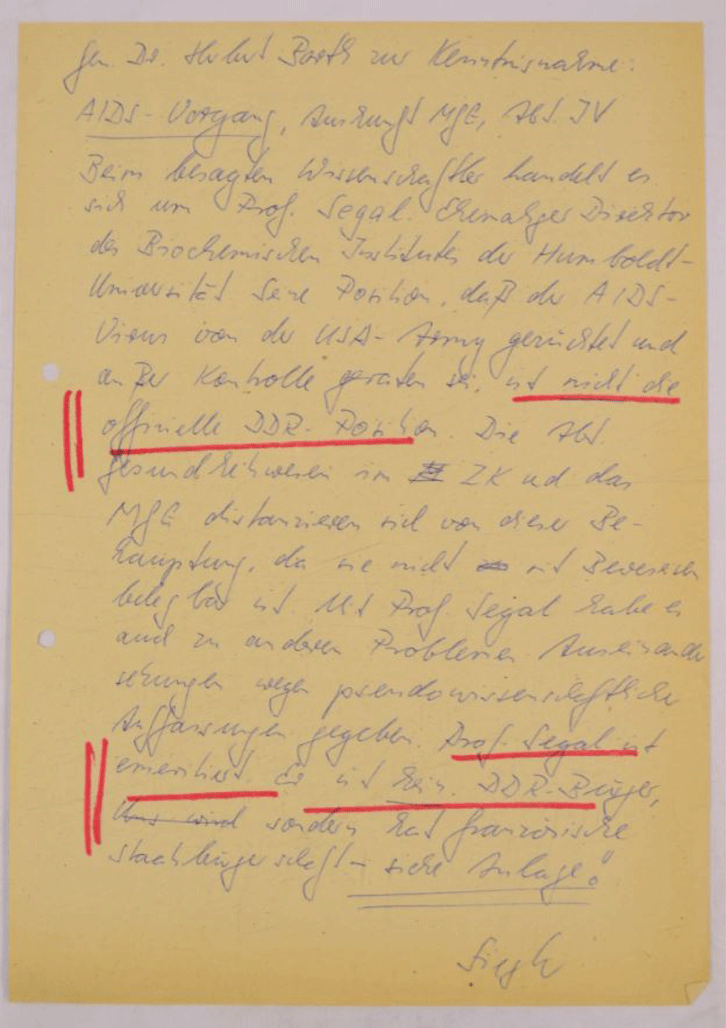
More revealingly, though, Ambassador Meehan’s complaint caused immediate action within the MfAA. Staff members procured a copy “of Professor Segal’s paper mentioned by Ambassador Meehan.” 136 It was an undated manuscript entitled “AIDS — Natur und Herkunft [AIDS — Nature and Origin].” Its source was not mentioned, but materials distributed at Sönnichsen’s meeting of experts might still have been available. Reference Sönnichsen137 In addition the MfAA asked the Health Department of the ZK of the SED and the Ministry of Health itself for information about Segal and his claims. Mr. Siegler of MfAA’s United States Department informed Dr. Herbert Barth, the department’s head, that Segal’s “opinion that the AIDS virus was created by the USA Army and went out of control is not the official DDR [GDR] position. ” 138 The sender, Siegler, added a blue-ink line under nicht [not]; the recipient, nominally Dr. Barth, added red-marker underlining toward the end of the sentence and, at the left margin, red bars (see Figure 2). The note went on to affirm “that the Health Department of the ZK and the Health Ministry dissociate themselves from that claim [Segal’s claim] since it cannot be substantiated with proofs. There have been discussions with Prof. Segal also regarding pseudoscientific opinions about other problems. Prof. Segal is retired. He is not a citizen of the DDR [GDR] but has French citizenship.” The sender added a double blue-ink line at the end of this “citizenship” sentence; the recipient added red-marker underlining to the first half and, at the left margin, red bars. Segal’s citizenship, in reality, though, was not French but Soviet.
Note from Mr. Siegler to his superior, Dr. Herbert Barth, head of the United States Department at the Ministry of Foreign Affairs (MfAA); undated, but 8 January 1988 or earlier. Source: Politisches Archiv des Auswärtigen Amtes. Bestand MfAA ZR 1.202/13. Akten-Nr. 608 “AIDS-Bekämpfung USA-DDR” 1987–1989. See text for interpretation.

Dr. Barth immediately made this newly understood position known to Minister Fischer. “Professor Segal’s opinion as mentioned by Ambassador Meehan is not the opinion of the GDR.” The word “not” had been underlined by a recipient; in addition, the entire paragraph had been marked at the margin. Again, Segal’s status as retired was mentioned correctly and his citizenship as French incorrectly. The memo ended with the proposal that the Minister of Foreign Affairs should inform the U.S. Embassy as soon as possible about the GDR’s position. Reference Barth135
The matter was urgent. Already the Health Ministry had informed the MfAA that within the same month, from 25 to 28 January 1988, the World Health Organization was to hold an international conference and that minister Mecklinger was to participate. “Considering the remarks Ambassador Meehan made in his talk with comrade Nier the US Embassy should be at all costs informed in advance of the conference of the official position of the GDR regarding AIDS to prevent a possible confrontation GDR-USA.” 139
The Foreign Minister concurred immediately. On 7 January 1988 counselor John Greenwald of the U.S. Embassy was officially informed of the position of the GDR with respect to Segal’s opinion regarding the origin of the AIDS virus. “Greenwald expressed his thanks for the information and declared that this position of the GDR will have a positive effect on bilateral relations. He will report to the Ambassador on that.” 54
Nonetheless, Segal’s efforts continued. When on 30 March 1988, three months after Ambassador Meehan’s protest, a first consultation on joint anti-AIDS measures took place between officials of the GDR and the United States, U.S. Counselor Harnish asked again for the position of the GDR government regarding Segal’s claims. According to a representative of the MfAA participating in the meeting, “Dr. Theodor, Head of the Main Department of Hygiene and of the National Supervisory Board for Hygiene, emphasized the position of the GDR again.” 54
In February 1989 the United States protested once more. Counselor John Greenwald submitted a memorandum recalling
the many earlier discussions held between the Foreign Ministry and the Embassy and representatives of the Department of State and the Congress on the subject of AIDS. …We welcomed assurances that have been given in the past, on several occasions in 1988, for example, by Deputy Minister Nier to representatives of the U.S. Congress and the Administration, that the GDR disagreed with the spurious charges of Dr. Jakob Segal that the U.S. Army invented and spread the AIDS virus. Regrettably, new articles have appeared drawing on an interview with Dr. Segal that not only revives this charge but also …slanders the pioneering work done by Dr. Robert Gallo of the National Cancer Institute in identifying the AIDS virus. Reference Greenwald140
Greenwald referred to a Segal interview published in an Austrian journal, Basta. In that interview Segal had not only repeated his allegations but had also asserted that virologist Robert Gallo — along with Montagnier and Françoise Barré-Sinoussi a co-discoverer of HIV — was responsible for the creation of the AIDS agent through genetic manipulation. 141 Later Segal explained that “the Pentagon simply purchased Gallo.” Reference Segal142
Greenwald continued:
My authorities protest this as a gross distortion and misrepresentation. They recall that on October 21, 1987[,] the United Nations adopted unanimously a resolution co-sponsored by the United States and Soviet Union which stated that “AIDS is caused by one or more naturally occurring retroviruses of undetermined origin.” The German Democratic Republic also supported this resolution which, I would note again, was passed unanimously. The revival of Dr. Segal’s spurious charges will be interpreted by many as evidence that the GDR is not serious about desiring to work with the United States bilaterally and multilaterally, as it has said, on a successful treatment of this dread disease. Reference Greenwald140
Dr. Norbert Reemer from the MfAA’s United States Department replied, inter alia, that “he had already on 7 January 1988 informed Counselor Greenwald on the official position of the GDR regarding the origin of AIDS in response to the question forwarded by Ambassador Meehan to Vice Minister Kurt Nier. Accordingly the opinion of Professor Segal is not the position of the GDR. Professor Segal is retired. Professor Segal is not citizen of the GDR.” 143
8. Did Segal’s faux French citizenship indicate misinformation or disinformation?
Misinformation is false by mistake, disinformation false by design. 144 Misinformation knowingly propagated becomes disinformation, this “mis-to-dis” transformation now being recognized as a “fake news” variant. Still, misinformation’s prevalence is hard to exaggerate.
In September 1986 in “Pentagon behind AIDS?” Moscow’s New Times referred to “French scientists Jacob and Lily [sic] Segal.” 145 Later the GDR’s Ministries of Health and Foreign Affairs described Jakob Segal as French. Reference Barth135,138 But the Ministry of State Security — the MfS or Stasi — knew Segal was a citizen of the Soviet Union. USDoS also knew this: “Throughout the early and middle stages of the disinformation campaign, Soviet-bloc media repeatedly misidentified Segal as a French national.” USDoS assumed disinformation in “an effort to downplay his ties to the G.D.R.” But USDoS also suggested not disinformation but misinformation: “Segal, who resides in East Berlin but claims to have graduated from the Sorbonne in 1940, has been repeatedly misidentified as a French researcher.” 146
Selvage and Nehring have seen here only disinformation: an attempt to hide Segal’s ties to East Berlin — ties that Segal himself made patently obvious again and again. Pretending Segal was French, Selvage and Nehring have proposed, would have been advantageous since “AIDS disinformation spread from the East ought to be supported by ‘Western scientists.”’ 147
In fairness to all observers, the Segals’ citizenship was genuinely confusing. As we wrote in 2013,
Jakob Segal was not a citizen of the GDR but of the Soviet Union; Reference Segal148 he was not “a German of Jewish descent,” as Boghardt has described him, 149 but a Russian-born Lithuanian citizen who became a Soviet citizen through Stalin’s annexation of the Baltic States. Jakob’s coauthor and wife, Lilli, although born German, had become a Lithuanian citizen by marriage and then a Soviet citizen by annexation. Reference Segal150,151
Besides that, Jakob had grown up in Königsberg, East Prussia, Germany — now Kaliningrad, Russia — and had studied biology in Königsberg, Berlin, and Munich before moving on to Toulouse and Paris and the Sorbonne. During World War II, Jakob and Lilli were both partisans of the French resistance. In 1952 the Soviet consul in Paris advised them to depart France for East Berlin, and they accepted that advice. Reference Segal152 Professionally the Segals’ colors remained importantly French, as shown in a 1986 journal review of the Harare pamphlet: “Prof. Jakob Segal (D.Sc.) – Licence in Toulouse (France), graduated at the Sorbonne (Paris) in 1940 and Dr. Lilli Segal – Licence in Toulouse, graduated at the Humboldt University (Berlin) in 1959.” 153
The most likely reason for the Segals’ misidentification was simple enough: Jakob and Lilli had lived in France from the mid-1930s until 1952, 32 and an early draft of Jakob’s version of the myth they had given out as a manuscript in May 1986 in Tel Aviv in French. Reference Claasen60
9. Did three Stasi officers make a “true conspiracy”?
While the Partei- und Staatsführung, including the Ministry of State Security, explicitly dissociated themselves from Segal’s allegations, three Stasi officers in one MfS department, HV A/X, did take an interest in AIDS disinformation. Knowing this, Selvage and Nehring promised that their “study will prove empirically that there was a ‘true conspiracy’ between the KGB and the HV A to spread the Fort Detrick thesis of the origin of HIV and that a biologist named Jakob Segal was one of their protagonists as conscious or unconscious multiplier.” They went on to claim that “the HV A was instructed by the KGB to provide their own ‘scientific’ contribution to the campaign.” 154
Since protagonists, if “unconscious,” cannot themselves be conspirators, any “true conspiracy” must have excluded Segal, the only figure in the Selvage-Nehring theory trying to make a “‘scientific’ contribution.” This paradox we cannot reconcile.
In reality, “the HV A” — meaning the Main Directorate HV A — did not support the myth. Rather, three officers of HV A’s Department Ten, or HV A/X, the “X” being a Roman numeral, did show interest. HV A/X was the department responsible for “active measures” and disinformation, so the interest shown did make some sense professionally. The three officers were Colonel Dr. Rolf Wagenbreth, head of Department Ten, Colonel Wolfgang Mutz, his deputy, and Captain Hans Pfeifer. In our 2013 paper these and other names we redacted in compliance with KOMDOS requirements, as conveyed by Nehring, but since Selvage and Nehring have revealed these names in their 2014 monograph we have not maintained our redactions here.
Selvage and Nehring have written that “the HV A started their activities already in 1985,” 22 but we have seen no AIDS-relevant evidence dating from that year. What evidence we have seen suggests that Wagenbreth, Mutz, and Pfeifer got a late start. A file dealing with an anti-western action called “Denver” — Objekt-Vorgang [Object-Action; OV] “Denver” — was deposited 17 July 1986, 22 but no source so far seen by us indicates AIDS-disinformation activities before 3 September 1986, when East German agents proposed to Bulgarian agents “joint and agreed measures” to be taken during 1987 and 1988, saying they would provide “a scientific study and other materials that prove that AIDS did originate from the USA and not from Africa and that it is a product of biological weapons research performed in the USA.” 155 We agree with Selvage and Nehring 156 that this “scientific study” referred to Segal’s paper, especially since “not from Africa” was a point made, and stressed, in Segal’s version of the myth but not in the KGB’s version. Segal’s paper and “other materials” would be provided “Termin: ab I. Quartal 1987 [Date: from the 1st quarter of 1987],” suggesting that the three named HV A/X officers still had to procure what they were now promising to provide. 155 Consider selected dates:
- 12 March 1986
The Segals sent manuscript copies to Tokyo and Frankfurt am Main. 59
- May 1986
Jakob Segal distributed French manuscript copies in Tel Aviv. Reference Claasen60
- 17 June 1986
The Segals sent a manuscript copy to Cameroon. 62
- 4 August 1986
The Segals sent a manuscript copy to California. 63
- 26 August 1986
Manuscript copy distribution likely began in Harare. Reference Segal and Lilli52
- 3 September 1986
HV A/X officers promised the Bulgarians a manuscript copy in 1987. 155
One way to interpret this list is to infer that the three named HV A/X officers knew copies did exist and may have known copies were being given away in Zimbabwe but had no copy themselves and did not know how to get one quickly.
According to the documents upon which Selvage and Nehring have relied, the three named HV A/X officers met their Bulgarian counterparts four times to discuss joint activities intended to spread the myth.
At a first meeting, 16 to 19 September 1986 in Sofia, a Bulgarian minute-taker noted inter alia: “The Germans will provide us with the complete documentation regarding the disease [AIDS] including the AM [active measures] they have performed in that direction for our use in a corresponding AM [active measure][.] …The German comrades informed us that GDR scientists had been requested to participate in that action. One of them has elaborated a scientific memo which proves that AIDS is a result of biological weapons [research] of the U.S.A.” Reference Nikolow157 Mentioned in a later report about this first meeting were comments by Mutz about “action ‘AIDS”’ in preparation for which the MfS officers, “will provide us with the complete documentation. …It will be interesting to call in Bulgarian scholars who support the thesis of the German professor.” Reference Stankow158
If true “that GDR scientists had been requested to participate” and that “[o]ne of them [had] elaborated a scientific memo” Reference Nikolow157 and if true “that the HV A played a role in compilation and distribution of the booklet [the Harare pamphlet] 159 and if true that “an active role of HV A/X in publication of the booklet cannot be excluded” 160 — quoting the three Stasi officers indirectly in the first respect and quoting Selvage and Nehring directly in the second and third respects — then Wagenbreth, Mutz, and Pfeifer should have had at least one copy of the “scientific memo” or the “booklet” to show the Bulgarians during their first meeting.
A Bulgarian officer, L. Nikolow, noted that Mutz had claimed that East Germans “have been and are using this [scientific] memo in several active measures all over the world.” Reference Nikolow157 We have no evidence of such East German active measures other than the Segals’ own “conscious or unconscious” efforts, 154 and the Segals, as the Stasi well knew, were not East German citizens. Mutz had also reported that the “action regarding AIDS was coordinated with the head of the department of public health. He has discussed that with the minister for health and other secretaries.” Reference Stankow158 This statement is hard to believe. As already discussed, the Minister of Health did not share Segal’s view. Head of the Central Medical Service of the MfS was Major General Prof. Dr.med. Klaus-Wolfgang Klein. He represented the MfS on the Governmental AIDS Commission, the Ständige Arbeitsgruppe “AIDS” der Zentralen Kommission des Ministerrates zur Verhütung und Bekämpfung von Epidemien [Standing Working Group on AIDS of the Central Commission of the Council of Ministers for the Prevention and Control of Epidemics], founded in 1987. Neither in the files of that commission 161 nor in other documents of the Ministry of Health have we found any hint of events consistent with that claim. Likewise comrade Prof. Karl Seidel of the ZK seems not to have been aware of AIDS-related interests within HV A/X; when Seidel met him on 17 September, Segal complained about a lack of support from the Partei- und Staatsführung. If Mutz or any other official of the MfS had kept him informed, Seidel would logically have relayed, or at least alluded to, that information in his memo to Kurt Hager, who, as a member of the Politbüro, was superior to the MfS.
The Bulgarians recorded “an interesting fact” mentioned by Mutz: “that the Americans asked the author for a copy of his study.” Reference Nikolow157 Selvage and Nehring added this: “One week before Mutz met the Bulgarians a diplomat of the U.S. Embassy in East Berlin” 162 — seeming to accept our demonstration that Bohnsack had grievously misled Boghardt on this point 30 — “had asked the Segals for a copy of their paper.” 162 According to a minute-taker, Mutz added this: “Right now the German comrades have decided to refrain from providing the official American representatives with the study.” Reference Nikolow157 Here Mutz, at best, revealed his ignorance. Other Stasi officers would already have known of the meeting because they monitored the movements of American diplomats. Lilli herself, in an undated note, would soon report the same meeting and the request and the gift. She reported to Main Department HA II, whose mission was counter-intelligence within the borders of the GDR. 163,164 Selvage and Nehring have conceded that Mutz was mistaken, if not disingenuous, but they have done so 27 pages later in their monograph and in an entirely different context. 165 The Bulgarians may have been bemused to hear what the three HV A/X officers were proposing, since exactly one year previously the KGB had briefed the Bulgarians on the Soviets’ AIDS disinformation campaign, and about two months after that briefing the first Literaturnaya Gazeta article had been published.
At a second meeting, 29 June 1987 in Sofia, the three HV A/X officers did finally deliver a “scientific memo.” Indeed, they delivered that and more: Jakob and Lilli Segal’s paper “AIDS – Natur und Ursprung [AIDS – nature and origin],” described as “Der Originaltext [The original text]”; Jakob Segal’s interview by Stefan Heym; and Segal’s response to his critics, “Die Erwiderung [The reply].” Yet these three items had materialized not through security-service tradecraft but through purchase at a bookstore. What the officers presented was AIDS — pathogens from the gene laboratory?, a volume assembled by Kuno Kruse, science editor at the TAZ. Reference Kruse166 Kruse was skeptical about Segal’s allegations and included in this volume a critical interview with Meinrad Koch and critical articles by other authors. Reference Koch167 HA XX/9, the department monitoring Stefan Heym, correctly reported: “In the brochure [Kruse’s edited volume] are published contributions of qualified scientists countering the views of Segal, who is considered a ‘Verschwörungstheoretiker [a conspiracy theorist].”’ 168 Nevertheless, the HV A/X officers submitted Kruse’s volume to their Bulgarian colleagues saying that they “can refer to” it while conspiring to spread the myth. 169
Perhaps the three Stasi officers had had no opportunity to review Kruse’s volume before delivering it to Sofia. But Selvage and Nehring have reviewed it, saying it not only included Segal’s papers but also included “some contributions from the thematic sphere [aus dem thematischen Umfeld] — such as criticisms of gene technology as well as other theories regarding the artificial origin of the AIDS agent.” 170 The majority of the articles rejected Segal’s work. Selvage and Nehring chose not to acknowledge that fact and went on to interpret Kruse’s volume as “an additional unplanned success for HV A/X.” 170
At a third meeting, 26 to 29 September 1988 in Sofia, the HV A/X officers brought five more publications, a collection of press clippings, and a few other documents, Reference Stankow171 none of which would have been much use in sustaining an AIDS disinformation campaign, especially one in which the Bulgarians were not taking much interest. 172 One of the items provided was an article published in Stern 12 March 1987; written by a journalist who just several weeks prior had refused to publish Heym’s interview of Segal, the article accused Segal of misleading the public. Reference Klare173 As before, Stasi officers had clumsily sought to induce KOMDOS officers to help market the HIV-from-Fort-Detrick myth by presenting evidence of its non-marketability.
Surely more impactful was the news, conveyed by Mutz and Pfeiffer, that the Stasi had “ordered …the production of a movie in West Germany.” Reference Stankow171
10. Did the Stasi order or co-fund a documentary film?
When at their third meeting with KOMDOS Mutz and Pfeiffer said the Stasi had “ordered …the production of a movie in West Germany,” Reference Stankow171 the production to which they referred was already two years along, so the “order” would have to have been placed prior to any other evidence that the Stasi were interested in AIDS disinformation.
We agree with Selvage and Nehring that “the movie” was a television documentary, “AIDS – die Afrikalegende [AIDS – the Africa Legend],” which would be broadcast by Westdeutscher Rundfunk (WDR) on 3 January 1989 and then two more times. An extended version of this documentary, retitled Monkey Business — AIDS: The Africa Story, would be broadcast subsequently in Britain by Channel Four. 174
Indeed, a documentary exploring the origin of HIV — with Segal’s theory set among other theories — was in production in the Federal Republic of Germany. The documentarians were two West Germans, Heimo Claasen and Malte Rauch.
Claasen has told us the idea to make this documentary occurred to him in early September 1986 when he found the “Harare pamphlet” in the press room of the Harare conference. Reference Claasen65,175 This was Claasen’s second encounter with Segal’s manuscript, but this version, in English rather than French and in a conference brochure with a laudatory introduction, made a deeper impression than had the first. A meeting with Segal in November 1986 confirmed Claasen in his intention to examine the HIV-origin problem. Throughout 1987 he researched his topic.
Claasen and Rauch asked Jakob and Lilli Segal to present their not-in-Africa hypothesis on camera in their East Berlin flat, but western journalists were not free to operate behind the Iron Curtain, so Claasen, Rauch, and their team sought permission from the East German government. Usually the Ministry for State Security would be informed about such requests and would be involved in whatever decisions were to be taken. Presumably HV A/X first learned about the film, its production by then long underway, on this occasion.
Mutz promised the Bulgarians that the documentary’s “highlight” would be “an interview that Prof. Segal will give this year [1988] in October.” Reference Stankow158 Had Mutz known the production schedule because the Stasi had “ordered” the film or because he had seen the filmmakers’ request to interview the Segals in their flat in October? The latter would seem more likely.
Nevertheless, Selvage and Nehring have declared the Claasen-Rauch documentary a Stasi success. “The interview with the researcher couple, Jakob and Lilli Segal, in their flat in East Berlin is the centerpiece of the film[.]” 176 Plus, “not only was the Segals’ thesis propagated, but Jakob and Lilli Segal were stylized as heroes.” 113
We also have seen the film — both versions — but formed different impressions. As we detailed in our 2013 study, “less than five minutes [out of nearly 43 minutes in total in the German version] dealt with the myth; of the thirteen people shown expressing their opinions, only Jakob and Lilli Segal believed it, and six others [including Gallo and Montagnier] either endorsed a simian origin [for HIV] or in some other fashion rejected the myth.” 177 Dietrich Peter Winterberg, the journalist who introduced the documentary, summarized its message: “The conclusion of the film is then: legend, all legend if today anyone claims he knows where the AIDS virus comes from.” 178 This was true enough in 1989, yet Selvage and Nehring have counted Winterberg as an additional “multiplier” of the myth. 179 We have seen no basis for maligning Winterberg in this way.
In the film’s English version, the myth was mentioned less. And while they now showed Segal making an additional comment, Claasen and Rauch had selected not a coda of HIV-origin allegations but, incongruously, a complaint about scientists’ dependence on governments. However intrigued he may have been when meeting Segal two years previously, Heimo Claasen had educated himself on the topic of his project with Malte Rauch, and together the two filmmakers must have realized that “the legend” of a simian origin in Africa was gaining credence, not losing it. An Anglophone African film reviewer noted that a “number of scientists [in the interview segments shown] have strongly refuted” the myth. 174 Indeed, they had.
Even if Mutz was boasting about having “ordered” it, might the Stasi have helped fund the film? Might the Stasi have contributed, even secretly, to the Claasen-Rauch project simply because they wanted to ensure that it would go forward? In 1988 the HV A/X officers said they had “provided financial support.” Reference Stankow158
At a fourth meeting, one year later, 26 to 29 September 1989, when they hosted their Bulgarian colleagues in East Berlin, Wagenbreth, Mutz, and Pfeifer claimed that they “had paid 40,000 DM [Deutsche Mark]” for the film and West German sources had contributed 80,000 DM. 180 More money was also cited: 60,000 DM offered by the Soviets but declined by the East Germans. Selvage and Nehring have accepted these claims: “Co-funding of the Film ‘AIDS – die Afrikalegende’ in the framework of ‘Action Denver’ was perhaps the most challenging maneuver of HV A/X.” 181
We were skeptical. The GDR was practically bankrupt. 40,000 DM was a lot of foreign currency; approving its use might not have been solely within the authority of the HV A/X head, and we had seen no other mention of such an expense in any BStU document. Yet, while we grew skeptical, Claasen and Rauch — suddenly maligned as Stasi contractors — grew furious, denying any funding from any East German source, overt or covert. Claasen insisted that the film had been fully funded by West German (WDR) and British (Channel-4) television companies by spring 1988, Reference Claasen65,175 months before HV A/X officers were to brag about having “ordered” production. 182
Malte Rauch, producer of the film, went to court 25 February 2015 to demand that the BStU, publisher of the Selvage-Nehring monograph, refrain from asserting that Afrikalegende had been co-funded by the GDR’s Ministry of State Security — the MfS, the Stasi. On 2 December 2016 Rauch’s suit — Rauch gegen Bundesrepublik Deutschland [Rauch against the Federal Republic of Germany] — was rejected by the Landgericht Frankfurt am Main, the Regional Court for Frankfurt am Main. The court explained that the plaintiff had not been able to prove that his film had not been co-funded by the Stasi. 183 Rauch did not accept this decision and appealed to the Oberlandesgericht, the Higher Regional Court. Rauch’s lawyer paid to have our paper translated from English into German, and the court accepted the translation into evidence. This time, on 16 November 2017, in reference to the story about Stasi money, Rauch won. 184 “The defendant [the BStU] was not able to prove the claim made in the study that the plaintiff’s film ‘AIDS – The Africa Legend’ was co-funded by the State Security of the DDR [GDR].” 185
The Oberlandesgericht thus instructed the Federal Republic of Germany — as represented by Roland Jahn, Federal Commissioner for the Stasi Records — to cease allowing Selvage and Nehring to defame Rauch, and therefore Claasen as well, in respect to claims about funding from the East. The Court repeatedly cited findings and reasonings “as in the article by Dr. Geissler and Dr. Sprinkle” and criticized Selvage and Nehring for ignoring parts of our paper particularly relevant to the plaintiff’s defamation claim. 186 One comment considered both credibility and conceivability:
The credibility of the two HV A/X officers’ statements is particularly significant, as the information on the financial participation of HV A/X in the film ultimately came from that source only and was not confirmed by any third party or other documentation. Whether Pfeifer and Mutz had a reason to give inaccurate information regarding the involvement of HV A/X in the plaintiff’s film project cannot be affirmed or denied as an internal fact. Motives, such as the possibility Geissler and Sprinkle pointed out, that the HV A/X officers could have boasted to their Bulgarian colleagues and [could have] praised themselves about an actual existing film project, which they knew was being produced in West Germany, in which they in truth had but no share and over which also had no say (see enclosure …); in any case conceivable, with the authors of the [Selvage and Nehring] study not having dealt with this. 187
But how had the Stasi officers known that West German sources — really just WDR — had spent 80,000 DM on the film’s production? Selvage and Nehring had accepted this figure and had taken the officers’ knowledge of it as evidence of involvement. 188 Our question’s answer is that the Stasi officers had not known. They had needed a number, and they guessed one. Evidence presented in court showed the real figure to have been 56,000 DM. Reference Grißmer189,190
Discussion
Now, in summary, we answer the ten questions posed above.
1. Did the KGB have a logical mission interest in AIDS disinformation?
The KGB’s motivations, beyond the perfection of skulduggery as a Cold War art form, were to slander the United States world-wide and particularly, as explained to KOMDOS, in sub-Saharan Africa and in countries hosting American military bases and by so doing to discredit — and thus retard American progress in — biotechnology and genetic engineering. The KGB might also have been preparing a self-defense argument against the day when the Soviet Union would have to explain its violations of the BWC.
2. Did the KGB direct Jakob Segal?
No.
3. Did the Ministry for State Security (MfS) — the Stasi — direct Jakob Segal?
No.
4. Did the Partei- und Staatsführung of the GDR direct Jakob Segal?
No.
5. Did the Partei- und Staatsführung of the GDR embrace Jakob Segal’s theory?
No.
6. Did the GDR’s Ministry of Health (MfG) support, promote, or control Jakob Segal?
No.
7. Did the GDR’s Ministry of Foreign Affairs (MfAA) support, promote, or control Jakob Segal?
No.
8. Did Segal’s faux French citizenship indicate misinformation or disinformation?
The more likely answer is misinformation, although the knowing perpetuation of misinformation counts as disinformation and could have occurred.
9. Did three Stasi officers make a “true conspiracy”?
Whether the three named Stasi officers were acting on orders or without orders or even against orders, we cannot say. But we have seen no evidence of the acting-on-orders possibility. We can, though, report confidently that these officers were acting ineffectually, even ineptly, and did not appear to inspire much action from their Bulgarian counterparts.
10. Did the Stasi order or co-fund a documentary film?
With one exception the evidence presented to support a Stasi-involvement claim would have arisen routinely, no inside knowledge needed. The one exception, a production-cost subtotal, was wrong by a wide margin. A German appeals court likewise was doubtful and in a judgment recommending our prior work ordered the BStU to withdraw support for the Selvage-Nehring claim.
In disinformation scholarship, misperception is inherently hard to avoid but, we have found, can be made less often troublesome by observing several disciplines. A document’s ambiguity must be pursued until resolved, or, if unresolvable, must remain actively under consideration until, for good and stated reasons, all but one interpretation can be ruled implausible. Words must be taken in context and, if at all ambiguous, quoted in context, even at length, just as a staging biopsy must have its tissue margins and an ancient artifact its soil stratum. Ambiguity must not be allowed to prompt, or to excuse, fictionalization. And, however serviceable they may be to a favored explanatory narrative, the claims of spies, informants, sycophants, and opportunists need corroboration — independent markers of some sort, the more the better. For example, records of the Partei- und Staatsführung, however illegitimate that leadership was, offered us valuable points of comparison, just as the contrasting testimony of criminals may in a prosecution.
Many of the misperceptions we have tried to clarify here have been exacerbated by believing what professional dissemblers have said when professing sincerity and by believing at face value what has been written by functionaries unimpeded by tests of veracity. Bearing upon this latter point, Günter Grass, winner of the 1999 Nobel Prize for Literature, read what the Stasi wrote about him and, in reflection, wrote this:
Diese Stasi-Akten haben wie ein Gift gewirkt, weil sie wie gültige Dokumente gewertet werden. Was da steht, muss wahr sein. …[Man hat] dem Wortlaut dieser Aussagen zu sehr vertraut und nicht in Betracht gezogen …, dass vieles zugespitzt wird, auch zum Teil frei erfunden wird, um dem Führungsoffizier zu gefallen, um Leistung zu beweisen. Und das halte ich für einen verhängnisvollen Umgang mit den Stasi-Akten.
These Stasi files have acted like a poison, because they have been taken as valid documents. What is there must be true[, the reader assumes]. […One has] grown too familiar with the text of these statements and [has] not taken into consideration that much has been emphasized, even in some part freely invented, to please the Führungsoffizier [managing officer], [in order] to demonstrate achievement [by the subordinate officer]. And I hold that [such acceptance of the written as the true] to be a fateful handling [a fateful misuse] of the Stasi files. Reference Grass191
As a practice, propaganda dates from earliest politics; as a word, it dates from the Counter-Reformation. When disinformative, propaganda comes in shades: black, grey, white. Each shade was seen in the AIDS case. Propaganda need not be shaded, need not be disinformative, but disinformation does seem to be propaganda’s ascendent form — in chemical metaphor the more active, more volatile, more toxic, and more persistent of two isomers — and not surprisingly so, since the novelty of falsehood generally exceeds the novelty of truth. Reference Vosoughi, Roy and Aral192
Through new communications pathways — what could be called “social technical means,” in contrast to “national technical means” such as orbital surveillance and digital espionage — almost anyone can disinform almost everyone else. But while almost anyone now can play, national governments, often through their security services, are playing best. And playing to win, with evident vengeance. In 2014, as Ebola virus disease was terrifying West Africa and disquieting the world, conspiracy theorists again began conjuring a Pentagon plot, Reference McCoy193 and a state-sponsored platform, Pradva.ru, feigning surprise, began discussing their theory — while in parallel falsely denouncing the West for causing a civil war in Ukraine and for mischaracterizing Russia’s annexation of Crimea. Reference Sudakov194 Thus re-emerged a pattern inscribed first in the HIV-from-Fort-Detrick myth.
All of which makes AIDS disinformation of the 1980s appear both prototypical and counterfactual. The first of these adjectives is the more expected, but the second is the more interesting.
The KGB’s myth and Segal’s myth shared some features, but they did not share motivations. The KGB was pursuing geopolitical advantage; Segal was pursuing geopolitical crime, bidding to make a “scientist’s arrest” of, in his view, the leading racist-imperialist power. Segal thought he had solved a mystery through his personal forte: against-the-consensus reasoning. He was so proud of his work — his work, not the KGB’s or the Stasi’s, he would insist 195 — that he constantly sought its review by a global intelligentsia from which he expected approbation, eventual if not immediate. Segal did not avoid identification with his theory; he sought it — as any academic scientist would seek priority in publication of new knowledge or any inventor would seek first-to-file status when applying for a patent — and his eagerness in this respect went far to explain the efforts he and his wife expended and the successes they enjoyed. Segal was, in his own way, honest, and his honesty was attractive, especially to sharply skeptical minds unschooled in the life sciences. These sophisticated amateurs comprised his best audience. Segal’s efforts became the most salient in AIDS disinformation, ironically so since Segal thought that he had guessed the truth — or a story so close to the truth that by telling it he could free the real truth from confinement. Eventually he changed his “direction,” moving on to study other problems, but, as far as we know, he never admitted to changing his mind. 50