INTRODUCTION
Sexual organisms are expected to optimally allocate resources to male and female reproduction, e.g. sex ratios in species with separate sexes (Charnov, Reference Charnov1982). For simultaneous hermaphrodites, sex allocation should maximize the fitness gained by the individual through investment into male (sired offspring) and female function (viable eggs produced) (Charnov, Reference Charnov1979; Schärer, Reference Schärer2009; Avise, Reference Avise2011; Schärer and Pen, Reference Schärer and Pen2013). Local sperm competition, the competition among related sperm to fertilize eggs, is predicted to strongly affect the optimal allocation to male function (Schärer, Reference Schärer2009). In the extreme situation of self-fertilization, the sperm of the single sperm donor will face no competition with unrelated sperm (=high local sperm competition). In this case, male fitness gains saturate as soon as sufficient sperm is produced to fertilize all available eggs, so biasing sex allocation towards female tissue will maximize the individual's fitness (Charlesworth and Charlesworth, Reference Charlesworth and Charlesworth1981). As the number of unrelated partners increases, competition between unrelated sperm increases (=low local sperm competition), increasing the return on investment into male function. Thus, the level of polyandry is expected to affect the male fitness gain curve and subsequently the investment into tissues, traits and behaviours that increase paternity (e.g. Schärer and Ladurner, Reference Schärer and Ladurner2003; Tan et al. Reference Tan, Govedich and Burd2004; Hoch and Levinton, Reference Hoch and Levinton2012).
Simultaneous hermaphrodites likely mate with other individuals in order to maximize their sperm donation rather than their sperm intake (Charnov, Reference Charnov1979), and this can lead to conditional reciprocity, where an individual can only donate sperm if it also accepts sperm (Anthes et al. Reference Anthes, Putz and Michiels2006). But this does not imply that mating is indiscriminate with little variance in male success. Partners may be assessed so as to maximize the fitness gained per mating event (male choice). This is likely why larger, more fecund partners are often preferred (Angeloni et al. Reference Angeloni, Bradbury and Charnov2002; Lüscher and Wedekind, Reference Lüscher and Wedekind2002). Any cues, like density, that indicate the probability of competing with unrelated sperm might be useful for determining the time and energy to invest into mating with a given partner (e.g. Koene and Ter Maat, Reference Koene and Ter Maat2007; Velando et al. Reference Velando, Eiroa and Domínguez2008). However, the utility of mate assessment will ultimately depend on the post-copulatory mechanisms determining paternity. For instance, if sperm can be displaced by a subsequent donor or if recipients can preferentially use sperm from particular ‘males’ (i.e. cryptic female choice), then the profitability of a mating may be challenging for individuals to assess (Greeff et al. Reference Greeff, Nason and Compton2001; van Velzen et al. Reference Van Velzen, Schärer and Pen2009). Post-copulatory mechanisms biasing paternity may be widespread in hermaphrodites, in part because reciprocal sperm exchange likely forces individuals to accept excessive sperm (Schärer and Pen, Reference Schärer and Pen2013).
Very little is known about the factors influencing male reproductive success in hermaphroditic parasites like the parasitic platyhelminths (monogeneans, trematodes and cestodes), simply because experimentally breeding these worms is logistically challenging. Density varies considerably both within and across parasite species (Poulin, Reference Poulin2006), and it is likely to affect access to mates, outcrossing rates (Nollen, Reference Nollen1983; Criscione and Blouin, Reference Criscione and Blouin2006) and the intensity of local sperm competition (Schärer and Wedekind, Reference Schärer and Wedekind2001). In accordance with theoretical expectations, sex allocation is more male-biased at high densities in at least two trematodes (Trouvé et al. Reference Trouvé, Jourdane, Renaud, Durand and Morand1999; Al-Jahdali, Reference Al-Jahdali2012). However, it is not clear that such density effects actually lead to increased relative male fitness, because fertilization rates have not been measured. Here, we used the simultaneous hermaphroditic cestode, Schistocephalus solidus, to assess how the presence of multiple worms in the second intermediate host influences male reproductive success in the final host. We had two worms, one originating from a multiple infection in the second intermediate host and one from a single infection, compete to fertilize the eggs of a third worm. We predicted that worms which have originated from a multiple infection would sire more offspring than worms from a single infection.
MATERIALS AND METHODS
Study system
Schistocephalus solidus has a complex life cycle involving three different hosts: a copepod, fish and piscivorous bird (Clarke, Reference Clarke1954). Freshwater, motile stages called coracidia hatch from eggs and must be ingested by copepods, which are in turn eaten by the second intermediate host, the three-spined stickleback Gasterosteus aculeatus. The worm develops into a plerocercoid and undergoes the majority of its growth in fish before transmission to its definitive bird host. Development of the reproductive organs begins in sticklebacks, but they remain non-functional until worms arrive in the final host (Dubinina, Reference Dubinina1980; Schjørring and Lüscher, Reference Schjørring and Lüscher2003). Maturation in birds is rapid (Dubinina, Reference Dubinina1980), and the whole reproductive period is completed in about a week (Schärer and Wedekind, Reference Schärer and Wedekind1999).
In general, S. solidus abundances in sticklebacks vary over time (Pennycuick, Reference Pennycuick1971; Heins et al. Reference Heins, Birden and Baker2010, Reference Heins, Baker and Green2011), so mating group size in birds presumably varies too, favouring flexible sex allocation strategies (Schärer, Reference Schärer2009). Worms receive more sperm at higher densities in birds, but this seems to be accomplished behaviourally and not through larger testes (Schärer and Wedekind, Reference Schärer and Wedekind2001). Allocation to male and female tissues depends on body size (Schärer et al. Reference Schärer, Karlsson, Christen and Wedekind2001), which is entirely determined in sticklebacks. Density in fish affects parasite size (Heins et al. Reference Heins, Baker and Martin2002), but it may also affect allocation decisions beyond that. Dörücü et al. (Reference Dörücü, Wilson and Barber2007) found that the fecundity of worms from multiply infected fish (mainly fish with two or three worms) was not as strongly dependent on body size as for worms from singly infected fish, suggesting that sex-allocation may be adjusted away from female, egg-producing tissue at higher densities. In addition, Schjørring and Lüscher (Reference Schjørring and Lüscher2003) found that worms from doubly infected fish forced to self-fertilize produced fewer eggs but with higher hatching rates, which is also suggestive of allocation from female function (egg production) to male function (fertilization success and consequent hatching).
Samples, breeding conditions and experimental protocol
Worms were dissected from wild-caught three-spined sticklebacks originating from Skogseidvatnet, Norway (60°31′N, 05°13′E), weighed to the nearest 0·1 mg and subsequently size matched and allocated to triplets (Fig. 1). Infection intensities ranged from 1 to 3. Sharing a fish with just one or two other worms was sufficient to affect egg production and, presumably, sex allocation in previous studies (Schjørring and Lüscher, Reference Schjørring and Lüscher2003; Dörücü et al. Reference Dörücü, Wilson and Barber2007). All worms used for breeding were >100 mg and thus well above a minimum size for reproduction (50 mg; Tierney and Crompton, Reference Tierney and Crompton1992). We acknowledge that using natural, instead of experimental, infections has drawbacks. Density was not experimentally manipulated, so it is possible for density effects to actually be caused by unmeasured factors influencing the probability of a fish to be multiply infected or by factors confounded with density, like worm condition.
Breeding procedure for an experimental ‘triplet’. A worm from a singly infected fish competed with a worm from a multiply infected fish to fertilize the eggs of a third, focal worm. Note that in half the triplets the ‘multiple’ worm interacted with the focal worm first, and in the other half the ‘single’ worm was first.

We bred plerocercoids in an in vitro system mimicking a bird's gut (Smyth, Reference Smyth1946; Wedekind, Reference Wedekind1997). We formed worm triplets consisting of a focal worm, one worm originating from a multiple infection, and one worm from a single infection (Fig. 1). A total of 14 triplets were created. The focal worm of 13 triplets originated from a single infection. To be able to identify the focal worm, it was ‘clipped’ before incubation by cutting a small (<5 mg) wedge from the right side of the body. Initially, all worms were singly placed into nylon net bags and transferred into a 50 mL bottle containing pre-warmed medium (breeding medium contained the following components added to each L of MEM [Sigma M2279]: 25 mL 1 M HEPES buffer [Sigma H0887], 20 mL of sterile-filtered glucose solution (325 g L−1), 10 mL 200 mm L-Glutamine [Sigma G7513], 10 mL antibiotic-antimycotic solution [Sigma A5955]). The bottles were incubated in a shaking water bath at 40 °C in complete darkness, mimicking the gut environment of their final host.
All worms in the experiment were incubated alone for 36 h. By this time, worms possess mature spermatozoa and most have started releasing eggs (Dubinina, Reference Dubinina1980; Schärer and Wedekind, Reference Schärer and Wedekind1999). After 36 h, the worms were removed from their net bag and the first pairs were created. Pairs of worms were added to a single net bag and placed into a new bottle with fresh media. They were allowed to reciprocally fertilize for 4 h. At the end of the 4 h, worms were again removed from their net bags and the second pairing occurred. The sequence in which worms from multiple and single infections were added to the focal worm was randomized, i.e. in some triplets the ‘multiple’ worms came first and in others the ‘single’ worms came first (Fig. 1). Sequential, rather than simultaneous, competition excluded the possibility of mating between the two competing worms. Once both competing worms had 4 h each with the focal worm, all worms were individually placed in 50 mL tubes containing fresh medium and were allowed to release eggs for 3 additional days. All eggs released by the focal worm in these 3 days were collected and washed in cold (4 °C) tap water. Eggs were stored at 4 °C, to prevent any larval development, before they were hatched for genotyping.
Estimating the proportion of the focal worm's eggs sired by each competing worm
DNA was extracted from all adult worms bred in the experiment using the Qiagen DNAeasy Blood & Tissue Kit following the manufacturer's protocol. Attempts to extract DNA from S. solidus eggs have been unsuccessful (Lüscher and Milinski, Reference Lüscher and Milinski2003), so DNA was extracted from coracidia released by the fertilized eggs. Eggs were incubated for at least 21 days at 20 °C to allow embryonal development (2 weeks is normally sufficient; Dubinina, Reference Dubinina1980). Incubation took place in total darkness to inhibit hatching, and synchronous hatching of the eggs was stimulated by a light (4 h)-dark (8 h)-light (4 h) cycle (Dubinina, Reference Dubinina1980). Coracidia were then individually collected for DNA extraction (Chelex method; Lüscher and Milinski, Reference Lüscher and Milinski2003). Six microsatellite loci were used for typing. Five of the six loci have been characterized by Binz et al. (Reference Binz, Reusch, Wedekind, Schärer, Sternberg and Milinski2000) and we followed their methods for amplifying these five loci, which included 10 μL volume PCR reactions with 1 μL of template, 1 μL 10×NH4 reaction buffer (STRATEC molecular), 1 μL 1% bovine serum albumin, 1 μL 2 mm dNTPs, 0·3 μL of 50 mm MgCl2, 0·25 U Taq polymerase (STRATEC) and 0·375 μL of forward and reverse primers. Cycling parameters were 3 min at 94 °C, and then 34 cycles of 30 s denaturation at 94 °C, 15 s annealing at 57 °C and 60 s for extension at 72 °C, followed by a final elongation step at 72 °C for 7 min. The sixth locus (Ssco33) has been described by Samonte and Kalbe (Andris et al. Reference Andris, Arias, Barthel, Bluhm, Bried, Canal, Chen, Cheng, Chiappero, Coelho, Collins, Dash, Davis, Duarte, Dubois, Françoso, Galmes, Gopal, Jarne, Kalbe, Karczmarski, Kim, Martella, McBride, Negri, Negro, Newell, Piedade, Puchulutegui, Raggi, Samonte, Sarasola, See, Seyoum, Silva, Solaro, Tolley, Tringali, Vasemägi, Xu and Zanón-Martínez2012) and was amplified under similar conditions. Forward primers were fluorescently labelled, and amplified fluorescent fragments were visualized using an ABI 3730 DNA analyser. Parental worms were typed at all six loci, and loci were identified with which the three potential sires in a triplet could be unambiguously distinguished. Offspring were only typed for informative loci. Although we aimed to type 192 coracidia per focal worm, the number of successfully typed offspring varied from 52 to 270 (mean = 160, s.d. = 85), because PCR was not always successful, and in some cases, this was compensated for by collecting additional samples.
Data analyses
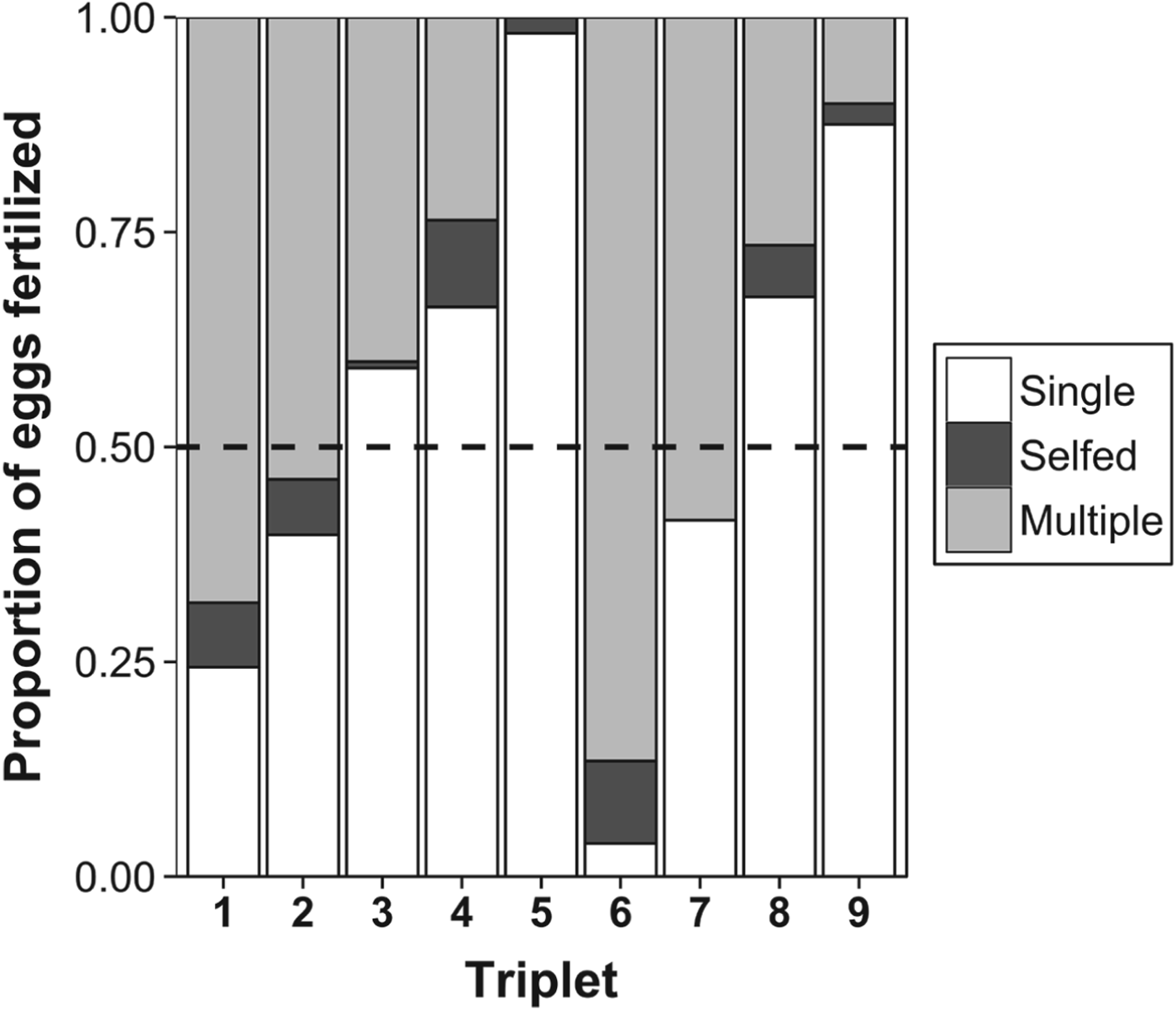
In total, 1439 coracidia were typed, of which only 50 were selfed (3·5%). In 9 of the 14 triplets, the available microsatellite loci allowed us to unambiguously distinguish offspring sired by the two competitors from each other and from selfed offspring. Worms from the same multiply infected fish were used in more than one triplet; for the 9 triplets, worms were taken from 6 multiply infected fish. Thus, in a strict sense one might not consider all triplets statistically independent. However, we do not believe that worms from the same fish are necessarily likely to perform similarly, given that (i) there can be considerable size variation between worm individuals from the same fish (Heins et al. Reference Heins, Baker and Martin2002) and that (ii) fertilization success also depends on the competitor and the focal worm, which were independent across triplets. For example, in triplets one and five (see Fig. 2), the ‘multiple’ worms came from the same fish but had very different success in siring eggs (68 and 0%, respectively). Thus, we used the full dataset for the analyses. All statistical analyses were performed with R 3.0.1 (R Development Core Team, Vienna, Austria).
The proportion of the focal worm's eggs that were self-fertilized or cross-fertilized by one of two competing worms. In each of 9 triplets, a worm from a singly infected fish competed with a worm from a multiply infected fish to fertilize the eggs of a third, focal worm. In triplets 1 to 5, the ‘single-infection’ worm was the first one to have access to the focal worm, whereas in triplets 6 to 9 it was the second worm to interact with the focal worm.

We first tested whether the proportion of the focal worm's eggs fertilized by each of the two worms differed from a 50–50 ratio. We performed a chi-square test for each worm triplet, excluding the selfed eggs and only using the outcrossed eggs.
Next, we tested whether two factors affected paternity: (i) the order in which worms were allowed to interact with the focal worm (first vs second) or (ii) whether the worm came from a multiply or singly infected fish. We fit two generalized linear models with logit link functions and quasi-binomial errors, in which proportions are weighted by the total number of eggs analysed per triplet (Wilson and Grenfell, Reference Wilson and Grenfell1997). In the first model, the response variable was the number of eggs fertilized by the first worm as a proportion of the total. If the intercept in this model differs significantly from 0 (i.e. 50% on the logit scale), it would indicate that fertilization success is affected by being the first or second worm to interact with the focal worm. The second model was formulated and tested in the same way, except that the response variable was defined as the proportion of eggs fertilized by the worm from a multiply infected fish.
Body size affects attractiveness in S. solidus (Lüscher and Wedekind, Reference Lüscher and Wedekind2002; Lüscher and Milinski, Reference Lüscher and Milinski2003). Worms were therefore size-matched within triplets to limit the impact of body size per se on paternity patterns. We nonetheless checked whether remaining size differences could have influenced our results (e.g. the largest size difference within a triplet was 18·5 mg or, in relative terms, 6% of the larger worm's weight). For each triplet, we calculated a relative weight difference between the competing worms as (w1−w2)/wf where w1, w2 and wf are the weights of the two competing worms and the focal worm, respectively. This can be thought of as the weight difference expressed as a per cent of the focal worm's weight. We checked whether it was a significant covariate in the two GLM models. Data were deposited in the Dryad online repository (http://doi.org/10.5061/dryad.v7b3n).
RESULTS
In 8 of the 9 triplets, the ratio of eggs fertilized by the two competing worms differed significantly from 50% (χ 2 1>5·1, P<0·05 for 8 of 9 tests; Fig. 2). However, worm order did not affect fertilization success (54% fertilized by the first worm [95% CI: 33–74%], t = 0·38, P = 0·71), nor did being from a multiply infected fish (35% fertilized by the worm from the multiply infected fish [95% CI: 19–55%], t = −1·49, P = 0·17) (Fig. 2). Finally, the relative weight difference between the first and second worm did not affect the probability of fertilization by the first worm (t = −0·29, P = 0·78) nor, in the second model formulation, did the size difference between the ‘single-’ and ‘multiple-infection’ worm affect the probability of fertilization by the worm from a multiply infected fish (t = −0·48, P = 0·64).
DISCUSSION
In our experimental triplets, we found the fertilization success of competing worms to generally depart from the 50–50 null expectation, sometimes very significantly, with one worm fertilizing nearly 100% of the focal worm's eggs. We tested three factors that might explain this variation (density in the fish host, mating order and body size), and we discuss them in turn.
We did not find evidence that S. solidus worms originating from multiple infections were better sperm competitors than worms originating from single infections, despite suggestive evidence that sex allocation in S. solidus originating from multiply infected fish may be adjusted away from female, egg-producing tissue (Schjørring and Lüscher, Reference Schjørring and Lüscher2003; Dörücü et al. Reference Dörücü, Wilson and Barber2007). This suggests that: (i) plastic sex allocation in response to worm density in the second intermediate host, does not occur, or at least not in the population we studied, which was not the same as in the evocative previous studies; or (ii) that worms from multiple infections may invest relatively more in male function in the presence of potential higher sperm competition, but due to resource limitations as a result of crowding in the fish host, absolute investment is not higher than for worms from single infections. Resource limitations due to crowding can also negatively impact the investment in female tissue in worms from multiple infections, making them less attractive partners (Schjørring, Reference Schjørring2009) and perhaps reducing reciprocal sperm exchange.
Copulation order is important for paternity in many organisms (Birkhead and Hunter, Reference Birkhead and Hunter1990), but our results indicated that the order in which a worm mated with the focal worm (first or second) does not significantly affect its fertilization probability. Schistocephalus solidus possesses a sperm storage organ (seminal receptacle) located relatively deep in the parenchyma, and it is very likely to be inaccessible to the male copulatory organ (Dubinina, Reference Dubinina1980), limiting the ability of a later worm to displace the sperm of a previous partner. Although we did not observe order effects, paternity is not necessarily a ‘fair raffle’ (Parker, Reference Parker1990) in which a male's fertilization probability simply depends on the proportion of his sperm in the female reproductive tract. In fact, the considerable variability in fertilization success within triplets is suggestive of alternative mechanisms influencing paternity, such as cryptic female choice or genetic compatibility between mating pairs.
Body size plays an important role in mate choice in S. solidus (Lüscher and Wedekind, Reference Lüscher and Wedekind2002), and reciprocal sperm exchange seems to depend on donor and acceptor being of similar size (Lüscher and Milinski, Reference Lüscher and Milinski2003). To control for this, we size matched the worms within each triplet. We found no evidence that the remaining size differences between competing worms affect the probability of fertilization. Thus, worms may vary in male quality independently of their body size. It would be worthwhile to quantify the relationship between size, density in fish and sex allocation to verify this, but also to assess the effect of our size-matching protocol. Given that crowding reduces the average size of worms from multiple infections (Heins et al. Reference Heins, Baker and Martin2002), by size matching we may have competed relatively big worms (for a multiple infection) against relatively small worms (for a single infection). Whether this affected paternity patterns likely depends on whether sex allocation scales with body size differently in worms from singly vs multiply infected hosts.
One limitation in our study was that only eggs that successfully hatched after exposure to light could be assigned to a sire. This could influence our results if the eggs fertilized by different sires have different hatching rates or phenologies. For example, a worm's fertilization success would be underestimated if the eggs it sires hatch at a lower rate or if they tend to hatch later, many hours after the initial light exposure, so that they would not be collected for typing. Analogous concerns have been raised about measuring selfing rates in S. solidus (Lüscher and Milinski, Reference Lüscher and Milinski2003; Benesh, Reference Benesh2013). The ability to experimentally induce massive, synchronous hatching in S. solidus (Dubinina, Reference Dubinina1980) suggests that variable hatching phenologies is an unlikely cause of the high variance in paternity. Differences in hatching rates, on the other hand, is common between clutches (e.g. Wedekind et al. Reference Wedekind, Strahm and Schärer1998; Christen et al. Reference Christen, Kurtz and Milinski2002), implying that sire-dependent hatching may be an important factor skewing paternity. While the outcome of sperm competition may be best measured as fertilization success, the fitness ultimately gained through the male function also depends on the viability of the sired offspring. Thus, it would be interesting to determine to what extent egg hatching is determined by the sire, the dam, or their compatibility.
In conclusion, we found substantial variation between individuals in their ability to fertilize the eggs of a partner under competition, but we did not find paternity to be influenced by copulation order or the density experienced in the intermediate host. Even if the skew in paternity is entirely random, it can have important evolutionary consequences, like favouring female-biased sex allocation (Greeff et al. Reference Greeff, Nason and Compton2001). More generally, high variance in male fitness implies (i) a reduced effective population size with likely lower genetic diversity (Criscione and Blouin, Reference Criscione and Blouin2005), and (ii) a high opportunity for sexual selection on traits influencing paternity (Arnold and Wade, Reference Arnold and Wade1984). It would be interesting to examine whether this result holds under more realistic breeding conditions, such as when worms simultaneously compete with multiple individuals for fertilizations. As S. solidus is an important model system for the reproductive behaviour and biology of helminths (Barber and Scharsack, Reference Barber and Scharsack2010), additional work to identify the traits and the environmental conditions shaping male reproductive success would be worthwhile.
ACKNOWLEDGEMENTS
Thanks to M. Kalbe and P. Jakobsen for collecting the fish and to M. Kalbe and B. Wölfing for helpful comments on an earlier draft of the manuscript. This work was supported by the Max-Planck Society.