Implications
Fibre is of vital importance for endothermy in mammals. The impact of husbandry by humans, principally in shearing, modifies the thermoregulation capacity. This review highlights the role of hair for their thermoregulation in the fine fibre-producing South American camelids. Although fleece removal could be beneficial as preventative measure against heat stress, an adverse effect under cold conditions may arise from excessive heat loss following shearing. This impact depends on the length of residual fibre with shorter fibres producing poorer insulation. There is, therefore, potential for welfare considerations to conflict with industrial demands for fibre length or homogenous quality.
Introduction
Hair fibre, synthesised from follicles located on the external integumental surface of the body (Galbraith, Reference Galbraith2010a), is commonly regarded as a unique mammalian feature. It is assumed that mammalian hair evolved about 200 million years ago (Ruben, Reference Ruben1995; Meng and Wyss, Reference Meng and Wyss1997; Grigg et al., Reference Grigg, Beard and Augee2004). The recent identification of reptilian genes encoding hair keratin-like proteins revealed a new insight into the evolutionary origin of hair (Eckhart et al., Reference Eckhart, Valle, Jaeger, Ballaun, Szabo, Nardi, Buchberger, Hermann, Alibardi and Tschachler2008).
Several functions have been attributed to hair fibre including barrier to cutaneous water loss, mechanical protection against abrasion of the skin, camouflage or display through hair pigmentation and an important role for endothermy (Grigg et al., Reference Grigg, Beard and Augee2004). Hair fibre in mammals has some apparent advantages for thermoregulation over scales as found in ectotherm reptiles as it allows a more flexible adaptation of the body surface to environmental conditions. In particular, air with its minimal thermal conductivity is trapped within (medullation) and between hairs resulting in improved insulation.
In the process of domestication by humans, some species have been selected for their hair characteristics. Usually, commercialised animal fibres are divided according to their origin into wool (sheep) and fine fibre (e.g. goats, camels, South American camelids (SACs) and yak). The artificial selection resulted in marked changes with regard to follicle number, type, distribution, growth and even natural shedding (Allain and Renieri, Reference Allain and Renieri2010; Antonini, Reference Antonini2010; Galbraith, Reference Galbraith2010a). The impact of these genetic manipulations on the adaptation and acclimatisation of the animals is not completely understood. This review focuses on the fine fibre-producing SACs and the role of hair for their thermoregulation. Emphasis will be on the relationship between integumental characteristics and thermoregulation.
Temperature regulation
The energy budget for an animal with fur depends on many factors, and several general models have been proposed including the special role of the hair coat (e.g. Walsberg et al., Reference Walsberg, Campbell and and King1978; Turnpenny et al., Reference Turnpenny, McArthur, Clark and Wathes2000).
Thermoregulation is part of a homoeostatic mechanism related to energy metabolism as it keeps the organism at optimum operating temperature within certain boundaries, even when the surrounding temperature is very different. In mammals, endothermic homoeothermy generally results from a combination of high resting, aerobically supported heat production rates (about five- to tenfold that of reptiles) in all soft tissues and sufficient insulation to retard excessive heat loss (Ruben, Reference Ruben1995; Grigg et al., Reference Grigg, Beard and Augee2004).
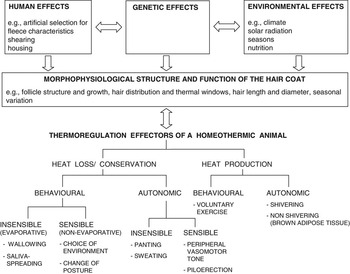
A schematic overview on thermoregulatory mechanisms including the role of fibre is given in Figure 1. These mechanisms can be divided into those concerned with the modulation of the rate of heat production and those modulating the rate of heat flow into or out of the organism (Bligh, Reference Bligh1998). The processes of energy transfer include the sensible heat transfer (flow of energy into or out of the organism by convection, conduction or radiation) and the insensible heat transfer through evaporation (energy transfer from the organism to the environment). During evaporation, a thermal gradient through the peripheral body tissues from the core to the skin is created or enhanced. Evaporative cooling involves the transfer of water to water vapour, which requires 2443 J/g of water converted. The rate of sensible heat transfer through a thermal gradient depends on the magnitude of the gradient, the thermal conductivity of the intervening masses and the size of the area over which the heat transfer occurs. The evolution of subcutaneous (layer of fatty tissue) or supercutaneous (hair or feathers) thermal insulation influences the flow of heat down the thermal gradient from the organism to the environment (Walsberg et al., Reference Walsberg, Campbell and and King1978; de Lamo, Reference de Lamo1990; Schmidt-Nielsen, Reference Schmidt-Nielsen1997; Bligh, Reference Bligh1998; Jessen, Reference Jessen2001).
Schematic overview on effects acting on thermoregulatory mechanisms in a homoeothermic animal including the particular role of the haircoat (modified after Bligh (Reference Bligh1998)).

The capacity for piloerection by muscles at the base of the hairs allows the variation of the supracutaneous insulation provided by still air trapped in the hair coat, thus changing the area of the hairs relative to the skin (Bligh, Reference Bligh1998), comparable to feathers in birds (Gerken et al., Reference Gerken, Afnan and Dörl2006).
Specific integumental characteristics in SACs related to thermoregulation
SACs originate from habitats with temperature extremes ranging from about −10°C to 30°C. The wild lamoids vicuña (Vicugna vicugna) and guanaco (Lama guanicoe) survive in a broad range of different harsh climatic conditions ranging from the Puna highlands of the Andes and altitudes above 3500 m to the sea coast. The domestic lamoids, llama (Lama glama) and alpaca (Lama pacos) have shown themselves to be able to adapt to very different climatic conditions all over the world.
During evolution, SACs have developed several integumental characteristics to allow adaptation to environmental changes (Atlee et al., Reference Atlee, Stannard, Fowler, Willemse, Ihrke and Olivry1997; Fowler, Reference Fowler1998). It is notable that in wild lamoid guanaco and vicuña genotypes, the hair coat is formed by two types of hair – the coarse outer guard hairs and a finer undercoat, which is typical of the ‘double coat’ found in other undomesticated mammalian species. In contrast, variations in coat morphology are observed in the domesticated llamas (L. glama) and alpaca (L. pacos) that exhibit variably double coat and predominantly single coat, respectively. Further details of hair follicle morphology in SACs are given elsewhere (Antonini, Reference Antonini2010). The double coat may be hypothesised to represent a specific adaptation to the harsh environment in which longer thicker guard hair on the fleece surface may promote shedding of water and also act as a physical barrier against wind. The major outcome is, thus, the protection of the underlying finer undercoat and skin and the reduction of body heat loss.
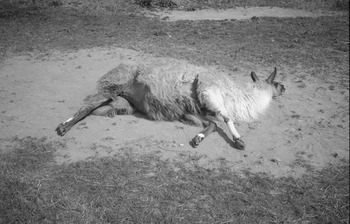
In SACs, the distribution of the hair coat across the body is not homogenous, and several ‘thermal windows’ (Figure 2) can be identified at the ventral abdomen, axillary space and inside the thighs with fewer hair follicles, shorter hair or thinner skin (Fowler, Reference Fowler1994). Morrison (Reference Morrison1966) estimated for a male guanaco the surface areas with fur of different thickness (Table 1). About 40% of the guanaco skin was covered by heavy fur, but almost 20% was nearly bare allowing to modulate heat dissipation (Morrison, Reference Morrison1966). Parallel differences in dermis thickness were described by Atlee et al. (Reference Atlee, Stannard, Fowler, Willemse, Ihrke and Olivry1997) for the llama. The average dermal thickness was 3.1 mm. The thickest dermis was found for the neck with 4.6 and 5.1 mm for the dorsal and lateral aspects of the neck, respectively. Ventral areas were covered by a much thinner dermis of 2 to 3 mm.
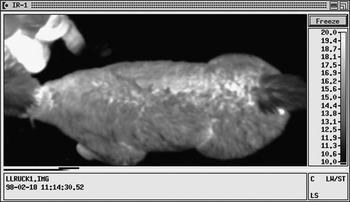
During natural rolling behaviour, the ‘thermal windows’ at the ventral abdomen, axillary space and inside the thighs with fewer hair follicles, shorter hair or thinner skin are clearly visible. Lamoids have developed behavioural strategies to modify heat loss by adopting specific postures according to ambient conditions and thus closing or opening the ‘thermal windows’.

Proportions of surface areas with pelage of different thickness in a guanaco (Lama guanicoe; from Morrison, Reference Morrison1966).

The density of the hair varies with body region, with the thickest fibre on the back and the sides, and follicles that produce the hair are oriented in a sharp oblique angle (Atlee et al., Reference Atlee, Stannard, Fowler, Willemse, Ihrke and Olivry1997). It is suspected that this pattern provides insulation and protection to extreme climatic conditions. This marked angulation of the hair follicle is in contrast to sheep in which the follicles are generally orientated almost perpendicular to the skin surface (Atlee et al., Reference Atlee, Stannard, Fowler, Willemse, Ihrke and Olivry1997).
Each hair follicle is associated with sebaceous glands, but in lamoids, the production of grease is low in comparison to that of sheep with percentages in raw material ranging between 0.8% and 5% in lamoids v. 10% and 25% in sheep (Dawes, Reference Dawes1973; Duga, Reference Duga1986).
The distribution of the epitrichial sweat glands varies with body location, but the sweat gland are more complex and productive in areas of the ‘thermal windows’ (Atlee et al., Reference Atlee, Stannard, Fowler, Willemse, Ihrke and Olivry1997; de Lamo et al., Reference de Lamo, Lacolla and Heath2001). In llamas, well-developed Arrector pili muscles are associated with larger hair follicles in the areas of long dense haircoat (Atlee et al., Reference Atlee, Stannard, Fowler, Willemse, Ihrke and Olivry1997), whereas they are small and rudimentary in areas with short sparse haircoat (‘thermal windows’).
In contrast to sheep wool, lamoid fibres are mainly medullated (Antonini, Reference Antonini2010). The medulla may be continuous or interrupted, empty or filled (Phan, Reference Phan1994). In coarse fibre, the medulla diameter may range between 0.25% and 0.30% of the fibre diameter. Even in the very fine fibres of vicuña, medulla size was about one-fifth of the fibre diameter. It is assumed that these specific characteristics contribute to the remarkable insulating properties of lamoid fibres. However, the influence of medullation on absorption of water by the fibre and thus its possible impact on the thermoregulative properties of the fibre are not well-known in SACs.
The thermal conductance of winter, summer and sheared pelts of guanacos was measured by guarded hot plate technique (Bulgarella and de Lamo, Reference Bulgarella and de Lamo2005), with thermal conductance defined as the heat flow per unit area per unit temperature difference across the fleece (Harris et al., Reference Harris, Huppi and Gessaman1985). The summer pelage had higher thermal conductance than the winter fleece (1.79 v. 1.64 W/m2 °C), implying that more heat will flow through a surface area of the summer fleece than that in winter fleece per unit difference in temperature. Winter and summer pelage did not differ in hair length, indicating that the better winter insulation was due to a greater hair density and not to longer fibres. It was calculated that fibres longer than 5 cm would not express significant changes in conductance. The highest mean conductance (2.68 W/m2 °C) was found for the axillar and lower flanks, which coincide with the ‘thermal windows’ (Morrison, Reference Morrison1966; Fowler, Reference Fowler1994). Mean heat loss in natural fleece was 1.74 and 2.3 W/m2 °C in sheared pelage, when measured in free convection conditions (Bulgarella and de Lamo, Reference Bulgarella and de Lamo2005).
Acclimatisation and thermotolerance
The resting body temperature of adult llamas and alpacas ranges from 37.5°C to 38.6°C (Fowler, Reference Fowler1998) measured in a neutral or moderately extreme ambient temperature. Normal body temperatures of neonates may be a degree higher than that of the adults (Fowler, Reference Fowler1994). In guanacos, body temperatures were measured by telemetry in winter and summer under natural conditions in Argentine. Body temperatures fluctuated between 37.2°C and 39.7°C in both seasons. The diurnal temperature pattern was characterised by a sinusoidal variation with high body temperatures during the daytime and low ones after the sunset with daily fluctuations larger than 1.0°C (de Lamo, Reference de Lamo1990). In llamas and alpacas, diurnal patterns of core body temperature were found to lag behind the diurnal ambient temperature by 6 to 8 h (Bligh et al., Reference Bligh, Baumann, Sumar and Pocco1975).
Data on thermoneutral zones for camelids appear to lack. Some indirect conclusions may be drawn by studies conducted on sweating. In guanacos, ambient temperatures between 20°C and 33°C were the main stimuli for activation of sweat glands. The total heat loss by evaporation calculated at ambient temperatures of 20°C and 30°C were 11.9% and 37%, respectively, of the standing basal metabolic rate (de Lamo, Reference de Lamo1990; de Lamo et al., Reference de Lamo, Lacolla and Heath2001). Guanacos (de Lamo et al., Reference de Lamo, Lacolla and Heath2001) react with sweating at rather low temperatures from 20°C (with a maximum at 25°C), whereas llamas did not show any water loss from the skin when exposed to 20°C to 25°C (Allen and Bligh, Reference Allen and Bligh1969).
Rosenmann and Morrison (Reference Rosenmann and Morrison1963) concluded from their studies that in guanacos panting occurs under work (e.g. running) but not under heat exposure. In the study by de Lamo (Reference de Lamo1990), guanacos did not change their respiratory rate when exposed to ambient temperatures between 20°C and 30°C. Thus, respiratory water loss appears not to be an important mechanism for heat dissipation in guanacos and the main channel for water loss is evaporation by sweating (de Lamo et al., Reference de Lamo, Lacolla and Heath2001).
SACs have shown themselves to be able to adapt to a broad range of different climatic conditions all over the world. However, they may come under severe heat stress when living in countries with extremely hot summers; animals which die from heat have been reported, for example, from Texas (Rotter, Reference Rotter1991; Fowler, Reference Fowler1994). In a hot climate, adult lamoids may maintain a daytime core body temperature of 40°C (Fowler, Reference Fowler1994). Body temperatures in llamas and alpacas rarely exceed 43.3°C, and animals in severe heat stress may have temperatures of only 41.1°C to 42.2°C. Protein denaturation takes place at temperatures of 45°C to 47°C, causing irreversible defects of tissues and organs (Fowler, Reference Fowler1994).
Alpacas are reported to be more tolerant to heat than llamas. This may be due to the larger body size in llamas compared with alpacas (Navarre et al., Reference Navarre, Heath, Wenzel, Simpkins, Blair, Belknap and Pugh2001), and thus their less favourable relation between body mass and body surface for heat dissipation.
In a study by Gerken et al. (Reference Gerken, Bramsmann and Dörl2003), rectal temperatures and ambient temperatures were taken in 14 adult female, unshorn llamas (ambient temperatures between −0.4°C and 25.1°C). The fibre lengths varied between 70 and 240 mm, with an average of 125.7 mm. Spearman correlation coefficients between fibre length and rectal temperatures were not significant. The highest values were obtained for the correlation with fibre length of the shoulder (r = 0.49) and belly (r = 0.28); the lowest for neck (r = 0.13), back (r = −0.14) and thigh (r = −0.04). The higher correlations with shoulder and belly hair length might underline the importance of these regions for thermoregulation as thermal windows (Morrison, Reference Morrison1966; Fowler, Reference Fowler1994).
Behavioural adaptation
Behavioural modification of the hair coat aiding thermoregulation includes piloerection by small muscles at the base of primary follicles. It is open to question, however, to which extent camelids are using piloerection to minimise cold or heat stress.
Lamoids have developed behavioural strategies to modify convective heat loss by adopting specific postures according to ambient conditions. The behavioural patterns include the closing or opening of the ‘thermal windows’, thus decreasing heat loss through radiation and convection (Atlee et al.,Reference Atlee, Stannard, Fowler, Willemse, Ihrke and Olivry1997). In Guanacos de Lamo et al. (Reference de Lamo, Sanborn, Carrasco and Scott1998), calculated energy savings of 67% attributed to posture. When the ambient temperature (Ta) was between 0°C and 10°C, the animals decreased the area of the thermal windows to 5% to 7% of the total surface area, whereas at temperatures above 10°C, animals increased the area up to 22%. When Ta was below 0°C to 1°C, the guanacos tended to bed. In llamas, Milz (Reference Milz2001) observed more lying with elongated neck under high temperatures.
Different behavioural activities are used to aid in heat dissipation including seeking shade or ventilated areas, orientation to minimise radiant heat gain when lying in the sunlight or recumbency to cover the thermal windows (Fowler, Reference Fowler1994). Lamoids are described to readily use water for cooling (Rotter, Reference Rotter1991). Lamoids use dry sand, dust or bare places for rolling behaviour. Subsequent to rolling, they exhibit body shaking (Pilters, Reference Pilters1954). The rolling behaviour may also serve to improve the thermoregulatory properties of the pelage by removing adherent sweat, grease or dirt and aligning the fibre, comparable to dustbathing in birds (Gerken et al., Reference Gerken, Afnan and Dörl2006).
Fleece surface temperature
The knowledge of the surface area of an animal is important to determine the heat loss for a particular environment. In adult guanacos (80 to 100 kg), the surface area varied from 1.68 to 1.92 m2 (de Lamo, Reference de Lamo1990).
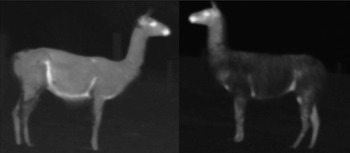
The surface temperature of an animal can be measured by the radiated electromagnetic waves. Infrared thermography offers an excellent non-invasive tool for measuring this infrared radiation on the boundary layer of an animal (de Lamo, Reference de Lamo1990; Gerken, Reference Gerken1996; Gerken et al., Reference Gerken, Afnan and Dörl2006; McCafferty, Reference McCafferty2007; Schwalm et al., Reference Schwalm, Erhardt, Gerken, Moors and Gauly2008). Figure 3 shows the thermal windows at the ventral abdomen, axillary space and inside of the thighs emitting higher infrared radiation.
Infrared thermography is an excellent non-invasive tool to measure the infrared radiation on the boundary layer of the hair coat. In non-sheared animals (right side), heat dissipation is mainly restricted to the ‘thermal windows’ (lighter shades at the ventral abdomen, axillary space and inside of the thighs), whereas more heat is radiated across a larger surface in sheared camelids (left side). False colour pictures taken in llamas with a scanner operating in the 8 to 12 μm band of the infrared spectrum, with light shades indicating higher temperatures.

Surface temperature depicts the thermal energy that flows between the outer surface of the body and the environment. In a study in guanacos kept between −11°C and 27.5°C, the mean surface temperature (thermal imaging camera, measuring infrared radiation between 2 and 14 μm) decreased with decreasing ambient temperature until this reached 0°C. Below that point, mean surface temperature remained nearly constant at 6°C to 8°C. In the model proposed by de Lamo (Reference de Lamo1990), radiative heat loss was calculated to fluctuate between 58.8 W/m2 at −11°C and 23.3 W/m2 at 27.5°C in a 90 kg guanaco.
McArthur (Reference McArthur1991) considered the heat exchange on the coat surface in sheep kept outdoors during night. The calculated flux density of latent heat gained at the coat surface on the back of a sheep could exceed 30 W/m2. When the surface temperature cools to the dew point temperature of the air, condensation onto the hair coat will occur and the fleece may accumulate up to 0.1 kg of water during the night.
Temperature within the fleece
Analysis of heat flow through animal coats is complicated due to the involvement of several modes of heat transfer. In addition, wind may open the fleece and reduce the insulation of the hair coat (Turnpenny et al., Reference Turnpenny, McArthur, Clark and Wathes2000).
A fleece contains air spaces with water vapour that is in equilibrium with the water either absorbed or adsorbed on the wool fibres (Gatenby et al., Reference Gatenby, Monteith and and Clark1983), with the latent heat of vaporisation of water having an important effect on the energy budget of the animal (Walsberg et al., Reference Walsberg, Campbell and and King1978). When the skin is covered by a heavy pelage, passive transfer of water vapour across the skin is negligible. In that case, the high humidity of the air immediately above the skin prevents significant water vapour transfer unless the fur is strongly ruffled. However, in the thermal windows, the hair is so short that both sensible and insensible water loss is possible (de Lamo et al., Reference de Lamo, Lacolla and Heath2001). Heat dissipation from the fleece is inhibited if the fibre coat is dirty, matted, excessively long or wet (Fowler, Reference Fowler1994).
Solar radiation may penetrate into the coat and the depth of penetration depends on the colour (Walsberg et al., Reference Walsberg, Campbell and and King1978; Hansen, Reference Hansen1990; Turnpenny et al., Reference Turnpenny, McArthur, Clark and Wathes2000) and the density of the coat. However, the fleece does not represent a purely physical system because the microclimate next to its skin is subject to control by the animal. Llama skin has been shown to have several particular features, including a very thick dermis with marked differences between dermis layers. The dermis also contains a prominent cutaneous vascular plexuses (Atlee et al., Reference Atlee, Stannard, Fowler, Willemse, Ihrke and Olivry1997), which may play a role in tissue resistance during heat exchange.
Gatenby et al. (Reference Gatenby, Monteith and and Clark1983) measured temperature and relative humidity in a sheep fleece of 7 cm thickness at different distances from the skin and found that on the surface of the fleece the temperature closely followed the air temperature, but deeper in the fleece there was much less change. During rain, the sensible heat loss from the body is increased because the thermal insulation of the fleece is reduced as air within the fleece is displaced by water. Sheep wool has been reported to absorb a considerable amount of water (1 kg fleece is assumed to absorb 2 kg of water), with the water-absorbing capacity being modified by adherent suint and grease (Gatenby et al., Reference Gatenby, Monteith and and Clark1983). However, comparable studies are lacking for lamoid fibre with its much lower content of grease.
Modification of the fleece
Natural moult
SAC hair is subjected to seasonal changes, such as shedding or moult, allowing morphological adaptation to seasonal climatic changes. During moult, the hair number, diameter or growth intensity are modified (Galbraith, Reference Galbraith2010b). While wild lamoids (guanaco, vicuña) are reported to shed annually (Fowler, Reference Fowler1998), adult male llamas kept under natural light and ambient conditions in Scotland have been reported as shedding only partially, with 30% to 50% of the fibres being shed over an extended period (Russel and Redden, Reference Russel and Redden1994).
Artificial selection
Manipulations of the fleece may influence the adaptive function of hairs thus imparing the thermoregulation capacity of the hair. In SAC, artificial selection has produced domestic genotypes differing in hair follicle morphology (Allain and Renieri, Reference Allain and Renieri2010). These include the Suri and Huacayo genotypes of alpaca that differ in follicle number, the ratio of primary/secondary follicles and the occurrence of natural shedding (Antonini, Reference Antonini2010). There are casual reports of SAC keepers on higher delicacy of the Suri variety as regards growth, diseases or mortality, and it is postulated that the curly hair might have less protective properties against the harsh Andean climatic conditions.
Shearing
Heat stress
The specific integumental characteristics described for SAC indicate that they have developed adaptation mechanisms particularly suited for cooler climates. Accordingly, hyperthermia might become a problem in hot, humid areas outside of their orginal habitat (Fowler, Reference Fowler1994).
In several studies, the beneficial effect of shearing on thermoregulation against heat stress was shown. In a study by Navarre et al. (Reference Navarre, Heath, Wenzel, Simpkins, Blair, Belknap and Pugh2001), two groups of intact male alpacas were compared when kept under summer climate in central Alabama, USA. The first group (n = 7) was sheared to within 2 cm of their skin, the second remained not sheared. Clinical heat stress was not evident in any animals during the study. However, significant differences between treatment groups were found in rectal temperature, sodium concentration and blood urea nitrogen suggesting that non-sheared alpacas were less heat tolerant than sheared ones.
Similarly, Heath et al. (Reference Heath, Navarre, Simpkins, Purohit and Pugh2001) exposed sheared (within 2 cm of their skin) and non-sheared male alpacas to summer climate in the United States with ambient temperatures between 22.5°C (am) and 31.5°C (pm) and relative humidity between 79.6% and 60.2%. Thermographic studies of the scrotum revealed cooler surface temperatures in sheared v. non-sheared animals. Temperatures of the right medial thigh of the sheared animals were 0.9°C or 1.6°C cooler than that of non-sheared animals in the morning or in the afternoon, respectively.
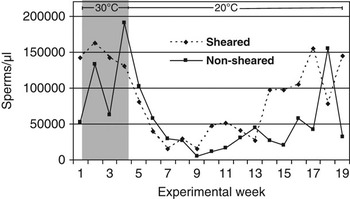
These results agree with the experiment by Schwalm et al. (Reference Schwalm, Erhardt, Gerken, Moors and Gauly2008). Ten fertile male llamas, five unshorn and five shorn, were exposed for 4 weeks to an ambient temperature of 30°C, followed by a recovery period at 20°C to study the possible beneficial influence of shearing. Parameters of thermoregulation (e.g. infrared thermography, physiological parameters) and reproduction (e.g. sperm quality and quantity) showed that heat dissipation was improved in shorn animals compared with unshorn controls. Images of infrared thermography revealed that in shorn animals the heat exchange took place over the entire body surface and was not restricted to the thermal windows only. During heat exposure, all animals were able to maintain their body temperature within the normal range. However, animals had a significantly increased respiratory rate, indicating that the adaptation of breathing rate is an important mechanism for thermoregulation in llamas. During the heat period, the sperm concentration and the sperm motility declined significantly (Figure 4).
Spermdensity obtained from sheared (n = 5) and non-sheared (n = 5) male llamas (Lama glama) subjected to heat stress. During experimental weeks 1 to 4 (grey shade), animals were exposed to 30°C, followed by a recovery period at 20°C (from Schwalm et al., Reference Schwalm, Erhardt, Gerken, Moors and Gauly2008).

Low environmental temperatures
Seasonal changes may be simulated by shearing and removal of fleece. Shearing may be expected to have a severe impact on thermoregulation capacity of the animal depending on age, shearing frequency, season (e.g. ambient climatic conditions), shearing technique (machine v. hand), and thus, the length of resulting residual hair. As shearing is an essential activity in the harvesting of fibre of SAC, it is important to be aware of the impact of the methodology used on the thermoregulation in these animals.
Shearing changes the conditions of the protective layer, resulting in a loss of thermal conductance. The mean heat loss in natural guanaco pelt was 1.74 W/m2 °C compared to 2.3 W/m2 °C in sheared pelage, when measured in free convection conditions. When the insulative effect of the fleece is reduced, the increased heat loss may be compensated by a higher metabolic rate (de Lamo, Reference de Lamo1990) according to climatic conditions.
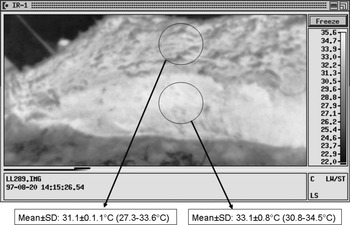
For the study of the influence of residual fibre length in llamas, different shearing machines and shearing depth were applied (Gerken and Snell, Reference Gerken and Snell1998). Two machines were used: a sheep shearing machine leaving a short residual fibre length of 4 to 11 mm and a more recently developed camelid shearing machine with a longer residual fibre length of 10 to 40 mm. Four adult females were shorn. The animals served as their own control with one side shorn with the sheep machine, the other side with the camelid machine. The second (control) group consisted of four unshorn adult females. Infrared thermography equipment was used for the non-invasive measurement of superficial body temperature (Thermovision® 900 System, AGEMA Infrared Systems AB, Danderyd, Sweden) with a high resolution of 0.1°C, accuracy of ±0.5°C and temperature measurement range from −30°C to 1.500°C. A scanner operating in the 8 to 12 μm band of the infrared spectrum was used as infrared detector. Further details are provided elsewhere (Gerken, Reference Gerken1996). The traits recorded were residual fibre length, surface body temperature by infrared thermography and deep body temperature as measured by rectal temperature. The rectal temperature of the animals was taken at monthly intervals using a digital thermometer of 0.01°C precision. Immediately after shearing (Figure 5), the mean difference in surface temperatures between the sides shorn by sheep or camelid machine in the same animal was about 2°C at 25°C ambient temperature. Shearing resulted in a very evenly distributed hair length of about 5.8 mm (range between 3 and 10 mm). After 6 months, the difference between both body sides was very small (Figure 6).
Superficial temperature (measured by infrared thermography with scanner operating in the 8 to 12 μm band of the infrared spectrum) for body sides in a female llama shorn with camelid machine (right body side, above) and sheep machine (left body side, below) immediately after shearing (ambient temperature 25°C). The shorter residual fibre obtained by the sheep machine results in higher surface temperatures with a difference of about 2°C between shearing machines.

Superficial temperature (measured by infrared thermography with scanner operating in the 8 to 12 μm band of the infrared spectrum) for body sides in a female llama shorn with sheep machine (right body side, above) and camelid machine (left body side, below) 6 months after shearing (ambient temperature 7°C). The difference between body sides is very small due to the regrowth of the fibre.

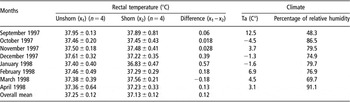
The recording of the rectal temperature revealed the impact of residual fibre length on core body temperature (Table 2). At lower ambient temperatures (December and January), core body temperature tended to be lower in shorn animals (P = 0.1, one tailed Mann–Whitney U-test). However, the overall means for unshorn and shorn animals were not significantly different (37.25 ± 0.12 v. 37.13 ± 0.12; P = 0.25).
Influence of fleece length on mean rectal temperatures in adult female llamas, Germany (mean ± s.d.; modified after Gerken and Snell, Reference Gerken and Snell1998)

Ta = ambient temperature.
It is concluded that the residual fibre length has an important role in maintaining endothermy in fine fibre-producing animals such as SAC. However, this impact largely depends on rates of regrowth of fibre. There exist genetic or species differences, as suggested by studies of Russel and Redden (Reference Russel and Redden1994) showing that alpacas and llamas differed in hair growth rate under European conditions.
Wild SACs
The coexistence of wild and domestic SAC species in the same habitat in its autochthonous regions of South American is probably unique. Chronicles on the Inca empire describe how populations of both vicuñas and guanacos were captured and sheared once in every 3 to 4 years (Flores Ochoa, Reference Flores Ochoa1994), but the ancient shearing techniques are not documented. Today, there are different approaches, for example, in Argentine, Bolivia and Peru ranging from a concept of wildness, including protection of landscape, animal welfare and genetic diversity, to breeding of vicuñas in captivity (Laker, Reference Laker2006).
As outlined before, wild and domestic species differ in their hair coat morphology, moult and fibre growth that makes them probably more vulnerable to harvesting of fibres than their domestic counterparts. The long-term impacts of capture, shearing and release of wild lamoids are not well studied (Bonacic et al., Reference Bonacic, Feber and Macdonald2006). The harsh climate of the Altiplano may cause severe cold stress to sheared animals with insufficient protection of an insulating fleece (Eltringham and Jordan, Reference Eltringham and Jordan1981). Bulgarella and de Lamo (Reference Bulgarella and de Lamo2005) calculated that fibres longer than 5 cm would not express significant changes in conductance for sheared guanaco pelt. However, usual sheep-shearing machines would leave residual fibre lengths of about 1 cm and less. When the insulative effect of the fleece is reduced, the increased heat loss may be compensated by a higher metabolic rate (de Lamo, Reference de Lamo1990) according to climatic conditions. But, this compensation mechanism requires the intake of an adequate energy content in the diet, which is frequently not provided by the available native forage. In addition, climatic conditions in the Altiplano might be subject to unpredictable changes (e.g. El Niño-Southern Oscillation phenomenon).
For the further development of a conservation concept that includes the sustainable use of wildlife products from vicuña and guanaco, the impacts of shearing techniques and the consideration of animal welfare aspects with regard to thermoregulation require further studies.
Conclusions
Fibre is of vital importance for endothermy in mammals. The impact of husbandry by humans, principally in removal of hair coat, modifies the thermoregulation capacity in SACs. Although fleece removal could have a beneficial effect on thermoregulation as preventative measure against heat stress, an adverse influence on thermoregulation under cold conditions is likely to arise from excessive heat loss following shearing. This impact is dependent on the length of residual fibre with shorter fibres producing poorer insulation and potentially conflicting with welfare of the animals, particularly in young animals (e.g. baby alpaca production) and wild SACs. In deer, more heat was lost by convection from a square metre of surface of a small animal than from a larger animal (Moen, Reference Moen1973). Assuming a similar proportion in lamoids, young animals and also wild SACs might be subject to high heat loss when sheared under unfavourable climatic conditions, in particular if they cannot compensate the heat loss by increase in metabolic rate as in the case of a low energy diet (de Lamo, Reference de Lamo1990). There is, therefore, potential for these welfare considerations to conflict with industrial demands for longer fibre length and/or homogenous quality. In the woollen process, shorter fibre of 4.5 to 5 cm is usually employed, unlike the 7 to 8 cm, which is the desired length for fibre used in the worsted operation (Patthey Salas, Reference Patthey Salas1994). In SACs, the possible consequences with regard to the impairment of animal welfare are not well understood and the impact of residual fibre length for subsequent fibre regrowth and quality requires further study.
Acknowledgement
This review is based on an invited presentation at the 59th Annual Meeting of the European Association for Animal Production held in Vilnius, Lithuania during August 2008.