Introduction
The nosological status of delusional disorder (DD) has been debated since Kraepelin (Reference Kraepelin1921) described paranoia as an illness distinct from schizophrenia (SZ). In an influential paper, Kendler (Reference Kendler1980) reviewed the existing evidence on DD according to a number of antecedent, concurrent and predictive validators in order to answer the question of whether DD is a subtype of SZ, a subtype of affective illness or a distinct nosological entity. He concluded that although some of the data is consistent with the hypothesis of DD as a subtype of SZ, it is both more plausible and parsimonious to view DD as a distinct syndrome. This view has impregnated the current conception of DD as echoed in the successive editions of the official classification systems.
In the three decades following Kendler's review, there has been a paucity of studies examining the characteristics of DD or their relationship to SZ, this probably due to the low prevalence of DD in psychiatric services (Munro, Reference Munro1988). In fact, only recently two studies have addressed the relationship of DD with SZ. In a longitudinal follow-up study, Marneros et al. (Reference Marneros, Pillmann and Wustmann2012) compared 43 subjects with DD and 42 subjects with paranoid SZ and concluded that each disorder was an independent and separate entity that exhibited differentiated symptoms, course and outcome. The other study (Hui et al. Reference Hui, Lee, Chang, Chan, Lin, Xu and Chen EY2015) compared clinical and neurocognitive variables in 71 first-episode subjects with DD and 71 age-matched subjects with first-episode SZ. It was concluded that there were no meaningful differences among groups in the most of the examined variables. The different results from these studies may be due to methodological concerns such as small sample size (Marneros et al. Reference Marneros, Pillmann and Wustmann2012), diagnostic uncertainty (Hui et al. Reference Hui, Lee, Chang, Chan, Lin, Xu and Chen EY2015; Peralta & Cuesta, Reference Peralta and Cuesta2016) or inadequate comparison group (Marneros et al. Reference Marneros, Pillmann and Wustmann2012; Hui et al. Reference Hui, Lee, Chang, Chan, Lin, Xu and Chen EY2015). A further methodological question, not considered in previous studies, is that when comparing DD with SZ, the heterogeneity of the latter should also be taken into account.
The aims of this study were to contribute to the characterization DD subjects and to add to the relationship between DD and SZ. With these aims in mind, we compared a broad sample of subjects with DD, paranoid SZ and non-paranoid SZ across a comprehensive set of characteristics including demographics, risk factors, premorbid features, illness-related characteristics, index episode variables, delusional-related features, response to treatment and outcome.
Method
Subjects
The study population was recruited from consecutive admissions to the Virgen del Camino Hospital (since 2010 renamed Complejo Hospitalario de Navarra). The psychiatric facility of the Virgen del Camino Hospital has 27 beds for acute psychiatric patients and served a defined population-based catchment area of 300000 inhabitants and the Complejo Hospitalario de Navarra has 54 psychiatric beds serving a catchment area of 550000 inhabitants. The study sample comprised consecutive admissions of psychotic disorders between 1988 and 1996, of which only subjects with a Diagnostic and Statistical Manual of Mental Disorders, fourth edition (DSM-IV APA, 1994) diagnosis of SZ or DD were included in the present study. After 1996 we undertook an ongoing selective recruitment approach from consecutive admissions for specific disorders or conditions (e.g. DDs and first-episode psychoses). Thus, in this study the schizophrenic sample was ascertained between 1988 and 1996 and the DD sample between 1988 and mid 2014. All the subjects underwent the same assessment procedures (see below) and were assessed by one of the authors, each rating approximately half of the subjects. The SZ sample has been used in previous studies of the authors for other aims (Peralta & Cuesta, Reference Peralta and Cuesta2003), but the DD sample has not been previously reported.
To be included in the study, subjects had to fulfil DSM-IV criterion A symptoms for SZ and complete inpatient treatment. Only subjects with high-quality data from several sources, including information provided by a close relative were included in the study. Exclusion criteria were drug abuse confounding diagnosis, demonstrable or suspected brain disease, severe medical disease or intellectual disability. The study sample included 146 subjects with DD, 114 subjects with paranoid SZ and 244 subjects with non-paranoid SZ.
Ethics statement
The study was approved by the local ethical committee, and all subjects or their legal representatives provided informed consent to participate. The authors assert that all procedures contributing to this work comply with the ethical standards of the relevant national and institutional committees on human experimentation and with the Helsinki Declaration of 1975, as revised in 2008.
Procedure
In comparing DD and SZ, and apart from the presence of delusions, we selected characteristics not included in the definition of the disorders, therefore, this being a proper external validity procedure. A total of 52 characteristics were examined across disorders, which were grouped into the following domains (the number of variables within each domain are given in parentheses): demographics (4), risk factors (4), premorbid features (3), illness-related variables (8), index episode variables (6), delusional-related features (20), response to antipsychotic medication (1) and psychosocial functioning (6). Because of the high number of delusional-related features examined, the following subdomains were considered: global measures of delusions (2), dimensions of delusional experience (4), severity of specific delusions (7) and type of predominant delusion (7).
Assessments
Patients were administered a battery of instruments to assess clinical symptoms and diagnoses, which have been described in detail elsewhere (Peralta & Cuesta, Reference Peralta and Cuesta2003). For the present study, the main instrument for assessing most of the clinical variables was the Comprehensive Assessment of Symptoms and History (CASH; (Andreasen, Reference Andreasen1987). The CASH is a semi-structured interview designed to provide a comprehensive information base concerning psychotic and major mood disorders including demographic variables, premorbid features, treatment, course, outcome, 74 sign and symptoms, 12 symptom global ratings and a variety of illness-related features. Because of the information base is broad, the schedule is not wedded to a specific diagnostic system thus permitting to make diagnoses using a wide range of systems including the DSM-IV classification of psychotic disorders. CASH symptoms and diagnoses have shown good to excellent inter-rater reliability in our centre (Peralta et al. Reference Peralta, Moreno-Izco, Calvo-Barrena and Cuesta2013). More specifically, the inter-rater reliability (κ value) of SZ and DD was 0.88 and 0.81, respectively. To minimize criterion and information variance for final research diagnoses, best estimated DSM-IV diagnosis were produced on a consensus basis by the authors using all available information.
Demographics, premorbid adjustment, illness-related characteristics, drug abuse or dependence and Global Assessment of Functioning (GAF) were all rated with the CASH. A positive family history of SZ was examined in the first-degree relatives of the patients by means of the Family History – Research Diagnostic Criteria (Andreasen et al. Reference Andreasen, Endicott, Spitzer and Winokur1977), which served to calculate the familial loading score that takes into account family size and age structure (Sham et al. Reference Sham, MacLean and Kendler1994). Obstetric complications were rated according to the Lewis & Murray (Reference Lewis and Murray1987) scale. Psychosocial stressors (acute plus chronic) before illness onset were rated according to the psychosocial stressors scale from the DSM-III-R (APA, 1987). Cluster A personality disorders were rated using the DSM-III-R checklist features for these disorders (APA, 1987).
Index-episode affective symptoms, i.e. depression, mania, dysphoria, obsessions and anxiety, and lack of insight were all rated with the Manual for the Assessment and Documentation of Psychopathology (AMDP; Guy & Ban, Reference Guy and Ban1982), which rates symptoms from 0 (absent) to 3 (severe). This scale includes three lack of insight symptoms (lack of feeling ill, lack of insight into symptoms, and refusal of treatment) that are highly interrelated, and thus they were collapsed into a single score ranging from 0 to 9.
Among other rating scales, the CASH includes the Scale for the Assessment of Positive Symptoms (SAPS) that served to assess delusions. The SAPS rates 12 types of delusions on a 6-point Liker-type scale. The Dimensions of Delusional Experience scale (Kendler et al. Reference Kendler, Glazer and Morgenstern1983), scored on a 5-point ordinal scale, was used to rate five delusional dimensions, and like other symptoms including delusions, the time period covered for rating the scale was the last month. Scale's inter-rater reliability was assessed in 25 deluded subjects and the intraclass correlation coefficient (ICC) for individual items ranged from 0.64 (bizarreness) to 0.83 (pressure) with a mean ICC of 0.78. As delusions tend to co-occur, dimensions of delusional experience were assessed on the most severe delusion according to the SAPS, and in case of similar prominence of delusions the dimensions were weighted according to the prominent delusions. Bizarre delusions and bizarreness of delusional experience were not considered in the analyses because of circular reasoning since they are a diagnostic criterion of SZ and an exclusionary criterion of DD.
At index episode, patients were treated with antipsychotic medication according to clinical choice and response to treatment was rated at the end of admission using the Clinical Global Impression Improvement Scale (Guy, Reference Guy1976).
Psychosocial functioning was rated over the last year using the GAF scale and the World Health Organization Short Disability Assessment Schedule (WHO/DAS-S; WHO, 1988) plus paid work at two time points: index admission and 1 year after discharge. At 1 year follow-up, 61 subjects were unavailable or refused to participate. Non-completers were more likely to have a diagnosis of DD than SZ (n = 26, 17.8% v. n = 35, 9.8%; χ2 = 6.28, p = 0.012), and non-completers had a non-statistically significant higher lack of insight ratings at index admission than completers [6.21 (s.d. = 2.69) v. 5.60 (s.d. = 2.96), F = 3.31, p = 0.127]. For measures of psychosocial functioning, only those available at 1 year follow-up were included in the analyses.
Statistics
Analyses were conducted in a step-wise process. We first conducted univariate analyses for individual variables across the diagnostic classes of DD, paranoid SZ and non-paranoid SZ. For continuous measures, and as preliminary analyses, Liliefors tests were used to examine whether there were significant departures from the normality assumption. Non-normal variables were log-transformed and one-way analyses of the variance were performed. A χ2 or Fisher's exact test was used to assess the significance of the differences in categorical data, which, if significant, were followed by a series of 2 × 2 analyses. Effect-size estimates for analyses of variance were determined with partial eta squared (η 2 p) (0.01 is a small effect size, 0.06 is a medium effect size and 0.14 is a large effect size) and for χ2 analyses with Cramer's V (0.1 is a small effect size, 0.3 is a medium effect size and 0.5 is a large effect size).
In a second step, we used multivariate logistic regression analyses to examine the independent contribution, within each variable set, of specific variables to the distinction between DD and SZ with and without adjusting for covariates. Last, we also employed logistic regression analysis to examine overall fit indices for the differences between DD and SZ using those variables significantly differentiating among disorders in the univariate analyses.
Because of the exploratory character of this study, results are presented primarily without Bonferroni adjustment of type I error probability. Such an adjustment would have significantly decreased the test power, i.e. the probability of revealing existing differences would be too low. However, subordinate post-hoc comparisons among groups were performed when appropriate using the Bonferroni correction. The significance level was α = 0.05, and all tests were two-tailed. Statistical analyses were performed with SPSS v. 20 (IBM Corp., USA).
Results
Univariate analyses
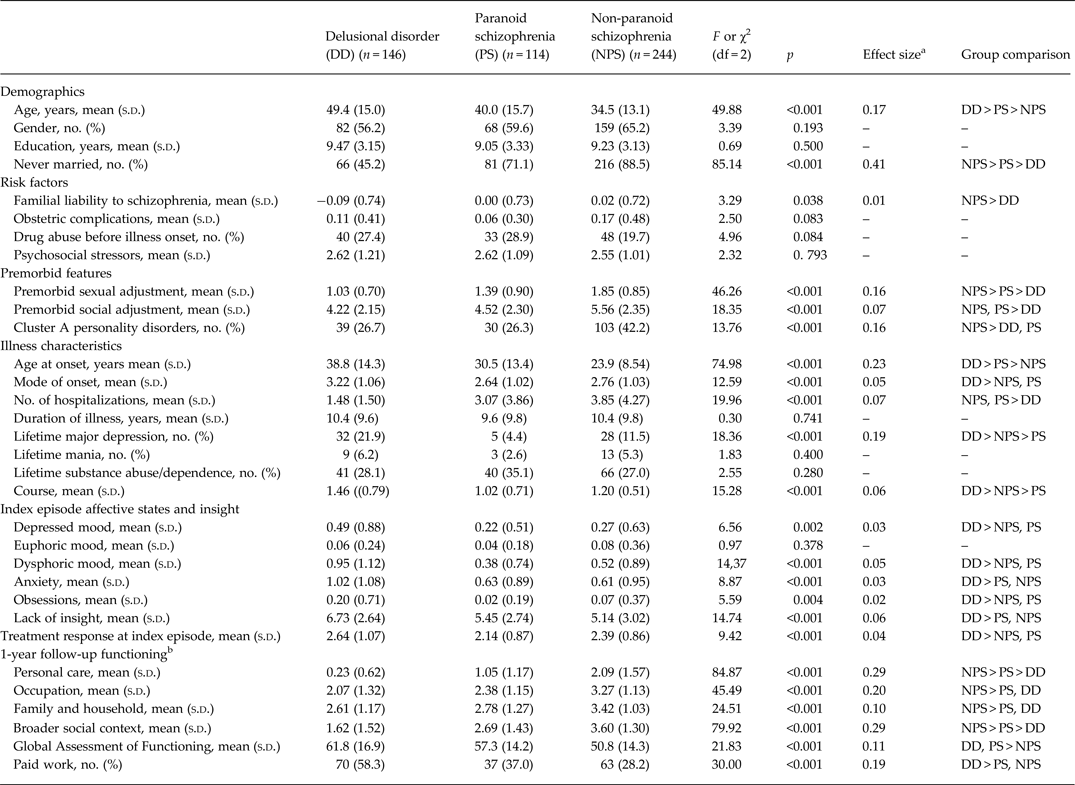
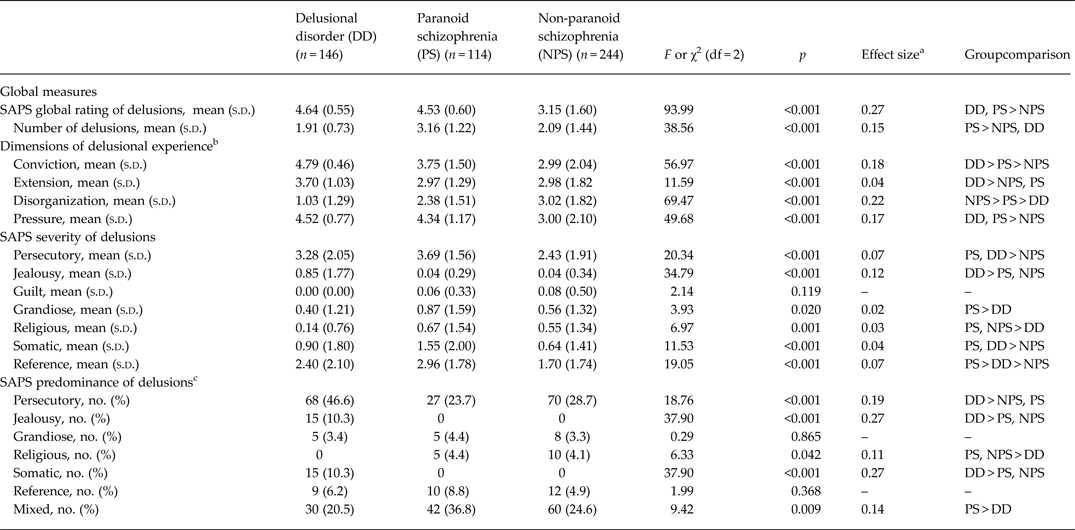
The results of comparing DD with paranoid and non-paranoid SZ across the different variables’ domains are displayed in Tables 1 and 2. Of the 52 examined variables, 40 differentiated DD from paranoid or non-paranoid SZ. These findings indicate that DD and SZ have much more differences than similarities, although on several measures these disorders did not differ. Non-discriminating variables were: gender, years of education, obstetric complications, drug abuse before illness onset, psychosocial stressors, duration of illness, lifetime mania, lifetime drug abuse/dependence, index episode euphoric mood, severity of delusions of guilt, and predominance of delusions of grandiosity and reference.
Demographic, risk factors, premorbid features, illness characteristics, index episode and outcome variables

Except for Global Assessment of Functioning, higher ratings indicate higher impairment.
a Effect size was calculated using η 2 p for continuous variables (large effects ⩾0.14) and Cramer's V for categorical variables (large effects ⩾0.50).
b Assessed in the 443 subjects completing follow-up, 120 with delusional disorder, 100 with paranoid schizophrenia and 223 with non-paranoid schizophrenia.
Delusional features

a Effect size was calculated using η 2 p for continuous variables (large effects ⩾0.14) and Cramer's V for categorical variables (large effects ⩾0.50).
b Assessed only in deluded subjects (n = 458; 146 with delusional disorder, 312 with schizophrenia).
c Only one patient had predominance of delusions of guilt and was excluded from the analyses.
Of the 40 discriminating variables, 29 differentiated DD from the two SZ subtypes, nine variables differentiated DD from non-paranoid SZ and two variables differentiated DD from paranoid SZ. Regarding the position of paranoid SZ relative to DD and non-paranoid SZ, the results were rather clear in that 17 variables did not differentiated between paranoid and non-paranoid SZ and only seven variables did not differentiate between paranoid SZ and DD. The proportion of the variance explained by the predictor variables in differentiating DD from paranoid SZ, non-paranoid SZ and SZ as a whole was 66%, 68% and 67%, respectively (Table 3). This pattern of findings indicated that DD can be differentiated from SZ irrespective of its subtypes and that paranoid SZ was much more similar to non-paranoid SZ than DD.
Overall model fit indices for the differences between delusional disorder (DD) and schizophrenia (SZ)

Risk factors were the variables less discriminating among disorders in that only subjects with DD had significantly lower familial liability to SZ than those with non-paranoid SZ. The group of variables most neatly discriminating DD from the two SZ subtypes was index episode affective states and insight.
Large effect sizes for the differences among groups were observed for demographics (age), premorbid features (premorbid sexual adjustment), illness characteristics (age at onset, lifetime major depression), and 1-year functioning (personal care, occupation, broader social context) (Table 1). Regarding delusional features, large effect sizes were observed for global severity and number of delusions, all dimensions of delusional experience excepting extension, and predominance of persecutory, jealousy, somatic, bizarre and mixed delusions. Both somatic and jealousy delusions appeared to be characteristic of DD in that no subjects with either form of SZ had predominance of these types of delusions. Likewise, religious delusions were not observed in DD, and they may be considered as characteristic of SZ.
Multivariate analyses
Multivariate analyses showed that, relative to subjects with SZ, those with DD had unique associations with 28 of the 51 characteristics examined (Table 4).
Multivariate associations between delusional disorder and schizophrenia

OR, Odds ratio; CI, confidence interval; SAPS, Scale for the Assessment of Positive Symptoms; WHO-DAS-S, World Health Organization Short Disability Assessment Schedule; n.a., no cases in the delusional disorder or schizophrenia groups had the exposure.
OR > 1 favours delusional disorder and OR <1 favours schizophrenia.
a Years of evolution and age at onset were found to be co-linear, and therefore years of evolution was excluded from the analysis.
b Assessed only in deluded subjects (n = 458, 146 with delusional disorder, 312 with schizophrenia).
c Assessed in the 443 subjects completing the follow-up, 120 with delusional disorder and 323 with schizophrenia.
Subjects with DD were significantly older, had significantly less years of education and were more likely to be married. After adjusting for by age and gender, subjects with DD had more drug abuse before illness onset (p = 0.006), had better premorbid social adjustment (p < 0.001), presented with a later age at illness onset (p = 0.008), had less hospitalizations (p < 0.001), were more likely to have lifetime major depression (p = 0.001), were more likely to have a chronic illness course (p = 0.010), had higher index episode ratings of depressed mood (p = 0.013), dysphoria (p = 0.002), anxiety (p < 0.001), obsessions (p = 0.010) and lack of insight (p < 0.001), had less but more severe delusions (both p < 0.001), had higher ratings of conviction of delusional experience (p < 0.001) and lower ratings of disorganization of delusional experience (p < 0.001), had more severe delusions of jealous (p < 0.001), somatic delusions (p = 0.018), and delusions of reference (p < 0.001), had poorer response to antipsychotic drugs (p = 0.022), had better personal care and social functioning (both p < 0.001), and had higher rates of paid work (p < 0.001) while having poorer occupational functioning (p = 0.047).
Discussion
To date, this is the largest and most comprehensive study of personally interviewed subjects with DD and their comparison with subjects with SZ. Further strengths of our study include the differentiation between paranoid and non-paranoid SZ, the use of validating variables not included in the definition of the disorders, and the prospective assessment of functioning. Furthermore, we searched for independent associations of the examined features with DD using multivariate analyses.
Main findings
Our characterization of DD is in line with and expands that described in previous studies (Winokur, Reference Winokur1977; Berner et al. Reference Berner, Gabriel and Shanda1980; Munro, Reference Munro1988; Kendler, Reference Kendler1982; Opjordsmoen & Retterstöl, Reference Opjordsmoen and Retterstöl1991; de Portugal, Reference de Portugal, Gonzalez, Haro, Autonell and Cervilla2008). Compared with SZ, and in line with most previous reports (Kendler, Reference Kendler1980, Reference Kendler1982; Marneros et al. Reference Marneros, Pillmann and Wustmann2012), our study shows that DD is characterized by better premorbid adjustment, higher rate of being married, higher age at onset, higher age at index admission, less number of hospitalizations, a more chronic course and an overall better functioning. We also found that DD had a poorer response to antipsychotic medication that is in line with the mostly chronic course of the disorder.
A major finding of our study was that subjects with DD could be differentiated from those with SZ in most of the variables examined, and hence they appear to be different classes of disorders, this acknowledging that different set of validators may not agree in defining or differentiating classes of disorders (Kendler, Reference Kendler1990). Furthermore, most of the differences observed between DD and SZ involved the two SZ subtypes with paranoid SZ being much more similar to non-paranoid SZ than DD in most targeted measures.
Drug abuse before illness onset was the only risk factor independently related to DD. It has been previously noted that a history of drug abuse in not uncommon in subjects with DD (Munro, Reference Munro1988), and drug abuse is a well-known risk factor of delusional experiences in clinical and non-clinical populations (van Os et al. Reference Van Os, Linscott, Myin-Germeys, Delespaul and Krabbendam2009). However, most risk studies in clinical populations have focused on SZ or psychotic disorders in general, but not on DD. Thus, it is possible that the effect of drug abuse on functional psychotic disorders, thorough its effect on delusions, is maximal in DD, a question that needs to be corroborated in future studies.
Subjects with DD exhibited fewer and more severe delusions at admission than those with SZ. Of note was that, on average, subjects with DD presented with two types of delusions, this contrasting with the view of DD as composed by monothematic delusions (Munro, Reference Munro1988; Wustmann et al. Reference Wustmann, Pillmann, Friedemann, Piro, Schmeil and Marneros2012). Regarding dimensions of delusional experience, subjects with DD had higher levels of delusional conviction and their delusions were more systematized (i.e. less disorganized). Delusional thematic was an important differential feature, since no subjects with SZ had predominance of jealousy and somatic delusions, thus these delusions can be considered as specific of DD.
Clinically and theoretically important for characterizing DD was the lifetime co-occurrence of major depression and the index-episode co-occurrence of a range of affective states including depression, dysphoria and anxiety, findings that are consistent with research that points to the importance of affective states in characterizing the disorder (de Portugal et al. Reference de Portugal, Gonzalez, del Amo, Haro, Díaz-Caneja, Luna del Castillo and Cervilla2013) such as in the development and persistence of delusions (Gabriel, Reference Gabriel1987; Bentall et al. Reference Bentall, Rowse, Shryane, Kinderman, Howard, Blackwood, Moore and Corcoran2009; Tewissen et al. Reference Tewissen, Bentall, Oorshot, Campo, van Lierop, van Os and Muin-Germeys2011). The high levels of both lack of insight and delusional conviction in subjects with DD are at the hearth of the disorder itself, which arguably underlie the poor help-seeking behavior and compliance with treatment of these subjects, which represents a major therapeutic challenge.
Regarding 1-year psychosocial functioning, univariate analyses showed that subjects with DD had better outcomes on all measures than those with SZ. However, multivariate analyses revealed that this was only true for personal care, social functioning and paid work. Indeed subjects with DDs, despite retaining more paid work than those with SZ, their work functioning was poorer, which may be explained by the fact that subjects with DD exhibited more severe delusions together with the possibility that delusions might have been particularly focused on work relational areas. Last, family functioning was indistinguishable between DD and SZ.
Limitations
The present investigation has several limitations. First, the study subjects were recruited from consecutive admissions and therefore the sample is likely biased to the more severe forms of the disorders. While diagnostic groups were biased in the same direction of severity, which could attenuate this bias, the case of representativeness of the DD group is of particular concern as these subjects rarely come to voluntarily treatment and our sample may represent a small part of the whole population of subjects with DD (Perälä et al. Reference Perälä, Suvisaari, Saarni, Kuoppasalmi, Isometsä, Pirkola, Partonen, Tuulio-Henriksson, Hintikka, Kieseppä, Härkänen, Koskinen and Lönnqvist2007). It is therefore unclear how generalizable our results are to individuals in the community, and it is likely that a more representative sample of subjects with DD would result in more differences with SZ. Thus, our results on DD need to be understood as pertaining to the most severe group of subjects with the disorder. Second, delusional-related features were rated over the last month at the index episode and many of these characteristics (e.g. severity, delusional theme, dimensions of delusional experience) may change over time (Mizrahi et al. Reference Mizrahi, Kiang, Mamo, Arenovich, Bagby, Zipursky and Kapur2006; Ben-Zeev et al. Reference Ben-Zeev, Morris, Swendsen and Granholm2012), particularly in SZ. Thus, the consistency over time of the associations of delusional features remains unknown. Third, we addressed heterogeneity within SZ by examining paranoid and non-paranoid subtypes; however, heterogeneity within DD is also likely. For example, it is possible that subtyping DD according to some relevant features (e.g. delusional theme, age at onset or response to treatment) may reveal meaningful heterogeneity and that some subtypes are more related to SZ than others. Hence, future studies should address the putative heterogeneity of DD. Fourth, because this study is largely exploratory, we did not correct for multiple comparisons. Thus, there is possible inflation of Type I error rates, and some findings, particularly those of only modest significance, may reflect chance associations. Fifth, whereas all the subjects underwent the same assessment procedures, the years of data collection were not the same for the most part of subjects with SZ or DD, which may have biased the assessments to some degree. Last, the differences in age and other demographic and premorbid features among the classes of disorders may influence other clinical characteristics and controlling for age may not be sufficient to equate the samples, which may weaken the comparisons among groups. However, the alternative option of matching the groups by age or other variables would introduce even more bias mainly due to a poorer representativeness of either SZ or DD.
Implications
The differential characteristics associated with DD have implications for nosology, etiology and targeted treatment strategies. Our results provide additional support for the existing distinction between DD and SZ. Paranoid SZ was more closely related to the non-paranoid form than DD, this suggesting that future studies should compare DD with SZ as a whole rather than paranoid SZ. Because of drug abuse appears to be a genuine risk factor for DD, preventive strategies aimed at identifying drug abuse in vulnerable subjects could diminish the incidence of the disorder. Furthermore recognizing drug abuse early in the course of the disorders could arguably improve symptoms and the associated disability. Subjects with DDs respond poorly to antipsychotic drugs, and it is unlikely that present and even future pharmaceutical interventions will be completely effective in these patients, which should make us aware of the necessity of looking for alternative psychological treatments. Our findings highlight the importance of addressing some delusional-related features such as lack of insight, dimensions of delusional experience and co-occurring affective states when treating subjects with DD. In this regard, cognitive behavioural therapy targeted on delusional-related affective states has been shown to be effective in ameliorating enduring delusional syndromes (Freeman et al. Reference Freeman, Dunn, Startup, Pugh, Cordwell, Mander, Cernis, Wingham, Shirvel and Kingdom2015). However, effective psychological therapies for lack of insight and delusional conviction in subjects with DD are lacking, this being clearly an unmet need.
Acknowledgements
This study was partly supported by the Departamento de Salud del Gobierno de Navarra (grants number 946/2005, 55/2007 and 04/2010); and the Ministerio de Educación y Ciencia (grant number SAF2008-05674-C03-02).
Declaration of Interest
None.