INTRODUCTION
Fungi of the genus Fusarium cause Fusarium head blight in small grain cereals and ear rot in maize, leading to major yield and quality losses. Furthermore, these fungi endanger human and animal health, as they produce mycotoxins (toxic secondary metabolites). From a food and feed risk perspective, the mycotoxins deoxynivalenol (DON), zearalenon and fumonisins are most important in agriculture (Shephard Reference Shephard, Barug, Bhatnagar, Van Egmond, Van der Kamp, Van Osenbruggen and Visconti2006). On wheat, Fusarium graminearum (FG) is a prevalent fungus in Europe (Logrieco et al. Reference Logrieco, Bottalico, Mulé, Moretti and Perrone2003) and produces mainly the mycotoxin DON.
The incidence of FG and the content of DON depend on weather conditions (Schaafsma & Hooker Reference Schaafsma and Hooker2007; West et al. Reference West, Holdgate, Townsend, Edwards, Jennings and Fitt2012), soil management practices (Dill-Macky & Jones Reference Dill-Macky and Jones2000; Edwards Reference Edwards2004; Vogelgsang et al. Reference Vogelgsang, Hecker, Musa, Dorn and Forrer2011), preceding crops, i.e. crop residues and crop rotation used (Charles et al. Reference Charles, Cholley and Frei2011; Landschoot et al. Reference Landschoot, Audenaert, Waegeman, De Baets and Haesaert2013) and the susceptibility of the wheat variety grown (Schaafsma & Hooker Reference Schaafsma and Hooker2007; Blum et al. Reference Blum, Chervet, Forrer, Vogelgsang and Schmid2011). A wet, warm climate during flowering supports FG infection (Schaafsma & Hooker Reference Schaafsma and Hooker2007), but although weather conditions are fixed, the farmer can exert influence by cultivation measures. For example, ploughing buries harvest residues with FG in the ground and thereby reduces FG infection risk (Landschoot et al. Reference Landschoot, Audenaert, Waegeman, De Baets and Haesaert2013). In the case of direct sowing, farmers can use a rotary harrow to chop surface residues on which FG can survive and accelerate their decomposition.
Wheat and maize are the most prominent and typical cereals in central European crop rotations. In the crop rotation, maize is often followed by wheat due to agronomic considerations such as the compatibility of harvest and sowing dates or the soil and weed conditions after maize harvest. In such a situation, FG can remain dormant on maize residues and infect young winter wheat in spring (Bateman et al. Reference Bateman, Gutteridge, Gherbawy, Thomsett and Nicholson2007; West et al. Reference West, Holdgate, Townsend, Edwards, Jennings and Fitt2012). From an economic point of view, approaches to cut production costs favour crop rotations with high proportions of cereals, reduced tillage and lower pesticide use (Charles et al. Reference Charles, Cholley and Frei2011). The Swiss agri-environmental policy supports low-input crop production refraining from the use of pesticides apart from herbicides in the so-called ‘Extenso programme’: More than half of the Swiss wheat area is farmed under this programme (Bundesamt für Landwirtschaft 2013). This is one of the main reasons why pesticides have been used less frequently in winter wheat production in Switzerland (1·9 annual applications in winter wheat) compared with other European countries (Great Britain: 5·9 and Germany: 3·9 annual applications) (Spycher et al. Reference Spycher, Badertscher and Daniel2013). Avoiding the use of fungicides, however, increases the risk of mycotoxins, such as DON.
The use of pesticides is seen more and more critically in Europe (Wittmer et al. Reference Wittmer, Moschet, Simovic, Singer, Stamm, Hollender, Junghans and Leu2014) and is still discussed intensely (Hensche et al. Reference Hensche, Lorleberg, Schleyer, Wildraut, Kathmann and Orth2011; Noleppa & von Witzke Reference Noleppa and von Witzke2013; Zandonella et al. Reference Zandonella, Sutter, Liechti and von Stokar2014). The European Union is targeting the sustainable use of pesticides and non-chemical alternatives: directive 2009/128/EC requires the member states to prepare national action plans to ‘reduce risks and impacts of pesticide use’ and to encourage ‘the development and introduction of integrated pest management and of alternative approaches’ (European Parliament & Council of the European Union 2009). Also, the Federal Council of Switzerland has published the draft of an action plan to halve the risks of pesticides (Eidgenössisches Departement für Wirtschaft, Bildung und Forschung (WBF) 2016). In summary, the importance of preventive agronomic measures affecting mycotoxin content will probably rise in the near future.
As the mycotoxin DON is chemically relatively stable, it can be found in feed and food products. The intake of highly contaminated food and feed can cause acute gastrointestinal symptoms (vomiting, diarrhoea) in both humans and animals (European Food Safety Authority 2013). Thus, a large number of publications deal with the occurrence of FG and preventive actions to avoid mycotoxin contamination in food and feed products (such as van der Fels-Klerx et al. Reference van der Fels-Klerx, Kandhai, Brynestad, Dreyer, Börjesson, Martins, Uiterwijk, Morrison and Booij2009; Jard et al. Reference Jard, Liboz, Mathieu, Guyonvarch and Lebrihi2011; Wegulo Reference Wegulo2012; European Food Safety Authority 2013). Several countries in Europe and North America implemented mycotoxin forecast models (Prandini et al. Reference Prandini, Sigolo, Filippi, Battilani and Piva2009) and have been monitoring the occurrence of mycotoxins (namely deoxynivalenol, European Food Safety Authority 2013). The monitoring programme of ‘Swiss granum’ found on average 1·9% bread grain samples with DON contents above the threshold value of 1·25 mg DON/kg unprocessed wheat grain (Blum et al. Reference Blum, Chervet, Forrer, Vogelgsang and Schmid2011) during the period 2007–2013; in difficult agronomic years, DON contents of >2 mg/kg wheat grain were detected (Swiss granum 2013). Cereal traders are continuously challenged by food and feed mycotoxin contamination; therefore, European cereal traders advise their contractual farmers on mycotoxin risk management (Siegel & Babuscio Reference Siegel and Babuscio2011).
According to recent research, it is not only the agricultural sector but also consumers who are sensitive towards DON: Raupach & Marggraf (Reference Raupach, Marggraf, Bahrs, Becker, Birner, Brockmeier, Dabbert, Doluschitz, Grethe, Lippert and Thiele2013) pointed to the inappropriateness of current legal DON threshold values (0·75 mg/kg cereals intended for direct human consumption, such as cereal flour, Commission of the European Communities 2006) for risk groups, such as children between 2 and 4 years of age. This risk group consumes on average 86 g processed wheat every day; the maximum DON content should be below 0·2 mg DON/kg processed wheat, i.e. more than three times lower than the current critical value of 0·75 mg DON/kg processed wheat, in order to not exceed the maximum tolerable daily intake of 1 µg DON/kg bodyweight (Raupach & Marggraf Reference Raupach, Marggraf, Bahrs, Becker, Birner, Brockmeier, Dabbert, Doluschitz, Grethe, Lippert and Thiele2013). Research on German parents’ willingness to pay for bread with low mycotoxin content revealed acceptance for a surcharge of around a quarter of the regular bread price; this increased willingness to pay applies to parents with young children in particular (Niens et al. Reference Niens, Strack and Marggraf2014).
Preventive agronomic measures against FG infections affect production costs and revenues (Mouron & Musa Reference Mouron and Musa2014). However, no literature – as far as the authors are aware – exists on the economic consequences of preventing mycotoxins in wheat without using fungicides. Therefore, the following analysis of these abatement costs is of direct relevance for farmers and public policy intending to reduce mycotoxin risk. The costs of preventive measures are specifically relevant in connection with current efforts to reduce pesticide emissions via national action plans (European Parliament & Council of the European Union 2009; Eidgenössisches Departement für Wirtschaft, Bildung und Forschung (WBF) 2016).
MATERIALS AND METHODS
To quantify DON abatement costs, firstly, the DON content of winter wheat (bread wheat) was simulated by using the forecast system FusaProg (Musa et al. Reference Musa, Hecker, Vogelgsang and Forrer2007). In a second step, the cost effects of the evaluated management methods were assessed. Based on these results, the costs for reducing the DON risk in wheat were calculated.
Data used for FusaProg simulations
Because real data on different agronomic measures and resulting DON content were not available from field trials, the forecast model FusaProg was applied to assess the risk of FG infection and DON contamination. FusaProg models the epidemiology of FG in wheat. For the simulation, FusaProg took the following factors into account: Information on field site and local weather conditions, soil management applied before sowing wheat, preceding crops, the susceptibility of wheat variety grown and its growth stage (phenological data) (Musa et al. Reference Musa, Hecker, Vogelgsang and Forrer2007). Meteorological and phenological data used were taken from measured and observational data, whereas FusaProg was used to simulate the effects of agronomic factors.
For the present study, three soil management systems were differentiated: (1) ploughing, (2) direct sowing (conservation tillage) in combination with a rotary harrow to chop surface residues and (3) direct sowing (conservation tillage) with un-chopped surface residues. Regarding crop rotation, FusaProg distinguished whether the preceding crop in the previous 2 years was maize (increasing the basic mycotoxin risk) or any other crop (decreasing the basic mycotoxin risk). Data on the phenology of wheat, notably on the ending of ear emergence (heading), were available only for the main Swiss wheat varieties used in field trials (Agroscope 2010–2013). To perform simulations on the DON content of wheat, corresponding weather data from MeteoSwiss, the federal office of meteorology and climatology, on temperature, relative humidity and precipitation for each specific site was used. Based on these data, FusaProg assessed the DON content of wheat.
The current work faced a conflict of objectives and had to weigh a longer period of analysis against the number of investigated wheat varieties, since the wheat varieties used in field trials change and field trials do not cover all varieties continuously (i.e., the longer the period of analysis, the fewer phenological data on wheat varieties were available for different trial sites). Prevalent Swiss wheat varieties with different levels of resistance to FG (Courvoisier et al. Reference Courvoisier, Häner, Bertossa, Thévoz, Anders, Stoll, Weisflog, Dugon and Grünig2015) but also with differences in yield expectations and quality characteristics were used to represent farmers’ possible choice of wheat variety. The selection of three varieties at four trial sites allowed a maximum time span of 7 years (2005–2011). The varieties considered were Arina (high FG resistance, quality class I), CH Claro (moderate FG resistance, quality class TOP) and Zinal (weak FG resistance, quality class I). The qualitative assessment of the varieties’ FG resistance was based on Swiss variety recommendations (Courvoisier et al. Reference Courvoisier, Häner, Bertossa, Thévoz, Anders, Stoll, Weisflog, Dugon and Grünig2015). The selected sites were Nyon and Grange-Verney in the canton of Vaud, Delley in the canton of Fribourg and Ellighausen in the canton of Thurgau; these sites are located in the main wheat production areas and range from Lake Geneva in the west to Lake Constance in the east of Switzerland to cover different site conditions and climatic variations.
Differentiating the parameters wheat variety (three factors), preceding crop (three factors – no maize as preceding crop, maize as preceding crop, wheat following two successive years of maize) and soil management (three factors – plough, direct sowing with rotary harrow, direct sowing) at four sites during 7 years resulted in 756 simulations (=3 × 3 × 3 × 4 × 7) on DON content.
Abatement costs
The cost calculation followed the four-step approach suggested by Lips & Gazzarin (Reference Lips, Gazzarin, Bahrs, Becker, Birner, Brockmeier, Dabbert, Doluschitz, Grethe, Lippert and Thiele2013) to assess the costs of distinctive quality characteristics. Hence, the differences between the simulations outlined in the preceding section were of major interest. First, the reference product was determined as wheat resulting from production based on mere economic considerations, i.e. maximizing profit (maximum average yearly revenue of a crop rotation and minimizing production cost), and neglecting any risk of mycotoxin contamination. Given that the analysis was carried out for each influencing factor separately, the reference product altered. Accordingly, the smallest difference between the reference and the alternative product was chosen, ensuring that the treatment effect was not overestimated. Second, the distinctive quality characteristic of the alternative product was a reduced risk of the mycotoxin DON; here, only alternatives with significantly lower mycotoxin contents were considered (e.g. ploughing instead of direct sowing). For both reference and alternative products, mycotoxin contents were calculated as described in the preceding section. Third, the difference between revenue and costs for the reference and alternative products was calculated, following the approach of Schneider (Reference Schneider2009). Variety-specific yield differences were included according to perennial results from Swiss field trials (Agroscope 2008–2011). The relative yield differences between varieties were considered as a relative increase/decrease of the actual financial results from average Swiss farm accountancy data network (FADN) data. Potential yield effects from crop rotation or from soil management practices were not considered. Like yield differences, mean price differences between wheat varieties during the period of analysis were calculated as relative surcharge (deduction). No further qualitative price differentiation (such as markdowns due to extreme DON contamination) was assumed.
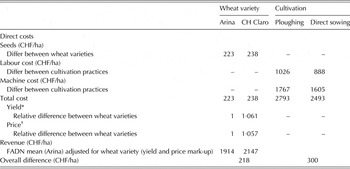
On the cost side, only relevant cost items that differed between alternative production methods were considered: Direct costs, such as differing seed cost of varieties, and machinery and labour costs were accounted for as shown in Table 1. Further joint costs (e.g. labour and machinery costs for fertilization, storage or office costs) were not considered because they did not differ between simulations (the analysis focused on slight adaptations of production technology, which do not require investment, such as new buildings). Choosing the wheat variety Arina (more resistant) instead of CH Claro (more profitable) involves an overall profit loss of CHF (Swiss Francs) 218/ha (CHF 15 fewer costs, but CHF 233 less profit per ha). Finally, the abatement costs of reducing DON risk in bread wheat were derived from the differences between alternative (situation with preventive agronomic measure to reduce DON risk) and reference products of both calculated profits and DON contents assessed by FusaProg. The profit difference is typically expected to be negative (lower profits due to preventive measures) and can be interpreted as abatement costs. When these costs were divided by the difference between the mycotoxin contents, which were also expected to be negative, the abatement costs per unit of reduced mycotoxin could be calculated. Finally, the abatement costs were related to a reduction of 100 µg DON/kg wheat to compare the measures. The cost to abate 100 µg DON/kg wheat were reported on a per ha-basis and, given a wheat yield of 6·1 t/ha, additionally per 100 kg wheat to determine the required price mark-up in relation to a wheat price of CHF 50/100 kg wheat.
Relevant positions of the cost–revenue analysis with an exemplary illustration for two wheat varieties and two soil cultivation practices

* The results of field trials with high yields were used as basis for relative adjustments of actual mean economic results of winter wheat from the Swiss farm accountancy data network (FADN). In this example, the average economic result of winter wheat according to FADN data (1914 CHF/ha) in case of CH Claro with 6·1% higher yields (7·66/7·22 t/ha) would proportionately be increased by 6·1%.
† Prices are mean prices of two wheat qualities (Weizen I – Arina, Zinal; Weizen TOP – CH Claro) during the period of analysis. The surcharge of the quality ‘Weizen TOP’ represents 5·7%.
For example, ploughing costs were calculated compared with the economically most attractive tillage, which was direct sowing. Ploughing resulted in additional costs of CHF 300/ha. The mean DON content was 389 µg DON/kg wheat lower in case of ploughing (187 µg/kg) compared with direct sowing (576 µg/kg). Dividing the additional costs (CHF 300) by 100 µg DON reduction (here: 3·89) gave the abatement costs (CHF 77·12/ha to reduce 100 µg DON/kg wheat).
For the analysis, groups of simulations were used. Accordingly, in the above mentioned example all simulations were used including direct sowing (different years and different wheat varieties) to determine the mean DON content of the reference product and all simulations with ploughing were treated as alternative products with reduced DON content. All simulations were weighted equally. The cost difference resulted from the different labour and machinery costs of the tilling methods.
Crop rotation
The economic consideration of preceding crops as a measure to reduce mycotoxin contamination required calculating the profit for the complete crop rotation. Perennial crop rotations and specific weather conditions in each year were considered. For a crop rotation with m elements it was assumed that each crop covers the same share of the area. To allocate the mean profit during year t (from 2005 to 2011), the expected net profit per ha was calculated by weighting the profit of each crop c by its share in a crop rotation (1/m) and summing the corresponding economic results (Eqn (1)):
 $${\rm Expected}\,{\rm net}\,{\rm profit}\,{\rm of}\,{\rm a}\,{\rm crop}\,{\rm rotation}\,{\rm in}\,{\rm year}\,t = \displaystyle{{\sum\nolimits_{c = 1}^m {{\rm Net}\,{\rm profit}\,{\rm of}\,{\rm crop}\,c_t}} \over m}$$
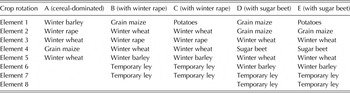
It is possible that a crop appears more than once in the crop rotation (e.g. winter wheat as elements 3 and 5 in crop rotation A in Table 2). In these cases, the two elements were treated separately (element 2: winter wheat following winter barley and element 5: winter wheat following grain maize).
Crop rotations used for mycotoxin and economic analyses

The crop rotations included are typical for Switzerland: they were selected from the literature (Jossi et al. Reference Jossi, Zihlmann, Valenta, Scherrer, Krebs, Dubois, Fried, Malitius, Anken, Sidler and Bergmann2002; Strickhof 2013) and based on an expert's evaluation. The rotations differed with regard to crops and duration, which was either 5, 7 or 8 years. Only one of the crop rotations excluded grain maize as preceding crop (crop rotation C with winter rape, Table 2). In addition, crop rotation D (with sugar beet) included winter wheat after two successive years with grain maize, which illustrates the main exposure of wheat. Crop rotations A, B and E contained wheat after maize. The DON content of a crop rotation was calculated as the arithmetic average DON content of the two wheat elements.
To calculate the DON abatement costs of a crop rotation, the average annual profit of a crop rotation (see last row of Table 3) was subtracted from that of the best crop rotation (D) yielding an annual average profit difference for each crop rotation. Summing up this annual profit difference over the duration (years or elements m) of a crop rotation and allocating this overall profit difference to the two wheat elements in each crop rotation provided the abatement costs per hectare of wheat. Notice that a single crop (such as sugar beet) can determine the profitability of a crop rotation.
Yearly and average economic profits (CHF/ha) of crop rotations

Data for cost analysis
The economic analysis was based on data from the FADN of Switzerland (Agroscope 2006–2012) for the years 2005–2011: from annual farm accountancy reports of Swiss arable farms, the documented crop yields and prices, direct payments (subsidies) and additional profits (such as receipts from selling wheat straw) were used to calculate gross revenues. Furthermore, the FADN reports provided data on aggregated direct costs (such as seeds, manure, pesticides, drying, insurance and other direct costs) and spending for machinery rental and/or private contractors of farm machinery. Data on variable machinery costs and labour requirements were taken from annual reports on farming standard costs (AGRIDEA 2005–2011a). To validate farm labour and evaluate fixed machinery costs, data from reports on Swiss machinery costs were used (Agroscope 2006–2007; Agroscope 2008–2011). Table 3 shows the economic results by overall revenues minus direct, labour and machinery costs of the five crop rotations.
The machinery cost report was also employed to calculate the cost differences between the tillage and seedbed methods as distinguished in the section ‘Abatement costs’. To capture the effects of a specific wheat variety on profit, average yields (from variety tests, such as Agroscope 2010–2013) and average prices of inputs (such as seeds) and outputs (quality premiums for wheat; AGRIDEA (2005–2011b)) were used as a basis. To account for differences, variety-specific relative adjustments (percentage increases or decreases) were applied.
RESULTS
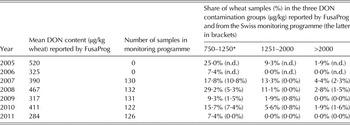
The results of FusaProg were reported as arithmetic mean values of DON contents of all simulations. In order to illustrate the variance in time for the period in question (2005–2011), Table 4 shows the annual mean DON contents from FusaProg. Furthermore, in order to compare FusaProg's results, Table 4 contains the percentage of samples from a monitoring programme for wheat above critical values. This monitoring programme was implemented in 2007 and has been conducted since then by Swiss granum, the inter-trade organization of the Swiss grain sector. However, the monitoring results are not representative for Switzerland and cannot be compared directly with FusaProg, principally because farmers could have reacted by spraying fungicides after FusaProg had forecast a critical situation.
FusaProg simulation results on mean deoxynivalenol (DON) content in winter wheat (2005–2011) and according results from the Swiss granum DON monitoring programme (2007–2011)

* 1250 µg/kg wheat is the threshold value according to Swiss and European food law for unprocessed cereals.
n.d. = No data available.
Sources: Own calculations with FusaProg, effective values of Swiss granum (2013).
Table 4 illustrates that high DON contents occurred from time to time during the 7-year period of analysis; the years 2005, 2007, 2008 and 2010 were especially characterized by relatively high mean DON contents (>390·0 µg/kg wheat). The categorization from the monitoring programme was adopted to classify and juxtapose FusaProg results with monitored DON contents. The general reliability of FusaProg was recognized, especially during the critical years 2007, 2008 and 2010: High forecasts for mean DON contents were reflected in considerable shares of samples with more than 2000 µg/kg wheat in the monitoring programme (Table 4).
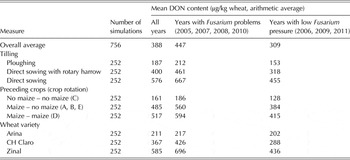
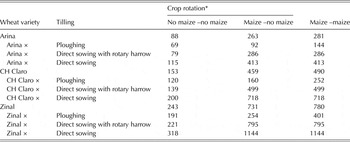
The effects of single preventive agronomic measures considered in FusaProg are illustrated in Table 5. Furthermore, the effect of preventive agronomic measures was different between years with Fusarium head blight problems (2005, 2007, 2008 and 2010) and years with low Fusarium pressure (2006, 2009 and 2011). The third column of Table 5 shows the arithmetic mean DON contents of all corresponding simulations. The combined methods of tillage and seedbed preparation in FusaProg resulted in the following DON contents (increasing order): Ploughing (187 µg DON/kg wheat, no seedbed preparation), direct sowing with rotary harrow for seedbed preparation (400 µg DON/kg wheat) and direct sowing (576 µg DON/kg wheat). Maize as preceding crop of wheat tripled the average DON content (485 µg DON/kg wheat) compared with any other preceding crop (161 µg DON/kg wheat); if wheat was sown after two successive years of maize cultivation, the DON content increased further, but only slightly (517 µg DON/kg wheat). According to their Fusarium resistance, the average DON contents of varieties increased from Arina (211 µg DON/kg wheat) to CH Claro (367 µg DON/kg wheat) and finally to Zinal (585 µg DON/kg wheat). This differentiation of preventive agronomic measures allowed consideration of their effectiveness: not growing maize before winter wheat, choosing a Fusarium-resistant variety (such as Arina) or ploughing could yield DON contents far below the threshold (1250 µg DON/kg wheat), even in years with high mycotoxin risk. An overview on arithmetic mean DON contents by combining preventive measures is provided in Table 6.
Agronomic measures to reduce the deoxynivalenol (DON) risk in wheat and their effect on average DON content during the years 2005–2011 (average of all years, years with high/low Fusarium pressure) based on FusaProg assessments

Sources: Own calculations with FusaProg.
Average DON contents (μg DON/kg wheat) of wheat during the years 2005–2011 based on FusaProg assessments of combining preventive measures

* The crop rotation refers to the preceding two main crops of wheat: ‘Maize –no maize’ illustrates the crop rotations A, B and E (see Table 3) and means that the preceding crop was maize, whereas 2 years ago, another crop was planted on this field.
Each case of the combination ‘wheat variety × crop rotation’ is based on 84 observations. The differentiation by ‘wheat variety × crop rotation × tilling’ results in 28 observations in each cell.
Sources: FusaProg.
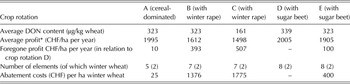
Table 7 reports the characteristics, i.e. the average calculated DON contents and the average profits (both as arithmetic means), of the five crop rotations. The DON content was similar for most variants except crop rotation C – the only crop rotation in which wheat never followed maize. The DON content of this crop rotation was about half that of other crop rotations; however, this crop rotation's profit was very low compared with alternatives.
Average economic results and average (both as arithmetic mean) deoxynivalenol (DON) content of five modelled crop rotations for the years 2005–2011

* Average profit was calculated from the yearly crop-specific results and their weighting according to the shares of crops in the rotation. To allow a reliable comparison of the profits, relevant cost categories (direct costs, machinery and labour costs) were considered.
The average exchange rates during the period of analysis were 1 CHF = 0·897 USD and 1 CHF = 0·668 EUR (based on monthly averages reported by the Swiss National Bank (SNB 2016)).
Sources: FusaProg (DON contents) and own calculations.
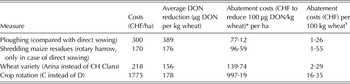
The calculation of a measure's costs is illustrated for crop rotation. Overall, the average annual costs of this measure aggregated to CHF 507. This was the predicted profit if choosing crop rotation C (average annual profit of CHF 1498) instead of crop rotation D (CHF 2005). Considering that wheat was included twice in the 7-year crop rotation C, this sum had to be allocated only to the wheat share in the rotation (2 of the 7 years, i.e. CHF 507 × 7/2), amounting to CHF 1775/ha wheat. The costs to reduce contamination by 100 µg DON/kg wheat amounted to CHF 997·19/ha wheat (Table 8). Thus, controlling DON risk via selection of this crop rotation would be very costly due to considerable revenue losses. The small share of wheat in the considered rotation and the attribution of losses to wheat only led to high costs. However, the absolute abatement costs of crop rotation A (five elements/years of rotation, including two wheat elements, Table 2) compared to crop rotation D amounted to CHF 25/ha, although the absolute DON reduction was very small (with 16 µg DON reduction/kg wheat, Table 7). When adopting crop rotation C instead of the similar crop rotation B, the possible absolute DON reduction was substantial. Reduction of DON by 100 µg DON/kg wheat was possible with abatement costs of CHF 246/ha.
Deoxynivalenol (DON) abatement measures: their effectiveness and average costs

* Costs to reduce the DON content of wheat by 100 µg/kg wheat.
† Reduction of 100 µg DON/kg wheat in CHF based on a yield of 6·1 t/ha.
Sources: FusaProg (DON contents) and own cost calculations.
Ploughing with an average reduction of 389 µg DON/kg wheat compared with direct sowing was shown to be a very effective measure to prevent DON contamination in wheat. Adverse impacts of ploughing, e.g. on soil life or soil loss (Nemecek et al. Reference Nemecek, Huguenin-Elie, Dubois, Gaillard, Schaller and Chervet2011), were not considered. With regard to abatement costs, ploughing was also the most efficient measure with abatement costs of CHF 77·12/ha to reduce DON content by 100 µg DON/kg wheat, although in absolute terms it was a relatively costly measure. Shredding maize residues before conservation tillage or direct sowing was almost as efficient (CHF 96·59/ha to reduce contamination by 100 µg DON/kg wheat) as ploughing, but shredding was not very effective in DON reduction (reduction of 176 µg DON/kg wheat). Controlling DON risk by selecting a Fusarium-resistant wheat variety (CHF 139·74/ha) or a specific crop rotation (CHF 997·19/ha to reduce DON content by 100 µg/kg wheat) was considerably more expensive. The abatement costs in relation to a mean wheat price of CHF 50/100 kg corresponded to a mark-up of between 2·5 and 32·7%.
The content of DON could further be reduced by combining measures (Tables 6 and 8). Cultivating the wheat variety Arina in a ploughed field resulted in an average DON content of 102 µg/kg wheat; the combination of these two measures resulted in abatement costs (to reduce 100 µg DON/kg wheat) of CHF 125/ha compared with directly seeded CH Claro without shredding maize residues (545 µg DON/kg wheat). This corresponds to a mark-up of 4·4%. Such a combination of preventive agronomic measures could use synergistic effects and contribute to very low DON contents acceptable for risk groups, even in years with high Fusarium pressure.
DISCUSSION AND CONCLUSIONS
The present study investigated the costs and effects of important preventive agronomic measures to reduce the content of the mycotoxin DON in wheat without applying pesticides. Based on the forecast model FusaProg, DON content of wheat and effectiveness of abatement measures were simulated. Using actual financial data from Swiss arable farms, the efficiency of these measures was evaluated for the period 2005–2011. Hereby, the analysis covered years with differing risk of FG infections as well as varying yields and prices of wheat and other crops.
The approach for simulating DON contamination of wheat was restricted by two issues. First, the results are not based on field trials and resulting experimental data. Rather, the DON contents reflect the programming of FusaProg. However, as no structured field or farm data on agronomic measures, local weather conditions and resulting DON contents were available; this simulation was a feasible approach to assess DON abatement costs in a cost-efficient way. Second, weather conditions at the four locations during the period of analysis are not representative for the whole of Switzerland. Nonetheless, due to the perennial analysis and the consideration of various influential factors, the DON results cover considerable variation between years and provide an adequate basis for reliable cost calculations.
The choice of a wheat variety is influenced by many criteria, foremost yield potential, protein content, standing ability (resistance to lodging) and resistance to diseases. Focusing on resistance to FG involves opportunity costs, such as a lower resistance to other diseases or lower protein content. Whereas the protein content could be reflected in price differences, plant health issues besides Fusarium are not covered by this analysis.
The economic considerations focused on costs of preventive measures to lower the risk of DON contamination. Other side-effects of the measures, e.g. on soil fertility, were not evaluated in monetary terms. A diversified crop rotation, for example, could result in direct benefits, such as higher yields of the following crop or lower costs for pest management. Considering such effects could reduce the high costs of a versatile crop rotation as a preventive measure. However, data on such effects are sparse and based on rough estimates.
The analysis considered five commonly applied crop rotations in Switzerland. Their profitability differs considerably. Differences result from the profitability of specific crops in a crop rotation, such as sugar beet. The selection and application of a crop rotation is dependent on site-specific natural (e.g. soil) and economic conditions (e.g. marketability such as a sugar processing plant nearby). The analysis of alternative measures indicates alternative options (such as adapting tillage) to reduce the risk of DON within a given crop rotation. A comprehensive analysis of the economic effects of changing a crop rotation requires interdisciplinary approaches (covering e.g. soil, plant nutrition, pest management, economic analysis) and offers further research possibilities.
Lastly, potential positive external effects from waiving of fungicides, e.g. on the environment, are not considered in the present study. The high market relevance of the Swiss Extenso programme clearly shows society's interest and reflects a certain market potential of fungicide-free production systems for wheat. This Swiss case could serve as an example if regulations or the authorization of pesticides in the European Union were to be tightened.
Without application of fungicides, the cost of producing wheat with a DON reduction of 100 µg/kg wheat ranges between CHF 77·12 and CHF 997·19/ha across the measures. This cost corresponded to a price mark-up of between 2·5 and 32·7%. Further costs could arise from the implementation of a reliable quality assurance scheme, from logistical costs (such as separation and transport) and from marketing. In light of the low share of farmer revenues in the final consumer price (on average 8% for plant products; Wendt & Peter Reference Wendt and Peter2014) and the current trend towards sustainable, healthy food (Zukunftsinstitut 2013), the corresponding mark-up of low-cost measures such as ploughing seems to be accepted by some consumer groups. Parents of young children in Germany, for instance, would accept 20% higher prices for bread and rolls made from ‘safer cereals’ with regard to DON (Niens et al. Reference Niens, Strack and Marggraf2014). Accordingly, the analysed differentiation of wheat production could be a promising business model for arable farms. The Swiss quality strategy (Qualitätsstrategie der Schweizerischen Land- und Ernährungswirtschaft 2014) and corresponding support programmes such as the Swiss directive on the support of quality and sustainability in the food sector (QuNaV 2013) offer the possibility of implementing a DON-reducing quality programme. A corresponding instrument in the European Union consists of the European Innovation Partnerships (Aho et al. Reference Aho, Schwaag Serger, Mönig, Wilson, Garmendia, Steinberg and Swieboda2014). These instruments allow for building on this primary analysis and disseminating the potential of agronomic measures to farmers and other stakeholders to further elaborate sustainable agricultural production systems.