Introduction
Valeriana jatamansi is widely distributed throughout temperate Himalayan region and southwestern areas of China (He et al., Reference He, Wang, Shi, Sun, Lei, Yin, Qian, Tang and Xie2018), and is a well-known Traditional Chinese Medicine for gastrointestinal diseases and anxiety indexed in the Chinese Pharmacopeia (Part 1) 2020 edition. The most active compounds of V. jatamansi include iridoids, sesquiterpenoids and essential oils accumulated mainly in the roots and rhizomes of this plant (Bhatt et al., Reference Bhatt, Dauthal, Rawat, Gaira, Jugran, Rawal and Dhar2012; Li et al., Reference Li, Wu, Li, Li and Li2013). Valtrate is the major active component of iridoids in V. jatamansi plants, and has shown antifungal, antitumour, antianxiety and cytotoxic activities in many studies (Shi et al., Reference Shi, Shi, Liu, Wang, Wang, Hou and Guo2014; Tian et al., Reference Tian, Wang, Wu, Wei, Yang and Lou2019). Iridoids are synthesized by classical cytosolic mevalonate/plastidial methylerythritol phosphate pathways of terpene biosynthesis in many plants, and geranyl diphosphate synthase is responsible for formation of geranyl diphosphate from isopentenyl diphosphate and dimethylallyl diphosphate, leading to monoterpene biosynthesis (Dewick, Reference Dewick2009). The early stages of iridoids biosynthesis involve the hydroxylation of geraniol by geraniol 10-hydroxylase (G10H), while 10-hydroxygeraniol oxidoreductase catalyses its further oxidation to the dialdehyde, 10-oxogeranial and then iridoid synthase (IS) cyclizates 10-oxogeranial to form iridodial (Salim et al., Reference Salim, Wiens, Masada-Atsumi, Yu and De Luca2014). The enzyme cytochrome P450 geraniol 10-hydroxylase (G10H, CYP76B6) hydroxylates the monoterpenoid geraniol at the C-10 position to generate 10-hydroxy-geraniol and that represents the first committed step in the formation of iridoid monoterpenoids in plant species (Simkin et al., Reference Simkin, Miettinen, Claudel, Burlat, Guirimand, Courdavault, Papon, Meyer, Godet, St-Pierre, Giglioli-Guivarc'h, Fischer, Memelink and Clastre2013; Miettinen et al., Reference Miettinen, Dong, Navrot, Schneider, Burlat, Pollier, Woittiez, van der Krol, Lugan, Ilc, Verpoorte, Oksman-Caldentey, Martinoia, Bouwmeester, Goossens and Werck-Reichhart2014; Kumar et al., Reference Kumar, Kumar, Dwivedi, Rai, Shukla, Shanker and Nagegowda2015).
Hairy roots are genetically and biochemically stable and can be used for large-scale secondary metabolite production and for expression of recombinant proteins, regeneration of whole plants and functional analysis of genes (Petrova et al., Reference Petrova, Zayova and Vlahova2013; Srivastava et al., Reference Srivastava, Mehrotra and Mishra2018). In recent years, hairy root cultures of many plants have already been widely studied for production of secondary metabolites (Patra and Srivastava, Reference Patra and Srivastava2016; Perassolo et al., Reference Perassolo, Cardillo, Mugas, Núñez Montoya, Giulietti and Rodríguez Talou2017). We have recently constructed hairy root system of V. jatamansi (Zhao and Tang, Reference Zhao and Tang2020).
Although much is known about biosynthesis of iridoids in other plants, little is known about regulation of valtrate biosynthesis in V. jatamansi plants. There have been reports that overexpression of G10H gene can increase accumulation of iridoids in other plants and their hairy roots, but no report on the introduction of G10H genes into V. jatamansi plants. In this study, we investigated the effects of overexpressing VjG10H in hairy root cultures of V. jatamansi.
Materials and methods
Plant materials
V. jatamansi was grown at the campus of Yunnan University of Traditional Chinese Medicine, Yunnan Province, China. The seeds of V. jatamansi were surface-disinfected by dipping them in 70% (v/v) ethyl alcohol (10 s), and sterilized for 10 min with 0.1% mercury bichloride solution, rinsed with sterile water (5–6 changes) and left for germination on hormone-free MS solid medium (Murashige and Skoog basal medium), and maintained at 25oC in the light (700 lux).
Construction of plant expression vectors
The complete VjG10H cDNA was cloned from the sterile seedlings of V. jatamansi according to the sequences reported in NCBI (ACCESSION: MN896997). The full-length ORF of VjG10H cDNA was inserted into pCAMBIA1304 (Novagen, Darmstadt, Germany), in place of the mGFP5 and GUS genes to generate a pCAMBIA1304-VjG10H expression vector containing the VjG10H gene under the digestion of Bgl II and BstE II (Takara, Ohtsu, Japan) (Fig. 1). The gene VjG10H was under the control of the strong cauliflower mosaic virus (CaMV) 35S promoter. The blank vector pCAMBIA1304 without exogenous genes was used as the control. The Agribacterium rhizogenes strain R1601 was used for plant genetic transformation.
The scheme of pCAMBIA13041-VjG10H recombinant vector.

Plant transformation and hairy root culture
Young leaves of 5-week-old plantlets were excised from in vitro grown plants and were cut into small segments with a sterile scalpel. Infection of plant material was accomplished by immersion in overnight bacterial (A. rhizogenes strains R1601 containing pCAMBIA1304-VjG10H expression vector) suspension for 20 min. All infected leaves were transferred onto MS solid medium without hormones. The co-cultivation continued from 2 to 5 days at 25°C in the dark. The uninfected leaves used as control were cultured in the same conditions. After co-culture, the explants were washed three times with sterile distilled water and blotted dry on sterile filter paper. The infected and the uninfected leaves were transferred to hormone-free MS medium, containing 300 mg/l cefotaxime (Sigma, Boston, USA) to remove the bacteria. Approximately 4 weeks after infection, sterile hairy roots were cultured on solid MS/2 medium and subcultured every 5 weeks. All cultures were maintained in darkness at 25oC on a gyratory shaker at 100 rpm. All medias were hormone-free and adjusted at pH 5.9 before autoclaving.
DNA isolation and PCR analysis
Genomic DNA was isolated from harvested hairy root samples by the MiniBEST Plant Genomic DNA Extraction Kit (Takara). The DNA was then used as the template in PCR analysis for detecting the presence of VjG10H genes in transgenic hairy roots. The sequences of 35SF23 (forward primer) located at the 35S promoter of the pCAMBIA1304 plasmid and VjG10H (reverse primer) in the interior of the VjG10H gene used for the amplification of the VjG10H gene were as follows: 5′-GAGGACC TAACAGAACTCGCC-3′ and 5′-GCGGTTGTGCTTTCTGCAACGTAATT-3′. The primer sequences to amplify a 752 bp portion of the rolB gene (ACCESSION: AB006689.1) were 5′-ACTATAGCAAACCCCTCCTGC-3′ and 5′-TTCAGGTTTACTGCAGCAGGC-3′. The PCR reaction consisted of 50 ng of genomic DNA, 0.2 mM of dNTPs, 1.0 U of Taq DNA polymerase (Takara), 1.0 μM of each primer and 2.5 μl of 10 × Taq DNA polymerase buffer in a total of 25 μl reaction. The PCR was initiated in programmable thermal cycler (Bio-Rad, USA) programmed with a hot start at 94°C for 5 min, followed by 30 cycles of 94°C for 55 s, 56°C for 1 min, 72°C for 1 min and inoculated at 72°C for 10 min extension. The reaction products were analysed by electrophoresis on a 1.0% (w/v) agarose gel and visualized by staining with ethidium bromide.
cDNA synthesis and qRT-PCR amplification
qRT-PCR was performed using the StepOneTM Real-Time PCR Systems (ABI, USA) with 2SYBR Green mix (Fermentas, DE, USA) according to the manufacturer's instructions. Total RNA was extracted from the hairy root samples using the RNA prep pure plant kit (Tiangen, Biotech, China) according to the manufacturer's protocol. First-strand cDNA was synthesized from 1 μg of total RNA with reverse transcriptase (Takara) and oligo (dT) 15 primer, and the resulting products were used as templates for qRT-PCR. Gene-specific primers VjG10H-QF (5′-GCAGCACAGTAGATTGGACGAT-3′), VjG10H-QR (5′-ATGGCGCAGCAGGGTATAA-3′) were used to detect the expression level of VjG10H. GAPDH (glyceraldehyde-3-phosphate dehydrogenase) gene GAPDH-QF (5′-CTTCT GAGTGGCAGTATGGAG-3′), GAPDH-QR (5′-CCGATGTTTGTTGTGGGTG-3′) was used as reference gene. The qRT-PCR thermal cycling condition for all reactions was 95°C for 3 min, followed by 35 cycles at 95°C for 7 s and 57°C for 10 s. All reactions were conducted in triplicates, and the results were expressed as relative expression levels to the GAPDH gene. The Ct values obtained were used as the original data to calculate the relative expression level of different genes to GAPDH gene by the 2−ΔΔCt method (Huang et al., Reference Huang, Li and Mo2015; Ye et al., Reference Ye, Wu, He, Wang, Zhang, Li, Fan, Tan, Liu and Xe2016).
Transgenic hairy roots elicited by methyl jasmonate
Methyl jasmonate (MeJA) was dissolved in 95% ethanol and filter sterilized. Twenty-five-day-old hairy root cultures (NC: non-transgenic hairy root line; G1–G4: VjG10H single gene transformed lines) were transferred to 100 ml of fresh medium and treated with MeJA 100 mg/l for 7 days, and the same amount of ethanol was added to the control cultures. Control and elicited hairy roots were harvested on the 32th day of cultivation and analysed for valtrate content. All the treatments were replicated three times.
Valtrate quantification
For valtrate extraction, hairy roots were freeze-dried, ground and kept in a freezer at −20°C. Dry weight was determined for each sample after freeze drying. The powdered plant material was extracted five times at 25°C with methylene chloride using 30 min sonication.
All samples were filtered through a 0.22 μm micro-filter (Merck, Germany) and this solution was used for chemical analysis. High-performance liquid chromatography (HPLC) analysis was carried out using Waters Alliance 2690/2695 LC system with waters 2996 PDA detector (Waters, USA). The chromatographic conditions were as follows: C18 column (4 μm, 3.9 × 150 mm i.d.) (Nova-Pak, Waters, USA) adapted to a guard column C18 (3.9 × 20 mm) (Nova-Pak, Waters, USA); mobile phase was isocratic CH3CN/H2O, 50:50 (v/v) and flow rate was 1 ml/min; detector sensitivity set at 1.0 and detection wavelength at 254 nm. Standard valtrate was from Apin Chemicals Ltd. (Abingdon, Oxon, UK). The valepotriates were dissolved in methanol, diluted stepwise (1.0, 0.5, 0.25, 0.125 and 0.0625 mg/ml) and the injection volume was 10 μl. All analyses were repeated three times employing three replicates each. The metabolite contents were calculated as mg of the compound per gram of root dry weight.
Results
Generation of transgenic V. jatamansi hairy roots with VjG10H
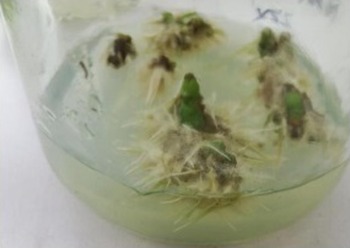
The plasmid pCAMBIA1304-VjG10H containing the cDNAs encoding VjG10H under the control of the CaMV 35S promoter was introduced into V. jatamansi hairy roots by using A. rhizogenes R1601 strain after infection of young leaves of V. jatamansi. Hairy roots of V. jatamansi were formed on the cut surface of the leaf explants after 3–4 weeks of co-cultivation with A. rhizogenes R1601, and were developed mainly on the base of the leaf near the petiole and rarely at the leaf tip (Fig. 2). Transgenic V. jatamansi hairy roots were generated with phenotypic characteristics such as plagiotropism, rapid growth and many lateral branches.
Transgenic V. jatamansi hairy roots with VjG10H.

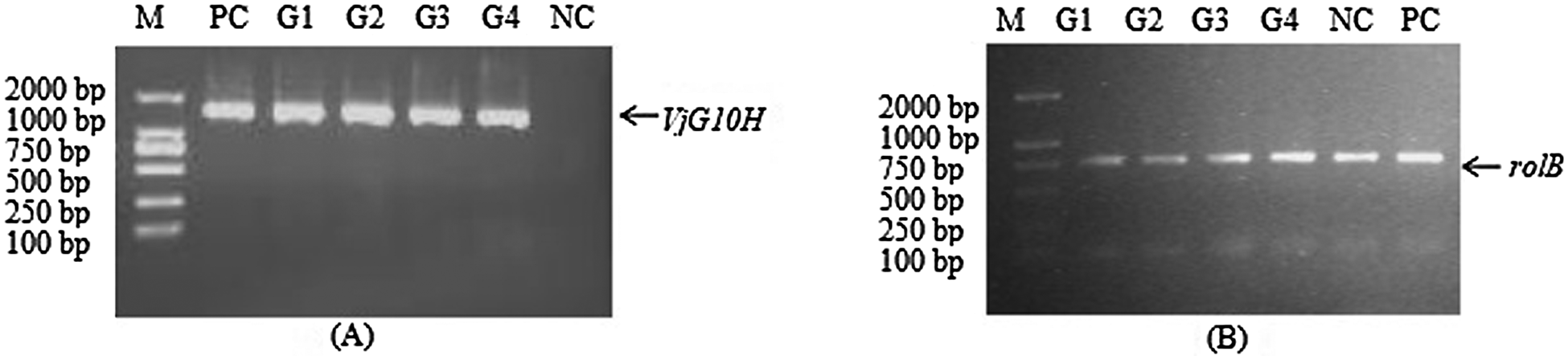
In total, four VjG10H single gene transformed lines (G line) were generated. Genomic DNA of all the above independent hairy roots was isolated and used for PCR analysis using primers specially designed to overlap part of the VjG10H and the CaMV 35S promoter sequences. The R1601 strains harbouring the plasmid pCAMBIA1304-VjG10H were also amplified as positive controls (PC), and the hairy root line generated from transformations with A. rhizogenes R1601 strain that did not contain the plasmid pCAMBIA1304-VjG10H was used as a negative control (NC line). The rolB gene as a marker gene of R1601 was detected in all the PCR-positive clones, and no amplicons of VjG10H was detected in the NC line (Fig. 3). These results confirmed that the VjG10H genes were introduced into the genome of G lines, and all the hairy root culture lines were selected for qRT-PCR and HPLC experiments.
Representative results of transgenic hairy root by PCR identification (A). PCR analysis of VjG10H gene for G lines; (B). PCR analysis rolB gene for G lines; M: marker DL2000; PC: the plasmid pCAMBIA13041-VjG10H were also amplified as a positive control; NC: non-transgenic hairy root cultures; G1–G4: VjG10H single gene transformed lines.

Transcript analysis of VjG10H gene in hairy roots
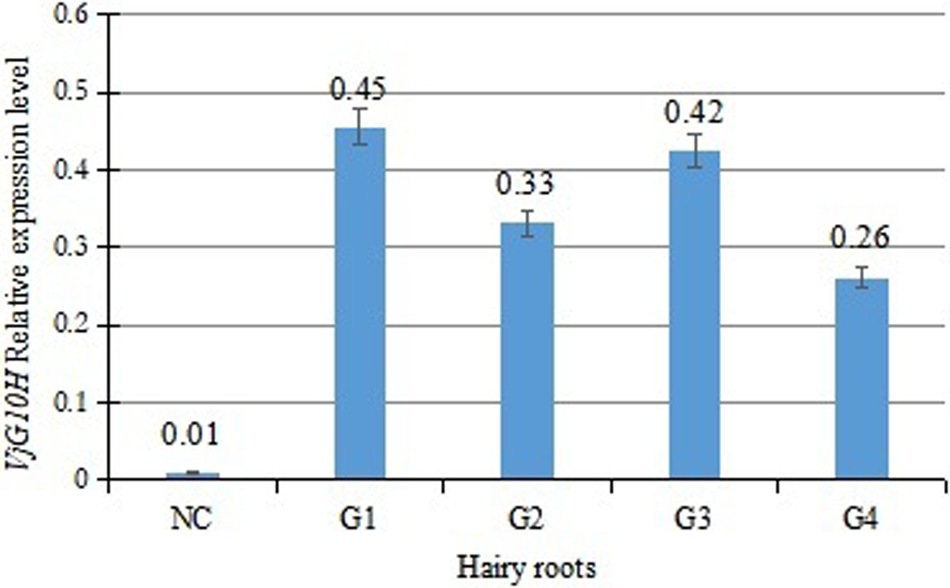
qRT-PCR was determined to further analyse the expression level of the target gene VjG10H and reference gene GAPDH was used for the internal control gene. As shown in Fig. 4, compared to the expression level in the NC line, the relative expression levels of VjG10H were up-regulated in all the G lines, but varied in different lines, respectively. Among all the transgenic lines, the G1 line had the highest expression level of VjG10H. These results show that VjG10H gene was expressed in corresponding transgenic lines, but with varied expression levels.
Transcription level of VjG10H in transgenic V. jatamansi hairy roots NC: non-transgenic hairy root cultures; G1–G4: VjG10H single gene transformed lines.

Accumulation patterns of valtrate
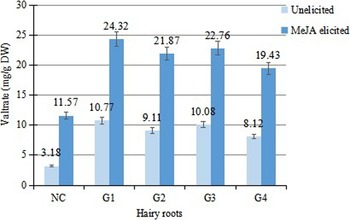
The transgenic hairy roots of V. jatamansi were inoculated into 100 ml liquid MS/2 medium and cultured for 32 days followed by collection for further study. The valtrate that accumulated in the hairy roots was detected and quantified by HPLC analysis. As shown in Fig. 5, during the unelicited treatments, higher levels of valtrate ranging from 8.12 to 10.77 mg/g were present in G10H-transformed lines than in NC hairy root (3.18 mg/g). The average valtrate content (9.52 mg/g) of all the four G lines was obviously higher than NC root, implying that overexpression of VjG10H can efficiently promote the accumulation of valtrate in V. jatamansi. These results suggested that G10H may be a key regulation target gene for metabolic engineering of valtrate biosynthetic pathway.
Effect of different MJ concentrations on valtrate of V. jatamansi hairy root cultures for 7 days NC: non-transgenic hairy root cultures; G1–G4: VjG10H single gene transformed lines. Error bars represent the standard error of the mean of three repeated experiments.

Effects of MeJA on valtrate production of hairy roots
To examine how overexpression of VjG10H might influence valtrate biosynthesis in these recombinant lines, the 25-day-old hairy root cultures were treated with 100 mg/l MeJA for 7 days, and harvested at 32th day in our hairy root culture system. MeJA treatment stimulated valtrate accumulation in all of the recombinant lines compared to untreated cultures, as shown in Fig. 5, higher levels of valtrate ranging from 19.43 to 24.32 mg/g than in NC hairy root (11.57 mg/g). The highest valtrate yields were achieved by MeJA treatment of the VjG10H overexpression G1 line. These results indicate that MeJA treatment also enhanced the production of valtrate in V. jatamansi, suggesting that MeJA treatment may be an effective regulation target for metabolic engineering of valtrate biosynthesis in V. jatamansi.
Discussion
G10H, a cytochrome P450 monooxygenase, is a key enzyme involved in iridoid monoterpenoids and indole alkaloid synthesis, which hydroxylates the monoterpenoid geraniol at the C-10 in different plant species (Kai et al., Reference Kai, Xu, Zhou, Liao and Zhang2011; Sankar-Thomas and Lieberei, Reference Sankar-Thomas and Lieberei2011). Overexpression of CrG10H has increased the accumulation of monoterpenoid indole alkaloids (TIAs) in Catharanthus roseus plants and hairy roots (Wang et al., Reference Wang, Liu, Gao and Zhang2010a, Reference Wang, Liu, Cai, Zhang, Xia and Xiang2010b; Pan et al., Reference Pan, Wang, Yuan, Xing, Zhao, Choi, Verpoorte, Tian, Wang and Tang2012), and also enhanced the production of camptothecin in Ophiorrhiza pumila (Cui et al., Reference Cui, Ni, Ji, Teng, Yang, Wu, Zekria, Zhang and Kai2015). Hence, G10H is a possible bottleneck for iridoid monoterpenoid production and a good candidate target for genetic manipulation.
Since the most active compounds are mainly present in the roots and rhizomes of perennial medicinal herb V. jatamansi, collection of its roots as drug source may deplete natural stock of the plants in the wild. Hairy root culture is regarded as a promising strategy to obtain the active compounds without threatening the survival of related resource plants. In this study, a transgenic hairy root culture system of V. jatamansi with good valtrate production ability was successfully established for the first time. The valtrate content of VjG10H-transformed lines ranged from 8.12 to 10.77 mg/g, with an average valtrate content (9.52 mg/g) of all the four G lines being obviously higher than the NC root. The above results demonstrate that expression of VjG10H obviously enhanced the production of valtrate in V. jatamansi, which was in good agreement with previous results that overexpression of CrG10H increased the accumulation of TIAs in C. roseus plants and hairy roots (Wang et al., Reference Wang, Liu, Gao and Zhang2010a, Reference Wang, Liu, Cai, Zhang, Xia and Xiang2010b; Pan et al., Reference Pan, Wang, Yuan, Xing, Zhao, Choi, Verpoorte, Tian, Wang and Tang2012). These results also provided direct evidence that VjG10H was an effective regulation target for metabolic engineering of valtrate synthesis in V. jatamansi.
MeJA, a signal transduction elicitor for plant defence responses, has increased significantly the release of resveratrol in the hairy root cultures of muscadine grape (Nopo-olazabal et al., Reference Nopo-Olazabal, Condori, Nopo-Olazabal and Medina-Bolivar2014), and the accumulation of tanshinone in the hairy root cultures of Salvia miltiorrhiza (Wei et al., Reference Wei, Gao, Deng, Zhang and Chen2019). MeJA has been implicated in stimulating G10H mRNA levels and accumulating monoterpene indole alkaloids (Galaz-Ávalos et al., Reference Galaz-Ávalos and Roberto Kú-Cauich2007). In this study, MeJA treatment stimulated valtrate accumulation in all of the VjG10H overexpression recombinant lines compared to untreated cultures, but with varied eliciting levels. These results show that MeJA treatment also enhanced the production of valtrate in V. jatamansi, suggesting that MeJA treatment was another effective regulation target for metabolic engineering of valtrate synthesis in V. jatamansi. Transgenic hairy root cultures of V. jatamansi coupled with MeJA treatments have increased valtrate yield efficiently, which may be an effective method to obtain valtrate when the wild plant resources of V. jatamansi are becoming less and less. However, the complex response to MeJA declares that additional layers of regulation might be functioning in V. jatamansi roots, and further investigation is necessary to understand the signal transduction leading to metabolite production.
Conclusions
In this study, we successfully established overexpressing VjG10H hairy root cultures of V. jatamansi with good valtrate production ability, the valtrate content of all the VjG10H-transformed lines was higher than the NC root, and MeJA treatment stimulated valtrate accumulation in all of the VjG10H overexpression recombinant lines compared to untreated cultures. The above results demonstrate that expression of VjG10H enhanced the production of valtrate, and MeJA at 100 mg/l also significantly enhanced the biosynthesis of valtrate from recombinant hairy root cultures. Thus, transgenic hairy roots technology coupled with elicitor treatments may be an alternatively promising approach to produce more valtrate in place of natural plant resources in the future.
Acknowledgements
This research was financially supported by the Basis Research Program of Yunnan Province-General Project (202001AT070553).