Bowhead whales (Balaena mysticetus) distributed in the north Atlantic between East Greenland and Servernaya Zemlya are assigned to the Spitsbergen stock of the species. This stock was heavily depleted by whaling between 1611 and 1911, but has been protected since 1932 (Ross Reference Ross, Burns, Montague and Cowles1993; Reilly and others Reference Reilly, Bannister, Best, Brown, Brownell, Butterworth, Clapham, Cooke, Donovan, Urbán and Zerbini2008). The species is currently listed as critically endangered (CR) by International Union for Conservation of Nature (IUCN 2009), due to the ‘lack of any calf sightings in recent decades’ (Reilly and others Reference Reilly, Bannister, Best, Brown, Brownell, Butterworth, Clapham, Cooke, Donovan, Urbán and Zerbini2008). The number of observations in recent years has increased throughout the former distribution range, but the concurrent increase in observation effort has prevented a firm conclusion on population recovery (Gilg and Born 2005; Reilly and others Reference Reilly, Bannister, Best, Brown, Brownell, Butterworth, Clapham, Cooke, Donovan, Urbán and Zerbini2008; Wiig and others in press; Boertmann and others Reference Boertmann, Merkel and Durinck2009). Here we report the observation of a calf during the summer of 2009.
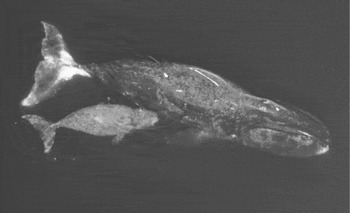
During an aerial survey for seabirds and marine mammals in the coastal areas of northeast Greenland, the permanent fast ice edge between 77° N and 80° N was surveyed on 26 July 2009 (for the method see Boertmann and others (Reference Boertmann, Merkel and Durinck2009)). At 78° 24′ 48″ N, 16° 15′ 39″ W, 55 km due east of ‘Danske Øer’ on the Greenland coast a female bowhead whale in company with a calf was observed close to the ice edge. The length of the calf was, based on photographs, estimated to be some 40% of that of the female (Fig. 1). There is no information on the size of sexually mature females in the Spitsbergen stock, but they are >13.5 m long in the Bering-Chukchi-Beaufort Sea stock (Koski and others Reference Koski, Davis, Miller, Withrow, Burns, Montague and Cowles1993). This particular female seemed to be rather small to medium in length, and it is fair to assume that it was approximately 15 m long, indicating a calf length of approximately 6 m.
A female bowhead whale in company with an estimated 3 months old calf photographed from aircraft on 26 July 2009 off the northeast Greenland coast.

No other bowhead whales were recorded during the survey despite survey transects in coastal waters between 69° N and 82° N incl. the northeast water polynya. However, fog prevented observations in some of the more important bowhead whale areas.
The calf was, due to its small size, certainly born in the spring of 2009. Calculating backwards and using data from the Bering-Chukchi-Beaufort Sea stock, the observed calf was born in April. The calf length at birth is estimated at 4.0–4.5 m with an early growth rate at 1.5 cm/day (Koski and others Reference Koski, Davis, Miller, Withrow, Burns, Montague and Cowles1993). This is somewhat later than the birth dates given by William Scoresby (quoted from Reeves and Leatherwood Reference Reeves, Leatherwood, Ridgway and Harrison1985), who believed that most births in the Greenland Sea occurred in February and March, although he also refers to a newborn calf from April.
The only post-whaling record of calves in the Spitsbergen stock that the authors can trace is an observation in the Zemlya Frantsa-Iosifa [Franz Josef Land] archipelago in April 1981 ‘11 bowhead whales including calves’ (Belikov and others Reference Belikov, Gorbunov and Shilnikov1984). However, a young bowhead whale was observed off east Greenland in June 2008 (Boertmann and others Reference Boertmann, Merkel and Durinck2009). This and the calf reported here are apparently the first records of reproduction in the entire stock since 1981 and the first in the western part of the distribution range since the advent of protection.
The increase in observations, although inconclusive with regard to population trends, the young individual seen in 2008, and the calf reported here, are all positive signs for the Spitsbergen stock of bowhead whales, and suggest a population recovery. Our observation shows that local reproduction may drive such a recovery, but we cannot exclude the possibility that immigration, facilitated by the reduced summer extend of the polar ice, from neighbouring stocks in Baffin Bay or in Bering Sea, also takes place.
The population estimates for the Spitsbergen stock ‘in the tens’ (Christensen and others Reference Christensen, Haug and Øien1992) or ‘of a few tens’ (for example Zeh and others Reference Zeh, Clark, George, Withrow, Carroll, Koski, Burns, Montague and Cowles1993) are obviously not current as is pointed out by Reilly and others (Reference Reilly, Bannister, Best, Brown, Brownell, Butterworth, Clapham, Cooke, Donovan, Urbán and Zerbini2008). The many observations reported from east Greenland, the Greenland Sea, Svalbard and Zemlya Frantsa-Iosifa since 1980 (Moore and Reeves Reference Moore, Reeves, Burns, Montague and Cowles1993; Korte and Belikov Reference Korte and Belikov1994; Gilg and Born 2005; Wiig and others Reference Wiig, Bachmann, Vincent, Kovacs and Lydersen2007, in press; Boertmann and others Reference Boertmann, Merkel and Durinck2009) and additional unpublished observations by the first author from the northeast water in August 2009 of 11 different individuals indicate a population of at least an order of magnitude higher than these figures.
Acknowledgements
The survey was financed by the Greenland Government, Bureau of Minerals and Petroleum, and the aircraft was flown by Leif Petersen. The military outpost Station Nord and the airport of Constable Point provided landing facilities and accommodation during the survey.