Introduction
Dengue fever and dengue hemorrhagic fever have become major public health problems in tropical and sub-tropical countries. In Sri Lanka, more than 47,000 dengue fever cases and 100 deaths due to dengue and dengue hemorrhagic fever were reported in 2014 (Ministry of Health Sri Lanka, 2014). The major focus in dengue disease control programmes in Sri Lanka is to control the vectors Aedes aegypti and Ae. albopictus, through elimination of breeding sites and application of insecticides. Larviciding and space spraying with insecticides have been widely used for several years to control dengue vectors (Karunaratne et al., Reference Karunaratne, Weeraratne, Perera and Surendran2013). Space spraying of insecticides, also known as fogging, is frequently conducted in dengue-affected areas to control Aedes vector mosquitoes during outbreaks. By virtue of the high abundance and great variety, insects are the major players in many ecosystem processes. Many complaints from the general public indicate that indiscriminate insecticide fogging kills insect pollinators, thus affecting the pollination of flowering plants, and thereby the economy of the country. Since Aedes mosquitoes are active during the day, fogging operations are usually conducted in the mornings and evenings; but this is also the active time for many other insect species.
Various studies have shown the adverse effect of insecticide fogging on non-target insect populations. Frye et al. (Reference Frye, Dix and Carey1988) showed that the abundance of non-target heleomyzid, calliphorid and carabid insects in Siberian elm windbreaks decreased soon after application of carbaryl. Moreby et al. (Reference Moreby, Sotherton and Jepson1997) showed that spraying demeton S-methyl and dimethoate on pests of cereal fields in England caused reductions of non-target heteropteran species. Holland et al. (Reference Holland, Winder and Perry2000) described the effect of dimethoate spraying to control insect pests on winter wheat on the spatial distribution of beneficial arthropods, mostly Coleoptera, Araneae and Hymenoptera. Aerial spraying with pyrethrins during a West Nile virus outbreak in an urban California environment made a significant impact on non-target, small-bodied arthropods (Boyce et al., Reference Boyce, Lawler, Schultz, McCauley, Kimsey, Niemela, Nielson and Reisen2007). The fitness of larval and adult butterflies was reduced when deltamethrin was applied even at 1/640 of the recommended field dosage (Çilgi and Jepson, Reference Çilgi and Jepson1995).
Sri Lanka is rich in biodiversity due to its location within the tropical belt (Bingham, Reference Bingham1897). A total of 342 arthropod species have been documented in Sri Lanka, with 282 species of insects in 90 families and 17 orders. Majority of the insects documented were hymenopterans, dominated by bees and ants (Bambaradeniya and Edirisinghe, Reference Bambaradeniya and Edirisinghe2008). Sri Lanka is home to about 150 species of bees that play an important role in pollinating the natural and cultivated vegetation (Karunaratne and Edirisinghe, Reference Karunaratne and Edirisinghe2008). There is a high possibility that fogging affects insect pollinators and other insects, and has a huge negative impact on ecosystems and the economy. Although there have been several studies carried out elsewhere to assess the impact of insecticide fogging on non-target organisms, we report here for the first time the direct impact of fogging on non-target insects, after collecting the insects knocked down by fogging and counting them.
Materials and methods
Study site
Kurunegala District of Sri Lanka has had a history of dengue epidemics since 1996, and the vector abundance in the area has been shown to be high (Weereratne et al., Reference Weeraratne, Perera, Mansoor and Karunaratne2013). Eight field treatments were carried out during April 2014 to March 2015, each with two fogging operations at two different habitat types at Panaliya (7°20′N 80°20′E) in Kurunegala District. Site 1 was an open area of about 180 m2 situated about 1 km away from site 2, which is a home garden of about 270 m2 with dense vegetation. The open area was mainly grassland with a sandy path. The area with dense vegetation was mainly covered with coconut (Cocos nucifera), banana (Musa acuminata), mango (Mangifera indica), papaya (Carica papaya) and small bushes.
Preparing insecticide solutions and fogging treatments
Pesguard (d-tetramethrin + cyphenothrin) insecticide, which is commonly used in Sri Lanka for its high efficacy in controlling dengue vector mosquito populations, was used for fogging treatments (Karunaratne et al., Reference Karunaratne, Weeraratne, Perera and Surendran2013). The World Health Organization (WHO) recommended dosage of the insecticide solution of pesguard (d-tetramethrin + cyphenothrin) was prepared, by mixing 30 mL technical grade insecticide solution with 5.0 L kerosene oil. A hand-held pulse jet type thermal fog generator with nozzle aperture set at 19−20 μm was used to spray the insecticide mixture (WHO, 2003). A hired professional fogging machine operator sprayed an insecticide solution of 2.5 L while walking within the site for about 8 minutes. All the fogging activities were done during 08.30−09.30 h.
Collecting and identifying ‘knockdown insects’
Ten polyethylene sheets, each covering an area of one square metre were spread on the ground randomly within the fogging area, before a fogging treatment. Thirty minutes after the fogging exercise, insects that dropped on the sheets were collected into clean plastic bottles. The mouth of each bottle was covered with a net and a cotton pad soaked with 10% glucose was kept outside the net. ‘Knockdown insects’ were re-examined after a 24-hr recovery period and the mortalities recorded. Insects that did not respond to prodding with a needle were considered dead. Both recovered and dead insects were stored in labelled vials with 70% ethanol for identification and body size measurements.
Insects were identified according to order and family using the taxonomic keys of Dodge (Reference Dodge1953), Bland and Jaques (Reference Bland and Jaques1984) and Castner (Reference Castner2000). The average length along the anterior−posterior axis of randomly selected five adults from each morpho-species was taken as the average body length of that morpho-species.
Mosquito and stingless bee (Trigona iridepennis) cage bioassays
During fogging treatments, standard WHO cage bioassays with mosquitoes were always conducted as positive controls. Female Ae. albopictus mosquitoes (about 2−3 days old) were obtained by rearing mosquito eggs collected using ovitraps, and larvae collected from larval breeding sites. Three cylindrical cages (20 cm length × 5 cm diameter) were hung on tree branches in each fogging area and 15−20 adult mosquitoes released in each cage. After exposure of the insects to insecticide spray, cotton wool pads soaked in 10% glucose solution were provided to the insects as food source, before transporting the cages to the laboratory. Negative control experiments were carried out only once by keeping three mosquito cages about 500 m away from the fogging sites. After fogging, mosquito cages were examined and knockdown and mortality after 24 hr recorded.
To show the direct effect of fogging on pollinator bees, similar bioassays were carried out with stingless bees (Trigona iridipennis) using the WHO bioassay cages. Three cylindrical cages were hung at each site on tree branches, within the fogging area. Adult stingless bees were collected from beehive situated about 2 km away from the study sites. About 15−22 field-caught, adult stingless bees were released into each cage. After exposure to insecticide spray, knockdown and mortality after 24 hr was recorded. One stingless bee cage kept in an area about 500 m away from the fogging comprised the control experiment. Cage bioassays for stingless bees were done as a positive control only during the first field treatment using 180 bees, and were not repeated to avoid interference with beneficial insects.
Data analysis
Most affected insect order, least affected insect order, most affected morpho-species, and significant variance of the insect mortalities between the sites, were analysed by two-way ANOVA using MINITAB 14 version. The diversity of affected insects of the two sites was compared using the Shannon diversity index, H. Rainfall, temperature and humidity data were obtained from the Department of Meteorology, Sri Lanka and analysed using PAST version 3.14 to examine their effect on the abundance of insects in the two sites.
Results
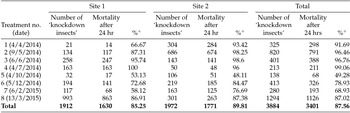
A total of 3884 ‘knockdown insects’ were collected from an area of 160 m2 covered with polyethylene during the eight fogging treatments conducted at both sites. Out of these, 12.44% were recovered during the 24-hr recovery period, leaving 3401 dead (Table 1). In the positive controls, the initial mosquito-knockdown (n = 417) and stingless bees (n = 122) exposed to the fogging were 100%. Mortalities after the 24-hr recovery period were 72.5%−95% for mosquitoes and 93.5% for bees. Negative controls (n = 50 for mosquitoes and n = 60 for bees) always gave 0% knockdown and mortalities.
Mortality of ‘knockdown insects’ during the pesguard insecticide fogging treatments conducted at two sites (Site 1: an open area; and Site 2: an area with dense vegetation) at Panaliya, Sri Lanka from April 2014 to March 2015

+ Mortality as a percentage of knockdowns.
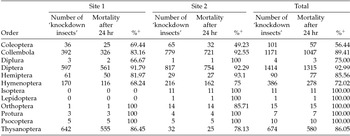
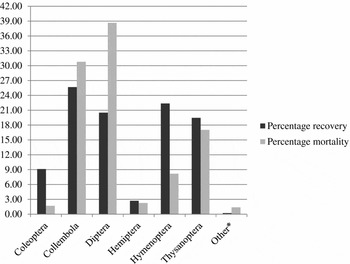
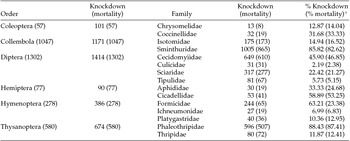
The number of ‘knockdown insects’, recoveries after 24 hr and mortalities are shown by order in Table 2 and Fig. 1. For each treatment, the total number of ‘knockdown insects’ and total mortalities were not significantly different between the sites (P = 0.132 and P = 0.651, respectively). ‘Knockdown insects’ belonged to 12 orders (i.e. Collembola, Coleoptera, Diptera, Hymenoptera, Hemiptera, Isoptera, Orthoptera, Protura, Psocoptera, Diplura, Lepidoptera and Thysanoptera). For orders Diptera, Hymenoptera and Thysanoptera, the number of knockdown insects at site 2 was significantly higher than that at site 1 (P = 0.001, 0.038, 0.001, respectively). However, the only order where mortalities were significantly different between the sites was Hemiptera (P = 0.047). When the Shannon diversity indices calculated using ‘knockdown insects’ were compared, site 1 had a higher insect diversity than site 2 (H = 1.4 and 1.26, respectively). Dominant families of the ‘knockdown insects’ are presented in Table 3. Out of 3884 ‘knockdown insects’ (3401 mortalities), there were only 31 mosquitoes (31 mortalities) belonging to the species Culex quinquefasciatus (18), Aedes albopictus (2), Anopheles subpictus (1) and Armigerus subalbatus (10). It is interesting to see that mosquitoes comprised less than 1% of the total insects affected and that less than 0.1% belonged to the target genus Aedes.
Order-wise composition of ‘knockdown insects’ during the pesguard insecticide fogging treatments conducted at two sites (Site 1: an open area; and Site 2: an area with dense vegetation) at Panaliya, Sri Lanka from April 2014 to March 2015

+ Mortality as a percentage of knockdowns.
Order-wise composition of the recovered (within 24 hr) and dead insects after fogging operations. Insects knocked down (3884) after the pesguard insecticide fogging were collected from 160 m2 during 16 fogging operations conducted at two sites at Panaliya, Sri Lanka.Percentage recovery: given as a percentage of total recovered insects (483). Percentage mortality: given as a percentage of total dead insects (3401). *Other: Protura, Orthoptera, Isoptera, Psocoptera, Diplura and Lepidoptera.

Orders and families of the insects that were dominant among the ‘knockdown’ insects collected on a 160-m2 area following eight fogging treatments of the insecticide pesguard. Mortalities after a recovery period of 24 hr are given in parentheses

+ Knockdown/mortality of the family is given as a percentage of that order.
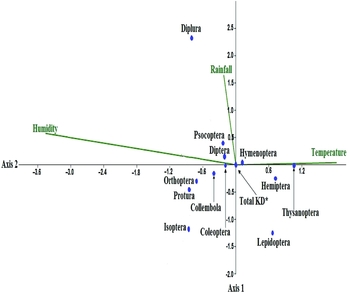
According to the canonical correspondence graph (Fig. 2), abundance in the knockdowns of the orders Diptera, Psocoptera and Diplura were positively correlated with rainfall and humidity whereas that of orders Hemiptera and Lepidoptera were negatively correlated with humidity and rainfall. Abundance in the knockdowns of the orders Hymenoptera and Thysanoptera was positively correlated with temperature whereas that of the orders Coleoptera, Collembola, Orthoptera, Protura and Isoptera had a negative correlation with temperature. Body length of the affected insects ranged from 0.099 mm to 15 mm. Out of all the ‘knockdown insects’, 93% had body length within a range of 0.35 mm–1.8 mm. The smallest affected insect (0.099 mm) was a hymenopteran and the largest affected insect (15 mm) an orthopteran.
Canonical correspondence graph showing the abundance of knockdown insects of different orders in relation to monthly average rainfall, temperature and relative humidity [‘Knockdown insects’ (KD) (3884) were collected on 160-m2 area following eight fogging treatments of the insecticide pesguard].

Discussion
Spraying the recommended dosages of malathion, pesguard and deltacide resulted in 100% mortality at a 10 m distance and > 50% mortality at a 50 m distance from the point of fogging in both Aedes aegypti and Ae. albopictus, even in an area with dense vegetation. Karunaratne et al. (Reference Karunaratne, Weeraratne, Perera and Surendran2013) reported that pesguard and deltacide spraying led to 100% mortality up to a distance of 50 m in open areas and in areas with little vegetation. Pesguard fogging is commonly used in Sri Lanka to control dengue vector mosquito populations. Cage bioassays conducted during the present study showed that pesguard fogging is highly toxic for both mosquitoes and pollinators.
Mosquito densities were not systematically tested during the present study. However, previously we reported that mosquito densities were high in the area (Weeraratne et al., Reference Weeraratne, Perera, Mansoor and Karunaratne2013). Egg and larval collections done to obtain adults for positive controls showed that Ae. albopictus is abundant in the area. According to the results, the number of mosquitoes knocked down was insignificant. This may be due to their specific microhabitats, which are away from the areas where the polyethylene sheets were spread. The actual abundance of adult mosquitoes may also have been low compared to that of other insect species. It has also been reported that the meteorological conditions prevailing in the study sites can reduce the effect of chemicals on the target mosquitoes, thus reducing their numbers in the collections (Bonds, Reference Bonds2012). In previous studies, the effect of fogging on non-target insects had been monitored using the difference of insect abundance between treatment areas and control areas. Insect traps (such as malaise trap, drop trap, CDC light trap, pane trap and pit fall trap) were used to detect abundance after insecticide spraying in treated areas and the results compared with abundance in control areas that were under natural conditions (Frye et al., Reference Frye, Dix and Carey1988; Holland et al., Reference Holland, Winder and Perry2000; Boyce et al., Reference Boyce, Lawler, Schultz, McCauley, Kimsey, Niemela, Nielson and Reisen2007; Breidenbaugh and Szalay, Reference Breidenbaugh and de Szalay2010). Such comparisons are inaccurate, as the abundance of insects can vary in two areas at any given time even without fogging. Also, insect abundance measured by traps after the treatment can include insects that move in from the surrounding area to the treated area once the fog diminishes. The present study is the first to show the direct effect of insecticide fogging on non-target insects by collecting insects knocked down by fogging. The method facilitated the determination of the prompt effect of space spraying on non-target insects. The knockdown was recorded after 30 minutes to exclude the insects that were not totally affected. Results showed that about 12% of the completely knocked down insects could recover within a 24-hr period.
Initial knockdown (collected on 10 m2 sheets × 8 treatments) was 1912 (1630 mortality) in site 1 and 1972 (1771 mortality) in site 2. On average, 23.9 (20.4 mortality) and 24.7 (22.1 mortality) insects per treatment per m2 were knocked down in site 1 and site 2, respectively. The operator walked around an area of about 225 m2 in each site during the 8-minute fogging period. Accordingly, on average, the total number of knockdown in the fogging area during an operation can be estimated as 5378 (4590 mortality) in site 1 and 5558 (4973 mortality) in site 2. The knockdown must be higher because the insecticide fog extended to the surrounding area.
A total of 3884 (3401 mortality) individual insects belonging to 12 insect orders were identified as knockdowns during this study. A study done in South Carolina reported that aerial applications of the organophosphate insecticide naled were successful in decreasing pest numbers, but the impact on non-target communities was less pronounced (Breidenbaugh and Szalay, Reference Breidenbaugh and de Szalay2010). According to the results of the present study, dipterans (39% of dead insects) and collembolans (31% of dead insects) were severely affected in both sites. Many insects found among the knockdown are prey for many insectivores. Also, some are important as detritivores, and participate in nutrient cycles (Merritt and Cummins, Reference Merritt and Cummins1996). Fruit flies are commonly found on ripened fruit contributing to the decaying process (Daly et al., Reference Daly, Doyen and Purcell1998). Collembolans are mostly found in moist environments with decaying organic matter. Decaying coconut husks and other plant materials were abundant at both sites. Springtails are primarily detritivores and microbivores. They play a major role in the establishment of plant−fungal symbioses and thus are beneficial to agriculture (Ponge, Reference Ponge1991; Thimm et al., Reference Thimm, Hoffmann, Borkott, Munch and Tebbe1998; Klironomos and Moutoglis, Reference Klironomos and Moutoglis1999). They contribute to control of plant fungal diseases through their active consumption of mycelia and spores of pathogenic fungi (Lartey et al., Reference Lartey, Curl, Peterson and Harper1989; Sabatini and Innocenti, Reference Sabatini and Innocenti2001; Shiraishi et al., Reference Shiraishi, Enami and Okano2003).
Out of the total initial number of knockdown insects, 17% (17% among dead insects) were thrips. The majority of thrips are phytophagous insects and contribute to pollination while feeding (Hunter and Ullman, Reference Hunter and Ullman1989). It has been identified that thrips are major pollinators of some dipterocarps (Appanah and Chan, Reference Appanah and Chan1981). Results also reveal that the effect of fogging is much higher on smaller insects with soft bodies. Boyce et al. (Reference Boyce, Lawler, Schultz, McCauley, Kimsey, Niemela, Nielson and Reisen2007) and Kwan et al. (Reference Kwan, Novak, Hyles and Niemela2009) have made similar observations.
When comparing Shannon diversity index values of the two sites, insect richness and evenness was higher in site 1 than in site 2. From the canonical correspondence graph, it is clear that the abundance of insect orders correlates either positively or negatively with the measured environmental parameters. There may be some other environmental factors controlling the abundance of insects in the habitats, thus contributing to the difference in their abundance between the two habitats. Most of the affected insects are soil-dwelling insect groups; and therefore, soil characteristics may also have influenced their abundance.
Conclusion
Insecticide fogging has a high adverse effect on the non-target insects in the environment, affecting several services provided by these non-target insects. For example, reduction of pollinators can reduce seed production in crop plants. Therefore, fogging operations should be done in a controlled manner and indiscriminate fogging should be avoided. Future studies should focus on determining the relationship between thermal fogging and disease incidence with structured randomized controlled trials (RCTs) that explore more insecticide classes as recommended by WHO. Impact of the removal of non-target competitors of Aedes mosquitoes by fogging, on the population dynamics of Aedes mosquitoes should also be assessed.
Acknowledgements
The National Research Council, Sri Lanka provided financial assistance (Grant no. 14–94). We thank M.A.C.M. Mansoor, Anti-Malaria Campaign, Kurunegala, Sri Lanka, for field assistance.