A few years after his arrival in British India in 1861, American minstrel Dave Carson added the “Bengalee Baboo,” a caricature of an Indian clerk, to his blackface variety show (Trivedi Reference Trivedi2007:246–49; Chattopadhyay Reference Chattopadhyay2024:196). Nearly a decade later, Bengali actor Ardhendu Sekhar Mustafi blackened up to lampoon the “Saheb,” or gentleman, in his improvised retort, Mustafi Saheb ka Pukka Tamasha (Mr. Mustafi’s Surely Spectacular Show, 1873).Footnote 1 Then, in 1977—long after Carson and Mustafi’s impressions had waned from public memory—Hindi cinema star Amitabh Bachchan dressed up in a top hat and tails to dance the cakewalk in front of a painting of a grass-skirted black figure in the film Amar Akbar Anthony. His character, Anthony Gonsalves, remains one of the superstar’s most iconic roles today.
What meaningful connections could these unique performances possibly share? Each emerged from such distinct cultural, geographic, and temporal contexts that any link beyond the superficial seems improbable. But beneath their discrete outer layers, the three share a common ancestor: the urban dandy of the blackface minstrel stage. Although each of these acts weaves together a complex web of political, social, and theatrical histories specific to the milieu that produced it, analyzing them together uncovers the buried lineage tying them back to the originary thread of US American minstrelsy.
Carson’s act—as the earliest of the three, and the only one performed by a US American emigrant—is most obviously grounded in this theatrical tradition. Indeed, the Bengalee Baboo caricature that Carson delivered to Anglo-Indian viewers was little more than the frame of the American blackface dandy retrofitted with parts from the extant British bābū stereotype.Footnote 2 As Kellen Hoxworth argues, insofar as both the minstrel dandy and Carson’s Baboo are “defined by [their] failed aspirations toward high class status and whiteness,” the latter is simply a blackface minstrel figure in a “brownface mask” (2023:48). When Carson’s Bengali contemporary, Mustafi, adopted the use of blackface to parody the Bengalee Baboo in a critique of colonial tyranny, he also inadvertently invoked both local and imported hierarchical orders.
By the time Bachchan impersonated the dandy in his comic song nearly three decades after Indian independence, the figure’s connections to US American minstrelsy had all but disappeared from popular consciousness. Despite its temporal distance from Mustafi’s initial farce, however, Bachchan’s performance illustrates how the behaviors and characteristics once synonymous with the urban dandy figure remained legible in the cultural imagination—though no longer as a symbol of US American racialism, but rather as a signifier of the specter of British colonialism. In this way, the trajectory of the minstrel dandy in Indian performance practice was permanently reshaped by its 19th-century iterations. But it was not Carson’s bumbling and biddable Baboo—the dandy’s first Indian avatar—that most impacted the next century’s cinematic imaginings. Instead, as Anthony Gonsalves’s signature song-and-dance number “My Name Is Anthony Gonsalves” demonstrates, the figure had far more staying power in its recasting as Mustafi’s sneering, despotic Saheb.
Situating Carson’s minstrelized Baboo within the particular sociopolitical circumstances that emerged in the wake of the 1857 Indian Rebellion reveals how two racial representations as apparently unrelated as the blackface urban dandy and the colonial bābū stereotype could have been coproduced under shared ideological frameworks. Mustafi’s Saheb act and Bachchan’s impersonation of the dandy each exemplify anticolonial hybridizations of the imported blackface mask. In the same way that the scandal plays of early Bengali public theatre used the word darpaṇ (mirror) in their titles to signal the social truths reflected therein, Mustafi uses the blackface mask as a mirror to reflect the true conditions of the audience back upon itself (Sarkar Reference Sarkar2009:166–67). This same self-reflexive element is later extricated from “My Name Is Anthony Gonsalves” (1977), which repurposes the urban dandy figure to anticipate a secularized future of Indian modernity for its viewing publics. To the extent that the film “dramatiz[es] the distance and difference between what is close”—the secularized democratic community it speculates—and “what is far away”—the social division and communalism embodied in the dandy as an agent of high imperialism—it produces its own versions of what Edward Said calls an “imaginative geography and history” (1979:55). Ultimately, I aim to restore nuance to our understanding of the many discursive afterlives of blackface minstrelsy on the Indian stage.
Recasting the Dandy
The success of Carson’s Bengalee Baboo on the Anglo-Indian stage attests to the relative ease with which US American and British racial representations can be exchanged in the interest of upholding white domination.Footnote 3 US American humorist Charles Godfrey Leland aptly describes this reciprocal discursive practice in an 1869 letter:
We have had [a guest] who explained that there is in India an enterprising American named Dave Carson who has made $100,000 by singing n[…]r minstrel songs in broken Hindoo English in Oriental dress. Who but an American could have done such a thing! (in Pennell Reference Pennell1906:387)
As Leland’s colorful language implies, the popularity of the Baboo act had little to do with the originality of Carson’s creation. It is a marker, instead, of Carson’s resourcefulness—or, more accurately, his timeliness. With a quick change of clothes and a new accent, Carson could easily refashion the products of US American antiblackness to better address Anglo-Indians’ emergent ideological exigencies. It is thus unsurprising that Carson devised this new routine just when Britain’s confidence in the unwavering loyalty of its Indian subjects had steadily begun to dwindle following a widespread series of uprisings against the colonists after the midcentury.
The Indian Rebellion of 1857/58 was orchestrated by native soldiers in the East India Company called “sepoys.” Though the rebels ultimately failed in their mission to oust the British from power, their impudence had successfully alarmed the imperialists; thereafter, the so-called Sepoy Mutiny became an emblem of terror in the British imagination. Gautam Chakravarty describes how sensationalized narratives of sepoys brutally violating, dismembering, and otherwise butchering colonists began to circulate in Victorian popular culture after the rebellion (2005). The conflict henceforth came to represent a “libidinal mutiny”—a violation of imperial power by a perpetrator who combined the docility of the “Oriental” subject with the sexual lasciviousness of the dark-skinned soldier (40). The figure of the postmutiny Indian was thus a hybrid subject, risen from the dangerous interstices between Orientalness and blackness. But this new image of the Indian as a rageful mutineer was also at odds with existing stereotypes of the effeminate native whose unfitness for self-governance and political freedom necessitated imperial domination (Sinha Reference Sinha1995:3–5).
Following the rebellion, Britain attempted to reconcile these oppositional subjectivities and further tighten its administrative grip over India using divide-and-rule tactics. Colonial administrators applied Victorian schemas of biological race to the existing system of social stratification. They claimed that the innately devious upper-caste soldiers were the masterminds behind the mutiny, whereas the non–upper caste soldiers who had remained loyal to the British had done so due to an inborn sense of honor (Barua Reference Barua1995:109–15). The mutiny was thought of as a direct consequence of the high numbers of Brahmin and other upper-caste soldiers in the Bengal Army, whose enlistment had upset the supposedly natural order that separated the duty-bound from the dishonorable (110–11). These conceptualizations later solidified as a new system of racial classification that divided all Indian ethnic groups into either hypermasculine “martial” races or effeminate yet hypersexual “non-martial” races (Barua Reference Barua1995; see also Farooqui Reference Farooqui2015; Sinha Reference Sinha1995:8–9).Footnote 4 To the degree that he simultaneously embodied both the effeminacy of fashionable dress and the threat of hypersexuality, the aspirational dandy of the US American minstrel stage could also contain the upper-caste Bengalis eventually categorized as nonmartial (Miller Reference Miller2009:99, 101–02). Carson’s Bengalee Baboo act simply stretched the gendered construction of the urban dandy to also accommodate this novel figuration of the scheming and dishonorable sepoy.
Though the popular image of the Indian shifted drastically after the rebellion, it had been long predated by another stereotypical figure that inspired Carson’s show. Despite the many newspaper advertisements describing the Bengalee Baboo as an “original” character, Carson directly rehashed the well-established British stereotype of the colonial bābūFootnote 5 that dated back to the 18th century (Victoria Theatre, Sydney 1857; Theatre Royal, Victoria 1859; Theatre Royal, Grant Road 1866a, 1866b, 1869). Before the midcentury, the bābū was a provincial “commercial assistant”; an 1860 Leisure Hour article describes this “old bāboo” as an “unmitigated” “specimen” of “Hindoo,” a “class” of
corpulent, unctuous, lazy masses of humanity […] intolerant in their creed, much given to the hoarding of wealth, ungainly in their appearance, […] powerfully addicted to the abrogation of all clothing that could possibly be dispensed with, and garnished mentally with [only] a smattering of English […]. (Macauley Reference Macauley1860:186)
This “old” bābū figure, as the magazine describes, faded away after the rebellion, replaced instead with a bābū more suited to the conditions of “young India” (186). By 1858, power over the colony had shifted from Company to Crown rule, and the Indian Civil Service was established shortly after; by the 1870s, a handful of Indians had managed to elevate themselves into the highly sought-after position of Covenanted clerk (Kirk-Greene Reference Kirk-Greene2000:89–90, 245–46). It was these administrative changes that ushered in an updated version of the bābū. And, not unlike the minstrel dandy, this new bābū was flamboyantly dressed, aspirational, and hopelessly Anglophilic.Footnote 6 The great number of characteristics this newer bābū class shared with the minstrel dandy enabled Carson to easily depict his Baboo as a nouveau riche civil-servant-hopeful.
As several scholars have argued, US American urban dandies like Long-Tail Blue and Zip Coon embody white anxieties about the social and sexual threat of black boundary-crossing through upward mobility and miscegenation (Lewis Reference Lewis1996:257–72; see also Miller Reference Miller2015; Miller Reference Miller2009). This same indifference to racial and cultural boundaries emerges in the indulgent behavior of Carson’s Baboo. On the one hand, he never strays far from the sign systems of Orientalist representation—his agrammatical English signals that he is unassimilable and innately subservient to the “Sahib-logue” (translated in McMahon as “gentlemen”) he fantasizes about joining (McMahon Reference McMahon1874:49). But, on the other, the figure’s stereotypical bābū exterior contradicts his sexual audacity and ambivalence toward racial boundaries, exposing a “menacing” resemblance to the blackface minstrel dandy, as illustrated in his song:
By-and-by make very long journey, cross kalla-pawney [the sea] I can go,
[…]
Little time make good Civil Servant, eat beef-steak and simpkin [champagne] drink.
[…]
Ev’ry Sahib then wait on lady, of course I cannot do less,
Then I upset two, three custad, spoil one lady’s new silk dress,
Mem-Sahib [lady] then get very goosa [angry], tell me, “Quick jow [go away] leave this place,”
[…]
When Mem-Sahib see I first-class Baboo, she say, “Excuse, I make mistake.” (in McMahon Reference McMahon1874:50–51)Footnote 7
Here, the Baboo seems to violate Hindu religious and cultural norms with ease. He casually casts away old traditions for promises of the new: though his caste prohibits overseas voyages, he vows to “cross kalla-pawney” to one day “make very long journey” to England. What is more, he guiltlessly craves English upper-class indulgences, even acquiring a taste for forbidden consumables like “beef-steak” and “simpkin.” But, in the manner of a minstrel dandy, the Baboo also disregards colonial rules of propriety: he sets his sights on lofty political aspirations, obsesses about dressing the part, and daringly pursues white women who deign to accept his advances (49–51). On some level, this bābū figure’s characteristic Anglophilia continues to tether him to his Orientalist origins. At the same time, Carson remakes his Baboo in the image of the typical urban dandy by supplying him with new characteristics—namely, a foppish preoccupation with material signifiers of status and the unbridled machismo of a randy bachelor.
As Carson’s Bengalee Baboo song illustrates, the colonizers viewed the bābū stereotype as a relatively simplistic designation capable of encompassing most English-speaking Indian clerks (Burnell and Yule Reference Burnell and Yule1903:44). This was certainly not the case for all of Kolkata society, however, and particularly not for the Bengali publics aware of their internal caste-class dynamics. Locals used the versatile term bābū in much more nuanced and fluid ways that could far exceed the limited representational schema of the British usage. Depending on the context, bābū could signify anything from a generic honorific to a descriptor for the bhadralōk (which included both landed gentry and English-educated middle classes) or even to the class of lower-ranking clerks known as kērāni (Chakrabarti Reference Chakrabarti2021:59–60; Sinha Reference Sinha1995:5–6). And in some circumstances, the term bābū did not apply at all, for instance when addressing high-ranking Bengalis like aristocrats or administrators. Even though Britons would have instantly classified this latter group as the finest of bābū specimens, other Bengalis sometimes called these elite individuals sāhib—a title otherwise reserved for white outsiders (Chakrabarti Reference Chakrabarti2021:60; see also Allen’s Indian Mail 1867:262). Carson’s challenge, then, was to recast a bābū character who could simultaneously represent both these high-ranking administrators and the low-ranking peons who served them. He did so by imbuing his Baboo character with the same racial logics that undergirded the minstrel dandy: a homogenous, blackened racial other that could contain all manners of social difference. But these logics did not translate so neatly into the Indian performances of dandyism that came after Carson’s Baboo act, as exemplified by Mustafi’s use of blackface to spoof the polysemous sāhib title.
The Mask as Mirror
On 15 January 1873, Bengali actor Ardhendu Sekhar Mustafi—one of the cofounders of the Calcutta National Theatrical Society (known as the National Theatre)—performed an off-the-cuff riposte to Carson’s Baboo act (Dasi Reference Dasi1998:156n6; Chowdhury Reference Chowdhury1995:266–74). While Mustafi mimicked Carson’s use of blackface in his own farce, he also repurposed it to both paradoxically represent the British colonial sāhib’s whiteness and simultaneously critique the haughty “black” bābū for his performance of whiteness.Footnote 8 In her autobiography, the actress Binodini Dasi recounts the circumstances that led Mustafi to improvise his iconic Saheb act (Dasi Reference Dasi1998). That fateful day, heavy rains had left the audience stranded at the end of a show. Scrambling to placate the restless audience, Mustafi—the production’s lead actor—devised a parody of Carson’s popular impression. As Dasi describes, Mustafi began his Saheb act by first entering the stage in tattered clothes, his “face and hands all blackened.” Holding a copper vessel and carpet needle instead of a fork and knife, the Saheb gawks around silently, contorting his face to choke down an “English style” supper of dry bread. “Even before he had said a word,” Dasi writes, “the audience was in splits” (136). The Saheb breaks his silence only after his mother and his wife, played by Khetramoni and Dasi, respectively, enter the stage to offer him some “cholar dal” and “mochar ghanto,” traditional Bengali vegetarian dishes (“tarkari”) (137). Enraged at their offer, he throws a tantrum:
The Saheb jumps up from the chair and looking quite violent, screams […] “What? You ask me to eat Bangali tarkari?” […He] looks around furtively and picks up some of the dal and the ghanto lying on the floor and eats it up. […] The Saheb points to the dal and says in broken Hindustani, “Ema, e mafik kya le aya? Dheo to hamake.”Footnote 9 [What’s this stuff you’ve brought? Give me some.] Meanwhile, there appears a peon from the Municipality […and] the Saheb turns on him in a rage, [shouting] “Look here, you black Bangali, neechu ja abi! [get down!]” […] Mustafi Saheb then does such a polka […] sing[ing] lines that are quite nonsensical. (137)Footnote 10
In this strange display, Mustafi uses blackface to evoke Carson’s performance practice, and, by extension, represent the white sāhib. As Dasi tells us, the audience instantly recognizes Mustafi’s twist on the Bengalee Baboo: even before he utters a word, they are “in splits” at his arrogant yet frenzied gesticulations. The Janus-faced Saheb’s appearance and behavior automatically undermine whatever claims to authority he makes. He curses at a “black Bangali” servant though he himself wears blackface; he scolds his mother for cooking vegetables, but sneakily eats them off the floor; he turns his nose up at the audience yet wears torn clothing and eats stale crusts. Whereas the Baboo’s agrammatical English plays up his Orientalist origins, the Saheb’s rageful, epithet-filled tantrum—delivered in “broken Hindustani”—ironizes the white sāhib’s insistence that it is the incompetence of Indians that necessitates British rule rather than the imperialist’s hunger for power (Dasi Reference Dasi1998:136–38; see also Sinha Reference Sinha1995:18–19). In this way, Mustafi’s inverted use of blackface reveals the performative nature of the colonizer’s purported superiority. But the white sāhib is not the only target in this farce. The Saheb’s appearance also allows Mustafi to critique the haughty, traitorous bābūs: those Indian sāhibs, or sāhib-aspirants whom Carson restyles in blackface dandy fashion.
While on the surface Mustafi’s blackface mask appears to be a straightforward mimicry of Carson’s “Bengalee Baboo” act, it is intrinsically double layered. More precisely, his use of blackface is also an imaginative instrument of banter—a self-ironic device that mocks the “black” sāhib for thinking himself above his “black Bangali” peon (Dasi Reference Dasi1998:137). But seeing as Mustafi and the other middle-class founders of the National Theatre were English-educated members of the bhadralōk, they themselves would have fit into the monolithic British bābū stereotype (Banerjee Reference Banerjee1989:166; Chatterjee Reference Chatterjee2012:230–32). Though the Bengali public theatres of the 1870s were established by members of the English-educated middle class, they drew in audiences from a variety of economic and educational backgrounds (Chatterjee Reference Chatterjee2012:230). Scholars interpret this tradition of self-ridicule as part of the 19th-century Bengali literati’s subversive attempt to forge a communal identity outside the stereotypical bābū formulation. Audience members belonging to all social groups, including the bhadralōk, would have likely shared in Mustafi’s self-reflexive mockery of bābūism (Chattopadhyay Reference Chattopadhyay2011:271; Dutta Reference Dutta2021:22–3; Kaviraj Reference Kaviraj2000:383).
Mustafi’s doubly-applied blackface both points outward at the colonial other and looks inward at the self, therefore exceeding the binary oppositions upheld by Western blackface minstrel shows.Footnote 11 It is a “hybrid” act: even as Mustafi adapts Carson’s performative gestures, he redirects them toward the oppressive nature of the colonizing power, and in so doing, indigenizes them (Bhabha Reference Bhabha1994:112). The hybridity of Mustafi’s act is particularly evident in the song that follows his initial display:
The merry Christmas is at hand
Sherry Champagne let us try
And how twill be a jolly land
When pegs [shots of liquor] begin to fly
Oh, what a cheerful eve
Let us all the high way cry
And how happily we shall live
When pegs begin to fly
Ham baḍā sāhib haĩ dunīyā mẽ [we are a big gentleman in this world]
None can be compared hamārā sāth [with us]
Mr. Mustafi nām hamārā [is our name]
Chāṭgão merā āchē bilāt [Chittagong is my England (or foreign land)]
Rom-ti-tom-ti-tom…
Ghar kī mālik, ādmī kī mālik [Master of the house, master of men]Footnote 12
Lord of all haĩ ham [are we]
Nahī˜suntā n[…]rs bāt merā tolerate [I do not listen to, or tolerate, what n[…]rs say]Footnote 13
Chunāmgalī merā dhām [My place is in the lime (or dirt) road]
Rom-ti-tom-ti-tom &c
Dirty N[…]rs I hate to see
Baḍā maẏlā, uff, bāp re bāp! [So dirty! Oh, dear me!]
Holway pills ham khāyenge rāt kō[we shall take Holloway’s Pills (a Victorian patent medicine) tonight]
Health rakhne merā sāf [To keep my health clean]
Rom-ti-tom-ti-tom &c
Coat pahanī, pantaloon pahanī, pahanī merā trousers [I wear a coat and pantaloons, and I wear my trousers]
Every two years new suits pahanī [Every two years I wear new suits]
Direct from Chandny Bazar [the local market]—
Rom-ti-tom-ti-tom &c
Chingṛī fish and kānchā kelā the only Hazree once I eat [Prawns and plantains, the soldier’s meal I eat only once a day];
Chārpāī is my palang pōsh, mōrā is my Royal seat [My bedcover is a woven cot, a bamboo stool is my royal seat].
Rom-ti-tom-ti-tom &c
[Chorus] Ham baḍā sāhib haĩ dunīyā mẽ […] (Bandhopadhyay Reference Bandhopadhyay1943:38–40; see also Das Gupta Reference Das Gupta2002:202–03)
The lyrics of Mustafi’s song underscore the dissonance between the Saheb’s physical and dialogic performances to demonstrate the incongruities between the perceived and lived realities of both the white and Indian sāhib (or aspirational sāhib).Footnote 14 To his middle- and lower-class publics, Mustafi’s Saheb act collapses the two domineering forces in Bengali society into one singular body. On one level, he embodies the self-important white army officer who refers to himself in the majestic plural—“Lord of all are we”—despite his dependence on Indian goods.Footnote 15 But on another, he emulates the same Anglophilic bābūs who worship and collaborate with this colonizing other. The Saheb is a self-proclaimed “big gentleman,” “master of [his] house,” “master of [presumably, Indian] men,” who uses an antiblack pejorative to refer to those “dirty,” darker peoples over whom he holds (or aspires to hold) mastery. But the incongruities between the Saheb’s self-representation and his reality emerge in the materiality of his daily life, revealing his doubled subjectivity. At face value, the inventory of local artifacts the lordly Saheb lists out exposes his impoverished lifestyle and dependence on Indian goods (as well as the labor of local tradesmen) to survive. His gentlemanliness is a costume—quite literally, as his English attire hails “Direct from Chandny Bazar” (Bandhopadhyay Reference Bandhopadhyay1943:38–40). By remaking the US American racial hierarchies evoked in Carson’s act, Mustafi inverts expectations, using blackface as a signifier for both whiteness and for the bābūs or Indian sāhibs who aspire towards it.
Not only does the Saheb’s self-perception compete with his lived reality; his bodily performance is also in stark visual contrast with his surrounding environment. Though a happy consequence of the improvisatory circumstances of the farce’s devising, this material juxtaposition is an operative part of the punchline of Mustafi’s in-joke. Trapped in the theatre and with little time to prepare, the cast members in the initial performance were forced to utilize scrap materials and props from other plays to stage the scene. Dasi remembers being directed to hurriedly prepare a scene “of a decrepit room,” for which “a table was put up with bricks and a plank, and a strip of cloth from a white sari had to do for a tablecloth” (Dasi Reference Dasi1998:136). This setting in effect surrounds the Saheb in quotidian reminders of Bengali life: Mustafi must use a copper ritual vessel and carpet needle to approximate a formal place setting and rely upon a “pair of ancient drawers and a torn coat” to represent Western garb.
Mustafi also had the foresight to cast Dasi and Khetramoni in roles not unlike the ones they would have taken on for an ordinary play, enabling them to use their acting experience to the advantage of the otherwise “impromptu” performance.Footnote 16 To play the Saheb’s demure Bengali wife, Dasi was instructed to wear a “red-bordered sari,” a symbol of her marital status, and to occasionally “peep in” and then “dart away as if frightened.” The experienced senior actress Khetramoni, who “did not have to be told much, [for] she knew what to do the moment she had a hint,” slipped naturally into the role of Dasi’s demanding mother-in-law, doting on her spoilt son by cooing at him “softly,” attempting to overfeed him her homemade “Bangali tarkari” (136–37). Certainly, this hasty combination of material objects and familial archetypes would have been recognizable markers of Bengali domestic life to much of Mustafi’s audience.
The material composition of this scene only further reinforced the dual function of Mustafi’s blackface Saheb as a representation of elite powers across social strata. Though after the 1880s public theatrical productions began to depict elaborate religious and nationalist themes, early public theatre from the 1860s and ’70s was more concerned with addressing the distribution of power throughout Bengali society, critiquing not only colonial rule but local leadership as well (Sarkar Reference Sarkar2009:154–55, 168). One way in which this critique was launched in scandal plays was through the trope of the darpaṇ, or mirror, which implied that the performance offered a true reflection of both foreign and local despotism (166–67). By “inserting itself into the contemporary and everyday worlds of spectators”—not just through its expansive mirroring of social power, but also through the accessibility of its vernacular composition and portability of its makeshift sets—“theatre constituted, unified, and staged the emergent public sphere” (173). To some extent, then, Mustafi’s use of blackface in his Saheb farce is also an improvised darpaṇ of sorts, capable of reflecting the hierarchies that pervade all levels of Kolkata society.
The physical and geographic location of the National Theatre also contributed to its unificatory function. Despite being the first Bengali public theatre, it was located neither in an actual theatre nor in a public space. Rather, plays were staged in the private residence of local aristocrat Madhusudan Sanyal.Footnote 17 Sanyal rented out the courtyard of his mansion at 33 Upper Chitpore Road to the troupe for around 30 rupees a month (Mukherjee Reference Mukherjee1982:31–39).Footnote 18 The open-air productions were lit using gas lamps, and audiences found seats wherever they could, at times even watching from the courtyard stairs (33). That the public gathered to watch Mustafi and the other players at the threshold of Sanyal’s estate resembles the liminoid position public theatre inhabited as an interface between multiple facets of Bengali society. Though the palatial residence undoubtedly served as a reminder that Sanyal’s inherited wealth was from the indigo trade, its location on Chitpore Road—one of the four “principal streets of the native portion” of the city, as one contemporary source describes it—positioned it in the border space between White Town and Black Town (Furneaux Reference Furneaux1895:190). But this separation of “Black” from “White,” as Siddhartha Sen points out, was less a cartographic designation than a marker of the perceived social and racial distance between Indians and Anglo-Indians, particularly insofar as the boundaries separating each half of the city were far more permeable than imperial maps represented (Sen Reference Sen2017:121). As just one of the many ways in which the National Theatre staged a darpaṇ, then, Mustafi’s use of blackface in the Saheb act is a mirror that can reflect not only the hybridity of the nascent Bengali public sphere, but also the superficiality of the colonial terms of order that attempt to control it.
Mustafi and the other artists who helped shape the emerging Bengali public theatre in the last quarter of the 19th century were “situated in the uncomfortable middle zone of cultural and class differences,” and therefore always navigating “the tension between mimesis and alterity” (Chatterjee Reference Chatterjee2007:153). Mustafi’s hybridization of blackface suggests that rather than replicating these binaries, he remade his performance practice to account for them, and in doing so, built them anew. By rearticulating—and, by extension, defamiliarizing—the “menace” of Indian political power lingering in Carson’s Baboo act, Mustafi’s farce redirects the minstrel gaze from the effeminacy of the bābū figure towards the new Bengali public theatre’s promise of communal identity formation. In this sense, the colonist’s stock antiblackness (that so easily enfolds the Orientalized whenever convenient) becomes the recycled canvas upon which the colonized can negotiate their own shared identity.
But Mustafi’s act is also ambivalent to the politics of blackface in that it negotiates these local identities by severing the semiotic connections between blackface and racial blackness. On some level, by gratuitously peppering an antiblack slur into his “broken Hindustani” speech, Mustafi forges a connection to other blackened peoples subjected to European domination. Still, this gesture is not enough to imply a sense of pan-colonial solidarity with them. By the 1840s, the English educational system had introduced a racially inflected geographical discourse to India, one that Bengali elites used to classify themselves as Caucasian due to their “Aryan” ancestry, even as Anglo-Indians consistently labeled them “n[…]r” instead (Basu Reference Basu2010:68–76; Fischer-Tiné Reference Fischer-Tiné2014:217). In the zeitgeist of late 19th-century India, then, Mustafi’s choice to use the slur while mirroring Carson’s blackface costume can be most reliably interpreted as a critique of the bābū’s internalized hatred and resistance to the colonizer’s racial misclassification of Bengalis. Put differently, the word is used as shorthand for both the white supremacy of the British and of Anglophilic Bengali elites. To some extent, then, Mustafi’s parody of US American blackface is devoid of any direct reference to US American blackness. His use of this appropriated theatrical practice demonstrates that even when the specific racial groups represented in blackface are exchanged for others, the mask itself remains a stable marker of white supremacy.
Dandifying the Ṭapōrī
Almost a century after Mustafi used blackface in a hybrid caricature of both white and Indian sāhibs, the minstrel dandy figure reappeared in a song-and-dance number from Manmohan Desai’s 1977 film, Amar Akbar Anthony (hereafter AAA). Multigenre “masala” films like AAA are made for a wide demographic audience and can be used to reinforce and disseminate ideological propaganda to unify the Indian public as a whole. At the same time, such films can also introduce progressive ideas to the masses. As Ulka Anjaria argues, while mainstream Indian films may center “Indianness” to such an extent that they appear on the surface to tout a “conservative, homogenizing, or militaristic Indian nationalism,” they simultaneously offer “new [and liberal] definitions of what Indianness means” (2021:4–5, 141). But since Hindi cinema also enacts what Priya Joshi calls a “public fantasy,” the new definitions of Indianness it offers are not just limited to the idea of the nation but also produce entirely new conceptions of the public as an entity that exists independently of the state (2015:5–6). AAA invokes the dandy to symbolize the tyrannical imperialist who is markedly different from the viewing public it imagines—not unlike how, in the century before, Mustafi’s act crafted a new Bengali communal identity by turning its critique of the colonizer inward.
Secularism is at the core of how AAA creates distance between the modern public it envisions and the bygone days of colonial hierarchization.Footnote 19 By reiterating the Nehruvian notions of secularism that emerged in the postindependence moment, the film insinuates that Indian religious communities share an inherent familial connection (Roy Reference Roy2022:226). The movie’s ideological underpinnings appear in the title itself, which lists the names of three main characters identifiable as Hindu, Muslim, and Christian, respectively. Though these characters belong to different faiths, they are revealed to be brothers tragically separated in childhood from one another and from their impoverished Hindu parents. Amar, Akbar, and Anthony are each adopted by three good Samaritans: a Hindu policeman, a Muslim tailor, and a Catholic priest. In line with many popular Hindi films from the 1970s, AAA echoes Indira Gandhi’s platform that poverty and class division were grave threats to Indian unity.Footnote 20 This is particularly evident in Desai’s casting choice of Amitabh Bachchan to play Anthony, whom audiences at the time associated with his numerous roles as the quintessential “angry young man,” a voice of the “subaltern classes” (Poduval Reference Poduval2012:43–44). Bachchan’s performance in the comic song “My Name Is Anthony Gonsalves,” therefore, reveals the staunchly populist politics that buttress AAA’s primary investment in building a multifaith public coalition.
“My Name Is Anthony Gonsalves” situates the film’s critique of socioeconomic division in the context of Anthony’s impersonation of a minstrel dandy. The mutually constitutive relationship between songs and narrative events in the Hindi filmic medium produces structural gaps where aspects of characterization, visuality, and affect can be developed and negotiated (Morcom Reference Morcom2008:239). This is certainly the case in AAA, where even as Amitabh Bachchan’s performance throughout the picture mediates Anthony’s on-screen portrayal, within the world of the narrative, Anthony, too, is a character who mediates his own self-performance. Though raised as a Christian, Anthony is no Anglophilic mimic man like the bābū. Instead, he is a poor, drunken bootlegger who embodies the archetypal ṭapōrī: the flaneur or street ruffian, a rebel whose agency lies in the “performance and performative gestures” of working-class dialect, streetwise swagger, and roguish masculinity (Mazumdar Reference Mazumdar2007:41–50). While Anthony is a religious, social, and moral in-betweener, he is depicted as a purehearted Robin Hood. Though poor, his goodness makes him a suitable match for his love interest, the wealthy and Westernized Jenny. Hoping to win Jenny over with his charms, Anthony poses as an entertainer and crashes an Easter party at the elite Catholic Gymkhana. There ensues his song. Accessorized in the manner of an upper-class Victorian gentleman (umbrella, monocle, top hat, morning coat, white gloves), Anthony sings a Hindi ballad interspersed with segments of a minstrel dandy act, including a stump speech and cakewalk. For the duration of Anthony’s performance at the Gymkhana, his dandified costume, movements, and speech transmogrify the ṭapōrī into a figure not unlike Carson’s Baboo and Mustafi’s Saheb.
Just as the mid-19th century importation of blackface minstrelsy affected how Indian performers negotiated their relationship to imperial power, so too is Anthony’s act shaped by the long history of exchange between Black American performance traditions and the entertainment industry in erstwhile Bombay.Footnote 21 Marvin McAllister’s description of the Black American theatrical tradition of “whiting up” gives us language to think through the different layers at work in this song. Some Black “whiting up” artists, McAllister claims, concurrently negotiate both their own racial positionality in relation to whiteness and to their audience’s, while also anticipating and constructing new future meanings of “blackness,” “whiteness,” and “other identity markers such as class and gender” (2011:5–6). Though the contextual circumstances that produced “My Name Is Anthony Gonsalves” differ significantly from those of the “whiting up” performers McAllister considers, at a narrative level, Anthony’s live performance operates similarly by mocking the white colonizer in order to critique Westernized Indian elites. By emphasizing the contrast between his highfalutin spoken dialog and the Hindi lyrics of his love song to Jenny, Anthony clearly separates his impersonation of the dandy from his authentic identity as the working-class ṭapōrī. He also uses his costuming to ensure his fellow partygoers are aware of the falseness of his dandy guise—quite literally, in revealing the number “420” sewn into his jacket lining, the symbol of a confidence trickster in Indian popular culture.Footnote 22
Like 19th-century minstrel stump speeches, the nonsensical monologs Anthony performs in the interludes of his song are filled with non sequiturs and malapropisms (Zanger Reference Zanger1974:35–36). But while blackface minstrels used exaggerated mispronunciations in their monologs, the ṭapōrī—whose social class is already marked through a linguistic performance—delivers his lines perfectly in the Received Pronunciation. Several times throughout the number, Anthony’s soulful Hindi singing is disrupted by the dandy’s discordant English exclamations (the bracketed ellipses mark moments of singing between monologues):
Wait, wait, wait! You see, the whole country of the system is juxtapositioned by the hemoglobin in the atmosphere, because you are a sophisticated rhetorician intoxicated by the exuberance of your own verbosity!
[…]
Excuse me please!
[…]
Right, right!
[…]
You see, such extenuating circumstances coerce me to preclude you from such extravagance!
[…]
You see, the coefficient of the linear is juxtapositioned by the hemoglobin of the atmospheric pressure in the country! (AAA 2012:1.15.45–1.21.00; lyrics by Anand Bakshi)
Though most of Anthony’s monologs are nonsensical, some of his first line alludes to British Prime Minister Benjamin Disraeli’s 1878 description of an opponent.Footnote 23 This is a particularly apropos reference: because Disraeli played a central role in orchestrating the 1858 act cementing Crown rule over India, any mention of him in Hindi cinema must be understood as a symbolic invocation of British imperial power (Elison et al. Reference Elison, Novetzke and Rotman2016:145).
While the incongruities between linguistic and bodily performance are a central feature of Mustafi’s Saheb act, both Anthony’s external appearance and his uncharacteristically pompous speech poke fun at Westernized Indians who, like the bābū figures of the previous century, are too “intoxicated by the exuberance of [their] own verbosity” to remember where their racial and cultural loyalties lie (AAA 2012:1.15.45–1.21.00). Within the context of the film, this critique is most applicable to the two villains: the foreign-coded bodybuilder, Zebisko, who keeps Jenny from Anthony; and Robert, a wealthy Christian crime lord and Jenny’s estranged father. It is clear that everybody in the audience apart from Zebisko is in on the joke: after each segment of Anthony’s drawn-out stump speech, the spectators respond in unison with befuddled cries of “What?!” To the extent that “masala” films like AAA are shared social texts intended to be consumed communally, Anthony’s critique reaches beyond the circumstances of its narrative performance at the Gymkhana to also enfold Bachchan’s cinema spectators—and, by extension, the public as a whole—into the crowd of onlookers in on the joke.
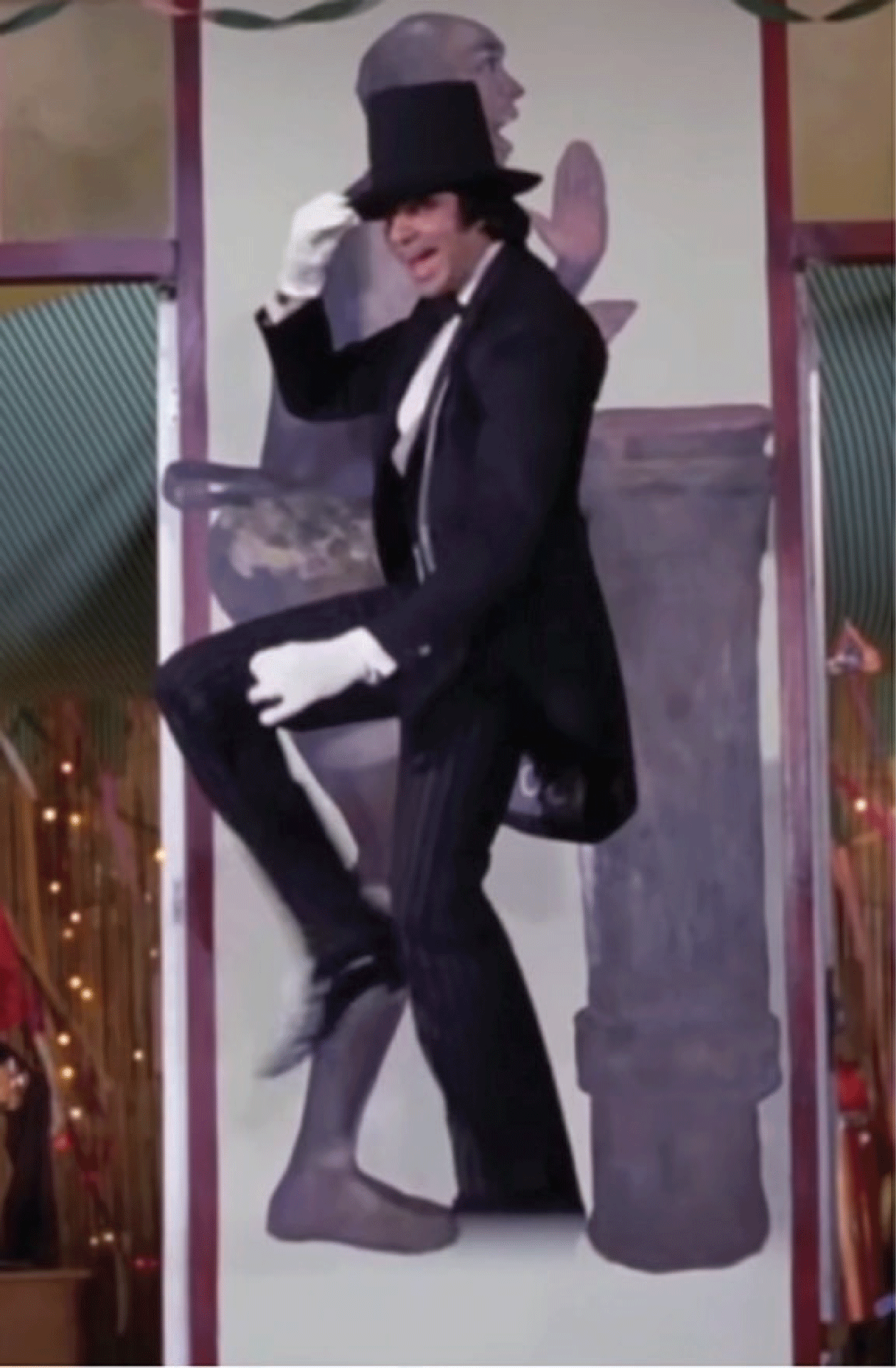
Several aspects of the song’s production—including choreography, staging, and special effects—help create its extranarrative political signification. Whereas Mustafi’s Saheb act uses blackface to signify both Indian and white sāhib figures, Bachchan’s performance uses an external visual representation of the Black body to advance AAA’s social and political critiques while also implicitly articulating the film’s anxieties about Indian identity. In between the stump speeches woven through the song, the dandy figure spends a lengthy interlude posing and doing a cakewalk-like dance in front of a mural of a dark-skinned figure wearing a grass skirt and posing in profile view—a starkly out of place representation that would more likely belong in the pages of a Victorian-era travelog than a 1970s social club. With the use of special effects, the dancing dandy floats in midair as he struts in his jazzy cakewalk, his movements superimposed onto the Black body behind him (fig. 1). Bachchan mirrors the painted figure’s gestures and poses exaggeratedly, as if emphasizing the difference between the two bodies while simultaneously underscoring their common otherness. The Black body is fixed in the background scenery, still and contained until Bachchan brings it to the forefront of the scene to reanimate its bodily posture with the dandy’s movement.
Amitabh Bachchan portrays Anthony Gonsalves doing a cakewalk-like dance in front of a painting of a black figure. From “My Name Is Anthony Gonsalves” in Amar Akbar Anthony (1977) dir. Manmohan Desai. (Screenshot courtesy of author)

Though Bachchan does not literally wear blackface to play Anthony’s performance of a dandy caricature, by positioning himself as a mirror image to this Black figure, the whiteness of the dandy his character is parodying becomes starkly clear. Insofar as 19th-century Britons viewed all dark-skinned colonial subjects homogenously—as exemplified by the Anglo-Indian propensity to use a singular antiblack slur for all dark-skinned “natives”—the figure in the background evokes the generic colonial subject, a stock embodiment of the West’s “savage” other. This primitivist image, however, also has local implications for the secular Indian publics AAA envisions. The postindependence Indian nation-state had its own internal “primitive others”: the Adivasi or Vanavasi peoples who were seen as indigenous “tribes” and forest dwellers, “the marginalized and politically excluded ‘others’ of the modern” treated as “distinct from ‘mainstream’ Hindu and Muslim population” (Das Gupta Reference Das Gupta2019:108, 115–18).Footnote 24 As Mustafi’s act implies, the seeds of a racialized historical and geographical order had already been sown by colonial education systems in the 19th century. AAA’s fantasy of a postcolonial “secular time” further builds upon this discourse, enabling the clichéd grass-skirted figure in Anthony’s song to also conjure “the stagnant time of the colonized, indigenous person” (Basu Reference Basu2010:55). Anthony’s parodic superimposition of the Victorian gentleman upon the blackened “native” figure, then, subtly homogenizes modern aspirational Indian subjectivity while positing it as antipodal to both.
Similar to Mustafi, Bachchan mimics the minstrel show while ambivalently complicating the antiblackness inherent to the form. AAA’s conceptual use of the blackface mechanism—sans artificial coloration—demonstrates the percolation of the racist caricatures embodied in Carson’s act into the Indian public’s struggle to craft its own colonial and postindependence identity. Performances like “My Name Is Anthony Gonsalves” reveal the long shelf life of the blackface minstrel figure as a portable prop for Western conceptualizations of racialized blackness. But they also reveal the eclectic accretions of localized significations that accumulate upon this mask, adding to, but never erasing, the white supremacist ideologies that birthed it.
These complex theatrical and political negotiations reveal the tangled histories and legacies of blackface—and its anticolonial affordances—beyond US American shores. While white blackface performers positioned dandy figures in a space between a white audience and the terrifying bodies that threatened their social and political power, these Indian caricature performers defamiliarize the blackface mask to address local concerns about hierarchization. Even if the imprint of US American blackface minstrel shows like Carson’s has faded to near illegibility in the archives of Indian performance, figures like Mustafi Saheb and Anthony Gonsalves show how blackface conventions can both stand in for the authoritative power of whiteness writ large and be redirected inwards to build new ideas of a collective public. Ultimately, it is through a better understanding of such parodic, localized retorts that the meanings of blackness and blackenedness formulated on the Indian minstrel stage can be unmasked, mirrored, and turned inside out.