

Introduction
In many countries, the number of autonomous or semi-autonomous public organizations in central government has increased over recent decades. The key concern has been that policy-making should be separated from policy implementation (Verhoest et al., Reference Verhoest, Peters, Bouckaert and Vershuere2004; Christensen and Lægreid, Reference Christensen and Lægreid2006; Pollitt and Bouckaert, Reference Pollitt and Bouckaert2011). By allocating more discretion to the management of these organizations, it is assumed, organizational performance can be improved. In the public administration literature, an active debate on definitions of, and effects from, organizational autonomy has followed (e.g. Verhoest et al., Reference Verhoest, Peters, Bouckaert and Vershuere2004; Christensen and Lægreid, Reference Christensen and Lægreid2006; Van Thiel et al., Reference Van Thiel, Verhoest, Bouckaert and Lægreid2012). This debate is focused primarily on the external relations of the organization, assuming that these are the primary factors affecting organizational performance. However, to understand organizational performance, this article argues, it is equally relevant to understand relations within the organization, in particular, professional autonomy in relation to managers.
The tension between managerial and professional discretion, between hierarchy and specialized knowledge, is classic (e.g. Williamson, Reference Williamson1973; Lindblom, Reference Lindblom1977; Thorelli, Reference Thorelli1986; Powell, Reference Powell1991). However, it has grown increasingly severe in recent years. It can be described as a distinction between old and new managerialism. Fueled by the financial crisis and growing expenses for the welfare state, the public sector has been subjected to rather extensive restructuring, including the introduction of management systems aimed to weaken professional control (Ferlie and Geraghty, Reference Ferlie and Geraghty2007). At the core of the new managerial ideas in the public sector, is the idea that organizational performance can be improved by importing market orientation and business practices into public organizations. This line of ideas is often referred to as the new managerialism (e.g. Clarke and Newman, Reference Clarke and Newman1997; Exworthy and Halford, Reference Exworthy and Halford1999; Flynn, Reference Flynn1999; Broadbent and Laughlin, Reference Broadbent and Laughlin2001; Freidson, Reference Freidson2001; Kitchener, Reference Kitchener2002; Parker, Reference Parker2002; Deem and Brehony, Reference Deem and Brehony2005; Kirkpatrick et al., Reference Kirkpatrick, Ackroyd and Walker2005; Ackroyd et al., Reference Ackroyd, Kirkpatrick and Walker2007) – alternatively, as neo-managerialism (Terry, Reference Terry1998) and, more recently, leaderism (O’Reilly and Reed, Reference O’Reilly and Reed2011).
Thus, whereas the basic idea of agencification is that organizational performance can be improved by allocating extensive autonomy to executive agencies, as opposed to government ministries, the basic idea of new managerialism is that organizational performance can be improved by allocating extensive autonomy to agency managers, as opposed to professionals. This means that a considerable amount of power is concentrated in the directors-general of the new, more or less autonomous, executive agencies. With this ideological turn, new managerialism has left behind the traditional idea that managers of public organizations should serve simply as neutral tools in the implementation of public policy (Diver, Reference Diver1982), an approach that could be referred to as old managerialism. With new managerialism, public managers enjoy more autonomy, and it is assumed that their self-interest will guide them to solutions that benefit not only themselves, but also the organization as a whole, including its task in terms of efficient policy implementation.
However, despite a charitable intention of improving the performance of public organizations, studies from different sectors suggest that new managerialism may have many unexpected – and unwanted – side effects (cf. Hood and Peters, Reference Hood and Peters2004). One such recurring side effect is the undermining of professional norms and identities, following a battle between managers and professionals over professional jurisdictions. This has been documented, for example, in studies on higher education (Deem, Reference Deem2001; Reed, Reference Reed2002; Noordegraaf and de Wit, Reference Noordegraaf and de Wit2012; Teelken, Reference Teelken2012), street-level work (Denhardt and Denhardt, Reference Denhardt and Denhardt2000; Evans and Harris, Reference Evans and Harris2004; Brodkin, Reference Brodkin2011; Evans, Reference Evans2011), and public health care (Newman and Lawler, Reference Newman and Lawler2009; Choi et al., Reference Choi, Holmberg, Löwstedt and Brommels2011). Many of these studies indicate that new managerialism may have the paradoxical effect of decreasing organizational performance, contrary to expectations. This conforms to other studies, which indicate that granting autonomy to lower or middle internal levels in organizations will lead to more committed and motivated employees, and improved organizational performance (e.g. Guest, Reference Guest1997; Thomas and Dunkerley, Reference Thomas and Dunkerley1999; Ingraham, Reference Ingraham2005; Meyer and Hammerschmid, Reference Meyer and Hammerschmid2010; Tummers and Knies, Reference Tummers and Knies2013).
The aim of this article is to investigate how professional autonomy, under the influence of new managerialism, may affect the performance of public organizations. Since the setup and staffing of public organizations is likely to have a major impact on the achievement and realization of political ambitions in any policy field, this ought to be a central concern in the literature on public governance, we argue. The expectations and outcomes of basic managerial ideas are of fundamental importance if we acknowledge that politics could not just be about talk but also about delivery.
Both old and new managerialism, as outlined above, can be compared with professionalism (e.g. Freidson, Reference Freidson2001; O’Reilly and Reed, Reference O’Reilly and Reed2011). With professionalism, autonomy is seen as an obligation in the pursuit of everyday professional work, whereas managerialism assumes that autonomy is a matter primarily on the institutional level, concerning the relation between the organization and its principal. Professionalism also holds that professionals are more likely than managers to be able to secure organizational performance, as they hold strongly motivated professional norms where quality and efficiency in professional work is key.
The study is based on a framework that builds on Evetts (Reference Evetts2006) and her distinction between organizational professionalism, representing the ideas of new managerialism, and occupational professionalism, representing the classic idea of professionalism. To separate between the two types of professionalism, three aspects are introduced: the formal organization design, the professional practice, and work assessment.
For reasons which we shall return to, we chose to conduct a longitudinal case study of the Swedish National Audit Office (SNAO). The SNAO was formed in 2003 and was expected to serve as a role model both for executive agencies in Sweden and, internationally, among Supreme Audit Institutions (SAIs). In the Swedish legal system, the SNAO is treated as a traditional central agency, with only a few exceptions. The main difference is that it enjoys full autonomy for its principal, which is the Swedish Parliament, while executive agencies in Sweden are only semi-autonomous. This means that the SNAO organizational performance must be understood primarily as a result of internal procedures and priorities, rather than as a result of priorities and initiatives by the (external) principal. This way, managers cannot easily be excused for poor organizational performance by referring to them as ‘good people trapped in bad systems’ (Gore, Reference Gore1993), as some liberation management scholars would argue (Terry, Reference Terry1998).
In short, findings from this study show how new managerialism, based on a complex interplay of factors on the micro level, may lead to lower – rather than higher, as often expected – organizational performance. One reason is that managers compensate for their lack of authority among professionals in the same domain, by expanding support functions and systems for management control and by attempting to standardize and streamline professional practice. This is evident, in particular, in contexts where these managers lack professional experience in the specific areas where the agency in question operates.
The article is organized as follows. An introduction to the literature on professions with a focus on professional autonomy is provided first. This includes an analytical framework to capture the distinction between occupational professionalism and organizational professionalism. The research design is outlined and the case (the SNAO) is introduced. Empirical data from the case study are then presented, followed by a discussion and conclusions.
Professional autonomy and organizational performance
In order to explore professional autonomy, the key concept of professionalism must be defined. A typical definition would say that professionalism is signified by common occupational norms, high internal demands for quality, a common educational background, highly specialized work tasks based on objective standards, and extensive autonomy (cf. Wilensky, Reference Wilensky1964). Freidson (Reference Freidson1995) has emphasized that professional work is inherently discretionary, and its very indeterminacy places constraints on the capacity for external inspection and supervision. Professional autonomy, hence, is about the right to exercise professional judgment – rather than bureaucratic rule – in the process of providing a service.
Classic examples of professional groups are lawyers, medical doctors, engineers, and teachers; these groups have had varying success in achieving exclusivity and status (Burrage and Torstendahl, Reference Burrage and Torstendahl1990; Brante, Reference Brante1992, Reference Brante1999). In the early days of professional theory, power struggles and status striving were regarded as natural to all occupations, and it was assumed that very few occupations would achieve the authority of the classic professions. At that time, scholars were primarily focused on trying to establish criteria by which groups could be defined as professions. This stream of research has gradually been replaced by an essentialist interpretation of professions (Brante, Reference Brante1999; Freidson, Reference Freidson1999), where a common minimum definition of what constitutes a profession is similar to what is suggested at the beginning of this section.
Today, professions and the professionalization process are explored to understand all kinds of aspects of the dynamics within organizations and in society as a whole. A typical problem in organizations with strong professional (occupational) groups is the issue of balance between organizational and professional loyalty, sometimes referred to as organizational–professional conflict (OPC) (e.g. Aranya and Ferris, Reference Aranya and Ferris1983; Gunz and Gunz, Reference Gunz and Gunz1994; Cowton and Brierley, Reference Cowton and Brierley2000; Shafer, Reference Shafer2002). One way to explore professionalism in OPC studies has been suggested by Hall (Reference Hall1968), who adopts five characteristics to define professionals. First, professionals are affiliated with a professional community, associated with specific professional institutions. Second, they share a commitment (a ‘social obligation’) to serve the public interest. Third, they believe in self-regulation and peer review for quality assurance. Fourth, they experience a sense of calling (a ‘professional dedication’) to their work, making extrinsic rewards less effective. Fifth, professionals demand extensive autonomy. A weakness with this framework is that it captures only the attitudinal aspects of professionalism and the perspective of the professional. An alternative would be to define professionalism from an outside perspective, focused on formal organizational structures and routines. These structures would show to what extent the organization adheres to the professionals’ call for discretion.
Similarly to the OPC studies, Evetts (Reference Evetts2006) distinguishes between two different and contrasting forms of professionalism in knowledge-based work: organizational professionalism and occupational professionalism. She describes occupational professionalism as an approach operationalized and controlled by practitioners themselves, meaning that they are self-regulating, subject mainly to informal collegial control. This self-regulation is based on shared education and training, a strong socialization process, shared work culture and occupational identity, and shared codes of ethics that are monitored and operationalized by professional institutes and associations. From the contrasting perspective of organizational professionalism, professional conduct is governed at a distance and includes a substitution of organizational values for professional values such as bureaucratic, hierarchical, and managerial controls, rather than collegial controls. With organizational professionalism, the profession is subordinated to externally established performance targets and increased political or administrative control. The traditional perspective on professionalism presupposes a delegation of decision power to the profession, in order to make use of its professional expertise. In the organizational perspective, discretion is typically replaced with standardized and detailed instructions from superiors, who thereby minimize the room for professional judgment. Against this backdrop, we argue that this type of organizational professionalism is a good representation of, what is referred to in the literature as, new managerialism.
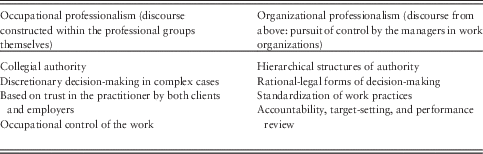
To understand professional autonomy, we will adopt a framework building on the OPC literature and, in particular, on Evetts (Reference Evetts2006) distinction between the two types of professionalism. Evetts’ description of the two ‘discourses’ is summarized in Table 1. As the framework shows, the organizational hierarchy imposes constraints on professionalism – constraints that professionals cannot easily circumvent. With occupational professionalism, collegial authority and peer review will characterize the organizational design, which typically would be rather flat. The concept of organizational professionalism means that there is a more hierarchical structure of authority, where managers are typically recruited from outside the professional field, as ‘experts in management.’ This can be compared to managers who have assumed their role after a distinguished career within the profession, whose members they are now supposed to manage (e.g. Pollitt, Reference Pollitt1990: 438). Only these managers can claim to be able to make substantive and detailed judgments of the quality of the work of the professionals in the organization (ibid.). This important aspect concerns who has the right to define what constitutes work well performed.
A framework comparing occupational professionalism and organizational professionalism, building on Evetts (Reference Evetts2006)
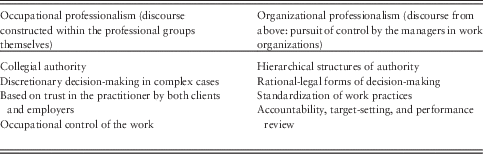
In occupational professionalism, professional practice will build on discretionary decision-making in complex cases and on a high degree of trust in practitioners. A shared knowledge base is typically required and, according to Douglas (Reference Douglas1971), so is a shared professional association, although this may be contested. In organizational professionalism, on the other hand, work will often be standardized and based on rational-legal forms of decision-making. Introducing standards is a way of embedding authority in rules and systems rather than in credentialed professionals (Brunsson and Jacobsson, Reference Brunsson and Jacobsson2000). Hence, for the professionals, there may be incentives to minimize the standardization of their work in order to preserve their professional autonomy and status. Both types of professionalism require that professionals and their work be considered legitimate by society and clients (Agevall and Jonnergård, Reference Agevall and Jonnergård2007).
How can we empirically evaluate the presence of either discourse? First, when it comes to collegial authority versus hierarchical structures of authority, we argue that this could best be observed through the organization’s design. For example, a tendency to centralization in the new organization could be an indication of hierarchical structures, while a tendency to a more decentralized organization could indicate more scope for collegial authority. To make the final judgment on this, however, we also need to pay attention not only to organizational charts, but also to the organization’s rules of procedure (i.e. who has the competence to decide what). In this investigation, we labeled this dimension ‘Organization design’ (first dimension in Table 1). Second, another way of identifying what kind of professionalism is at hand is to study who controls the exercise of the daily professional practice. Whose norms and standards are decisive in the exercise of performance auditing? Is it the professionals themselves (including professional associations), which would indicate occupational professionalism, or is it a process dictated by top management, which would be a sign of organizational professionalism? The former would indicate more trust in the professionals by the employer than would the latter. We have called this dimension ‘Professional practice’ (second and third dimensions in Table 1).
Third, we will also analyze how the work of professionals is assessed and controlled. Who determines the performance measures used to determine the quality of the work? For example, a peer-review system would indicate that the assessment is decentralized to the professional norms of the professionals, indicating occupational professionalism. This last dimension we have labeled ‘Work assessment’ (last dimension in Table 1).
By organizing the analysis around these dimensions, summarized in Table 1, we seek to chisel out what type of professionalism is pursued within a particular public organization. We also plan to relate our findings to organizational performance. This is operationalized along the following three dimensions: Quality and relevance of the audit reports, SNAO efficiency, and autonomy of SNAO auditing. By presenting evidence along these three dimensions, our aim is to make a compelling case of how the new SAI organization has performed during the period studied. This account is necessary if we are to discuss how professional autonomy may affect organizational performance.
Research design
In order to investigate the characteristics and significance of professional autonomy for the performance of public organizations, we chose to distinguish between organizational professionalism and occupational professionalism, as outlined in the previous section. The organization that we found of particular interest for this specific line of enquiry is the SAI. An advantage of a single in-depth study is the opportunity to gain a thorough understanding of organizational processes, and the opportunity to build hypotheses based on these findings. One of the advantages of a wide set of cases, on the other hand, would be the opportunity to test hypotheses and provide generalized explanations for causal relations. Because the topic of this study has not been subjected to previous, extensive research, we are, at this stage, primarily interested in understanding the dynamics of micro-level processes, and this way, attempting to understand how professional autonomy and managerialism is played out in practice.
There are two main reasons why we found the SAI context to be a suitable case for our analysis. First, studying a SAI allows us to explore the organizational micro-processes triggered by new managerialism, in an environment with minimal influence from the political sphere, since SAIs typically enjoy an autonomous position in relation to both ministries and Parliament. Otherwise, even with semi-autonomous agencies, the approach and decisions of policy-makers and officials at the ministries may have a thorough influence on organizational performance (Maor, Reference Maor2004). Studying a traditional agency would thus make it difficult to isolate effects from managerial decisions regarding professional autonomy from the decisions of ministries. Hence, managers rather than policy-makers can typically be held to account for performance at a SAI. We should underline that in terms of institutional autonomy, the SNAO is representative of central agencies in most other regards. It is basically subject to the same legislation as the executive agencies, although it enjoys more autonomy.Footnote 1
Second, the SAI is a type of organization where balancing the autonomy of managers and professionals is particularly challenging, considering that both these groups can claim – and do claim – to be experts in the areas of organizational performance and management. For this reason, we added a special focus on the performance audit practice at the SAI in question – the SNAO. These professionals are experts in the area of management.
To conclude, we found the context of SAIs, and in particular the Swedish SAI (the SNAO), of relevance for our study. The Swedish setting is advantageous, not least, because of the extensive access to official records in all types of public institutions (including public agencies, the SAI, and the governmental offices). The case study stretches over a 10-year period, ranging from 2002 (with preparations for a reform implemented the year after) to 2011. Several sources and techniques were combined, with a special focus on document studies (of official and informal records and documents) and an extensive interview study, including 93 interviews. For the present article we make direct reference to a few of these, that is, six semi-structured interviews (conducted during the period 2002–07). All interviews had a broad focus, covering the areas of culture, communication, leadership, career, and general reflections on current organizational issues. Moreover, we consulted five employee attitude surveys. Four of these were conducted by professional statistics institutes (Sifo Research and Consulting, 2004, 2005; ZonderaCom, 2008, 2010), while one survey was from a research study (Bringselius, Reference Bringselius2011). Numerous other documents were also studied, such as the internal SNAO personnel magazine, the SNAO intranet, parliamentary records, union protocols, and media articles. In summary, we used a wide range of sources to facilitate an intensive examination of the possible significance of professional autonomy for organizational performance.
Finally, we would like to add a few words about our definition of a profession. Is it appropriate to study a narrow group, such as the group of performance auditors at SAIs, as a profession? There is no authorization of performance auditors, as there is for financial auditors. We argue that performance auditors qualify for this kind of analysis of professionalism, since this group belongs to a knowledge-based category of occupations that usually require a period of tertiary education, vocational training, and experience (cf. Pollitt and Summa, Reference Pollitt and Summa1999; Evetts, Reference Evetts2003: 397). Moreover, the development of international standards and a code of ethics for SAI performance auditors by the International Organization of Supreme Audit Institutions (INTOSAI, 2001, 2004), illustrates an ongoing reflection on internal standards and norms within this professional group. Furthermore, the former Swedish audit institution under the central government, Riksrevisionsverket (RRV), has been known for adopting scientific standards and methods in its auditing work. In an empirical study comparing performance audit in five countries, Pollitt and Summa’s, Reference Pollitt and Summa1999: 211 ff.) observations on the Swedish case were as follows:
Notions of compliance are much less to the fore at this pole. Instead the task of the performance auditor is to produce explanations which can be defended in terms of their analytical rigour and methodological sophistication.
Hence, we do not argue that performance auditors at SAIs constitute a profession comparable to traditional professions, such as, physicians, judges, or teachers. Nevertheless, we argue that it is still meaningful and relevant to try to understand the situation of this occupational group in terms of professionalism.
The new SNAO: increased organizational autonomy, but decreased organizational performance
The SNAO underwent a thorough restructuring in 2003 when the constitutional securing of organizational autonomy was at the very forefront of the reform, that is, securing a high degree of autonomy in all the dimensions presented by Verhoest et al. (Reference Verhoest, Peters, Bouckaert and Vershuere2004). The reform was a result of decades of debate exclusively focused on the organizational autonomy of this kind of political institution; the reform was not at all concerned – or occupied – with the actual performance of the professional work of the two state audit agencies that preceded the new SNAO. When the SNAO was established, it was expected to serve as a role model for executive agencies in terms of efficiency and professionalism (Bringselius, Reference Bringselius2008, Reference Bringselius2013, Reference Bringselius2014). In spite of this major reform to secure organizational autonomy, the performance of the institution declined after the reform – a puzzle and an unexpected outcome that, we argue, needs to be described and investigated with the help of the literature on professionalism.
The introduction of a new Supreme Audit Institution represented a major constitutional reform in the Swedish setting (Ahlbäck, Reference Ahlbäck2001). Before 2003, Sweden had two audit institutions: RRV, which was the larger institution, located under the Ministry of Finance, and Riksdagens revisorer, or the Parliamentary Auditors, an agency under the Swedish Parliament (Riksdag). Following considerable political deliberations in the 1990s, the model with two central audit institutions was finally abandoned, in particular because SAI’s organizational autonomy could not be secured with the former institutions (Ahlbäck, Reference Ahlbäck1999; Bringselius, Reference Bringselius2008). The SNAO was formed in July 2003, as a new and pronounced autonomous agency under the Swedish Parliament, but in organizational terms as a merger of the auditors from RRV and the Parliamentary Auditors (Bringselius, Reference Bringselius2008). The organizational autonomy of the new Swedish SAI was given constitutional protection, including protection of funding and the employment security of the three Auditors-General.
Before we set out our analysis of professionalism at the SNAO, we will give an account of SNAO’s performance, based on three dimensions that we have presented in an earlier section: the quality and relevance of SNAO audit reports, SNAO efficiency, and the autonomy of SNAO auditing. Hence, our study of the professional autonomy at the SNAO is made with this information as the background.
Quality and relevance of SNAO audit reports
Issues concerning the quality and relevance of audit reports include matters concerning the focus on audits. At the SNAO, the debate over this focus began in the first months after the office had been formed, as the Auditors-General requested a new audit approach, focused on compliance and accountability (Bringselius, Reference Bringselius2008). This can be compared with the traditional performance audit (sometimes referred to as value-for-money audit), focused on the three E’s: efficiency, economy, and effectiveness. The internal debate would continue for several years. A review of SNAO audit reports from the period 2003–08, conducted by Grönlund et al. (Reference Grönlund, Svärdsten and Öhman2011), reveals that the new compliance-focused approach was indeed implemented in practice. This new approach, however, did not comply with the tradition established by RRV and the Parliamentary Auditors, nor did it comply with the expectations and requests of the SNAO stakeholders. In a parliamentary commission (Sveriges riksdag 2008/09:URF1 and URF3), policy-makers expressed their concern over a perceived lack of quality, relevance, and correct focus on audits. This concern was confirmed in SNAO stakeholder surveys (e.g. Gullers Grupp, 2007). More recent studies, indicate that SNAO audit reports still have serious quality issues (Bringselius, Reference Bringselius2011; Hertting et al., Reference Hertting, Jungerhem, Murhem, Sjöblom, Stenbacka and Söderberg2011).
SNAO efficiency
The former two state auditing institutions in Sweden, RRV and the Parliamentary Auditors, had been quite productive. After the SNAO was formed, it took several months before the first report was issued. This delay was followed by considerably fewer reports each year than what had been expected. This was increasingly questioned in the media; one news article was headlined: ‘The new National Audit Office paralyzed by internal conflicts’ (Dagens Nyheter, 2003); that is, the conflicts reported in this article were assumed to be a key reason behind the low productivity of the SNAO. One of the Auditors-General (Interview #85) argued that the quality of reports was much more important than the number of reports each year. However, the quality of the reports was also subjected to criticism, as previously described. A highly critical report was issued by the SNAO board in 2006 (SNAO Board, 2006), comparing the cost of each audit report at the SNAO to that of previous reports by RRV and the Parliamentary Auditors. An audit report at the new SNAO cost twice as much as one from RRV and four times as much as one from the Parliamentary Auditors. Efficiency, in these terms, has remained low at the SNAO over the years, and in a 2011 survey (Bringselius, Reference Bringselius2011), 44% of responding SNAO performance auditors explained that they did not consider the overhead costs of the SNAO to be reasonable. Only 27% of respondents believed that the costs for operations were acceptable, and just 32% believed that the SNAO itself lived up to the expectations it raised among other public organizations.
Autonomy of SNAO auditing
The autonomy of SNAO auditing was questioned, among other aspects, in the stakeholder attitude report from the year 2007. One interviewee, referred to in this report, considered the new SNAO as trying to ‘be independent by being the enemy’, meaning that the SNAO was overly critical of the auditees and tended to use this approach to seek attention and recognition in the media (Gullers Grupp, 2007: 13). Even auditors themselves (Bringselius, Reference Bringselius2014) perceived the SNAO as having become too focused on identifying problems that could then be reported in the media.
There was also some debate about what the conditions for audit autonomy were within the SNAO. Auditors argued that autonomy – and audit quality – required extensive professional autonomy, whereas the Auditors-General saw themselves as guarantors for audit autonomy and quality. Building on the latter idea, they allowed themselves to intervene in all the key parts of the auditing process; they had a decisive influence on the choice of audits, the choice of audit designs, and the establishment of audit conclusions (Hertting et al., Reference Hertting, Jungerhem, Murhem, Sjöblom, Stenbacka and Söderberg2011, Reference Hertting, Jungerhem and Sjöblom2012; Bringselius, Reference Bringselius2013). In any case, where the Auditor-General responsible for an audit was biased in some regard, he or she would have excellent opportunities to influence, or even hinder, audits. This was also subject to debate, for example, in 2011 (as reported in a news broadcast on Swedish national television, SVT Aktuellt, 2011). In this case, the Auditor-General in question chose to cancel an audit with critical preliminary results, which was focused on the government office (Ministry of Foreign Affairs) from which she had been recruited. The Auditor-General explained that the decision had been based only on a quality assessment.
Professional autonomy at the SNAO (2003–11)
Organization design
During merger preparations, many auditors from the former audit institutions had been involved in a project to suggest an organization design for the SNAO. The three Auditors-General, after they had been appointed, would take part of their report and make the final decision. In the project, two basic designs were identified and compared. Model 1 was based on audit areas, allowing auditors to move between areas and work as generalists. This model meant that financial auditors and performance auditors were mixed together in the same departments. Model 2 was based on professions; there were three versions (A, B, and C), but in all of them, financial audit was separated from performance audit.
Auditors from the two merging organizations, RRV and Parliamentary Auditors, strongly recommended Model 2, arguing that it was important for audit quality that performance auditors were not separated from colleagues in their profession. Furthermore, many auditors wanted to work as generalists, or at least be able to move with relative ease between different audit areas. In Model 1, audit areas would be fixed, although arrangements could be made to ‘borrow’ auditors from other departments. The organization project was led by a specialist in organization design, working as an independent consultant. As the Auditors-General took up their posts, the specialist, the organization project members, and many other employees, all requested Model 2.
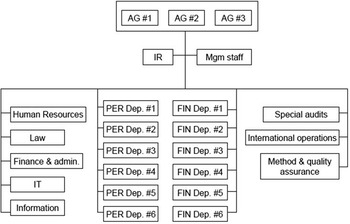
Because of this strong consensus, it came as a surprise when the three Auditors-General announced, in February 2003, that they had chosen Model 1. The first organization design is shown in Figure 1.
Organization design for the new Swedish SAI, as decided by the three Auditors-General (AG). PER=performance auditing; FIN=financial auditing.
Source: Documentation from a presentation at a conference for employees from RRVand the Parliamentary Auditors on 7 March 2003.

The project leader explained that this organization design was a radical choice, as compared with the traditional profession-based design that she, her project team, and employees had asked for. She also emphasized that the Auditors-General had been very clear about their wish to decide for themselves what kind of organization they wanted to have, regardless of the work conducted by the members of the organization project:
I had worked a lot on empowering employees and seeking their support for organizational solutions and I guess they [the Auditors-General] were afraid that there was too much employee perspective perhaps and too little management perspective.
(Interview #40; our translation)
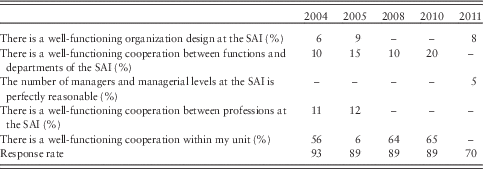
The organization was subjected to heavy criticism by auditors throughout the years following the reform. Auditors objected to the forced collaboration between financial auditors and performance auditors, and both professions explained that there was very little natural overlap in their work. The Auditors-General did not provide any guidance. Employee attitude surveys in 2004–05 revealed that only 11–12% of employees believed that the cooperation between the two professions worked well (see Table 2).
Responses to employee attitude surveys at the SNAO 2004–11 (the table states positive responses, meaning 4–5 on a 5 level scale)
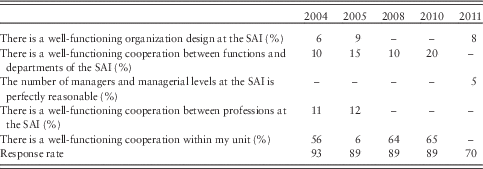
SNAO=Swedish National Audit Office; SAI=Supreme Audit Institutions.
Sources: Sifo Research and Consulting, 2004 and 2005; ZonderaCom, 2008, 2010; Bringselius, Reference Bringselius2011.
The organization did not allow a meeting place for performance auditors, and many auditors found this problematic. Some compared the situation with RRV, where there had been several arenas for professional discussions and knowledge transfer. The development of audit methods was managed within a separate unit. In a survey in 2011 (Bringselius, Reference Bringselius2011), only 25% of respondents stated that they believed there was a well-functioning structure for continuous dialog and learning among SNAO employees. In the same survey, only 8% (5 out of 65 respondents) believed that the SAI had a well-functioning organization design.
The members of the organization project, as well as members of other projects assigned by the Auditors-General only a few months before the merger, had very little feedback on their reports, and often none whatsoever. This caused disappointment and anger among many auditors:
I was one of the project leaders last spring. […] We struggled very hard with this. We had different ideas about things and rather tough discussions. We met once a week over ten weeks. For me, this meant a couple of days a week during that period, which is quite a huge work effort, for at the same time I had many things to do in my own organization. This work resulted in a document. […] We have not had any response to this paper whatsoever. None. Of course, the Auditors-General went out with a general thanks to the project leaders for their work, but we have not had any concrete response to the work, and I find this very strange considering the work we devoted, both in quantitative terms and in qualitative terms. I do not believe that the Auditors-General understand that this really is wearing for the organization.
(Interview #39; our translation)
Auditors spoke of how they experienced themselves as very much put aside and ignored:
From time to time, we felt very passed over and left out in all kinds of ways. And of course this kind of experience did not contribute a positive feeling for the forthcoming reform, but rather the opposite.
(Interview #28; our translation)
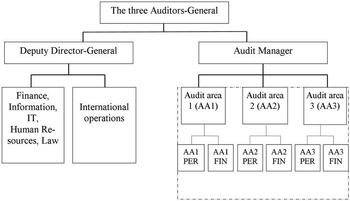
In 2006, an organizational change was announced, but as it turned out, this only involved partial change. In particular, new managerial levels were added; the Auditors-General explained that this was meant to allow them more time to focus on external relations, rather than internal issues. Unions and employees objected, but to no result. The formal organization chart is shown in Figure 2.
New organization design at the SNAO from 2006.
Source: Kuriren, 2006, translated. AA=audit area; PER=performance audit; FIN=financial audit.

However, auditors explained that the actual structure involved many more managerial layers. One auditor’s perception of this was that of being at the bottom of a very deep vertical hierarchy (Interview #76).
For several years, particularly after the organizational change in 2006, auditors consistently maintained that it was both costly and unnecessary to have all the new managerial levels that had been introduced. A survey in 2011 showed that only 5% believed the number of managers at the SAI was reasonable (Bringse lius, Reference Bringselius2011). This result may be compared with the local level within the specific organizational unit, where cooperation worked much better (see Table 2).
This was how the organizational design was developed at the SNAO over the years 2002–11. The development, compared with the former SAI organizations, is that of greater hierarchy and centralization, which in turn has consequences for the performance auditors to carry out their work according to professional norms.
Professional practice
Very soon after the formation of the new Swedish SAI, a new performance audit approach was announced. The three Auditors-General explained that from then on, performance audit would be focused on accountability and compliance with formal norms and regulations. This was described as a way to increase the quality of the performance audit and a way to provide the Swedish Parliament with documentation so that it could hold people and institutions responsible. Professionals claimed that this type of performance audit was substantially less qualified than the traditional performance audit – the one they were used to conducting. They also maintained that this new audit approach was not what Parliament had intended with the reform.
The professionals’ opposition to the new performance audit approach had little support from the Auditors-General, who were decisive on this matter. They called this approach their ‘business idea’ for the agency and added that those employees who did not support it should leave the organization. One of the Auditors-General explained it this way:
It is we, the Auditors-General, who own the right to decide how audit should be conducted at the agency. There is no general right for the personnel to decide what they think audit should be. We have precedents for this interpretation. When we were formed, we decided that for us performance audit, and of course financial audit, is something more than a general investigation or research. Audit is that you audit something based on norms and simply review: Has the government done what it should? […] We are of the opinion that this is the track we have chosen. Either you are on that train, or you actually have to leave the organization if you are not happy with it. We have taken a stand and there will be no more discussion on whether we shall do this or not.
(Interview #85; our translation)
Along similar lines, the performance auditors were also informed by the Auditors-General that specific templates should be used from now on in their audit work, a modification that sought to achieve more standardization (and less professional judgment) in the audit. Templates were distributed within the organization, but auditors again objected and asked how the Auditors-General meant their audits to be streamlined this way. The Auditors-General did not provide any guidance, but asked the auditors to figure this out for themselves.
A research study (Grönlund et al., Reference Grönlund, Svärdsten and Öhman2011) revealed that the SAI reports also changed character in the years that followed the reform, to focus more on compliance audit than on traditional performance audit. This study, as well as others, revealed that the SAI failed to deliver the broad analysis of trends and issues in central government that had been requested with the reform. In 2007, a parliamentary committee was appointed to evaluate the reform behind the new Swedish SAI. It resulted in two highly critical reports, issued in 2008 and 2009 (Sveriges riksdag 2008/09:URF1 and URF3). In the reports, the new audit approach requested by the Auditors-General was contested. The parliamentary investigation established that the new performance audit approach had not been requested by the Swedish Parliament and that it was not in line with the reform intentions of the Parliament:
Neither in the parliamentary guidelines, nor in decisions on the SAI reform […] or in other preliminary studies, can any writings be found that indicate that Parliament expected a performance audit approach other than that which was adopted before the reform. This must be interpreted as it being so taken-for-granted that operations should continue with the same approach as before, and in accordance with the professional tradition developed over several decades, that this was not even necessary to state.
(Sveriges riksdag 2008/09: URF3: 23; our translation)
Written criticisms, as harsh and explicit as these, are rare in parliamentary investigations in Sweden. The Committee on the Constitution endorsed the investigation’s conclusion and this resulted in changes to the Swedish Act on Auditing of State Activities (SFS, 2002:1022), where the meaning of performance audit is now stipulated in greater detail. By this amendment, the Swedish Parliament has now laid down that performance audit should not be narrowed to compliance audit, but should, rather, follow discourse and practice within the academic field – the three E’s of economy, efficiency, and effectiveness (e.g. Pollitt and Summa, Reference Pollitt and Summa1999: 194 ff.) – and the international professional organization (INTOSAI, 2004).
By doing this, Parliament thereby supported the professional performance auditors’ position, leaning against the professional norms and standards of the greater international SAI community, rather than the narrower top-down perspective of top management.
Work assessment
A new quality assurance process was introduced after the formation of the SAI. This would be subjected to heavy criticism by auditors over the ensuing years, and it was changed several times. Professionals were especially critical of the lengthy process and of the fact that the quality of their work was evaluated by people with little or no experience in professional practice. When one of the Auditors-General was asked in an interview how it was that the professionals had been discontented with the quality assurance process at the SAI for so many years, the response was:
It is because we decide. It is not our employees who decide what quality audits shall hold, it is we who take the final responsibility for these audits. If you do not want us to be part of it and decide, then of course it is a difficult situation that we have different opinions about audits.
(Interview #85; our translation)
As the SAI was formed, the three Auditors-General explained that there would be an intense focus on quality in the new performance audit reports. The quality of reports from the previous two agencies had varied, they maintained. The auditors, on the other hand, increasingly queried whether their previous work had been that poor. They also queried the Auditors-Generals’ ability to understand what was of high quality and what was not, since they had little or no experience of performance audit work. One professional explained that she had been proud of her former director-general at the former audit institution RRV and considered her very competent, but added that she was not very convinced of the aptitude of the three Auditors-General at the SAI (Interview #65). Another professional explained:
The Auditors-General announce with pomp and splendour that there shall be quality in everything, as if that is something new. […] The Auditors-General do not know what quality in performance audit is anyway.
(Interview #39; our translation)
The quality control process grew over time. The Quality Assurance Committee (Kvalitetssäkringsrådet, previously Lektörsrådet) commented on the texts. In the organization implemented in 2006, this became a subgroup to the Unit for Planning and Quality. More control points were included in the audit process, but the process was still centered around the three Auditors-General, who had the final say – and they often called for extensive changes to reports. Furthermore, the Auditors-General had announced that they only wished to present their feedback to project leaders and that other project members were not allowed to participate in these meetings.
Professionals objected to the lengthiness of the quality assurance process and argued that they often had different advice at the different control points, as well as from the Auditors-General. In addition, the criticism was sometimes considered poorly substantiated. None of the Auditors-General had much experience working on performance audit on a daily basis, and this was increasingly questioned by professionals, who claimed that they did not understand the ‘soul’ and practice of performance auditing at the SAIs. The definition of quality assurance was questioned, and professionals started to argue that, due to the lack of support in this desire to increase quality, it was more a matter of quality control than quality assurance or support, the latter being more cooperative and open. Only 13% of respondents, in the first employee attitude survey in 2004, claimed that the quality assurance process functioned well.
To conclude, the quality control process had become highly demotivating. Professionals explained how they almost gave up at the outset, when initiating a new project, because they knew there would always be very different comments on various aspects. The three Auditors-General led the three main reviews. As mentioned earlier, in the new organization implemented in 2006, the three Auditors-General had been separated from the organization in order to be able to ‘focus more externally’. However, they were still very much involved in this review process and the three control points.
Hence, the culture and the leadership at the SAI were also questioned. Professionals experienced very little recognition and there was ‘a mutual lack of confidence’ between them on the one hand and the Auditors-General on the other. At the same time, they pointed to the three Auditors-Generals’ lack of experience in performance audit, arguing that it was inappropriate that, despite this inexperience, they should be able to define the quality of work by professionals. In employee attitude surveys, the professionals claimed that the three Auditors-General did not understand performance audit, that they made misinformed decisions, and that their leadership was obsolete and demotivating (see Table 3).
Positive responses (4–5) in employee surveys at the SNAO (on a 5 level scale)

SNAO=Swedish National Audit Office.
Sources: Sifo Research and Consulting, 2004, 2005; ZonderaCom, 2008.
Discussion
What happened to professional autonomy?
Our analysis of the SNAO shows that occupational professionalism was replaced with organizational professionalism, as the professional autonomy of the performance auditors at the SNAO was curtailed in every dimension analyzed. Large parts of earlier existing collegial authority were broken down in favor of hierarchical structures of authority. It is interesting to note that the three Auditors-Generals’ lack of professional experience in performance auditing did not stop them from far-reaching interventions in professional practice. The quality assurance process they had introduced did not indicate much confidence in the existing professional norms and practices, but rather a desire to take charge over processes. This kind of approach is contrary to the professional standards of INTOSAI, which reads: ‘Streamlined and detailed procedures, methods and standards may in fact hamper the functioning of performance auditing’ (INTOSAI, 2004, 29). Since one of the SNAO Auditors-General chaired the INTOSAI Auditing Standard Committee, which developed these guidelines, we can assume that the guidelines were well known to them.
The performance audit profession at the SNAO, however, was not only weakened by the curbing of professional autonomy in the audit process itself, but also by the splitting of this professional group into smaller organizational units without a shared manager and by scattering professionals on different office floors. Although open criticism diminished among these professionals, their criticism was louder in the anonymous employee attitude surveys.
How was organizational performance affected?
The curbing of professional autonomy affected SNAO performance in two ways. First, it hindered the voicing of performance alarms by professionals. Throughout the study period, SNAO auditors attempted to signal to the Auditors-General that they were concerned over SNAO efficiency, audit quality, relevance, and autonomy. These alarms had little impact, and a culture of silence was fostered, as some critics were subjected to sanctions. These alarms, or collective opposition to authority in organizations, in areas where employees perceive that they have a moral duty to report what they perceive as wrongdoing, is sometimes referred to as whistle-blowing. With whistle-blowing, employees typically aim to improve organizational structures or performance. This is common, in particular, in organizations with large groups of professionals (Miceli and Near, Reference Miceli and Near1988), such as the SNAO.
Second, extensive procedures for (managerial) quality control not only curbed professional autonomy but also tended to lead to increased overhead costs (Hood and Peters, Reference Hood and Peters2004). This is nothing but a paradox, since the aim of top-down systems (such as the one here referred to as organizational professionalism) is to enhance efficiency and quality, and to reduce costs. When professional norms and ethics focused on quality and performance are instead nurtured, they may become a strong force in favor of organizational performance, and at the same time, reduce organizational risk, partly through the (explicit or implicit) system of peer review.
In all, findings indicate that new managerialism may result not only in decreased professional autonomy, but also in decreased organizational performance – or, at least, increased risk in this regard. Abma and Noordegraaf (Reference Abma and Noordegraaf2003) have suggested that contemporary public management is characterized by a strong tendency to use performance measurement in order to reduce complexity. Our study suggests that ‘new public managers’ may be inclined not only to introduce performance measurement, but also to standardize the professional practice and curb organizational dissidence in order to reduce complexity and increase their sense of control. This will result in increasing tension between managers and professionals. At the SNAO, interestingly, the Auditors-General chose to intervene in detail in the wording of audit reports, despite their lack of experience in the audit profession. This managerial interest in detail may also, in itself, have a negative impact on organizational motivation and performance. When extensive autonomy and decision-making power is concentrated in only one or a few directors-general (or other types of managers), organizational risk will increase, as compared with a model where managers and professionals collaborate to find efficient ways to produce high quality output.
Why curtail professional autonomy?
The rich data set provides a number of explanations for this development. In particular, it shows how managers, lacking a background in the profession in question, tried to reduce complexity by increasing standardization (ex ante control), developing a lengthy quality assurance process (ex post control), and expanding organizational (managerial) support functions.
Why did the SNAO Auditors-General persist in their approach, despite extensive resistance, despite their lack of experience in the professional work, and despite extensive performance issues? Why would any public organization choose organizational professionalism over occupational professionalism? Apart from the more general explanation of reducing complexity, some additional explanations should be brought to the fore:
First, managerial identity: managerial identity and ideals are partly personal, but they also partly spring from contemporary ideas in society, for example, following the ‘new managerialism’. Already in 1990, Pollitt (Reference Pollitt1990) noted that the autonomy of professions in the public sector was being challenged by managers from other professions, who claimed to be able to make quality assessments.
Second, management ideology: the Auditors-General may have thought this top-down management approach the best way to achieve professionalism. In public appearances, they defended their pursuit of professionalism at the SNAO (e.g. keynote speech, Sveriges Riksdag, 2009: 133). An advantage of the standardization of work – from the perspective of the Auditors-General – might be a sense of greater quality and relevance in processes and outputs. This may be considered especially important in a setting where the management experiences a strong pressure to produce tangible and useful results.
Third, risk management strategies (including quality control): the Auditors-General may have wished to minimize risk. The SNAO reform had been preceded by decades of political deliberation, and it seems as if the Auditors-General wished to secure the outcome of this reform by increasing control. The former audit institutions had been accused of poor quality in some cases, and by increasing control, the Auditors-General may have wanted to minimize the risk of criticism and negative media attention.
Fourth, a lack of understanding for the professional practice: the approach may also be the result of a lack of understanding and respect for professional practice. Considering that the Auditors-General themselves had very little practical experience in this field, it is possible that their knowledge of the character of SAI audit was limited.
All four explanations can be found within the organizational context, indicating that studies on the public sector need to direct considerable attention not only toward inter-organizational arrangements between different governmental actors, but also internal arrangements in specific public organizations. This perspective includes studies in difficult areas, such as the area of managerial identity. Rather than assuming that organizational performance can be increased merely by increasing agency autonomy, we need to direct more attention to the complexities that can be found within agencies, affecting performance in various ways.
Conclusions
Findings from this study show how new managerialism, based on a complex interplay of factors on the micro level, may lead to lower – rather than higher, as often expected – organizational performance. One reason is that managers compensate for their lack of authority among professionals in the same domain, by expanding support functions and systems for management control and attempting to standardize and streamline professional practice. This is evident, in particular, in contexts where these managers lack professional experience in the specific fields where the agency in question operates. We see the need for more studies on this topic, to develop our understanding of the consequences of new managerialism in public administration practice. At the same time, we recognize that too much professional autonomy may also be a problem, since it may give a specific group too much influence in the implementation of public policy – thereby challenging the idea of political equality, which is a fundamental principle of democracy.
Nonetheless, our findings suggest that studies focused only on the organizational autonomy of agencies may need to be complemented with studies on professional autonomy, designed to understand governance issues as well as performance issues in public organizations. In the formation of autonomous agencies in central government, the key concern has been that policy-making should be separated from policy implementation, in this way, increasing both service quality (in particular, legality) and efficiency (Verhoest et al., Reference Verhoest, Peters, Bouckaert and Vershuere2004; Christensen and Laegreid, Reference Christensen and Lægreid2006; Pollitt and Bouckaert, Reference Pollitt and Bouckaert2011). However, based on findings from this study, we maintain that it is equally important to consider how autonomy is distributed within these agencies, as it is to consider how autonomy is distributed between the political sphere and the administration. Indeed, our study shows that the connection between organizational autonomy and organizational performance is not clear-cut – the interplay between professionals and different levels of managers in the organization is also of significance. Consequently, an agency’s demand for increased organizational autonomy in order to improve its performance is, thus, insufficient unless an analysis of the scope for professional autonomy is taken into account. This conclusion opens up new research questions, for example, relating to the standardization of professional practice, how knowledge and standards are formed (and, in particular, by whom), and how professional feedback is managed.
The study presented in this article shows the complex interplay between professionalism, new managerialism, and organizational performance. Our contribution has been to frame an argument for the significance of internal relationships within a public organization to understand organizational performance. Since quality and efficiency are constant priorities in the public sector, the top-down approach advocated in new managerialism may be tempting – but our in-depth empirical study indicates that managerial control, to the point of actual de-professionalization, might just impede those results that are sought from the outset.
Acknowledgment
The authors would like to thank Professor Christopher Ansell for valuable input and suggestions on an early draft of this article.