Animals must eat, necessitating their encounter with food. At least one of the two, predator or prey, must move for the two to meet. Many predators forage for prey by one of two strategies, or foraging modes. They forage either actively, in which case their prey may be mobile or sessile, or passively by waiting in ambush, depending on prey motility. These two foraging modes have been studied extensively in lizards as a model organism (Cooper Reference COOPER1995, Huey & Pianka Reference HUEY and PIANKA1981, Pianka Reference PIANKA1966, Pietruzska Reference PIETRUZSKA1986). Many aspects of a species' biology are correlated with its foraging mode. For example, active foragers employ their chemosensory apparatus for following the prey's trail. Sit-and-wait foragers rely on their eyes to identify approaching prey (Cooper Reference COOPER1995). Other differences are briefly referenced elsewhere (Werner et al. Reference WERNER, OKADA, OTA, PERRY and TOKUNAGA1997, Reference WERNER, TAKAHASHI, YASUKAWA and OTA2004).
Many geckos (Gekkota) mix both active and sit-and-wait foraging modes (Bauer Reference BAUER, Reilly, McBrayer and Miles2007). Their behaviour shows interspecific, intraspecific and intra-individual variation (Werner et al. Reference WERNER, OKADA, OTA, PERRY and TOKUNAGA1997). Therefore geckos were used to try to identify the organismic and external factors that affect foraging behaviour, with partial success (Seligmann et al. Reference SELIGMANN, ANDERSON, AUTUMN, BOUSKILA, SAF, TUNIYEV and WERNER2007, Werner et al. Reference WERNER, TAKAHASHI, YASUKAWA and OTA2004, Reference WERNER, TAKAHASHI, YASUKAWA and OTA2006).
Among the external factors affecting gecko foraging, natural illumination plays manifold roles. Among nocturnal geckos, moonlight enhances locomotor activity in some species (Bouskila et al. Reference BOUSKILA, EHRLICH, GERSHMAN, LAMPL, MOTRO, SHANI, WERNER and WERNER1992, Frankenberg & Werner Reference FRANKENBERG and WERNER1979, Werner et al. Reference WERNER, TAKAHASHI, YASUKAWA and OTA2006), while depressing it in others (Seligmann et al. Reference SELIGMANN, ANDERSON, AUTUMN, BOUSKILA, SAF, TUNIYEV and WERNER2007). Among diurnal geckos, in sit-and-wait-foraging species of Gonatodes locomotor activity increases with the intensity of daylight. Presumably improved illumination increases the incidence of discovering prey, extends the range of sighting prey, or both (Persaud et al. Reference PERSAUD, WERNER and WERNER2003). While natural light often enhances foraging locomotion, man's artificial lights may encourage sit-and-wait tactics in nocturnal house geckos feeding on photo-tactical insects (Petren & Case Reference PETREN and CASE1996).
Against this background we report here the foraging strategy of a gecko population that is active day and night in a tropical environment. The Malagash day gecko Phelsuma laticauda (Boettger, 1880) comprises a thriving invasive population in Hawaii. This diurnal arboreal species also inhabits house walls (Glaw & Vences Reference GLAW and VENCES1994) and is considered a commensal with humans (Ota & Ineich Reference OTA and INEICH2006). Its occurrence at night lights at Kona, Hawaii, has been reported without detail (Perry & Fisher Reference PERRY, FISHER, Rich and Longcore2006, Perry et al. Reference PERRY, BUCHANAN, FISHER, SALMON, WISE, Jung and Mitchell2008). We aimed to see whether its foraging strategy at night differs from that in daytime and how. To our knowledge this is the first project addressing this issue. We hypothesized that at night the pauses between moves would increase, because geckos would await phototactic insects. Because assorted organismic variables may affect foraging behaviour (Werner et al. Reference WERNER, TAKAHASHI, YASUKAWA and OTA2006), we noted the morphology characterizing the study population (data available from authors).
The study site comprised Patey's Place Hostel, in Kailua-Kona (19°38′60″N, 155°59′39″W), on Hawaii Island. The property approximated 1000 m2 surrounded by a fence (part wire mesh, part wooden planks). It included two two-storey wooden buildings, illuminated at night by assorted lamps on the walls, and surrounded by paved walks and, towards the fences, a narrow irrigated garden with some assorted trees and stemless Pandanus-like shrubs. Gecko activity was in daytime greater on the vegetation and less on the buildings and fences, and at night more on the building walls near the lights. The gecko fauna comprised almost exclusively P. laticauda; we found only one Hemidactylus frenatus Schlegel and it was in poor condition.
Two to three observers visited the site on 3–5 and 18–19 March 2000 and conducted observations during 06h30–18h00 (daytime) and 20h00–22h30 (night-time). Night-time observations were conducted only when the moon rose during the day. We scanned the habitat visually, and at night also with electric torches.
Observations were conducted from the greatest possible distance to minimize observer effects (Kerr et al. Reference KERR, BULL and MACKAY2004, Sugerman & Hacker Reference SUGERMAN and HACKER1980). We observed each gecko for 30 min, unless it escaped from view. This long observation bout reduced the number of observations but enabled discovery of temporal variation in behaviour (Stanner et al. Reference STANNER, KUMTHORN, WERNER and WERNER1998, Werner et al. Reference WERNER, OKADA, OTA, PERRY and TOKUNAGA1997). We avoided observing the same individual again.
When possible, individuals were captured (by noose) after the observation, and were marked. Since individuals could not be marked with adhesive tape, due to mucus glands (Hiller & Werner Reference HILLER and WERNER2008), we clipped half of one or two toes. Upon capture we recorded body (rectal) temperature (in some cases), air temperature (1 m above ground, in shade) and (sometimes) substrate temperature (Miller–Weber small-animal mercury thermometer); time; sex and location where the gecko had been.
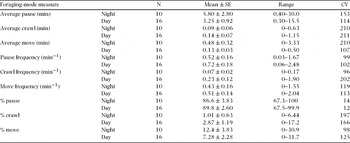
The behavioural data comprised the basic foraging-mode measures: (1) stationary pause duration (average pause); (2) crawling duration – advancing so slowly that movement is difficult to detect (average crawl); (3) duration of moves other than crawl (average move); (4) the frequency at which a gecko switched from any locomotion to being stationary (pause frequency); (5) the frequency at which a gecko started crawling locomotion (crawl frequency); (6) the frequency at which a gecko started any move other than crawl (move frequency); (7) per cent of time that the gecko spent being stationary (% pause); (8) per cent of time that the gecko spent crawling (% crawl); (9) per cent of time that the gecko spent moving (locomoting) other than crawling (% move). Observations suspected to be due to social effects were excluded from the analyses.
Behavioural data were obtained from 15 individuals of known sex and 11 of unknown sex. Foraging parameters for day and night can be found in Table 1 (and for males and females are available from the authors).
The measures of foraging mode of Phelsuma laticauda at night and in daytime. N, number of individuals observed; CV, coefficient of variation.

To rule out observer effect, we tested changes of the acts (move, crawl and pause) during the bouts, using ANOVA, separately for day and night observations. No observer effects were found (P > 0.10 for all tests).
We applied Multivariate analyses of variance (MANOVA, using SPSS 15) tests to investigate the correlation between the dependent variables and the potential effects of sex and day time on them. The two explanatory variables were tested separately due to small sample sizes. Each test was conducted on a group of measurements that were related to each other: the single-act duration measures; the frequency of act occurrence and each act performance time in per cent (due to redundancy, only move and pause were used). The MANOVA results (male-female and day-night) showed no significant correlation between the dependent variables (P > 0.10, all tests). Additionally, no significant sexual differences in any of the criteria were found (P > 0.10, all tests). Two individuals (male and female) were observed during both daytime and night-time.
The nine foraging-mode measures were tested for effects of body, substrate and air temperatures. Each measure was tested for each temperature type separately for daytime and night-time. Due to data paucity, effects of body temperature and substrate temperature during daytime were not tested. Moreover, the small number of temperature readings prevents our conducting more complex statistics (e.g. using temperature as a covariate in the day-night tests). To test temperature effects on behaviour, we applied linear regression, and evaluated the significance of the slope.
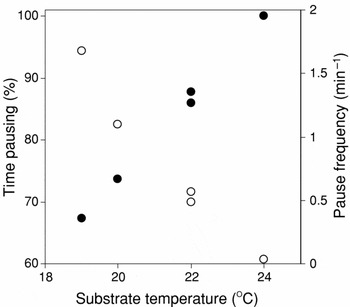
Air temperature ranged in daytime between 24–31 °C (12 readings), and at night 23–24 °C (N = 3); it had no significant effect on any foraging-mode measure. Other temperatures were taken mainly at night: body temperature, 17–28 °C (N = 8), too, had no significant effect on any foraging-mode measure. In contrast, substrate temperature at night, 19–24 °C (N = 5), had significant effects on the main foraging-mode measures (Figure 1). The warmer the substrate temperature (ST) was, the more time the individual spent pausing (% pause = 6.55 × ST – 57.3; R2 = 0.997; P < 0.01. Pause frequency = −0.32 × ST + 7.57; R2 = 0.97; P < 0.01). Increase in pause duration was achieved by decreasing move duration (% move = −6.52 × ST + 155; R2 = 0.97; P < 0.01. Move frequency = −0.31 × ST + 7.36; R2 = 0.97; P < 0.01).
The effects of substrate temperature at night on the per cent of time spent pausing (·) and pause frequency (°).

These results invite some conclusions. Sexual foraging diergism (functional dimorphism; Rhodes & Rubin, Reference RHODES and RUBIN1999) occurs in some lizards (Ananjeva & Tsellarius Reference ANANJEVA, TSELLARIUS and Rocek1986, Perry Reference PERRY1996). While it was observed in nocturnal terrestrial (ground-dwelling) geckos (Werner et al. Reference WERNER, TAKAHASHI, YASUKAWA and OTA2006), it was not found in diurnal scansorial (climbing) geckos (Persaud et al. Reference PERSAUD, WERNER and WERNER2003) as in P. laticauda, likewise diurnal and scansorial. However, the low number of species investigated for diergism precludes the correlation of sexual diergism with nocturnality, terrestriality or both.
The similarity of night-time and daytime foraging behaviour of P. laticauda recalls the thermal behaviour of Hemidactylus frenatus and Lepidodactylus lugubris in Hawaii. Both regulate the same body temperature in buildings at night, basking on lamps etc., as their conspecifics do in nature in daytime, using solar heat (Werner Reference WERNER1990). Apparently commensal geckos are euryoecic and adaptable.
Because at night pause length positively correlated with temperature, one would expect in daytime still longer pauses and shorter moves. The data (Table 1) point this way but are not statistically significant. The reason for this may be that most observations were within the preferred temperature range of the species (McKeown Reference MCKEOWN1993) and geckos are relatively eurythermic (Avery Reference AVERY, Gans and Pough1982, Mayhew Reference MAYHEW and Brown1968: figure 7, Werner Reference WERNER1976) so that temperature had little effect during the day.
The strong effects of substrate temperature probably reflect the frequently observed tight coupling of lizard body temperature to substrate temperature (Tanaka & Nishihira Reference TANAKA and NISHIHIRA1987, Werner et al. Reference WERNER, CARILLO, ESPINOZA, HUEY, ROTHENSTEIN, SALAS and VIDELA1996). In contrast, the accuracy of body temperature measurement depends on observer-subject interactions. The increase of gecko activity at lower temperature could relate to insect activity but we lack data on this. More likely, perhaps at higher temperatures the geckos move more swiftly and spend less time in reaching sighted prey.
In conclusion, our expectation that at night the sit-and-wait strategy would be more extreme was not realized. The result that locomotor activity was increased at night and at lower temperatures, invites further research. Indeed, it has been commented that in general, little is known about the effects of night lights on diurnal reptiles and the possible implications for conservation (Perry & Fisher Reference PERRY, FISHER, Rich and Longcore2006, Perry et al. Reference PERRY, BUCHANAN, FISHER, SALMON, WISE, Jung and Mitchell2008). Altogether the interaction of light and temperature effects on gecko behaviour (Frankenberg Reference FRANKENBERG1979, Sievert & Hutchison Reference SIEVERT and HUTCHISON1988) requires further study with larger samples. Furthermore, it is hard to understand the foraging behaviour of insectivorous lizards without data on the abundance, distribution and behaviour of the potential prey. Further progress in this field would require more extensive projects.
ACKNOWLEDGEMENTS
This work was supported by the National Institutes of Health (MBRS 3 S06 GM08073–26S1 to W.J.M.) and indirectly by Hidetoshi Ota (University of the Ryukyus, Okinawa) and the Ministry of Education, Science, Sports and Culture, Japan to Y.L.W.). We thank Fred Kraus (Bishop Museum, Honolulu) for information and advice and Prof. Uzi Motro (Departments of Statistics and of Evolution, Systematics and Ecology, the Hebrew University of Jerusalem) for use of his program for Fisher's exact test.