Introduction
Seeds of Dodonaea viscosa (Sapindaceae) have a water-impermeable seed coat, i.e. physical dormancy, PY (Burrows, Reference Burrows1995; Baskin et al., Reference Baskin, Davis, Baskin, Gleason and Cordell2004; Phartyal et al., Reference Phartyal, Baskin, Baskin and Thapliyal2005; Benítez-Rodríguez et al., Reference Benítez-Rodríguez, Gamboa-deBuen, Sánchez-Coronado, Alvarado-López, Soriano, Méndez, Vázquez-Santana, Carabias-Lillo, Mendoza and Orozco-Segovia2013), although some studies have claimed that the seeds of this species are non-dormant (see Baskin et al., Reference Baskin, Davis, Baskin, Gleason and Cordell2004). The Sapindaceae is one of 17 angiosperm families that produce seeds with PY, and this form of dormancy has not been reported in any gymnosperms (Baskin and Baskin, Reference Baskin and Baskin1998; Baskin et al., Reference Baskin, Baskin and Li2000; Cook et al., Reference Cook, Turner, Baskin, Baskin, Steadman and Dixon2008; Jayasuriya et al., Reference Jayasuriya, Baskin, Geneve, Baskin and Chien2008b; Turner et al., Reference Turner, Cook, Baskin, Baskin, Tuckett, Steadman and Dixon2009). Genera of Sapindaceae, including Dodonaea (Burrows, Reference Burrows1995; Baskin et al., Reference Baskin, Davis, Baskin, Gleason and Cordell2004; Phartyal et al., Reference Phartyal, Baskin, Baskin and Thapliyal2005; Benítez-Rodríguez et al., Reference Benítez-Rodríguez, Gamboa-deBuen, Sánchez-Coronado, Alvarado-López, Soriano, Méndez, Vázquez-Santana, Carabias-Lillo, Mendoza and Orozco-Segovia2013; Nasr et al., Reference Nasr, Savadkoohi and Ahmadi2013), Distichostemon (Cook et al., Reference Cook, Turner, Baskin, Baskin, Steadman and Dixon2008) and Cardiospermum (Johnston et al., Reference Johnston, Murray and Williams1979) have seeds that germinate once the seed coat becomes permeable and, therefore, possess only PY. In some Sapindaceae genera, such as Diplopeltis (Turner et al., Reference Turner, Merritt, Baskin, Baskin and Dixon2006) and Koelreuteria (Garner, Reference Garner1979; Rehman and Park, Reference Rehman and Park2000), in addition to the seed coat being impermeable to water, the embryo exhibits physiological dormancy (PD). Thus, these species have combinational dormancy, i.e. PY+PD. However, since the seeds of D. viscosa germinate when the coat becomes permeable to water without any additional treatment, the embryo of this species does not possess PD, thereby confirming the presence of only PY (Baskin et al., Reference Baskin, Davis, Baskin, Gleason and Cordell2004; Phartyal et al., Reference Phartyal, Baskin, Baskin and Thapliyal2005; Benítez-Rodríguez et al., Reference Benítez-Rodríguez, Gamboa-deBuen, Sánchez-Coronado, Alvarado-López, Soriano, Méndez, Vázquez-Santana, Carabias-Lillo, Mendoza and Orozco-Segovia2013).
In most species with PY, the seed coat becomes impermeable to water only during the final stage of maturation drying, due to the palisade layer of the lignified Malphigian cells (Rolston, Reference Rolston1978; Baskin and Baskin, Reference Baskin and Baskin1998; Baskin et al., Reference Baskin, Baskin and Li2000). However, the impermeable nature of the seed coat is maintained until a specific dormancy breaking cue opens a small specialized anatomical structure (water gap) which serves as an entry point for water. Numerous treatments, including sulphuric acid, mechanical scarification, dipping in boiling water, dry heat, high temperatures, fire, drying, freeze–thaw cycles and passage through the digestive tracts of animals, can break PY in seeds (Rolston, Reference Rolston1978; Baskin and Baskin, Reference Baskin and Baskin1998; Baskin et al., Reference Baskin, Baskin and Li2000). While sulphuric acid, mechanical scarification, nicking of the seed coat and hot water treatment can effectively break dormancy in D. viscosa seeds (Burrows, Reference Burrows1995; da Rosa and Ferreira, Reference da Rosa and Ferreira2001; Baskin et al., Reference Baskin, Davis, Baskin, Gleason and Cordell2004; Phartyal et al., Reference Phartyal, Baskin, Baskin and Thapliyal2005; Benítez-Rodríguez et al., Reference Benítez-Rodríguez, Gamboa-deBuen, Sánchez-Coronado, Alvarado-López, Soriano, Méndez, Vázquez-Santana, Carabias-Lillo, Mendoza and Orozco-Segovia2013; Nasr et al., Reference Nasr, Savadkoohi and Ahmadi2013), such treatments have little, if any, ecological value in alleviating dormancy. In the field, seeds mostly break PY by experiencing a brief period of chilling temperatures or fluctuating temperatures in temperate zones (Baskin and Baskin, Reference Baskin and Baskin1998; Van Assche et al., Reference Van Assche, Debucquoy and Rommens2003), or warm soil temperatures in tropical locations (Probert, Reference Probert and Fenner2000; Turner et al., Reference Turner, Cook, Baskin, Baskin, Tuckett, Steadman and Dixon2009). Ecologically, dormancy breaking cues must be driven primarily by the combination of seasonal temperature changes, because factors such as fire or passing through the digestive tracts of animals are sporadic; therefore a seed may not undergo these mechanisms of dormancy breaking for long periods of time.
In Australia, seeds of many Sapindaceae species become permeable to water in nature while experiencing warm and moist conditions during summer (Cook et al., Reference Cook, Turner, Baskin, Baskin, Steadman and Dixon2008; Turner et al., Reference Turner, Cook, Baskin, Baskin, Tuckett, Steadman and Dixon2009). In Dodonaea hackettiana, summer temperatures effectively broke dormancy and, consequently, improved total germination (Cook et al., Reference Cook, Turner, Baskin, Baskin, Steadman and Dixon2008). According to Turner et al. (Reference Turner, Cook, Baskin, Baskin, Tuckett, Steadman and Dixon2009), high temperatures open a specialized ‘water gap’ present in Dodonaea seeds, thereby allowing the seeds to imbibe water and germinate. However, detailed information on how dormancy is alleviated in other adapted species is lacking, although the genus Dodonaea has a widespread geographical distribution from tropical to temperate regions (Liu and Noshiro, Reference Liu and Noshiro2003; Baskin et al., Reference Baskin, Davis, Baskin, Gleason and Cordell2004; Harrington and Gadek, Reference Harrington and Gadek2009). Furthermore, to the best of our knowledge, long-term burial experiments with Sapindaceae species having PY do not exist and such information seems to be highly restricted to species of Fabaceae, Geraniaceae and Malvaceae (Baskin and Baskin, Reference Baskin and Baskin1998; Van Assche et al., Reference Van Assche, Debucquoy and Rommens2003; Van Assche and Vandelook, Reference Van Assche and Vandelook2006; Hu et al., Reference Hu, Wu and Wang2009). As a result, we were interested in understanding the dormancy breaking mechanisms of D. viscosa in its natural environment. Thus, our study has two main objectives: (1) to determine if D. viscosa from southern India produces dormant seeds; and (2) to document dormancy loss in D. viscosa by incorporating seeds in an artificial burial experiment.
Materials and methods
Seed collection
Seeds of D. viscosa were collected from 10–15 plants growing on roadsides in Anaikati, Tamil Nadu, India (11°10' N, 76°74' E) on 22 December 2010 and on 3 and 7 January 2011. The collection site is a tree-dominated landscape that lies adjacent to the Western Ghats. The climate is warm with approximately more than 150 days with soil temperatures above 50°C (see results). Rainfall is mostly brought by the south-west monsoon during July to October, sometimes lasting until November, and the north-east monsoon during October and November, rarely continuing during December (Agro Climate Research Centre, Tamil Nadu Agricultural University, Coimbatore, India). Seeds collected from individual plants were grouped into one lot, mixed thoroughly and stored in jute bags at room temperature (25–30°C; c. 50–60% RH) until used in the experiments. The number of days between first seed collection and the inception of experiments was less than 1 month.
Moisture content measurement
Moisture content of the freshly collected seeds was determined by drying four replicates of 100 seeds each at 103°C for 17 h and weighing seeds before and after drying (International Seed Testing Association, 2009). Moisture content is expressed as percentage of fresh weight (mean ± SD).
Germination test
Four replicates of 25 seeds each were germinated in Petri dishes containing 1% agar-water. Seeds were incubated at an alternating temperature of 20/30°C at a 12 h photoperiod. Light was provided during the warm phase by cool white fluorescent tubes at approximately 40 μmol m–2s–1, 400–700 nm. Radicle emergence was the criterion for germination, and germination counts were made daily for 21 d. Total number of seeds germinated is presented as a percentage (mean ± SD). Following the different dormancy-breaking treatments, unless stated otherwise, seeds were tested for germination at 20/30°C with the same light conditions as described here.
Dormancy breaking
In order to break dormancy, seeds were both mechanically scarified (by a razor blade) and dipped in hot water for 5 s (Phartyal et al., Reference Phartyal, Baskin, Baskin and Thapliyal2005). In all cases, the temperature of the hot water was 90 ± 3°C. In a separate experiment, the importance of hot-water temperature in breaking dormancy was evaluated by dipping seeds in water at 40, 50, 60, 70, 80 and 90°C for 30 s. Three replicates of 25 seeds were used for each temperature. In addition, freshly collected seeds were stored dry in empty Petri dishes under natural light at four different temperatures: 15, 20, 25, 30°C. Three replicates of 50 seeds each were used. Freshly collected seeds were sown on natural soil in 9-cm Petri dishes. The soil was kept hydrated by adding water whenever required. The Petri dishes were incubated in light (12 h; 30 μmol m–2s–1, 400–700 nm) at 10/20°C, 15/20°C, 15/30°C, 20/35°C and 25°C (constant temperature). Four replicates of 25 seeds each were placed at each temperature, and germination was scored weekly for 32 weeks.
Seed imbibition
Three replicates of 20 seeds were used to monitor the imbibition of water in mechanically scarified, hot-water-treated and control (without any treatment) seeds. The seeds were placed in Petri dishes on wet filter paper and kept under laboratory conditions. The increase in mass was calculated by weighing the seed mass with a micro-balance at hourly intervals, after drying the surface of the seed between soft tissue towels. The percentage increase in seed mass of seeds was determined following Baskin et al. (Reference Baskin, Davis, Baskin, Gleason and Cordell2004).
Seed burial experiment
One hundred freshly collected seeds were placed in each of 16 nylon mesh bags and buried at a soil depth of 3–5 cm. Four bags were placed in each of four plastic trays (15 cm × 8 cm × 4 cm) which contained drainage holes that facilitated water movement during burial. Before use, trays were filled with natural soil and covered with a loose lid (clipped), to prevent any accidental damage, e.g. predation. Thus, although we intentionally prevented any accidental damage that might be associated with seed dispersal, this experimental set-up did not affect the conditions seeds would experience in nature, e.g. temperature, soil moisture, etc. The trays were placed at four different locations within the experimental site (i.e. seed collection location) on 10 February 2011. The site was fenced before starting the burial experiments. After 6 months (25 August 2011), 12 months (21 February 2012), 18 months (30 August 2012) and 24 months (28 February 2013) the bags (one tray each time) were exhumed and the contents were spread on a laboratory bench. Seeds germinated in the soil were counted and the remaining seeds were incubated at 20/30°C for germination, as a replicate of (100 − number of seeds germinated in soil) × 4. Germinated seeds were counted and removed on a daily basis. After 3 weeks the remaining non-germinated seeds were dipped in hot water (5 s) and returned to 20/30°C.
In preliminary trials, germination during burial obscured when seeds had germinated during burial periods of longer than 6 months. To obviate this confounding issue, we buried an additional 400 seeds, placed in one bag, at the time when the first batch of seeds buried in February 2011 was exhumed, i.e. 25 August 2011. These seeds were stored dry in Petri dishes at room temperature between collection (January 2011) and burial in August 2011. Prior to burial, the germinating ability of these seeds was tested, as described above, from a subset of stored seeds, and at this time 9 ± 2.5% seeds germinated. The seeds buried in August were exhumed in February 2012 and germinated separately.
Soil temperature measurement
Soil temperature during seed burial was recorded at 1 h intervals using a data logger fixed firmly to the ground with a thick screw clamp at 1–2 cm below the soil surface, which measured the soil temperature in the surroundings of buried seeds at a depth of 3–5 cm.
Statistical analysis
The percentages of seeds germinating after various periods of burial were compared using analysis of variance (ANOVA). To improve the normality, data were arcsin transformed before testing for statistical significance, but the actual germination percentages are reported. We used the Turkey HSD post-hoc test (α = 0.05) to check the significance between groups.
Results
Germination and moisture content
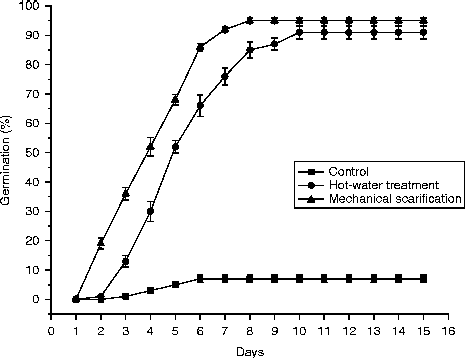
Moisture content of the freshly collected seeds was 7.5 ± 0.9%. Seeds at the time of collection only germinated to 7 ± 1.3% without any pre-treatment. However, hot-water treatment and mechanical scarification increased germination to 91 ± 2.2% and 95 ± 1.0%, respectively (Fig. 1). In general, mechanically scarified seeds germinated faster than the hot-water treated and control seeds. After 24 h the mass of mechanically scarified seeds increased to 99 ± 2%, but the mass of the seeds treated with hot water and control seeds only increased to 34 ± 4% and 8 ± 2%, respectively (data not shown; see Baskin et al., Reference Baskin, Davis, Baskin, Gleason and Cordell2004; Phartyal et al., Reference Phartyal, Baskin, Baskin and Thapliyal2005).
Germination percentage of untreated (control), mechanically scarified and hot-water treated D. viscosa seeds at 20/30°C for 15 d. Error bars indicate standard deviation.

Dormancy breaking
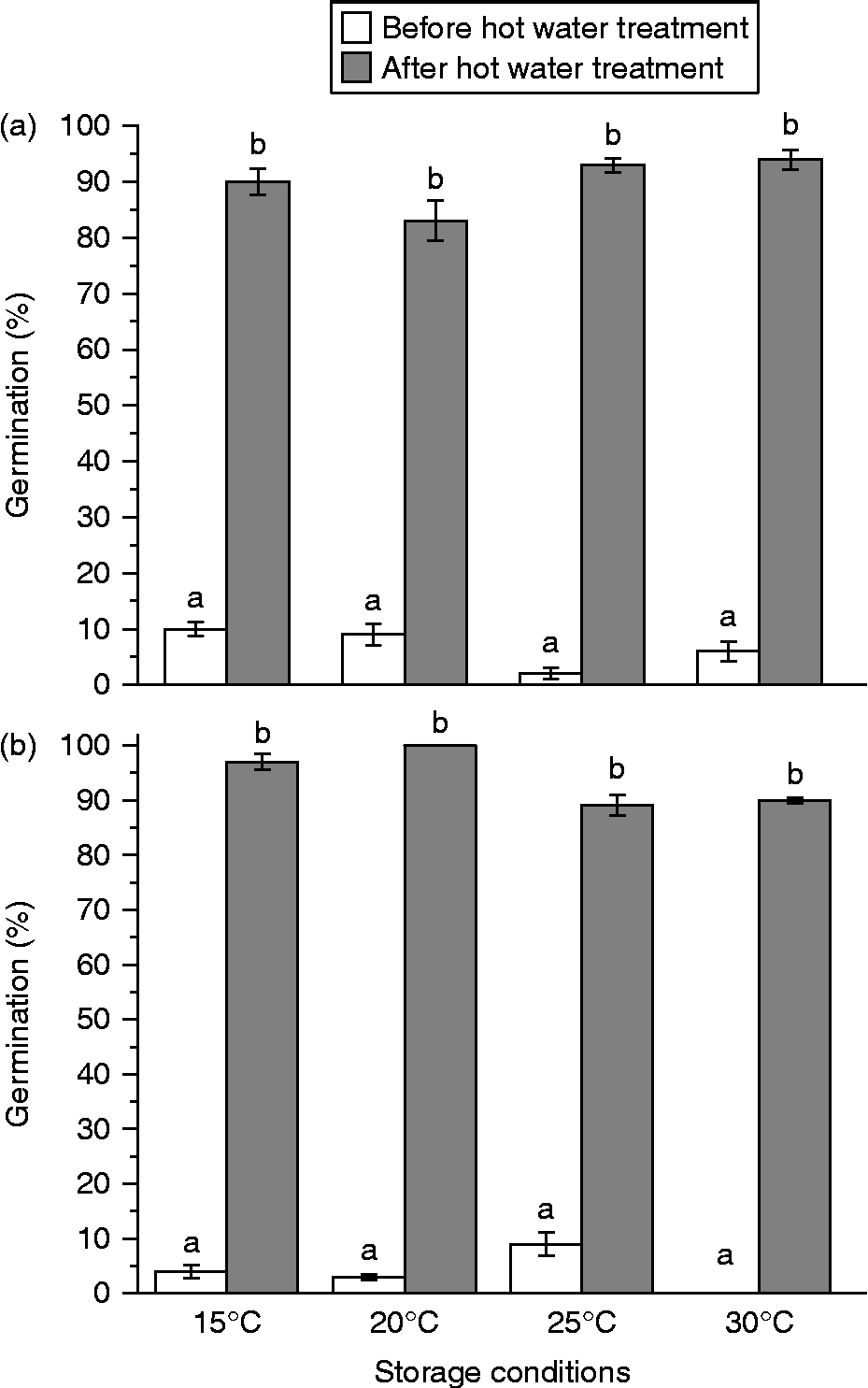
Seeds stored dry at 15, 20, 25 and 30°C for 1 year only germinated to < 15%, when incubated at 25°C and 15/30°C for 21 d at the end of storage (Fig. 2). However, hot-water treatment (90°C) for 30 s increased germination percentage to >90% in seeds stored at all four temperatures.
Germination percentage of D. viscosa seeds stored for 1 year at four different temperatures and germinated at (a) 25°C constant and (b) 30/15°C before and after dipping in hot water.

Germination of seeds stored at 10/20°C, 15/20°C, 15/30°C, 20/35°C and 25°C ranged from 5 ± 1.5% at 10/20°C to 13 ± 3.2% at 15/30°C after 32 weeks. Seeds at 15/20°C and 20/35°C germinated to 7 ± 2.1% and 12 ± 2.7% respectively. Seeds held at a constant temperature of 25°C showed a final germination of 9 ± 1.5%. At all the temperatures germination occurred during the first 3 weeks of storage.
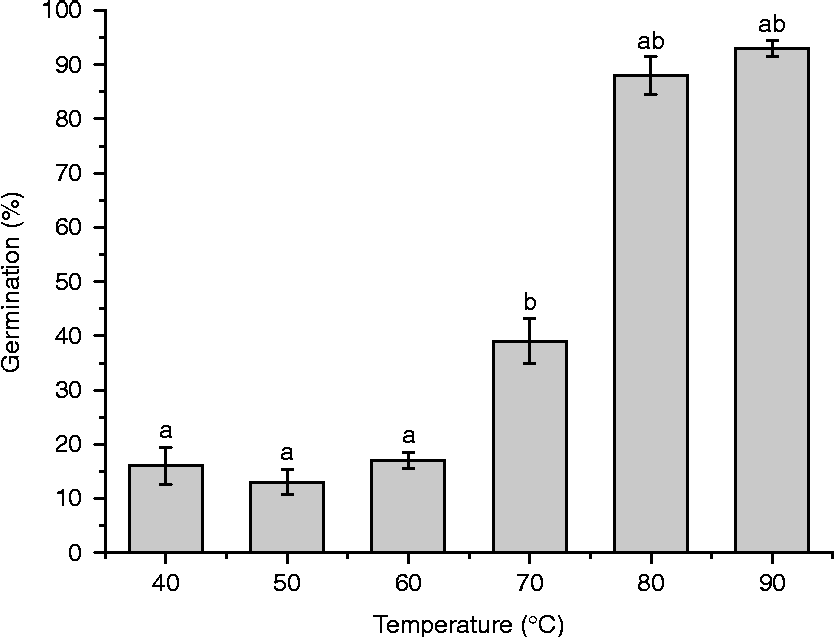
The temperature of the water had a significant effect on dormancy breaking of D. viscosa seeds (F (5,12)= 23.98, P< 0.05; Fig. 3). Dormancy was not broken to a significant level in seeds unless the temperature of the water was between 70°C and 90°C (P< 0.05; Fig. 3). However, germination after dipping seeds in water at 70°C was slow, with most seeds germinating only during the second week. Dipping seeds in water at 80 and 90°C effectively broke dormancy in 88 and 96% of seeds, respectively (P< 0.05), with most seeds completing germination within 2 weeks.
Germination percentages (mean ± SD) of D. viscosa seeds dipped in hot water at different temperatures for 30 s and incubated at 20/30°C for 3 weeks. Temperatures at which significant changes (P< 0.05) occurred are marked with different lower-case letters.

Soil temperature
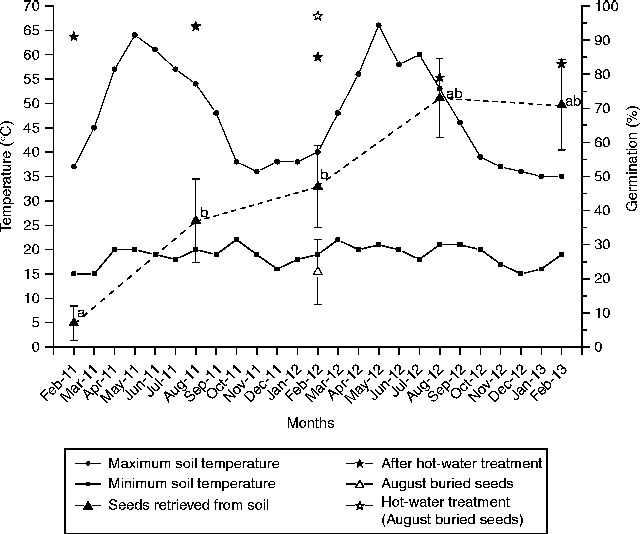
Soil temperature measurements during the 2-year burial period showed that the months between April and July were warmer, with May the warmest (Fig. 4). Temperatures ranged from 15°C in February 2011, March 2011 and December 2012 to 66°C in May 2012. In total, there were 170 and 148 d in 2011 and 2012, respectively, with temperatures rising above 50°C (Fig. 4). During the burial period, soil temperatures never dropped below 15°C (Fig. 4). Higher temperature fluctuations were observed during the warmer months of the year compared to a narrow fluctuation range of 10°C between September and February.
Maximum and minimum soil temperature in °C recorded at 3–5 cm below the soil surface at the study site between February 2011 and January 2013. Dormancy loss corresponding to the seasonal temperature fluctuation is presented as germination percentage (mean ± SD) of buried seeds exhumed every 6 months and tested at 20/30°C, for 2 years between February 2011 and February 2013. The percentage of seeds that remained dormant and germinated after hot-water treatment is indicated by asterisks. Error bars represent standard deviation of the mean. Data points with different lower-case letters represent statistically significant differences in germination percentages.

Seed burial and germination
In contrast to low germination at the time of collection, seeds buried in their natural environment showed improved germination with time (Fig. 4). There was a significant time × dormancy loss effect observed during burial, F (4,15)= 19.96, P< 0.05. Seeds retrieved after 6 months in August significantly (but marginally) improved germination as compared to the control (P< 0.05; Fig. 4). Within 6 months of burial, germination percentage increased to 37 ± 12.3%, as compared to 7% at the time of burial. Although seeds exhumed after 1 year showed higher germination percentages (47%) as compared to August-retrieved seeds (37%), the effect was not statistically significant (P>0.05). However, seeds exhumed on 2 August (2012) showed a significant increase in germination (P< 0.05) and by this time 73 ± 11.7% of the buried seeds had germinated. Percentage germination of seeds buried for 2 years was only 71 ± 13.2% (P>0.05). Of the 400 seeds buried in August 2011, only 22 ± 9.5% of the seeds had germinated after 6 months in soil. Most of the seeds germinated during burial and only very few did so when incubated at 30/20°C for 3 weeks. Seeds that remained non-imbibed at the end of the germination test germinated to nearly 90% after dipping in hot water (Fig. 4).
Discussion
The experiments confirm that seeds of D. viscosa from southern India have PY and only germinate after dormancy is broken. Similar results were reported for D. viscosa occurring in Australia (Hodgkinson and Oxley, Reference Hodgkinson and Oxley1990), Brazil (da Rosa and Ferreira, Reference da Rosa and Ferreira2001 cited by Baskin et al., Reference Baskin, Davis, Baskin, Gleason and Cordell2004), Hawaii (Baskin et al., Reference Baskin, Davis, Baskin, Gleason and Cordell2004), Mexico (Gonzalez Kladiano and Camacho Morfin, Reference Gonzalez Kladiano, Camacho Morfin and Rojo1994 cited by Baskin et al., Reference Baskin, Davis, Baskin, Gleason and Cordell2004; Benítez-Rodríguez et al., Reference Benítez-Rodríguez, Gamboa-deBuen, Sánchez-Coronado, Alvarado-López, Soriano, Méndez, Vázquez-Santana, Carabias-Lillo, Mendoza and Orozco-Segovia2013), northern India (Phartyal et al., Reference Phartyal, Baskin, Baskin and Thapliyal2005) and New Zealand (Burrows, Reference Burrows1995). This study therefore adds additional support to the earlier suggestion by Baskin et al. (Reference Baskin, Davis, Baskin, Gleason and Cordell2004) and Phartyal et al. (Reference Phartyal, Baskin, Baskin and Thapliyal2005) that: (1) seeds of D. viscosa from all geographical locations must be dormant; and (2) studies claiming that seeds of D. viscosa are non-dormant must have collected seeds before they attained full maturity.
It is reasonable to speculate that a small proportion of D. viscosa seeds at the time of maturity may have been non-dormant and germinated without any dormancy-breaking treatments (Fig. 1), as reported previously for species within the Sapindaceae (Burrows, Reference Burrows1995; Cook et al., Reference Cook, Turner, Baskin, Baskin, Steadman and Dixon2008) and other families with PY, e.g. Fabaceae (Morrison et al., Reference Morrison, Auld, Rish, Porter and McCalay1992; Moreira et al., Reference Moreira, Tormo, Estrelles and Pausas2010; Hu et al., Reference Hu, Li, Wang, Wang, Baskin and Baskin2013) and Cistaceae (Moreira et al., Reference Moreira, Tormo, Estrelles and Pausas2010). However, this argument is likely to be affected by the seed collection environment. For example, although only less than 2% of the seeds from Hawaii (Baskin et al., Reference Baskin, Davis, Baskin, Gleason and Cordell2004), Mexico (Benítez-Rodríguez et al., Reference Benítez-Rodríguez, Gamboa-deBuen, Sánchez-Coronado, Alvarado-López, Soriano, Méndez, Vázquez-Santana, Carabias-Lillo, Mendoza and Orozco-Segovia2013) and New Zealand (Burrows, Reference Burrows1995) germinated at the time of collection, Phartyal et al. (Reference Phartyal, Baskin, Baskin and Thapliyal2005) recorded 24% germination in freshly collected seeds from India. On the other hand, Nasr et al. (Reference Nasr, Savadkoohi and Ahmadi2013) showed that about 50% of the freshly collected D. viscosa seeds from Iran germinated without any pre-treatment, although 45 min in sulphuric acid and 5 s in hot water improved germination to almost 90%. However, the result of Nasr et al. (Reference Nasr, Savadkoohi and Ahmadi2013) that 50% of the freshly collected D. viscosa seeds are non-dormant must be approached with caution. This is because, in their study, the moisture content of the seeds at the time of collection was not determined, thus there is a possibility that seeds used in their experiment might have been collected before full maturity.
Baskin et al. (Reference Baskin, Davis, Baskin, Gleason and Cordell2004) reported that seeds of D. viscosa stored dry under laboratory conditions for 1 year had failed to break dormancy. Also, Benítez-Rodríguez et al. (Reference Benítez-Rodríguez, Gamboa-deBuen, Sánchez-Coronado, Alvarado-López, Soriano, Méndez, Vázquez-Santana, Carabias-Lillo, Mendoza and Orozco-Segovia2013) stored seeds at room temperature for 2.5 months with no improvement in germination. Our results are in line with this. The duration required for breaking PY in seeds stored at room temperature not only varies between families but also within a family. Thus, while dry storage of several species with PY from the Fabaceae (Hu et al., Reference Hu, Li, Wang, Wang, Baskin and Baskin2013), Geraniaceae (Meisert, Reference Meisert2002; Van Assche and Vandelook, Reference Van Assche and Vandelook2006) and Malvaceae (Egley, Reference Egley1976) lose dormancy during storage, some genera in the families including Geraniaceae (Van Assche and Vandelook, Reference Van Assche and Vandelook2006) and Malvaceae (Egley and Paul, Reference Egley and Paul1981; Van Assche and Vandelook, Reference Van Assche and Vandelook2006) produce seeds that remain dormant even after 2 years of dry storage.
Furthermore, unlike seeds of D. petiolaris, which came out of dormancy at ecologically significant temperatures within 24 weeks of incubation, with the total percentage of seeds germinated increasing with increase in temperature: 20/35°C>13/26°C>15°C>10/20°C (also high temperature broke dormancy quickly) (Turner et al., Reference Turner, Cook, Baskin, Baskin, Tuckett, Steadman and Dixon2009), seeds of D. viscosa stored on a moist substrate at 10/20°C, 15/20°C, 15/30°C, 20/35°C and 25°C showed no improvement in germination even after 32 weeks (Fig. 2; see also Baskin et al., Reference Baskin, Davis, Baskin, Gleason and Cordell2004). A comparison of temperature and time requirements for rendering seeds of Dodonaea species non-dormant, reflects an extremely species-specific degree of hardseededness. For example, seeds of D. aptera and D. hackettiana displayed significant improvement in germination when wet heated for 1 h at 50°C and 60°C, respectively, but those of D. ptarmicaefolia and D. viscosa (this study) failed to do so at any temperature below 80°C (Cook et al., Reference Cook, Turner, Baskin, Baskin, Steadman and Dixon2008; Fig. 3). Similarly, seeds of D. viscosa subjected to dry heat for 60 min came out of dormancy at temperatures only above 80°C, although an increase in temperature decreased the required duration (Baskin et al., Reference Baskin, Davis, Baskin, Gleason and Cordell2004), but contrasting temperature requirements in other species of Dodonaea have been reported (Turner et al., Reference Turner, Cook, Baskin, Baskin, Tuckett, Steadman and Dixon2009).
According to Benítez-Rodríguez et al. (Reference Benítez-Rodríguez, Gamboa-deBuen, Sánchez-Coronado, Alvarado-López, Soriano, Méndez, Vázquez-Santana, Carabias-Lillo, Mendoza and Orozco-Segovia2013) immersing seeds of D. viscosa in sulphuric acid for 6–10 min can break dormancy in more than 90% of the seeds, but dipping seeds in hot water for 2.5–5 min was ineffective. However, the results of the present and earlier studies (Hodgkinson and Oxley, Reference Hodgkinson and Oxley1990; Baskin et al., Reference Baskin, Davis, Baskin, Gleason and Cordell2004; Phartyal et al., Reference Phartyal, Baskin, Baskin and Thapliyal2005) are in sharp contrast to their conclusion, as hot water treatment for 30 s broke dormancy in almost 90% of the seeds tested (Fig. 2).
High temperature requirements to break dormancy in Sapindaceae, especially in the genus Dodonaea, have been tested in some of the Australian species (Cook et al., Reference Cook, Turner, Baskin, Baskin, Steadman and Dixon2008; Turner et al., Reference Turner, Merritt, Baskin, Baskin and Dixon2006, Reference Turner, Cook, Baskin, Baskin, Tuckett, Steadman and Dixon2009). In particular, Cook et al. (2008) demonstrated that artificially buried seeds of D. hackettiana germinated to 36% when exhumed after 4 months, although seeds before burial were only able to germinate to 6%. In the present study, D. viscosa seeds buried in the soil for 6 months also germinated to 37 ± 5.1%, but 94% of the remaining non-germinated seeds were alive and germinated successfully after hot-water treatment. Seed germination of buried seeds improved progressively with increase in time (Fig. 4). However, all the seeds buried must have experienced more or less similar conditions since we buried them in the top soil layer. Nevertheless, this is a chance event in nature, because seeds do not germinate immediately after dispersal and persist for a long period. This observation provides some evidence to suggest that seeds of D. viscosa establish persistent seed banks because dormancy allows only a proportion of seeds to germinate every year, as observed in many Fabaceae species (Baskin and Baskin, Reference Baskin and Baskin1998; Van Assche et al., Reference Van Assche, Debucquoy and Rommens2003; Van Assche and Vandelook, Reference Van Assche and Vandelook2006; Hu et al., Reference Hu, Wu and Wang2009).
One of the most important findings of the present study was that seeds of D. viscosa displayed pronounced germination when exhumed after summer (in August) (Fig. 4). Additional evidence that dormancy is broken by summer temperatures also comes from a study conducted in Brazil, which showed that seeds of D. viscosa collected in January only germinated after scarification, but those collected in November were able to germinate to 93%, i.e. dormancy was broken in the field during summer and autumn (da Rosa and Ferreira, Reference da Rosa and Ferreira2001, cited by Baskin et al., Reference Baskin, Davis, Baskin, Gleason and Cordell2004). In a 2.5-year soil seed bank study on 14 Fabaceae species, Van Assche et al. (Reference Van Assche, Debucquoy and Rommens2003) critically highlighted that most of the seeds germinated during spring after PY was broken by low temperatures in winter. In contrast to temperate locations, where many species require low winter temperature to break dormancy, low winter temperatures do not occur in the wet–dry tropical environments (Fig. 4). Germination during June through September can have numerous advantages to D. viscosa seeds. Water requirements to complete initial stages of germination can be satisfied during the rainy season after summer. Furthermore, following the rainy season, moderate climatic conditions prevailing until summer provide ideal conditions for seedling growth.
Based on our data, we believe there may be three factors that would provide conditions favouring dormancy break in D. viscosa seeds in the soil: (1) dry heat – soil temperatures rising to 55–65°C during April to June; (2) moist heat – rainfall events moistening the seeds with subsequent temperatures rising above 50°C; and (3) daily fluctuating temperatures of 15–20°C in the months of May to July. However, which of these particular factors, or combinations, are required for seeds to lose PY remains to be shown. However, there is some indication that dormancy breaking occurs in wet soil at high temperature. Interestingly, Benítez-Rodríguez et al. (Reference Benítez-Rodríguez, Gamboa-deBuen, Sánchez-Coronado, Alvarado-López, Soriano, Méndez, Vázquez-Santana, Carabias-Lillo, Mendoza and Orozco-Segovia2013) found that D. viscosa seeds artificially buried for 2.5 months in a moist forest site, germinated to 22%, as compared to less than 5% at drier sites. In their study area, similar to our data, temperatures above 60°C are common. Hodgkinson and Oxley (Reference Hodgkinson and Oxley1990) also found that soil temperatures rising above 70°C, as a result of fire, improved germination in D. viscosa seeds, mostly in moist soil. These studies suggest that the ability of seeds to break dormancy can be influenced to some extent by the micro-site. Perhaps the variation in micro-climate and soil environment between August and February can be a reason for the low germination seen in seeds buried in August.
While dry heat of 80°C for 1 h, and wet heat of 80°C for 5 s, can break dormancy in D. viscosa seeds, this is not even a chance event in the natural environment. However, although the dormancy-breaking effects of long-term exposure of seeds to temperatures between 40 and 60°C have not been studied in D. viscosa or in many PY species, we suggest that this is more likely an ecological route of dormancy breaking or pre-conditioning (see below). In alfalfa, seeds held at 41°C became permeable to water after 5 d (Ellis and Palmer, Reference Ellis and Palmer1973). A moderate temperature of 55°C for 16 h was effective in breaking PY of Mucuna aterrima (Wutke et al., Reference Wutke, Maeda and Pio1995). Van Assche and Vandelook (Reference Van Assche and Vandelook2006) noted that summer temperatures may dry the seeds present in soil surface which alleviates PY and serve as a possible environmental cue for the winter annuals to germinate after summer, so that germination synchronizes with the most favourable condition.
Experiments with Geranium carolinianum (Gama-Arachchige et al., Reference Gama-Arachchige, Baskin, Geneve and Baskin2012), G. columbinum, G. dissectum, G. lucidum, G. molle and G. pusillum (Van Assche and Vandelook, Reference Van Assche and Vandelook2006), Ipomoea lacunosa (Jayasuriya et al., Reference Jayasuriya, Baskin and Baskin2008a), Ornithopus compressusL. (Taylor and Revell, Reference Taylor and Revell1999) and Trifolium subterraneum (Taylor, Reference Taylor1981) have shown that PY breaking involves a pre-conditioning step prior to the actual opening of the water gap. Identical dormancy breaking in Sapindaceae could therefore be expected, and there is some evidence to show that cooler conditions prior to the rise in summer temperatures act as a pre-conditioning step (Fig. 4). Importantly, pre-conditioning serves as an ‘environmental detector’ to sense the favourable time for opening the water gap. Thus, the seeds are conditioned at lower temperature and if favourable conditions (high temperatures) are not met, the pre-conditioning step is reversed and seeds continue to persist until next year (Baskin and Baskin, Reference Baskin and Baskin2014). Future studies, for example similar to those conducted in Geraniaceae (Gama-Arachchige et al., Reference Gama-Arachchige, Baskin, Geneve and Baskin2012), are imperative to predict the ecological significance of those factors determining the timing of germination in Sapindaceae seeds.
In general, mechanically scarified seeds germinated faster than other dormancy-breaking methods tested here and dry heat as indicated by Baskin et al. (Reference Baskin, Davis, Baskin, Gleason and Cordell2004). For example, only one hot-water treated seed germinated at the third day of incubation, but 19% of the mechanically scarified seeds germinated by this time (Fig. 1). We agree with Baskin et al. (Reference Baskin, Davis, Baskin, Gleason and Cordell2004) that water movement in mechanically scarified seeds occurs throughout the scarified regions, and that a slower imbibition rate in other treatments is explained by water movement only through specialized structures. Evidently, germination of seeds buried in the soil was also slow and some seeds started to germinate only during the second week, when most, if not all, mechanically scarified seeds completed germination. These results indicate that seeds break dormancy in the natural environment by opening specific gaps available on the seed coat for water entry. In a detailed study on Dodonaea petiolaris and Distichostemon hispidulus, Turner et al. (Reference Turner, Cook, Baskin, Baskin, Tuckett, Steadman and Dixon2009) identified the water gap in members of the Sapindaceae family to be a small plug in the seed coat, which is located adjacent to the hilum. There is a great likelihood that this plug may also act as the water gap in D. viscosa.
Germination of seeds during burial supports the paradigm that seeds of D. viscosa do not require light for radicle emergence (Burrows, Reference Burrows1995; Baskin et al., Reference Baskin, Davis, Baskin, Gleason and Cordell2004). However, Benítez-Rodríguez et al. (Reference Benítez-Rodríguez, Gamboa-deBuen, Sánchez-Coronado, Alvarado-López, Soriano, Méndez, Vázquez-Santana, Carabias-Lillo, Mendoza and Orozco-Segovia2013) reported that D. viscosa seeds buried at a depth of 5 cm in soil for 2.5 months failed to germinate until exhumed and germinated ex-situ. Consequently, they suggested that other soil factors, e.g. gases, prevented germination in soil. On the other hand, in the burial experiment conducted in Australia, all the seeds of D. hackettiana germinated during burial (Cook et al., Reference Cook, Turner, Baskin, Baskin, Steadman and Dixon2008). From the available evidence it is clear that most of the seeds with PY occurring in different environments can germinate at a wide range of temperatures under both darkness and light, even from a soil depth of 7 cm, once the seed coat becomes permeable (Van Assche et al., Reference Van Assche, Debucquoy and Rommens2003; Van Assche and Vandelook, Reference Van Assche and Vandelook2006; Hu et al., Reference Hu, Wu and Wang2009; Liu et al., Reference Liu, Shi, Wang, Yin, Huang and Zhang2011). Thus, it seems likely that either the requirement of additional soil factors might have been satisfied in the study area or germination in soil occurs after 2.5 months.
In conclusion, we have shown that seeds of D. viscosa from the south of India are dormant. In addition, there is strong evidence to conclude that dormancy break occurs in the field due to high summer temperatures. This study, to our knowledge, is the first to evaluate the ecological dormancy loss in Sapindaceae over 2 years. In contrast to the spring germinators in temperate environments, which benefit by growing rapidly in summer, germination at the end of summer or early in autumn is highly adaptive to the tropical climate, so that seedlings grow actively to suitable size during the months of moderate temperature, thereby tolerating summer drought. The overriding role of season in controlling germination of other Dodonaea species and other members of Sapindaceae family having PY is currently under investigation.
Acknowledgements
We are thankful to Dr Palanisamy, Tamil Nadu Agricultural University, for helping us to set up the experiments in the field. Thanks are also extended to Mr Krishnan and Mrs Sumathi for their support during seed collection and seed exhumation. We are also thankful to Dr Shane Turner and Dr Kathryn Steadman for expressing positive comments on the manuscript. We also thank two anonymous reviewers and Professor Ken Thompson for their helpful suggestions on an earlier version of manuscript.
Financial support
This work was supported by the NSFC (Grant No. 51076108).
Conflict of interest
None.