‘It will be a dream, a fairy tale that will warm your heart’: echoing billboard promises of pleasure and packed with insider titbits on the production, a local newspaper whetted Brno's appetite for Leoš Janáček's newest opera, Příhody lišky Bystroušky (The Cunning Little Vixen, hereafter Bystrouška). The opera was set to open at Brno's Na hradbách Theatre on 6 November 1924 with František Neumann at the podium, and in a staging by Ota Zítek, but the article revealed little of the music or set. Instead, it treated its readers to a taste of the ‘seventy costumes’ designed by artist Eduard Milén: grasshoppers and crickets in ‘yellow-green tailcoats and magnificent little wings’; black-and-white glow-worms with reflectors ‘to light up their bottoms’ in the night scenes; a wire-frame rooster costume lined with brightly coloured fabrics; and a green, blue and black dragonfly of ‘melancholy beauty’, whose tiny, delicate underwings were illuminated in glittering gold.Footnote 1
The writer's near exclusive focus on the opera's costumes, and on the animal and insect costumes in particular, reflected one of Bystrouška's most unusual features: its large number of animal characters. The story, which intertwines the fates of a young female fox and her animal friends and foes with the lives of the human inhabitants of a rural Moravian village, goes, very briefly, like this: a forester finds a female fox cub and takes her home. She kills all his fowl and escapes back to the woods where she takes over a badger's den. She falls in love with a handsome male fox; there is a shotgun wedding; fox cubs follow soon thereafter. The forester tries but fails to recapture the vixen; he, the parish priest and the village schoolteacher grumble about their respective troubles over cards and beer at the local pub. Finally, the vixen plunders a poacher's poultry and is shot dead. In a return to the opening, the forester awakens from a nap to find himself observed by a young and curious female fox cub.
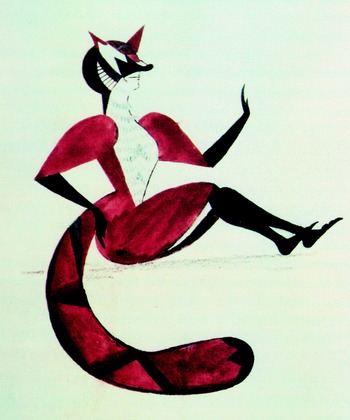
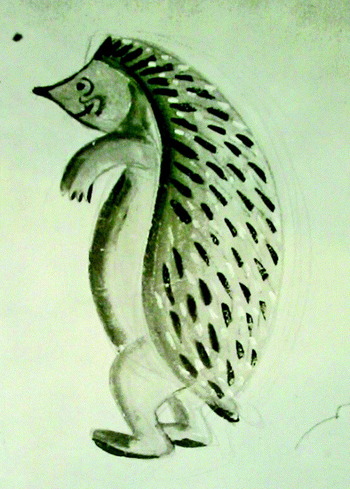
Bystrouška was a success in Brno. The article cited above embraced the opera's animal heroine as ‘a fellow compatriot’ of Moravians and loved her all the more for speaking the Moravian dialect, like many in the city. Milén's costumes for Bystrouška (see Fig. 1) also continued to draw attention and admiration: Ludvík Kundera, in his review of the premiere, pronounced them ‘truly beautiful pictures’ in their own right.Footnote 2 Not to be outdone – at least in costumes and sets – in their first production of Bystrouška, the Prague National Theatre engaged Josef Čapek, one of the city's foremost painters and brother of the prominent author Karel, as designer. Scheduled to open on 18 May 1925, Bystrouška was one of the showcase Czech compositions at the International Society for Contemporary Music Festival, held that year in Prague. Čapek had some experience in costume and set design for spoken drama, in particular in productions of his brother Karel's plays at the National Theatre, such as R.U.R., Rossum's Universal Robots (1920) and Ze života hmyzu (From the Life of Insects, 1921, hereafter Hmyz), but this would be his first opportunity to design for opera. Both R.U.R. and Hmyz had been huge theatrical sensations, rapidly travelling beyond the borders of the Czech lands to international stages; the National Theatre was surely counting on the Čapek name to bring Janáček's opera additional attention.Footnote 3 As in Brno, there was fun to be had with the opera's wide array of costumes and Čapek's designs are full of whimsical touches: black-and-white jail-bird stripes and flying goggles for the mosquito; flouncy polka-dot petticoats for the hens; cowboy spurs with golden rowels for the rooster; a furry deerstalker for the forester's dog. A sketch for a hedgehog is particularly arresting for – in a way that resonates with Kundera's observation about Milén's designs – Čapek's watercolour sketch does not appear to be a costume at all. Rather, it resembles an illustration for a story: animated, childlike, a little anthropomorphised, and rendered in Čapek's inimitable style (see Fig. 2).
(Colour online) Vixen costume design by Eduard Milén for Příhody lišky Bystroušky, directed by Ota Zítek, conducted by František Neumann, Národní divadlo, Brno, 1924. Image reproduced courtesy of the Brno National Theatre.

(Colour online) Hedgehog costume design by Josef Čapek for Příhody lišky Bystroušky, directed by Ferdinand Pujman, conducted by Otakar Ostrčil, Národní divadlo, Prague, 1925. Image HM6 D16655 reproduced courtesy of the National Museum, Prague.

The attention critics paid to the costumes for these first two stagings of Bystrouška adumbrates an enduring concern with visual aspects of the opera that underpins both the aims of subsequent productions and critical reactions to them. The reason for this interest, I suggest, lies not just in the commercial attractiveness of such theatrical whimsy, but in something more fundamental. By taking into account the production and reception histories of all the Czech productions of Bystrouška given in Prague and Brno, this article is able to trace the ways in which the opera's visual component interplays with its music to complicate notions of morality in the opera.Footnote 4 This concentration on how Bystrouška looked and moved on stage, I suggest, adds a new dimension to the more usual focus in scholarship on how the style and structure of Janáček's music relates to his theory of speech melody.Footnote 5 The first section of this article outlines the context of animal satires within which contemporaneous critics somewhat uneasily located Janáček's ‘animal opera’, and suggests that its contravention of the satire genre has led to the common perception that the opera expresses an amoral outlook on society. The next section discusses several productions of Bystrouška, along with reactions from critics, to demonstrate that, for much of its production history, the question of the opera's ambiguous morality has frequently been tied up not only with how productions looked, but also with how the singers moved. In the last section I argue, with support from close readings of the music, that the various degrees to which gestures correspond with the music at key moments in the opera create its amoral message.
Pigeonholes and animal opera
While it is barely possible to imagine fleas on Josef Čapek's untroubled and merry hedgehog, one of his literary kin plainly suffered from them. The suggestion that its eponymous rodent protagonist had an itch he had to scratch was one way in which the Czech author Jaroslav Hašek's short story ‘Povídka o neslušném ježkovi’ (The Tale of the Indecent Hedgehog) satirised base human urges. Hašek's hedgehog is employed by a hotel to keep the cockroaches in check, but the salacious animal turns out to be an obsessive voyeur. Instead of ridding the hotel rooms of pests, he spies on the guests, watching them from under the furniture, beady-eyed and scratching himself compulsively, as they undress. Hašek continued to mock human weakness and vice in his writing, including in his epochal novel Osudy dobrého vojáka Švejka za světové války (The Good Soldier Švejk).Footnote 6 He penned a number of short stories in which he used, as he had in the hedgehog story, animals as the satirical device.
Hašek's story of the immoral hedgehog was only one of a number of animal satires dating from the early twentieth century. When animal stories and fables made a late addition to the nineteenth-century interest in collecting folk tales and mythologies, collectors tended to clean up their rougher edges and to heighten – or provide – the moral before including them in their anthologies.Footnote 7 Hašek's Povídka exemplifies this trend to moral critique in modern satire, for which animals make particularly effective devices because, as literary scholar Daphne Patai has observed, they draw on preconceived notions of animal traits.Footnote 8 These associations (the slyness of a fox, for example) were to some degree formed by the long, if patchy, literary tradition of animal fables and bestiaries, and also by extension in the folk and fairy tales mentioned above.
Other notable Czech contributors to the animal satire genre were the Čapek brothers, whose collaborative play Ze života hmyzu (From the Life of Insects) used insects to satirise a number of evils in society including, most topically, war. Act I's butterflies, for example, are social butterflies, preoccupied only with self-gratification and the pursuit of carnal pleasures. The dung beetles, crickets and ichneumon wasps of the second act are callous opportunists who feed off others (literally, in the case of the wasp). The army of ants in the last act manufacture products and war in unquestioning support of the nationalist ideals and expansionist aims of their dictator. Though the satire in Hmyz is carried out almost exclusively through anthropomorphised insects, the morals are explicitly drawn by a lone human figure, a tramp, who observes the insects and comments on their behaviour.
A list of Czech animal satirists might also include the Moravian writer Rudolf Těsnohlídek, the author of the story on which Janáček based his opera. The adventures of the vixen had run originally in the Brno newspaper Lidové noviny, from April to June of 1920, and had taken the form of a serial, illustrated by artist Stanislav Lolek. That Janáček based the libretto on cartoons published in the local daily newspaper is the most pervasive misconception about Bystrouška. Lolek's pen and ink drawings – around two hundred of them – preceded the writing of the text, but they were not printed as a captioned comic strip, as is often assumed.Footnote 9 The editor of Lidové noviny, who had spotted Lolek's drawings at the artist's studio, contracted Těsnohlídek to develop a story based on them for the newspaper. The resulting instalments comprised a half-folio page of text with two or three of the pictures printed alongside.Footnote 10 The serial proved so popular with readers that it was subsequently reprinted without any modification as a novella: it was this amalgamation of Těsnohlídek's words and Lolek's images that Janáček worked from in composing his opera. However, while Lolek's pictures had occasionally put the animals in recognisably human situations, and Těsnohlídek amplified and made obvious their implied satire, the result was more one of gentle mockery than either the bald crudeness of Hašek's stories or the Čapeks' uncompromising condemnation of humankind.
That popular literary pedigree notwithstanding, critics were puzzled as to what to make of the opera. The exploits of animals have rarely been given scope on the operatic stage. Except, perhaps, for Ravel's almost exactly contemporaneous L'Enfant et les sortileges, there are virtually no operas with which Bystrouška can be compared: even amongst Janáček's own works, Bystrouška holds ‘an entirely special place’, the critic Hubert Doležil observed. Its ‘unusual and arresting appearance as an “animal opera”’ attracted attention and, Doležil predicted in 1937, ‘predestined it for the same success in theatres around the world as the Čapek brothers’ insect play had achieved'.Footnote 11 By comparing Bystrouška to Hmyz, Doležil offered animal satire as a possible context for an opera that otherwise had none. Indeed, several critics initially positioned Bystrouška thus, comparing it not only to Czech works such as Čapek's Hmyz, but also locating it more broadly in an early twentieth-century renaissance of animal satire and beast fable that included Rudyard Kipling's stories and Edmund Rostand's play Chantecler (1910).
It was an uneasy fit, or at least only a partial one, arising more out of attempts to pigeonhole Janáček's animal opera than out of any real conviction that it functioned as satire. So, even as critics situated Bystrouška alongside Hmyz, Chantecler and other works, they qualified the opera's position, contrasting its inconsistent satire with the more pointed thrusts of other stage and literary works. Janáček had ‘followed the same path as Kipling, Rostand and Čapek’, one critic suggested, but his musical setting captured Těsnohlídek's story with ‘pantheistic optimism and inherent passion’.Footnote 12 Another writer observed that Janáček's animals revealed ‘the quintessence of human wisdom’ as well as ‘human idiocy’, unlike Rostand's animals in Chantecler, which exclusively caricatured human failings such as jealousy and egoism; nor, the writer added, did Janáček's opera mock with the ‘ungodly irony of the Čapek brothers’ insect play'.Footnote 13 It was Bystrouška's combination of animals and humans that caused problems, the critic Antonín Šilhan suggested. Also making use of a comparison between Bystrouška and Chantecler, Šilhan argued that by representing only the animal world on stage, Rostand allowed its illusion of animals talking and behaving as humans to be maintained and thus comprehended as an allegory by the audience. The action of Janáček's opera, by contrast, alternated between the fantastic and the realistic, meaning that the audience had to readjust their frame of reference from scene to scene.Footnote 14 That the opera does not merely alternate the human and animal worlds, but also allows them to interpenetrate in certain scenes, further complicates the issue.Footnote 15
The above commentary from early critics hints at how Bystrouška bends the customary rules of beast fables and animal satire. Though the opera's animals are anthropomorphised, they do not always provide the moral or the satirical gloss which results in the expected critique of human folly. Janáček's opera – as Těsnohlídek's novella – also brings together both animal and human characters, breaking the convention that has animal fables and satires depict animals alone. The issues of the combined animal and human worlds and of Janáček's inconsistent use of the opera's animals as satiric devices thus complicate Bystrouška's position relative to other contemporary animal satires, and thereby blur the opera's moral message.
Although there are moments in the opera when Bystrouška's animal characters appear alone and are used, in some of those instances, to poke fun at human weaknesses, the scenes in which animals and humans commingle, on the other hand, are seldom as straightforwardly satirical. Literary scholar Karen Ryan has suggested that the effectiveness of animal satire depends, in large part, on the portrayal of the animals allowing a ‘dual level of perception’ – that is, they appear simultaneously animal and human. ‘If there is slippage in either direction (i.e., if the characters lose their dual and balanced beast/human quality)’, Ryan argues, ‘the satire will sacrifice some of its force’.Footnote 16 Ryan's required balance is disturbed most, I suggest, during those scenes in the opera in which animals and people interact. From the perspective of the audience, the animals regularly take on human characteristics, but for the people in the opera with whom they interact, they are nothing other than ordinary animals. Perhaps the most extreme example of this occurs in the scene in which the schoolteacher staggers home from a late night at the pub. In the darkness and the haze of his intoxication he confuses some sunflowers (inadvertently animated by the concealed vixen) for a girl named Terynka on whom he has a crush. The vixen observes the schoolteacher's comedic lurches and listens to him rambling drunkenly, but does so warily from the undergrowth; she also remains completely silent. With nothing to say and little to do except act out the part of a mistrustful wild creature, the perception of the vixen as both human and animal in this scene tips entirely in favour of the animal.
Even when not complicated by the presence of animals and humans together on stage, Janáček's treatment of the individual characters in Bystrouška is more complex than simply depicting people behaving like animals and animals acting as humans. The historian Charles Susskind has suggested that the opera is reminiscent of Aesop's fables, especially in its use of the sly fox trope, but the comparison does not seem particularly apt.Footnote 17 Janáček's vixen is sometimes cunning and manipulative but she is not always so. Indeed, Czech critics of the early productions thought the kinship between the operatic vixen and her fabled cousin rather more removed. ‘Much to my surprise’, Doležil wrote, ‘the foremost characteristic trait of her slyness, which operates so wittily both in our own and in foreign fables and stories, was not used very much in the anthropomorphisation of this fox’.Footnote 18 Susskind, perhaps, had been misled by the English title – ‘cunning’ having been derived from the German schlau (shrewd), which Max Brod chose when he translated the opera into German for Universal Edition's score. The Czech bystroušký actually means sharp-eared.Footnote 19 What is more, though Janáček had bajka (fable) in the opera's title during the early phase of its composition, he discarded it soon thereafter in favour of the příhody (adventures) of Těsnohlídek's story, suggesting a deliberate decision not to align his opera with the beast fable genre.Footnote 20
Additionally weakening the connection between Aesop's sly fox and Janáček's vixen is the absence of a moral principle underpinning the opera's drama. Janáček's previous operas had strong ethical subtexts, but Bystrouška did not fit the model of social critique, psychological drama and tragedy of Její pastorkyňa (Jenůfa) or Káťa Kabanová. Even the comedic, waltz-laden Výlety paně Broučkovy (The Excursions of Mr Brouček), advocating active nationalism and criticising the materialism and apathy of the bourgeoisie, was more pointed. The difference between Aesop's fables and Janáček's opera is clear: fables have morals, but at the end of the opera no moral can easily be drawn.
This is not to say, however, that Bystrouška is entirely devoid of message. When Janáček wrote the libretto, which he compiled from a selection of the novella's episodes plus a few (such as the vixen's death) of his own, he retained both the earthiness of Těsnohlídek's language and some of its more ribald scenes. But, whether he had meant to or not, Janáček tempered these so that Bystrouška, in the words of one critic, ‘combines jocular humour with melancholy nostalgia’.Footnote 21 In addition to weakening the satire of the novella, Janáček refrained from carrying over any of its moralising to the opera. A clue to his motivation may be found in one of his letters, in which the composer described an incident he had witnessed in his own village. A spurned lover tried to shoot the guests at his former sweetheart's wedding. The young man was tried and sentenced, but when he finally returned to the village, everyone treated him as though the incident had not happened. ‘For me’, Janáček wrote, ‘it was confirmation that ordinary people don't take evil as a lasting stigma. It happened – and is no more. My Vixen is like that.’Footnote 22
I have argued here that the critics who discussed the opera in terms of contemporaneous animal satires did so more because they lacked any other context in which to locate an animal opera than because the opera was satirical. Bystrouška's union of animals and humans on stage, and the inconsistency with which animals were used to mock human failing in the opera, sets it apart from other animal satires; the absence of a sharply defined moral principle only distances it further. At the same time, however, these same traits provided critics with another theme by which to make sense of the opera. The twin framing scenes Janáček gave Bystrouška, in both of which the forester is awakened from mid-afternoon naps by an inquisitive young fox (first the vixen, later one of her cubs), lend the opera a nostalgic, even sentimental, tone at times. What is more, by having one of the vixen's cubs restart the cycle after the vixen's death, the opera takes up an unmistakable theme not present in the novella: the eternal circle of life.
Observations that Bystrouška reflects nature and its endless cycle have been as common as the admiration of the forester's meditative closing monologue (routinely interpreted as a reflection of the composer, then in his autumnal years). Representations of the opera as a ‘symphony’, a ‘meditation’, an ‘ode’ or a ‘hymn’, praising nature and celebrating the ‘eternity of life’ have been accruing ever since its premiere.Footnote 23 It is significant, however, that in the opera this theme was not bound solely to nature and the animal world. Kundera started it off in 1924, perhaps, with his proposal that the opera's blend of animal and human was also its ideological underpinning: the ‘connection of the worlds of people and animals, the situations between both of them, and their internal analogies’.Footnote 24 Otakar Šourek, the Prague music critic, commented that Janáček had created Bystrouška as ‘a fairy-tale depiction of the essential fate of union between everything that lives in nature’.Footnote 25 Jaroslav Vogel, who conducted several of Janáček's operas as well as writing a biography of the composer, described it as an ‘intoxicated hymn of love and sympathy for the human and animal worlds, a sanctified optimistic whirl in love and brotherhood with nature’.Footnote 26
As consistent as such reflections have been, matters here, as with considerations of Bystrouška as animal satire, were not entirely straightforward. Several critics were troubled by the connection in the opera between the animal and the human worlds, particularly by the elusive and apparently arbitrary correlations between animal and human characters that Janáček had created. For example, the same singer was to be used for the forester's wife and the owl, the priest similarly paired with the badger, and the schoolteacher with the mosquito (both have low tolerance for drink). Finally, there were the vague suggestions that the vixen was the animal embodiment of a desirable village girl named Terynka. These ‘symbolisms’, as several writers dubbed them, needlessly complicated the plot. One problem identified by the critic Karel Boleslav Jirák was that the character Terynka appears in the opera in name only. A second was that the parallel character traits between the animal and human pairs were inconsistently maintained: the priest, for example, does not display the greediness of his animal counterpart, the badger. ‘Insofar as it is possible to listen to Bystrouška as a narrative fairy tale’, Jirák concluded, ‘it is fine, but once the libretto falls into symbolisms that we don't understand, this is a cause for concern [as it] induces a bleak sensation of dissatisfaction’.Footnote 27 Jirák's point could certainly be taken as one more demonstration of Janáček's avoidance of satire in Bystrouška; however, another critic took issue with the symbolic pairings because they obscure the opera's ‘guiding thought … the idea of endless cycles in nature’ which, as a consequence, ‘does not emerge graphically and clearly from the action’.Footnote 28 In the end, neither expressions of satire nor the embrace of life's regeneration were clear.
The complications surrounding both descriptions of the opera stem, I suggest, from the peculiar impression Bystrouška gives of detachment with regard to the actions of its characters and events. Doležil, for example, criticised the opera for being ‘barely dramatic’ because there was neither linear narrative to connect the individual scenes, nor a sense that one particular event had more dramatic weight than another: ‘The scenes stream before us in lively variation’, he wrote, ‘yet they neither proceed to a climax nor fall off. Even the vixen's death is not dramatically motivated; instead it is coincidental and, moreover, not even the climax of the action, which proceeds regardless.’Footnote 29 The world that Janáček chose to portray in Bystrouška does not judge by moral code but absolves immoral actions; significantly, it included both animals and people, thus merging nature's amoral sphere with human society. Paul Stefan, an American journalist in attendance at the Prague premiere, perhaps put his finger on Bystrouška's peculiar morality – or, rather, absence of morality – when he wrote that the opera expressed a ‘pantheistic credo’, implying thereby that the opera was unconcerned with observing more conventional codes of right and wrong.Footnote 30 Another critic, several years later, observed that Janáček had ‘adapted Bystrouška according to his personal psychological and moral laws’, adding not only ‘humour and the grotesque, but also the serious and tragic’.Footnote 31 In the next section, I will continue to unpack the twin problems of Bystrouška's intertwined animals and humans and its enactment of a complex expression of morality by turning to stagings of the opera.
Caught in the act
Unsurprisingly, perhaps, reception informed production (and vice versa): the issues Czech directors responded to in staging Bystrouška have been the same ones that preoccupied critics. One unprecedented staging problem was that of differentiating the animal characters from their human companions, a distinction blurred already by the pairing of human and animal characters performed by the same singer.Footnote 32 Janáček surely developed the double roles to help Brno's small ensemble cope with the exigencies of a large cast, but he also attempted (if patchily) to integrate them by forming parallels between the pairs, as discussed above.Footnote 33 Contradictorily, perhaps, he considered the matter of differentiation to some extent, because he suggested casting children in some of the animal roles in order to distinguish them from the adults portraying the people in the opera.Footnote 34 On the other hand, there were some improbable interactions that Janáček had not considered – the logistics of having a bass (the forester) hoist a soprano (the vixen) by the scruff of her neck, for example (although if a child plays the part of the young vixen at this point, assuming the composer's suggestion mentioned above is also extended to the role, then this problem is largely solved). Lastly, there were some problems caused by the transference of the earthiness of Těsnohlídek's story to the opera. For example, it was one thing to describe in words the vixen relieving herself into the badger's den to force him to evacuate, but another to mime it on stage. Troubled by the indelicacy of the scene, Max Brod, who was translating Bystrouška into German for Universal Edition's score, suggested it be changed. Why not, Brod asked, have the vixen administer a kiss to the badger instead? Janáček refused.Footnote 35 In the end, all that can be said is that Janáček treated the matter of placing animals and humans together in the staging of his opera with about as much consistency as he had when composing it.
In their overview of staging approaches to Janáček's operas in Brno, Czech scholars Jindřiška Bártová and Monika Holá argue that the defining issue in productions of Bystrouška has been the separation of its animal and human worlds.Footnote 36 Their perspective is partial, however, and seems to have been shaped specifically by the director Ota Zítek's response to criticism in the wake of the 1924 premiere of Bystrouška and subsequent critical discussion. Zítek had a number of opportunities to direct Bystrouška after the premiere, the last of which came in 1947. On the morning of his final production's opening, Zítek published a feuilleton in which he explained the problem:
The first production was stylised. [Eduard] Milén worked out set designs and costumes that hinted at a stylisation with which Janáček and [I] were in complete agreement. After the performance, however, Dr Vladimír Helfert correctly pointed out … that some sort of difference must be created between the animal world and human world: possibly that the animals should be separated from the humans in order that the audience could have a clearer sense of the action.Footnote 37
Zítek never seemed to question the appropriateness of Helfert's criticism. He took it as read and made it his life's mission to render the distinction properly on stage. His account of how he had gone about achieving a complete divorce of the animal world from the human in his 1947 feuilleton is detailed and extensive: an attempt, perhaps, to foreclose anticipated criticism, but its particularity also suggests obsession.
The issue of the separation of animals and humans in Bystrouška raised by Zítek was duly taken up by critics of the 1947 production. Some did little more than parrot his words in their reviews; others engaged with his statement more analytically. One writer supported the director's view, arguing that separation was appropriate because the opera's music consistently formulated ‘dualism’.Footnote 38 But not all agreed that division was necessary: another critic argued that Janáček, on the contrary, had made deliberate connections between the worlds of animals and people, citing the paired human and animal characters as evidence.Footnote 39 Indeed, to make differentiation the central staging issue is to overlook the opera's premise that everything in nature is connected – a message that few critics have missed. Certainly, other directors have not been as consumed by the problem as Zítek was. As a consequence, perhaps, Brno critics have tended to be less concerned with how much other directors have differentiated beast from man in their productions of Bystrouška – even after Zítek's1947 feuilleton had pitched the issue into such prominence within the critical discourse. Nor was the matter ever pursued with the same energy in Prague. Instead, I would argue that separation was important only insofar as it related to the way in which the production represented the opera's ambiguous morality – in particular, how to avoid rendering it too childishly black-and-white. Czech directors have responded to these issues with a variety of means. Here, I will focus on the treatment of gesture in their productions, a term I use in the way Czech directors and critics frequently do, to encompass a very broad range of physical movements by the singers and dancers.
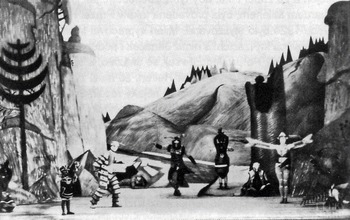
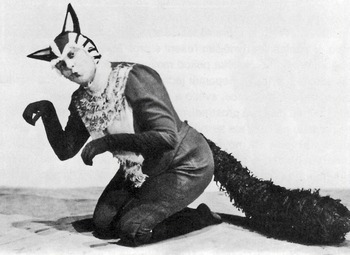
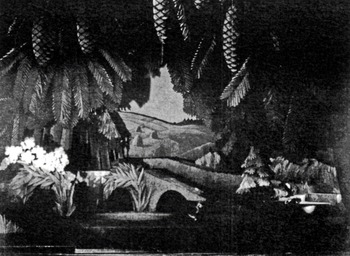
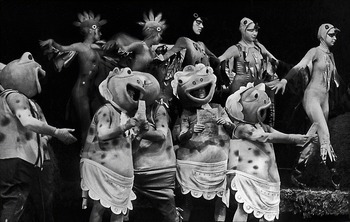
Critics have rarely, if ever, explicitly articulated the role that gesture plays in staging Bystrouška; nonetheless, its importance in performing the opera emerges clearly from the reception. For example, Naďa Šormová, who sang the title role in Brno in 1965, referred specifically to gesture when asked if she found it difficult to ‘turn, all of a sudden, into a fox’. ‘Not at all’, Šormová replied, ‘the only issue is connecting the gestural action with the singing, but this doesn't bother me. I am at home with regard to gesture.’Footnote 40 It had also played a significant part in Zítek's 1947 strategy for evoking distinct animal and human worlds in the opera. The ‘stylisation’ Zítek referred to, looking back at the premiere, was that production's tendency towards abstraction rather than realism. Eduard Milén, who had trained as a graphic artist, simplified the lines and shapes of his costumes, frequently using geometric shapes to represent the animals' characteristic markings (see Fig. 1 again). It is likely that Zítek's choreography was similarly stylised: the poses from a scene early in the first act, a danced pantomime between a frog and a mosquito, appear stiff, angular and not, perhaps, particularly animal-like (see Fig. 3). Certainly, the production photograph suggests nothing of the gestural aping Božena Snopková, the first performer of the vixen role, adopted in her posed publicity photograph (see Fig. 4). In his 1947 staging, Zítek first exaggerated the perspective and size of the sets for the animal scenes in order to represent the world through animal eyes (see Fig. 5) and then applied this exaggeration to the animal gestures as well – even to the point, Zítek said, of ‘grimacing’. They were not meant to be realistic, but were extractions, he said, from the ‘characteristic features of the gestures that make an animal unique’.Footnote 41 Their function was the reverse of the sets: to represent animals through human eyes. There is little to show what Zítek's ‘grimacing’ actually looked like on stage, but it is evident that most critics found it off-putting. One writer, who otherwise commended the director's use of ballet to emphasise the ‘visual’ aspect of the opera, drew the line at Zítek's indulgence in ‘caricature’ and condemned the ‘violations of forced gestures’ in the singers' otherwise natural style of acting.Footnote 42
Premiere of Příhody lišky Bystroušky, directed by Ota Zítek, conducted by František Neumann, set and costume design by Eduard Milén, Národní divadlo, Brno, 1924. Image reproduced courtesy of the Brno National Theatre.

Božena Snopková in role of vixen, Příhody lišky Bystroušky, directed by Ota Zítek, conducted by František Neumann, set and costume design by Eduard Milén, Národní divadlo, Brno, 1924. Image reproduced courtesy of the Brno National Theatre.

Set by František Malý for Příhody lišky Bystroušky, directed by Ota Zítek, conductor Robert Brock, Národní divadlo, Brno, 1947. Image reproduced courtesy of the Brno National Theatre.

Zítek's 1947 production was not the first to be faulted for abuse of gesture in Bystrouška, nor would it be the last. Generally, there has been a preference for subtlety in the acting over ‘mummery or artificiality’, or what the critic Vladimír Bor in 1965 called ‘Disneyesque illustrations of naturalism’, by which he meant the precise matching of action and music that we commonly refer to in English as ‘mickey-mousing’.Footnote 43 Much later, in his review of Brno's 1984 Bystrouška (directed by Oldřich Šimáček and choreographed by Boris Slovák), Jiří Fukač observed that the more the staging ‘held back gestures of both [acting and dancing] types, the greater the significance each detail had’.Footnote 44
Finding an acceptable level of gestural representation remained an elusive goal: just as it was possible to overdo it, underacting, in particular by the singers in animal roles, was a dangerous pitfall, as the story of Miloš Wasserbauer's 1965 Brno production suggests. Wasserbauer's staging needs to be seen in tandem with another: in 1956, the Berlin Komische Oper had rocked the boat with a production by Walter Felsenstein – in German – that brought the opera unprecedented international success. The Czech press reacted to the popularity of this foreign staging with anxiety: the Komische Oper's representation of Bystrouška as a comic ‘animal’ opera was a misinterpretation.Footnote 45 What is more, it was embarrassing that a foreign production had more successfully staged an opera that, with its rural Moravian setting and dialect, had always been close to Czech (and even more to Moravian) hearts. That it dumbed down the opera's philosophical and moral subtexts, reducing it to ‘a series of adorable episodes’, and pitching it at children, was bordering on national insult.Footnote 46
So, in 1965, the director Miloš Wasserbauer responded by taking the opera in a more adult direction. There was a lot at stake for this production: Brno had just built a new, state-of-the-art opera house, and Příhody lišky Bystroušky was chosen to inaugurate it before a distinguished audience comprising political dignitaries, and foreign and Czech opera cognoscenti, as well as the general opera-going public.Footnote 47 One critic described the production as having eschewed the opera's ‘traditionally established fairy-tale quality’, in order to focus on the forester and the ‘spiritual temperament of a man whose day-to-day relations with nature have brought him wisdom and rich emotional experience’.Footnote 48 But this representation white-washed some of Wasserbauer's more risqué decisions. As another contemporary critic, Jiří Bajer, pointed out, the director had dramatically ‘sexed-up’ all the relationships in the opera, casting, for example, a tenor, Vladimír Krejčík, in the role of the male fox, a part originally written for soprano.Footnote 49 The result was that the opera's heroine, portrayed by Nad'a Šormová as a sexy mod vixen, sported a handsome, manly fox on her arm, as well as a sleek blond hairdo and go-go boots. Wasserbauer called his staging concept a ‘lyrical song of nature’; Bajer suggested that an ‘erotic song of love’ would have been more accurate.Footnote 50
The gender switch, perhaps surprisingly, passed mostly without comment.Footnote 51 The real sticking point was how Wasserbauer treated gesture in his staging: in order to shift the balance of Bystrouška towards the human world, the director had excised much of the stage business involving the animal roles. A number of reviews voiced disappointment about the opera's deserted and unanimated stage, yet pictures of Wasserbauer's production reveal the stage was not that bare at all. The disappointing emptiness the critics perceived was more the result of the production's lack of physical animation; as one writer pointed out, at least some representation of the music's implied physical activity had to appear on stage: ‘Janáček's forest is full of life [but] Wasserbauer's’, he complained, ‘is almost empty’.Footnote 52 The director achieved his emphasis on human relationships by toning down the amount of animal gesture, but critics responded that, as a consequence, the opera's diversity of perspectives on human existence had been lost.
Over the years, Czech productions of Bystrouška have tended to alternate between stagings that have overdone the opera's action and stage business and those that have undershot it; directors have consistently sought correctives to problems of previous productions, including addressing how to balance the animal and human spheres and how to enact the opera's ambiguous moral code. After the disappointment with Wasserbauer's barren stage, Prague's 1978 Bystrouška, staged by Ladislav Štros and choreographed by Jaroslav Čejka, saw the unruly animals and their defiant antics once again taking over the opera (see Fig. 6). And once again, reviews echoed the old concerns about over-doing the gestures. ‘I am unable’, critic Vladimír Čech wrote:
to banish the impression that this production is designed especially for children, who are certainly worthy of the hens' hilarious high jinks or [the moment] when the vixen kicks (!) the forester so that he falls down onto the platform below. Likewise, a child's heart will delight in the fact that hardly a beat in the score is not matched to a stage exposition … But in the end the fragile, symbolic web is severed and the philosophical subtext drowned in gilded effects.Footnote 53
Příhody lišky Bystroušky, directed by Ladislav Štros, conducted by Miloš Konvalinka, costumes by Adolf Wenig, Národní divadlo, Prague, 1978. Image reproduced courtesy of the Prague National Theatre Archive.

Of course, in any opera, too much mickey-mousing on stage risks offending the fastidious; the issue here is not merely that some productions of Bystrouška were ridiculous and others visually boring. At the heart of Čech's concern, like Bajer's over Wasserbauer's production and other critics' elsewhere, was the perception that any extreme handling of the gestures – be it too expansive or too minimal – had a detrimental effect on the transmission of the opera's subtexts to the audience. The persistent debate over gesture in Bystrouška leads me to suggest that we need a better understanding of how gesture, music and meaning work together in the opera.
Mimicry, music and meaning
In setting Těsnohlídek's novella to music, even with the modifications he made to it, Janáček could have enlisted the potential of music to comment on stage action in order to retain the story's gently satirical bent. But, as I observed above, Janáček was at pains not to do so. So how did he make the world of his Bystrouška so lenient in its morality? I propose that he achieved this intended neutrality by varying the interactions between music and stage action. The four moments I describe here through close reading do not all pertain equally – or even at all – to morality in the opera. Rather, I argue, Bystrouška's ambiguity arises from the cumulative effect of hearing and seeing the different interactions between music and gesture in relation to each other.
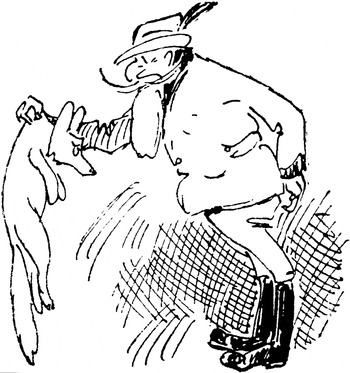
Large portions of Bystrouška consist of instrumental music designed for sections of dance and pantomime that some critics have felt play a functional, structural role in the opera. Josef Bartoš, for example, observed that Janáček's ‘daring experiment’ in Bystrouška – ‘placing side by side animal scenes, atmospheric illustrations of nature, and realistic scenes played by humans’ – only worked because those diverse scenes were ‘organically linked by ballet’, as he called it, though what happened on stage in these moments would not have had much in common with classical notions of dance.Footnote 54 Janáček conceived of the idea of numerous instrumental sections early in the planning of the opera: even as he read through the novella while preparing the libretto, he marked certain scenes to be danced or mimed, rather than sung. Indeed, Janáček seems to have been particularly struck by the visual suggestiveness of the story: some of his stage directions correspond closely with those of Lolek's illustrations reproduced in the novella – the instruction for the forester to pick up the vixen by the scruff of her neck in the opening act, for example (see Fig. 7). What is more, Janáček referred to the instrumental sections of the opera as ‘pantomime’ as often as he called them ‘ballet’, invoking a sense of stage movement that is more gesturally mimetic than dancelike.Footnote 55
Stanislav Lolek, illustration for the newspaper serial Liška Bystrouška.

The mimetic effect of Bystrouška's music, which one critic in 1937 described as rendering in sound ‘the whirling turns of animals, the quaint movements of a grasshopper, [and] the heavy steps of the drunk schoolteacher’, is striking.Footnote 56 Another writer, Karel Boleslav Jirák, called particular attention to the ‘witty rhythms’ of the ballet music in the first act, which he thought was some of the most effective music of that type that Janáček had ever written.Footnote 57 Indeed, more than any of Janáček's previous operas, Bystrouška overflows with the type of music that, as Mary Ann Smart has argued in a different context, operates on a level of gestural meaning, ‘pinning itself to a particular character or sequence of movements in order to guide the spectator's attention, sending us signals about where to look or what to feel while looking at a body on stage’.Footnote 58 One brief example should suffice to illustrate the most straightforward type of mimetic music that occurs.
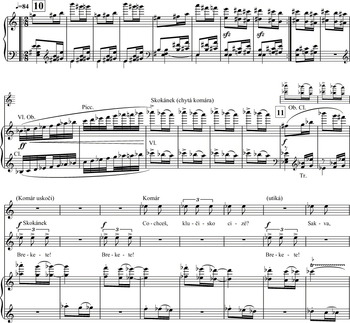
During a dance for a mosquito in the first act, a frog attempts to seize the insect. As the dance music is swept away (four bars before rehearsal number 11), a six-bar ostinato pattern begins in the upper extreme of the violins' range (see Ex. 1). The music, reflecting the stage direction above it, suggests a repeated snatching motion; as the creature in question is a frog, perhaps we can award the accented C♭ quaver on each downbeat the snapping flick of a long tongue, and the subsequent descending semiquavers its recoil. The conclusion of the six-bar gesture is marked by another musical shift and a further stage direction: Komár uskočí (the mosquito jumps away). Violins still dominate the instrumental texture, but the previous rhythmic cell is altered by tying the final semiquaver over to the next bar. The articulation of the quaver (now on A♭) is changed to staccato, and as the semiquavers descend from the A♭ in little hops, so too does the final iteration of the motif jump down a third.
Act I. The frog and mosquito dance.
[The frog grabs at the mosquito.
The mosquito jumps away.
Frog: Croak! Croak!
Mosquito: What do you want, you strange little fellow?
Frog: Croak!
Mosquito: runs off. Lord, give it a rest!]

Such precise mimicking is relatively common in music, and in music for theatre or film (the aforementioned ‘mickey-mousing’) in particular; here I would like to make one further point about the relationship between physical gesture and Janáček's characteristic use of ostinati. Janáček's compositions were often criticised for the ‘pointillistic’ effect of his frequent use of small cells: Doležil's comment that Janáček was ‘the master of details, of the single situation and its splinters, of that which his music can capture with exhaustive appropriateness, but which, in their rhapsodic isolation, does not connect together in a more unified whole’ is representative.Footnote 59 Typically, this charge had two subtexts: a concern, as Doležil shows, for the absence of thematic development and large-scale form in the music, and an accusation of provincialism in the man. But rather than being the product of deficient compositional technique, the ostinato here is generated by the actions on stage; that is, the iterations in the actions on stage provide the logic for the repetition in the music. Though small, the point is worth making for the comparison I will draw shortly with a later example in which the relationship between action and repeated musical fragment differs crucially.
The frog-and-mosquito pantomime is a reasonably straightforward example of the type of instrumental music that frequently occurs in the opera to accompany physical action taking place on stage. But Janáček's mimetic music is not only orchestral: it also appears in the vocal lines at special moments. Janáček was, amongst other things, pleased with the opportunity Bystrouška gave him to extend his speech-melody theory to the ‘speech’ of animals, with which he claimed to be well acquainted. Near the beginning of his work on the opera, after word had got out that he was going to set Těsnohlídek's story, Janáček wrote a short feuilleton, ‘Stehlíček’ (The Little Goldfinch), for the local newspaper. The article described the birds that visited his garden and was sonically illustrated with musical notations of their birdcalls. Janáček closed with the following comment:
Why these few words about the goldfinch's angular tones in glowing crystals, in prickly thistles, in pale flashes? In the first place, because it pleases me. And also, I am collecting suitable company for Liška Bystrouška.Footnote 60
Vocal imitations of this sort are evident in the example cited above (the frog only croaks in response to the mosquito's verbal enquiries); they appear from time to time throughout the opera, adding to its impression of continuous mimicry.
The tight parallels between action and music were no doubt useful in Bystrouška, where the underscoring often provided much-needed continuity and sometimes even articulated the drama. Indeterminate periods of time pass between scenes, ends of plots are left dangling: the audience is frequently left with ‘several nagging questions for which’, Jirák suggested, ‘the answers can only be found in the musical language’.Footnote 61 Rosa Newmarch, an English musicologist and a contemporary of Janáček's, noted that the audience treated the libretto with ‘impatient criticism’ because, she supposed, it required ‘a quickness of imaginative perception that few possess’. But, she added, for those who are perceptive, the music ‘fill[s] in its blank spaces and light[s] up its obscurities’.Footnote 62
Of course, one of the main functions of operatic music is to draw from the libretto additional layers of meaning, providing insight into subtexts at the same time, I would argue, as elucidating events on stage. The coincidence in Bystrouška of so much music used to create continuity and fill in ‘blanks’ with the more usual function of operatic music as a commentary on the stage action creates a situation whereby the music in this opera becomes extraordinarily vocal about what is happening on stage. And yet, not all the underscoring in the opera embodies or dictates stage movement as straightforwardly as it does for the frog and mosquito. Nor, I would suggest, does it provide a gloss on characters and events in the opera with the consistency we might expect given the critics' commentary. Rather, it is the selectivity of how and, perhaps more importantly, when Janáček utilises the possibilities of music as commentary that is of interest, and that I will consider in concluding this article.
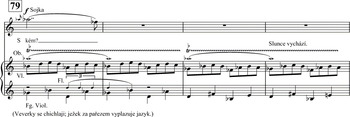
In the second act, a hedgehog is required to stick out its tongue from behind a tree stump while at the same time, according to the instruction, squirrels giggle and the sun rises. The directions are printed over four bars of instrumental music that link an exchange between two birds (an owl and a jay) and a discussion between the fox couple (see Ex. 2). The tempo is quick, and the lively music accommodates lively action on stage, but while the bassoons do seem to chuckle and an oboe trill above them is suggestive of a rudely outthrust tongue, the music and gestures of the laughing squirrels and cheeky hedgehog do not exhibit the tight mickey-mouse pairing of music and action seen in the frog-and-mosquito ballet. The oboe trill, for example, continues too long after the hedgehog's stage direction and in doing so blurs the line between a moment of musical and gestural synchronisation, and musical underscoring more generally. Nor do we hear a rising sun – at least nothing that sounds like a conventional musical sunrise. I suggest that, in comparison with the previous example, the relative ambiguity illustrated by the hedgehog instance encourages us to think about what happens when the music does not match the stage business very closely. In an opera such as this, where the musical background so frequently evokes physical gesture, the stage actions that lack a musical depiction stand out in sharp relief. In the following cases I will discuss, the absence of musical depiction is particularly notable; moreover, and in contrast to both the preceding examples, the physical gestures taking place portray selfish and cruel acts. It is by leaving such fraught moments in Bystrouška without musical corollary, by allowing what is seen to pass without comment as it were, that, I propose, Janáček creates the opera's morally ambiguous message.
Act II. The hedgehog sticks out its tongue.
[Jay: With whom?
The squirrels giggle; from behind a tree stump a hedgehog sticks out its tongue.
The sun rises.]

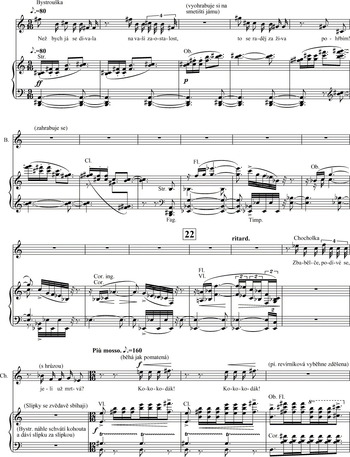
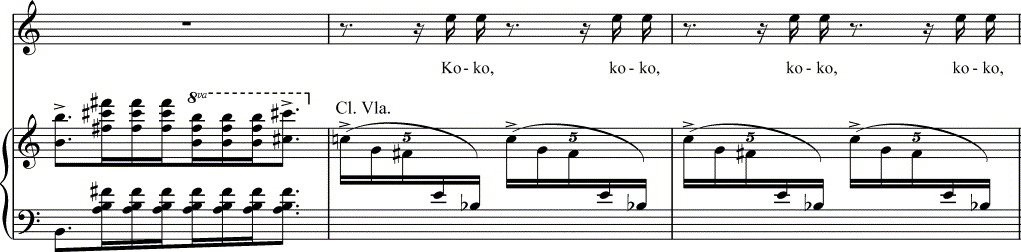
At the end of the first act, the vixen is tied up in the forester's yard and mocked by the rooster. Irked, the vixen attempts to rally the rooster's hens to her side, calling them ‘sisters’ and ‘comrades’ in a quick, martial four, sharply articulated with accented staccato notes and accompanied by snare drum. But her politicking fails and so the vixen switches to trickery: feigning a sulk, she slinks off to the rubbish heap, claiming that she'd rather be buried alive than live with such social backwardness. The music shifts abruptly to a compound triple metre, scored with lush strings that rise in contrary motion with the vixen's petulantly descending vocal line. Though the hens suppress their curiosity for a few moments, they soon take the bait. Led by the rooster, they approach the concealed vixen – who wrings their necks one by one. Chaos ensues, but despite the forester's threats and his wife's screeches, the vixen escapes to the forest.
Act I. The vixen kills the rooster and the hens.
[Vixen: Rather than witness your backwardness, (she digs a hole in the rubbish heap) … I'd
prefer to bury myself alive! She digs herself in.
Crested fowl: Coward, go and check (in horror) … if she's dead yet!
The hens rush up inquisitively.
All of a sudden the vixen seizes the rooster and wrings the hens' necks one after another.
Crested fowl: runs around as if crazed. Kokokodák! Kokokodák!
The forester's wife comes running out in a panic.
Crested fowl: Koko, koko, koko, koko]

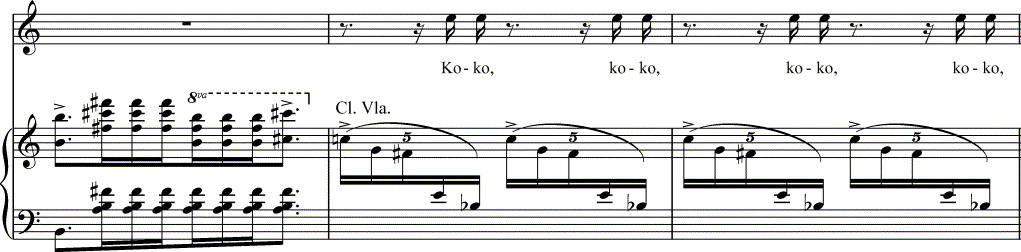
Example 3 begins with the vixen's sulk. She delivers her taunts and then from the top of the ascending figure in the oboe, emerges on a high G♯, hanging there for a thrilling moment before falling off it into the mock declaration of suicide. In the eleven bars that follow, the repeated descending flourishes suggest the flutters of the hens' curiosity, while the sustained strings hold the passage static. A depiction of waiting is very clear, but there is no foreshadowing of the vixen's murderous mischief: the E-flat major chord at rehearsal number 22 is radiant and the last, slower appearance of the descending motif in the violins and flute further relaxes the suspense. The rooster approaches, but the crucial stage direction for the vixen to kill him and the hens occurs while he is still singing; the fast rising triplets of the following bar, in 12/16 and Più mosso, capture the gestural quality of the one, last, frantic bird remaining in the yard. Janáček neither composed a musical gesture for the vixen's terrible actions, nor allowed any time for them. Her violence is stuffed into a barline and elided out of the music, which proceeds directly to the scene that follows. Musically, the vixen has done nothing at all.
If the farmyard scene is selective about which gestures to portray, the following example pushes this discrimination even further. At the beginning of the second act, having escaped her bonds, the vixen returns to the forest. Rather than make her own burrow, she turfs a badger out of his house, first by inciting some animals to join her in harassing him, and then by relieving herself into his den. The crotchety old badger turns his walking stick on the vixen, but does not do her any injury and is rather to be pitied in the exchange.
Three stage directions crowd around only a bar and a half (see Ex. 4). These three actions – the vixen lifting her tail, the badger's eviction and his huffy departure – must happen with blazing speed. But again there is neither musical representation of hasty activity, nor mimicry of the specific gestures. The ostinato in the orchestra, in fact, begins six bars earlier with a two-bar motif in the oboe. This figure is heard twice and then, slightly modified, twice more with amplified instrumentation. The new instruments – the violins and the piccolo in particular – are an accompaniment to the vixen's simultaneous vocal entry, but they make no attempt to represent her mean-spirited actions: the increased orchestration is only an alteration of timbre, not an indication of sudden stage activity. The difference between this example and the previous one is subtle. In the farmyard scene, the decisive action was elided from the music altogether: it was supposed to take place over a barline. In the badger's scene, music is heard during the stage events but it is not particular to them; the ostinato already set up in the bars before carries on regardless. By starting up a new pattern before the three stage actions take place and repeating the same tune throughout, the orchestral music seems to occlude the stage events, as though, by chugging along to its own tune, it is pointedly ignoring what is happening on stage.
Act II. The vixen evicts the badger.
[Vixen: I could've taken you to court.
Forest animals: Take him to court!
Vixen: But who'd want to have anything to do with you?
Here's something feminine for you, (she raises her tail) … just so you know how
you're appreciated!
The badger climbs from his den indignantly. He runs off to a hill.]

In a sense, then, the music in these scenes abandons the role it often takes in opera, and certainly does elsewhere in this one: giving us clues as to how to view what is happening on stage. To return to animal satire, Karen Ryan has argued that, in order for the satire to be effectively transmitted, ‘the author's tone may range from gentle mockery to bitter vituperation, but the reader must understand where the author stands’.Footnote 63 But in Bystrouška, Janáček does not always clearly establish his position. The point may be illuminated by a comparison with a scene from Ze života hmyzu by the Čapek brothers. A young cricket couple move into a deserted hole whose former occupant has been eaten. The pair express superficial pity for his bad luck, but their words lack real sympathy and so they meet justice of the poetic sort when they themselves are eaten. The Čapek brothers, the Czech literary scholar Bohuslava Bradbrook suggests, show no tolerance for either the opportunism or the indifference of their characters, and act out retribution upon them.Footnote 64 The Čapeks voice their judgement through the figure of the Traveller, who imparts commentary not unlike that occasionally supplied by the music in Janáček's opera. Bystrouška depicts a similar dog-eat-dog world but, though the badger trudges away, wiping his tears and complaining bitterly, his moral indignation is not supported by the music, which, in the moment, instead withholds comment.
Like the crickets who meet an abrupt end as a snack for another insect, the vixen is also killed, in this case by a poacher whose basket of poultry she has raided. Considering she is the title character, it comes as a surprise when she dies several scenes before the end of the opera. Doležil, cited above, had been baffled to discover that her death was not even a climax, but only one more scene in the general stream.Footnote 65 An extended passage of instrumental music offers a solution to this problem – if it is one – providing musical space for the vixen's last breaths, and for the opera to take a new one, as it were, in order to continue without her. A clarinet and celesta motif – its iteration left incomplete – poignantly depicts the end of the vixen's life. But then softly shimmering violins enter, followed by winds and harp, and encircle the poignancy with a sonic aureole: any sense that the vixen might have deserved her death is closed off. As the critic Otakar Šourek described it:
That unusual trust in the eternally unending quality of nature and its lives, those characteristics were of such paramount significance for Janáček. That the poacher Harašta shot the vixen, right in front of her fox cubs? Never mind! New life will grow in those little fox cubs; they will also profess their love to a fox, as the amorous forester once professed love to his young wife and, as it goes with nature, will fill their forest as [he filled his] yard.Footnote 66
The death of the vixen is neither mourned nor viewed as justice reasserted; neither is Harašta's lethal shot condemned. Indeed, much as it had done for all the vixen's morally dubious acts throughout the opera, the music withholds moral commentary here too. Like the violent rampage of the jilted lover in Janáček's village, the vixen's death ‘happened – and is no more’.
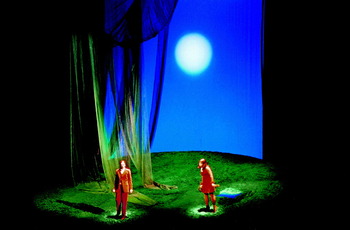
To conclude then, one final look at a production: Michal and Šimon Caban's 2002 Bystrouška for the National Theatre of Prague was one of the more unusual stagings of the opera seen in the city. The Caban brothers were known for their work in ballet, television and film, but they had never staged an opera. Their conception, possibly, drew on Robert Wilson for inspiration; certainly it does not follow the established Czech practice of rustic sets, folksy details and myriad animal costumes. Instead, the simple, uncluttered stage was suffused with clear, vivid colours and leant shimmering texture by means of translucent veils (see Fig. 8). The Cabans made no alterations to the music or the libretto, but they introduced new symbolic and dramatic content – even new characters – by means of the staging alone. This enrichment of action took place primarily in the many instrumental sections of the opera, where the Cabans replaced Janáček's pantomimes and dances with ones that took the drama in new directions. For example, in Janáček's opera, the forester's son is a young boy whose only part in the opera is to tease the vixen when the forester first brings her home as a pet. In the Cabans' version, however, his character is developed over time: the audience sees him maturing into adulthood and falling in love. Despite its beauty and innovation, the Cabans' production received mixed responses and, perhaps, more than its share of negative criticism.
(Colour online) Příhody lišky Bystroušky, directed, choreographed and staged by Michal Caban and Šimon Caban, conducted by Bohumil Gregor, costumes by Simona Rybáková, Národní divadlo, Prague, 2002. Image reproduced courtesy of the Prague National Theatre Archive.

It would be easy to explain the critical resistance to the Cabans' Bystrouška as a typical reaction to interference with the text. But it should be clear by now that another, perhaps more nuanced, understanding of the situation is available. The additional storylines the Cabans introduced in the instrumental sections of the opera, though they involved neither ‘grimacing’ nor the ‘Disneyesque’, were nonetheless a further way in which the opera's stage action could be over-determined. What is more, the simplicity of the set and its vibrant colours recalled, I suspect, the childish slant typically associated with productions in which the gestures and stage business were exaggerated.
While it may seem from the survey of Czech productions of Bystrouška provided here that they were negatively received, this was not, generally, the case. Many, in fact, were regarded with deep affection, despite the on-going debate over issues connected with their stagings. But this only underscores how important the relationship between the stage gesture and the music is to the way in which audiences hear and see the opera. Too little stage action might render Bystrouška one-dimensional; on the other hand, a super-saturation of gesture frequently overshadowed its sophisticated themes of life and morality. As I have argued, the variety of Janáček's gestural music in Bystrouška, as well as the selectivity with which he paired music with stage action, is one of the sources of the opera's amoral subtext. What emerges, from both the performance tradition and reception history, is that a similar selectivity in how and when gesture is paired with the music has to be maintained for a production to be successful. Too much, or too little, and the delicate balance will be dismantled, bringing down with it Bystrouška's perhaps amoral yet morally instructive world.