International bargaining is often a lengthy process, delaying potentially cooperative outcomes for the participating governments. For example, the Uruguay Round of international trade negotiations began in September 1986 and was not completed until April 1994, resulting in a bargaining phase that lasted almost eight years. A 1994 General Agreement on Tariffs and Trade (GATT) report estimated that the loss of global income during this period amounted to about $109 billion annually; consequently, eight years of bargaining delay could be associated with an opportunity cost approaching one trillion dollars.Footnote 1 Similarly, negotiations leading to the 1966 International Covenant on Civil and Political Rights began in 1946,Footnote 2 thus taking twenty years to complete, although it is difficult to estimate the political opportunity costs associated with this bargaining delay.
But there is also considerable variation in the length of international negotiations. Although the Uruguay Round bargaining took eight years to complete, the first Geneva Round of international trade negotiations lasted only seven months (April to November 1947). And although the International Covenant on Civil and Political Rights took twenty years to negotiate, the same process leading to the 1950 Convention for the Protection of Human Rights and Fundamental Freedoms took little more than one year to complete. What factors explain this variation in international bargaining delay? Indeed, because almost all outcomes in international relations can be associated with bargaining (including war, which has been modeled as bargaining failure), it is important to account more fully for costly negotiation delay.
Thus far, there is not much theory to explain bargaining delay and even less empirical evidence bearing on existing theory. From the International Relations literature, Fearon offered an important argument in decomposing the cooperation problem into two sequential phases: first negotiations and then enforcement when/if an agreement was successfully reached in the initial bargaining phase.Footnote 3 The key proposition from his two-phase framework was that, although a long shadow of the future may facilitate enforcement cooperation (an already established result in the cooperation literature),Footnote 4 this same factor may also hinder cooperation in the preceding bargaining phase by increasing costly negotiation delay. We label this potential tradeoff concerning the shadow of the future as “Fearon's cooperation dilemma”: actors must theoretically choose between a more durable agreement and a shorter bargaining time to achieve that agreement.
While Fearon's paper has emerged as one of the most cited articles in international cooperation theory, his proposed dilemma has been subject to little, if any, direct empirical testing,Footnote 5 perhaps because it is difficult to identify operational measures for the shadow-of-the-future concept. Whereas many scholars seemingly accept his theory without empirical evidence to demonstrate its truth, this faithful acceptance is undesirable because the proposition comes from a war of attrition bargaining model where negotiators cannot introduce any new proposals to reduce or avoid bargaining delay. Thus, one may not observe such delay, or delay for the same reason, in “real” international negotiations where actors could offer new proposals.Footnote 6
This research note explores whether a particular feature of rational institutional design, namely finite duration provisions, can help to reduce international bargaining delay. This exploration is important because it may help resolve two related research questions. First, is there any evidence consistent with the Fearon cooperation dilemma in the context of real international negotiations? We show how a finite duration provision is a measure of expected agreement durability, arguably the primary shadow-of-the-future consideration for actors in an international bargaining phase. Second, to the extent that this dilemma is real, can actors choose their preferred position in terms of this policy tradeoff? In this regard, a finite duration provision within an international agreement is a manipulatable independent variable, potentially allowing negotiators to achieve a shorter bargaining phase when they prefer this outcome to a potentially more durable agreement.Footnote 7 Resolving the first question has theoretical significance, whereas the second has important international policy implications.
The first section of the study develops the hypothesis that that international agreements should take less time to negotiate when they include a finite duration provision. The second section tests this hypothesis using a sample of real international agreement negotiations. The third section then discusses the results in the context of the literature on the rational design of international institutions.
The Shadow of the Future and Finite Duration Provisions
In terms of the aforementioned cooperation dilemma, the analysis in this study focuses on the primary effect during the negotiation phase: does a longer shadow of the future increase international bargaining delay? Given the space limitations associated with a research note, we put aside the enforcement phase effect, or whether a longer shadow of the future also makes international agreements more durable, especially because there is some evidence already bearing on this secondary proposition.Footnote 8
Fearon's bargaining phase effect comes from a two-player war of attrition model with five parameters. Each player brings a preferred agreement (x and y) to the negotiating table where they pay player-specific opportunity costs (c i) until either x or y is adopted; no new proposals can be introduced. During this bargaining phase, the players discount payoffs according to a common discount rate r > 0. The length of the bargaining phase, or the time until an agreement is reached (t), is determined endogenously:
 $$t = \lpar x - y\rpar /\lpar r\lsqb 1 + c_{\it 1} + c_{\it 2} - \lpar x - y\rpar \rsqb \rpar .$$
This equation predicts that the bargaining phase will be longer (a larger t) given a greater distance between the two proposals (x − y) on the negotiating table and shorter (a smaller t) given higher costs associated with nonagreement, or delay (c i). Most importantly for the analysis in this study, it also predicts that the bargaining phase will be longer given lower values of r, which indicate less discounting, or a longer shadow of the future. As Fearon explained: “if less time is available for states to take advantage of the gains from cooperation [a higher value for r], it makes less sense to waste time holding out for a better deal. Likewise, the longer states expect today's agreement to be relevant in the future [a lower value for r], the more reason they have to delay agreement by bargaining hard over distributional advantage.”Footnote 9
Readers may be more familiar with the shadow of the future being represented as a discount factor {w ∈ (0, 1)}Footnote 10 instead of using a discount rate {r ∈ (0, ∞)}. But the discount rate can be directly converted into a discount factor following the formula: w = 1/(1 + r). In this regard, the discount factor can be interpreted as a continuation probability, or the probability that the game will be played again. As w approaches 1, the game becomes more likely to continue, indicating a longer shadow of the future. But as w approaches 0, the game becomes less likely to continue, meaning a shorter shadow of the future. In this regard, Fearon's discount parameter r can also be understood as a continuation value albeit with smaller values (r → 0) indicating a greater likelihood of continuation.
This understanding explains how Fearon's discount parameter concerns agreement durability. In this regard, r is not player-specific; the agreement reached in the bargaining phase will be either more or less durable for all players together. Indeed, this is precisely how Fearon suggested that scholars operationalize shadow-of-the-future considerations during the bargaining phase. He was talking about “states’ expectations about the likely duration of an agreement, should an agreement be reached. If the parties expect that an agreement would be likely to govern relations for a long time to come ... [then] discounting is probably low. By contrast, if the parties expect that an agreement will probably be short-term because circumstances are likely to change so as to render the agreement irrelevant or unprofitable, their shadow of the future is probably relatively short.”Footnote 11
One agreement feature that directly relates to expectations about its potential durability is the presence or absence of a finite duration provision. Among international agreements, there is variation not only in whether they include a finite duration provision, but also in the expected durability among agreements that contain a finite duration provision.Footnote 12 For example, the 1962 International Coffee Agreement was negotiated to last for six years with the possibility of renegotiation, whereas the Nuclear Non-Proliferation Treaty entered into force in 1970 for an initial twenty-five-year period. Conversely, the 1959 Antarctic Treaty and the 1967 Outer Space Treaty were negotiated with no expiration date and remain in force to this date.
For the purpose of this study, we treat the inclusion of a finite duration provision—an event that takes place during the bargaining phase—as creating the expectation that the agreement will end at some prespecified future date in the subsequent enforcement phase, although it could certainly be renegotiated. Similarly, an agreement without a finite duration provision could be expected to last indefinitely (that is, a potentially infinite enforcement phase), although future circumstances might well change this expectation. Thus, an agreement without a finite duration provision is expected to have a longer shadow of the future, whereas an agreement containing such a provision has a shorter expected shadow of the future. In this regard, it is important to stress that although the variation in finite duration provisions simply captures the actors’ expectations about agreement durability, this is the most relevant consideration during international negotiations because negotiators cannot know the actual durability of their potential agreement in the initial bargaining phase because that fact will be realized only in the subsequent enforcement phase.
We thus hypothesize that international agreements should take less time to negotiate when they include a finite duration provision. Stated differently, agreements that are expected to be more durable because they do not include a finite duration provision or include a finite duration provision of longer length should take more time to negotiate. To the extent that finite duration provisions of varying lengths have no effect on the time that it takes to negotiate international agreements or if these agreements take more time to negotiate when they include a finite duration provision, there would be no support for the bargaining phase effect associated with the Fearon cooperation dilemma.
Finite Duration Provisions and International Bargaining Times
To test this hypothesis, we utilize Koremenos's sample of international agreements.Footnote 13 This sample has two key properties that make it useful for our empirical analysis of the bargaining phase effect associated with this cooperation dilemma. First, Koremenos offered her set of agreements drawn from the United Nations Treaty Series (UNTS) as a random sample across four broad issues areas in international relations: economics, environment, human rights, and security. Second, Koremenos coded for each of these agreements whether its intended duration was finite or potentially infinite (without a finite duration provision). Because this was the dependent variable in her analysis, our analysis begins using her dichotomous measure, but we will later shift to a continuous measure of expected agreement durability.
We then coded the bargaining time (measured in days) for the agreements in Koremenos's sample.Footnote 14 Following the definition of a bargaining phase from Bearce, Floros, and McKibben's three-phase cooperation framework that includes a prebargaining phase, the subsequent bargaining phase begins when there is more than one proposal on the negotiation table with the actors having already agreed to negotiate among at least this set of alternatives.Footnote 15 The bargaining phase then ends when an agreement has been signed (that is, the signature date). Although the signature date is not hard to identify, there is no central database for information about the start of an international bargaining phase. We thus relied on limited primary source materials available from the United Nations and secondary source materials from national newspapers and from books referencing the relevant agreements.Footnote 16 Since many of the agreements in Koremenos's random sample were negotiated many years ago and remain obscure to this date, we were able to code the length of the bargaining phase (bargaining time) for only 127 of the 146 agreements in her sample (87 percent coverage).Footnote 17
Among this set of 127 agreements, Koremenos coded 86 as finite either because of the inclusion of an explicit finite duration provision of varying length (n = 53) or because of some external contingency related to domestic laws or other international agreements (n = 33).Footnote 18 This latter set of agreements can be viewed as short-term arrangements and would be understood by negotiators as finite in character; thus, they are theoretically relevant to the Fearon cooperation dilemma with the expectation of shorter bargaining times, much like agreements with an explicit finite duration provision. Nonetheless, we will conduct our empirical analysis using two samples. The first is the full sample of coded agreements (n = 127), and the second is a reduced sample excluding the “contingent” finite agreements (n = 94) to assess the extent to which the results in the full sample depend on these short-term agreements without an explicit finite duration provision.
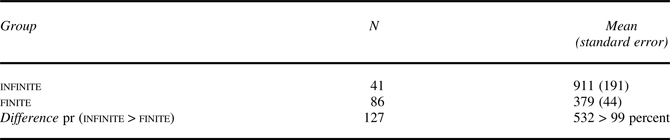
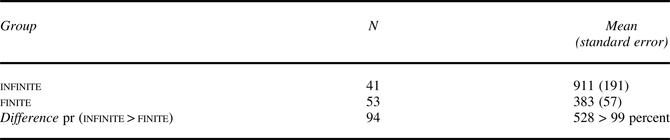
Given that we can observe both the length of bargaining phase and identify whether these agreements are potentially infinite (or finite) in character, we begin by looking at the simple relationship between these two variables. To this end, we perform a difference in means test, comparing the average bargaining time for agreements that are potentially infinite with those that are expected to be finite. Beginning with the full sample (Table 1A), the mean bargaining time for agreements coded as infinite is more than twice as long as those coded as finite (911 compared with 379 days), a substantively significant difference (532 days) that is also statistically significant with greater than 99 percent confidence. In Table 1B, we present the same test when excluding the thirty-three finite agreements that Koremenos marked as contingent. One can see that the results scarcely change because the finite agreements coded as such because of an explicit finite duration provision have more or less the same average bargaining time as those marked as finite based on a contingency.
Bargaining time difference in means test using full sample

Bargaining time difference in means test excluding contingent finite agreements

Endogeneity
At this point in the analysis, it is important to address a potential sample selection problem for which there is no obvious econometric solution. In sampling on international agreements, we miss cases where there were no negotiations because actors did not anticipate an enforceable bargain.Footnote 19 For these nonobserved “potential” agreements, the Fearon cooperation dilemma predicts that the bargaining time would have been very short, meaning that actors would have little need to insert a finite duration provision to achieve this particular negotiation outcome (that is, a shorter bargaining phase). This understanding suggests that there might be an upward bias in bargaining time for the set of infinite agreements because we do not observe nonnegotiated and potentially nonenforceable agreements where the bargaining time would have been very short (had the potential agreement actually been negotiated).
This understanding could also explain why the set of infinite agreements is smaller than the set of finite agreements within Koremenos's sample: only when an agreement becomes potentially enforceable does one observe serious international negotiations, and it is also this situation (that is, a longer shadow of the future) that makes it more necessary for actors to add a finite duration provision in an effort to shorten what would be an otherwise longer bargaining phase. This selection problem suggests that the results in Tables 1A and 1B may tend to overstate the bargaining time for potentially infinite agreements. Having acknowledged this potential sample selection problem, two comments are in order.
First, to the extent that this sample selection bias is indeed present in our estimates, the standard econometric technique for eliminating it—the two-stage Heckman sample selection model—is infeasible in this particular context.Footnote 20 It is infeasible because the first-stage equation, where some instrument is used to predict what observations make it into the smaller second-stage sample, requires a larger sample including both negotiated agreements (the second-stage sample) and potential agreements that were never negotiated (and thus do not exist). Whereas we can observe the former, the latter is unobservable by definition. Consequently, one cannot assemble the first-stage sample necessary to estimate the two-stage Heckman sample selection model. But whereas we cannot econometrically eliminate this bias, we can estimate how large it would need to be before the statistically significant results shown here would disappear.
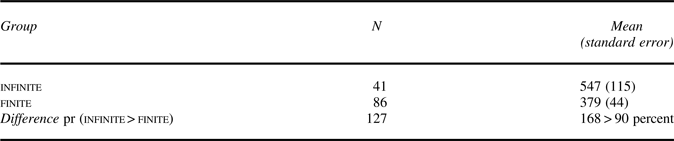
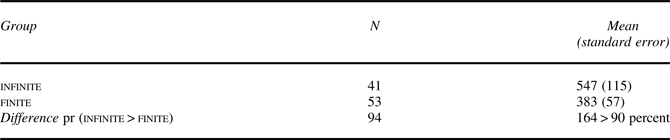
We estimate the point at which this selection bias would become statistically problematic for our result by reducing bargaining time for the infinite agreements, but not for the finite agreements. This bargaining time reduction for the group with the larger observed mean simply serves to decrease the difference between the two groups, allowing us to calculate whether the smaller difference in means remains statistically significant. In fact, the difference does not lose statistical significance at conventional levels until bargaining time is reduced by more than 40 percent for the infinite agreements. Tables 2A (using the full sample) and 2B (using the reduced sample) report the results when the bargaining time for each potentially infinite agreement has been reduced by 40 percent, and the results show that the difference in means remains statistically significant with 90 percent confidence. We interpret these results to indicate that the sample selection problem would have to be quite large before it could completely eliminate the hypothesized difference between the two groups.Footnote 21
Bargaining time difference in means test using full sample with infinite reduced by 40 percent

Bargaining time difference in means test excluding contingent finite agreements with infinite reduced by 40 percent

Second, it should be noted that this sample selection problem would exist only if a finite duration provision were expected to reduce international bargaining times, consistent with our proposed test of the Fearon cooperation dilemma. If a finite duration provision were not expected to have this effect, then the upward bias in bargaining time associated with not observing nonnegotiated, or potential, agreements should be present in both of our groups (finite and infinite). To the extent that this upward bias is present in both groups, it should have little effect on the mean difference between them. Stated more broadly, this very sample selection problem represents evidence in favor of this cooperation dilemma: if there was no tradeoff between the durability/enforceability of an agreement and the time that it takes to negotiate it, then observed enforceable agreements would not be expected to take longer to negotiate than the nonenforceable agreements that we do not observe (because they were never negotiated).
It is also important to state that we do not know exactly when during the bargaining phase a finite duration provision was inserted into the set of finite agreements. Unfortunately, no negotiation transcripts exist for any of the agreements in Koremenos's sample that would allow us to ascertain this timing. We thus face another potential endogeneity problem in the form of reverse causality. Although we want to know if the ex ante insertion of a finite duration provision (the cause) leads to a shorter bargaining phase (the expected effect), it may be the case for some finite agreements that negotiators inserted this treaty provision to conclude an already long bargaining phase. In this latter situation, a long bargaining phase becomes the proximate cause, leading to the insertion of a finite duration provision as the subsequent effect.
Although this form of endogeneity could be addressed with an instrumental variable (provided that one can find a sufficiently strong instrument that also meets the exclusion restriction), two considerations should be noted. First, if negotiators are adding this design feature into their agreements to conclude an already long bargaining phase, then it suggests that finite duration provisions function in a manner consistent with our hypothesis (that is, shortening a bargaining phase that would have been even longer). Second, this reverse causality does not bias the statistical results in favor of our hypothesis. To the contrary, the latter situation tends to create a positive relationship between bargaining time and finite agreements, thus working against our hypothesis that finite agreements should be associated with a shorter bargaining phase. Stated differently, this reverse causality tends to create a Type 2 error, or a false negative. In this regard, it potentially offsets some of the sample selection bias we discussed.
Duration Models
Having discussed two offsetting forms of endogeneity, we now proceed with a more complete test of the hypothesis. One obvious concern with the difference in means tests offered here is that they did not control for other factors that might influence observable international bargaining times. To better control for these factors, we estimate the duration of the bargaining phase using the Cox proportional hazard model. The advantage in using a semi-parametric Cox model to estimate how long it takes the bargaining phase to “fail,” or to end, is that one does not need to specify the distribution of the baseline hazard rate in advance.Footnote 22 The key assumption in using a Cox model is that the hazard rate for the various independent variables are constant, or proportional, over time. A test of the proportional hazards assumption using the Schoenfeld residual for each regressor (to be described) shows that there is no statistically significant correlation between this residual and failure time for any of the independent variables, a result that is consistent with the proportional hazard assumption.Footnote 23
For independent variables in the bargaining time Cox models, we begin with the dichotomous infinite variable used earlier, although we will also consider a set of continuous expected durability variables. Given our hypothesis that potentially infinite agreements should take longer to negotiate than those that are expected to be finite in duration, infinite should take on a negative sign in the Cox proportional hazard model, indicating that this agreement feature makes a bargaining phase less likely to fail, or to end (that is, a longer bargaining phase).
Because finite duration provisions are a much-studied agreement feature in the research program on rational institutional design,Footnote 24 our control variables begin with two other linked agreement features discussed in this literature. With a focus on trade agreements, Johns argued that deeper agreements tend to be associated with greater flexibility.Footnote 25 In a similar vein, Rosendorff argued that more flexible agreements should also be more stable, a concept that includes greater durability during the enforcement phase (that is, a longer shadow of the future).Footnote 26
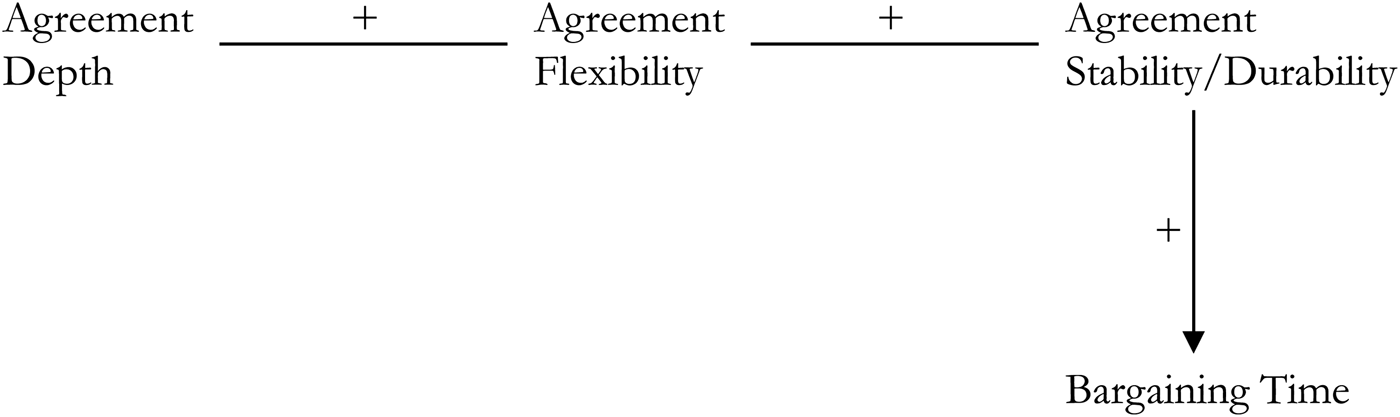
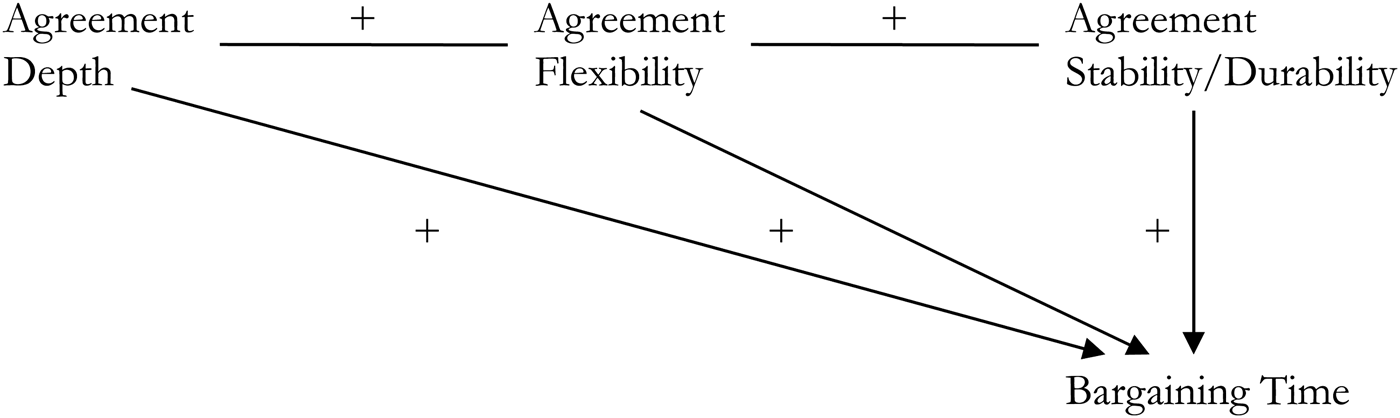
As illustrated in Figure 1, these three agreement features (depth, flexibility, and stability/durability) can be understood as an endogenous agreement package, potentially linked to our dependent variable bargaining time. In this regard, depth should be positively correlated with flexibility, which should in turn be positively correlated with stability/durability. Although Koremenos identified a finite duration provision as a flexibility feature,Footnote 27 it might be better understood, at least in the context of Figure 1, as a design feature related to stability/durability. To the extent that agreements with a finite duration provision are expected to be less stable or durable over time, the agreements coded as potentially infinite should be associated with both greater flexibility and greater depth. We thus need to control for these related endogenous agreement features to make sure that we do not attribute their effects to our primary independent variable.
Depth, flexibility and durability

Our depth control is an ordinal indicator with three possible values, following the coding rules used by Simonelli.Footnote 28 Agreement depth is coded as 2 for those that specify new and concrete obligations and coded as 1 for those agreements with less concrete obligations or those that simply further codify preexisting obligations. Finally, depth is coded as 0 for agreements that require little to no change in existing behavior. Our flexibility measure takes account of three different agreement features that scholars have identified with agreement flexibility: the presence of escape clauses, a dispute resolution mechanism (of any form) and a withdrawal provision. To the extent that an agreement has all three of these features, flexibility is coded as 3. An agreement lacking any of these flexibility features is coded as 0.
Our next three controls deal with attributes related to the negotiating states. participant count takes the logged value of the number of states involved in the bargaining phase, treating all of the initial signatory governments as participating, at least to some extent, in the preceding bargaining phase. To the extent that political regime type matters for negotiation length, polity min takes the minimum Polity score among the bargaining governments.Footnote 29 To the extent that relative power affects the length of the bargaining phase, we also include a measure of power concentration among the negotiating states.Footnote 30
We also include a control variable indicating the year in which the bargaining phase ended to pick up on any time trend that might be associated with both negotiation length and the use of finite duration provisions, potentially creating a spurious correlation between these two variables. Finally, to the extent that there may be some unmeasured variation based on factors like subject complexity that vary by issue area, we include three issue area dummies: human rights, environmental, and economic, with security issues as the omitted category.
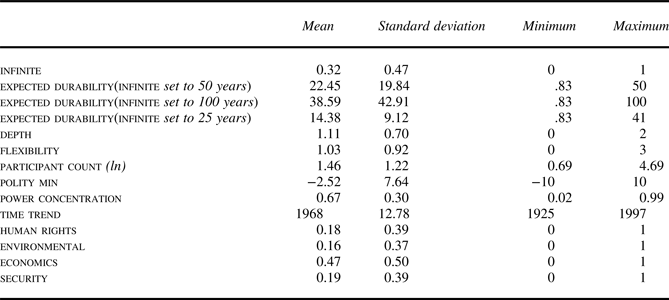
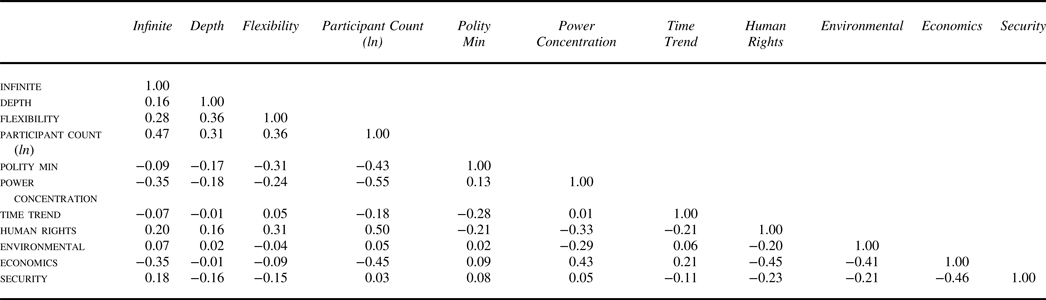
Table 3 presents some descriptive statistics for these independent variables, showing that, at least within Koremenos's sample, international agreements tend toward being finite in character with moderate depth and with limited flexibility. Table 4 shows their bivariate correlations with some notable results. Most importantly, the three endogenous agreement features (infinite, depth, and flexibility) are indeed positively correlated with each other, consistent with the agreement framework offered by Johns and Rosendorff (see Figure 1). Table 4 also shows some interesting sample variation by issue area. human rights agreements tend to be more infinite (or less characterized by finite duration provisions), deeper, more flexible, and more multilateral (a larger participant count). Conversely, economic agreements tend to be less infinite (or more characterized by finite duration provisions) and less multilateral (a smaller participant count). security agreements are like human rights agreements in that they are less characterized by finite duration provisions, but unlike human rights agreements in being less deep and also less flexible.
Descriptive statistics

Note: N = 127.
Bivariate correlations

Note: N = 127.
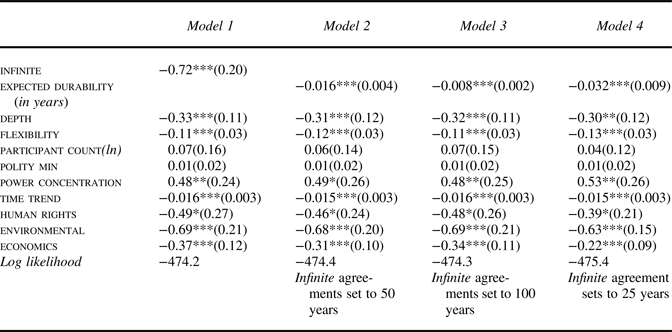
Having described the control variables, we now proceed with a multivariate test of the hypothesis. Model 1 in Table 5 presents the first set of Cox estimates, showing that infinite takes on a negative coefficient that is statistically significant with greater than 99 percent confidence. This result indicates that the bargaining phase for potentially infinite agreements, or those that lack a finite duration provision, are less likely to end compared with finite agreements, including those with an explicit finite duration provision. This coefficient can be converted to a hazard rate by exponentiation (e−0.72 = 0.48) to show that potentially infinite agreements are only 48 percent as likely to fail as finite agreements, representing a substantively significant difference. Stated inversely, finite agreements are more than twice as likely to end at any given point in time compared with potentially infinite agreements, thus resulting in a shorter bargaining phase for the former compared with the latter.
Cox proportional hazard models of bargaining time

Notes: N = 127. Cell entries are coefficients with robust standard errors clustered on the issue area in parentheses. Positive (negative) coefficients indicate that the variable makes the bargaining phase more (less) likely to fail or end. Statistical significance: * p ≤ .10; ** p ≤ .05; *** p ≤ .01 (two-tailed).
Many of the other independent variables are also significantly correlated with the length of the bargaining phase. Deeper agreements take longer to negotiate, as do more flexible agreements. The perhaps surprising flexibility result will be further discussed in the next section. Conversely, a greater power concentration among the negotiating states leads to a shorter bargaining phase. The significant negative time trend coefficient indicates that more recent agreements tend to have longer bargaining phases.Footnote 31 Finally, all of the issue area dummy variables take on significant negative coefficients, indicating that human rights, environmental, and economic agreements take longer to negotiate than security agreements (the omitted category).Footnote 32
Our next set of estimates takes advantage of the fact that finite duration provisions specify a time length for the agreement. We can thus use this information to create a continuous independent variable labeled expected durability, measured in years, to replace the dichotomous infinite variable used thus far in our analysis. In order to code expected durability for the entire sample, we need a coding rule for two sets of international agreements without a prespecified length in years: (1) the “contingent” finite agreements and (2) those that are potentially infinite in duration. To include this first set, we simply use the mean expected durability value for the finite duration agreements in the relevant issue area.Footnote 33 We will also present a set of Cox estimates excluding the set of contingent finite agreements.
It is more complicated, however, to deal with the second set of agreements, or those that were previously coded as infinite. Effectively, we need to assign them some finite number that is consistent with their longer expected durability compared with the set of agreements with a finite duration provision.Footnote 34 Based on the understanding that many international agreements without a finite duration provision that were negotiated after World War II remain in force today, we begin by assuming that potentially infinite agreements have an expected durability of fifty years. The results will also be explored when assuming that potentially infinite agreements have an expected durability of one hundred years and of twenty-five years.
When treating the potentially infinite agreements as having an expected durability of fifty years, the Cox estimates presented as Model 2 in Table 5 show a statistically significant negative coefficient (−0.016) for this independent variable. A negative coefficient of this size indicates that every one additional year of expected durability has the effect of making the bargaining phase about 1.6 percent less likely to fail, or end. Substantively, this represents a significant result because the average finite agreement has an expected durability of slightly less than ten years. This forty-year difference in expected durability between the finite and potentially infinite agreements makes the latter 64 percent less likely to fail than the former.
In Model 3, we estimate the same model, but now treating the potentially infinite agreements as having an expected durability of one hundred years. Given that we have increased the variation for this independent variable without also increasing the variation for the dependent variable bargaining time, we should observe the expected durability coefficient attenuate. As expected, its coefficient in Model 2 is cut in half compared with the same coefficient in Model 1, but this former coefficient (−0.008) remains statistically significant with greater than 99 percent confidence.
In Model 4, we assume that the potentially infinite agreements have an expected durability of only twenty-five years. With reduced variation in this independent variable compared with the dependent variable, each additional year of expected durability should have an even greater substantive effect on bargaining time. In this regard, the expected durability coefficient doubles compared with its coefficient in Model 2 (−0.016 → −0.032) and quadruples compared with the same in Model 3 (−0.008 → −0.032).
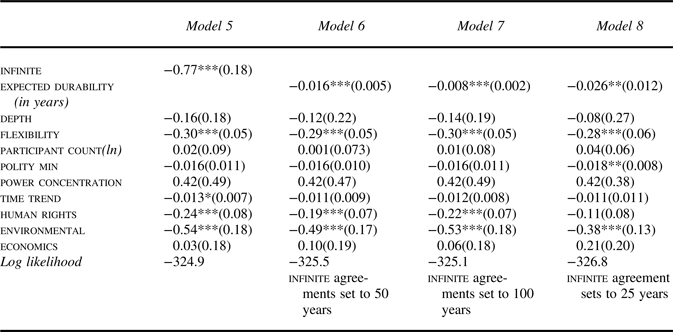
To assess if these results depend in any significant way on the short-term agreements without a prespecified length in years, we estimate the same sequence of models in Table 6 using the reduced sample excluding the contingent finite agreements (n = 94). Although some of the control variables lose statistical significance (notably depth, power concentration, and the economics dummy variable), our hypothesized result remains intact whether measured using the dichotomous infinite (Model 5) indicator or using a continuous expected durability measure (Models 6, 7, and 8).
Cox proportional hazard models of bargaining time excluding contingent finite agreements

Notes: N = 94. Cell entries are coefficients with robust standard errors clustered on the issue area in parentheses. Positive (negative) coefficients indicate that the variable makes the bargaining phase more (less) likely to fail or end. Statistical significance: * p ≤ .10; ** p ≤ .05; *** p ≤ .01 (two-tailed).
Discussion
Since finite duration provisions are a much-studied agreement feature related to the rational design of international institutions, it is useful to discuss how the results presented in this study speak to this important and ongoing research program. Over the past decade, finite duration provisions have been studied primarily as a dependent variable, or as an agreement feature to be explained. Most notably, Koremenos explored how certain factors—namely uncertainty and risk aversion—lead actors to insert a finite duration provision into their international agreements.Footnote 35 More recently, Copelovitch and Putnam also showed that states with a common institutional history/context are more likely to choose finite agreements, helping to explain further why this institutional design feature is so common.Footnote 36
But it had not been demonstrated that such intuitional design features, including but not limited to finite duration provisions, have any important causal effects. As Wendt argued on this point, “what if [these] design features are not, in fact, functional?”Footnote 37 Following the challenge issued by Martin and Simmons that scholars should focus more on how institutions matter (that is, treating institutions and institutional features as independent variables),Footnote 38 Duffield advanced a similar critique of the rational institutional design research program: “[it] moves in the opposite direction, revisiting international institutions as dependent variables.”Footnote 39 The results presented here address this critique by (1) treating finite duration provisions of varying lengths as an independent variable and (2) showing how this feature can reduce costly negotiation delay, an important form of international bargaining cooperation.
In fact, our results permit a parallel argument about the bargaining time effect of flexibility features within international agreements. But in this regard, these results point in the contrary direction: although finite duration provisions can be associated with reduced bargaining delay, agreement flexibility is associated with increased negotiation time. This latter result is perhaps surprising for two different reasons. First, finite duration provisions have been identified as a flexibility feature in the literature on rational institutional design. Yet this particular feature's effect on negotiation times appears to be different from, even opposite to, other flexibility features in that literature, including escape clauses, dispute resolution mechanisms, and withdrawal provisions (the three components of our flexibility measure). Second, other scholars have argued that these other flexibility features, namely escape clauses and dispute settlement structures, should make agreements easier to reach.Footnote 40 Do the results we presented stand in contradiction to this argument?
With regard to the first possible surprise—that different forms of flexibility may have different, even opposite, effects on international negotiation delay—it is useful to reconsider Koremenos, Lipson, and Snidal's distinction between “two kinds of institutional flexibility: adaptive and transformative. ‘Escape clauses’ are a good example of adaptive flexibility. They allow members to respond to unanticipated shocks or special domestic circumstances while preserving existing institutional arrangements.”Footnote 41 Conversely, finite duration provisions are an example of transformative flexibility, fundamentally changing and potentially terminating the agreement.
This same flexibility distinction can be made with reference to the shadow of the future, understood in terms of agreement durability. Finite duration provisions reduce international bargaining time based on the expectation that this particular transformative feature will make the agreement less durable (that is, shorten its shadow of the future). This is why we earlier identified finite duration provisions as a negative stability/durability feature in the context of Figure 1 (see also Figure 2). But adaptive flexibility features like escape clauses and dispute settlement procedures are designed to make the agreement more durable by giving actors short-term relief from treaty obligations, thus enabling them to stay within the agreement over the long term. This understanding is consistent with Rosendorff's proposed positive relationship between agreement flexibility and stability/durability.Footnote 42
Depth, flexibility, and durability and their relationship with bargaining time

To the extent that flexibility features such as escape clauses and dispute resolution mechanisms increase agreement stability (supported by the positive relationship between flexibility and infinite observed in Table 4), greater adaptive flexibility should also be positively associated with international bargaining time (see Figure 2).Footnote 43 This means that the results in Tables 5 and 6 showing that greater flexibility makes the agreement's negotiation phase less likely to fail should not come as an empirical surprise. To the contrary, these results are theoretically consistent with the endogenous depth/flexibility/stability agreement package hypothesized by Johns and Rosendorff.Footnote 44
But is this same flexibility result inconsistent with the hypothesis advanced by Rosendorff and Milner that agreements should be easier to achieve when they include an escape clause?Footnote 45 Likewise, is this result contrary to Rosendorff's argument that states should be more willing to sign an agreement when it contains a dispute settlement procedure?Footnote 46 To answer this question, it is important to understand that the bargaining models used in both of these papers were not designed (as was Fearon's war of attrition model) to explain the length of the bargaining phase. Instead, the models show how a wider variety of countries can join an agreement with these adaptive flexibility features compared with the same agreement otherwise lacking them.Footnote 47 This understanding shows how the flexibility hypothesis is not about bargaining time per se; instead, it concerns a different form of bargaining cooperation: the variety or the number of different states that can sign the agreement. Restated, this flexibility hypothesis implies that a greater number of states should be able to join more flexible agreements.
Indeed, our analysis provides some additional support for this proposition as Table 4 shows a strong positive correlation between flexibility and participant count. Stated differently, more flexible agreements have indeed been easier for a wider variety of states to sign as measured by the initial number of participants, although this larger number of states may take longer to complete their bargaining phase, with the end of this phase defined by the agreement's signature date.
Conclusion
Building from Fearon's proposed cooperation dilemma, this research note hypothesized that international agreements including a finite duration provision or with a shorter expected duration should take less time to negotiate. Using a random sample of international agreements across different issue areas, we found strong statistical support for this hypothesis. Agreements without a finite duration provision experienced a bargaining phase that was twice as long as agreements including a finite duration provision and otherwise short-term agreements.
These results not only offer empirical support for the theoretical proposition that a longer shadow of the future leads to increased bargaining delay—they also have important policy implications. International negotiators can include a finite duration provision when they prefer a shorter bargaining phase to a potentially more durable agreement, and they can avoid this feature when they prefer a more durable agreement, although this decision comes with the cost of additional bargaining delay. These results also address a major critique of the research program on the rational design of international institutions that it moves backward by considering only design features as dependent variables. Instead, we treat finite duration provisions and adaptive flexibility features as independent variables, showing how they affect the length of international negotiations, an important form of bargaining cooperation.