In the late afternoon on December 1, 1914, some 150 of New York City's most distinguished citizens met at the Hotel Belmont—one of Manhattan's top venues at the time. Four months after the outbreak of the European war, the illustrious gathering was assembled to discuss what its attendees perceived as the most pressing issue of the day: national security. The men present at the Belmont had accepted an invitation from S. Stanwood Menken, a successful New York lawyer who became a fervent defense enthusiast when he witnessed the British parliament's war debate during a stay in London in early August.Footnote 1 Menken and his guests were deeply concerned that the United States might be drawn into the cataclysmic conflict. After all, America's military did not have the same impressive arsenal of mighty war machines as the European powers did. What chance did the U.S. Army, a force smaller than that of some Balkan countries, stand against the Old World's armies of millions? How should the undermanned U.S. Navy fight off foreign invaders? And how would the increasingly diverse American society respond to the obstacles of wartime mobilization? The meeting came to the alarming realization that the United States was utterly unprepared to protect itself against the perils of a dangerous world. Main speaker George Haven Putnam, a wealthy publisher well connected among the Northeastern elite, warned that an invasion force would lay waste to the entire Hudson Valley before the U.S. government could even muster enough men to defend the homeland's shores. Much to the chagrin of the meeting's participants, however, most Americans seemed to be rather ignorant of the dangers lurking beyond the Atlantic Ocean. Apparently, they concluded, a large-scale propaganda campaign was necessary to enlighten the American public about the importance of proper defense measures—a patriotic mission only a national organization was able to accomplish. Thus, the gathering at the Belmont marked the birth of America's foremost lobby group dedicated to the defense cause: the National Security League (NSL).Footnote 2
The founders of the NSL were not alone in their concerns. One of the first public figures to address the U.S. military's lack of combat readiness was Augustus P. Gardner, a Republican representative from Massachusetts and son-in-law of GOP powerhouse Henry Cabot Lodge. “The time has come for us to rub our eyes and look about us,” the congressman emotionally declared on the House floor in the fall of 1914. Americans needed to awake from their “awful lethargy and grapple [with the] question on which our nation's safety depends.”Footnote 3 The United States, Gardner made clear in no uncertain terms, was “totally and absolutely unprepared for war.”Footnote 4 The congressman's Cassandrian warnings only marked the beginning of what would become a nationwide campaign to strengthen national security. Despite President Woodrow Wilson's promise to keep America out of the European conflict, a growing number of voices were heard criticizing the nation's military weakness. These concerns gave rise to the formation of the so-called preparedness—or defense—movement that advocated a massive buildup of the U.S. Army and Navy as well as universal military training—a concept of peacetime conscription that would break with American traditions of troop recruitment.Footnote 5 Former President Theodore Roosevelt, pleased by the campaign's martial spirit and, probably even more so, by its implied critique of his nemesis Wilson, soon seized the initiative and positioned himself as the movement's most prominent exponent. Lesser known, but equally important to the cause was Major General Leonard Wood, former Army chief of staff, renowned expert on military planning, and an “[a]postle of preparedness”Footnote 6 even before the outbreak of the European war.Footnote 7
The defense movement can be subdivided into a “governmental” and a “civilian” branch. Led by Roosevelt and Wood,Footnote 8 the governmental branch comprised preparedness-minded politicians, department officials, and military personnel. While partisans like Gardner or Roosevelt were free to advocate defense policies not in line with the president's agenda, officers and government officials were not. Military reformers on the executive level had to work discreetly to further their cause, cautiously moving the U.S. government toward strengthening the armed forces. Civilian defense enthusiasts, however, did not fall under such restrictions. Free from administrative obstacles, men like Menken or Putnam could launch a large-scale propaganda campaign to promote their uncompromising vision for national security. By the end of 1915, a whole range of societies had been organized to lobby for the defense cause. The NSL was only the largest of several groups that proliferated all across the country and attracted tens of thousands of members. Determined to “educat[e] our people in the necessities of preparedness,”Footnote 9 these self-styled patriotic associations distributed pamphlets, issued press releases, and hosted information events. Thus, civilian defense societies became the most visible manifestation of the American preparedness movement in World War I.
I.
Though historians have stressed the relevance of the preparedness movement in a number of studies,Footnote 10 they have tended to marginalize its civilian branch. Highly critical of the United States’ participation in the Great War, the revisionist scholars of the 1920s and 1930s depicted the defense campaign as part of corporate America's profit-driven conspiracy to push the nation into the European conflict. In their view, “professional militarists, bellicose politicians, and grasping profiteers”Footnote 11 made up the true core of a movement only pretending to be genuinely concerned about American security. According to the revisionists, civilian organizations like the NSL were merely another tool to economic lobbyists and pro-Allied propagandists in their quest to evoke “a preparedness mania.”Footnote 12 Emphasizing their financial and logistical dependence on major companies, defense societies were portrayed as little more than pawns in the hands of Big Business and High Finance.Footnote 13
After World War II, a new generation of scholars mitigated the revisionists’ harsh assessment of the movement. Historians like Robert Osgood or Russel Weigley did not identify particular ties to Wall Street but acknowledged the preparedness campaign's intent to challenge the American public's naïve ignorance toward matters of national security.Footnote 14 With reference to the movement's civilian branch, however, most studies still postulated that defense societies depended, in large part, on outside guidance. This narrative has eventually come to dominate historiography, despite the fact that some scholars—John Chambers most prominent among them—indicated that the role of civilian preparedness advocates requires more attention.Footnote 15 In line with John Finnegan's 1974 standard work Against the Specter of a Dragon: The Campaign for American Military Preparedness, 1914–1917,Footnote 16 the entire preparedness movement is often described as the brainchild of a small circle of preparedness-minded officers and department officials. Finnegan argues that the outbreak of war provided Leonard Wood and his fellow military reformers with the necessary public attention to gather civilian support for their cause. As Michael Pearlman puts it trenchantly, the European conflict opened a window of opportunity to “transform an intra-army argument … into a political debate and a social movement.”Footnote 17 According to this interpretation, defense societies relied heavily on the input of the governmental branch of the movement—not only intellectually, but also personnel-wise. After all, civilian organizations appointed preparedness-minded politicians as honorary patrons; the NSL even made former War Secretary Henry L. Stimson the head of its Army Committee. This arrangement, Finnegan argues, “ensured that the League would commit itself to the plans of the military professionals and not strike out on new paths of its own in quest of defense.”Footnote 18 In sum, he concludes that the societies might have been “highly visible” but were “perhaps a little less solid than they looked.”Footnote 19 The notion that the civilian branch of the preparedness movement was little more than an appendix to a rather centralized campaign led by military professionals has shaped historiography for decades and has only partially been amended by a small number of studies that looked into the organizational history of defense societies.Footnote 20
Just as scholars have equated the whole movement with its governmental branch, they have likewise identified the neutrality period between 1914 and 1917 as the historiographic time frame of preparedness, indicating that the campaign effectively ended with American mobilization following the declaration of war in April 1917.Footnote 21 After all, historians have argued, preparedness-minded officers and government officials quickly shifted their attention from the sham fights of the defense debate to actual warfare once the United States entered the conflict.Footnote 22 With most of their demands met as a result of belligerency, they saw little reason to further engage in abstract debates over military reform. Reinforcing the perception that the defense campaign became obsolete in 1917, Finnegan ironically remarks at the end of his standard work that “America's participation in World War I fulfilled and destroyed the preparedness movement.”Footnote 23
This article examines the defense movement through the lens of its civilian branch in order to challenge historiography's traditional view on preparedness. Exploring the key role of two major defense societies between 1914 and 1920, it presents two central arguments: First, civilian societies were not merely the appendix to a centralized campaign dominated by military professionals and politicians associated with the defense cause but acted as principal agents of preparedness. Second, the historiographic time frame of preparedness cannot be limited chronologically to America's years of neutrality but must include the period after April 1917.
II.
After the Belmont meeting, which attracted favorable press coverage not only by the New York Times, Stanwood Menken formally incorporated the NSL on January 7, 1915. In order to promote preparedness as a bipartisan cause, the League appointed anti-corruption fighter Joseph H. Choate, a prominent Republican, as honorary president and 1904 Democratic presidential nominee Alton B. Parker as honorary vice president. The League's National Committee, an advisory body, was composed of more than a dozen governors from both major parties and several former Cabinet secretaries—three of them ex-heads of the War Department.Footnote 24 However, while the NSL decorated its letterheads with the names of prominent leaders, its bylaws provided for a structure assigning the authority to determine the organization's day-to-day operations to an Executive Committee.Footnote 25 For all practical purposes, the politicians associated with the League were figureheads that left the business of waging the campaign for preparedness to the NSL's civilian leadership—a role Parker himself once described in the following way:
I have been interested in its [i.e. the NSL's] work—that is, as I knew it in a general way only a little bit better perhaps than the general public knew it. In its work for preparedness I was very much interested, but I have had little to do with it officially.Footnote 26
The real power resided with the president and chairman of the Executive Committee—a position for which Menken was the obvious choice. While it would be exaggerated to state that he started the League's quest for proper defense “single-handed[ly],”Footnote 27 as a contemporary Outlook portrait did, Menken was the driving force behind the League's founding. Certainly, Roosevelt, Wood, and others in the governmental branch of the preparedness movement looked favorably upon the establishment of a civilian lobby group advocating defense. However, military professionals and their political allies by no means orchestrated it—neither financially, logistically, nor intellectually.
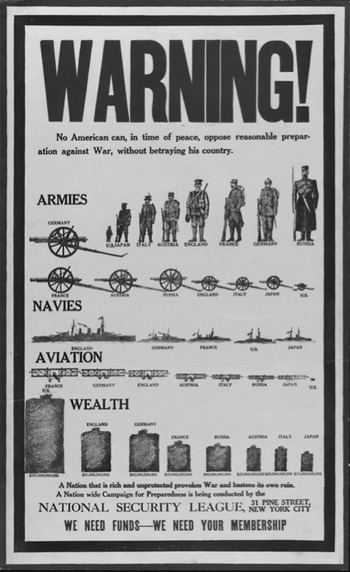
The NSL's national headquarters in New York City officially unleashed its crusade for preparedness in May 1915. Sending press releases to more than 1,200 newspapers all across the nation, the society informed the public that it had looked carefully into the question of defense. Since the investigation had revealed that the United States was in a “deplorable condition of unpreparedness,”Footnote 28 the League urged the American people to support a bold program for national security. Patriotic citizens were not only encouraged to donate money to the NSL's cause but to become members. Throughout the year, the League hosted hundreds of meetings, information events, and mass gatherings in dozens of cities to spread the blessing of preparedness over the land. It flooded the nation with a myriad of pamphlets and reprinted speeches, bearing titles such as Why Military Preparedness? or National Defense.Footnote 29 The NSL also intensified its contacts to political leaders, asking governors, congressmen, and mayors to endorse the organization and its agenda. In short, “[t]he campaign for adequate preparedness was vigorously prosecuted by every known means of publicity and appeal,”Footnote 30 as Menken would later proudly recall. Indeed, the League expanded rapidly in scope and size throughout 1915, claiming to have a membership of approximately thirty thousand spread over seventy local branches at the end of the year.Footnote 31
Propaganda poster issued by the National Security League (ca. 1916). Private Collection

United in its quest for defense, the organization's attitude toward the Wilson administration proved to be one of the most controversial issues within the NSL. As a society claiming to be “non-partisan and neutral in [its] endeavors,”Footnote 32 the NSL was reluctant to openly attack the administration for its allegedly feeble stance on national security. After all, such an approach could be construed as serving Republican interests, seeing as the GOP's Atlanticist wing had seized the preparedness issue for its own political purposes. For Clarence S. Thompson, the League's publicity director and a fierce critic of the president's defense policy, however, there was no room for compromise. When Menken refused to provide funds to reprint preparedness speeches critical of Wilson, Thompson accused the NSL leadership of being too pro-administration. He and his followers left the League and, in August 1915, incorporated a new preparedness organization—the American Defense Society (ADS).Footnote 33
Determined to wage a “fearless and aggressive campaign to secure adequate preparedness,”Footnote 34 the ADS effectively became a more radical twin organization of the NSL. Though they claimed not to play politics, most of the ADS's founders were affiliated with the Republican Party (or the Progressive Party), giving it the reputation of a more partisan, somewhat anti-Wilsonian association. The ADS later even succeeded in winning over Theodore Roosevelt to serve as its honorary president—a coup the NSL was never able to accomplish.Footnote 35 However, Roosevelt's stated sympathies for the ADS's “invaluable work”Footnote 36 did not mean that the organization did his bidding. Its civilian leadership operated autonomously in its day-to-day quest for defense—a fact the Rough Rider once acknowledged himself with a touch of lament:
I did advise and keep in touch with the [ADS's] larger measures of policy and action. … But I did not keep in touch with certain other activities where my name appeared without any knowledge on my part.Footnote 37
While the ADS never superseded the NSL in terms of members or prominence, it managed to establish itself as a major player in the defense movement, essentially becoming America's second most significant preparedness society.
Schism proved to be a constant issue for the civilian branch of the preparedness movement. Indeed, the landscape of defense societies became increasingly fragmented. From larger organizations that pursued a broad preparedness agenda comparable to the NSL's or the ADS's (e.g., the American Rights League) to rather obscure single-issue groups (e.g., the National Association for Universal Military Training), patriotic societies promoting the defense cause proliferated all across the United States. Furthermore, several older organizations founded before the outbreak of the European war jumped on the movement's bandwagon. Not only did lobby groups that were already associated with military matters (e.g., the Navy League) join the campaign; even associations like the Daughters of the American Revolution or the Boy Scouts began to advocate preparedness. The confusing abundance of civilian organizations obviously crippled the effectiveness of their campaign—a handicap its allies in the movement's governmental branch were aware of but, apparently, could do little against. Leonard Wood once complained that “we are a little swamped with the multiplicity of societies.”Footnote 38 Former President William H. Taft, who, like most of the more active supporters of preparedness, enrolled in more than one organization, even lost sight of his memberships:
There are so many Associations that is it very difficult to know what to join. I am a member of the American Legion, but not of the National Protective League. I believe I am a member of the National Security League.Footnote 39
Efforts to consolidate the fragmented landscape of societies were less than successful. Certainly, the Conference Committee on National Preparedness (organized in June 1915) and the National Committee of Patriotic and Defense Societies (organized in February 1917) united most of the associations under one umbrella, claiming to coordinate their campaigns.Footnote 40 But the committee was a toothless tiger. Having “no control over the organisations which compose it, none of its organisations [were] bound to follow its recommendations.”Footnote 41 Only hesitantly joining forces on special occasions, defense societies continued to regard each other with mistrust. In the end, each of them kept a jealous watch over its particular gospel of preparedness.
Until 1917, civilian organizations fought an uphill battle for preparedness. While the defense cause gradually advanced among the American people, anti-military sentiments were still strong in large parts of U.S. society. One the one hand, the movement managed to gather considerable support among the upper and upper-middle class, especially in the urban Northeast, winning over many newspapers and a respectable number of officeholders. The leadership of defense societies was, after all, made up of lawyers, businessmen, academics, and other white-collar professionals. On the other hand, both the working class and the rural population—notably in the Midwest—remained skeptical of armament measures. Not feeling particularly threatened by the war in Europe, many ordinary Americans did not want to waste taxpayer money on some elitist figment. Most prominent among the anti-preparedness forces accusing the movement of militarism were pacifist organizations such as the Woman's Peace Party.Footnote 42 However, while its opponents often portrayed the preparedness campaign as a warmongering endeavor, it was not openly bellicist. Though there certainly were pro-Allied interventionists among them, the majority of Americans active in the movement thought in defensive terms. Civilian societies wanted the United States to be prepared should war be inevitable, but they did not settle on a pro-war platform. Before 1917, intervention was simply too controversial. Besides, beyond all the warnings of foreign dangers, defense enthusiasts’ primary concerns were domestic. They saw preparedness not merely as a program to reform the military but to remake the social body of society. Ideologically, these men might be best described as American nationalists—both of conservative and progressive leanings.Footnote 43
The divisive character of the defense controversy was also reflected in the White House. Wilson's position on preparedness was, at best, ambiguous. Initially, the president opposed a military buildup, jeering in October 1914 that the debate on preparedness was merely a “good mental exercise.”Footnote 44 It was not until after the sinking of the Lusitania in May 1915 that Wilson hesitantly warmed up to armament measures. Never adopting the more ambitious proposals for preparedness, though, he remained a difficult commander in chief for defense enthusiasts.Footnote 45
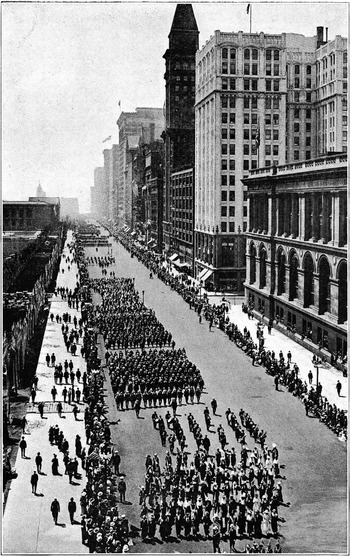
When they realized that Wilson would not embrace compulsory military service, defense societies grew increasingly critical of the president. Intensifying their campaign, they organized so-called preparedness parades in more than a dozen major cities—mass events that attracted tens of thousands of marchers.Footnote 46 When plans for a new army bill were debated in Washington, defense societies aimed to raise public pressure on the government even further. In January 1916, the NSL held a “National Security Congress” in the capital, urging the nation to implement a system of universal military training.Footnote 47 After a heated debate, the administration and both houses of Congress settled on the National Defense Act—a compromise bill enacted on June 3, 1916, that provided for a federally regulated National Guard, armament measures, and a modest expansion of the Army, but did not introduce compulsory service.Footnote 48 This notable rejection of their main demand antagonized defense societies and further mobilized the movement. In January 1917, the NSL hosted another national convention on preparedness in Washington. This “Congress of Constructive Patriotism” brought together all the various civilian associations active in the campaign. The conference proceedings listed more than fifty attending defense societies, including the renegade ADS. Overall, more than two thousand delegates were accredited at the Congress, representing not only organizations associated with the defense cause, but also governors, mayors, colleges, commercial bodies, bar associations, and women's clubs.Footnote 49 Prominent speakers such as former War Secretary Elihu Root criticized the “lethargy”Footnote 50 to which Americans had succumbed.Footnote 51 A message from Theodore Roosevelt was read, labeling the National Defense Act as “as foolish and unpatriotic a bit of flintlock legislation as was ever put on the statute book.” The Rough Rider made clear that, in matters of preparedness, “there is no middle course.”Footnote 52
When the United States entered the war in April 1917, the preparedness campaign underwent a major transformation. Given the necessities of warfare, most of its proposals for a military buildup were no longer controversial. In May, Congress established a wartime draft, making the demand for a permanent system of universal military training less of a priority.Footnote 53 Besides, many military reformers in government positions preferred to actively coordinate America's war efforts rather than further debating abstract ideas of preparedness. Even the movement's most prominent champions turned their attention from propaganda to warfare. Roosevelt made plans for mustering a volunteer division, aiming to lead them into battle against the Germans—a desire the president would eventually deny him. General Wood, on the other hand, received an official assignment from the War Department and was busy training raw recruits.Footnote 54 For civilian preparedness organizations, however, there was no reason to abandon their cause. Did America's involvement in the European conflict not demonstrate that their campaign had been right from the beginning? Did the turn of events not foster their moral authority among the American people? Did the imperatives of war not provide ideal conditions to fundamentally reshape the nation in their image of defense? In the view of civilian preparedness organizations, belligerency would not end the movement. It would renew it.
Remarkably, defense societies did not see a fundamental difference between the themes of peacetime preparedness and wartime mobilization. While civilian organizations certainly reduced the inflationary use of the term “preparedness” between April 1917 and November 1918, they never fully abandoned it. Looking back on the first twelve months of U.S. belligerency, the NSL's annual report issued in May 1918 reflected this notion of continuity:
During the year we have continued our endeavor to awaken the American people to the actual needs of preparedness for war as waged in this era of great machinery and conquest, and have renewed our prior statements of the men and material necessary for victory.Footnote 55
The NSL had tacitly reinterpreted preparedness from a concept to prevent war into a rationale to wage total war. The League henceforth emphasized its “determination to fight the next war now” in order to preserve a righteous peace “for all time to come.”Footnote 56 It vowed to “stimulate the spirit to conquer” as it would “accept no peace with the autocratic powers of the world … which will interfere with the privilege of all men to enjoy liberty.”Footnote 57 Similar thoughts can be found in ADS pamphlets that portrayed U.S. warfare against Germany as a preemptive action against future threats—or against the “coming storm,”Footnote 58 as one author put it poetically. In the view of defense societies, American belligerency had become the most crucial preparedness measure of all.
Preparedness Parade in Chicago (June 10, 1916). The Clarence Darrow Digital Collection, University of Minnesota.

With the United States finally in arms, defense societies turned their attention to the American home front. While nonmilitary facets of preparedness had always been latent themes of their campaign, civilian mobilization now assumed center stage. Thus, national unity became the new leitmotif of a campaign whose emphasis shifted from foreign threats to domestic dangers. In the summer of 1917, the NSL organized a Committee on Patriotism Through Education, aiming to arouse “an American morale to insure universal support of the Government in the vigorous … prosecution of the war.”Footnote 59 The NSL's Education Committee not only sent speakers to schools and colleges to lecture students on civic duties, but also organized summer schools for teachers with courses in patriotic instruction. Warning against enemy propaganda in the classroom, the ADS vowed “to stamp out sedition and disloyalty in the public schools.”Footnote 60 Defense societies fueled the witch hunt against German Americans that swept across the United States. Pamphlets bearing titles such as German Spies in America or The Tentacles of the German Octopus in America exacerbated the perception of an enemy within.Footnote 61 Not surprisingly, suppressing the German language became one of the top priorities of their campaign. Advocating “100 percent Americanism,” preparedness societies also addressed the issue of immigration, emphasizing the necessity of Americanization work.Footnote 62 The hysteria accompanied by belligerency provided optimal conditions for defense organizations to push their agenda.Footnote 63 Their membership numbers reached a peak in 1918, with the NSL alone claiming to have as many as 150,000 enrolled members.Footnote 64 There was still opposition against the defense cause, however—even in the highest echelons of the government. Stating that the old party lines between Republicans and Democrats had become obsolete (and thus maintaining the appearance of nonpartisanship),Footnote 65 the League intervened in the 1918 midterm elections to ensure a Congress of its liking. The NSL publicized the voting records of representatives in order to expose whether they had voted “right” or “wrong” on key defense legislation and to unseat congressmen unsympathetic to preparedness—an unprecedented measure that would eventually provoke a congressional investigation into the NSL's activities.Footnote 66
The end of World War I marked the second significant watershed in the defense societies’ campaign. In late 1918, the NSL leadership briefly considered “whether the League might not retire on its laurels.” This proposition, however, was quickly defeated as Leaguers concluded that they “had a great work to continue.”Footnote 67 A similar decision was made by the ADS, praising the association's organizational strength as too appealing as to not carry on.Footnote 68 In the view of defense societies, national security had not yet been achieved because the menace of revolution was looming. In its program for the postwar period, the NSL included a pledge to protect America's institutions “from dangerous proletarians,”Footnote 69 while the ADS demanded “drastic reforms in public policy toward … the Bolshevik doctrines.”Footnote 70 Defense societies had found a new enemy they could prepare against—communism. Fueling America's Red Scare, they vigorously agitated against radicalism and what they perceived as such. Since they denounced all the “various disturbing elements generally masquerading under the guise of socialism,”Footnote 71 they often targeted organized labor as well. Linking America's socialist movement to radical immigrants, defense societies maintained the xenophobic thrust of their campaign. In a 1919 pamphlet, the NSL expressly warned against the “vicious element in the unassimilated hordes.”Footnote 72 The ADS demanded to protect American workers from foreign competition and argued in favor of immigration restriction laws.Footnote 73 Faced with America's postwar problems, defense societies had sought refuge in extreme notions of anti-communism and nativism.
Remnants of a time of crisis, civilian preparedness enthusiasts lost their purpose once there no longer was a crisis. When the Red Scare abated in 1920, defense societies did not follow mainstream America's return to normalcy. Their ongoing extremism cost them most of their public support and led to a rapid demise throughout the 1920s. After years of obscurity, the NSL was officially closed in 1942. The American Defense Society, practically inactive for decades, was last listed in New York City directories in 1956. By that time, military preparedness was broadly accepted. Ironically, the defense campaign born from the Great War had little to do with it.
III.
Looking back from 1920, the final year of this article's focus, defense enthusiasts had come a long way. On their quest for preparedness, they had scored major victories as well as stunning defeats. What had begun as a limited campaign to look into the shortcomings of the U.S. military became a mass movement that, for a time, dominated the public discourse and left its mark on the fabric of American society.
Contrary to assumptions made by many historians, the preparedness campaign was never a centralized endeavor. Given the fact that it was associated with the military, one of the most hierarchic institutions in society, the movement had an oddly pluralistic structure. While united in a common—if sometimes vague—purpose, its governmental and civilian branches operated independently of each other. Certainly, civilian defense organizations were inspired by preparedness-minded politicians like Roosevelt and military reformers like Wood. After all, these men were paragons of the defense cause; associations like the NSL or the ADS often heeded their proposals for proper defense and sought to win them over for promotional purposes. However, there was no relationship of dependence between the movement's two branches. Defense societies were founded on the initiative of civilians who independently decided to engage in civic participation for preparedness. The organizations were led by a duly elected leadership that did not consult military officers, department officials, or politicians before making major decisions. Civilian leaders like Stanwood Menken ran their respective campaigns autonomously—often with divergent priorities. The fragmented landscape of defense societies—the movement's greatest handicap—proves this point. Why orchestrate civilian support for preparedness and then let it crumble into schism? Demonstrably, neither the societies’ activities nor their programs were subject to outside guidance. The civilian branch was not simply an appendix to the defense campaign but constituted one of the two pillars on which the movement rested. Shaping the public discourse on national security, defense societies were principal agents of preparedness.
As principal agents of preparedness, defense societies did not consider their mission completed once armament and enlistment measures had become broadly accepted as a result of belligerency. Nor did they disband when American power reached its zenith after the Allied victory. In fact, organizations like the NSL or the ADS intensified their activities in April 1917 as well as in November 1918. Unlike the fairly pragmatic governmental branch of the movement, civilians felt emboldened to continue until their vision for comprehensive defense was achieved. By viewing the movement through the lens of its civilian agents, it becomes clear that historiography's traditional periodization of the campaign is too confined. The historiographic time frame of preparedness cannot be limited chronologically to America's years of neutrality but must include the war and postwar period—at least until 1920. In these crucial years, civilian organizations broadened the discourse on defense and attributed a new meaning to preparedness.