Introduction
Over the past decade, the international hydrogen storage research community has focused on developing hydride materials for onboard vehicle storage stimulated by an ambitious plan of using environmental-friendly and high energy-efficiency hydrogen-powered fuel-cell vehicles (FCVs) to replace gasoline internal combustion engine vehicles (ICEVs) that are responsible for significant global carbon dioxide emissions. To enable a ∼500 km driving range without refueling, FCVs need to load sufficient hydrogen safely and economically onboard. Conventional hydrogen storage methods using high pressures or cryogenics offer near-term solutions but suffer from issues such as high cost, energy efficiency, and safety.Reference Schlapbach and Züttel1 Storing hydrogen in condensed materials through chemical interactions, on the other hand, may be a viable approach and has attracted tremendous attention in the last decade.
The development of high-performance solid-state hydrogen storage materials generally necessitates considering several prominent factors:
1. High density of hydrogen. Solid-state hydrogen storage materials normally have high volumetric hydrogen capacities of >50 g H2/L. But to reach a gravimetric hydrogen capacity greater than 5.5 wt% hydrogen content, the material should be mainly composed of lightweight elements (Z < 20).
2. Suitable thermodynamics of dehydrogenation. The dehydriding/hydriding operating conditions (equilibrium hydrogen pressures P eq and temperatures T (K)) are determined by the thermodynamic parameters of the hydrogen storage materials (enthalpy change (∆H) and entropy change (∆S)), as described by the van’t Hoff equation.
(1) $$\ln (P_{eq} {\rm{/}}P^\theta ) = - \Delta H{\rm{/}}RT + \Delta S{\rm{/}}R$$
Here, P ө and R represent the standard atmospheric pressure and the gas constant, respectively. Taking into account H2 delivery temperatures (–40∼85°C) for proton exchange membrane fuel cells (PEMFC) and the dehydriding ∆S des of hydrogen storage materials (100∼130 J/[mol H2 • K] determined experimentally), ∆H des should be between 23∼47 kJ/mol H2 in order to reach 1 bar equilibrium hydrogen pressure.
3. Fast kinetics. Dehydriding/hydriding should proceed at a sufficiently rapid rate to meet the practical targets of refueling time and hydrogen delivery to the fuel cell. However, relatively poor de-/hydriding kinetics is a common issue encountered by solid-state chemical sorption materials.

Alanates, amides, and borohydrides with “complex” anions of [AlH4]–, [NH2]–, and [BH4]–, respectively, are generally referred to as complex hydrides. Considerable efforts have been expended on research and development of these materials for hydrogen storage because of their high hydrogen storage capacity that allows room for materials engineering to improve thermodynamics and kinetics. Several comprehensive reviews on complex hydrides are available.Reference Orimo, Nakamori, Eliseo, Züttel and Jensen2–Reference Mandal and Gregory4
In the present review, we focus on recent progress in amides and borohydrides for hydrogen storage, with emphases on materials design and improvements in kinetics.
Amides
The amide-hydride composite system has a general form of M(NH2)x–M’Hy, where M or M’ refers to a metal, and x or y is the valence of M or M’, respectively. In the following section, different approaches to forming and optimizing this type of material will be reviewed.
Chemical combination to alter dehydrogenation path
Alkali-metal amides have been successfully synthesized since the early 1900s and used as reagents in organic synthesis. The thermal decomposition of amides alone usually gives off ammonia rather than hydrogen. Amides had not been considered as candidates for hydrogen storage until the LiNH2-LiH composite was reported in 2002 to reversibly store a large amount of hydrogen.Reference Chen, Xiong, Luo, Li and Tan5
The chemical interactions between LiNH2 and LiH can be expressed by Equation 2, where LiNH2 reacts with LiH to release one equiv. H2 and form Li2NH. The latter can further react with LiH to release the second equiv. H2 and form Li3N. In total, ∼10.5 wt% H2 can be desorbed/absorbed in the composite LiNH2–2LiH.Reference Chen, Xiong, Luo, Li and Tan5
 $${\rm{LiNH}}_{\rm{2}} + {\rm{2LiH}} \leftrightarrow {\rm{Li}}_{\rm{2}} {\rm{NH}} + {\rm{LiH}} + {\rm{H}}_{\rm{2}} \leftrightarrow {\rm{Li}}_{\rm{3}} {\rm{N}} + {\rm{2H}}_{\rm{2}}$$
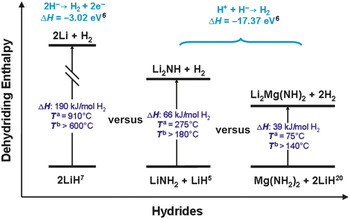
The enthalpy diagram of LiNH2-LiH is demonstrated in Figure 1. LiH, a highly stable hydride with a formation enthalpy of –91 kJ/mol, desorbs H2 at temperatures higher than 600°C. The decomposition of LiNH2 takes place at temperatures above 300°C. However, upon forming the composite, LiNH2 interacts with LiH and releases H2 at relatively low temperatures (starting at temperatures <180°C). Distinguished from other hydrogen storage materials reported previously, the LiNH2-LiH composite system has three distinct features:
1. It contains non-metallic elemental N;
2. Both protic hydrogen (Hδ+ in LiNH2) and hydridic hydrogen (Hδ– in LiH) co-exist;
3. H2 generation relies on the chemical interaction of two reactants. The high chemical potential of the combination of Hδ+ and Hδ– to molecular hydrogen (Equation 3) can be regarded as one of the driving forces for dehydrogenation and results in improved thermodynamics.
 $${\rm{H}}^ + + {\rm{H}}^ - \to {\rm{H}}_{\rm{2}} \,\Delta {\rm{H}} = - {\rm{17}}{\rm{.37 eV}}^{\rm{6}}$$
Enthalpy diagrams of dehydrogenation of LiH,Reference Veleckis7 LiNH2-LiH,Reference Chen, Xiong, Luo, Li and Tan5 and Mg(NH2)2-2LiHReference Xiong, Hu, Wu, Chen, Luo, Gross and Wang20 composites. T a is the calculated temperature corresponding to 1 bar equilibrium H2. T b is the dehydrogenation onset temperature observed experimentally.

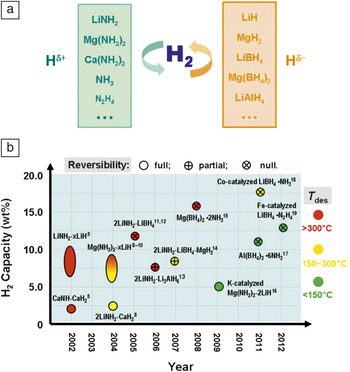
Based on this understanding, a variety of composites and complexes containing both Hδ+ and Hδ– components have been investigated in the past decade (see Figure 2). Figure 2b shows the chronosequence of the development of composite and complex systems, in which the hydrogen content, temperature for dehydrogenation, and reversibility are indicated. The hydrogen desorption enthalpies of these systems vary from highly endothermic (e.g., Li2NH-LiHReference Chen, Xiong, Luo, Li and Tan5) to exothermic (e.g., 2LiNH2-LiBH411), showing an effective approach to tune the thermodynamics of dehydrogenation via compositional change. The hydrogen content varies from ca. 2 wt% for CaNH-CaH2Reference Chen, Xiong, Luo, Li and Tan5 to ca. 17.8 wt% for LiBH4·4/3NH3.Reference Zheng, Wu, Li, Xiong, He, Guo, Chen and Chen18 Among them, most of the amide-elemental metal hydride composite systems exhibit endothermic hydrogen desorption with full or partial reversibility. In particular, the Mg(NH2)2-2LiH composite possesses both a relatively high reversible hydrogen capacity of 5.6 wt% and suitable thermodynamic properties (∆H des = 39 kJ/mol H2, ∆S des = 112 J/[mol H2 • K], see Figure 1), which allow hydrogen desorption at 1 bar H2 pressure below 90°C, thus showing considerable promise for onboard hydrogen storage application.Reference Xiong, Hu, Wu, Chen, Luo, Gross and Wang20 However, hydrogen desorption from those composites or complexes containing Al or B is generally exothermic or mildly endothermic in nature, which is to a large extent due to the formation of stable Al–N or B–N bonds, and thus suffers from irreversibility under normal conditions.
(a) Representative chemicals containing protic or hydridic hydrogen for making composites or complexes. (b) The chronosequence of the development of amide-hydride materials.

It is worth highlighting that this approach of constructing composites or complexes is not restricted to hydrides having Hδ+ and Hδ–, but has been employed as a general guide in the design and development of other non-amide hydrogen storage materials. A few successful examples show that elementsReference Vajo, Mertens, Ahn, Bowman and Fultz21 or halidesReference Gosalawit-Utke, Colbe, Gornheim, Jensen, Cerenius, Bonatto, Peschke and Bormann22 can also be mixed with hydrides and alter the de-/hydriding thermodynamics by either interacting with dehydrogenated or hydrogenated products or both. However, in this case, it leads to a significant loss of the hydrogen capacity.
Structural features hint reaction mechanism
Clearly, the combination of hydrides comprising Hδ+ and Hδ– offers an effective approach to develop new hydrogen storage materials with tunable thermodynamic properties. However, hydrogen desorption from these composite materials usually undergoes multistep reactions, involves complicated intermediates, and possibly co-exists with competing reaction pathways. Interestingly, most of the amide-elemental hydride composites, such as LiNH2-LiH, CaNH-CaH2, Mg(NH2)2-LiH, and Ca(NH2)2-LiH, have notably good reversibility, which is likely due to the significant structural similarities between amides and their corresponding dehydrogenated products (i.e., imides). As examples, structural similarities were found for LiNH2 versus Li2NH, Mg(NH2)2 versus MgNH, CaNH versus Ca2NH, Mg(NH2)2 versus Li2Mg(NH)2, Ca(NH2)2 versus Li2Ca(NH)2 and Ca(NH2)2 versus MgCa(NH)2. Considerable investigations have clarified the structures of LiNH2, Li2NH, Mg(NH2)2, and Li2Mg(NH)2.Reference Sørby, Nakamura, Brinks, Ichikawa, Hino, Fujii and Hauback23–Reference Noritake, Aoki, Matsumoto, Miwa, Towata, Li and Orimo27 As shown in Figure 3, NH2– and NH2– anions in the structures of LiNH2, Li2NH, Mg(NH2)2, and Li2Mg(NH)2 are all arranged in a close-packed configuration. The metal cations (Li+ and/or Mg2+) are tetrahedrally coordinated by the anions. The difference between the amides and imides, from a structural viewpoint, can be regarded as different extents of cation occupation in the tetrahedral interstices in the nitrogen framework (i.e., more interstices are occupied by cations when in imide form than in amide form). The apparent structural similarity between the reactant and product implies that the transport and exchange of small cations of Li+ and H+ in the N framework of amide/imide phases may play an important role in the de-/hydrogenation of LiNH2-LiH and Mg(NH2)2-2LiH systems.Reference Rijssenbeek, Gao, Hanson, Hunag, Jones and Toby25,Reference Noritake, Aoki, Matsumoto, Miwa, Towata, Li and Orimo27,Reference David, Jones, Gregory, Jewell, Johnson, Walton and Edwards28 Such a mechanistic understanding of hydrogen storage in these composites may shed light on the design and prediction of new hydrogen storage materials as well as subsequent kinetic improvements.
Crystal structures of (a) LiNH2 (I-4, 8 cells), (b) Li2NH (disorder Fm-3m, 16 cells, H not shown), (c) Mg(NH2)2 (I41/abc), and (d) Li2Mg(NH)2 (Iba2, 8 cells). The origin is set at an N atom. The crystal data used are from References 23–25.

Strategies for kinetic improvement
If a hydrogen storage material is to be used in a FCV, good de-/hydriding kinetics are required in order to deliver hydrogen sufficiently fast. Due to the complexity of the heterogeneous solid-state reaction, hydrogen desorption from the amide-hydride composite materials generally encounters severe kinetic barriers that may originate from H2 dissociation, interface reactions, nucleation/nuclei growth, or/and diffusion processes. We consider the Mg(NH2)2-2LiH system as an example. Thermodynamic calculations show that the temperature for hydrogen release at 1 bar pressure is below 90°C, but an appropriate rate of dehydrogenation was only observed at temperatures above 180°C.Reference Xiong, Hu, Wu, Chen, Luo, Gross and Wang20 Despite controversial interpretations of the reaction mechanism of the amide-hydride system,Reference David, Jones, Gregory, Jewell, Johnson, Walton and Edwards28–Reference Aguey-Zinsou, Yao and Guo33 various strategies for adequate mixing and an introduction of catalytic additives have proven to be effective in improving the de-/hydriding kinetics.
Adequate mixing
Hydrogen desorption from composite materials occurs via interaction of at least two phases, therefore, thorough mixing of different phases is indispensable. Experimental results show that hydrogen storage performance of both LiNH2-LiH and Mg(NH2)2-2LiH systems can be remarkably improved by intensive ball milling of reactants. Mechanical ball milling can efficiently reduce the particle size of reactants and increase the homogenous distribution as well as contact of amide and hydride particles in the resulting mixture, and thus lead to a significantly decreased kinetic barrier of dehydrogenation.Reference Chen, Xiong, Yang, Wu and Luo31,Reference Shaw, Ren, Markmaitree and Osborn34,Reference Liu, Zhong, Luo, Gao, Pan and Wang35 However, small particles are prone to aggregate into larger ones during the subsequent de-/hydriding cycles, which slows down the reaction kinetics. Introducing proper dispersantsReference Wang, Hu, Liu, Xiong, Wu, Pan and Chen36 or confining with scaffold materialsReference Demir-Cakan, Tang, Darwiche and Janot37,Reference Menjo, Hyodo, Moriyama, Li, Matsuo, Semboshi and Orimo38 can suppress the aggregation/growth of reactant particles to some degree and alleviate the decline of kinetics.
Catalytic additives
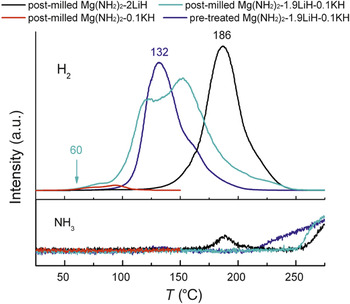
Transition metals or their compounds have been recognized as proper catalysts for NaAlH4 and MgH2.Reference Bogdanović and Schwickardi39,Reference Barkhordarian, Klassen and Bormann40 Significant catalytic effects of transition metals, such as Fe, Co, Ni, and Pt, were also observed in the amide-complex hydride system (e.g., 2LiNH2-LiBH441) and complex hydride ammoniates (e.g., LiBH4•NH318) or hydrazinates (e.g., LiBH4•N2H419) (see Figure 2). But the roles of transition metals in the amide-elemental hydride system have not yet been well identified.Reference Wang, Liu, Wu, Li, Liu, Araujo, Scheicher, Blomqvist, Ahuja, Xiong, Yang, Gao, Pan and Chen16,Reference Ichikawa, Isobe, Hanada and Fujii42–Reference Yao, Shang, Aguey-Zinsou and Guo44 Efforts to improve the Li+ conductivity of materials by introducing BN,Reference Aguey-Zinsou, Yao and Guo33 LiBH4,Reference Lewis, Sachtler, Low, Lesch, Faheem, Dosek, Knight, Halloran, Jensen, Yang, Sudik, Siegel, Wolverton, Ozolins and Zhang45,Reference Hu, Liu, Wu, Xiong, Chua and Chen46 and halidesReference Anderson, Chater, Hewett and Slater47 yielded significant kinetic enhancement of hydrogen sorption as well as suppression of ammonia generation, however, little reduction in dehydrogenation onset temperature was obtained. A notable kinetic enhancement was achieved by introducing ∼3 mol% KH to the Mg(NH2)2-2LiH system.Reference Wang, Liu, Wu, Li, Liu, Araujo, Scheicher, Blomqvist, Ahuja, Xiong, Yang, Gao, Pan and Chen16 Compared to the K-free Mg(NH2)2-2LiH sample, the dehydrogenation onset and peak temperatures were significantly reduced by more than 70°C and 50°C for the post-milled and pre-treated K-doped Mg(NH2)2-2LiH samples, respectively, together with undetectable NH3 formation in the dehydrogenation processes (see Figure 4). The prior interaction between KH and Mg(NH2)2 likely plays a key role in reducing the onset temperature. A mechanistic investigation showed that in the dehydrogenation, a kinetically stable intermediate of K2Mg(NH2)4, whose N–H bonds are considerably weakened compared to that of Mg(NH2)2, was formed that facilitates its subsequent interaction with LiH.Reference Wang, Wu, Shen, Guo, Xiong, Zhang, Gao, Pan and Chen48 This result indicates that severe kinetic barriers exist for the interface reaction of Mg(NH2)2 and LiH, which has received less attention in the past. Therefore, the introduction of multifunctional additives should be necessary in order to obtain high performance of hydrogen storage materials. There is thus room for further materials development in this area.
Temperature dependence of H2 and NH3 desorption from KH-doped and KH-free Mg(NH2)2-2LiH samples and a KH-doped Mg(NH2)2 sample (adapted from Reference 16).

Borohydrides
Metal borohydrides (M(BH4)n) contain the metal cation M n+ and the BH4– polyatomic anion in which one B atom covalently bonds with four hydrogen atoms. Various M(BH4)n, such as LiBH4,Reference Züttel, Wenger, Rentsch, Sudan, Mauron and Emmenegger49,Reference Orimo, Nakamori, Kitahara, Miwa, Ohba, Towata and Züttel50 Mg(BH4)2,Reference Li, Kikuchi, Nakamori, Miwa, Towata and Orimo51–Reference Soloveichik, Gao, Rijssenbeek, Andrus, Kniajanski, Bowman, Hwang and Zhao54 and Ca(BH4)2,Reference Rönnebro and Majzoub55–Reference Kim, Jin, Shim and Cho57 with hydrogen gravimetric density higher than 10 wt%, have been widely regarded as potential candidates for onboard hydrogen storage. In the past decade, enormous progress has been made, and borohydrides have been developed from having no promise for onboard storage (being irreversible) to finding ways to engineer them to perform better, as summarized in review papers.Reference Chen and Zhu58–Reference Rude, Nielsen, Ravnsbæk, Bösenberg, Ley, Richter, Arnbjerg, Dornheim, Filinchuk, Besenbacher and Jensen63 Here, we will shed light on the fundamental de-/rehydrogenation properties and various approaches for optimizing thermodynamics and kinetics.
Complicated multistep dehydrogenation and possible reversibility
We consider the widely studied Mg(BH4)2 as an example to depict the dehydrogenation. Mg(BH4)2 releases approximately 14.9 mass% of hydrogen through several endothermic events together with the formation of intermediate compounds in the temperature range of 230∼530°C51–54 (see Figure 5a). One of the intermediate compounds has been theoretically predicted and experimentally confirmed as being MgB12H12 under certain reaction conditions,Reference Li, Kikuchi, Nakamori, Ohba, Miwa, Towata and Orimo52,Reference Soloveichik, Gao, Rijssenbeek, Andrus, Kniajanski, Bowman, Hwang and Zhao54,Reference Li, Miwa, Ohba, Fujita, Sato, Yan, Towata, Chen and Orimo64–Reference Ozolin, Majzoub and Wolverton66 similar to reaction mechanisms of LiBH4Reference Hwang, Bowman, Reiter, Rijssenbeek, Soloverchik, Zhao, Kabbour and Ahn65–Reference Friedrichs, Remhof, Hwang and Züttel68 and Ca(BH4)2.Reference Ozolin, Majzoub and Wolverton66,Reference Wang, Graham, Robertson and Johnson69 Formation of B12H122– was suggested as a sequential BH condensation pathway involving a buildup of the increasing higher BnHn+x species,Reference Chong, Karkamkar, Autrey, Orimo, Jalisatgi and Jensen70 as shown in Figure 5b.
(a) Summary of multistep dehydrogenation processes of Mg(BH4)2. The question mark indicates the possible formation of an intermediate compound during the dehydrogenation. Reprinted with permission from Reference 62. © 2011 MDPI. (b) Schematic illustration of a BH condensation pathway under certain reaction conditions. Reprinted with permission from Reference 70. © 2011 RSC Publishing.

The complicated dehydrogenation pathway results in several common issues for most M(BH4)n:
1. De-/rehydrogenation temperature higher than 230°C and sluggish reaction rates;
2. Accumulation of intermediate compounds containing B12H122–, which degrades the reversibility;
3. Difficulties in obtaining exact enthalpy for each reaction step and identifying the rate-determining step;
4. Formation of different BnHn+x species that may affect overall entropy.
Reversibility is of great importance for onboard hydrogen storage, therefore, a major effort was initiated in the United States, Europe, and Asia for exploring reversibility of lithium, calcium, and magnesium borohydrides during the last decade. Reversibility of LiBH4 could be achieved at a very high temperature of 600°C,Reference Orimo, Nakamori, Kitahara, Miwa, Ohba, Towata and Züttel50 which is impractical for use with PEMFC applications, but may be feasible for TES applications. Therefore, focus was shifted to Ca and Mg borohydrides. Reversibility of Ca(BH4)2 was, for the first time, shown by using a high-pressure, high-temperature route, starting with its presumed end-products—CaB6 and CaH2.Reference Rönnebro and Majzoub55 This promising result has led to numerous studies of crystal structures, reaction mechanisms, and attempts to improve performance. Reversibility of Mg(BH4)2 was shown using a similar route from hydrogenation of MgB2.Reference Severa, Rönnebro and Jensen71
Electronegativity’s role in tuning enthalpy
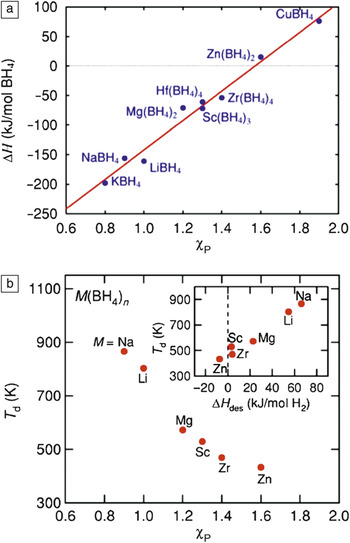
The Pauling electronegativity χP of M may be adopted as an indicator to roughly estimate and tailor the formation enthalpy ∆H boro of M(BH4)n. Theoretical prediction suggests a good linear relationship between ∆H boro of M(BH4)n and χP of M (i.e., the larger χP of M suggests a smaller ∆H boro of M(BH4)n72) (see Figure 6a). Experimental results indicate the dehydrogenation temperature T d of M(BH4)n decreases with increasing χP of M Reference Nakamori, Miwa, Ninoyiya, Li, Ohba, Towata, Züttel and Orimo72 (see Figure 6b). Assuming that borohydrides, except for Zn(BH4)2, decompose into elemental hydrides MHm in the first dehydrogenation as follows,
 $$M({\rm{BH}}_4 )_n \to M{\rm{H}}_m + n\,{\rm{B}} + (4n - m){\rm{/}}2\,{\rm{H}}_2 ,$$
(a) Relation between formation enthalpy ∆H boro of M(BH4)n and Pauling electronegativity χP of M. The zero-point energy contributions to ∆H boro are approximately taken into consideration. (b) Dehydrogenation temperature T d of M(BH4)n as a function of Pauling electronegativity χP of M. The inset shows the relation between T d and estimated ∆H des of dehydrogenation of Equation 4. Reprinted with permission from Reference 72. © 2006 The American Physical Society.

the dehydrogenation enthalpy ∆H des can be estimated from the predicted ΔH boro and the experimental data ∆H hyd of MHm. The good correlation between ∆H des and T d (see Figure 6b) supports the theoretical prediction.Reference Nakamori, Miwa, Ninoyiya, Li, Ohba, Towata, Züttel and Orimo72 It should be noted that T d obtained from temperature programmed desorption spectra, including both thermodynamic and kinetic parameters, and the chemical state of dehydrogenated products will largely affect the ∆H des.
Inspired by this finding, mixing two kinds of metals having different electronegativities to produce bimetallic borohydrides MM’(BH4)n, has been proposed to be an approach to tune thermodynamic stability.Reference Li, Orimo, Nakamori, Miwa, Ohba, Towata and Züttel73 Guided by this approach, several novel MM’(BH4)n were synthesized, including LiK(BH4)2,Reference Nickels, Jones, David, Johnson, Lowton, Sommariva and Edwards74 LiSc(BH4)4,Reference Hagemann, Longhini, Kaminski, Wesolowski, Černý, Penin, Sørby, Hauback, Severa and Jensen75 Mg1–xMnx(BH4)2,Reference Černý, Penin, d’Anna and Ruziska76 and NaY(BH4)Cl2.Reference Rude, Nielsen, Ravnsbæk, Bösenberg, Ley, Richter, Arnbjerg, Dornheim, Filinchuk, Besenbacher and Jensen63 Most MM’(BH4)n, except some forming a large [M’(BH4)n]m− anion unit such as [Sc(BH4)4]−, exhibit moderate T d between those of M(BH4)n and M’(BH4)n. Reference Rude, Nielsen, Ravnsbæk, Bösenberg, Ley, Richter, Arnbjerg, Dornheim, Filinchuk, Besenbacher and Jensen63
Reactive hydride composites to tune enthalpy
Combining M(BH4)n with elements, metal hydrides, or complex hydrides (also called reactive hydride composite) is another approach to reduce ∆H des through the formation of more stable dehydrogenated products. Figure 7 shows a typical example of the 2LiBH4-MgX (X indicates halogen) system for this approach.Reference Vajo and Olson77 Take the most studied 2LiBH4-MgH2 system as an example. Pure LiBH4 releases approximately 13.8 mass% of hydrogen according to the following reaction,(5)
 $${\rm{LiBH}}_{\rm{4}} \leftrightarrow {\rm{LiH}} + {\rm{B}} + {\rm{3/2}}\,{\rm{H}}_{\rm{2}} .$$
Enthalpy diagram for destabilization of LiBH4 by the MgX (X indicates halogen) system. Reprinted with permission from Reference 77. © 2007 Elsevier.

∆H des for pure LiBH4, predicted to be 67 kJ/mol H2, can be considerably reduced to 46 kJ/mol H2 by the formation of MgB2 according to the following reaction,Reference Vajo, Skeith and Mertens78
 $${\rm{2LiBH}}_{\rm{4}} + {\rm{MgH}}_{\rm{2}} \leftrightarrow {\rm{2LiH}} + {\rm{MgB}}_{\rm{2}} + {\rm{4H}}_{\rm{2}} {\rm{.}}$$
The combination with MgH2 not only decreases T d of LiBH4 but also kinetically improves rehydrogenation, so this significantly improves the reversibility. Formation of MgB2 during dehydrogenation is crucial to maintain good reversibility, however, this largely depends on the hydrogen pressure. Hydrogen pressure at least higher than 0.3 MPa is required to suppress the formation of Li2B12H12 from the individual decomposition of LiBH4.Reference Bösenberg, Doppiu, Mosegaard, Barkhordarian, Eigen, Borgschulte, Jensen, Cerenius, Gutfleisch, Klassen, Dornheim and Bormann79,Reference Pinkerton, Meyer, Meisner, Balogh and Vajo80 In situ powder neutron and x-ray diffraction studies of the dehydrogenation pathway at low partial pressures of hydrogen suggest that Li-rich samples form a passivating hydride layer, hindering further hydrogenation.Reference Price, Grant, Weston, Hansen, Arnbjerg, Ravnsbæk, Jensen and Walker81 Similar hydrogen pressure dependence phenomena of the formation of borides such as YB4 and CaB6 are also observed in other systems (e.g., LiBH4-YH3Reference Shim, Lim, Rather, Lee, Reed, Kim, Book and Cho82 and LiBH4-CaH283). Another prominent combination is between borohydrides with amides (see Figure 2). In these systems, reaction between BH4– and NH2– anions forming a very stable B–N related compound results in exothermic dehydrogenation that makes hydrogenation irreversible. In addition, a “self-catalyzing” strategy for enhancing the kinetics was proposed in the ternary LiBH4-2LiNH2-MgH2 system.Reference Yang, Sudik, Siegel, Halliday, Drews, Carter, Wolverton, Lewis, Sachtler, Low, Faheem, Lesch and Ozolins14
Additives to enhance kinetics
Most borohydrides, similar to amides, are known to encounter sluggish kinetics. Stimulated by the pronounced improvement of the de-/rehydrogenation kinetics of the NaAlH4 system with the addition of Ti-based compounds,Reference Bogdanović and Schwickardi39 hundreds of additives, including oxides, halides, metals, and carbon-based materials, have been extensively screened. Some of them, such as halides, exhibited considerable catalytic capability. With regard to the most studied LiBH4 due to its early commercialization, a mixture of 0.2 MgCl2–0.1 TiCl3 displayed a superior catalytic effect compared to other additives, releasing 5 mass% of hydrogen from 60°C to 400°C; it can be rehydrogenated to 4.5 mass% at 600°C in 7 MPa H2.Reference Au, Jurgensen and Zeigler84 ZrCl4 substantially influences the dehydrogenation kinetics of 2LiBH4-MgH2 and significantly reduces the incubation period for the first dehydrogenation. ZrB2 nanoparticles formed during ball milling are suggested to act as heterogeneous nucleation sites for MgB2, thus avoiding the incubation period and refining the microstructures.Reference Bösenberg, Kim, Gosslar, Eigen, Jensen, Bellosta von Colbe, Zhou, Dahms, Kim, Günther, Cho, Oh, Klassen, Bormann and Dornheim85 Though the catalytic mechanism in most additives is still uncertain, the particle size and dispersion state of additives are important to the exertion of catalytic function. For this reason, halides that readily react with borohydrides in situ to form nano-sized active species display a superior catalytic effect relative to the pure elements.
Nanoconfinement to overcome kinetic barriers
Fabricating and maintaining nano-sized metal borohydrides is expected to be an effective way to overcome the kinetic barriers originating from, at least in part, the mass transport of M, B, and H accompanying de-/rehydrogenation of M(BH4)n. Nanoconfinement is an alternative approach that can improve kinetics and sometimes alter thermodynamics as well. For instance, dehydrogenation rates of LiBH4 nanoconfined into carbon scaffolds with a 13-nm pore size can be increased up to 50 times at 300°C, and the capacity loss over three cycles was significantly reduced from 72% to 40% compared to that of bulk LiBH4.Reference Gross, Vajo, van Atta and Olson86 Nanoporous carbon with a smaller pore size of 2 nm can further reduce the dehydrogenation temperature and significantly suppress the release of the impurity gas B2H6.Reference Liu, Peaslee, Jost, Baumann and Majzoub87 Detailed information regarding the improvement effects and mechanisms of nanoconfinement on various hydrides are discussed in the article by de Jongh et al. in this issue.
Prospectives
Extensive research and development of amides and borohydrides over the past decade have considerably expanded the material scope of hydrogen storage. However, pursuing high performance hydrogen storage materials with both high hydrogen capacity and suitable thermodynamics is still challenging. Currently, thermodynamic alteration mainly focuses on the enthalpy change of dehydrogenation. The entropy change is, however, generally regarded as a constant of 130 J/[mol H2 • K] dominated by the entropy of hydrogen gas. However, it has been shown that the vibrational entropies of solid phases can be significantly altered by structural and compositional factors, such as nanostructure and order-disorder transformations.Reference Fultz88 The alteration in entropy of the solid phase would result in up to a 30% change in ∆S in dehydrogenation and thus, significantly affect the equilibrium hydrogen pressure and thermodynamic stability of hydrogen storage materials.Reference Wang, Hu, Liu, Xiong, Wu, Pan and Chen36,Reference Ozolin, Majzoub and Wolverton66 The control of entropy change may be effective in the thermodynamic modification and widen the range of ∆H for onboard hydrogen storage in vehicles.
On the other hand, slow kinetics generally encountered by complex hydrides is another challenging issue that should be addressed. So far, introducing “catalytic” additives to hydrogen storage materials has been effective. But the “catalytic” function depends significantly on particle size and the dispersion state of additives in the matrix. Well-dispersed fine particles of additives by mechanistic ball milling or in situ reactions are prone to aggregate/grow during de-/hydriding cycling, which results in a significant kinetic decline in the cycling tests. Improving kinetic cycling durability is another issue. Moreover, a mechanistic understanding of the chemical sorption of complex hydrides and the “catalytic” role of additives is of fundamental importance for future R&D. In this regard, theoretical simulation is essential in the prediction and screening of new materials and modeling reaction pathways.
Previous considerations are based on the requirements for onboard hydrogen storage application. Some amides and borohydrides with large values of endothermic ∆H des could potentially be used for thermal energy storage applications.
Acknowledgments
P.C. thanks the financial support from the Knowledge Innovation Program of CAS (KJCX2-YW-H21), 973 (2010CB631304) Project and National Natural Science foundation of China (51225206). H.W.L. acknowledges financial support from JSPS KAKENHI Grant Number 23760658, JSPS, and CAS under the Japan—China Scientific Cooperation Program, and the International Institute for Carbon Neutral Energy Research (WPI-I2CNER), sponsored by the Japanese Ministry of Education, Culture, Sports, Science and Technology.