INTRODUCTION
Rando (1984) observed that death “is not romantic. It is not graceful. It is not beautiful. In fact, death stinks—literally and figuratively! It is clammy too. It can sound bad, and it often is ugly” (p. 272). Consequently, people with terminal illnesses may be spending the more advanced stages of their illness in a hospice. Palliative care may be provided in a hospice or at home, with the goal of achieving the best possible quality of life for the dying patients and for their families, and to assist them in adjusting to the many losses they endured and may still face, and to provide them with dignified treatment and lowered distress for the rest of their days (Faull & Woof, 2002; Tang et al., 2004). Van Bommel (1992) eloquently observed that palliative care provides “physical, emotional, spiritual and informational support to help improve the quality of a person's remaining life, and recognizes the patient and family as the principal decision makers” (p. 22). Palliative care, thus, takes a holistic view and integrates the psychological, physical, social, and spiritual aspects of a patient's care. It offers a support system that enables and encourages patients to live as actively as possible until death, and helps the family cope (during the patient's illness) with the bereavement, anticipatory, and postmortem grief (Faull & Woof, 2002).
The Dying Patient
Rokach and Rokach (2005) presented a multidimensional model of the needs of dying patients, including the following:
Physical/medical needs: These include pain and symptom management, the need to have a warm and caring environment, and the patients' need to have a sense of control in regard to their treatment.
Social needs: Completing unfinished business, the needs to love and to be loved, to forgive or be forgiven, and to sustain trusting and intimate relationships.
Emotional/psychological needs: These include maintaining a sense of control, affirmation of one's existence, searching for meaning, and finding the courage to “let go” and bring closure to one's life.
Spiritual/religious needs: These needs include having a sense of hope and inner peace and being able to participate in cultural observances and in prayers.
People in the North American culture have been socialized into fearing the process of death and dying so that as the patient comes closer to death, one endures the ultimate aloneness; neither mortal nor faith in God can save the patient from death (Bascom, 1984; Cherry & Smith, 1993). This experience is common to all individuals with a terminal disease in their final stages of illness (Bascom, 1984). Kaye (quoted by Vachon, 1998, p. 37) further stated that “ultimately one is alone with the diagnosis, with the need to receive treatment, and with the reality of one's life being threatened. Nothing another contributes, no matter how valuable, can change this.” Loneliness has been documented to be an integral part of ill health, for both the patient and his or her caregivers.
One of the most excruciating elements of death is the leaving of all that the patient owned, had, and knew behind. Separating from friends and family is not only one of the most heart-wrenching aspects of dying, but also a precursor of loneliness and aloneness (see Doka, 1997). Although much has been written about the loneliness of dying, researchers have not asked the dying to indicate how loneliness felt to them, how they experienced it.
The Caregivers
Caregivers (not the professional, employed ones) of the dying are usually family members. Mangan et al. (2003) indicated that approximately 52 million Americans serve as caregivers for an ill adult. Moreover, it is predicted that within the next 50 years, the total number of cancer cases is expected to double, and consequently, it is likely to increase the prevalence of and need for informal caregiving. Commenting on the effect of death of a loved one, Rainer and McMurry (2002) noted that “the physical changes that accompany the dying of a loved one can be difficult to watch and often impossible to understand. Adding the mental, spiritual, social and emotional adjustments may make this event overwhelming” (p. 1421). Caring for a dying person creates considerable strain for caregivers and may affect their working schedule, family life, and social relationships. It is, consequently, of no surprise that caregiving is frequently associated with significant physical and psychological vulnerability. Their distress, reported the authors, is evident in the form of depression, anxiety, anger, health problems, and loneliness. Alarmingly, 14% of caregivers admitted entertaining suicidal thoughts (Chentsova-Dutton et al., 2002). Seeing the suffering of a loved one without being able to ease the pain or prevent death and facing one's own mortality and small stature in the “big scheme of things” may result in loneliness and alienation from the rest of the healthy and bustling society.
A multitude of studies suggest that a large proportion of the population feels lonely frequently (Rokach & Brock, 1997). U.S. surveys indicate that a quarter of North Americans report having felt lonely in the past 4 weeks (Perlman, 2004). Loneliness has been linked to depression, anxiety, and interpersonal hostility (Hansson et al., 1986), to increased vulnerability to health problems (Jones et al., 1990), and even to suicide (Cutrona, 1982; Medora & Woodward, 1986). Rook (1988) observed that loneliness results from the interaction of personal factors and situational constraints. That interaction is closely associated with the changing life circumstances that one encounters.
The present study has, thus, explored the qualitative aspects of the loneliness experienced by the dying and by their attending caregivers. Knowing how they experience it may suggest a way that hospice personnel and palliative care workers can assist them to feel more connected, understood, and cared for.
METHOD
Participants
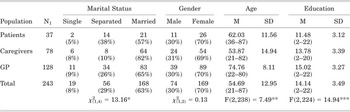
Two hundred and forty-three participants volunteered to answer the loneliness questionnaire. A total of 74 men and 169 women comprised the sample. The average age of all participants was 54.7 years with ages ranging between 21 and 87. The mean level of education (i.e., last grade completed) was 14.1 years, with a range of 2 to 22. Eight percent of the participants were single, 63% married, and 29% had had a relationship but were no longer in it due to separation, divorce, or death of a spouse. Table 1 provides a more detailed breakdown of gender, age, education, and marital status within each of the three groups: patients, caregivers, and the general population.
Demographics

Procedure
The dying and their caregivers were recruited in an oncological hospice that is attached to a general hospital in central Israel, whereas the general population sample was composed of participants who came from all walks of life. Each dying patient and his/her caregiver were approached by one of the authors and asked to participate. Participants were asked to reflect on their past loneliness experiences and to endorse those items that described it. Those patients unable to read or write were assisted by a researcher. Questions that the patients or their families may have had were answered while the participants were answering the questionnaire. About 10% of those who were approached declined to participate. They took approximately 15 min to answer the questionnaire.
In an attempt to overcome the methodological difficulty of other studies that relied solely on college students (see McWhirter, 1990; Vincenzi & Grabowsky, 1987), the general population participants were recruited from all walks of life. They were recruited in high schools, universities, shopping malls, and community centers. They were assured of anonymity and were not asked to identify themselves.
The Loneliness Questionnaire
All items for the questionnaire were written by the senior author and based on Rokach's previous research on loneliness (Rokach, 1988). That study yielded a theoretical model of loneliness as reported by 526 subjects who were asked to describe their experiences of loneliness. The present items were chosen from those descriptions and were modified to provide clarity and gender neutrality. Six psychologists and two psychology students reviewed the first draft of the questionnaire for any items or instructions that might have been lacking in clarity, relevance, or content. The questionnaire was then constructed incorporating this feedback.
Principal components factor analysis with varimax rotation was applied to the data, with .40 being designated as the minimum loading for an item. The factor analytic procedure, using an SPSS program, extracted the principal components, and the factor matrix was then subjected to varimax rotation. The items contributing to the factors were then examined for their meaning. Five factors could be assigned meaning, and each accounted for sufficient amount of the variance (at least 3%) to support statistical meaningfulness. Accordingly, repetitions of the varimax rotations were limited to five factors each to permit the results to be restricted to the most robust factors.
That analysis yielded five factors. The most salient factor to emerge was Emotional Distress (which accounted for 19% of the variance). This included items that captured the intense pain, inner turmoil, hopelessness, and feelings of emptiness associated with loneliness. The second factor, Social Inadequacy and Alienation (7% of the variance) addressed the perception and concomitant self-generated social detachment that were reported as part of the loneliness experience. The third factor, Growth and Discovery (4% of the variance) captured the positive, growth-enhancing, and enriching aspects of loneliness and the increased feelings of inner strength and self-reliance that follow. Interpersonal Isolation (3% the variance) was the fourth factor. It depicted feelings of alienation, abandonment, and rejection, which were reported as related to a general lack of close relationships and/or absence of a primary romantic relationship. The fifth factor, Self-alienation (3% of the variance) described a detachment from one's self that is characterized by numbness, immobilization, and denial. In all, these factors accounted for 36% of the variance. Each factor was a subscale in the questionnaire and participants' scores are the sum of items they endorsed in each subscale (see the Appendix for items). The questionnaire had 30 items that describe the experience of loneliness. It was comprised of five scales, each of which had six items. (see Rokach, 2000). The general instructions request that participants reflect on their experience of loneliness and endorse the items that describe them. Kuder-Richardson internal consistency reliabilities were calculated and yielded the following alpha values: F1 = .65, F2 = .65, F3 = .80, F4 = .63, F5 = .57. K-R alpha for the 30-item questionnaire was .79. The questionnaire was translated into Hebrew by bilingual Canadian students and was then verified and edited by an Israeli academician.
RESULTS
Table 1 illustrates the breakdown of gender, age, marital status, and educational level within each group. Age, F(2,238) = 7.49, p < .01, education, F(2,224) = 19.94, p < 0.01, and marital status, χ2(1,4) = 13.16, p < .05, were found to be significantly different among the three groups. Gender, χ2(2,1) = 0.13, was found to be not significantly different across populations. The three demographic variables were covaried in later analyses.
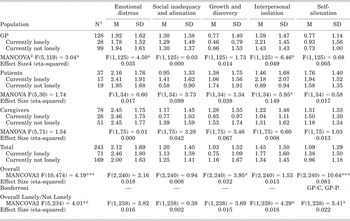
A MANCOVA, F(10,474) = 4.19, p < .001, yielded significant differences in the experience of loneliness that were reported among the three subgroups. ANCOVAs were then calculated to examine in more detail those differences. Results of the present study demonstrate that overall, the three subgroups experience loneliness differently (see Table 2).
Comparing Mean Subscale Scores of Loneliness Experience

Significant differences among the three subgroups were found in the Growth and Discovery subscale, F(2 240) = 3.95, p < .05, with Bonferroni indicating a significant difference on the Growth and Discovery subscale and the Self-alienation subscale, F(2,240) = 10.64, p < .001, where the patient and the caregiver subgroups, who did not differ from each other, had significantly higher mean subscale scores than the general population.
Examining whether experiencing loneliness while answering the questionnaire may have influenced the responses given revealed that the “currently lonely” scored significantly higher than the “currently not lonely” subgroup on the Interpersonal Isolation, F(1,238) = 4.29, p < .05, and on the Self-alienation subscales, F(1,238) = 5.41, p < .05.
A significant correlation (r = −.38, p < .05) was found between Emotional Distress and the number of days of hospice hospitalization, and the number of days was also significantly correlated with Self-alienation (r = −.41, p < .02).
DISCUSSION
Life is a journey and death is its final destination. “For many individuals, death comes as a universally unwelcome event…. [T]he mental, spiritual, social and emotional adjustments may make this event overwhelming” (Rainer & McMurry, 2002, p. 1421).
Death is not only distressing and overwhelming, but it is accompanied by loneliness—both, for the dying and for those who care for him or her (Chentsova-Dutton et al., 2002).
The present study examined that very loneliness, the loneliness of the dying and of their caregivers. What we focused on was not the quantity or level of loneliness, but rather its qualitative aspects. The present results indicate that loneliness is experienced differently in or out of the hospice, the place where the patients and their caregivers were recruited. That difference was confined to the Growth and Discovery and the Self-alienation subscales. In both instances, the general population scored significantly lower than the other two subgroups. It is intuitively apparent, and easier to explain, the higher mean subscale scores of the patients and their caregivers. The pain, emotional turmoil, and sense of terror that both death and loneliness many evoke could mobilize a reaction akin to fainting, which is a physical response to acute pain. Self-alienation may be present as a reaction to loneliness and to their impending death. Rando (1984) pointed to the need of the patient and the caregiver to have, at least, some control of the dying process. She goes on to observe that the patient often feels powerless in the midst of a progressive and debilitating illness. Connor (1998) observed that people respond differently to their impending death. Most often their behavior is characterized by ambivalence—“fearful avoidance and the desire for release” (p. 46). Results of the present study thus indicate that in the midst of that ambivalence—which most probably is experienced by the patient and the caregiver—self-alienation may be the dimension of loneliness that they most acutely experience. And indeed, a form of distancing and numbing may be needed in facing the end of life and the impending separation from loved ones.
The Growth and Discovery higher scores are not intuitively expected, though they can be explained in light of the “moments of truth,” the shirking of social “niceties” and expectations, and the order that the dying are putting in their affairs (see Rokach, 2005). It is thus suggested that in the atmosphere of a hospice, attending to the dying, both the patient and the caregiver may find the strength, inner resources, and personal capabilities to deal with loneliness and with the impending separation and loss.
We also examined whether the qualitative aspects of loneliness would differ if the participants were lonely at the time they answered the questionnaire. An analysis across subgroups revealed that, as would be intuitively expected, the lonely participants scored significantly higher on both the Interpersonal Isolation and Self-alienation subscales.
It appears that although the scores of the other three subscales have not been affected by the presence of loneliness, interpersonal isolation, the feeling of being unwanted, unneeded, unappreciated, and disconnected from others, is naturally felt more acutely at times of loneliness regardless of the health status or supportive function of the participant.
Within each subgroup, except in the general population (GP), the presence of loneliness did not influence how participants reported it. In the GP subgroup, the lonely had a significantly higher mean subscale score than the currently not lonely on the Interpersonal Isolation subscale. Although one may expect that emotional turmoil may be reported more acutely by the lonely (and it was not), the lonely did report interpersonal isolation as a more salient feature of loneliness than did the currently not lonely. It stands to reason that, for those who are undergoing the pain and agony of loneliness, the feeling of being alone, of being unsupported and unloved, would be more emphasized than for the currently not lonely group (see Rokach, 2000).
In an attempt to examine how the length of hospitalization in the hospice affected the patients whose cancer was at terminal stage, correlations were calculated between the number of days that the dying patient was hospitalized and each of the subscales. Emotional Distress and Self-alienation were both significantly negatively correlated to the length of the patient's stay in the hospice. It is possible that prior to arriving at the hospice the patient was very ill, experiencing discomfort, pain, and fear, whereas in the hospice the patient may be comforted, cared for, and supported, and thus his or her emotional distress, psychological pain, and consequently self-alienation are lowered, in line with “taking care of the process of dying and attending to unfinished business. If that result [such as the one in the present study] could be replicated on a larger sample of hospice patients it may speak to the great service, the calming influence, and the assistance and caring that the dying experience in hospices” (see Canine, 1996, p. 7; Connor, 1998).
To conclude, it was found that loneliness is experienced differently by the dying patient, his or her caregiver, and the general population. The difference was mostly confined to the Growth and Discovery and to the Self-alienation subscales. This may be the first study to examine the qualitative aspects of the loneliness experienced by the dying and by their caregivers. As such, more research is needed to replicate the present study, using larger samples. Additionally future research needs to explore the influence on the loneliness of one's gender, kind of disease, and whether the person is spending his/her last days in a hospice, hospital, or at home.
APPENDIX: THE LONELINESS EXPERIENCE ITEMS
In the following, the number in parentheses is the factor loading of the item from the original questionnaire.
Factor 1: Emotional Distress
I experienced feelings of intense hurt (.58)
It felt as if I was crying inside (.54)
I experienced being overwhelmed with feelings of dread (.47)
I felt hollow inside like an empty shell (.53)
It felt like my heart was breaking (.65)
I felt sorry for myself (.65)
Factor 2: Social Inadequacy and Alienation
I felt that people wanted nothing to do with me (.47)
I felt insecure (.49)
I withdrew from others (.50)
I felt I was boring and uninteresting (.63)
I felt inadequate when interacting with others (.67)
I felt ignored (.58)
Factor 3: Growth and Discovery
I discovered a personal strength I was previously unaware of (.64)
I am happier and more content now (.69)
Life seems richer and more interesting than it was previously (.70)
I like and appreciate myself more than I did previously (.74)
My interpersonal relationships have been greatly improved (.65)
I have greater confidence in myself (.71)
Factor 4: Interpersonal isolation
I felt I had no one to love or be loved by (.52)
I felt the absence of a meaningful romantic relationship (.49)
I felt deserted by those closest to me (.54)
I felt I did not matter to those closest to me (.58)
I felt I had no one I could lean on in a time of need (.64)
Factor 5: Self-alienation
I felt as if my mind and body were in different places (.54)
It felt as if I were in a dream and waiting to awaken (.48)
I felt as if I did not know myself (.48)
I did not want to attribute my distress to loneliness (.42)
I felt that I was observing myself as if I was another person (.47)
I felt numb and immobilized as in shock (.47)