1. Introduction
The political economy of trade policy-making stands as the leading form of analysis regarding how domestic interests and institutions shape state interaction at the international level.Footnote 1 Significant work has been conducted on the particular interests of various domestic constituents, on the channels they use to shape trade policies, as well as on the conditions that strengthen or weaken their respective positions. However, identifying the relative influence of these often-competing actors remains a major problem in trade policy literature. Most approaches attempting to establish relative influences in trade policy-making are limited to a few domestic constituents. Society-centered approaches compare the relative influence of import-competing and export-oriented special interests groups. State-centered approaches focus on the interplay between the executive and the legislative branch. Unfortunately, these studies rarely consider the entire array of domestic constituents at the same time in a way that would reveal the status quo and the changes in their relative influence across the WTO membership.
Therefore, the present article attempts to answer two central questions: (1) What is the relative influence of different domestic constituents on the negotiating positions member states adopt in WTO trade rounds? And (2) how has their relative influence changed since the conclusion of the Uruguay Round in 1994? The article is based on a series of interviews conducted with members of national delegations and WTO employees, as well as on a survey of national delegations. It distinguishes between the influence of ministries and regulatory agencies, the national parliament, sub-federal units, import-competing and export-oriented special interest groups, civil society organizations, in addition to the general public during election and non-election years. It also differentiates between industrialized and developing countries.
The focus on the formation of WTO negotiating positions, rather than probing trade policy-making in general, is useful. The material interests of actors in promoting or preventing protectionist measures, the strength of normative arguments for and against protection, and the institutions directing the political process differ across trade policy settings.Footnote 2 For instance, the quest for attaining contingent protection under the discretion of member states – as long as they remain within the boundaries of existing WTO law – differs from the attempt to bias a country's position in negotiations on new WTO obligations. One difference is that anti-dumping measures and countervailing duties in many countries are granted through highly legalized channels, requiring less political clout than influencing WTO negotiating positions. Furthermore, harmed industries applying for protection against unfair competition have an especially strong normative position that resonates with politicians, bureaucrats, and the broad public.
This article first reviews the existing literature on the political economy of trade (Section 2), thus serving to justify the survey method as a complementary approach. Next, the results of the survey on the influence of the various domestic constituents and changes in their relative influence are presented (Section 3). Then, the implications of the changes for the progress of WTO negotiations are considered (Section 4). Section 5 summarizes the main findings.
2. Analysis of trade policy-making
This section opens with a review of the formal strand of the political economy literature, which is based on explicit models and statistical methods. It then examines selectively verbal analysis of trade policy-making in a WTO context, contained in case studies and general observations about how WTO member states form their negotiating positions.
Statistical analysis of trade policy-making with formal models
The general idea of statistical analysis of trade policy-making is to explain trade policy patterns or voting behavior on trade policy in parliament by measurable variables that can be linked to specific constituents. This method has found its major application in the analysis of votes on trade-related bills in the US Congress, most notably on the transfer of fast track authority for international trade negotiations to the President and on the ratification of international trade agreements.
In these models, the general public always favors free trade based on their consumer interests. Their interests as recipients of factor rewards depend on the mobility of factors across sectors. If they can be transferred from one sector to another without cost, the interests of an individual correspond to its relative endowment with capital and labor in comparison with the national relative factor endowment. Countries that are relatively rich in labor compared to capital, tend to import goods and services whose production is relatively capital-intensive. Thus, labor becomes less abundant compared to capital and marginal labor productivity will increase. Since marginal productivity tends to influence factor rewards, wages stand to rise. Accordingly, an individual in a labor-rich country will favor free trade if it is relatively well endowed with labor, while it will prefer protectionism if it is relatively well endowed with capital.Footnote 3 If factors are sector-specific, and shifting them to another sector reduces their returns, an individual with relatively high stakes in a sector strongly competing with imports prefers protectionism because this increases sector-specific factor rewards.
The effort of protectionist or liberal special interest groups to influence trade policies is commonly equated with their financial contributions to the election campaign of their parliamentary representative. Contributions can shape trade policy in two ways. First, they may enhance the chances of politicians or parties that endorse those trade policies that the special interest group prefers.Footnote 4 The underlying idea is that special interest groups finance campaigning expenses that influence voters. Alternatively, contributions may directly ‘buy’ sympathetic policies.Footnote 5 This implies that either legislators who have received contributions feel obliged to reciprocate the favors, or that legislators pass trade policies in anticipation of subsequent rewards. Empirical evidence shows that special interest groups give to like-minded candidates in order to improve their election chances, as well as to those legislators whose party tenure and committee responsibilities suggest they can directly deliver desired policies.Footnote 6
The independent causal role of a parliament follows from the ideological rating of its members. Special interest groups attempting to guide the electorate typically publish this rating. This ideological variable shows when parliamentarians vote consistently with their worldview and convictions – derived in particular from their previous voting patterns – rather than according to the interests and campaign contributions of their district's constituents.
The main contribution of this statistical approach based on simplified formal models has been to show that campaign contributions work well in influencing policies (at least in the case of the US Congress),Footnote 7 and to examine the circumstances determining the efforts and chances of special interest groups to attain or reverse protection.Footnote 8 Regardless, a number of shortcomings concern the attribution of interests to domestic constituents, their channels for influencing politics, and the spectrum of domestic constituents considered.
A first problem is that individuals' trade policy preferences are difficult to establish as they are shaped by a wide range of factors. In the statistical models, interests are framed as effects of trade policy on individual income. In reality, the perception of economic effects of trade policy is not determined exclusively by objectively discernible economic facts, but is dependent on subjective beliefs and education levels.Footnote 9 Furthermore, trade policy preferences also depend on altruism, social status, and ideology.Footnote 10 Poverty alleviation through trade inclines individuals toward free trade. Based on actual income or the individual's subjective evaluation, an advantageous position in domestic society is also associated with pro-free-trade preferences, whereas community attachment and nationalism dispose people towards protectionism.
A second fundamental limitation to the statistical approach that results from its rationalist commitment is its focus on voting and campaign contributions as channels for influencing trade policy-makers. Unfortunately, this ignores the information needs of the legislative and executive branches regarding the evaluation of likely material and political effects of international agreements. Private actors can help them to recognize how domestic regulation is working and how domestic regulatory changes implemented in accordance with WTO agreements would affect the home market. They also provide information about which foreign regulation is impeding trade, which changes would be recommendable, and how much trade might expand in response. Hence, relevant expert knowledge gives access to policy-makers.Footnote 11
Furthermore, the rationalist focus on a logic of consequences excludes the logic of appropriateness.Footnote 12 In a logic of consequences, actors select their means in order to arrive at certain ends. Actors who follow a logic of appropriateness, choose a certain behavior because they consider this behavior in itself to be right. They follow norms that prescribe appropriate behavior depending on the situation and the identity of the actor. Actors do not exclusively choose between the logic of consequences and the logic of appropriateness, but interests and norms compete in the final balance. The two logics are furthermore intertwined at an unconscious level as they influence perception. Actors tend to interpret their normative obligations in a way that fits their interests.Footnote 13 In the context of the WTO, the logic of appropriateness has two, potentially conflicting, implications. On the one hand, governments and delegates feel obliged to further national welfare. This moderates the influence of elections and contributions where they run afoul to the governments' perception of the public interest. Conversely, bureaucrats and delegates tend to believe that it is their duty to serve their country's special interest groups with whom they deal (or have dealt during their work in the capital) on a daily basis. Thus, they consider not only citizens' political representatives, but also special interest groups as legitimate stakeholders in trade policy formation.
Finally, the formal models exclude a number of domestic constituents active in trade policy-making, such as ministries, regulatory agencies, sub-federal units, and civil society organizations with non-economic objectives. Yet, these organizations do not simply reflect the interests of voters and economically oriented special interest groups in a symmetric way. Instead, they amplify the impact of certain groups while keeping independent organizational interests. A similar shortcoming is the way in which formal models simplify the functioning of parliaments.Footnote 14
For these reasons, statistical analysis drawing on formal models necessitating strong simplifying assumptions alone does not lead to a satisfactory assessment of the respective influence of domestic constituents. For instance, a non-governmental organization supporting environmental protection would, according to the standard assumptions of these models, have no constituency among the self-interested population. Politicians would be deaf to the information it provides and the legitimacy claims it makes, and consequently its existence could be safely disregarded. Since this contradicts common-sense observation of trade policy-making, existing statistical analysis alone is insufficient.
Verbal analysis of trade policy-making in a WTO context
An alternative to the formal study of trade policy-making is the verbal analyses contained in case studies, as well as in expert observations on general tendencies in trade policy-making practice. A comprehensive contribution to this approach is the collection of case studies presented by the WTO (2006).Footnote 15 Several circumstances and developments that many developing countries have in common can be inferred from this collection. The broader WTO agenda has been (1) reflected in a greater involvement of ministries and regulatory agencies beyond the trade, economic, finance, and foreign policy ministries that have traditionally reigned over these matters.Footnote 16 Special interest groups and civil society organizations show (2) a growing interest in participating in the formation of a national negotiating position. At the same time, governments have become more accommodating towards private actors because they believe in the legitimacy and effectiveness of an inclusive trade policy-making approach.
These two developments have led to the establishment of national councils (3) in which various ministries, regulatory agencies, special interest groups, civil society organizations, and academic institutions discuss trade policy.Footnote 17 What these councils have in common is that they do not produce policies that are governmentally binding, but they create expectations that their recommendations should be respected.Footnote 18 This structured coordination gives private actors a stronger incentive to organize and to develop a negotiating position, as well as a considerably improved capacity to make their opinion heard, especially when compared to the ad-hoc exchanges with governments as practiced in the past. Additionally, private actors often accompany or form part of national delegations at Ministerial conferences.Footnote 19
Furthermore (4), governments, private actors, and even academic institutions are frequently overtaxed by the complexity of WTO issues.Footnote 20 This lack in governmental capacity opens the possibility to private actors to influence their country's negotiating position provided that they manage to develop expertise.Footnote 21 Public awareness of trade issues varies (5) across countries, issues, and time. Whereas discontent with liberal trade policies played a central role in some elections,Footnote 22 it remained peripheral in others.
The tenet of these case studies is mirrored in other contributions to the literature, examining trade policy-making both in industrialized and developing countries. Common themes in a collection of case studies edited by Jackson and Sykes (Reference Jackson and Sykes1997) are the substantial and generally increasing influence of various ministries and regulatory agencies, of special interest groups, and of the sub-federal level particularly in the US and in Canada. The case studies compiled by Macrory, Appleton, and Plummer (Reference Macrory, Appleton and Plummer2005) show a similar picture of greater heterogeneity of domestic constituents that participate in trade policy-making and of advancing institutionalization of state–society relations.
Esty (Reference Esty2002) and Keohane and Nye (Reference Keohane, Nye, Porter, Sauvé, Subramanian and Zampetti2001) see the ‘club model’ of multilateral cooperation coming to an end. This model isolated the trade ministry from involvement by other ministries and the general public, thus immunizing agreements from disaggregating. Stein (Reference Stein2001) notes that following the Uruguay Round, state actors in several countries re-claimed their constitutional right to have a say on the negotiation of WTO treaties. In the EU, this concerned the relationship between the Commission and the member states, in Canada between the federal and the provincial level, in Japan between the executive and the parliament. Page (Reference Page2001) and Raghavan (Reference Raghavan2000) observe that domestic constituents have become more involved in the establishment of negotiating positions in developing countries after the Uruguay Round. Charnovitz (Reference Charnovitz2000), Deslauriers and Kotschwar (Reference Deslauriers, Kotschwar, Doh and Teegen2003) and Florini (Reference Florini and Siebert2003) point to the mounting activity of civil society organizations on WTO issues.
In conclusion, it is possible to derive certain power relations between domestic constituents and trends therein from the verbal analysis of trade policy-making in the WTO context. Within one piece of work, however, it is already difficult to infer precise information about the relative influence of various constituents because each actor's influence is loosely qualified but not ranked. By the same token, changes in their relative influence are noted, but the net effect of several developments is frequently not established or only vaguely characterized. In addition, the comparison across works from this verbal strand of analysis is notoriously problematic.
3. Survey of national delegates
Given the difficulty of assessing the relative importance of the various domestic constituents and the changes of their influence over time in a manner that would allow cross-country aggregation, it seems justified to tap the rich, contextual knowledge of experts with first-hand experience in the construction of member states' WTO negotiating positions. To this end, an empirical project was conducted during 2006 in Geneva. The one hundred missions at the WTO in Geneva were asked to fill out up to three questionnaires on negotiations regarding non-agricultural market access, agriculture, and services, respectively. Respondents were asked to assess the influence of several domestic constituents on their countries negotiating position. The questions were presented in the following way:
1. The negotiating positions that countries take in the WTO are partly shaped by domestic constituencies. These constituencies may be directly involved in the formation of negotiating positions. Similarly, governments may be influenced in their formulation of WTO negotiating positions by the reaction they expect from these constituencies when WTO agreements are adopted or when they produce their results. What influence do the following domestic constituencies have on your country's negotiating position?
a. the national parliament
b. sub-federal units (provinces, districts etc.)
c. interest groups with economic objectives, representing the interests of capital or labor employed in import-competing sectors
d. interest groups with economic objectives, representing the interests of capital or labor employed in export-oriented sectors
e. civil society organizations with non-economic interests
f. the general public during election years
g. the general public during non-election years
2. What influence do additional ministries (e.g. concerned with the environment or health) and independent regulatory agencies besides the trade, economic, finance, and foreign policy ministries have on your country's negotiating position?
3. How has the influence of the respective domestic constituencies on your country's negotiating position changed? (Please take as your time-frame the period since the conclusion of the Uruguay Round or since you are a delegate at the WTO, whichever is more recent.)
Twenty-eight states provided 43 total responses. The industrialized countries are Australia (2), Canada (1), the European Communities (3), New Zealand (1), and Switzerland (1) – that is, all countries that are commonly treated as industrialized countries in the WTO with the exception of the US, Japan, and Norway. The developing countries are Angola (1), Antigua and Barbuda (1), Brazil (3), China (3), Colombia (1), Croatia (1), Ghana (1), Hong Kong (1), Israel (1), Jordan (1), Malaysia (1), Mexico (2), Oman (1), Panama (2), Paraguay (1), Qatar (1), Romania (2), Senegal (1), South Korea (1), Taiwan (3), Trinidad and Tobago (2), Turkey (3), and Zambia (1).
In addition, 27 interviews on national negotiating positions and WTO negotiations, lasting about 90 minutes on average, have been conducted with members of the national delegations and WTO employees. These interviews served to prepare the questionnaire, interpret the results, and derive implications for the functioning of the WTO. Further discussion of the research design and data obtained is provided in Annexes A and B. One important caveat is that differences in means between industrialized and developing countries are not statistically significant. It is also worth noting that countries with a rather democratic political regime have greater domestic constituent involvement in WTO-related politics than more autocratic states. Since the responding developing countries are more democratic than the average WTO developing country member, the data set is likely to overestimate their level of domestic constituent involvement. Finally, Annex C shows the frequency distribution of responses.
Level of Influence
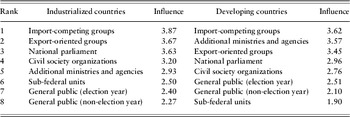
Table 1 shows a ranking of the average influence of domestic constituents for industrialized and developing countries. Respondents could choose between five answers (very low, low, medium, high, very high). Averages were constructed assigning weights to the responses, ranging from 1 (very low) to 5 (very high). Where a country returned two or three questionnaires, a country-specific average was formed first, thus ensuring that all participating countries have the same weight regardless of the number of questionnaires they sent back. Averages are presented on the second-digit level in order to keep the figures from distortion through rounding. It is necessary to emphasize that the subjective evaluation of delegates and the small sample size allow only to discern approximate patterns.
Ranking of domestic constituents by their influence

Several aspects of these results shown in Table 1 are noteworthy:
1. Overall, the difference in the political landscape between industrialized and developing countries is minor. There is no divide between industrialized countries – characterized by a complex inter-institutional process with strong participation of economic and non-economic societal actors and advanced public accountability – and developing countries – where one or few ministries could determine trade policy to their liking. One unsurprising difference is that national parliaments are more influential in industrialized than in developing countries (3.63 vs. 2.96). Interestingly, additional ministries and regulatory agencies wield greater power over negotiating positions in developing than in industrialized countries (3.57 vs. 2.93).
2. The influence of additional ministries and regulatory agencies, as well as of parliaments, is remarkably high (2.93 and 3.63 in industrialized countries, 3.57 and 2.96 in developing countries).Footnote 23 This being the case, trade-policies cannot be explained solely by regarding national interests derived from material economic circumstances, or from the interests and power of sector-based special interest groups or owners of factors of production, as some formal models imply. Executive and legislative institutions matter, whether as spaces where particularistic interests are aggregated or where national interests are defined.
3. Sub-federal units remain among the least important actors (2.50 in industrialized countries, 1.90 in developing countries). While they still rank above the general public in industrialized countries, they are even less influential in developing countries.
4. Special interest groups from import-competing and export-oriented sectors are the most powerful actors (3.87 and 3.67 in industrialized countries, 3.62 and 3.45 in developing countries).Footnote 24 The emphasis put on them in the formal models of trade policy-making is thus warranted in principle. The small difference to other constituents suggests, however, that this focus has been exaggerated. Furthermore, one can see that import-competing and export-oriented interest groups wield approximately equal influence, both in industrialized and developing countries. This contradicts the strongly held traditional notion that protectionist interests groups dominate in domestic politics, which used to justify the need to insulate the GATT regime from domestic influences.
5. On average, civil society organizations are considered to possess moderate power (3.20 in industrialized countries, 2.76 in developing countries). Interviews with the delegates and pertinent literature show that the influence of civil society organizations is highly asymmetric across issues and time. For example, while the lobby from consumer organizations to lower tariffs on goods is weak, public campaigns can exert considerable pressure to reduce subsidies that harm poor farmers abroad or contribute to environmental damage.
6. The general public has only a minor role to play regarding power influence. The small difference between election and non-election years is surprising (2.40 vs. 2.27 in industrialized countries, 2.10 vs. 1.90 in developing countries).Footnote 25 In the interviews, delegates expressed the view that the general public matters significantly only when it is incited and directed by special interest groups or civil society organizations. But governments seem not to actively analyze public opinion in order to anticipate how the general public will receive possible agreements.
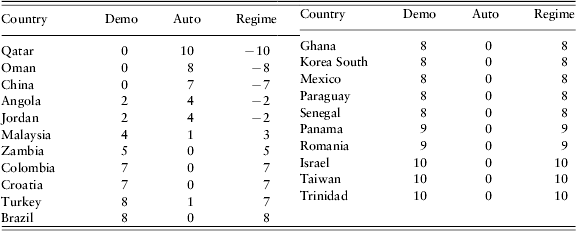
A further comparison can be established between countries with different political regimes. Table 2 shows the regime type of developing countries participating in the survey which are accounted for in the Polity IV database for the year 2004 (excepting only Antigua, Barbuda and Hong Kong). The regime type value is constructed by subtracting a country's value on an autocracy index (Auto) from its value on a democracy index (Demo).
Regime type of developing countries participating in the survey
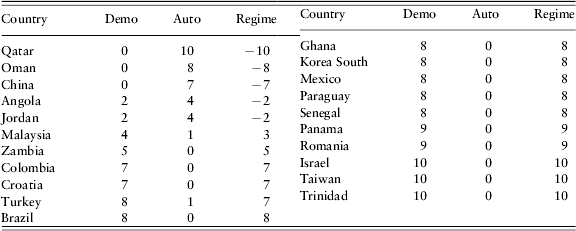
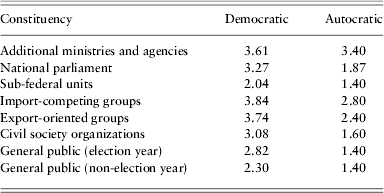
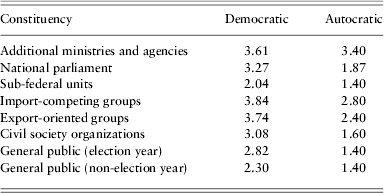
A regression analysis shows no significant correlation between the participation of domestic constituents and regime type. The reason for this astonishing result is that in countries with ‘decent’ political conditions (that is, regime type values of 3 or higher), which make up for the majority of responses, no such correlation exists. When those five countries with the lowest regime type values (−10 to −2) are juxtaposed with the remaining set, however, the disparity is striking. Table 3 presents the average values of domestic constituent participation for the 18 ‘democratic’ and the 5 ‘autocratic’ developing countries. It can be seen that only additional ministries and regulatory agencies wield about equal influence in ‘autocratic’ as in ‘democratic’ countries. Pressure groups with economic interests still fare relatively well even in ‘autocratic’ countries, whereas the national parliament, sub-federal units, civil society organizations, and the general public have only low to very low influence.
Influence of domestic constituents according to countries' regime type
Changes in influence
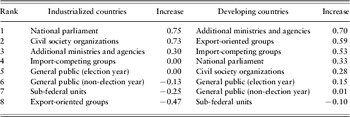
The second important aspect of the questionnaire dealt with the development of the domestic policy-making process. Answers could again be marked on a scale ranging from 1 to 5, with 1 standing for strongly decreased, 3 for unchanged, and 5 for strongly increased. Table 4 displays a ranking of increases in the influence of domestic constituents for industrialized and developing countries. These values result when the value of 3, or ‘unchanged’, is subtracted from the average response values. A value of 0 thus signifies that there has been no change in relative influence of this constituent.
Ranking of domestic constituents by increases in their influence

It should be noted that the responses are likely to substantially underestimate real changes since the experience of many delegates is limited to a few years; most delegates who participated in the Uruguay Round are no longer at their missions and would not be filling out this questionnaire.
Upon analysis of these tables, the following points can be elucidated:
1. With regards to developing countries, an overall tendency of increasing domestic politicization of trade policy-making is confirmed by the responses. This comes at the cost of those ministries traditionally in charge of trade policy-making in capitals, while also decreasing the discretion of delegates in Geneva. In industrialized countries, patterns of influence among stakeholders have also changed. Those stakeholders that have strengthened their position even in industrialized countries are the national parliament, civil society organizations, and additional ministries and regulatory agencies. The fact that these are all actors with strong non-economic concerns is of interest.
2. The tendency noted during the Uruguay Round that sub-federal units are becoming more involved in the development of WTO negotiating positions has not lasted. A large majority of delegates perceive their influence as unchanged.
3. Import-competing and export-oriented interest groups have grown more influential in developing countries. In industrialized countries, by contrast, the sway of import-competing interests has remained stable, while the power of export-oriented sectors and companies has even diminished. This is in line with recurring complaints that multinational companies do not back the current Doha Round with the same strength evidenced during past multilateral trade rounds.
4. Interestingly, the influence of the general public, whether in election or non-election years, has stayed largely unchanged. The increasing domestic politicization of WTO issues appears thus to stem less from a greater interest in trade issues shown by society in general, but rather from a more efficient organization of societal non-economic interests (as reflected in the relatively strong gains in influence by civil society organizations).
4. Implications for the WTO
The major changes in trade policy-making, as shown by the responses to the questionnaire, concern the role of additional ministries and regulatory agencies, the national parliament, import-competing and export-oriented interest groups, and civil society organizations. This section will discuss how these changes are likely to affect the progress of multilateral liberalization. It draws on the literature and the interviews conducted with delegates and employees of the WTO. First, greater involvement of certain domestic constituents entails more protectionist policy preferences. Second, more participatory trade policy-making discourages risk-averse governments. This is because these governments find it difficult to assess how strongly domestic constituents will react to agreements and how much pressure they will be able to exert if they are dissatisfied. Third, flexibility of member states' negotiating positions diminishes as more domestic actors have a greater say on trade policy-making. Fourth, governments, which benefit not only from what they attain but also from what they are seen to be fighting for, face greater incentives to be tough in their demands to attain market access abroad, as well as their refusal to grant access to their domestic markets. This pessimistic view resonates with other work on two-level games that shows how domestic conflict can inhibit international cooperation.Footnote 26 This does not, however, mean that more participatory trade policy-making is a predominantly negative type of development. Indeed, it is necessary to warrant the legitimacy of the world trading system and thus assure its long-term success.
More protectionist policy preferences
In the interviews, delegates expressed the view that the greater involvement of additional ministries, such as those for agriculture, fisheries, education, or culture, made their negotiating positions on average more protectionist. One possible reason for this is that additional ministries are more concerned about the non-economic regulatory objectives that might be endangered by liberalization. They tend to consider these objectives as more important and more threatened by liberalization than economic ministries. The latter emphasize the central role of economic growth and are more likely to believe in the market forces as the most effective way to attaining this growth. This negative attitude towards the WTO appears to be connected to a lesser degree of knowledge about likely effects. Exposed to substantial uncertainty about the legal functioning of the WTO and the likely effects of liberalization, additional ministries that are only recently or occasionally concerned with the WTO tend to believe in pessimistic scenarios.
A second reason for the protectionist inclination of additional ministries is that they perceive a stake in the existing policies that are being questioned by multilateral liberalization as they have themselves developed and implemented them. At issue is thus not only a rational evaluation of how to weigh competing objectives and to select optimal policies to attain them, but also bureaucratic resistance to changes in established regulatory approaches. This is especially pertinent if these changes are induced from the outside.
Connected to this is the fact that additional ministries have a different relationship to the WTO. As they are less acquainted with the reciprocal nature of the WTO, they do not accept the need to make concessions on what they consider optimal policies. Being far removed from the actual negotiations, they are less aware of the problems at the international level that an overly protectionist position implies for their state. They do not directly witness the pressure brought to bear on their country and they are less upset by the idea of tarnishing their country's reputation as a cooperative member of the international community.
This being the case, these ministries are generally classified as protectionist forces within their countries' trade policy-making process. They are seen as committed to regulatory objectives and approaches that are potentially in conflict with WTO rules, while remaining less informed or concerned about their overall beneficial effects. They are often confronted with manifold warnings and complaints about the WTO from their stakeholders, and not acquainted with the big picture of concession trading between member states.Footnote 27
The second point on which delegates agreed was that the greater average participation of parliaments tended to decrease their countries' readiness to open up their markets.Footnote 28 One reason for this is that parliamentarians have narrower constituencies, and thus more specific interests, than the executive bodies. They enlist support for their specific protectionist needs by endorsing the claims for protection by other parliamentarians. In addition to this log-rolling procedure, parliamentarians usually lack a thorough understanding of the WTO. As the selective signals they receive from their constituents are biased towards a negative perception of the WTO, they tend to be weakly informed, but skeptical.Footnote 29
Delegates perceived civil society as a strongly protectionist force. Most non-governmental organizations attempt to preserve a non-economic good, such as a healthy environment, safe food, and public education, against a perceived infringement driven by national and multinational economic interests. Consumer interest groups that traditionally appreciate free trade for its price-decreasing and variety-enhancing effect, are relatively weak and have been partly aligned to the WTO-skeptical mainstream, particularly regarding instances of health concerns arising from genetically modified organisms.
Furthermore, in developing countries, civil society organizations assume the defense of certain import-competing interests. In doing this, they do not only engage in surprising alliances with ailing industries, but they genuinely represent economic and non-economic interests. For example, rural development organizations equally struggle for the incomes of poor farmers, basic and agriculture-specific public services, and environmentally friendly local production and consumption patterns. This link to small producers with minor immediate export interests, fear of foreign competition, and an aversion against domestic regulatory liberalization that might accompany the opening to international trade makes civil society organizations all the more protectionist.
A further difference to the classic case is that international civil society organizations engaged in a worldwide struggle against ‘neo-liberalism’ are often preponderant in developing countries. They have the necessary expertise, the international connections, and the financial resources to shape the opinion amongst national civil society organizations on the WTO and to multiply civil society activity that is in line with their beliefs.
While most civil society organizations that are active on trade issues in industrialized countries are also positioned against the WTO, an increasing share subscribes to the ‘fair trade’ concept espoused in particular by organizations like OXFAM. Rather than unconditionally fighting against the WTO as an instrument of ruthless capitalism and imperialism, they exert political pressure on industrialized countries' governments to reduce tariffs and subsidies judged as harmful to the global poor or the environment.
Stronger discouraging effects of risky WTO agreements
Common sense and scientific evidence converge in the observation that governments, and human beings more generally, are risk-averse. This being the case, governments would prefer an international agreement with a guaranteed gain rather than agreements with several possible results if both offer the same average gain. More generally, the value of an agreement for governments decreases as the standard variation of expected outcomes increases. The important point is that a discouraging effect of risk can exist even if WTO agreements do not decrease governments' utility below the status quo without an agreement. Even if all expected outcomes involve net gains, uncertainty about the level of gains reduces the value of an agreement. Assuming that negotiations are efficient, governments expand their cooperation until the marginal benefits of further cooperation equal its marginal costs. By reducing the value of possible agreements, the risk involved in WTO agreements thus exerts a discouraging effect on the progress of multilateral trade liberalization. In other words, the greater the risks involved, the earlier the marginal gains from additional cooperation become zero.
The discouraging effect of risk is relevant in the context of domestic trade politics because governments find it difficult to assess how strongly domestic constituents will react to agreements and how much pressure they will be able to exert on the government if they are dissatisfied. Many domestic constituents are slow to inform themselves about possible WTO agreements, to adopt a position, and to mobilize their forces – with the intention of shaping the negotiations, of hindering implementation, or of ‘punishing’ their government with an eye on preventing further agreements of the same sort. Anticipating future political consequences is additionally complicated by domestic constituents' incentive to misrepresent their resolve and strength in order to impress governments. This means that governments are less willing to make concessions in WTO negotiations as the influence of domestic constituents increases because they fear internal disputes and public protest at the negotiating and implementation stage.
Reduced negotiating flexibility
If negotiations are (Pareto-) inefficient, gains from multilateral liberalization, which would be attainable despite governments' politically biased negotiating positions, remain unexploited. Thus, there would be an alternative, more liberal agreement that would improve the utility of at least one government without reducing the utility of another government. One reason for such inefficiency is a lack of flexibility in negotiating positions. This problem is discussed in the present section. States' excessive claiming on the gains from cooperation, another cause of inefficiency, will be treated subsequently.
Flexibility can be understood as the speed and intensity with which states react to market access offers and requests, as well as to suggestions for rules, submitted by other states in WTO negotiations. Member states' flexibility significantly influences the success of WTO negotiations. Since states benefit asymmetrically from any concession, it is not sufficient that a large number of states be willing to make concessions of substantial total value provided that others do the same. It is also necessary that these concessions benefit those states that are prepared to reciprocate. In other words, the exchange of concessions is an intricate matching process that requires a constant assessment of trade-offs across sectors and issue areas (e.g. market access in textiles against concessions on intellectual property rights). This is complicated by the fact that states are uncertain about the preferences of other states. The evaluation of how much a concession costs one government and benefits others depends on complex repercussions on economic and non-economic values, as well as on domestic political considerations. Consequently, states need to learn about each other's preferences during negotiations and to adapt their offers and demands. Moreover, windows of opportunity may open during one major meeting and close immediately afterwards. Ministerial meetings, the most important events in WTO negotiations, are held every two years. In the meantime, circumstances may change and thwart progress towards an agreement that would have been within reach before.Footnote 30 Governments may change, pre-election periods may immobilize main players, economic conditions and public opinion may turn, and protectionist interest groups may strengthen their positions. Therefore, member states need both the flexibility to recalibrate their negotiating positions between the rare Ministerial meetings and to achieve this within the days or even hours of critical negotiations.
Delegates confirmed that the flexibility of negotiating positions has been diminishing as more domestic actors have acquired a greater influence on trade policy-making.Footnote 31 First and foremost, consulting constituents with a recognized say on trade policy-making and achieving sufficient support for new negotiating positions takes time. Second, the trend towards institutionalization of domestic trade policy-making processes additionally recognizes and legitimizes the claims of private actors. Domestic constituents come to expect that compromises developed in these participatory policy-making systems weigh heavily on the country's negotiating position. This perception restrains governments that want to avoid political conflict at home, binding them to their original negotiating positions if no alternative consensus can be established. Lastly, governments need additional time to learn about the likely domestic political consequences of possible WTO agreements. The negotiating period thus serves as a test phase to gauge the clout of special interest groups and civil society organizations and the slow opinion building within the parliament and general public. The more domestic constituents care about the actions their government takes in the WTO, the longer governments will wait before making a move in order to avoid miscalculations.
Tougher fighting for the gallery
The bargaining over how the gains from cooperation in the WTO should be shared between governments constitutes a major obstacle to multilateral liberalization.Footnote 32 Since each government is uncertain about how other governments evaluate possible WTO agreements and their best alternatives to a negotiated agreement, it has an incentive to engage in aggressive gain-claiming, hoping to shape the resulting agreement in its own favor. By contrast, governments are enticed to moderate their initial negotiating positions and soften their gain-claiming over time. Doing so avoids delays and reductions in the ambition of the negotiations, prevents deadlocks that might damage the WTO in the long-term, and helps to avoid peer pressure.
Greater domestic politicization of trade policy-making shifts the balance of these competing factors in favor of tougher gain-claiming strategies. Economic interest groups have become more active in many member states since the Uruguay Round, and the greater transparency of WTO negotiations facilitates the monitoring of how governments defend particular interests. Therefore, governments face greater incentives to be tough in their demands to attain market access abroad and in their refusal to grant access to their domestic markets. A similar case can be made regarding non-economic values. Here, the increasing influence of civil society organizations frightens governments. This keeps them from making concessions without being able to argue that they have been struggling as hard as they reasonably could to further non-economic values. In both cases, governments benefit not only from what they attain, but also from what they are seen to be fighting for.
This effect is mitigated by the fact that other domestic constituents desire their government to be more willing to compromise. This is predominantly a consequence of the fact that making compromises facilitates the conclusion of an agreement and allows a state to claim concessions from other countries in return. Nevertheless, delegates in the interviews felt that greater domestic constituent participation toughens gain-claiming in the final balance. An explanation for this is that export-oriented interests use their influence first in compelling their governments to insist on concessions from other countries. The benefits of such lobbying are immediately visible. The benefits of convincing their governments to improve market access for foreign producers with the expectation that this might favor their own export interests are more uncertain. Own market opening may bring few foreign concessions. And even if market access abroad may be improved in exchange, it is not clear which export-oriented industries will be concerned. The export lobby thus suffers from a free-rider problem when attempting to promote own market opening. In contrast, import-competing pressure groups can focus their clout on preventing specific liberalization commitments that would harm their interests. Furthermore, the additional ministries and parliaments acquiring a greater say in trade politics tend also to be skeptical of own market opening but do little to restrain demands for market opening abroad.Footnote 33 This explains why overall domestic constituent involvement is associated with tougher gain-claiming.
5. Conclusion
The formal political-economy literature on trade policy that works with statistical methods and formal models is beset with the number of relevant constituents, the complexity of factors that shape their policy preferences, the heterogeneity of channels through which they exert influence on their country's negotiating position in the WTO, and the variety of interfering variables that also impacts trade policies. Verbal analyses contained in case studies and in expert observations on trade policy-making practice provide a richer picture. They congruently show that the GATT-model of autonomous policy formation by trade specialists with a varying degree of involvement by special interest groups with economic objectives is coming to an end. It gives way to a more inclusive and politicized WTO style where participation by various state and non-state actors is increasingly being formalized. However, it is generally difficult to infer precise information about the relative influence of the various constituents because each actor's influence is only loosely qualified but not ranked. Similarly, changes in their relative influence are observed without precisely qualifying their respective strength. Moreover, comparing works from this verbal strand of analysis is inherently problematic.
The survey of national delegations to the WTO presented in this article contributes to filling this gap. Its key findings are the following:
1. A number of domestic constituents wield substantial influence over industrialized and developing countries' negotiating positions in the WTO. This contradicts the traditional notion that developing countries' governments enjoy significantly more policy autonomy.
2. In industrialized and developing countries, additional ministries (besides the trade, economic, finance, and foreign policy ministries), regulatory agencies, the parliament, and civil society organizations are important players in trade policy-making. This emphasizes the need to go beyond the dominant analytical settings where the general public competes with special interest groups for influence. More complex frameworks are needed.
3. In industrialized and developing countries, import-competing and export-oriented interest groups muster approximately equal influence. This is at odds with the traditional notion that protectionist interests groups dominate domestic politics.
4. The general public has only a minor role to play, both in election and non-election years. While the public interest in trade politics may be increasing, as it is often suggested, public opinion is not a significant force in itself to shape trade policies.
5. How democratic the general political system of a state is does not matter for the influence of domestic constituents on the formation of WTO negotiating positions – as long as countries are ‘decently’ democratic. Variation in domestic constituent participation is then country-specific. Once the democratic quality of a country's political system falls below a certain threshold and is considered ‘autocratic’, domestic constituent participation sharply declines.
6. Trade policy-making in industrialized and developing countries has become more participatory. The gains in influence of non-traditional stakeholders are typically greater in developing than in industrialized countries. An important exception to the generally increasing involvement of the various domestic constituents is the decline of export-oriented interest group activism in industrialized countries.
The changes in the domestic political conditions of trade policy-making have important ramifications for WTO negotiations. Greater involvement by additional ministries, the national parliament, and civil society organizations incline member states' policy preferences towards protectionism. Furthermore, the uncertainty about domestic political repercussions of possible WTO agreements makes risk-averse governments more hesitant to accept WTO obligations. Similarly, member states' flexibility in negotiations shrinks in response to more participatory decision-making. Finally, politically motivated governments fight the harder over the partition of the gains from cooperation the more attentive the spectators at the domestic gallery.
Considering the important implications of domestic constituent involvement, further research is needed. One approach might be to conduct an annual or biannual survey, if possible with the endorsement of the WTO. This would have several advantages. The response ratio could probably be increased; the aggregation or comparison of data across several years would improve the reliability of the results; and changes could be traced more accurately. Furthermore, one might attempt to realize a series of case studies that specifically aim at cross-country comparability and that take due account of the role of actors other than traditional pressure groups with economic interests. Since all methods have their strengths and weaknesses, only their combined results can achieve satisfactory insight.
I am grateful to Dirk De Bièvre, Clara Brandi, Joachim Fünfgelt, Kishore Gawande and Oliver Vergote for comments on earlier drafts of this article. I would also like to thank the reviewers of this journal. The research has been conducted during a stay at the University of Geneva and is supported by the Fritz Thyssen Foundation.
Annex A: Accuracy
The accuracy of responses critically hinges on four points: (1) whether delegates have the requisite knowledge to answer the questionnaire, (2) whether they attribute the same meaning as the researcher to the questions given to them, (3) whether they make an effort to be precise in their responses, and (4) whether they do not consciously misrepresent their beliefs.
1. Knowledge: At first sight, national delegations to the WTO appear not to be the best judge of the domestic policy-making process. The inconvenience of their distance to capitals, however, is mitigated by the fact that most delegates have accumulated substantial experience with trade policy-making at the national level before being dispatched to Geneva. Furthermore, they are generally in close contact with their capitals, receiving negotiating orders and participating in the elaboration of negotiating positions. The claim can be made that this ‘bird's-eye perspective presents delegates with an advantage over national trade policy makers. They are often in charge of a broad portfolio of negotiating issues. They receive aggregated accounts of political sensitivities and are frequently in contact with various domestic constituents. Finally, they notice constituents' efforts at asserting their influence not only at the national level, but also at WTO level through lobbying of and participating in delegations. Another problem is that delegates – as any other potential respondent – may confuse actual influence with the ‘visibility’ of a constituent at the domestic stage.
2. Clarity: The questions were developed in preparatory interviews. The subsequent interviews served to interpret the results and confirmed that delegates shared an ordinary understanding of the questions.
3. Precision: Responses were generally highly differentiated across the (sub-)questions within each questionnaire returned. This indicates that delegates attempted to correctly assess their countries' trade policy-making processes. Only one questionnaire was eliminated ex-post as it gave the same response to all questions.
4. Misrepresentation: Delegates may bias their responses in order to please certain constituents or to give socially desirable answers (e.g. low ratings to import-competing special interest groups). Therefore, delegates were assured of total confidentiality. Moreover, they were free not to respond rather than giving twisted answers for political reasons.
Having reason to believe in the accuracy of the responses is all the more crucial as differences in means between groups of responding countries are not statistically significant. Assuming that the non-response error is not systematic, differences in responses could indicate that delegates did not give random responses – if numbers were large enough. With the present data, the values of the t-statistic do not generally allow the establishment of significant differences in means at 0.1 confidence level as most values of the t-statistic are below 1.5. A qualitative control, however, is possible; the responses quite consistently conform to expectations – whether comparing between different domestic constituents, industrialized and developing countries, or democratic and autocratic states.
Annex B: Non-response error
Even if responses are accurate, a non-response error may distort results. Delegates from five out of the eight industrialized country WTO members responded. Problematically, two lacking countries, the US and Japan, have particular weight in negotiations. It is reasonable to assume that the US Congress has greater weight than average parliaments in industrialized countries. The political-economy literature (cited in Section 2) indicates, however, that trade policy-making has generally developed along similar lines in these countries. Still, it would be highly desirable to attain responses from these two countries in a possible future survey.
Out of 102 developing countries with permanent missions to the WTO in Geneva, 23 responded. The potential non-response error is thus greater for developing countries. In order to assess whether the set of responding developing countries is representative, their geographical composition, income levels, and regime types are all examined.
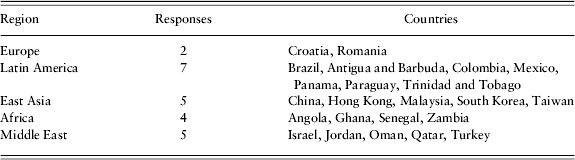
Table 5 splits up responding countries by regions. It can thereby be seen that Africa is underrepresented and that no country from South-Asia has responded, whereas Latin American countries were particularly willing to respond. This geographic representation appears not to be problematic. The average value of the seven Latin American countries for the influence of all domestic constituents is slightly higher than the corresponding average value of the other countries (+0.14), without any strong deviations for any type of domestic constituent (values between +0.01 and +0.32).
Developing countries by regions
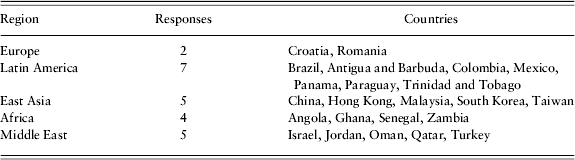
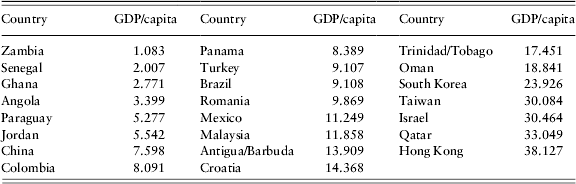
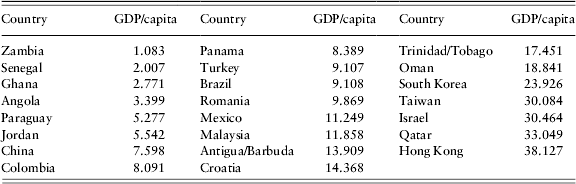
Table 6 presents the purchasing-power-parity adjusted gross domestic product of the responding countries for the year 2006 as estimated by the IMF. Least-developing countries are notably underrepresented. The small number of African countries (4) and least-developed countries (3) prohibits any generalization. At least for this small set of countries, there are no striking differences compared to the other developing countries.
Income levels of developing countries
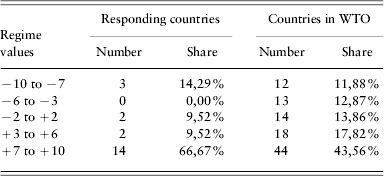
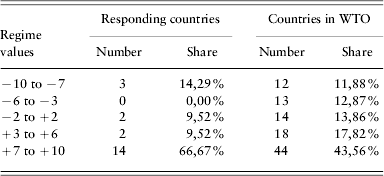
As argued in Section 3, countries with a rather democratic political regime have greater domestic constituent involvement in WTO-related politics than more autocratic states. Table 7 compares the level of participation based on regime type of those 21 developing countries that took part in the survey and for which regime type data were available with the 101 developing countries that are members of the WTO and for which regime type data were available (as shown in Polity IV). The figures show the responding countries as being more democratic/less authoritarian than the average WTO developing country member. However, more democratic countries tend to be more active traders and appear to be more influential in WTO negotiations. A bias towards more democratic countries is thus tolerable if the objective is to assess repercussions on WTO negotiations; that is, if the data set does not need to exactly reflect the membership composition but should also account for countries' weight in negotiations.
Comparison by political regime type
Overall, the survey results are thus likely to slightly overestimate the participation of domestic constituents in developing countries. One additional source of distortion cannot be addressed in this way: delegates felt that they were giving away highly sensitive information, and many non-responses are probably due to precaution. The link between delegates' willingness to provide this kind of information and domestic constituent involvement in their countries' negotiating positions remains unclear. It may be that countries feeling more comfortable about participatory trade policy-making offer greater access to domestic constituents and are more willing to be transparent about their respective influence. It may also be that delegates from countries where domestic constituents are more active, watchdogs are more fearful about compromising their personal position by rating their constituents' influence. The positive relationship between democratic regime type, on the one hand, and domestic constituent influence and survey participation, on the other, suggests that countries with more participatory trade policy-making were also more likely to respond.
Besides a potential non-response error based on countries, a distorted representation of sectors/issues with which delegates deal could bias results. Respondents were thus asked to identify the sector upon which they based their assessment (non-agricultural market access, agriculture, and services). Alternatively, they could choose not to select a specific sector but to base their answers on their experience in the WTO in general. As the majority of delegates selected the latter option, the number of responses for the three sectors is too small for a purposeful interpretation. This sector-specific information does, however, fulfill a control function. The sector-specific responses are quite evenly distributed (with 1/1/2 responses by industrialized countries and 6/6/7 responses by developing countries that are specific to non-agricultural market access/agriculture/services). Since the differences between non-agricultural market access, agriculture, and services are moderate, the slight difference in the share of responses based on a certain sector does not significantly distort overall results or the relationship between industrialized and developing country responses. As one might expect, the clearest sector-based variation is that trade policy-making is most politicized in services. Additional ministries, regulatory agencies, sub-federal units, civil society organizations, and the general public are more influential in this sector than in non-agricultural market access and agriculture. By contrast, import-competing and export-oriented interest groups are equally or less influential in services when compared to the other sectors.
Annex C: Frequency distribution of the survey results
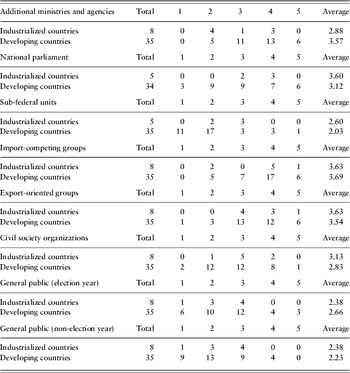
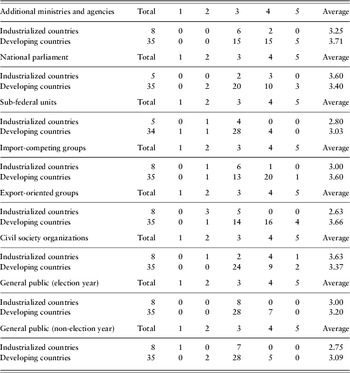
Tables 8 and 9 give the frequency with which each of the five possible answers was chosen with regard to influence and changes in influence of the various constituents. Answers are coded with numbers, ranging from 1 (very low/strongly decreased) to 5 (very high/strongly increased). The tables also show the average value for each characteristic based on total responses (that is, each questionnaire returned was counted equally regardless of whether further questionnaires were sent in by the same country). As some responses were incomplete, their total number does not sum up to 43 on every characteristic. This concerns notably the case of the EU where the question on the role of the ‘national parliament’ was not applicable.
Influence of domestic constituents on WTO negotiating positions

Changes in the influence of domestic constituents