Introduction
Immigration is a formidable trend that changes demographic profiles of many countries. The United States of America (USA) is the top destination for international migration, hosting one-fifth of the worlds’ international migrants (Zong et al., Reference Zong, Batalova and Hallock2018). In 2017, immigrants and their US-born children accounted for 27 per cent of the total US population (Zong et al., Reference Zong, Batalova and Hallock2018). As this population segment continues to grow in the USA, understanding the acculturation experience of US immigrants and factors contributing to their wellbeing are issues of increasing significance.
The family is a key context for such investigations. More than two-thirds of the legal permanent residencies granted in the USA in 2016 were based on family reunification (US Department of Homeland Security, 2017). For older immigrants in particular, the family is not only the major reason for which they migrated, but also the key for their survival and success (Treas, Reference Treas2008b). Most older immigrants came to the USA through sponsorship of their adult children who arrived earlier and often rely on their children for various support due to language barriers and difficulties in accessing entitlement programmes (Batalova, Reference Batalova2012). Older immigrants also reciprocate by providing child care and other household assistances (Treas, Reference Treas2008a). Sometimes caring for grandchildren or providing mutual support across generations is the major reason that drove older adults’ migration (Treas, Reference Treas2008b).
Regardless of age, immigrants bring with them their own cultural norms. As a matter of fact, acculturation experiences often centre around the ongoing negotiations between one's own culture of origin and the new culture in the receiving society (Berry, Reference Berry1997). In the family context, a key cultural norm is filial obligation – the sense of obligation that individuals feel towards ageing parents (Bengtson and Roberts, Reference Bengtson and Roberts1991). Sense of obligation provides a foundation for family dynamics by regulating other aspects of family life such as desired proximity and expectation of support exchanges between generations (Silverstein et al., Reference Silverstein, Gans and Yang2006). As immigrant families adapt to the host society, these values may be challenged. For instance, older adults’ filial expectations may not be met; adult children may be unable or unwilling to fulfil traditional familial obligations or the two generations may not reconcile differences in their expectations. In either case, difficulties in adjusting traditional family norms in the host society may lead to intergenerational conflict or distress, likely compromising the wellbeing of both older and younger immigrants (Wangmo, Reference Wangmo2010).
Our knowledge about culture-related intergenerational conflict in immigrant families is largely derived from studies on first-generation immigrants and their minor/adolescent children (Glick, Reference Glick2010). Much less is known about perceptions of family obligations among older immigrants and their adult children. Several intriguing questions remain unclear: Do older immigrants have higher filial expectation on their children than the younger immigrants on themselves? What factors contribute to each generation's expectation of family obligations? Is having a strong sense of family obligations a protective or risk factor for the mental health of each generation?
To address these questions, this study relied on two unique data-sets that contain identical measures of filial expectation among two cohorts of Chinese immigrants in the USA: older immigrants (aged 60+, representing ageing parents’ perspectives) and younger immigrants (aged 21–60, representing adult children's perspectives). We compared the levels of filial expectation between the two cohorts and examined the factors associated with filial expectation as well as the mental health implication of having high filial expectation among each cohort. The findings will shed light on the difficult-to-measure family processes and cultural restructuring in the immigration context. They will also provide useful information for practitioners to identify segments of immigrant populations who may have high mental health risk related to difficulties in cultural adaptation. From the public policy perspective, family obligations are closely related to the issue of who would care for senior citizens. Thus, the findings will also be useful for policy makers to maximise the effectiveness of informal and formal support for the rapidly increasing immigrant populations.
Background
Filial piety in a changing social context
Examining the evolvement of filial expectation and filial behaviours in a changing social context provides a unique lens to understand how macro-level factors such as modernisation and immigration shape micro-level family behaviours. Back in Asia, studies provided mixed evidence of both erosion (ACY Ng et al., Reference Ng, Phillips and Lee2002) and perseverance of filial norms (Luo and Zhan, Reference Luo and Zhan2012) in the Chinese society, which witnessed rapid demographic, economic and social changes in the past decades. Two studies took a step further to test the Ageing and Modernisation theory formally, which states that the family status of older adults is reduced in the modernisation process (Cowgill and Holmes, Reference Cowgill and Holmes1972). Both studies lent support to the theory, showing that the rate of modernisation at the society or individual levels is associated with lower levels of filial beliefs and practices (Cheung and Kwan, Reference Cheung and Kwan2009; Khalaila and Litwin, Reference Khalaila and Litwin2012).
Does the immigration process similarly damper this traditional norm of filial piety? The answer is less clear. Qualitative studies on older Asian immigrants in Western societies showed that the new economic, social, and cultural realities in the host society reshaped older immigrants’ filial expectations. A study on Tibetan older adults in India and Switzerland found that those living in India needed more financial support from children, whereas those living in Switzerland required more emotional rather than financial support due to better government benefits to older adults (Wangmo, Reference Wangmo2010). Similarly, Chinese older immigrants in New Zealand reconstructed the concept of filial piety to include ‘community piety’, which indicates social welfare support to elderly immigrants (WW Li, Reference Li2011). In the USA, both Chinese and Korean older immigrants were reported to modify or lower their filial expectations in response to both their and their children's adjustment and struggles in the host society (Kauh, Reference Kauh1997; Lieber et al., Reference Lieber, Nihira and Mink2004). Sun (Reference Sun2014) described such reconstructed expectation as ‘reconfigured reciprocity’, reflecting older immigrants’ lower sense of entitlement to receive filial care from children due to their sense of failure to support their own parents in the country of origin.
From the perspective of adult children, in-depth interviews have documented numerous ways in which adult immigrants with ageing parents adjusted their filial behaviours to reconcile the tension between ethnic tradition and mainstream values. For instance, Korean immigrants in Singapore adopted a ‘virtual co-residence’ strategy and made regular financial remittances to their elderly parents in Korea to maintain the cultural ideal of co-residence and support (Kim, Reference Kim2012). Named ‘situational–reciprocal–filial care-givers’, Chinese adult immigrants in the USA formed relatively non-hierarchical relationships with their parents and became more accepting towards the non-traditional filial practice of placing parents in senior housing (Hsueh et al., Reference Hsueh, Hu and Clarke-Ekong2008). In another qualitative study, Sharma and Kemp (Reference Sharma and Kemp2011) observed a continuum of filial support of Indian immigrants in the USA, ranging from traditional, modified to non-traditional support, illustrating diversity and fluidity of these cultural norms in ethnic communities.
Despite these interesting findings from qualitative studies, a few quantitative studies depicted somewhat different pictures of cultural adaptation in immigrant families. One study compared Chinese older immigrants in the United Kingdom (UK) and their counterparts back in China, and found that the two groups had very similar levels of filial expectations, indicating that living in the UK had little impact on these older adults’ beliefs about filial piety (Laidlaw et al., Reference Laidlaw, Wang, Coelho and Power2010). More studies took another approach of comparing older immigrants to non-immigrant populations in the host countries. The findings are largely consistent, showing that compared to their native counterparts, older immigrants not only had high filial expectation but also received more filial care from their children in multiple dimensions including co-residence, frequency of contact, children's obedience, financial support, care and respect (Liu et al., Reference Liu, Ng, Weatherall and Loong2000; SH Ng et al., Reference Ng, Loong, Liu and Weatherall2000; Chappell and Kusch, Reference Chappell and Kusch2007; Laidlaw et al., Reference Laidlaw, Wang, Coelho and Power2010; Katiria Perez and Cruess, Reference Katiria Perez and Cruess2014). Collectively, these findings seem to suggest that, despite ongoing transformation of filial beliefs in the immigration context, older immigrants and their children still strongly endorse the traditional family norm of filial piety.
Predictors of filial piety
Possibly due to the predominantly qualitative approach of studying filial piety, our understanding of what individual or family factors are related to high filial piety expectations is limited and equivocal. For older adults, studies have both reported that older age is associated with stronger familistic values (Kao and Travis, Reference Kao and Travis2005; Fuller-Iglesias and Antonucci, Reference Fuller-Iglesias and Antonucci2016), and that filial expectation did not vary by age (Wang et al., Reference Wang, Laidlaw, Power and Shen2010). Studies also reported mixed findings that older women had either lower (de Valk and Schans, Reference de Valk and Schans2008), higher (Kao and Travis, Reference Kao and Travis2005; Dong et al., Reference Dong, Wong and Simon2014a), or similar levels of filial expectation compared to older men (Wang et al., Reference Wang, Laidlaw, Power and Shen2010; Fuller-Iglesias and Antonucci, Reference Fuller-Iglesias and Antonucci2016). Some studies reported that better educated older adults had lower filial expectation (de Valk and Schans, Reference de Valk and Schans2008; Fuller-Iglesias and Antonucci, Reference Fuller-Iglesias and Antonucci2016), but others failed to find such a relationship (Kao and Travis, Reference Kao and Travis2005; Wang et al., Reference Wang, Laidlaw, Power and Shen2010). The same is true for the length of stay in the new country: mixed findings showed that either it was not related to filial norms (de Valk and Schans, Reference de Valk and Schans2008), or a longer stay was related to lower filial expectation (Kao and Travis, Reference Kao and Travis2005). In addition, studies on intergenerational relations reported that older immigrants who lived closer to children, had more frequent contact and who provided more support to them had higher filial expectations (Lee et al., Reference Lee, Netzer and Coward1994; Fuller-Iglesias and Antonucci, Reference Fuller-Iglesias and Antonucci2016).
Fewer studies examined predictors of adult children's filial expectation. A study on college students reported that although males scored higher on filial expectation on themselves than females, the two groups had similar actual filial behaviours (Chen et al., Reference Chen, Bond and Tang2007). In contrast, other studies reported no gender differences in filial beliefs among Chinese immigrants in the USA (Lieber et al., Reference Lieber, Nihira and Mink2004) and New Zealand (SH Ng et al., Reference Ng, Loong, Liu and Weatherall2000). Lieber et al. (Reference Lieber, Nihira and Mink2004) further reported no age differences in filial belief among Chinese immigrants in the USA and SH Ng et al. (Reference Ng, Loong, Liu and Weatherall2000) found that both New Zealand and Chinese identities were uniquely associated with greater adherence to filial piety norms. Overall, the limited and mixed findings warrant further investigations of individual and family characteristics that contribute to a greater sense of filial beliefs in immigrant populations.
Filial piety and mental health
As a core family norm shared by many ethnic groups, the sense of filial obligations has profound influence on individual wellbeing. Studies have found that receiving high filial piety from children was related to lower levels of depression, better life satisfaction and positive affects among Chinese elderly (Cheng and Chan, Reference Cheng and Chan2006; Xu and Chi, Reference Xu and Chi2011; Guo et al., Reference Guo, Sabbagh Steinberg, Dong and Tiwari2018). Along the same line, studies have also reported that perception of low filial performance of children was associated with greater suicidal ideation (Simon et al., Reference Simon, Chen, Chang and Dong2014b; H Li et al., Reference Li, Xu and Chi2016), higher perceived stress (Dong and Zhang, Reference Dong and Zhang2016) and sense of loneliness among this population (Dong et al., Reference Dong, Zhang and Chang2015). Such a protective effect of received filial piety on older immigrants may be through greater family support, sense of fulfillment or assurance for future care from children (Guo et al., Reference Guo, Sabbagh Steinberg, Dong and Tiwari2018).
Studies further showed that not only actual receipt, but also high filial expectations may be protective factors of later-life wellbeing. It was found that Chinese and Mexican older adults with higher expectations of familism or filial piety reported better self-esteem (Wang et al., Reference Wang, Laidlaw, Power and Shen2010) and psychological wellbeing (Fuller-Iglesias and Antonucci, Reference Fuller-Iglesias and Antonucci2016), likely because high filial expectation indicates older adults’ better outlook on life (Fuller-Iglesias and Antonucci, Reference Fuller-Iglesias and Antonucci2016) or it promotes positive intergenerational communications (Liu et al., Reference Liu, Ng, Weatherall and Loong2000).
How sense of filial piety influences adult children's wellbeing is less clear, or perhaps, more complex. As young adults in immigrant families often possess better language skills and greater economic and social resources than their ageing parents (Wong et al., Reference Wong, Yoo and Stewart2006), power dynamics are often shifted in immigrant families as older adults may be alienated in conversations about important matters with their adult children or from key family decision-making processes (Lin et al., Reference Lin, Bryant, Boldero and Dow2015). With these changes, children's strong sense of filial obligation towards parents might have a more complex impact on intergenerational interactions as well as their individual wellbeing. Some studies have shown that greater belief in family obligations was related to less conflict with parents, closer relationships with family members and greater perceived social support among high school or college students (Yeh and Bedford, Reference Yeh and Bedford2004; Campos et al., Reference Campos, Ullman, Aguilera and Dunkel Schetter2014). But others found that the same family norm was associated with greater mental distress among adult immigrants, as it may hamper their acculturation process and make it harder for individuals to adjust to the host society (Miranda and Matheny, Reference Miranda and Matheny2000). Schwartz et al. (Reference Schwartz, Weisskirch, Hurley, Zamboanga, Park, Kim, Umana-Taylor, Castillo, Brown and Greene2010) observed such mixed influence of filial piety in their study, which found that endorsing filial norms was associated with both positive psycho-social functioning and psychological distress. They explained that the benefit may result from family closeness that is associated with this value orientation, and the relationship with distress may be driven by incompatibilities between these collectivist values and the individualism that characterises American culture.
Intergenerational comparison of filial piety: what do we know?
There are only a handful of studies that directly compared sense of filial piety between older parents and adult children in immigrant families, possibly due to a lack of data-sets that contain comparable measures. A qualitative study on Korean immigrants in the USA reported that, while less than half of the older Korean Americans agreed on receiving care from children as rewards for giving birth or raising them, all younger respondents reported a strong sense of filial obligation towards their parents (Kauh, Reference Kauh1997). Also, most older Korean immigrants in this study were happy with their children's filial performance, but overall adult children did not feel they had demonstrated proper filial piety to their parents. Together, these findings indicate that the younger generation may have higher filial expectations on themselves than their parents do on their children. It seems the two generations also differ in what they believe is important in filial expectation. Hillcoat-Nallétamby (Reference Hillcoat-Nallétamby2010) found that older parents’ beliefs about filial piety reflected cultural norms of obligation, while young adults felt they should support their parents out of a sense of reciprocity.
There are several notable studies that used a quantitative approach to compare filial piety between ageing parents and their adult children. Kobayashi and Funk (Reference Kobayashi and Funk2010) studied congruence on filial obligations in 100 dyads of older Japanese Canadians and their adult children by asking one question of whether children should take care of their parents in old age. The study reported that the majority of parent–child dyads indicated overall congruence in filial obligations. Similarly, a study on 100 pairs of middle-aged Chinese and their children in New Zealand found no significant difference between parents’ actual expectation and children's felt obligations towards elderly parents (Liu et al., Reference Liu, Ng, Weatherall and Loong2000). Along the same line, SH Ng et al. (Reference Ng, Loong, Liu and Weatherall2000) compared middle-aged parents and their children in New Zealand. They found that in 15.8 per cent of the Chinese immigrant families, children had significantly higher filial expectation than their parents; in 11 per cent of the families, parents had significantly higher filial expectation than children, and parents and children had comparable levels of filial expectation (i.e. convergence) in the rest of the families (73.6%). This level of filial convergence was significantly higher than that of non-immigrant families in the study (36%).
The present study
Overall, the literature reviewed above indicates that we still have preliminary and equivocal understanding about how filial expectation – a key social norm that regulates family relations in most cultures – is involved among both older adults and their offspring in immigrant families. Neither do we know much about personal and family characteristics that shape this family norm and the implication of adhering to such a traditional norm for individual wellbeing. This study aims to address these gaps by using two large data-sets that contain identical and multi-dimensional measures of the cultural norm of filial expectation among older and younger Chinese immigrants in the USA to (a) compare the levels of filial expectations across the two cohorts, (b) examine the factors that are associated with filial expectations in each cohort, and (c) investigate the mental health implications of having high filial expectation in each cohort.
Methods
Sample
Two unique data-sets on Chinese immigrants from East Asia (China, Taiwan, Hong Kong) were used to address the research questions. Information about older immigrants was derived from the Population Study of Chinese Elderly in Chicago (PINE), an extensive study that examines the general health and quality of life of Chinese elderly in the greater Chicago area. Using a community-based recruitment strategy, a total of 3,159 community-living Chinese older immigrants aged 60 and older were recruited from more than 20 social service agencies, community centres, faith-based organisations and senior apartments in the Greater Chicago area between 2011 and 2013 (for more information on study design, see Dong et al., Reference Dong, Wong and Simon2014a). The PINE sample is representative of the Chinese ageing population in the greater Chicago area (Simon et al., Reference Simon, Chang, Rajan, Welch and Dong2014a).
Data on younger immigrants were derived from the PIETY study, which aims to complement the PINE to understand the health, wellbeing and care-giving behaviours of Chinese adult children with ageing parents in Chicago. Relying heavily on referrals from existing PINE participants with engagement from community agencies, 548 Chinese immigrants in the Greater Chicago areas who (a) are aged 21 years or above and (b) have a parent aged 60 years or older were recruited between 2012 and 2014. For both the PINE and the PIETY studies, face-to-face interviews were carried out in respondents’ homes, in the language preferred by the respondents. All study procedures were approved by the Institutional Review Boards of the Rush University.
For the purpose of comparisons, the analytic sample was limited to 3,157 PINE respondents who reported valid information on filial expectation and 468 PIETY respondents who were younger than 60 (to avoid overlapping with the PINE respondents) and reported valid information on filial expectation. The vast majority of the respondents in both PINE (99.65%) and PIETY (97.65%) were foreign-born.
Measures
Filial expectation
Questions were asked to assess both the behavioural and emotional components of filial expectation. The PINE respondents (i.e. older immigrants) were asked: how much do you expect your children to (1) respect you, (2) care for you, (3) greet you, (4) please you and make you happy, (5) obey you, and (6) provide financial support to you, on a five-point scale (1 = very little, 2 = rather little, 3 = average, 4 = rather a lot, 5 = very much). In contrast, the PIETY respondents (i.e. younger immigrants) reported how much they think children should care for their ageing parents in the six filial piety domains on the identical scale. Sum scores were calculated for each group, ranging from 6 to 30, with a higher score indicating a greater filial expectation. Internal consistency reliability was 0.89 and 0.85 for the PINE and PIETY samples, respectively. To capture the magnitude of filial expectation further, the sum scores were recoded to dichotomous variables using a cut-off point of 24 (1 = high filial expectation, if the sum score ⩾ 24; 0 = low or moderate level filial expectation, if the sum score < 24). Twenty-four was used because it indicated an average ‘rather a lot’ or ‘very much’ filial expectation across the six domains assessed. Sum scores that were smaller than 24 indicate that, on average, the respondents reported ‘very little’, ‘rather little’ or ‘average’ filial expectation on all six domains.
It is worth mentioning that, limited by secondary data analysis, the questions on filial piety were asked slightly differently in the two samples. Specifically, the PINE respondents reported their filial expectation of their own children, whereas the PIETY respondents reported their perceived obligation towards older adults in general, not specifically towards their own parents. Despite such nuanced distinctions, conceptually, both questions capture the respondents’ normative belief regarding family dynamics, that is, to what extent adult children in the family should perform various filial obligations. Prior research has also shown that adult children's strong filial responsibility towards older adults in general predicted their care-giving behaviours towards their own parents (Chen et al., Reference Chen, Bond and Tang2007), suggesting that the PIETY respondents who endorsed the filial norms to a greater extent are more likely to internalise such expectation towards their own parents. As such, we believe that the measures of filial expectation are comparable across the two samples.
Explanatory variables
Based on the prior literature, explanatory variables of filial expectation included socio-economic status (i.e. education, income), physical health (i.e. self-reported health), acculturation-related variables (i.e. length of residence in the USA, level of acculturation) and intergenerational interactions (i.e. living arrangement, frequency of contact, emotional cohesion). Education was measured in years; income was indicated by personal annual income, ranging from 1 = US $0–,999 to 10 = US $45,000 + . Self-rated health was recoded as a dummy variable with 1 = good/very good health, 0 = poor/fair. Length of residence in the USA was measured in years. Level of acculturation was measured by 12 questions asking respondents’ preference for speaking a given language (Chinese versus English) in different settings, in media use and preferred ethnicity of those they interact with (Chinese versus Americans) on a five-point Likert scale (Marin et al., Reference Marin, Sabogal, Marin, Otero-Sabogal and Perez-Stable1987). The total acculturation scores ranged from 12 to 60, with a higher score indicating a higher level of acculturation (α = 0.91 for PINE; 0.92 for PIETY).
Intergenerational interactions were reported by the PINE respondents towards their children, and by the PIETY respondents towards their parents. Living arrangement was captured by dummy variables indicating co-residence (1 = living with a child for the PINE respondents; living with a parent for the PIETY respondents). Frequency of contact was also measured by dummy variables indicating whether the respondents had weekly contact with their children (for the PINE respondents) or the parents (for the PIETY respondents) (1 = yes, 0 = no). The PINE respondents also reported how close they felt in their relationship with their children on a four-point scale (1 = not very, 2 = somewhat, 3 = very, 4 = extremely). The PIETY respondents reported how close they felt in their relationship with their parents on a five-point scale (1 = not at all, 2 = very little, 3 = somewhat, 4 = quite a bit, 5 = a great deal). For the purpose of comparison, two dummy variables were created for the two groups to indicate feeling very close to the other generation (for the PINE respondents, 1 = yes if the original score was 3 = very close or 4 = extremely close; for the PIETY respondents, 1 = yes if the original score was 4 = quite a bit or 5 = a great deal).
Mental health measures included depression and anxiety, two relatively common mental health problems among Chinese older immigrants which are closely related to their family relations (Guo et al., Reference Guo, Li, Liu and Sun2015; Guo and Stensland, Reference Guo and Stensland2018). Depression was assessed by a Patient Health Questionnaire (PHQ-9; Kroenke et al., Reference Kroenke, Spitzer and Williams2001). Both the PINE and PIETY respondents were asked to rate how often they experienced nine depressive symptoms (i.e. changes in sleep, changes in appetite, fatigue, feelings of sadness or irritability, loss of interest in activities, inability to experience pleasure/feelings of guilt or worthlessness, inability to concentrate or make decisions, feeling restless or slowed down, and suicide thoughts) during the past two weeks (0 = not at all, 1 = several days, 2 = a week or more, 3 = nearly every day). Sum scores were calculated, ranging from 0 to 27, with higher scores indicating higher levels of depression (α = 0.82 for PINE and 0.67 for PIETY). Anxiety was assessed by the Hospital Anxiety and Depression Scale – Anxiety (HADS-A; Zigmond and Snaith, Reference Zigmond and Snaith1983). Participants were asked how often they experienced seven symptoms (i.e. feel tense or wound up, have a frightened feeling as if something awful is about to happen, have worrying thoughts, sit at ease and feel relaxed, have a frightened feeling like butterflies in the stomach, feel restless, feel panic) in the past week (0 = not at all, 1 = occasionally, 2 = a lot of time, 3 = most of the time). Sum scores were created, ranging from 0 to 21, with a higher score indicating a higher level of anxiety (α = 0.80 for both the PINE and PIETY).
Data analysis
We first presented sample characteristics of both the PINE and the PIETY respondents. To address the first research question (i.e. cohort differences in filial expectation), we compared the two groups in the six individual domains of filial expectation (Mann–Whitney tests), the sum score (t-test) and the dichotomous variable of having high filial expectation (chi-square test). To address the second research question (what variables are associated with high filial expectation), we run separate logistic regressions for the PINE and PIETY to see what explanatory variables in each group are associated with a greater chance of having high filial expectation (1 = yes, 0 = no). We did not use the sum scores of filial expectation and correspondingly linear regressions for such analyses because the variable was highly skewed towards larger values in both samples, particularly the PINE. We further repeated the analysis using the combined samples with a dichotomous variable indicating whether the respondent was from the PINE or PIETY, to see whether the two groups still differ in their filial expectations after controlling for potential differences in explanatory variables. To address the last research question (mental health implications of filial expectation), we run separate negative binomial regressions on depression and anxiety in the two groups using filial expectation, while controlling for all the explanatory variables.
Results
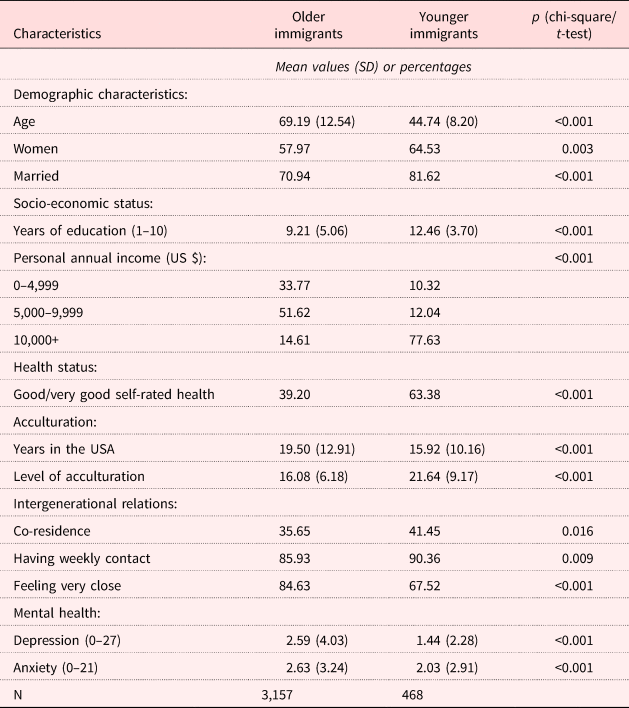
Table 1 presents sample characteristics of the older (PINE) and younger immigrants (PIETY) in this study. The mean age of the older immigrants was approximately 69 years, compared to the mean age of 45 years among the younger immigrants. The majority of the older (58%) and younger (65%) immigrants were women. More than 70 per cent of the older immigrants reported being married, compared to about 81 per cent of the younger immigrants. On average, the younger immigrants reported more years of education (12 years) than the older immigrants (nine years), and also reported a higher annual income than the latter: about two-thirds of the younger immigrants had an annual income that was more than US $10,000, compared to less than 15 per cent among the older immigrants. The younger immigrants also reported significantly better health than the older immigrants (63% had good/very good health, as opposed to about 39% among older immigrants). Although the older immigrants in this study had spent more years in the USA than the younger immigrants (20 years versus 16 years), they had significantly lower levels of acculturation than the younger group (mean = 16.08 versus 21.64).
Sample characteristics of the Chinese older and younger immigrants in the Population Study of Chinese Elderly in Chicago (PINE) and PIETY

Notes: SD: standard deviation. USA: United States of America. 1. Personal annual income ranged from 1 = US $0–999 to 10 = US $45,000 + .
In terms of intergenerational relations, 36 per cent of the older immigrants lived with their children and 41 per cent of the younger immigrants lived with their parents. The majority of the respondents in both cohorts reported having weekly contact with the other generation (86% among the older immigrants, 90% among the younger immigrants). Significantly more older immigrants (85%) reported feeling very close to their children than younger immigrants who reported feeling very close to their parents (68%). Regarding mental health outcomes, older immigrants reported significantly higher levels of depression (mean = 2.59 versus 1.44) and anxiety (mean = 2.63 versus 2.03) than the younger immigrants.
Cohort differences in filial expectations
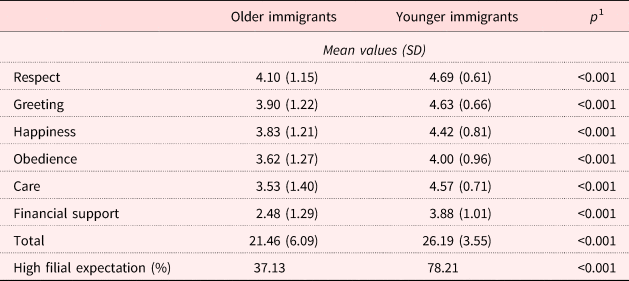
Table 2 compares filial expectations of the two cohorts. The results show that the younger immigrants reported significantly higher scores on all individual indicators and sum scores of filial expectation than the older immigrants. Overall, the younger immigrants were more than twice as likely (78%) to report having high filial expectations of themselves than the older immigrants who had such expectations of their children (37%).
Filial expectation reported by the Chinese older and younger immigrants

Notes: SD: standard deviation. 1. Mann–Whitney U-tests for individual filial piety item; t-test for the sum score; chi-square test for the dichotomous variable of high filial expectation.
Factors associated with filial piety
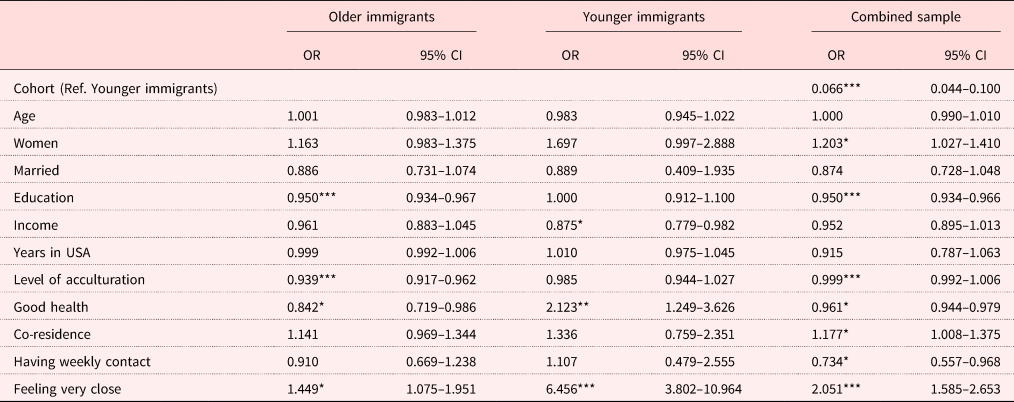
Table 3 reports the results from logistic regressions predicting high filial expectations among the older cohort, the younger cohort and a combined sample of the two. Among the older immigrants, those who were less educated (odds ratio (OR) = 0.950, confidence interval (CI) = 0.934–0.967), less acculturated (OR = 0.939, CI = 0.917–0.962), those who had poorer health (OR = 0.842, CI = 0.719–0.986) and who reported very close relationships with their children (OR = 1.449, CI = 1.075–1.951) were significantly more likely to report high filial expectation. In contrast, among the younger immigrants, those who had lower income (OR = 0.875, CI = 0.779–0.982), better health (OR = 2.123, CI = 1.249–3.626) and closer relationships with their parents (OR = 6.456, CI = 3.802–10.964) were significantly more likely to report high filial expectation.
Results of logistic regressions on filial expectation among Chinese older and younger immigrants

Notes: OR: odds ratio. CI: confidence interval. Ref.: reference category. USA: United States of America.
Significance levels: * p < 0.05, ** p < 0.01, *** p < 0.001.
In the combined sample, after controlling for all the covariates, the older immigrants were still significantly less likely to have high filial expectation than the younger immigrants (OR = 0.066, CI = 0.044–0.100). High filial expectations in this combined sample were significantly associated with being female (OR = 1.203, CI = 1.027–1.410), lower education (OR = 0.950, CI = 0.934–0.966), low levels of acculturation (OR = 0.999, CI = 0.992–1.006), poorer health (OR = 0.961, CI = 0.944–0.979), co-residence (OR = 1.177, CI = 1.008–1.375), infrequent contact (OR = 0.734, CI = 0.557–0.968) and closer a relationship with the other generation (OR = 2.051, CI = 1.585–2.653).
Filial piety and mental health outcomes
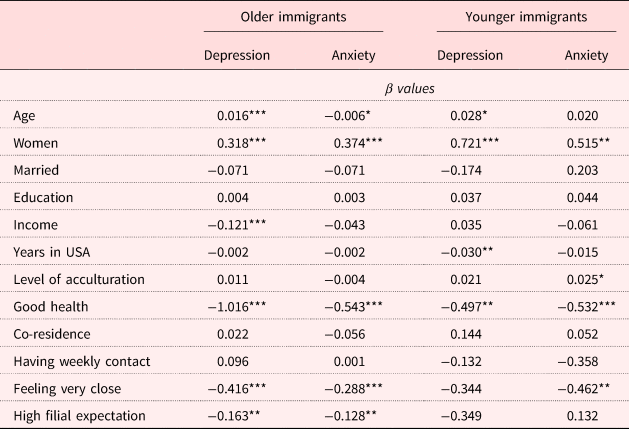
Table 4 summarises results of negative binomial regressions testing the associations between filial piety and the two indicators of psychological wellbeing in each sample, controlling for all the explanatory variables. For older immigrants, having high filial expectations was significantly associated with lower levels of depression (β = −0.163, p < 0.01) and anxiety (β = −0.128, p < 0.01). In contrast, having high filial expectations was not significantly related to depression or anxiety in the younger cohort. In addition, older immigrants who were older, female, and who had poorer physical health and distant relationships with children had significantly higher levels of depression and anxiety. For younger immigrants, being a woman and having poorer health were risk factors for both depression and anxiety. For the younger cohort, a longer stay in the USA was associated with lower levels of depression whereas high levels of acculturation and close relationships with parents were associated with lower levels of anxiety.
Negative binomial regressions on depression and anxiety among Chinese older and younger immigrants

Note: USA: United States of America.
Significance levels: * p < 0.05, ** p < 0.01, *** p < 0.001.
Discussion
Do older or younger immigrants have higher filial expectations?
A major finding of this study is that despite the younger immigrants’ better education, higher income, higher levels of acculturation and reported less-close relationships with their parents, they had significantly higher levels of filial expectation on themselves than that of the older immigrants. This holds true for all domains of filial piety – emotionally, behaviourally or financially – and even when differences in socio-demographic variables, physical health, acculturation and intergenerational relations of the two cohorts were taken into account.
The findings lend some evidence to a different acculturation process for older versus younger immigrants, when both face possibly conflicting norms regarding responsibility for elder-care and independence. Older immigrants in this study seemed to adjust (i.e. lower) their expectation of children's filial piety in the changing social and cultural context, a finding that is consistent with the results from prior qualitative studies (Lieber et al., Reference Lieber, Nihira and Mink2004; Sun, Reference Sun2014), which have frequently reported that older immigrants were afraid of being a burden on their children, who often face similar, if not more struggles in adjustment and adaptation in the host society (WW Li, Reference Li2011). In a study in China, older adults in rural areas did not rate children's filial piety lower after the children migrated to urban areas, implying that the older adults modified their expectations when their children were less available to provide care (Luo and Zhan, Reference Luo and Zhan2012). In addition, since the closeness experience was divergent in the study (i.e. older adults were more likely to report close relationships than adult children did), the higher closeness that the older immigrants felt towards children may also contribute to their lower filial expectation, reflecting their innate desire to not burden but to protect their offspring.
The similar adjustment of filial expectation did not seem to happen for the younger immigrants in this study. Our findings showed that filial piety is still a strong prevailing social norm in this population. It is worth noting that across all the six indicators of filial piety (respect, greeting, bring happiness, obedience, care and financial support), receiving care from children was listed as among the least important expectation for the older immigrants, but a top expectation that the younger immigrants had towards their parents (Table 2). For many Chinese older parents, filial children are responsible persons who make them feel proud (Lum et al., Reference Lum, Yan, Ho, Shum, Wong, Lau and Wang2015). A study on Chinese elderly people reported that adult children's failure to achieve a certain personal and social status of the parents was associated with parents’ greater ambivalent feelings (Guo et al., Reference Guo, Chi and Silverstein2013). This may partially explain why the actual behaviour of children providing care was listed as the least important expectation among Chinese older immigrants. On the contrary, our findings show that despite having high levels of acculturation, younger immigrants still are highly committed to providing care to their ageing parents. Previous research has found that younger generations may feel obligated to support their parents out of a sense of reciprocity or gratitude (Hillcoat-Nallétamby, Reference Hillcoat-Nallétamby2010; Yoo and Kim, Reference Yoo and Kim2010). It is possible that this sense of reciprocity remains strong even as individuals adjust to lives in a new culture. The high filial expectation of the younger immigrants could also be due to perceived societal pressure from relatives or peers, which is common among collective culture (de Valk and Schans, Reference de Valk and Schans2008). It is also likely that, according to Liu et al. (Reference Liu, Ng, Weatherall and Loong2000), younger generations hold a more idealised view of filial piety than their elders, due to having less experience regarding elder-care. Nevertheless, our finding provides evidence of Chinese younger immigrants’ strong adherence to the traditional cultural norm of filial piety.
What factors are associated with higher filial expectations?
Knowing individual and family factors associated with higher filial expectation helps to understand individual variances in the process of acculturation and cultural adaptation. In this study, Chinese older immigrants who had less education, lower levels of acculturation, poorer health and closer relationships with children reported higher filial expectation. Older immigrants who are more educated may have more diverse networks, greater independence, and thus are less likely to rely on their children and expect support from them (Fuller-Iglesias and Antonucci, Reference Fuller-Iglesias and Antonucci2016). de Valk and Schans (Reference de Valk and Schans2008) suggested that education may lead to more diversity in perceptions and opinions, which could facilitate older immigrants’ adaptation to the more individualistic filial norms in American society, contributing to their lower expectation of filial piety from children. In the cohort of older immigrants, a higher level of acculturation may further indicate greater adaptation to Westernised views of independence and autonomy, which also likely leads to lower filial expectations for their children (Kao and Travis, Reference Kao and Travis2005). In the health realm, older immigrants with poorer self-rated health may be more dependent on their children for care and support, and thus have higher expectations of them meeting the care-giving needs (Dong et al., Reference Dong, Zhang and Simon2014b). Feeling close to children is an indicator of cohesive intergenerational relationships. It is possible that older immigrants with a more cohesive relationship with children feel more comfortable expecting care and support from them and may not feel like it will be a burden to their children when receiving such support.
Fewer studies have examined factors that predict filial expectations among younger immigrants. In our study, Chinese younger immigrants who had lower income, better health and closer relations with their parents reported higher filial expectations of themselves. We speculate that the income level of younger immigrants may be related to the power dynamic between them and their ageing parents. Younger immigrants with higher income may have relatively non-hierarchical relationships with their parents and may be less likely to endorse the traditional norm of filial piety that is deeply rooted in the notion that parents have power over their offspring (Lum et al., Reference Lum, Yan, Ho, Shum, Wong, Lau and Wang2015). Conversely, younger immigrants with lower income may be more likely to adhere to the traditional norm of filial piety and have higher filial commitment towards their parents. Similar to older immigrants, self-rated health was significantly associated with filial expectation among the younger immigrants, but better health, not poorer health, was predictive of higher filial piety among the younger immigrants. This is likely because those with good health may feel more capable of caring for older family members, and therefore place higher expectations on themselves to do so. In addition, younger immigrants who have closer relationships with their parents may feel more motivated to provide care and support compared to those who do not feel as close. Notably, in this study, acculturation-related variables were not associated with younger immigrants’ filial expectation. This suggests that filial piety could be a more strongly internalised social norm for this generation compared to older immigrants.
Overall, in the combined sample, the variables associated with high filial expectation are common characteristics of ‘powerless groups’ (i.e. female, lower education, low levels of acculturation, poorer health and co-residence). This may further indicate that high filial expectation among the Chinese immigrants could implicate a certain level of vulnerability and inaccessibility to services or support for these minority people. Future studies should test how availability of individual resources and public services may shape immigrants’ filial expectation.
Is high filial expectation a protective or risk factor for mental health?
The ultimate goal of this study is to find out whether having high filial expectation, which indicates the extent to which an immigrant sticks to his or her own cultural identity, is a protective or risk factor for their mental health. This information is helpful to promote the wellbeing of the rapidly increasing immigrant populations from a culturally sensitive perspective. Overall, our findings revealed different results for older immigrants versus younger immigrants. Retaining this traditional norm seems to be a protective factor for older immigrants’ mental health, as having high filial expectations was related to lower depression and anxiety for this population. The finding is consistent with prior research on both Chinese and Latino older immigrants, which has unfailingly shown that filial piety is associated with better mental health outcomes, including fewer depressive symptoms (Chavez-Korell et al., Reference Chavez-Korell, Benson-Flórez, Rendón and Farías2014; Dong et al., Reference Dong, Li and Hua2017), less perceived stress (Dong and Zhang, Reference Dong and Zhang2016) and fewer suicidal thoughts (H Li et al., Reference Li, Xu and Chi2016). It is likely that older immigrants with higher filial expectation may have a better outlook on life (Fuller-Iglesias and Antonucci, Reference Fuller-Iglesias and Antonucci2016), better self-esteem (Wang et al., Reference Wang, Laidlaw, Power and Shen2010) and feel less stressed about the future as they expect their children to take care of them. Having high filial expectation may also indicate better intergenerational communication (Liu et al., Reference Liu, Ng, Weatherall and Loong2000), which is also beneficial for mental health. Older immigrants may also feel fulfilled if they perceive that their children are adhering to traditional cultural norms.
Interestingly, although younger immigrants on average reported higher levels of filial expectation than older immigrants in the study, such high filial expectation was not significantly related to their better mental health, suggesting that adhering to this traditional family norm may not provide the same protective effect for Chinese younger immigrants as it does for Chinese older immigrants. Such a difference may be due to the different nature of filial expectation for the two cohorts. For older immigrants, filial expectation indicates how much to receive from the offspring, whereas for younger immigrants, it indicates how much to provide to their ageing parents. Having high filial expectation among younger immigrants may mean greater care-giving commitment, either voluntary or enforced, and likely greater burden and stress. Younger immigrants with high filial expectation may worry about their ability to meet their parents’ needs, or that they will disappoint their parents if they do not meet their filial obligations. Meanwhile, given that younger immigrants reported less close relationships with parents than did older immigrants, the findings may also indicate that the high filial expectation of younger immigrants along with their lower levels of closeness with parents may lead to high mental health risks among this immigrant population. In this sense, having high filial expectations could be a stressor rather than a protective factor for younger immigrants.
Limitations
Ideally, to test intergenerational differences, dyadic data (i.e. parent and child from the same family) should be used. Although the PINE and PIETY were designed specifically to understand the migration experience of Chinese immigrants who are (a) older adults and (b) adult children with ageing parents, respectively, there might be some overlap between the two samples in terms of respondents’ roles and perspectives as either parents or children. For instance, theoretically speaking, some older respondents in the PIETY may resonate better with the PINE respondents in terms of value systems than with the much younger PIETY respondents. Future studies should use dyadic data to make more robust cohort comparisons. Related to the first point, the PIETY is composed of individuals with a large age range (20–59). Although sharing the similarity in having an ageing parent aged 60 or older, the PIETY encompasses a quite diverse population. While we have no theoretical rationale to select a sub-sample of the PIETY for comparisons, future studies need to further discern the acculturation process and experience of immigrants of various life stages. Regarding the measurement, due to the secondary data analysis, the measures of filial piety and emotional closeness were slightly different in the two studies (see the Measures section). Although they capture the same theoretical concepts of normative and affectual solidarity, future studies should adopt identical measures to facilitate comparisons. In addition, the measurement of the acculturation level is limited by its primary focus on English proficiency and social interaction. Although the major barrier to becoming assimilated is linguistic (Angel et al., Reference Angel, Buckley and Sakamoto2001), this scale may not fully capture the psychological, behavioural and attitudinal changes that occur along the acculturation process. Future research should include more comprehensive assessment of acculturation. Lastly, despite the large sample sizes of both the PINE and PIETY, they are cross-sectional studies, limiting the external validity of this study. Thus, the conclusions shall be interpreted with caution. For instance, it is likely that individuals’ mental health status shapes their filial expectation, not vice versa.
Implications
Despite these limitations, this study is among the first to use large data-sets of both older and younger immigrants and identical measures among the two groups to compare a core family norm that is prevailing in most immigrant populations. The findings have some important implications for future research and practice. If older immigrants have lower filial expectations and rely less on their children for support, it may be necessary for them to seek support from other sources. Service providers, such as social workers and health-care professionals, must be aware of the available support in the family and potential care-giving needs of older immigrants. Organisations that serve older adults should also be equipped to provide culturally sensitive services to older immigrants. This could include offering a wider range of programming, having materials available in different languages or hiring more culturally diverse staff. It is also imperative that older immigrants are aware of what kinds of services are available and how to access them, as they are less dependent on families for support.
Because younger immigrants still place high expectations on themselves to care for their parents, it is necessary for this generation to have appropriate supports so that they do not become overburdened. Professionals who provide services for immigrants and their families should be aware of the possibility of burden or stress associated with old-age support among this population. It is important that sufficient resources and support are available in the community to help immigrants who are caring for their parents to reduce burden or other negative outcomes that are related to cultural expectations. Furthermore, closeness in relationships seems like a significant confounding factor for intergenerational mutual support and filial expectations. Intergenerational differences in closeness and filial expectations may lead to conflict within families. More studies need to be conducted based on gauging the closeness between generations. Programmes could be designed to facilitate intergenerational conversations and promote intergenerational cohesion in immigrant families.
Previous studies have found that depressive symptoms are common among older Chinese immigrants in the USA (Dong et al., Reference Dong, Chen, Li and Simon2014c). Understanding the factors that promote mental health for older immigrants is necessary in order to provide effective services and interventions. Our findings show that maintaining the traditional value of filial piety may be beneficial in promoting the psychological wellbeing of Chinese older immigrants, particularly among individuals who are better educated and more acculturated as both are related to lower levels of filial expectation.
Financial support
This work was supported by the National Institute on Aging (grant number R21AG055804).