Introduction
Ischaemic heart disease and depression are two of the most prevalent conditions and causes of disability and early death in industrialized countries (Murray & Lopez, Reference Murray and Lopez1996, Reference Murray and Lopez1997). Furthermore, depression is a common co-morbid disorder with acute myocardial infarction (MI) (Schleifer et al. Reference Schleifer, Macari-Hinson, Coyle, Slater, Kahn, Gorlin and Zucker1989; Frasure-Smith et al. Reference Frasure-Smith, Lespérance and Talajic1993). In many well-designed studies, depression has been associated with a two- to fourfold increased risk of adverse clinical outcomes and impaired health status in post-MI patients (Ladwig et al. Reference Ladwig, Roll and Breithardt1994; Frasure-Smith et al. Reference Frasure-Smith, Lespérance and Talajic1995; Barefoot et al. Reference Barefoot, Helms and Mark1996; Spertus et al. Reference Spertus, McDonell, Woodman and Fihn2000; Lespérance et al. Reference Lespérance, Frasure-Smith, Talajic and Bourassa2002; Rumsfeld et al. Reference Rumsfeld, Havranek, Masoudi, Peterson, Jones, Tooley, Krumholz and Spertus2003; De Jonge et al. Reference De Jonge, Spijkerman, Avan den and Ormel2006). Hence, the American College of Cardiology/American Heart Association, and the European Society of Cardiology practice guidelines recommend that the psychosocial status of patients be evaluated, ‘including inquiries regarding symptoms of depression’, and that ‘efforts to relieve stress should be emphasized whenever possible’ (De Backer et al. Reference De Backer, Ambrosioni, Borch-Johnsen, Brotons, Cifkova, Dallongeville, Embrahim, Faergeman, Graham, Mancia, Cats, Orth-Gomer, Perk, Pyorala, Rodicio, Sans, Sansoy, Sechtem, Silber, Thomsen and Wood2003; Antman et al. Reference Antman, Anbe, Armstrong, Bates, Green, Hand, Hochman, Krumholz, Kushner, Lamas, Mullany, Ornato, Pearle, Sloan, Smith, Alpert, Anderson, Faxon, Fuster, Gibbons, Gregoratos, Halperin, Hiratzka, Hunt, Jacobs and Ornato2004).
Despite a growing body of literature stressing the importance of post-MI depression in the pathogenesis of coronary artery disease, there is a paucity of research on the evolution and persistence of depressive symptoms following MI (Schleifer et al. Reference Schleifer, Macari-Hinson, Coyle, Slater, Kahn, Gorlin and Zucker1989). Although evidence suggests that depression is highly prevalent and persistent during the first 12 months post-MI (Davis & Jensen, Reference Davis and Jensen1988; Lespérance et al. Reference Lespérance, Frasure-Smith and Talajic1996; Lane et al. Reference Lane, Carroll, Ring, Beevers and Lip2002; Lauzon et al. Reference Lauzon, Beck, Huynh, Dion, Racine, Carignan, Diodati, Charbonneau, Dupuis and Pilote2003), most studies have used relatively short follow-up periods, dichotomous data, and looked at prevalence rates across time rather than symptom patterns. Accordingly, the question remains if patients exhibit divergent profiles of recovery, as reflected by different symptom levels and course trajectories post-MI.
In a recent report of the National Heart, Lung, and Blood Institute Working Group on Outcomes Research in Cardiovascular Disease, the importance of promoting patient-centred care and its determinants was emphasized, i.e. clinicians need to attend to patients' physical and emotional needs in order to maintain or improve their quality of life (Krumholz et al. Reference Krumholz, Peterson, Ayanian, Chin, De Busk, Goldman, Kiefe, Powe, Rumsfeld, Spertus and Weintraub2005). Since depression has a major impact on patients' physical and emotional needs (Ladwig et al. Reference Ladwig, Roll and Breithardt1994; Thombs et al. Reference Thombs, Bass, Ford, Stewart, Tsilidis, Patel, Fauerbach, Bush and Ziegelstein2006) and quality of life (Goyal et al. Reference Goyal, Idler, Krause and Contrada2005), it is important to determine which factors predict the course of depressive symptoms in post-MI patients. Knowledge of these determinants may point to targets for psychosocial intervention and lead to the design of more successful intervention trials. The two recent randomized controlled trials, ENRICHD (Berkman et al. Reference Berkman, Blumenthal, Burg, Carney, Catellier, Cowan, Czajkowski, De Busk, Hosking, Jaffe, Kaufmann, Mitchell, Norman, Powell, Raczynski and Schneidermann2003) and SADHART (Glassman et al. Reference Glassman, O'Connor, Califf, Swedberg, Schwartz, Bigger, Krishnan, van Zyl, Swenson, Finkel, Landau, Shapiro, Pepine, Mardekian, Harrison, Barton and Mclvor2002), showed that a reduction in depressive symptoms did not translate into beneficial effects on survival, although benefits were found in quality of life (Swenson et al. Reference Swenson, O'Connor, Barton, van Zyl, Swedberg, Forman, Gaffney and Glassman2003). Hence, it remains unclear how to enhance secondary prevention in cardiac patients with depressive co-morbidity. A detailed analysis of the course of post-MI depressive symptoms and its predictors could help in determining the optimal timing for assessment of depression and might guide treatment efforts for depression in post-MI patients.
The aim of the present study was to examine the course of depressive symptoms during the first year post-MI and predictors of these symptom trajectories, using a sound and sophisticated statistical approach and evaluating a wide array of demographic, medical, and psychological variables as possible predictors of those trajectories.
Method
Study design and patient population
Between May 2003 and February 2005, 287 patients hospitalized for acute MI were included from four teaching hospitals (Catharina Hospital, Eindhoven; St Elisabeth Hospital, Tilburg; TweeSteden Hospital, Tilburg; and St Anna Hospital, Geldrop) in The Netherlands. MI was defined according to the following criteria: troponin I levels more than twice the upper limit, with typical ischaemic symptoms (e.g. chest pain) lasting for more than 10 min or ECG evidence of ST segment elevation or new pathological Q-waves. Patients with significant cognitive impairments (e.g. dementia) and severe co-morbidities (e.g. cancer) were excluded. Patients were assessed during the initial hospitalization for MI, and 2 and 12 months post-MI in the cardiology department of the participating hospitals. The research protocol was approved by the medical ethics committees of the participating hospitals, and the study was conducted in accordance with the Helsinki Declaration. After a complete description of the study to the patients, written informed consent was obtained.
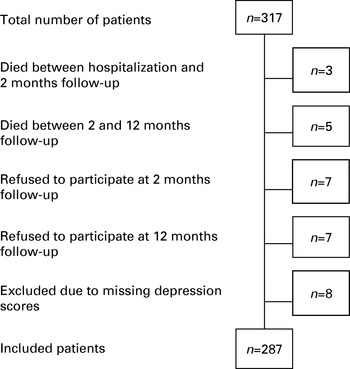
Patients completed self-report measures of depressive symptoms during hospitalization, and at 2 and 12 months follow-up. In addition, they were assessed on Type-D personality and lifetime diagnosis of major depressive disorder (MDD). Demographic and clinical variables were obtained from the medical records. Of the original 317 patients, 287 patients were included in the final analyses (Fig. 1).
Flowchart of patient selection.

Measures
Demographic and clinical characteristics
Demographic variables included age, sex, marital status, educational level, and occupational status. Clinical variables included co-morbidity (defined as arthritis, renal insufficiency or chronic obstructive pulmonary disease), cardiac history [defined as MI, angina, percutaneous coronary intervention (PCI) or coronary artery bypass graft (CABG) surgery prior to the MI], multi-vessel disease, diabetes mellitus, PCI versus conservative treatment, anterior MI location, obesity (BMI⩾30), smoking status (self-report), participation in cardiac rehabilitation, cardiac medications [β-blockers, angiotensin-converting enzyme (ACE) inhibitors, anticoagulants, statins, diuretics, and aspirin] and psychotropics.
Depressive symptoms
The Beck Depression Inventory (BDI) is a 21-item self-report measure developed to assess the presence and severity of depressive symptoms (Beck & Steer, Reference Beck and Steer1993). Each item is rated on a 0–3 scale. A total score is obtained by adding up all item scores. The BDI is a reliable and well-validated measure of depressive symptomatology with a Cronbach's α of 0.81 in non-psychiatric samples (Beck et al. Reference Beck, Steer and Garbin1988; Welch et al. Reference Welch, Hall and Walkey1990), and is a widely used self-report measure of depression. A BDI score ⩾10 is indicative of at least mild to moderate symptoms of depression and has been associated with poor prognosis in MI patients (Frasure-Smith et al. Reference Frasure-Smith, Lespérance and Talajic1995, Reference Frasure-Smith, Lespérance, Juneau, Talajic and Bourassa1999; Lespérance et al. Reference Lespérance, Frasure-Smith, Talajic and Bourassa2002).
Clinical diagnoses of depression
The Composite International Diagnostic Interview (CIDI; WHO, 1990) was used to assess a lifetime diagnosis of MDD based on DSM-IV diagnostic criteria (APA, 1994).
Type-D personality
The 14-item Type-D scale (DS14) was included to assess Type-D personality (Denollet, Reference Denollet2005). Items are answered on a 5-point Likert scale from 0 to 4. The scale consists of two 7-item subscales, negative affectivity (e.g. ‘I often feel unhappy’) and social inhibition (e.g. ‘I am a closed person’). Patients were categorized as Type-D using a standardized cut-off score ⩾10 on the negative affectivity and social inhibition subscales (Denollet, Reference Denollet2005). The DS14 is a valid and reliable scale with a Cronbach's α of 0.88/0.86 and a test–retest reliability over a 3-month period with r=0.72/0.82 for the two subscales, respectively (Denollet, Reference Denollet2005). Type-D has been associated with a four- to eightfold increased risk of adverse clinical outcome (Denollet et al. Reference Denollet, Sys, Stroobant, Rombouts, Gillebert and Brutsaert1996, Reference Denollet, Vaes and Brutsaert2000; Pedersen et al. Reference Pedersen, Lemos, van Vooren, Liu, Daemen, Erdman, Smits, Serruys and van Domburg2004; Denollet, Reference Denollet2005) and comprises a risk factor for the onset of depressive symptoms 12 months post-PCI (Pedersen et al. Reference Pedersen, Ong, Sonnenschein, Serruys, Erdman and van Domburg2006).
Statistical analysis
Latent class analysis (SAS procedure traj) was used to examine trajectories of depressive symptoms in post-MI patients over a 1-year period (Jones et al. Reference Jones, Nagin and Roeder2001). traj fits a finite mixture model to identify groups of individuals following similar patterns of behaviour over time. The time-course of each trajectory is modelled using a polynomial with a maximum order of 3. Subsequently, associations between group membership and covariates can be examined. To determine the optimal number of trajectories, the Bayesian Information Criterion (BIC) was used, with a higher BIC indicating a better fit. BIC is often used for comparing models, as it trades off model fit and model complexity. The optimal polynomial order of each trajectory was examined. Due to the number of measurement points, only constant, linear and quadratic parameters were used. The significance of all parameters (intercept, linear, quadratic) was investigated. If the quadratic parameter did not reach significance, it was dropped from the analysis and was tested for a linear trajectory. If the linear parameter did not reach significance, it was tested for a constant trajectory. Again, models were compared using the BIC. Multinomial logit regression was used to evaluate demographic, medical, and psychological variables as possible predictors of trajectories of depressive symptoms. Variables that were significant at p<0.05 in univariate analysis were evaluated in a final analysis by entering them simultaneously into a multivariate model.
Results
Prevalence and course of depressive symptoms
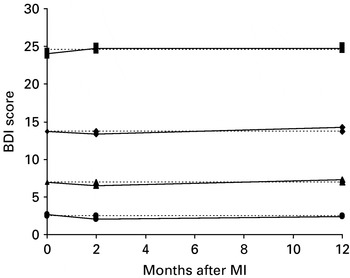
Based on the BIC criteria, a four-group model was found to be the best fitting model. This model was defined by intercept only. Quadratic and linear parameters were not significant. The level of depressive symptoms over time was stable in this sample of post-MI patients (Fig. 2) The first group (40%) was classified as the non-depressed group with a predicted mean BDI score of 2.52 (95% CI 1.69–3.35). The level of depressive symptoms in the second group (42%) was slightly higher than in the first group with a mean BDI score of 6.91 (95% CI 5.72–8.11); hence, this group was classified as mildly depressed. According to the standardized BDI cut-off score of ⩾10, groups 3 and 4 displayed significant depressive symptomatology. Group 3 (14%) had a predicted mean BDI score of 13.73 (95% CI 12.46–14.99) and was therefore classified as moderately depressed. The fourth group (4%) was described as severely depressed, with a mean BDI score of 24.54 (95% CI 22.88–26.20). Accordingly, based on the standardized BDI cut-off score of ⩾10, the prevalence rate of depressive symptoms during the first year post-MI was 18%.
Trajectories of depressive symptoms (- - -, predicted; ——, observed) in post-myocardial infarction (MI) patients. Severely depressed (■); moderately depressed (◆); mildly depressed (▲); non-depressed (●).

The derived finite mixture model suggests a stable course of depressive symptoms in post-MI patients. In order to validate this result, change in depression scores was examined at 2 and 12 months using the baseline depression score as a reference. A clinically significant decrease at follow-up was defined as having a BDI score <10 and a 50% decrease in BDI score. A clinically significant increase at follow-up was defined as having a BDI score ⩾10 and a 50% increase in BDI score. Only a minority of patients improved (severe group, n=0; moderate group, n=6) or deteriorated (mild group, n=29; non-depressed group, n=1) respectively. This suggests that even though there were clinically significant changes at the individual level, at group level the course of depressive symptoms was indeed stable.
Predictors of depressive symptom persistence
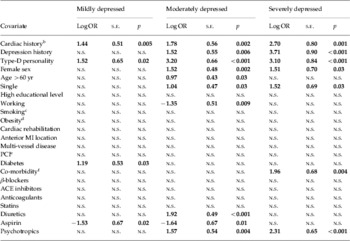
Univariate predictors of depressive symptom persistence are presented in Table 1. The estimates reported in Table 1 are log odds ratios (OR), using the non-depressed group as the reference category. Cardiac history was the most prominent clinical risk factor for depressive symptom persistence over the course of 1-year post-MI, with log odds varying from 1.44 to 2.70. In addition, history of MDD and Type-D personality had the highest associated risk, with log odds varying from 1.52 to 3.71. Other predictors varying according to the level of depressive symptoms comprised gender, age, marital status, occupational status, diabetes, co-morbidity, diuretics, aspirin and psychotropics.
Univariate predictors of depressive symptom persistenceFootnote a

MI, Myocardial infarction; PCI, percutaneous coronary intervention; ACE, angiotensin-enzyme converting; OR, odds ratio; s.e., standard error; n.s., not significant.
a Non-depressed group was used as reference category.
b MI, angina, PCI or coronary artery bypass graft prior to the MI.
c Self-report.
d BMI⩾30.
e Reference group: conservatively treated.
f Arthritis, renal insufficiency, chronic obstructive pulmonary disease.
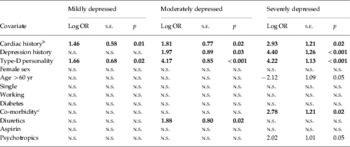
Variables that were significantly associated with one of the symptom trajectories were entered into a multivariate model. As displayed in Table 2, patients with a cardiac history and Type-D personality were more likely to be in the mildly, moderately and severely depressed groups compared to the non-depressed group. Furthermore, patients with a history of MDD and patients taking diuretics were more likely to be in the moderately depressed group, whereas patients with a history of MDD and co-morbidities were more likely to be in the severely depressed group.
Multivariate predictors of depressive symptom persistenceFootnote a

OR, Odds ratio; s.e., standard error; n.s., not significant.
a The non-depressed group was used as the reference category.
b Myocardial infarction (MI), angina, percutaneous coronary intervention or coronary artery bypass graft prior to the MI.
c Arthritis, renal insufficiency, chronic obstructive pulmonary disease.
In post-hoc analyses, the risk of being in the mildly, moderately or severely depressed group was stratified by the most prominent risk factors cardiac history, history of MDD and Type-D personality. There was a continuous relationship between the severity of depression group and number of risk factors, with the largest risk incurred in patients with all three risk factors.
Discussion
The aim of the current study was to examine the course of depressive symptoms and its predictors during the first year post-MI. Depressive symptoms were highly prevalent and the course of depressive symptoms stable. Four trajectories were observed, namely non-depressed, mildly depressed, moderately depressed and severely depressed. Cardiac history, history of MDD and Type-D personality comprised the most prominent risk factors for experiencing depressive symptoms across the trajectories, with patients with all three risk factors being at highest risk for the moderately and severely depressive symptom trajectories.
The present results indicate that symptoms of depression following MI are not a transient phenomenon, with levels of depressive symptomatology persisting during the course of the first year post-MI. Although a minority of patients showed a significant change in the level of depressive symptoms at group level the course of depressive symptoms was stable. These results are in line with a recent review on the prevalence of depression in post-MI patients, showing that the majority of MI patients with depression during initial hospitalization remain depressed 1–12 months later (Thombs et al. Reference Thombs, Bass, Ford, Stewart, Tsilidis, Patel, Fauerbach, Bush and Ziegelstein2006). In addition, in a prospective study of 288 MI patients, depressive symptoms were found to be prevalent and persistent, with only 6.7% of patients depressed in hospital experiencing no further symptoms of depression during the first year post-MI (Lane et al. Reference Lane, Carroll, Ring, Beevers and Lip2002). Although our results are consistent with previous studies, the majority of these studies had a relatively short follow-up period, used dichotomous data and did not assess symptom patterns but rather looked at prevalence rates across time.
One recent study, however, used the same methodology as applied in the current study to examine the course of depressive symptoms during the first year post-MI (Kaptein et al. Reference Kaptein, de Jonge, van den Brink and Korf2006). They identified five distinct courses in 475 post-MI patients, with 18% of patients experiencing elevated depressive symptom levels during the first year post-MI. These findings are fairly consistent with our results, even though they did find unstable trajectories. It should, however, be borne in mind that they had a considerably larger sample size making it more likely to find significant linear and quadratic parameters, and that the timing of the follow-up assessments was different (i.e. 3, 6, and 12 months in the Kaptein study versus 2, and 12 months in the current paper). The percentage of patients in their unstable groups was quite small (<10%), confirming our findings that the majority of post-MI patients display stable patterns of depressive symptoms over time. In post-hoc analysis, we made an effort to validate our model by examining changes using the standardized BDI cut-off. Those results indicated that only a minority of patients improved or deteriorated respectively. Moreover, Kaptein et al. (Reference Kaptein, de Jonge, van den Brink and Korf2006) showed that history of MDD and several psychological measures (e.g. neuroticism) played an important role in predicting a significantly greater risk for severe/persistent symptom trajectories. Patients with persistent symptoms, which were of at least moderate intensity during all follow-up assessments, had the highest rate of new cardiovascular events, indicating the importance of examining the course of depressive symptoms.
Additionally, our findings are compatible with the study by Spijkerman and colleagues reporting that personality was strongly related with ongoing and recurrent depression in 468 post-MI patients (Spijkerman et al. Reference Spijkerman, de Jonge, van den Brink, Jansen, May, Crijns and Ormel2005a). Cardiac history, however, was not found to be a significant predictor of depression following MI, although some trends were observed (Spijkerman et al. Reference Spijkerman, de Jonge, van den Brink, Jansen, May, Crijns and Ormel2005a; Van Melle et al. Reference Van Melle, de Jonge, Kuyper, Honig, Schene, Crijns, van den Berg, van Veldhuisen and Ormel2006). In another recent study, prior MI was associated with depressive symptoms post-MI, irrespective of whether they persisted, subsided, or newly developed in the first month after hospitalization (Parashar et al. Reference Parashar, Rumsfeld, Spertus, Reid, Wenger, Krumholz, Amin, Weintraub, Lichtman, Dawood and Vaccarino2006). In addition, history of MDD has been found to be a strong independent predictor of the development of post-MI depressive symptoms (Spijkerman et al. Reference Spijkerman, van den Brink, Jansen, Crijns and Ormel2005b; Parashar et al. Reference Parashar, Rumsfeld, Spertus, Reid, Wenger, Krumholz, Amin, Weintraub, Lichtman, Dawood and Vaccarino2006).
Insight into the course of depressive symptoms after MI and its predictors is important for clinical practice. First, the chronicity of post-MI depressive symptoms found in the present study strongly argues for routine psychological screening during hospitalization for acute MI. Hospitalization is not only the most convenient moment to screen patients for depression, but early identification and treatment of depression may also prevent symptoms from becoming chronic and improve patients' quality of life. Since depressed cardiac patients have a higher risk of morbidity, mortality and impaired health status after MI (Frasure-Smith et al. Reference Frasure-Smith, Lespérance and Talajic1993, Reference Frasure-Smith, Lespérance and Talajic1995; Ladwig et al. Reference Ladwig, Roll and Breithardt1994; Barefoot et al. Reference Barefoot, Helms and Mark1996; Lespérance et al. Reference Lespérance, Frasure-Smith and Talajic1996; Spertus et al. Reference Spertus, McDonell, Woodman and Fihn2000; Grace et al. Reference Grace, Abbey, Kapral, Fang, Nolan and Stewart2005; Parashar et al. Reference Parashar, Rumsfeld, Spertus, Reid, Wenger, Krumholz, Amin, Weintraub, Lichtman, Dawood and Vaccarino2006), it is important to identify patients with elevated levels of depressive symptoms as early as possible. Those patients should be considered for treatment, be it pharmacological or psychological or a combination thereof. Furthermore, knowledge about the predictors of depressive symptom trajectories may point to targets for psychosocial intervention and lead to the design of more successful intervention trials. The management of depression in MI patients is both a clinical and interdisciplinary challenge, with the development of collaborative and integrative approaches combining the medical and psychological expertise being imperative. However, an important first step in the management of post-MI depression comprises the unravelling of the determinants of depression, which probably consist of a combination of clinical, psychosocial, and biological factors. Studying the biological determinants in future studies may be of particular value, as treatment options for post-MI depression should also have a positive effect on cardiovascular biology (Von Känel & Begré, Reference Von Känel and Begré2006).
The results of the current study should be interpreted with some caution. First, we had no information on left ventricular ejection fraction. However, we included multi-vessel disease to adjust for disease severity. Second, only 4% of patients were in the severely depressed group, which may have led to unreliable results due to the relatively small number of patients within this particular group. Nevertheless, the most prominent risk factors were consistent across trajectories. Third, prior to setting up a multivariate model to predict depressive symptom trajectories, we evaluated a large number of predictors in univariate analysis. Although most of the variables have been associated with depressive symptoms in previous studies, this procedure may have let to overfitting of our regression model. Finally, cardiac history was defined as MI, angina, PCI, or CABG surgery prior to the MI. Since negative affectivity has been associated with thoracic pain unrelated to cardiac iscahemia, it is possible that a higher level of negative affectivity has contributed to misdiagnosed angina in this study. Yet, all clinical variables were obtained from the patients' medical records.
Depressive symptoms following MI are not a transient phenomenon, with levels of depressive symptoms persisting throughout the first year post-MI. Cardiac history, history of MDD and Type-D personality were the most prominent risk factors for depressive symptom trajectories. These findings support the importance of including both clinical and psychological variables in cardiovascular research. Since this is one of the first studies to look at trajectories of depressive symptoms in the year following MI and its determinants, further research is warranted to replicate these findings using this new methodology to describe courses of post-MI depressive symptoms. However, the results of this study strongly argue for routine psychological screening during hospitalization for acute MI in order to identify patients who are at risk for chronicity of depressive symptoms and its deleterious effects on prognosis.
Declaration of Interest
None.