


Introduction
The working alliance is a common factor within psychotherapy (Assay and Lambert, Reference Assay, Lambert, Hubble, Duncan and Miller1999), and meta-analyses support a moderate but consistent effect of the working alliance on treatment outcome for a variety of presenting problems, regardless of therapeutic orientation (Horvath and Symonds, Reference Horvath and Symonds1991; Martin, Garske and Davis, Reference Martin, Garske and Davis2000). The concept of the working alliance emerged from the psychoanalytic treatment literature (Bordin, Reference Bordin1979). Bordin was the first to develop a theoretical operational definition for the working alliance, identifying three factors: (1) agreed-upon goals; (2) agreed-upon tasks to be used in treatment; and (3) bonds formed within the therapy relationship.
Consistent with psychoanalytic theory, scholars proposed that a tear in the working alliance is inevitable due to treatment demands, and that repair of the alliance is an essential part of the therapy process (Bordin, Reference Bordin1979; Gelso and Carter, Reference Gelso and Carter1994). In other words, the beginning phase of treatment is expected to be characterized by rapid development of positive feelings toward the therapist and treatment, followed by ambivalence related to challenges inherent to the therapy process, which are then clarified and worked through toward the end of treatment (Golden and Robbins, Reference Golden and Robbins1990). Case studies support a rupture/repair trajectory of change in working alliance during both time-limited experiential (Horvath and Marx, Reference Horvath and Marx1990) and time-limited psychodynamic therapy (Golden and Robbins, Reference Golden and Robbins1990). More recently, empirical work examining the longitudinal change in working alliance during psychodynamic and interpersonal therapy has found support for rupture/repair, positive linear growth, and stable (unchanging) alliance patterns (Kivlighan and Shaughnessy, Reference Kivlighan and Shaughnessy1995, Reference Kivlighan and Shaughnessy2000; Stiles et al., Reference Stiles, Glick, Osatuke, Hardy, Shapiro and Agnew-Davies2004). Rupture/repair patterns have been posited as either (1) U-shaped over treatment, with initially high alliance scores followed by gradual declines mid-treatment and gradual increases to relatively high scores by the end of treatment or (2) V-shaped with an abrupt decrease in alliance scores sometime (timing is idiosyncratic to clients) during treatment, and a relatively quick repair, within 1–2 sessions (Stiles et al., Reference Stiles, Glick, Osatuke, Hardy, Shapiro and Agnew-Davies2004). As therapies with different approaches would be expected to exert different demands on the relationship, the profile of the working alliance may differ across theoretical orientations (Bordin, Reference Bordin1979; Horvath and Bedi, Reference Horvath, Bedi and Norcross2002). Cognitive behavioral therapy (CBT) emphasizes development of a collaborative working relationship, identification of goals early in treatment, and engagement with tasks to support goals. For example, during CBT for anxiety disorders, a client and therapist work together to construct a fear hierarchy and plan exposures. Thus, the course of the therapeutic alliance within CBT may not show the rupture/repair pattern previously observed in psychodynamic and interpersonal therapy. On the other hand, alliance ruptures may occur when therapists confirm clients’ dysfunctional beliefs about self and others during CBT (Safran, Crocker, McMain and Murray, Reference Safran, Crocker, McMain and Murray1990). Very little empirical research has charted the development of the working alliance over the course of CBT.
Development of the working alliance may be influenced not only by therapeutic orientation, but also by the client's idiographic presenting issues. Social anxiety disorder (SAD) is a case in point. People with SAD avoid social situations, experience intense distress during social interactions (American Psychiatric Association, 2000), and may “establish negative interpersonal cycles between themselves and others in which they adopt behavioral strategies that evoke negative reactions” (Alden and Taylor, Reference Alden and Taylor2004, p. 860). For persons with SAD, negative reactions from others may, in turn, confirm negative beliefs about the self and others. Given that the essence of psychotherapy comprises a social exchange, developing a working alliance may be a particular challenge for persons with SAD.
The limited empirical literature, in fact, suggests this is not the case – although only two studies have examined levels of working alliance in outpatient CBT treatment for individuals with SAD. Both studies utilized samples of participants with a primary diagnosis of SAD who received cognitive behavioral group therapy. In a sample of 53 adults, Woody and Adessky (Reference Woody and Adessky2002) reported that alliance ratings were generally high (mean item rating = 5.84 with a potential range of 1–7). Similarly, Hayes, Hope, Van Dyke and Heimberg (Reference Hayes, Hope, Van Dyke and Heimberg2007) reported high alliance by clients (M = 5.89, SD = 1.11, N = 18) and observers (M = 5.35, SD .93). Woody and Adessky (Reference Woody and Adessky2002) also examined the trajectory of change in the working alliance across sessions. The authors tested a U-shaped rupture/repair pattern wherein working alliance ratings are expected to rise at the beginning of treatment, decrease during the middle phase of treatment, and increase again during later sessions. Rather than quadratic growth predicted by a rupture/repair pattern, results showed positive linear growth for their outpatient sample (Woody and Adessky, Reference Woody and Adessky2002). In a study that examined cognitive and interpersonal treatment for persons with social phobia in an inpatient residential program, participants reported U-shaped change in their alliance with the therapist, whereas therapists reported linear growth (Hoffart, Borge, Sexton and Clark, Reference Hoffart, Borge, Sexton and Clark2009). In summary, although one might expect people with SAD to have difficulty developing and maintaining a working alliance, what little research exists suggests otherwise. Further, instead of the rupture/repair pattern commonly (although not universally) seen within psychodynamic and interpersonal therapy, participants receiving outpatient CBT for SAD report that the working alliance shows a linear pattern of change, with scores that steadily increase over time.
The present study seeks to add to the limited empirical literature on the trajectory of change in the working alliance by examining its course during two types of CBT for SAD, exposure group therapy (EGT) and individually administered virtual reality exposure therapy (VRE); it is only the second study to examine the trajectory of the working alliance in outpatient treatment of CBT for SAD. Because some empirical literature on CBT for SAD supports a “rupture and repair” pattern, whereas other literature supports a pattern of steady improvements in alliance across sessions, both trajectories will be examined. We hypothesize that, similar to other studies of outpatient samples with SAD, working alliance ratings will show a positive linear rate of change over the course of CBT treatment.
This also is the first study to examine the working alliance among people receiving an individual treatment for SAD, as well as one of the first studies to examine the trajectory of the working alliance within virtual reality exposure therapy, a relatively novel way to administer exposure therapy. During VRE, a person encounters a feared stimulus in a computer-generated environment presented via a head mounted display that allows for multisensory input. VRE has been shown to be effective for treating anxiety disorders (Powers and Emmelkamp, Reference Powers and Emmelkamp2008), including social phobia (Anderson, Zimand, Hodges and Rothbaum, Reference Anderson, Zimand, Hodges and Rothbaum2005; Klinger et al., Reference Klinger, Bouchard, Legeron, Roy, Lauer and Chemin2005) and public speaking fears (Wallach, Safir and Bar-Zvi, Reference Wallach, Safir and Bar-Zvi2009). Other computer based interventions for anxiety disorders, such as internet delivered therapy for social phobia, have shown high levels of working alliance (Anderson et al., Reference Anderson, Spence, Donovan, March, Prosser and Kenardy2012), and one study of anxious youth indicated levels of working alliance comparable to traditional psychotherapy (Anderson et al., Reference Anderson, Spence, Donovan, March, Prosser and Kenardy2012), but limited evidence exists for VRE. Scholars suggest that development of the working alliance may be impaired within VRE because the head-mounted display poses a physical barrier between the therapist and client, thereby preventing eye contact during exposure (Meyerbroker and Emmelkamp, Reference Meyerbroker and Emmelkamp2008). Recalling Bordin's (Reference Bordin1979) definition of the working alliance as consisting of agreed-upon goals, tasks, and the emotional bond, one might expect that VRE may inhibit the emotional bond. One empirical study involving participants with specific phobia compared augmented VRE with in vivo exposure therapy and found no difference between the task and goal aspects of the working alliance; the emotional bond of the therapeutic alliance, however, was not assessed (Wrzesien, Burkhardt, Botella and Alcaniz, Reference Wrzesien, Burkhardt, Botella and Alcaniz2012). The current study uses a measure that assesses the goal, task, and emotional bond aspects of the working alliance. We hypothesize that, relative to participants receiving EGT, those receiving VRE will report lower levels of the “emotional bond” aspect of the working alliance; no differences in the goal and task aspects of the working alliance are expected.
Method
This is secondary data analysis from an NIMH-funded, randomized clinical trial comparing VRE therapy to EGT and a wait-list control (WL; Anderson et al., in press). Relative to WL, participants randomly assigned to either treatment benefited from it compared to a wait-list control, with effect sizes (Cohen's d) immediately posttreatment ranging from .58 – 2.55 on standardized self-report questionnaires of fear of negative evaluation and fear of public speaking and on anxiety during a posttreatment behavioral avoidance task (i.e. giving a speech).
Participants
Participants (N = 63) were recruited through newspaper advertisements, posted flyers, internet-based sources targeted at persons with fear of public speaking, contacts with professionals, and word-of-mouth. Inclusion criteria included a primary diagnosis of social phobia, with fear of public speaking as the predominant social fear, and the ability to speak and read English. Participants taking psychoactive medication were required to be stabilized on their medication(s) and dosage(s) for at least 3 months prior to treatment; the same dosage was to be maintained for the duration of the study. Exclusion criteria included: (a) history of mania, schizophrenia, or other psychoses; (b) active suicidal ideation; (c) current substance dependence; (d) inability to tolerate the virtual reality helmet; and (e) history of seizures.
The sample was predominately female (61.9%, n = 39). Average age of participants was 40.02 years with a standard deviation of 11.96 years. Based on participant description, ethnic distribution of the sample was as follows: “Caucasian” (54%, n = 34), “African American” (28.6%, n = 18), “Latino” (4.8%, n = 3), “Asian American” (3.2%, n = 2), or “Other” (9.5%, n = 6). Within the “Other” category, participants self-identified as “African” (n = 1), “Multi-racial” (n = 1), “Chinese” (n = 1), “Eritrean American” (n = 1), and “Other-Not Specified” (n = 2). The sample had relatively high educational achievement; 66.7% earned college degrees. A large portion of the sample (44.4%) reported an annual income of $50,000 or more. Approximately half of the sample indicated involvement in a committed relationship. The majority of participants did not have a co-morbid diagnosis (n = 49, 77.8%). Co-morbid diagnoses included Specific Phobia (n = 7), Major Depressive Disorder (n = 4), Generalized Anxiety Disorder (n = 4), Dysthymia (n = 2), Panic Disorder without Agoraphobia (n = 1), and Post-traumatic Stress Disorder (n = 1).
Measures
Structured Clinical Interview for the DSM-IV (SCID; First, Gibbon, Spitzer and Williams, Reference First, Gibbon, Spitzer and Williams2002). The anxiety, mood, and substance disorder modules of the SCID were administered to determine whether participants met inclusion criteria for a primary diagnosis of SAD as well as co-morbid Axis I disorders.
Working Alliance Inventory-Short Form (WAI-SF; Horvath and Greenberg, Reference Horvath and Greenberg1989). The WAI-SF is a 12-item instrument used to evaluate the therapeutic alliance. It permits assessment of the relationship as a whole (total score) as well as three subscales including: (1) mutually agreed upon goals; (2) tasks used to pursue goals; and (3) the bond between the client and therapist. Participants are asked to rate items on a 7-point Likert scale ranging from 1 (Not at all) to 7 (Very much). Total scores range from 7 to 84; higher scores indicate a stronger alliance. The WAI demonstrates good psychometric properties, including content validity and internal consistency (α = 0.93; Tracey and Kokotovic, Reference Tracey and Kokotovic1989). The WAI-SF shows similar properties as the original, full length WAI (Busseri and Tyler, Reference Busseri and Tyler2003). The WAI-SF was administered following each treatment session.
Treatment
Both therapies were administered according to a treatment manual (VRE; Anderson et al., Reference Anderson, Zimand, Hodges and Rothbaum2005) and (EGT; Hofmann, Reference Hofmann2004). Study therapists were two licensed clinical psychologists (senior therapists) and three doctoral students in clinical psychology (junior therapists). All therapists attended a 2-day training workshop provided by the developers of each treatment manual. Every therapist conducted both treatments; and, for EGT, groups were led by a team comprised of a senior and a junior therapist.
Both treatments addressed processes commonly shown to maintain social anxiety, such as self-focused attention, negative perceptions of self and others (in social situations), perceptions of poor negative emotion regulation, ruminative tendencies, and unrealistic or lack of goal setting in social contexts. Targets for treatment were addressed through use of cognitive techniques that focused on deconstructing and ameliorating the impact of negative perceptions as well as behavioral strategies for increasing tolerance of physiological distress, coping with emotions, and reducing avoidant behavior. Participants also received approximately 3 hours of exposure therapy. The primary distinguishing characteristic between treatment models was the method of delivering exposure therapy and the fact that VRE was delivered in an individual format, whereas EGT was administered in a group format.
During virtual reality exposure therapy, participants used a head mounted display to confront a series of virtual environments, including a virtual conference room (~5 audience members), a virtual classroom (~35 audience members), and a virtual auditorium (100+ audience members). Therapists could manipulate audience reactions in a number of ways (e.g. interested, bored, distracted). Virtual environments were manipulated according to the participants’ fear hierarchy. Participants were exposed to each item on their hierarchy until their fear decreased.
EGT was co-led by a licensed clinical psychologist and an advanced doctoral student. Groups consisted of between three and five participants. During exposure, participants gave a videotaped speech in front of the group. Group members were also asked to provide each other with positive feedback when the videotaped speeches were reviewed.
To evaluate adherence to treatment protocols, developers of each treatment method provided ratings for a randomly selected subset (14%) of video recordings. Good compliance ratings of 92% and 93% were indicated for completion of essential components of VRE and EGT methods, with a single infraction noted per treatment type.
Data analysis
Hierarchical linear modeling (HLM) was used to examine longitudinal growth trajectories in the working alliance; analyses were conducted using HLM Version 6.05 (Raudenbush, Bryk and Congdon, Reference Raudenbush, Bryk and Congdon2004). At level 1, a quadratic model for each of the WAI-SF subscales was fit to the data to estimate individual rates of change in working alliance over time (in session weeks). The sign and magnitude of the level 1 quadratic coefficient determines the nature of the U-shaped rate of change, with high positive coefficients approximating V-shaped curves. At level 2, treatment group was included as a predictor of between-subjects variation in the intercept, linear slope, and quadratic slope, that is, a predictor of group differences in trajectories of change in WAI-SF. For each model, fixed and random effects were specified. Fixed effects estimate variation attributed to a specified variable that is assumed to be measured without error, such as time, and they produce parameters that are the same for all individuals in a group. Random effects estimate variability due to “error” including the impact of individual differences, measurement error, and the potential effect of variables not included in the study. Standard error estimates were obtained for parameters at all levels and were used to determine the statistical significance of each parameter estimate. The equations for the models were:
 \begin{eqnarray*}
{\rm Level \hbox{-} }1:\,{\rm WAI \hbox{-} SF} & = &{\rm \pi }_{0i} + {\rm \pi }_{1i} {\rm TIME}_{ti} + {\rm \pi }_{2i} {\rm TIME}_{ti}^2 + e_{{\rm t}i}\\
{{\rm Level \hbox{-} 2}:{\rm \pi }_{0i} } &=& {\rm \beta }_{00} + {\rm \beta }_{01} ({\rm GRPID}) + r_{0i} \\
{\quad \quad \quad \,\,\,{\rm \pi }_{1i} } &=& {\rm \beta }_{10} + {\rm \beta }_{11} ({\rm GRPID}) + r_{1i} \\
{\quad \quad \quad \,\,\,{\rm \pi }_{2i} } &=& {\rm \beta }_{20} + {\rm \beta }_{21} ({\rm GRPID}) + r_{2i}
\end{eqnarray*}
The π0 term is the estimated intercept; π1 is the estimated linear slope; π2 is the estimated quadratic slope; e represents error. First, models without the level-2 predictors were estimated to determine the shape of the trajectories of change in WAI scores. The level-1 model was also needed to establish whether there was significant individual variability in the intercept and slope terms to warrant examination of treatment group as a predictor of individual variability in these scores. Subsequently, models with treatment group added as a level-2 predictor of the WAI-SF scores with significant individual variability were estimated. Coefficients are interpreted at mid-treatment due to centering of the TIME variable.
Results
Preliminary analyses
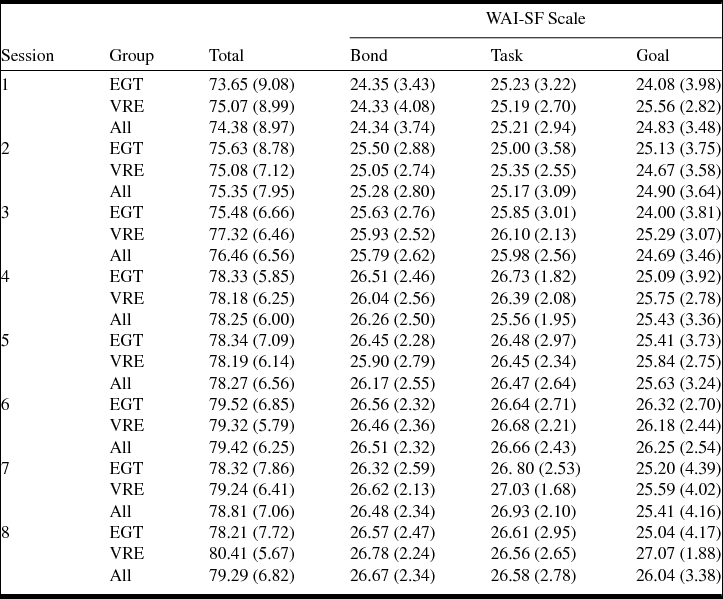
Prior to testing hypotheses, WAI-SF descriptive statistics were computed (see Table 1). Using Q-Q plots as described by Raudenbush and Bryk (Reference Raudenbush and Bryk2002) and tests of normality, the level 1 and 2 residuals were examined to ensure that they were normally distributed. Analyses were conducted to determine whether demographic variables were related to WAI-SF total and subscale scores. No significant differences between groups were observed based on ethnicity or education. Additionally, there were no differences between participants who met criteria for the generalized subtype of social anxiety disorder (50.8%) and those who did not (49.2%). There were a few differences for other demographic factors (e.g. age, gender, education), but none showed consistent differences across multiple sessions or subscales of the WAI-SF.
Means and standard deviations for working alliance scores.

Note: Values in parentheses are standard deviations. WAI-SF = Working Alliance Inventory-Short Form. EGT = Exposure Group Therapy. VRE = Virtual Reality Exposure. All = All participants, regardless of treatment condition
Change in working alliance over time
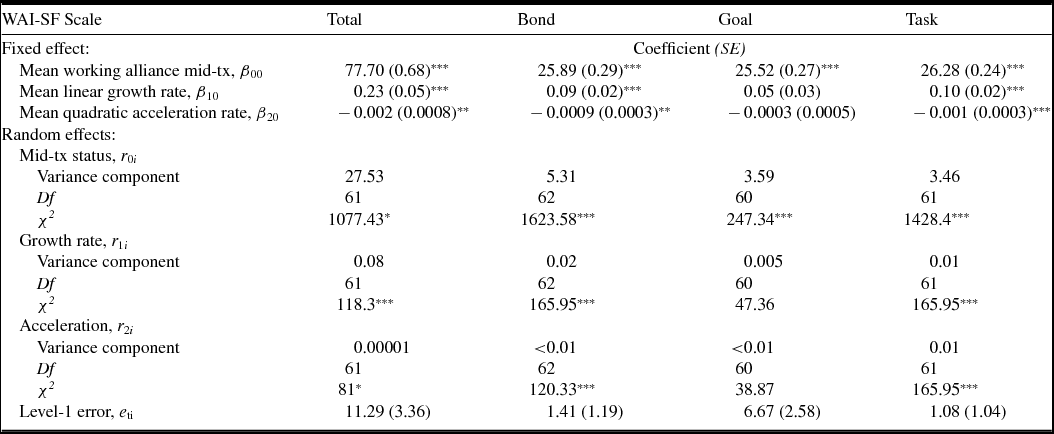
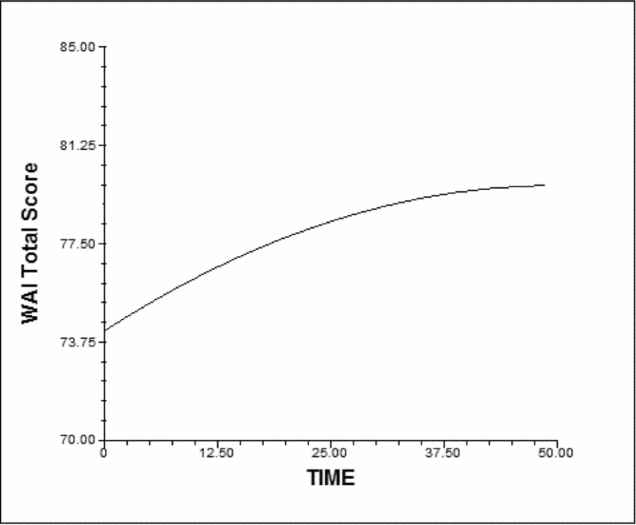
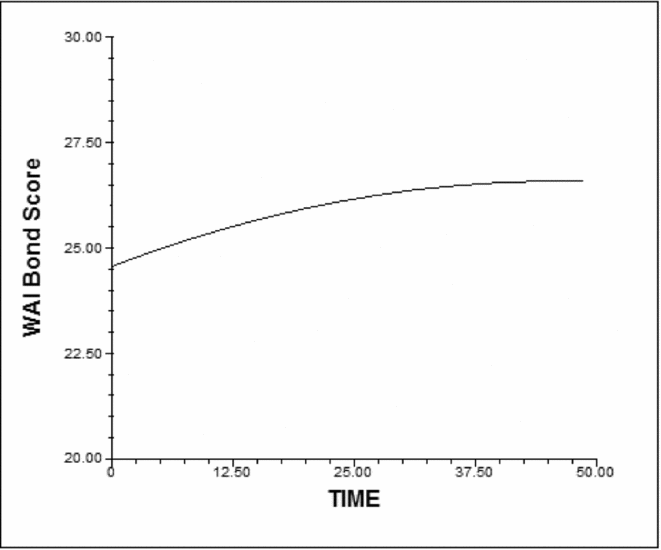
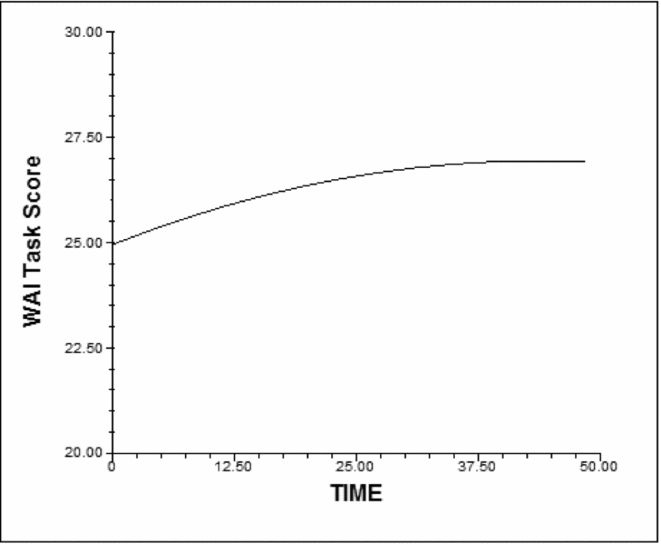
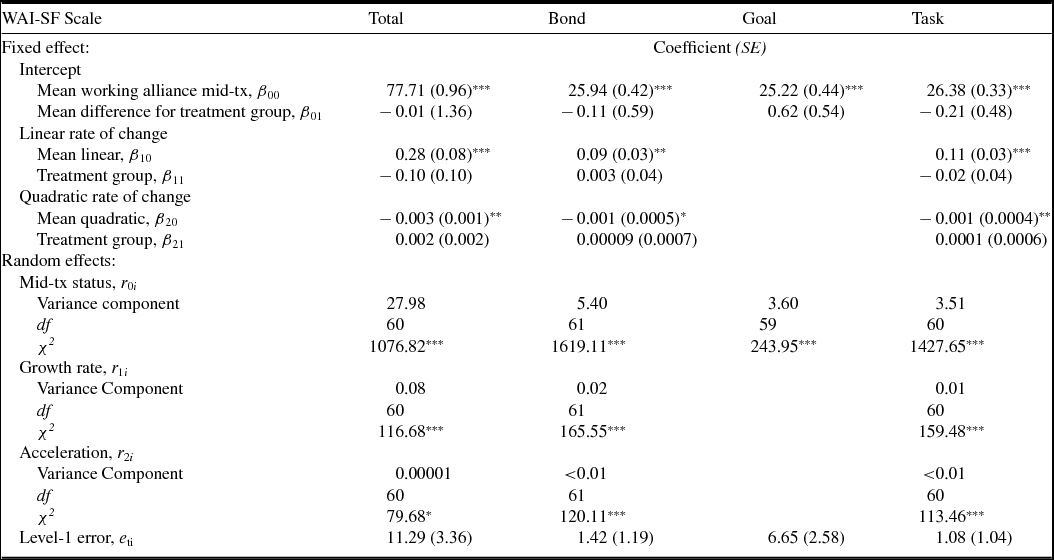
HLM analyses revealed a significant positive linear term and a significant negative quadratic term for total WAI-SF scores (Table 2), indicating that, for the average individual, total working alliance increased during treatment, with steeper increases earlier in treatment compared to later sessions when the rate of change plateaued (see Figures 1a–1c). The same patterns of change were also found for the WAI-SF bond and WAI-SF task subscales.
Model 1: estimated effects of change in working alliance over time
Notes: * = p < .05, ** = p < .01, *** = p < .001.
Impact of time on quadratic change in WAI-SF total scores
Impact of time on quadratic change in WAI-SF Bond subscale score
Impact of time on quadratic change in WAI-SF Task subscale score
Significant unexplained variability in scores mid-treatment (intercepts), as well as rates of change (slopes), was observed for most working alliance scale and subscale scores. Specifically, significant variability for the intercept term was observed for the WAI-SF total score (χ 2 = 1077.43, p < .001), WAI-SF bond score (χ 2 = 1623.58, p < .001), WAI-SF goal score (χ 2 = 247.34, p < .001), and WAI-SF task score (χ 2 = 1428.40, p < .001). Significant variability for the linear term was observed for the WAI-SF total score (χ 2 = 118.3, p < .001), WAI-SF bond score (χ 2 = 165.95, p < .001), and WAI-SF task score (χ 2 = 159.3, p < .001). Similarly, significant variability in the quadratic term was observed for the WAI-SF total score (χ 2 = 81, p < .05), WAI-SF bond score (χ 2 = 120.33, p < .001), and WAI-SF task score (χ 2 = 113.32, p < .001). In contrast, for the WAI-SF goal score, the linear (χ 2 = 47.36, p > .50) and quadratic (χ 2 = 38.87, p > .50) terms were not significant; there was no further variability to be predicted for this subscale. Therefore, treatment group differences in the trajectories of change in WAI-SF total, task, and bond - but not goal - scores were tested.
Treatment group as a predictor of change in working alliance over time
Analyses of differences in trajectories of change in working alliance according to treatment condition (VRE or EGT) revealed no significant differences in mean scores at mid-treatment (intercepts; see Table 3). Treatment condition also did not predict significant group differences in linear or quadratic patterns of change for any of the WAI-SF scores.
Model 2: estimated effects of treatment group on change in working alliance over time
Note: * = p < .05, ** = p < .01, *** = p < .001.
Discussion
Similar to prior research with socially anxious samples, participants in this study reported a strong working alliance. Although there are no norms for the WAI-SF, participants reported total scores ranging from 73–80 (out of 84) across treatment sessions. These scores are similar to (or higher than) previous research examining the working alliance among people with SAD (Hayes et al., Reference Hayes, Hope, Van Dyke and Heimberg2007). It would be interesting for future research to investigate why people who have impairment due to social fears can form a strong therapeutic alliance. The use of manualized treatments may be of particular interest. Treatment manuals were used in all studies that have found high levels of working alliance among people with SAD (Hayes et al., Reference Hayes, Hope, Van Dyke and Heimberg2007; Woody and Adessky, Reference Woody and Adessky2002). One potential benefit of a treatment manual for cultivating working alliance is that it can explicitly direct the treatment provider to focus on development of the working relationship, collaboratively identify goals, and clearly articulate tasks to reach goals.
A primary aim of this study was to examine the trajectory of change in the working alliance over treatment. Results showed significant negative quadratic change in WAI-SF total score, as well as bond and task subscale scores. The significant quadratic term, however, did not reflect the theoretical “rupture and repair” pattern (Bordin, Reference Bordin1979; Horvath and Luborsky, Reference Horvath and Luborsky1993) supported in some empirical research (Kivlighan and Shaughnessy, Reference Kivlighan and Shaughnessy2000). Rather, working alliance grew during treatment, with more rapid increases observed during earlier treatment sessions followed by a decline in rate of change over time. The lack of support for a rupture/repair pattern in the current study is especially interesting given that high working alliance scores at the beginning of treatment left plenty of room for an alliance rupture and repair.
Our findings should be considered in light of the only other study examining the trajectory of working alliance for clients diagnosed with SAD and treated with CBT (Woody and Adessky, Reference Woody and Adessky2002), which, upon testing both quadratic and linear patterns, found evidence for positive linear growth only. In contrast, the current study found a quadratic change effect, but this effect was small and may be the result of a ceiling effect. That is, initial mean ratings for WAI-SF scores were within the top 20% of the scale, which may have limited the degree and influenced the form of change observed in WAI-SF scores over time. Specifically, continued linear growth over the course of treatment may have been observed had the ratings spanned a broader range of scores, and the observed deceleration in WAI-SF scores may reflect limited room for further growth (i.e. a range of approximately 10 points for the WAI-SF total scale and 3.5 for the WAI-SF subscales).
This is the first study to show people receiving VRE report comparable ratings of working alliance as people receiving traditional group-based treatment for SAD. This finding was contrary to our hypothesis that people receiving VRE would show weaker alliance ratings on the emotional bond subscale. There were many similarities between the treatments that could have led to comparable alliance ratings. Both treatments followed a manual, utilized the same elements (e.g. targeting cognitive biases), and worked within the same overarching CBT framework, which emphasizes a collaborative working relationship. The fact that the two CBT treatments showed a similar trajectory, which differed from trajectories of time-limited experiential and psychodynamic therapy (Golden and Robbins, Reference Golden and Robbins1990; Horvath and Marx, Reference Horvath and Marx1990), is consistent with the suggestion that the profile of the working alliance may differ according to treatment approach (Bordin, Reference Bordin1979; Horvath and Bedi, Reference Horvath, Bedi and Norcross2002).
Study limitations and future directions
First, measurement of the working alliance posed limitations. Although the WAI is the most widely used measure of the working alliance, there are alternative forms (Hatcher and Gillaspy, Reference Hatcher and Gillaspy2006) that better differentiate between the subscales. Research suggests that participants tend to use the top 20% of the WAI scale and that the WAI was developed to measure the alliance at a single time point, both of which may impact observations of change. Furthermore, in the present study, working alliance was only assessed from the client's perspective, and research shows differences in client and therapist perceptions of this construct (Horvath and Marx, Reference Horvath and Marx1990).
There also are several limitations related to the sample. First, co-morbidity was lower than reported for other samples of people with SAD, although it is comparable to other research utilizing internet-based or VRE for public speaking fears (Andersson et al., Reference Andersson, Carlbring, Holmström, Sparthan, Furmark and Nilsson-Ihrfelt2006). Second, although the racial and ethnic distribution was relatively diverse in the current study, it is neither representative of the US population nor international populations. As demographic factors have been associated with differential patterns of working alliance within CBT for other problem behaviors (Walling, Suvak, Howard, Taft and Murphy, Reference Walling, Suvak, Howard, Taft and Murphy2011) and with social phobia prevalence rates (Chou, Reference Chou2009), this is an area in need of further research.
Despite these limitations, the present study adds to the small body of literature examining the working alliance among people with SAD receiving treatment. Results are consistent with prior research suggesting that persons with social anxiety disorder are capable of developing working alliance relationships comparable to those with other disorders, and that the alliance generally grows over time. Further research is needed to characterize the pattern of growth, factors that influence its growth, as well as to examine its impact on treatment outcome. The current study is one of the first to examine the working alliance within VRE, and the first to test and demonstrate that participant working alliance ratings are as high and show a similar pattern of growth compared to group-based CBT treatment, typically considered the gold standard treatment for SAD.
Acknowledgements
Research reported in this publication was supported by the National Institute of Mental Health of the National Institutes of Health under award number R42 MH 60506-02. The content is solely the responsibility of the authors and does not necessarily represent the official views of the National Institutes of Health.



Comments
No Comments have been published for this article.