What is your favourite anecdote of celebrity humanitarianism—Angelina Jolie’s work with the UNHCR, Bono’s lobbying in Washington to fight HIV/AIDS, or Jude Law’s peace promotion in Afghanistan?Footnote 1 Or perhaps you recall Princess Diana’s work to ban landmines, the concerts for Kampuchea and Bangladesh (that preceded Live Aid), or Danny Kaye’s work for UNICEF (Brockington Reference Brockington2014a)? Or, even further back would you include Stanley’s famous greeting to Livingstone as both, ostensibly, sought to liberate the African continent from slavery.Footnote 2 Perhaps you have no favourite but see celebrity as a sort of pathology, a problem to be minimised (cf. Ferris Reference Ferris2007). But whether you welcome, detest, or tolerate celebrities, their work at the intersection between culture and formal politics for humanitarian causes as proxy philanthropists, statesmen, executives, and healers requires the attention of political science (Street Reference Street2004).
Emerging alongside the post-Cold War expansion of humanitarianism, celebrities perform on both sides of what Michael Barnett terms the “politics of solidarity” and the “politics of governance” (Barnett Reference Barnett2005). Matthew Benwell and colleagues argue that “the diverse interventions of celebrities in global issues can be usefully examined precisely because they complicate some of the core categories inherent to contemporary geopolitical research” (Benwell, Dodds, and Pinkerton Reference Benwell, Dodds and Pinkerton.2012, 407). Some authors welcome the affordances that “celebrity diplomacy” brings (Cooper Reference Cooper2008). Others deplore its perpetuation of privilege, inequality, and exploitation (Kapoor Reference Kapoor2012). Some discern new, more narcissistic forms of humanitarianism that celebrity support is associated with (Chouliaraki Reference Chouliaraki2013), or note that it represents a form of governmentality that brings Northern audiences into alignment with international programs (Wilson Reference Wilson2011; Goodman Reference Goodman2010, Reference Goodman, Fridell and Konings2011). Others find that celebrity humanitarianism perpetrates stereotypes, particularly about the Northern Self and the humanitarian Other (Repo and Yrjölä Reference Repo and Yrjölä2011).
Unfortunately, the attention so far has focussed most on the politics in the global North. This, we argue, is misplaced. Rather, it is more important to understand the politics of celebrity humanitarianism as a form of North/South relations and that doing so involves scholarly focus on both North and South (Repo and Yrjölä Reference Repo and Yrjölä2011). That requires more attention to the Southern celebrities, Southern politics, and the consequences of humanitarianism in the South and the North/South relations that produce them. It requires understanding how celebrity humanitarianism reproduces the hierarchies and inequalities that constitute North/South relations.
We suggest that, following Brockington (Reference Brockington and Richey2016), these North/South relations and their politics can be broken down into two different domains:
1. What contests, and what types of contest, over financial, symbolic and discursive resources, and representational space arise from celebrity humanitarianism? Which disputes are silenced or diminished?
2. What happens in these disputes? What changes as a result of them? How do they distribute fortune and misfortune? How shallow or profound are these consequences? And what is left out, what does not happen, as a result of these interventions? (Brockington Reference Brockington and Richey2016)
To answer these questions we present a series of tropes through which celebrity humanitarianism is frequently conducted. Tropes are used in literature studies to refer to the limited ways that a particular story, or group of people, are represented (Wexler Reference Wexler2000, Spurr Reference Spurr1993). Tropes provide a lexicon, a way of talking and thinking about issues. They denote particular sorts of performance, which share certain characteristics, of both the celebrity humanitarian and the audiences of their performances. In literary analysis, tropes are often used in a negative context, in that tropes perpetuate stereotypes and are the vehicles (and substance) of discrimination and domination (for example see Wexler Reference Wexler2000; Sahlins Reference Sahlins1993; Stoler Reference Stoler1992). Identifying tropes highlights the common themes upon which celebrity humanitarianism tends to focus. It reveals the aspects of humanitarianism which are silenced or diminished. They also help us to see how celebrity humanitarianism fits with other aspects of the politics of North/South relations, and so to understand what changes, and what injustices do not change, as a result of these interventions.
We hold that celebrity humanitarianism, and by extension celebrity politics, cannot be understood by focusing on the individuals themselves. Rather, the political performances of celebrity humanitarianism must be interpreted through the institutions that produce them, the interpretive resources of their audiences, and their utility to broader political and corporate agendas. This framework is important for political scientists as it will help to situate the contributions of this discipline in relation to others. Furthermore, our case material and literature review will introduce existing work to new audiences and suggest research questions that political scientists are well-placed to examine.
We first define the key concepts and debates from literatures studying celebrities in advocacy, development, and humanitarian endeavors. Then, we examine the central approaches to the study of celebrity humanitarianism, to situate political scientists’ work within in them. Next, we develop a heuristic typology of celebrity humanitarianism to explain celebrity interventions spanning North and South. Finally, we use the typology to highlight some challenges for political scientists and international relations scholars who seek to understand the politics of celebrity humanitarianism and North/South relations.
Defining and Situating Celebrity Humanitarianism
Some definitions of celebrity focus on the amount of public interest in them. From politics, Lena Partzsch suggests that a celebrity is a person with an “above-average public profile,” which is too inclusive for an analytical category (Partzsch Reference Partzsch2018, 231). For most analysts, celebrity is not simply about the amount of attention, but its nature, organization, and consequences. There are tens of thousands of celebrities on the professional contact databases. The vast majority are unknown to the vast majority of people. Audiences for celebrity are often niche and small. Audience size does not help us understand what makes celebrity work.
Graeme Turner’s definition (from cultural studies) hinges on the nature of interest from the public: when a person’s private life attracts more attention than their professional life, then they are a celebrity (Turner Reference Turner2004, 3). This assumes a distinction between the personal and professional which is hard to maintain, for example, with musicians, politicians, royalty, and reality TV stars.
Another approach holds that the nature of celebrity is to commercialise both professional and personal aspects, in order to build a brand. Celebrities are created through a process of “celebrification” linking privatization, personalization, and commodification (Couldry and Markham Reference Couldry and Markham2007; Driessens Reference Driessens2013b; Gamson Reference Gamson1994). Brockington defines celebrity as “sustained public appearances which are materially beneficial, and where the benefits are at least partially enjoyed by people other than the celebrity themselves, by stakeholders whose job it is to manage the appearance of that celebrity” (Brockington Reference Brockington2014a, xxi). This definition recognizes that celebrity is a product of a variety of social and economic forces and a particular configuration of institutions, companies, and commercial interests. Celebrity, as the histories make clear, is an industry (Gamson Reference Gamson1994; Schickel Reference Schickel2000; Braudy Reference Braudy1997). Celebrities are the employees of an industry that manages and produces fame. Part of the push towards celebrity humanitarianism is that it provides more opportunities to be seen and build brand.Footnote 3
However, an industrial approach to celebrity does not help us to understand how it works symbolically, semiotically, hermeneutically or, crucially, politically, in the sense of providing power, authority, and legitimacy to bring—or prevent—change. Olivier Driessens’ contribution here is useful (Driessens Reference Driessens2013b). Drawing on Bourdieu’s field theory, he argues that celebrity constitutes a distinct form of capital that he calls “recognisability” that is based on “recurrent media representations or accumulated media visibility” (Driessens Reference Driessens2013b, 550-1). Driessens argues that celebrity capital works like other fungible capitals and can move across different fields such as economic capital (money), social capital (networks), symbolic capital (recognition), or political capital (political power). This characterizes a long-term process of “societal and cultural changes” termed “celebritization” that should be analyzed on par with globalization, individualization or mediatization (Driessens Reference Driessens2013a).
Celebrity humanitarianism is part of an evolving history of humanitarianism. International relations scholars use “humanitarianism” with a specific reference to the 1864 Geneva Convention’s recognition in international law of humanitarian principles to govern the moral practice of war (Barnett Reference Barnett2005). But the nature of humanitarian space has fluctuated over time and in different ways expanding notably after the Cold War (Barnett Reference Barnett2005; Barnett and Weiss Reference Barnett, Weiss, Barnett and Weiss2008; Fassin Reference Fassin2012; Boltanski Reference Boltanski1999; De Waal Reference De Waal1997). The remit of humanitarian activities has changed to include political and military interventions and not mere relief. And as the remit has changed, so have its partnerships, including the military and the private sector (including celebrity industries). As Brockington has shown, the organization of celebrity humanitarianism has entailed a radical reorientation of the sector towards working with celebrity (as we will describe, following Brockington Reference Brockington2014a, Reference Brockington2014b). It has also been accompanied by a new zeitgeist of humanitarian action, that Chouliaraki calls “post-humanitarianism” that focuses less attention on needy others, and more on the humanitarians’ fulfillment of their own life goals (Chouliaraki Reference Chouliaraki2010, Reference Chouliaraki2012, Reference Chouliaraki2013; see also Walton Reference Walton2018, 652). Celebrity humanitarians have moved beyond acting as “accessories” in what has been termed the “humanitarian-industrial complex,” and as we will demonstrate, their performances of humanitarianism reproduce fundamental inequalities that undergird North/South relations (Hoffman and Weiss Reference Hoffman and Weiss2018).
Debates over the character of humanitarianism center on its politics (Barnett and Weiss Reference Barnett, Weiss, Barnett and Weiss2008; Richey 2018). Roberto Belloni argues that humanitarianism serves to support the interests of powerful elites in ways that reproduce inequalities between North and South. In doing so, it undermines the moral basis of human rights that justify humanitarian intervention in the first place (Belloni Reference Belloni2007). Studying celebrity humanitarianism can add to this with insights into several debates about humanitarian performance and politics (Weiss Reference Weiss2016). One could explore it from the perspective of the debate about humanitarianism and neutrality. To what extent does celebrity humanitarianism resonate with performances meant to engage particular audiences—and therefore sides—in disputes or alter the nature of humanitarianism’s (performed) neutrality? Second, is celebrity humanitarianism a means of governing the management of conflict and crisis? Does it inhibit structural change? As Brockington has argued, both tame and unruly, unmanaged interventions are possible. The structures that produce celebrity humanitarianism can be seen as attempts to control and marshal the unruliness of celebrity intervention (Brockington Reference Brockington and Richey2016). Third, what is the broader political economy of celebrity humanitarianism; how is its authenticity cultivated?
Celebrity humanitarianism is different from celebrity advocacy. Celebrity humanitarianism requires a needy “Other”— it is something that one actor does for another person. Advocacy is taking up a cause and amplifying it in the public discourse, which could be about issues across the political spectrum that engage the celebrity’s own communities or those of Others (cf. Brockington Reference Brockington2014a, xxi). This distinction has important consequences for the study of celebrity politics in the context of North/South relations. Celebrity humanitarianism becomes one of the means by which North/South relations are maintained and renewed. North/South, as Richey has argued, is less of a geographic description than a reference to inequalities and perceived hierarchies (Richey Reference Richey and Richey2016). Accordingly, the performance of celebrity humanitarianism on the differential stages that North/South relations afford helps to construct and maintain these inimical differences.
The history of the two forms, celebrity advocacy and celebrity humanitarianism, are, however, intertwined. Brockington argues that the Victorian era was a moment when humanitarian causes lead the production of fame, in that many of the greatest figures celebrated in the late nineteenth century were celebrated for their contribution to good causes overseas (ending slavery in Africa, spreading Christianity, serving wounded soldiers).Footnote 4 Conversely after World War II, when the humanitarian apparatus expanded, celebrity engagement dwindled, with celebrity diplomat Danny Kaye’s work for UNICEF and the 1954 initiation of the Goodwill Ambassadors program being the exception, not the rule. Engagements expanded in the 1970s (UNICEF expanded celebrity operations then) and multiplied in the 1980s with UNHCR joining in and a number of high-profile events (Nelson Mandela’s birthday concerts, the Band Aid moment). By the early Noughties, UN organizations had sixteen official celebrity ambassadors and documented fifteen different UN titles bestowed onto celebrity humanitarians (Fall and Tang Reference Fall and Tang2006). Today, the most comprehensive (but still incomplete) database records 1,240 celebrities working on disaster relief, 1,684 on poverty, and 1,414 on human rights.Footnote 5
Situating Political Science Approaches in the Study of Celebrity Humanitarianism
Political scientists have contributed three kinds of inquiry around celebrity humanitarianism—descriptive overviews, qualitative case studies, and quantitative analyses. Examples of the former include the work of Daryl West and Andrew Cooper (West Reference West, Brainard and Chollet2008; West and Orman Reference West and Orman2003; Cooper Reference Cooper2008). Detailed case studies examine the limits, consequences, or legitimacy of particular interventions (e.g., Partzsch Reference Partzsch2018; Majic Reference Majic2017; Meyer and Gamson Reference Meyer and Gamson.1995; Tsaliki, Frangonikolopoulos, and Huliaras Reference Tsaliki, Frangonikolopoulos and Huliaras2011). Notably, contributions to Cooper, Dobson, and Wheeler’s collection address celebrity diplomacy in non-Western contexts (East Asia, Russia, and the Arab world; Cooper, Dobson, and Wheeler 2017, 316). Majic’s interpretation of an initiative against human trafficking demonstrates that celebrities are limited through a framing of cause and effect that leaves out Southern actors and global structures (Majic Reference Majic2017). Quantitative studies measure the impacts of specific interventions. These have been particularly insightful with respect to domestic political behavior or health outcomes. But measurable consequences of celebrity interventions on measurable behaviors and political outcomes on far flung causes are noticeable in their absence.Footnote 6
These different contributions also vary according to the emphasis given to individuals and to the mechanisms through which celebrity is created, produced, managed, and sold. Richey and Budabin are able to explain the emergence of actor Ben Affleck’s humanitarian work, and interpret its consequences and contradictions, by exploring how it has been fostered by different organizations in both the United States and the Democratic Republic of Congo (Budabin and Richey forthcoming). Dan Brockington’s study of celebrity advocacy hinges on the remarkable re-structuring of the humanitarian and development sector in the UK in the last eighteen years, leading to its radical re-orientation to work with celebrities (Brockington Reference Brockington2014a, Reference Brockington2014b). The management of celebrity humanitarianism has become a niche sector in the celebrity industries and a specific funded aspect of humanitarian organizations. The history and growth of celebrity humanitarianism (and the broader celebrity industries themselves) become much more intelligible through this structural approach.Footnote 7
Approaching the mechanisms of celebrity humanitarianism runs against the grain of typical interpretations in which the celebrity plays the role of hero. Looking to the system, rather than the individual, helps us to discern the driving forces that produce celebrity humanitarianism, how it is performed, and how authenticity is constructed. Authenticity is not some sort of inherent characteristic that precedes public engagement. It is produced in the public domain and performed for public consumption. Brockington’s work shows that celebrities perform authenticity through expert or experiential authority (knowledge and experience); affinity (similarity with others); empathy (shared emotion with others as a result of similar experiences; and sympathy (emotions provoked by the Other’s fate; Brockington Reference Brockington2014a, 106). Celebrity authenticity can then be adjudicated according to their performances (Jerslev Reference Jerslev2014; Budabin, Mubanda Rasmussen, and Richey 2017). In this respect, the carefully constructed authenticity of celebrity humanitarians precisely follows Rai’s account of the authenticity of “felicitous” political performances in the public sphere (Rai Reference Rai2015).
A second approach to celebrity humanitarianism focuses on its politics. Many contributions build on John Street’s foundational contribution to understanding celebrity politics as performance, distinguishing between politicians who instrumentalize aspects of celebrity (CP1) and celebrities who enter into the field of politics and international diplomacy (CP2) (Street Reference Street2012, Reference Street2004, Reference Street2003, Reference Street2002; Street, Hague, and Savigny Reference Street, Hague and Savigny2008). Building on Street, Mark Wheeler calls for a better understanding of how “a celebritization of politics has brought about alternative forms of political engagement” (Wheeler Reference Wheeler2013, 170). This requires attention to the informal, and performative, aspects of power, recognizing that celebrity politics does not stand outside of the “normal” or “non-celebrated” politics but are entering into, constructing, and affecting pre-existing politics (James Brassett, cited in Richey and Christiansen Reference Richey and Christiansen2018).
Brockington argues that celebrity interventions signal a new aspect of elite rule in post-democratic contexts (Brockington Reference Brockington2014a). Elitist celebrity humanitarianism is cheaper and easier than mass populist interventions, as it involves only a few selected players at higher levels of policy making and a rarefied realm of informed, educated policy-makers and lobbyists uncluttered by widespread participation that makes elite decision making easier. For some, this way of doing politics is just too repugnant.Footnote 8 Ilan Kapoor (Reference Kapoor2012) draws heavily on Žižek’s psychoanalytical approach to argue that celebrity humanitarianism should be understood as a spectacular celebration of corporate power, apparently urgent charity, and the seductions of celebrity. This approach limits the politics of celebrity humanitarianism to existing only as effects created by the unjust exploitative capitalist relations that underpin celebrity (Kapoor Reference Kapoor2012).
A third, hermeneutic approach examines transformative possibilities as read from key humanitarian texts. Chouliaraki shows celebrity humanitarian performances have shifted from support for grand narratives of solidarity to more individualist projects of self-fulfillment (Chouliaraki Reference Chouliaraki2010, Reference Chouliaraki2012, Reference Chouliaraki2006). Her analysis is concerned with seeking a politics of justice but is limited by the fundamental narcissism that makes humanitarianism possible only when it is linked to self-fulfillment or lifestyle choices.
These different approaches are useful for the framings that they offer to political science studies of celebrity humanitarianism. For example, the quantitative approaches of Atkinson and DeWitt or of Thrall and colleagues can be read as illustrations of the idea that celebrity activism’s elite politics reproduces disconnection with the public (Thrall et al. Reference Thrall, Lollio-Fakhreddine, Berent, Donnelly, Herrin, Paquette, Wenglinski and Wyatt2008; Atkinson and DeWitt Reference Atkinson and DeWitt.2018). Chouliaraki’s work suggests ways of approaching legitimacy, authority and authenticity other than in terms of the international apparatus governing humanitarianism. The typology we offer next has a similar goal. We want to provide a useful framing against which diverse case studies of celebrity humanitarianism can be read in order to help understand their political consequences and implications. It will suggest, as we show in the conclusion, a number of conceptual and methodological challenges for political scientists to take on.
Tropes of Celebrity Humanitarianism
It should be clear from our analysis that for celebrity humanitarianism to work, humanitarian values and practical support to particular places and people must be performed (Hoffman and Weiss Reference Hoffman, Weiss, Hoffman and Weiss2008, 281; Thompson Reference Thompson2014, 106; Street Reference Street2004). As Rai has argued, performance determines “how . . . representative claims are made and what makes them legitimate” (Rai Reference Rai2015, 1180). Unlike factual claims, it is the “mode of performance in which individuals and institutions (actors) make claims to represent and affect their audience (the represented)” that constitute the acceptability of claims to representativeness (Rai Reference Rai2015, 1180). Thus, to understand its politics, we must study its performance. The visual turn in international relations is helpful here, as the images of celebrity humanitarianism can hold more power and speak more about their politics than the texts (Hansen Reference Hansen2014; Kearns Reference Kearns2017; Bleiker Reference Bleiker2001). We have used performance as the basis for our tropes.
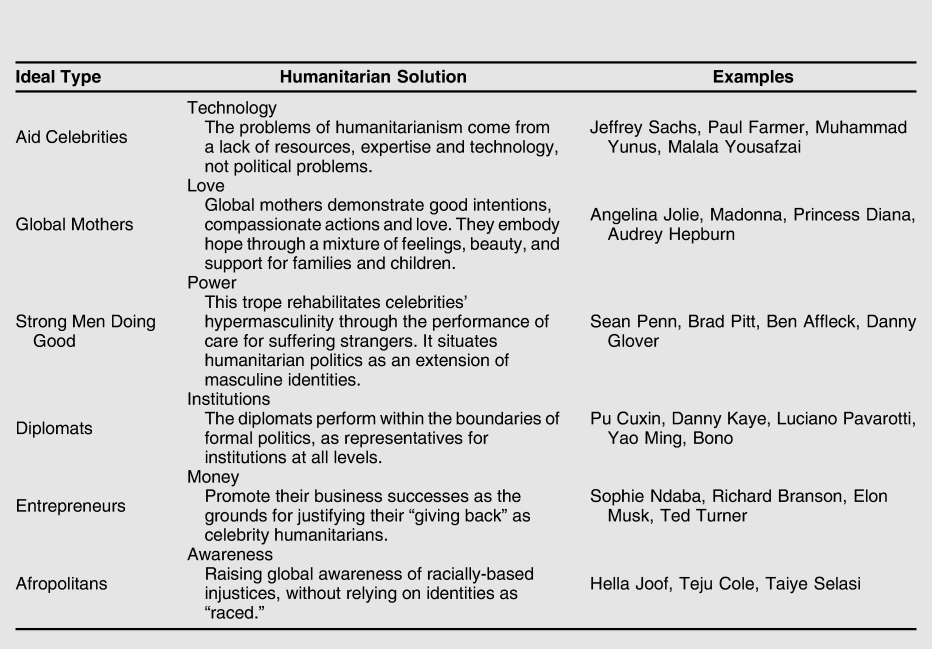
Methodologically, our tropes are an inductively drawn template of ideal types from published research. We are engaging in what Alexander Wendt terms “constitutive analysis” in that our work “seeks to establish conditions of possibility for objects or events by showing what they are made of and how they are organized” (Wendt Reference Wendt1999). Constitutive analysis allows us to capture the key ways in which celebrity is performed, and these tropes then capture the avenues for action and humanitarian solutions, which then become possible. Substantively, our tropes demonstrate the interactive effects between individual actors, their inferred audience responses, and their constitutive apparatus.Footnote 9 In the following discussion, we will describe six tropes of celebrity humanitarianism based on the performance of their solution to humanitarian problems. These are summarized in table 1.
A typology of celebrity humanitarianism

Aid Celebrities
When aid celebrities enter the realm of international development and humanitarianism, they bring the modalities of celebrity with them. They “embody a manufactured consensus, let simple moral truths substitute for rational debate, and thus manage the affective needs of those who would solve the world’s problems” (Richey and Ponte Reference Richey and Ponte2011, 11). Aid celebrities become advisors who are trusted to speak on issues that extend beyond the actual scope of their expertise, and their presence is invoked to stand in for important beliefs and social values about North/South relations. They embody classical developmentalist perspectives that deem parts of the world to need a “big push” to fulfill teleological notions of progress, and, as such, they tackle technical problems better than political ones. Being an aid celebrity does not imply any lack of expertise. In fact, it is on the basis of the high profile of their work as experts that aid celebrities came to be celebrated in the first place. The high level of achievement of their expert profile provides the justification for the public interest in their personae. They merge achieved and ascribed status distinguishing them from other stars who simply engage in do-gooding (Cooper Reference Cooper2008; Rojek Reference Rojek2001).
Our exemplar case, Jeffrey Sachs, is the economist renowned for his initiatives to eradicate poverty (Richey and Ponte Reference Richey and Ponte2008). His academic credentials are superlative. Trained at Harvard, he became full professor of economics there in 1983 when he as just 29 years old. But his fame reaches far beyond the academy. As Richey and Ponte summarized, “He was deemed ‘most important economist in the world” by The New York Times Magazine and “the world’s best-known economist”’ by Time magazine’ (Richey and Ponte Reference Richey and Ponte2008, 717). As he became more well known for his interventions in African poverty, Time also listed him as one of the most influential people in the world in 2004 and 2005. Bono has characterized Sachs as the “Jimi Hendrix” of the “Woodstock of Global Health,” and Angelina Jolie described him as “the world’s leading expert on extreme poverty” in the MTV production of their joint visit to a Millennium Village in Kenya. Yet, as Wilson has observed, Sachs’ contributions to minimizing the harm caused by poor economic policies and international interventions are somewhat schizoid (Wilson Reference Wilson2014). As an advocate of “shock therapy” in the 1990s in the former USSR, he facilitated the enforcement of policies which caused misery, illness, and death for tens of millions of people (Wilson Reference Wilson2014). He has since reinvented himself as an advocate for international aid.
In the aid celebrity performances, the problems of humanitarianism can be solved by simply adding more humanitarian technologies. Sachs’ demonstration project that ending poverty is possible provides a quintessential example of this view. The Millennium Villages Project was a multi-sector rural development project that operated in ten African countries between 2005–2015 to achieve the Millennium Development Goals. The project’s final evaluation has recently found that in spite of its considerable investment of funds from public and private donors, the project met only one-third of its goals (Mitchell et al. Reference Mitchell, Gelman, Ross, Chen, Bari, Kim Huynh, Harris, Sachs, Stuart, Feller, Makela, Zaslavsky, McClellan, Ohemeng-Dapaah, Namakula, Palm and Sachs2018). Together with the final project evaluation, The Lancet published a response piece entitled, ‘Lessons from the Millennium Villages Project: A Personal Perspective’ written by Jeffrey Sachs. Through the reflections of an expert economist reviewing a large-scale development failure, Sachs concludes:
(1) Set clear targets to 2030. (2) Identify key interventions and budgetary needs. (3) Form teams from national to local level prepared to work in an integrated manner. (4) Establish real-time information systems. And (5) don’t expect a quiet life! Rapid changes in technology, and even in geopolitics, will force considerable innovations, systems changes, and improvisation, between now and 2030. (Sachs Reference Sachs2018, 474)
Sachs’ faith in targets, planned interventions, managed budgets, integrated teams, and systems to harness technology in the service of good politics is consistent with his aid celebrity modality. Humanitarian crises and protracted developmental inequalities are solvable. According to Sachs, “Africa’s problems are tougher, but solvable” and “Africa is a great puzzle for a development economist and a great challenge for all of us involved in policy to try to do something about it.”Footnote 10
For the aid celebrity, the problems of humanitarianism come from a lack of resources, expertise, and technology. Sachs, for example, was quick to blame the failures of the Millennium Villages Project on inadequate aid flows, even though aid accounts for relatively little of the money flowing into poor countries (Sachs Reference Sachs2018). Aid celebrities’ ideal type of technical solution rests in doing development as it has traditionally been done, but doing more of it. This emphasis means that development becomes a series of technical, not political problems, and not something that might reflect, for example, unequal power structures underlying North/South relations.
Global Mothers
Global mothers perform the politics of affection for children around the globe, both actual children and the childlike desires of adults as well. Global motherhood is the most explicitly gendered category of celebrity humanitarian, as it involves a performance of motherly love as the archetype for solving humanitarian problems. The North/South positioning of the enslaved and colonized as children who need “care” in the cloak of domination lingers behind an entrancing feminized beauty. In contrast to the aid celebrity’s reliance on impact, expertise, or technology, the global mother is all about demonstrations of good intentions, compassionate actions, and love. Jo Littler describes how the celebrity humanitarianism of Angelina Jolie, Mother Theresa, and Princess Diana are performances of the celebrity “soul” in which “the confession of truly caring” presents itself as “plugging the gap” of structural inequalities in global social systems (Littler Reference Littler2008, 247-8; see also Repo and Yrjölä Reference Repo and Yrjölä2011).
According to the official hagiographical accounts, Angelina developed her interest in humanitarian work in 2001 when she was working in Cambodia on her Hollywood blockbuster film Lara Croft: Tomb Raider.Footnote 11 Since then, she has met with refugees and internally displaced people in more than twenty countries. In their study of gender politics in celebrity humanitarianism, Repo and Yrjölä document that:
Jolie’s primary humanitarian credentials were in the discourses of motherhood which intertwined with her humanitarian work . . . She was a humanitarian because she was a mother, and vice versa, producing humanitarianism as a fulfilment of a White feminine destiny. As a sort of “mother-without-borders,” Jolie constructed a model of what became referred to as the “rainbow family’’ (Repo and Yrjölä Reference Repo and Yrjölä2011, 50).
At times her maternity bordered on holiness, as she “wears a scarf and kneels among the needy like Mother Teresa” (Repo and Yrjölä Reference Repo and Yrjölä2011, 50).
In person, and in media representations, she draws attention because of her performance of care. While on the ground she impresses with her ultimate humanity, it is the good mother that is praised in her professional work as a celebrity humanitarian. In the Democratic Republic of Congo in 2003, her host, a long-experienced humanitarian worker, explained how impressed they were with Angelina: “They came to see a movie star but left with a sense that she was very serious about her job and was more on the human side of things.”Footnote 12
Mary Mostafanezhad’s ethnography among three NGOs in Northern Thailand documents how Angelina’s global-mother humanitarianism is translated into the practices and representations in photographs on social media by volunteer tourists (Mostafanezhad Reference Mostafanezhad2013). The images of “often Anglo-European, young, and vigorous volunteers are depicted in protective poses with children” in ways that create “an illusion of reciprocity which is highlighted by their innocuous poses of motherhood.” Interestingly, this global motherhood resonates with the Burmese refugees themselves who are reported to state that “I’ve heard that [Jolie] adopted two kids. It means she saved their lives. People like her must have a soul filled with compassion to save all refugees” (Mostafanezhad Reference Mostafanezhad and Richey2016, 28).
The refugees’ interpretations of Jolie’s role with the UNHCR were mediated by their own local gender regimes of power in which women who fulfill their traditional role in managing the household are idealized (Mostafanezhad Reference Mostafanezhad and Richey2016, 32). Thus, Jolie’s performance as the global mother was able to mobilize what Mostafanezhad terms a “geopolitics of hope” that shifts attention both locally and globally away from the ongoing political disputes over the UN’s insufficient curbing of human rights atrocities in the global South, to Jolie’s sentimental encounters with individual refugees and the nature of her caring soul.
Jolie’s work as the global mother also characterizes her non-humanitarian work as an actress and film director. Jolie described her recent critically-acclaimed war film,Footnote 13 ‘First they Killed My Father’ (2017) about the rule of the Khmer Rouge in Cambodia from 1975–1979:
The film is about family. It’s what would your family would go through? What would you do for your family to get through this? We have to show the horrors but it’s not about the horrors. This was supposed to be a beautiful film that was appealing to people. We wanted to show the beauty of the children and the country through the war.Footnote 14
The global mother trope serves to reinforce the affective turn in international relations where feelings, beauty, family and children are featured as the “hope” in geopolitics. Their ideal type of “caring” solution to humanitarianism is love. However, it comes with a warning. In North/South relations, actors in the global South have been historically read as “children” who need education through the institutions of governance and democracy. In this context the global mother works effectively because of its resonance with an infantilizing history. Global mothers are not as global as they would like to be. They are white women from the North performing roles demanded of them by northern audiences.
Strong Men Doing Good
The humanitarian trope of strong men doing good successfully rehabilitates celebrities’ hypermasculinity through the performance of care for suffering strangers (Chouliaraki Reference Chouliaraki2006). Strong men doing good focuses celebrity humanitarianism on “the man question” in North/South relations, what Zalewski and Parpart identify as power “with a ‘masculinized face’—that recirculates and makes invisible the constitutive evidence of violence in the everyday and in the international” (Zalewski and Parpart Reference Zalewski, Parpart, Parpart and Zalewski2008). These caring actions move beyond celebrity advocacy and engage in hands-on interventions.
Annika Bergmann-Rosamond documents the case of Sean Penn, the “bad boy of the U.S. entertainment industry with a reputation for disregarding authority” (Bergman-Rosamond Reference Bergman-Rosamond and Richey2016, 154).Footnote 15 She notes that “Penn does not limit himself to speaking out on behalf of distant others, but participates in heavy-duty rescue and reconstruction work, which adds authenticity, masculinity and radicalism to his story” (Bergman-Rosamond Reference Bergman-Rosamond and Richey2016, 154). Penn’s work as a celebrity humanitarian has been most notable in New Orleans after hurricane Katrina and in Haiti after the 2010 earthquake. While some might argue that only Haiti represents humanitarianism in the global South, we would dispute this perspective. Both places are linked by “historical experiences, cultural heritage and embedded practices of racism” and become spaces where North/South relations play out. In these crises, Penn brought a masculine rescue story of self-effacing celebrity humanitarianism of just “lending a hand” (Bergman-Rosamond Reference Bergman-Rosamond and Richey2016, 150-157). All the while, social media documented Penn motoring around the bayou of New Orleans looking for people to rescue, in his words, “on a personal crusade to save victims.”Footnote 16
Sean Penn’s hands-on celebrity humanitarianism is a critical component of the strong men-doing-good trope. While the global mothers feel, suffer and hope with their humanitarianism, men must be acting, literally, with their own hands. After the Haiti earthquake, a photograph of Penn, strain in his face and biceps bulging under the weight of a gunny sack over his shoulders, circulated across media forms as evidence of his “actually solving” humanitarian problems with his own hands. Yet as Bergman-Rosamond concludes, “media images of him employing his physical, masculine strength when carrying food to the needy are not innocent, but contribute to the gendering of his celebrity activism” (Bergman-Rosamond Reference Bergman-Rosamond and Richey2016, 164).
A popular newspaper’s introduction exemplifies this power: “Sean Penn no longer lives in a tent, surrounded by some 40,000 desperate people camped on a muddy golf course. And he no longer rushes about the capital with a Glock pistol tucked in his waistband, hefting bags of donated rice and warning darkly of a worsening humanitarian crisis.”.Footnote 17 The pistol, the hefting, and the dark warnings of humanitarian crisis are all justification for interventions by strong men, arriving from afar, to do good.
The trope of strong men doing good situates humanitarian politics as an extension of masculinist domesticity: acting, doing, making, and moving as the remedies for humanitarian need. Their ideal type of interventionist solution for humanitarian crises lies in the power to act. This leaves little room for waiting, listening, stock-taking, collaboration, and coordination of efforts—all of which take time. Hence, the humanitarian imperative that “lives are at stake” calls forth a quick draw response from the strong men doing good. This form of celebrity humanitarianism is most effective in situations in which the cause can be justified as “natural” and when the input needed is short term. However, the politics of the strong men are more difficult to institutionalize, whether that is toward multinational actions like the UN or longer-term development work done in collaborations between public and private sectors.
Diplomats
Celebrity humanitarians performing North/South relations with “glamourous conformity” embody the trope of diplomats (Cooper Reference Cooper2008, 18, cited in Wheeler Reference Wheeler2013, 147; see also Wheeler’s Reference Wheeler2011 account). This archetype is the oldest in the celebrity humanitarian typology and was the first to be noticed and studied as part of the informal realm of diplomacy (Cooper Reference Cooper2008). Most celebrity diplomats trace the archetype to the work of Danny Kaye, the first UN Goodwill Ambassador. Kaye’s partnerships with UNICEF helped to construct a new humanitarian image of the UN and links the diplomat simultaneously with national politics at home and with global politics (Wheeler Reference Wheeler2011). As celebrity humanitarians, the diplomats are those who perform within the boundaries of formal politics, as representatives for institutions at all levels and as informal brokers between formal political actors from public and private sectors. The diplomats are most effective when the context or institution is already politicized, and they are able charismatically to link opposing sides in a political debate to unite under a humanitarian mission.
In China, HIV/AIDS was one of the first causes that celebrities were allowed to endorse, and they found themselves working alongside global and local organizations ranging from UNAIDS, IFRC, and the China Red Cross to the Gates Foundation (Hood Reference Hood and Richey2016, 107). Our exemplar here is actor Pu Cunxin, who comes from a family of actors in Beijing and sings, acts, and recites poetry in Chinese television series, dramas, and popular films. He has become the most publicized “AIDS hero” in China for his dedication and work promoting HIV education and greater social acceptance for people living with AIDS. In spite of holding no formal educational credentials in health, Cunxin is assigned a more authoritative voice than comparable Western celebrity health advocates: he educates state leaders about HIV/AIDS, endorses official campaigns, and serves as an advisor on HIV publications. Hood argues that “Pu Cunxin’s uniqueness derives from his conformity with state visions of celebrity involvement in the promotion of public health, while simultaneously raising tacit social criticism of state inadequacy in the same arena” (Hood Reference Hood and Richey2016, 108).
His handsome public persona is charismatic, soft spoken, aware, and always impeccably dressed, and is “imbued with qualities that exceed the expected norms of human behavior” (Huang Reference Huang2003, 72, cited in Hood Reference Hood and Richey2016, 119). Cunxin perfectly embodies the diplomat trope of celebrity humanitarianism through his consistent, loyal dedication to working to solve humanitarian problems within the existing system. Also, Cunxin is known for bringing other actors into the humanitarian space, particularly big businesses and wealthy philanthropists.
The celebrity diplomat, like Pu Cunxin, highlights the vacuity of theorizations of celebrity as an amoral category that provides a blank repository for reflecting audience desires—being merely known for their “well-knownness” as Boorstin’s seminal work suggested (Boorstin Reference Boorstin1992). The trope of the celebrity humanitarian diplomat points us to a more contextualized, materially, and morally grounded theorization of celebrity.
The ideal type solution of diplomats to humanitarian dilemmas is through negotiation within institutions. The celebrity humanitarian diplomat must perform within the larger realm of humanitarian diplomacy. While definitions of humanitarian diplomacy vary, Egeland writes that “humanitarian diplomacy is to a large extent, the art of facilitating the optimal relief, reaching through the best channels and actors, without delay and waste, to those in greatest need” (Egeland Reference Egeland, Cooper, Heine and Thakur2013, 4). Determining “optimal,” “best,” and “greatest need” is always already laden in politics, regardless of the supposed cause of the humanitarian crisis. Thus, celebrity humanitarians in the diplomatic trope are also defining the politics of North/South intervention and justification, and they are doing this in terms of pre-existing political structures, both local and global. Indeed, as Brockington has shown, the reorganization of celebrity humanitarianism, and the niche economy it has adopted within the celebrity industries, exists partly to manage the potential unruliness of celebrity interventions and to ensure that they serve pre-existing structures (Brockington Reference Brockington2014a, Reference Brockington and Richey2016; Richey and Ponte Reference Richey and Ponte2011).
Entrepreneurs
The close links between celebrity humanitarians and business are well known, including the interlocking structures of commodification and marketing that promote celebrity, business, and development NGO brands (Brockington Reference Brockington2014a, Reference Brockington2014b). Also, many celebrities donate money to charities, both their own and those of others, and publicize this generosity. However, the entrepreneurs are most public in their promotion of their business successes as the grounds for justifying their “giving back” as celebrity humanitarians.
Danai Mupotsa’s research on one of South Africa’s most popular contemporary soap opera stars, Sophie Ndaba, illustrates the celebrity humanitarian entrepreneur perfectly.
Sophie Ndaba, tagged “socialite,” celebrity actress, soap opera star and entrepreneur comes on screen wearing an elaborate red gown to welcome us to her special “thanksgiving” celebration which will support her charity work with orphans in South Africa.Footnote 18 . . . She grew up in the foster care and orphanage system and aspired to one day be a social worker or a nurse and help others like herself. . . . Three hundred and fifty of South Africa’s celebrity elite are sitting patiently in neat rows separated by an aisle, to receive the “sudden surprise” that on this very special occasion Sophie will marry her beau, Reverend Keith Harrington. . . . Sophie later explains to the crew from Top BillingFootnote 19 that this was an important way for her to marry, she grew up poor and she wanted to share her wealth with others. (Mupotsa Reference Mupotsa and Richey2016, 88)
South Africa provides an exemplary case for thinking about the opportunities and exploitation inherent in North/South relations. Throughout the historical periods of apartheid and post-apartheid, “‘black women’s’ activism also included the production of images tied to consumption, beauty and fashion, as well as charity, social uplift and entrepreneurship” (Mupotsa Reference Mupotsa and Richey2016, 89). Ndaba starred as “Queen Moroka” on the soap opera Generations. The life of the celebrity and that of her character were intertwined in the performances of individual self-making, success, and giving back. Ndaba’s personal story was one of “overcoming” through successful consumption, and her achieved status as a full “citizen” was signaled through the culturally-appropriate gesture of holding a big wedding that was also a charity event (Mupotsa Reference Mupotsa and Richey2016, 91).
Ndaba’s entrepreneurial celebrity humanitarianism involves a public performance of “fixing” of the self through charity for others, and the “self-styling” that is on display is not simply over-consumption by a famous star, but must be read in the context of black South African women’s appropriation of signs and symbols of freedom (see Magubane Reference Magubane2004, cited in Mupotsa Reference Mupotsa and Richey2016, 99). The entrepreneur is about providing business solutions to humanitarian problems, but more than that, it is the performance of “by-the-bootstraps self-creation” (Peck Reference Peck2012). The entrepreneur in humanitarian crises is expected to work effectively within market relations to maximize profit and then “give back” to help those in need. Thus, the ideal type business solution rests in money as humanitarianism becomes a philanthropic cause. The individualization of responsibility, the focus on practices not on intentions, and the importance of performing a humanitarian “style” are characteristics of this trope.
Afropolitans
Because of their exceptionalism, celebrities are considered able to represent world citizens, or embody cosmopolitan ideals (Partzsch Reference Partzsch2018; Richey and Christiansen Reference Richey and Christiansen2018). In North/South relations, performing embodied cosmopolitanism provides a particular challenge. One intriguingly disputed incidence of this is “Afropolitanism” (Richey and Christiansen Reference Richey and Christiansen2018). This term refers to the work of cultural elites, either African or of African origin, in diaspora politics, online activism, fashion, and future debates. Richey and Christiansen observe that these engagements provide an interesting type of celebrity humanitarianism because
Afropolitanism can be usefully considered as an Africa-specific, post-colonial form of cosmopolitanism that spans discourses of elite pan-African culture to theories of elite global aid culture . . . Afropolitanism is an idea combining cosmopolitanism’s notions of kindness to strangers in a world where the “kindness” is aid and the “strangers”’ are Africans. (Richey and Christiansen Reference Richey and Christiansen2018, 238)
While Afropolitanism may be an increasingly popular concept, critics point out that it is constituted from the leftovers of political struggle, rather than a new, self-sustaining politics.Footnote 20 Our exemplary case involves a Danish celebrity humanitarian, Hella Joof, about whom we have written elsewhere, and her role as a host of a major media fundraising event in Denmark in 2010, which was themed “Africa’s Women,” where she played the dual roles of a leading cultural figure and at the same time an African-Danish celebrity.
As Richey and Christiansen have explained,
Since the mid-1990s, Joof has been an “A-list celebrity” in Denmark, working as a television host, comedian, singer, actress, director and public intellectual. Joof had her acting debut in 1985 playing Josephine Baker in a “variety show”,Footnote 21 and she revisits this role, playing with racial stereotypes, in a promotion campaign for the Danish branch of Fair Trade, where she has been an “ambassador” since 2011 and her image is adorned with a large banana headdress. (Richey and Christiansen Reference Richey and Christiansen2018, 255)Footnote 22
But Joof is not just an entertainer who earns her place in the public eye for her ability to perform, act, and make people laugh. Racial identity, commentary, and politics are part of her public persona. She has used her self-identification as African and Danish to build her career as a comedian.Footnote 23 And she is recognised, in Denmark, as a public intellectual because she challenges racism in diverse forms as they appear in Danish public life and society. She is quite open about how her racial identity has affected her life, and what it is like to grow up black in Denmark’s “white culture.” Footnote 24
Joof’s assimilation of her different identities has not been easy. As Richey and Christiansen observed, Joof derives her identity as an African woman from her genes more than her upbringing. She met her father (from the Gambia) and his family only once, when she was fourteen. She had to learn to “behave much more black” when she “met real black people as an adult.”Footnote 25 This combination of a thoroughly Danish upbringing and her deliberate and vigorous adoption of an African identity explains part of her appeal. As Richey and Christiansen argue in their analysis:
Joof embraces the role of celebrity humanitarian. She uses it to perform, visualize and realize a cosmopolitan possibility of Afropolitanism in Denmark that allows a Danish public to “feel” African in Joof’s black skin, without engaging in the conflictual realm of aid politics, inequality debates, or race as a contentious issue. (Richey and Christiansen Reference Richey and Christiansen2018, 256)
Afropolitan celebrity humanitarians are given the responsibility for raising global awareness of racially-based injustices, without relying on identities as “raced.” In some ways, these humanitarians are simply reproducing tropes occupied by the majority of humanitarians who are white, but in other ways they are allocated a disproportionate share of representativeness, and their roles in the global cadre of celebrity humanitarianism are to solve problems that they are not allowed to acknowledge exist. The educational solution to humanitarianism promoted by Afropolitans relies on awareness.
Discussion
The six tropes of celebrity humanitarianism demonstrate the premise of constructivist understandings of politics: social conduct is shaped by the ways that actors determine meaning and respond to it within specific contexts (Dessler and Owen Reference Dessler and Owen2005). Thus, understanding celebrity humanitarianism requires a multi-sited contextualization of the meanings audiences vest in this activity. Taking context more seriously requires, we argue, more attention to the Southern contexts in which much celebrity humanitarianism unfolds. Our conceptual framework based on our inductive typology provides a way of bringing together the generalizable elements from this multi-sited diversity into distinctive tropes. The tropes are not defined by their exclusiveness through the boundaries that separate them from other tropes, but by their core and key features that we have outlined.
In all the six tropes, celebrity humanitarianism offers a politics that is based on authenticity not accountability. This is common in humanitarianism, which is rarely downwardly accountable to the people receiving support, and more normally upwardly accountable to funders, governments, and multilaterals (Stein Reference Stein, Barnett and Weiss2008, 124). Our point here is not that celebrity humanitarianism is somehow inauthentic, or that more authentic celebrity humanitarianism should be more powerful than less authentic tropes. Rather, problems arise from the lack of accountability, or the mechanisms by which accountability is diverted and distorted. Even if some forms of celebrity humanitarian performances can be considered “legitimate” (by particular audiences), celebrities themselves are not formally accountable to anyone (Partzsch Reference Partzsch2018). Celebrity humanitarianism exemplifies an underlying tension as it relies on the popularization of a crisis to enlist more “caring,” yet more caring may not result in better practical care. This has important implications for understanding the consequences of celebrity humanitarianism (our second question). Understanding the consequences can hinge on understanding where, and with whom, legitimacy is sought.
The marginal role played by crisis victims or “beneficiaries” in performances of legitimacy is important. Each of the six tropes in our typology constitutes a familiar script in the storytelling of North/South relations, and their power comes from the wedding of a distinct affective performance of ideal values with an overall synergy into a single story in which the silences of these marginalized Others are not called into question.Footnote 26 Celebrity humanitarians are oligarchs in the attention economy, and in the case of humanitarianism, this usurping of the power of voice, whether by Northern or Southern celebrities, propagates the inequalities inherent in North/South relations.Footnote 27
All our tropes are drawn from the mainstream. The apparatus of celebrity engagement exists to reinforce this mainstream control and co-opt interventions that might challenge it. It is difficult to think of contemporary celebrity interventions that lie outside these formal frameworks.Footnote 28 The service to the mainstream and status quo of humanitarianism is most clearly visible in celebrity diplomats, but it is also apparent in other tropes—global mothers infantilize, Afropolitans diminish contentious racial politics, and entrepreneurs equate more profit with better outcomes. All draw attention away from structural causes of unequal power structures and the outrage and obscenity of crises. These structural causes are most notable in their absence.Footnote 29
All of the tropes in our typology of celebrity humanitarianism perform the affective desires of diverse humanitarian publics for demonstrations of care. Audiences buy in, or appear to buy in, because celebrity humanitarians are affective.Footnote 30 In a humanitarian context dominated by technicians who stop suffering in the most efficient way possible, celebrity humanitarians manifest the affective desire for humanitarianism to work. Celebrity humanitarians act as emotional sovereigns by performing solutions—technology, love, power, institutions, money, and awareness—for solving what might otherwise be considered (and may in fact remain) intractable global political problems.
Conclusions
Returning to the questions with which we began suggests a number of challenges for political scientists seeking to explore celebrity humanitarianism. The first is that, in order to answer the questions we posed, they will have to pay more attention to the South. As elite politics of humanitarianism become increasingly globalized and the business of humanitarianism expands into the global South, we need to pay more attention to North/South relations. This is both in terms of the celebrities from the South and in recognition of the historical precedents linking North and South in pursuits of development, slavery, empire, and unequal terms of trade.
The South matters because its politics, and celebrities, have been relatively neglected in the literature. But this also requires different ways of thinking about the South, not just as a separate realm of activity, but as a place where elitist politics of the North are extended, perpetuated, and reproduced by Northern and Southern actors. We need a North/South approach because the unequal hierarchies that the term describes are co-produced in different sites across the globe.
The imperative for this call is quickly visible if we consider what happens when we leave out the South. Can global mothers like Mother Theresa, for example, be properly understood without considering criticisms like Hitchens who examined the actual quality of the care they provided (Hitchens Reference Hitchens1995)? Likewise Jolie’s work with refugees is better understood with those refugees’ own perspectives on her interventions, as Mostafanezhad has shown (Mostafanezhad Reference Mostafanezhad2013, Reference Mostafanezhad2017, Reference Mostafanezhad and Richey2016). Work on Yunus cannot omit the questionable impacts that the proliferation of microfinance has brought (for example, see Maitrot Reference Maitrot2014). Viewing celebrity humanitarianism from the North alone is unsatisfactory.
Yet the suggested focus on performance and southern contexts also poses a challenge to mainstream political science. It excels in quantitative analysis and proxies to measure celebrity influence (media mentions, circulation of celebrity magazines, Wikipedia views).Footnote 31 However, as audiences fragment, or move overseas, and responses become increasingly diffuse, spotting the signal of celebrity influence becomes harder. Harder still is the fact that responses may not be about rational information seeking. Where they occur, they are about identity, affect, and emotive connection. They trigger and signify forms of behavior whose politics is more difficult to count and measure.
For example, as our typology has demonstrated, celebrities do engage with various publics and publics engage with celebrity humanitarians, often in informal and unpredictable ways. The Danish celebrity Hella Joof could talk about race and inequality while raising money for a humanitarian NGO because she was entertaining, not political. Sean Penn’s image as a gun-toting, wife-beating patriot served an authentic persona of getting things done in humanitarian emergencies both at home and abroad. Angelina Jolie is able to introduce a caring persona into institutions like the UNHCR, which might otherwise be known only for bureaucratic and rational evidence-based interventions. Further research is needed for a systematic assessment of how the affective politics of celebrity humanitarianism affects political engagement, even if it does so indirectly.
Yet for all the methodological challenges, approaching the performative work of celebrity humanitarians in a North/South perspective is productive. As Richey and Budabin show with the case of Ben Affleck, his interventions in the North reinforce elitist lobby politics, at the same time as his rhetoric in the South opposes such politics (Budabin and Richey Reference Budabin and Richey2018; Richey and Budabin Reference Richey and Budabin2018). Jim Igoe explored the production of Northern celebrity spectacle for conservation and its political consequences in East Africa (Igoe Reference Igoe2010, Reference Igoe2017). Similarly George Holmes’ work on the international conservationist class demonstrates how these methods might be used in a North/South perspective, and shows how the South both constructs and challenges Northern elitist politics (Holmes Reference Holmes2010). Only by examining both ends of the intervention, the nature of the contests, and their consequences can celebrity humanitarianism be understood.
Answering the questions we posed at the start of this paper poses important challenges that political science and international relations are well placed to address. With respect to the first question we posed on the type of contests celebrity humanitarianism promotes, and the results of these contests, it is perhaps easiest to answer these by examining the contests that are allowed, and the winners of them. Celebrity humanitarianism is a way of doing humanitarian politics as usual (Cox Reference Cox2011). Celebrity humanitarianism privileges special interests and corporate lobbyists in ways that characterize Colin Crouch’s description of post-democracy (Crouch Reference Crouch2004). To understand how this works, and to answer the second question we posed, requires “studying up” and undertaking the ethnographies of high-level power relations, bargaining, and murky processes that celebrity humanitarians are encouraged to facilitate. This requires techniques more commonly used in anthropology, rather than mainstream political science, but, when applied, can yield remarkable insights.Footnote 32
Finally, just as the increase of celebrity power is embedded in new forms of governance and the increasing relevance of private authority in global politics, so the celebritization of humanitarianism must be understood within the context of the changes that have been taking place to our understandings of what constitutes humanitarianism, who has a right or an obligation to engage it, and on what terms. The setting for the celebrity humanitarian to join the staging of global politics comes from the history of an ever-expanding humanitarian space that includes more actors and more types of actors from public and private spheres. At the same time, humanitarianism is an increasingly professionalized field of technicians who have replaced caring volunteers. As Stephen Hopgood illustrates, “the professionalism of technicians is all about not getting involved; they have generic and transferable skills—Weber’s ‘specialists without spirit, sensualists without heart.”Footnote 33 In contrast, celebrities are extraordinary, not generic, and their skills are to perform caring involvement. Our analysis of the tropes of celebrity humanitarianism has demonstrated the limited range of these performances.