

1. Introduction
This paper offers a simple interpretation of a robust but puzzling generalization recently proposed by Bruce Hayes and Kie Zuraw (HZ; Zuraw & Hayes Reference Hayes, Jesney, O’Hara, Smith and Walker2017, Hayes Reference Hayes2021a,Reference Hayesb, Reference Hayes2022). They focus on two grammatical factors that condition the rates of application of a given variable phonological process. They assume that these two factors are mutually independent in the sense that no individual phonological constraint is simultaneously sensitive to both factors and thus no constraint encodes any interaction between the two factors. HZ then measure the rates with which the variable process applies to four underlying forms that instantiate the four combinations of two values of those two factors. They discover that these four application rates can usually be fit onto two shifted sigmoids in such a way that, as soon as we know three of these four rates, we can predict the fourth one. Section 2 briefly reviews HZ’s generalization.
Why do the application rates satisfy this puzzling property? What is the phonological import of this exotic generalization? This paper tackles these questions within the framework of harmony-based probabilistic phonology. According to this framework, an underlying form is realized as a candidate surface form with a probability proportional to the harmony score of the resulting phonological mapping. Furthermore, this harmony score depends on the mapping only through its numbers of constraint violations. Maximum entropy (ME; Goldwater & Johnson Reference Goldwater, Johnson, Spenader, Eriksson and Dahl2003, Hayes & Wilson Reference Hayes and Wilson2008, Wilson Reference Wilson, Jardine and de Lacy2025) grammars are the poster child of harmony-based probabilistic phonology. Section 3 reviews this harmony-based framework.
Let me say that a constraint counts as even relative to an underlying form when it is unable to distinguish among its candidate surface forms because it assigns the same number of violations to all of them (these even constraints yield an e in Prince’s Reference Prince2002 ERCs). Intuitively, even constraints do not matter when deciding which candidate to choose as the winner (in categorical phonology) or how to split the probability mass among multiple candidates (in probabilistic phonology). Section 4 formalizes this intuition that the even constraints do not matter. All constraint-based grammars considered in the literature are indeed oblivious to the even constraints: categorical OT (Prince & Smolensky Reference Prince and Smolensky2004) and HG grammars (Legendre et al. Reference Legendre, Miyata, Smolensky, Gernsbacher and Derry1990a,Reference Legendre, Miyata, Smolensky, Gernsbacher and Derryb, Pater Reference Pater2009) as well as probabilistic ME grammars, stochastic OT grammars (SOT; Boersma Reference Boersma1998, Boersma & Hayes Reference Boersma and Hayes2001), and noisy HG grammars (NHG; Boersma & Pater Reference Boersma, Pater, McCarthy and Pater2016, Hayes Reference Hayes, Jesney, O’Hara, Smith and Walker2017).
The main result of this paper is that a harmony-based probabilistic grammar complies with HZ’s generalization if and only if (this is a complete characterization) it is indeed oblivious to the even constraints. In other words, within harmony-based phonology, HZ’s exotic generalization is equivalent to the intuitive and intelligible assumption that the even constraints do not matter. Section 5 explains this equivalence intuitively, with the more technical details of the reasoning relegated to the final appendix. HZ’s observation that ME grammars comply with HZ’s generalization now follows as a corollary from the fact that ME grammars are indeed oblivious to the even constraints.
This reinterpretation of HZ’s generalization in terms of even constraints does not extend beyond harmony-based phonology. To illustrate, de la Fuente et al. (Reference de la Fuente, Jeong, Anttila, Magri, Avelino, Balihaxi, Colvin, Czarnecki, Joo, Wang, Zobarlar, Jardine and McCollum2025) show that SOT and NHG grammars, although obviously constraint-based, are nonetheless not harmony-based in the sense of Section 3. Indeed, although they are oblivious to the even constraints (as observed above), they do not comply with HZ’s generalization (as shown by HZ). Although restricted to harmony-based phonology, Section 6 concludes that the reinterpretation of HZ’s generalization in terms of even constraints developed in this paper helps to clarify its phonological meaning, thus showcasing the crucial role of mathematical analysis in the development of quantitative probabilistic phonology.
2. Review of HZ’s shifted sigmoids generalization
This Section reviews HZ’s generalization that the rates of application of variable phonological processes governed by independent phonological factors can be fit onto shifted sigmoids at shared abscissas.
2.1. Fitting rates onto shifted sigmoids at shared abscissas
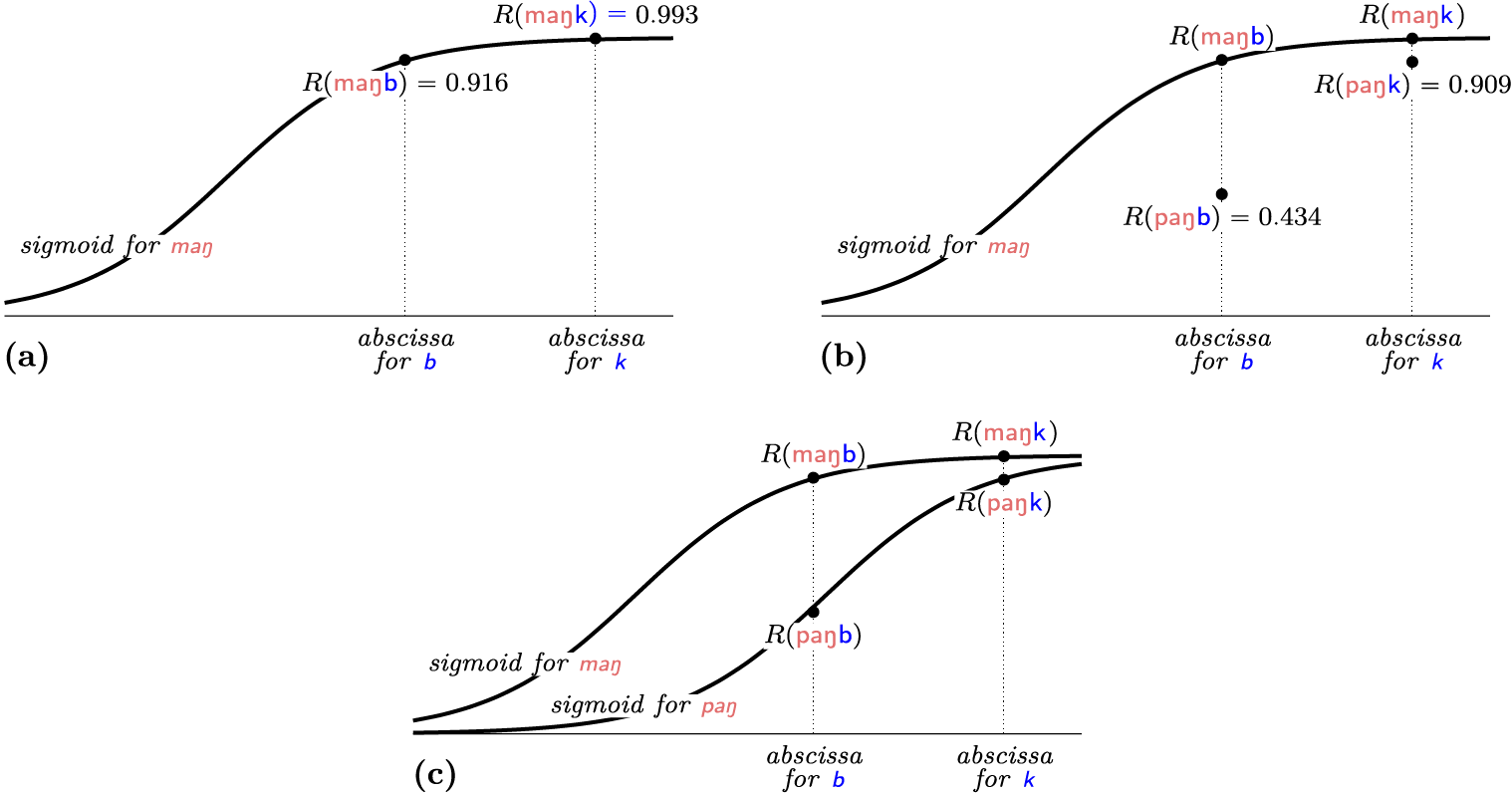
Tagalog consonant clusters derived by concatenating a prefix that ends with a nasal with a stem that starts with an obstruent undergo nasal substitution: the nasal and the obstruent are coalesced into a single consonant that retains the nasality of the former and the place of articulation of the latter, whereby /maŋ + bigáj/ is realized as [mamigáj] ‘to distribute’ (Zuraw Reference Zuraw2010:421). We focus on two factors that are known to condition the rates of application of this process. One factor is the quality of the stem-initial obstruent, say /b/ versus /k/. Another factor is the identity (perhaps the lexical frequency?) of the nasal-final affix, say /paŋ/ versus /maŋ/.Footnote 1 HZ observe that the rates of application of nasal substitution to the four resulting underlying concatenations in (1) reported by Zuraw (Reference Zuraw2010) satisfy an intriguing property illustrated in Figures 1a–c.
The rates of application of nasal substitution in Tagalog to the four underlying concatenations in (1) are fitted onto two shifted sigmoids at shared abscissas.

Figure 1 Long description
The figure consists of three panels labeled a, b, and c. Each panel features a horizontal x-axis with two marked points: abscissa for b and abscissa for k.
Panel a shows a single sigmoid curve labeled sigmoid for m a n g. Two points are plotted on this curve: R m a n g b equals 0.916 above the abscissa for b, and R m a n g k equals 0.993 above the abscissa for k.
Panel b shows the same sigmoid for m a n g curve. It includes the point R m a n g b and R m a n g k on the curve. Additionally, two outlier points are plotted: R p a n g b equals 0.434 located below the curve at the abscissa for b, and R p a n g k equals 0.909 located below the curve at the abscissa for k.
Panel c displays two shifted sigmoid curves. The upper curve is labeled sigmoid for m a n g and the lower curve is labeled sigmoid for p a n g. Vertical dashed lines connect the abscissas to points on both curves. At the abscissa for b, the upper point is R m a n g b and the lower point is R p a n g b. At the abscissa for k, the upper point is R m a n g k and the lower point is R p a n g k.
(1)

The sigmoid function
$ \mathbf{S}\left(\mathsf{x}\right)=\frac{1}{1+\exp \left(-\mathsf{x}\right)} $
 takes values between 0 and 1 (both excluded) that can therefore be interpreted as application rates. Figure 1a thus plots on the graph of the sigmoid function the rates R(/maŋb/) = 0.916 and R(/maŋk/) = 0.993 of application of nasal substitution to the two underlying concatenations that share the prefix /maŋ/. Next, Figure 1b plots as two points with the same abscissasFootnote 2 the rates R(/paŋb/) = 0.434 and R(/paŋk/) = 0.909 of application of nasal substitution to the two underlying concatenations that share the other prefix /paŋ/. HZ discover that the latter two points sit on the graph of some shifted sigmoid, namely the graph of the function S(x + δ) for some shifting constant δ, as verified in Figure 1c. In conclusion, these rates of nasal substitution can be fitted on two shifted sigmoids at shared abscissas. As a result, these four rates can be described through only three parameters: the two shared abscissas and the shifting constant δ. Equivalently, given three of these rates, we can guess the fourth one.
2.2. Independent phonological factors
HZ interpret this surprising property of the rates of application of nasal substitution as the reflex at the level of rates of the fact that the quality of the stem-initial obstruent and the identity of the prefix are independent factors. They formalize this intuition of independence as follows. When modeling the frequencies of nasal substitution within constraint-based phonology, we obviously need some constraints that are sensitive to the quality of the stem-initial obstruent. Furthermore, we also need some constraints that are sensitive to the identity of the prefix, because concatenations with different prefixes but the same stem-initial obstruent have different rates of nasal substitution. Yet, we expect no single constraint to be sensitive to both the quality of the stem-initial obstruent and the identity of the prefix. In conclusion, stems and prefixes are independent factors because no constraint is sensitive to both and therefore no constraint can encode any interaction between them.
To illustrate, the constraint *NC̥ penalizes sequences of a nasal followed by a voiceless obstruent and thus captures the observation that the rate of nasal substitution is higher when the stem-initial obstruent is voiceless. This constraint is only sensitive to the quality of the stem-initial obstruent but crucially insensitive to the identity of the prefix: it assigns the same number of violations to two faithful candidates that feature different prefixes, as long as the stems start with the same obstruent. Conversely, HZ’s faithfulness constraints Uniformity(maŋ) and Uniformity(paŋ) penalize coalescence but only when the coalesced nasal belongs to the prefix /maŋ/ or /paŋ/, respectively. Either constraint is sensitive to the identity of the prefix but crucially insensitive to the quality of the stem-initial obstruent: it assigns the same number of violations to the nasal substitution candidates of two underlying concatenations that feature different stem-initial obstruents, as long as they share the same prefix.Footnote 3
Beyond nasal substitution in Tagalog, Hayes (Reference Hayes2021a,Reference Hayesb, Reference Hayes2022) reviews a number of variable phonological processes in a number of languages: vowel harmony in Hungarian; consonant liaison in French; inversion of final devoicing in Dutch; genitive plurals in Finnish; schwa/zero alternation in French; stress placement in Hupa. For each of these variable processes, Hayes focuses on two factors that condition its rate of application and that are plausibly independent because no reasonable, natural constraint would be sensitive to both factors. He then looks at the rates of application of that variable process to the underlying forms corresponding to the four combinations of two values of those two factors. And he observes that these rates can be fitted on two shifted sigmoids at shared abscissas with good approximation.
This empirical discovery is puzzling. Why do the rates of application of disparate variable phonological processes in unrelated languages all comply with this exotic generalization? What is the proper phonological interpretation of the rate configuration plotted in Figure 1? To answer this question, this paper develops an intuitive and intelligible interpretation of HZ’s generalization in terms of even constraints within the framework of probabilistic harmony-based phonology.
3. Harmony-based phonology
This Section briefly reviews probabilistic grammars that are harmony-based because they realize an underlying form as a certain candidate surface form with a probability proportional to the harmony score of the constraint violation profile of the resulting mapping.
3.1. Probabilistic grammars based on harmony scores
As usual, Gen lists all the phonological mappings that are relevant for the description of the phonological system of interest. Gen(x) denotes the candidate set of an underlying form x, that we assume to be finite to circumvent the subtleties required to define probability masses over infinite sets.Footnote 4 A finite number n of constraints C 1, … , Cn suffice to quantify all the phonologically relevant properties of the mappings listed by Gen. The number of violations assigned by a constraint Ck to the mapping of an underlying form x to a surface realization y from the candidate set Gen(x) is denoted by Ck(x, y).
A harmony function H assigns a strictlyFootnote 5 positive harmony score H(x, y) to any underlying form x and any surface form y from the candidate set Gen(x). We assume that this harmony score H(x, y) depends on the mapping (x, y) only through its constraint violations Ck(x, y), as stated in 2b. In other words, H is really a function from n (constraint violation) numbers to positive scores. We then denote by GH the probabilistic grammar that is based on the constraints C 1, … , Cn through this harmony function H because GH realizes an underlying form x as a candidate surface form y with a probability GH(y | x) that is proportional to the harmony score H(x, y), as stated in (2a).

The proportionality relation (2a) defines the harmony-based probability GH (y | x) only up to a multiplicative constant Z, namely it says that GH(y | x) = H(x, y)/Z. Yet, this constant Z is univocally determined as follows. Because of their probabilistic interpretation, the numbers GH(y | x) must be normalized: their sum over all the surface forms y in the candidate set Gen(x) of the underlying form x must be equal to one. Normalization requires the constant Z to be equal to the sum of the harmony scores of all the surface forms z in the candidate set Gen(x), namely
$ Z={\sum}_{z\in Gen\left(\mathsf{x}\right)}H\left(\mathsf{x},z\right) $
 . As a result, Z is a constant in the sense that it only depends on the underlying form x but not on the candidate y considered.
The poster child of probabilistic harmony-based phonology is ME. Let me thus recall that a ME grammar G
ME realizes an underlying form x as a candidate surface form y with a probability G
ME(y | x) proportional to the ME harmony score H
ME
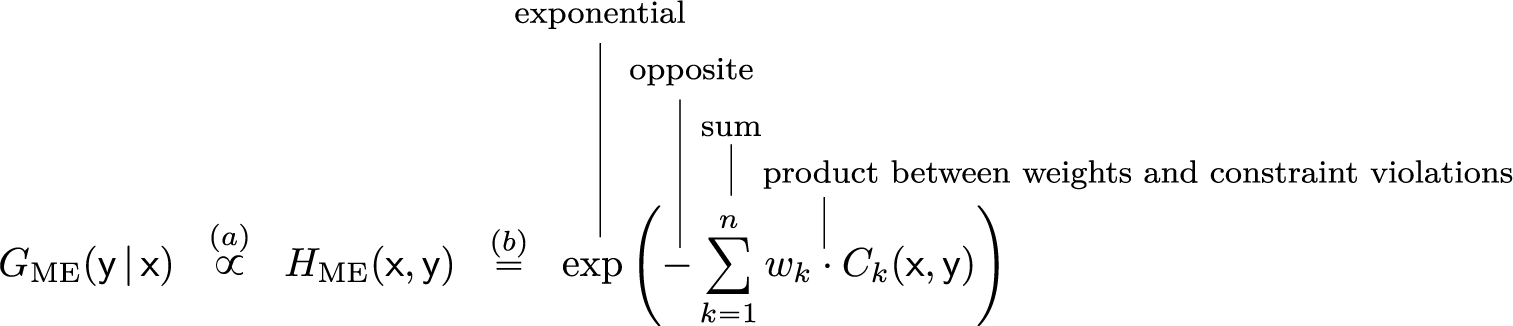
(x, y), as stated in 3a. This harmony score is obtained by applying the exponential function to the opposite of the sum of the weighted constraint violations, as stated in 3b.Footnote 6 The non-negative weight wk encodes the relative importance of the corresponding constraint Ck. Because of the minus sign inside the exponential (together with the fact that the exponential function is monotonically increasing), the ME grammar G
ME assigns a larger probability to candidates that yield a smaller sum
$ {\sum}_k{w}_k{C}_k $
 and thus violate the constraints less, taking into account the relative importance of each constraint through its weight.
(3)
3.2. ME grammars predict HZ’s generalization
HZ observe that ME grammars predict their generalization in the following sense. We consider some phonological process that applies variably to four underlying forms x
TL
, x
TR
, x
BL
, and x
BR
. We arrange these underlying forms into a square as in (4), so that the superscripts ‘
t
’ and ‘
b
’ (for top and bottom) specify the row an underlying form sits in while the superscripts ‘
l
’ and ‘
r
’ (for left and right) specify the column. We assume that these underlying forms satisfy two assumptions. The first assumption is that each of them is listed by Gen with only two candidates yes and no, corresponding to application and non-application of the variable phonological process of interest (see footnote 8 for discussion). The second assumption is that each relevant constraint C satisfies either the identities in 5a or those in (5b).
(4)

(5)
a.

b.

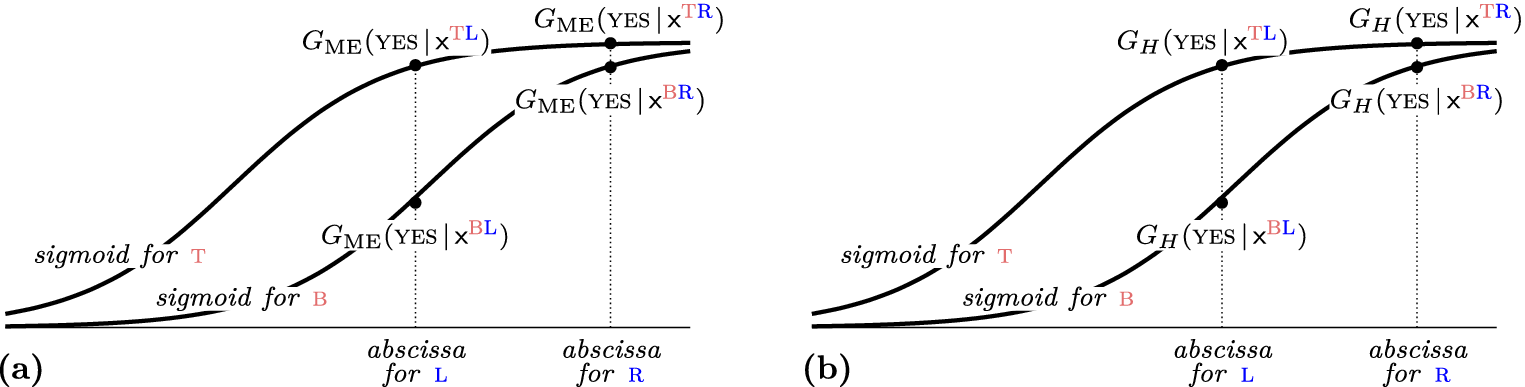
The ‘horizontal’ identities in (5a) say that the constraint C is insensitive to the column dimension because it does not distinguish between two underlying forms x TL versus x TR or x BL versus x BR that belong to the same row and thus only differ for the column. Analogously, the ‘vertical’ identities in (5b) say that the constraint C is insensitive to the row dimension because it does not distinguish between two underlying forms x TL versus x BL or x TR versus x BR that belong to the same column and thus only differ for the row.Footnote 7 Since no constraint is sensitive to both column and row dimensions, no constraint can encode an interaction between these two dimensions, that are therefore independent. Under this independence assumption, HZ show that the ME grammar corresponding to any constraint weights predicts that the four underlying forms in (4) undergo the variable process considered (namely are realized as the candidate yes) with probabilities that can be fitted onto two shifted sigmoids at shared abscissas, as in Figure 2a.
The ME grammar G me in (a) and the probabilistic grammar GH corresponding to an arbitrary harmony function H in (b) predict that the variable phonological process of interest applies to the four underlying forms in 4 with probabilities that can be fitted onto two shifted sigmoids at shared abscissas.

Figure 2 Long description
A two-panel figure showing phonological process probabilities.
Panel a, labeled lowercase a, displays the M E grammar G sub M E. The horizontal x-axis has two marked points: abscissa for L on the left and abscissa for R on the right. Two sigmoid curves rise from left to right. The upper curve is labeled sigmoid for T and the lower curve is labeled sigmoid for B. Vertical dotted lines connect the abscissas to points on the curves. On the upper curve, the left point is G sub M E open parenthesis Y E S vertical bar x super T L close parenthesis and the right point is G sub M E open parenthesis Y E S vertical bar x super T R close parenthesis. On the lower curve, the left point is G sub M E open parenthesis Y E S vertical bar x super B L close parenthesis and the right point is G sub M E open parenthesis Y E S vertical bar x super B R close parenthesis.
Panel b, labeled lowercase b, displays the probabilistic grammar G sub H. The layout is identical to panel a, but the labels use G sub H instead of G sub M E. The curves and points are positioned at the same relative coordinates as in panel a, showing the shared abscissas for L and R across both grammar types.
To illustrate, we revisit the four underlying forms in (1). In this case, the column dimension corresponds to the stem-initial obstruents (/b/ versus /k/) and the row dimension to the prefixes (/paŋ/ versus /maŋ/). Each of these four underlying forms is listed by Gen with only two candidate surface realizations, corresponding to application and non-application of nasal substitution. Finally, the constraint set consists of two types of constraints. Either constraints such as Uniformity(paŋ) that satisfy the ‘horizontal’ identities in (5a) because they are insensitive to the column dimension corresponding to the stem-initial obstruents, or constraints such as *NC̥ that satisfy the ‘vertical’ identities in (5b) because they are insensitive to the row dimension corresponding to the prefixes. The ME grammar corresponding to any constraint weights predicts that the four underlying forms in (1) undergo nasal substitution with probabilities that can be fitted onto two shifted sigmoids at shared abscissas.
3.3. Harmony-based grammars that predict HZ’s generalization
We can now easily move beyond the special case of ME grammars to arbitrary harmony-based grammars. We say that an arbitrary harmony function H predicts HZ’s generalization provided it satisfies the following condition. Choose four arbitrary underlying forms (4) with two candidates yes and no each, corresponding to application and non-application of the process of interest. Choose an arbitrary set of constraints that each satisfy the horizontal or vertical identities in (5). Then, the resulting harmony-based grammar GH predicts that the four underlying forms in (4) undergo the variable process considered (namely are realized as the candidate yes) with probabilities that can be fitted onto two shifted sigmoids at shared abscissas, as in Figure 2b.Footnote 8
To understand HZ’s generalization within the framework of harmony-based phonology means to understand which phonological property is both necessary and sufficient in order for a harmony function H to predict HZ’s generalization in the sense just made explicit. The rest of this paper shows that this property turns out to be remarkably simple and intelligible: it is the simple and intuitive property that a harmony function H is oblivious to those constraints that intuitively should not matter because they are even, as formalized in the next Section.
4. Even constraints do not matter
This Section formalizes the simple intuition that the constraints that are even among the candidates of an underlying form do not matter because grammars are oblivious to these even constraints.
4.1. Underlying forms that only differ for the even constraints
We consider two underlying forms x and
$ \hat{\mathsf{x}} $
 that satisfy the following two assumptions. The first assumption is that they are listed by Gen with the same (finite) number m of (possibly different) candidates, as stated in (6). Two candidates y
i and
$ {\hat{\mathsf{y}}}_i $
 that bear the same index are called corresponding candidates, capturing the intuition that they are obtained from the two underlying forms x and
$ \hat{\mathsf{x}} $
 by applying the same phonological processes. The second assumption is that each relevant constraint C satisfies either the ‘vertical’ identities in (7a) or the “horizontal” identities in (7b).
(6)

(7)
a.

b.

The ‘vertical’ identities in (7a) say that the constraint C assigns the same number of violations to any two corresponding candidates y
i and
$ {\hat{\mathsf{y}}}_i $
 of the underlying forms x and
$ \hat{\mathsf{x}} $
 . In other words, C does not distinguish between these two underlying forms. The ‘horizontal’ identities in (7b) say that the constraint C assigns the same number of violations to all the candidates of the underlying form x and it also assigns the same number of violations to all the candidates of the other underlying form
$ \hat{\mathsf{x}} $
 . In other words, C is even relative to both underlying forms (C yields an e in all ERCs; Prince Reference Prince2002). In conclusion, these two underlying forms x and
$ \hat{\mathsf{x}} $
 only differ for constraints that are intuitively irrelevant because they are even.
To illustrate, we suppose that Gen lists the underlying forms /rat/ and /rut/ with the faithful candidates [rat] and [rut] together with the candidates [ra] and [ru] obtained through coda deletion. Furthermore, we consider the constraints C
1 = NoCoda, C
2 = Max, and C
3 = NoRound, described in 8. NoCoda and Max do not distinguish between the two underlying forms: they assign the same number of violations to the two corresponding deletion candidates as well as to the two corresponding faithful candidates, as required by the ‘vertical’ identities (7a). Furthermore, NoRound is even relative to both underlying forms: it assigns the same number of violations to the two candidates of the underlying form /rat/ (both candidates satisfy the constraint) as well as to the two candidates of the underlying form /rut/ (both candidates violate it), as required by the ‘horizontal’ identities (7b). We conclude that the underlying forms /rat/ and /rut/ only differ for the constraint NoRound that is intuitively irrelevant because it is even.Footnote 9
(8)


4.2. OT and HG categorical grammars are oblivious to the even constraints
Let us consider the categorical HG grammar corresponding to some weights w
1, w
2, and w
3 of the constraints C
1 = NoCoda, C
2 = Max, and C
3 = NoRound, respectively. How does this grammar behave on the underlying forms /rat/ and /rut/ that only differ for the even constraint NoRound? The HG harmony H
hg
of a mapping is simply the sum of its weighted constraint violations. The difference between the HG harmony of the deletion candidate [ra] minus the HG harmony of the faithful candidate [rat] can therefore be made explicit as in (9a). Since the constraint NoRound is even between these two candidates, the two quantities ( ) and (
 ) are identical and therefore cancel out, yielding (9b). Since the remaining constraints NoCoda and Max do not distinguish between the two underlying forms /rat/ and /rut/, we can replace the former underlying form and its candidates with the latter underlying form and its corresponding candidates, yielding (9c). Finally, the identity (9d) holds by reasoning as in (9a–b).
(9)

This reasoning in (9) shows that the difference between the HG harmony of the deletion candidate minus the HG harmony of the faithful candidate is the same for the two underlying forms /rat/ and /rut/. It follows that our categorical HG grammar cannot distinguish between these two underlying forms /rat/ and /rut/ that only differ for the even constraint NoRound: our HG grammar deletes the coda of /rat/ if and only if it deletes the coda of /rut/ as well. The reasoning in (9) obviously extends to the general case. We conclude that no HG grammar can distinguish between two underlying forms x and
$ \hat{\mathsf{x}} $
 that only differ for even constraints in the sense of Subsection 4.1: every HG grammar realizes the underlying form x as a surface candidate y
i if and only if it realizes the other underlying form
$ \hat{\mathsf{x}} $
 as the corresponding candidate
$ {\hat{\mathsf{y}}}_i $
 . We summarize this conclusion by saying that HG grammars are oblivious to the even constraints. This conclusion extends to categorical OT grammars, as they are a special case of HG grammars.
4.3. ME grammars are oblivious to the even constraints
We now turn from categorical to probabilistic phonology. Let us consider the probabilistic ME grammar G ME corresponding to some weights w 1, w 2, and w 3 of the constraints NoCoda, Max, and NoRound, respectively. How does this grammar behave on the underlying forms /rat/ and /rut/ that only differ for the even constraint NoRound? We start by computing the logarithm of the ratio between the ME harmony of the faithful candidate [rat] divided by the ME harmony of the deletion candidate [ra]. Step (10a) holds because the logarithm of a ratio is the difference of the logarithms. Step (10b) holds because the ME harmony H ME recalled in 3b is simply the exponential of the opposite of the HG harmony H HG. Step (10c) holds because the logarithm and the exponential functions invert each other: whenever we feed some number x to the exponential and then feed the result exp x to the logarithm, we get back the number x we started from, because x = log(exp x). Step (10d) holds because the reasoning (9) has shown that the difference between the HG harmony scores of the faithful and deletion candidates is the same for the two underlying forms /rat/ and /rut/. Finally, step (10e) holds by reasoning as in (10a–c).

This reasoning in (10) shows that, since the differences between HG harmony scores are the same for the two underlying forms /rat/ and /rut/, the (logarithms of the)Footnote 10 ratios of ME harmony scores are the same as well. This observation makes intuitive sense: since ME is a probabilistic version of categorical HG, it makes sense that formal HG properties have ME counterparts. We now use this observation to compare the ME probabilities of deletion of the underlying codas of /rat/ and /rut/. Step (11a) holds because of the definition of harmony-based grammars from Subsection 3.1. Step (11b) holds because the normalization constant Z is equal to the sum of the ME harmony scores of the two candidates [ra] and [rat]. Step (11c) holds by dividing both the numerator and the denominator by the ME harmony score of the deletion mapping (/rat/, [ra]) (which is licit, because ME harmony scores are different from zero). Step (11d) holds because the two harmony ratios in the denominators have been shown to coincide in (10). Finally, step (11e) holds by reasoning as in steps (11a–c).

This reasoning in (11) shows that our ME grammar G
ME cannot distinguish between the two underlying forms /rat/ and /rut/ that only differ for the even constraint NoRound: G
ME deletes the underlying coda of /rat/ with the same probability it deletes the underlying coda of /rut/, namely G
ME([ra] | /rat/) = G
ME([ru] | /rut/). The reasoning in (10–11) obviously extends to the general case. We conclude that no ME grammar can distinguish between two underlying forms x and
$ \hat{\mathsf{x}} $
 that only differ for even constraints in the sense of Subsection 4.1: every ME grammar realizes the underlying form x as a surface candidate y
i with the same probability it realizes the other underlying form
$ \hat{\mathsf{x}} $
 as the corresponding candidate
$ {\hat{\mathsf{y}}}_i $
 , namely G
ME(y
i | x) = G
ME(
$ {\hat{\mathsf{y}}}_i $
 |
$ \hat{\mathsf{x}} $
 ). In other words, ME grammars are oblivious to the even constraints.
4.4. Harmony-based grammars that are oblivious to the even constraints
We can now easily move beyond the special case of ME grammars to arbitrary harmony-based grammars from Subsection 3.1. We say that an arbitrary harmony function H is oblivious to the even constraints provided, no matter how we choose two underlying forms x and
$ \hat{\mathsf{x}} $
 that only differ for even constraints in the sense of Subsection 4.1, the resulting harmony-based grammar GH predicts the same probability for their corresponding candidates y
i and
$ {\hat{\mathsf{y}}}_i $
 , namely GH (y
i | x) = GH (
$ {\hat{\mathsf{y}}}_i $
 |
$ \hat{\mathsf{x}} $
 ). We now have two general formal properties of harmony functions and their grammars: the property of predicting HZ’s generalization, formulated in Subsection 3.3; and the property of being oblivious to the even constraints, formulated here. The former property is empirically well supported by HZ’s work, but hard to interpret. The latter property instead admits a straightforward interpretation. The main result of this paper is that these two properties are equivalent, as shown in the next Section.
5. HZ’s generalization simply says that the even constraints do not matter
This Section shows that, within harmony-based phonology, HZ’s generalization is equivalent to the intuitive assumption that the even constraints do not matter because grammars are oblivious to them.
5.1. Main result: HZ’s generalization and even constraints
Let us take stock. Section 2 has reviewed HZ’s generalization that the rates of application of variable phonological processes governed by independent factors fit onto shifted sigmoids at shared abscissas. How can we make intuitive sense of this apparently exotic generalization? Can we relate it to some simple intuition? To this end, Section 4 has turned to the simple intuition that a constraint that is even among the candidates of an underlying form does not matter: grammars are oblivious to the even constraints when choosing (categorically or probabilistically) the surface realization of that underlying form. The main result of this paper, boxed below, is that HZ’s exotic generalization is equivalent to this simple intuition that the even constraints do not matter, at least within the framework of probabilisticFootnote 11 harmony-based phonology reviewed in Section 3.
A harmony function H from Subsection 3.1 predicts HZ’s generalization in the sense of Subsection 3.3 if and only if it is oblivious to the even constraints in the sense of Subsection 4.4.
The restriction to harmony-based phonology is crucial for this boxed result to hold. To illustrate, probabilistic SOT and NHG grammars are obviously constraint-based: they are defined solely in terms of constraint violations. Yet, they are not harmony-based in the sense of Subsection 3.1: de la Fuente et al. (Reference de la Fuente, Jeong, Anttila, Magri, Avelino, Balihaxi, Colvin, Czarnecki, Joo, Wang, Zobarlar, Jardine and McCollum2025) show how to construct candidate and constraint sets such that SOT and NHG probabilities are not proportional to the harmony scores of the constraint violation profiles, no matter how these harmony scores are defined. And indeed the boxed result fails for SOT and NHG. On the one hand, HZ observe that SOT massively fails at their generalization and that NHG as well admits counterexamples. On the other hand, SOT and NHG grammars are oblivious to the even constraints in the sense of Subsection 4.4. In fact, the SOT or NHG probability of a candidate is equal to the probability of sampling a categorical OT or HG grammar that indeed chooses that candidate surface realization. And categorical OT and HG grammars are themselves oblivious to the even constraints, as verified in Subsection 4.2.
The rest of this Section explains intuitively why the result boxed above holds, with the more technical steps of the reasoning relegated to the Appendix. The reasoning has the shape in (12). To start, Subsection 5.2 reviews from Magri (Reference Magri2025) the notion of harmony scores that factorize into products of rescaled constraint violations and therefore encode a particularly simple mode of constraint interaction. Then, Subsection 5.3 recalls from Magri Reference Magri2025 that a harmony function H predicts HZ’s generalization in the sense of Subsection 3.3 if and only if (this is a complete characterization) H is factorizable, as stated in (12a). Finally, Subsections 5.4–5.5 (together with the Appendix) show that a harmony function H is oblivious to the even constraints in the sense of Subsection 4.4 if and only if (again, this is a complete characterization) H is factorizable, as stated in (12b). The result boxed above that a harmony function predicts HZ’s generalization if and only if it is oblivious to the even constraints then follows straightforwardly.
(12)

5.2. Factorizable harmonies
A harmony function H from Subsection 3.1 effectively takes n (constraint violation) numbers and returns positive harmony scores. Magri (Reference Magri2025) focuses on the special case where the harmony score H(x, y) of the mapping consisting of some underlying and candidate surface forms x and y can be computed as in (13). First, we compute the number of violations Ck(x, y) assigned by each constraint Ck to this mapping. Then, we rescale this number of violations by feeding it to some corresponding unary function h k. Finally, we take the product of these rescaled numbers of violations hk(Ck(x, y)) over all constraints.

In other words, this condition (13) says that the harmony score is simply the product of the constraint violations. The only leeway is that, before taking these products, we are allowed to rescale the number of violations assigned by each constraint Ck through the corresponding unary function hk. Equivalently, the n-ary function H factorizes into the product
$ H={\prod}_k{h}_k $
 of the unary functions hk, each attuned only to the corresponding constraint Ck.
Footnote 12 As a result, these factorizable harmonies encode a particularly simple, restricted mode of constraint interaction.
Subsection 3.1 has reviewed ME grammars as the poster child of probabilistic harmony-based phonology. Now we observe that ME harmonies are actually the poster child of factorizable harmonies. In fact, the reasoning in (14) shows that the ME harmony factorizes into a product (13) of unary functions hk that are defined through the position hk (x) = exp(–wkx). Step (14a) recalls the definition (3b) of ME harmony scores as the exponential of the opposite of the sum of the weighted constraint violations. Step (14b) holds because the exponential of a sum is the product of the exponentials. Finally, step (14c) holds because of the choice of the unary functions hk.

5.3. Factorizable harmonies and HZ’s generalization
Subsection 3.2 recalled HZ’s observation that ME harmonies predict HZ’s generalization. HZ’s reasoning extends straightforwardly from ME harmonies to any harmony that factorizes in the sense of (13). In other words, factorizability entails HZ’s generalization. The main result of Magri Reference Magri2025 is that the reverse holds as well: whenever a harmony function predicts HZ’s generalization, it can be shown to factorize. In conclusion, a harmony function H predicts HZ’s generalization in the sense of Subsection 3.3 if and only if (this is a complete characterization) it factorizes into a product (13) of unary functions that attend each to a single constraint and thus encodes a simple mode of constraint interaction, as stated in (12a).
This equivalence between factorizability and HZ’s generalization can be understood intuitively as follows. We focus on a variable phonological process that depends on two phonological dimensions. HZ’s generalization starts from the assumption that this process can be described through constraints that are simple, in the sense that each constraint is only sensitive to one of the two relevant phonological dimensions whereby no constraint can capture any interaction between those two dimensions. Under this assumption, HZ’s generalization predicts that the pattern of rates of application of the process considered ought to be simple as well, in the sense that the rates of application to four underlying forms that cross-product the two relevant phonological dimensions can be fitted onto two shifted sigmoids at shared abscissas. Thus, they depend on only three parameters and are therefore so tightly connected that we can guess any of the rates from the others. Intuitively, in order for a simple constraint set to always predict a simple pattern of rates, we need a mode of constraint interaction that is simple. The result just quoted says that this intuition is correct when simple constraint interactions are formalized through harmonies that factorize into products of rescaled numbers of constraint violations.
5.4. Factorizable harmonies are oblivious to the even constraints
Subsection 4.4 observed that ME harmonies are oblivious to the even constraints. That reasoning extends straightforwardly from ME harmonies to any harmony that factorizes in the sense of (13). To illustrate, we revisit the example of the underlying forms /rat/ and /rut/ from Subsection 4.1 that only differ for the even constraint NoRound. We consider some harmony function H for the n = 3 constraints C
1 = NoCoda, C
2 = Max, and C
3 = NoRound that factorizes into the product (15) of three unary functions h
1, h
2, and h
3, each attuned only to the corresponding constraint. In other words, the harmony score of a mapping is simply the product of the numbers of violations assigned to that mapping by the three constraints considered. The only leeway is that, before taking these products, we are allowed to rescale the constraints through the corresponding unary functions h
1, h
2, and h
3.
(15)

We now compute the ratio between the harmony scores of the faithful and deletion candidates [rat] and [ra] through the reasoning in (16), which is analogous to reasoning in (9), above. Step (16a) holds because H has the shape (15). Step (16b) holds because the constraint NoRound is even between the two candidates [rat] and [ra], whereby the two quantities () and () are identical and their ratio is therefore equal to one. Step (16c) holds because the remaining constraints NoCoda and Max do not distinguish between the two underlying forms /rat/ and /rut/, whereby the former underlying form and its candidates can be replaced with the latter underlying form and its corresponding candidates. Finally, step (16d) holds by reasoning as in steps (16a–b).
(16)

This reasoning in (16) shows that the ratios between the harmony scores of the faithful and deletion candidates are the same for the two underlying forms /rat/ and /rut/. By reasoning as in (11), we conclude that the grammar GH based on this factorizable harmony H cannot distinguish between these two underlying forms /rat/ and /rut/ that only differ for the even constraint NoRound: G
h
deletes the underlying coda of /rat/ with the same probability it deletes the underlying coda of /rut/, namely GH ([ra] | /rat/) = GH([ru] | /rut/). The reasoning in (16) obviously extends to the general case. We conclude that no grammar GH based on a factorizable harmony H can distinguish between two underlying forms x and
$ \hat{\mathsf{x}} $
 that only differ for even constraints in the sense of Subsection 4.1: GH realizes the underlying form x as a surface candidate y
i with the same probability it realizes the other underlying form
$ \hat{\mathsf{x}} $
 as the corresponding candidate
$ {\hat{\mathsf{y}}}_i $
 , namely GH (y
i | x) = GH (
$ {\hat{\mathsf{y}}}_i $
 |
$ \hat{\mathsf{x}} $
 ). In other words, probabilistic grammars based on factorizable harmonies are oblivious to the even constraints in the sense of Subsection 4.4.
5.5. Harmonies oblivious to the even constraints are factorizable
The reverse holds as well. Suppose that a harmony H is oblivious to the even constraints: no matter the candidates and the constraints considered, whenever two underlying forms x and
$ \hat{\mathsf{x}} $
 only differ for even constraints in the sense of Subsection 4.1, the grammar GH based on this harmony H realizes the underlying form x as a surface candidate y
i with the same probability it realizes the other underlying form
$ \hat{\mathsf{x}} $
 as the corresponding candidate
$ {\hat{\mathsf{y}}}_i $
 , namely GH (y
i | x) = GH(
$ {\hat{\mathsf{y}}}_i $
 |
$ \hat{\mathsf{x}} $
 ). A more involved reasoning relegated to the Appendix shows that this harmony H then factorizes into the product (13) of unary functions hk each attuned only to the corresponding constraint Ck. In conclusion, a harmony function is oblivious to the even constraints if and only if (this is a complete characterization) it is factorizable, as stated in (12a).
To understand this result intuitively, we reason once again on the underlying forms /rat/ and /rut/ from Subsection 4.1. Which difference between these two underlying forms would justify deleting their codas with different probabilities? Within constraint-based phonology, the answer must be some difference in constraint violations. Let us thus consider each constraint in turn. The constraints NoCoda and Max do not distinguish between the two underlying forms /rat/ and /rut/ because they assign the same number of violations to their faithful candidates [rat] and [rut] as well as to their deletion candidates [ra] and [ru]. As a result, in and by themselves, these constraints NoCoda and Max justify no difference between the probabilities with which deletion applies to the underlying codas of /rat/ versus /rut/.
The remaining constraint NoRound is even relative to both underlying forms /rat/ and /rut/ because it assigns the same number of violations to the candidates [rat] and [ra] of the former as well as to the candidates [rut] and [ru] of the latter. Thus, NoRound has nothing to say on how the candidates [rat] and [ra] split up the probability mass between the two of them nor on how the candidates [rut] and [ru] split it up. As a result, in and by itself, NoRound justifies no difference between the probabilities with which deletion applies to the two underlying codas of /rat/ versus /rut/.
The only relevant difference between these two underlying forms /rat/ and /rut/ is that the faithful candidate [rut] of the latter violates both markedness constraints NoCoda and NoRound, while the faithful candidate [rat] of the former violates only NoCoda. Yet, this property is invisible to a harmony H that factorizes into the product (15) of three unary functions h 1, h 2, and h 3, each attuned to only one constraint. In fact, H makes decisions by narrowly taking into account only one constraint at a time, ignoring all other constraints. In conclusion, this factorizable harmony H cannot distinguish between the two underlying forms /rat/ and /rut/ because it cannot see the only relevant difference between them, namely that faithful realization of one but not of the other violates both markedness constraints.
6. Conclusions
Probabilistic phonology aims at uncovering the mathematical generalizations that govern the rates of application of variable phonological processes. Here is a natural approach to pursue this goal. We consider a number of underlying forms to which the phonological process of interest applies variably. For simplicity, we assume they come with only two surface candidates or variants, denoted yes and no because they correspond to application and non-application of the variable process considered. Intuitively, we expect identities among the numbers of constraint violations of these candidates to entail identities among the rates with which the variable process applies to these candidates. These entailments from constraint identities to rate identities provide a general scheme for formulating mathematical generalizations in probabilistic phonology. This paper focused on two such generalizations and investigated their formal relationship.
To start, we consider two underlying forms x and
$ \hat{\mathsf{x}} $
 and suppose that each relevant constraint C assigns the same number of violations to the application candidates yes of these two underlying forms x and
$ \hat{\mathsf{x}} $
 as well as the same number of violations to their non-application candidates no. These constraint identities are represented by the solid lines in (17a). Equivalently, the constraints are unable to distinguish between the corresponding candidates of the two underlying forms. Under the assumption that the constraints considered suffice, we expect the process considered to apply/non-apply to the two underlying forms x and x at the same rate. These rate identities are represented by the solid lines in (17b).
(17)
a.

b.

We suppose next that each relevant constraint C assigns the same number of violations to the application and non-application candidates yes and no of the underlying form x as well as to the two candidates of the other underlying form
$ \hat{\mathsf{x}} $
 . These constraint identities are represented by the dotted lines in (18a). Equivalently, the constraints are all even between the two candidates of either underlying form. Under the assumption that the constraints considered suffice, we expect the rates of application and non-application of the process to either underlying form to be identical. These rate identities are represented by the dotted lines in (18b). In other words (under the assumption that both underlying forms come with only these two candidates yes and no) the process applies with chance probability because all constraints are irrelevant because they are all even.
(18)
a.

b.

Now comes the interesting scenario. We suppose that some of the relevant constraints are unable to distinguish between the corresponding candidates of the two underlying forms because they satisfy the constraint identities represented by the solid lines in (19a). The remaining constraints are all even relative to both underlying forms because they satisfy the constraint identities represented by the dotted lines in (19a). Which rate identities hold in this mixed case? Section 4 has proposed that the same rate identities (17b) hold in this mixed case as well, and are therefore repeated in (19b). In other words, the process considered applies/non-applies to the two underlying forms x and
$ \hat{\mathsf{x}} $
 at the same rate. Equivalently, the rates are oblivious to the even constraints that satisfy the dotted identities because these constraints intuitively do not matter to decide how to split the probability mass between yes versus no, as captured by the rate identities in (18b).
(19)
a.

b.

Now we turn to the more complex case of four underlying forms xTL, xTR, xBL, and xBR. As in subsection 3.2, we arrange them into a square so that the superscripts ‘t’ and ‘b’ stand for top and bottom while the superscripts ‘l’ and ‘r’ stand for left and right. To start, we suppose that each relevant constraint assigns the same number of violations to the corresponding candidates of the two underlying forms xTL and xTR on the top row as well as to the corresponding candidates of the two underlying forms xBL and xBR on the bottom row. These constraint identities are represented by the solid lines in (20a). Under the assumption that the constraints considered suffice, we expect the process considered to apply/non-apply at the same rate to the two underlying forms xTL and xTR on the top row as well as to the two underlying forms xBL and xBR on the bottom row. These rate identities are represented by the solid lines in (20b).
(20)
a.

b.

Analogous considerations hold when we switch from rows to columns, as schematized in (21).
(21)
a.

b.

Now comes the interesting scenario. We suppose that some of the relevant constraints are unable to distinguish between corresponding candidates of two underlying forms on the same row because they satisfy the constraint identities represented by the solid lines in (22a). The remaining constraints are unable to distinguish between corresponding candidates of two underlying forms on the same column because they satisfy the constraint identities represented by the dotted lines in (22a). Which rate identities hold in this mixed case? Section 2 has reviewed HZ’s answer to this question. Since these four underlying forms are so tightly related in terms of constraint violations, their rates of application are so tightly related that, as soon as we know the rates of application to three underlying forms, we can guess the rate for the fourth underlying form, because these rates fit onto two shifted sigmoids at shared abscissas, as in (22b).
(22)
a.

b.

In conclusion, HZ’s generalization belongs to a family of generalizations that take the form of entailments from constraint identities to rate identities. The generalization (19) that the even constraints do not matter has a straightforward interpretation but has not been tested empirically, to the best of my knowledge. HZ’s generalization (22) has strong empirical support but looks exotic and lacks an obvious intuitive interpretation. To remedy this, the present paper has shown that these two generalizations are actually logically equivalent. This equivalence holds under the technical assumption that the rates are harmony-based, namely proportional to the harmony scores of the constraint violation profiles. In conclusion, within harmony-based phonology, HZ’s generalization does admit an intuitive interpretation because it simply says that the rates of application are oblivious to the constraints that are irrelevant because they are even.
Competing interests
The author has no competing interests to declare.
Data Availability Statement
This study did not involve the novel creation, generation, or analysis of primary research materials. All relevant literature is cited in the References.
Ethics statement
Not applicable. This research is a theoretical article and did not require data collection from human or animal subjects.
Apppendix
We recall from Subsection 3.1 that a harmony function H takes n numbers a 1, … , an (usually interpreted as numbers of constraint violations) and returns a positive score H(a 1, … , an). This appendix concludes the proof of the result boxed in Subsection 5.1 by showing that any harmony H that is oblivious to the even constraints in the sense of Subsection 4.4, is actually also factorizable in the sense of Subsection 5.4. The proof of this fact relies on the intermediate technical condition (23). The two numerators in this condition feature the harmony scores of the same tuple (a 1, … , an), only with the kth component replaced with a value c on the left-hand side and with a value d on the right-hand side. Analogously, the two denominators feature the harmony scores of the same tuple (b 1, … , bn), only with the kth component replaced again with the value c on the left-hand side and with the value d on the right-hand side.

A.1. Obliviousness to the even constraints entails the technical condition (23)
This appendix shows that a harmony function H that is oblivious to the even constraints in the sense of Subsection 4.4 satisfies the technical condition (23) for any index k = 1, … , n and any values ai, bj, c, d. To this end, we suppose that Gen lists an underlying form x with two candidates y
1
and y
2
and another underlying form
$ \hat{\mathsf{x}} $
 with two candidates
$ {\hat{\mathsf{y}}}_1 $
 and
$ {\hat{\mathsf{y}}}_2 $
 . Furthermore, we consider a set of n constraints C
1, … , Cn that assign the violation profiles in (24).
(24)


Every constraint Ch with h ≠ k assigns to the two corresponding candidates y
1
and
$ {\hat{\mathsf{y}}}_1 $
 of the two underlying forms the same number ah of violations. Furthermore, it assigns to the two corresponding candidates y
2
and
$ {\hat{\mathsf{y}}}_2 $
 of the two underlying forms the same number bh of violations. In other words, this constraint Ch satisfies the ‘vertical’ identities (7a) because it does not distinguish between the two underlying forms. The remaining constraint Ck assigns to the two candidates y
1
and y
2
of the underlying form x the same number c of violations. Furthermore, it assigns to the two candidates
$ {\hat{\mathsf{y}}}_1 $
 and
$ {\hat{\mathsf{y}}}_2 $
 of the other underlying form
$ \hat{\mathsf{x}} $
 the same number d of violations. In other words, this constraint Ck satisfies the ‘horizontal’ identities (7b) because it is even relative to both underlying forms x and
$ \hat{\mathsf{x}} $
 . We conclude that these underlying forms x and
$ \hat{\mathsf{x}} $
 only differ with respect to the constraint Ck, which is irrelevant because even.
Since the harmony function H is oblivious to the even constraints in the sense of Subsection 4.4, the probabilistic grammar GH based on this harmony H realizes the two underlying forms x and
$ \hat{\mathsf{x}} $
 as the corresponding candidates y
2
and
$ {\hat{\mathsf{y}}}_2 $
 with the same probabilities, namely GH (y
2
| x) = GH (
$ {\hat{\mathsf{y}}}_2 $
 |
$ \hat{\mathsf{x}} $
 ). The reasoning in (25) shows that this probability identity in turn secures the desired technical condition (23).
(25)

Step (25a) holds because of the definition of the grammar GH based on the harmony H from Subsection 3.1. Step (25b) holds because the normalization constant Z is the sum of the harmonies of the two candidates of each underlying form. Step (25c) holds by dividing the numerator and the denominator of the left-hand side by H(x, y
2
) and the numerator and the denominator of the right-hand side by H(
$ \hat{\mathsf{x}} $
 ,
$ {\hat{\mathsf{y}}}_2 $
 ). This step is licit because harmony scores are strictly positive. Finally, step (25d) holds because the harmony scores only depend on the constraint violation profiles that are in turn defined as in (24).
A.2. The technical condition (23) in turn entails factorizability
This appendix shows that a harmony function H that satisfies the technical condition in (23) for any index k = 1, … , n and any values ai, bj, c, d factorizes in the sense of Subsection 5.4 into a product of unary functions h
1, … , hn because it satisfies the identity
$ H\left({a}_1,\dots, {a}_n\right)={\prod}_{k=1}^n{h}_k\left({a}_k\right) $
 no matter how we choose the arguments a
1, … , an. To construct these unary functions hk, we assume that there exists a tuple of numbers (b
1, … , bn) with harmony equal to one, namely H(b
1, … , bn) = 1. This assumption can be made without loss of generality, because the harmony H can be rescaled without affecting the corresponding probabilistic grammar GH. We then define the unary function hk as in (26): the value hk(a) assigned by hk to an arbitrary argument a is the harmony score assigned by H to this designated tuple (b
1, … , bn), only with the kth component bk replaced with a.

The reasoning in (27) then holds for any tuple of arguments (a
1, … , an), showing that H factorizes into the product
$ H={\prod}_{k=1}^n{h}_k $
 as desired.

Step (27a) holds because the technical condition in (23) ensures that the harmony H satisfies (28).

Step (27b) holds because of the assumption H(b 1,…,bn) = 1. Step (27c) holds because of the definition (26) of the factor function h 1. Step (27d) holds by repeating steps (27a–b) working this time on the 2nd component. Step (27e) holds by repeating again steps (27a–b), iteratively from the 3rd component to the nth component. Finally, step (27f) holds because of the assumption H(b 1,…,bn) = 1.



 Open access

