It is generally agreed upon that classroom learning contexts produce great variation in second language (L2) learning outcomes. Such variation can be attributed to a host of different factors, including the type, duration, and intensity of language exposure, as well as individual differences in learner characteristics, such as age, motivation, and cognitive styles. From a psycholinguistic perspective, the extent to which specific cognitive factors constrain or enhance L2 learning is of particular importance. In this regard, there is mounting evidence that phonological memory, a subcomponent of working memory, is closely related to success in both first language (L1) and L2 acquisition. More specifically, within school settings, phonological memory or the ability to store verbal material temporarily in short-term memory, is a robust predictor of overall L2 achievement, particularly lexical and oral fluency development in both children and adults (French, Reference French2006; O'Brien, Segalowitz, Freed, & Collentine, Reference O'Brien, Segalowitz, Freed and Collentine2007; Service & Kohonen, Reference Service and Kohonen1995). However, with the exception of vocabulary acquisition, relatively little is known about the role phonological memory plays in the development of specific L2 subskills such as grammatical competence. This study investigated the relationship between phonological memory and L2 grammar learning in a classroom environment.
There is considerable evidence that phonological memory, most often tested using nonword repetition or immediate memory span measures, is related to vocabulary learning. For example, phonological memory strongly predicts children's overall L1 vocabulary acquisition (see Baddeley, Gathercole, & Papagno, Reference Baddeley, Gathercole and Papagno1998, for a review), and may even exert a possible causal influence on L1 vocabulary development in British preschool children (Gathercole, Willis, Emslie, & Baddeley, Reference Gathercole, Willis, Emslie and Baddeley1992). Phonological memory is also related to other aspects of children's L1 competence, such that children with better phonological memory abilities produce longer and semantically and syntactically richer utterances (Adams & Gathercole, Reference Adams and Gathercole1995, Reference Adams and Gathercole1996, Reference Adams and Gathercole2000; Blake, Austin, Cannon, Lisus, & Vaughan, Reference Blake, Austin, Cannon, Lisus and Vaughan1994). In addition, they recall more story information (Adams & Gathercole, Reference Adams and Gathercole1996) and are better at learning novel words, recalling new names, and learning definitions of new words (Gathercole, Hitch, Service, & Martin, Reference Gathercole, Hitch, Service and Martin1997).
With regard to L2 learning, phonological memory is a potent predictor of children's overall L2 achievement during the early elementary years (Dufva & Voeten, Reference Dufva and Voeten1999; French, Reference French2006; Service & Kohonen, Reference Service and Kohonen1995). It is closely linked to actual L2 learning gains in the classroom, even after removing effects of general intelligence, school motivation, and prior L2 skill (French, Reference French2006), and underlies the development of L2 vocabulary (Atkins & Baddeley, Reference Atkins and Baddeley1998; Cheung, Reference Cheung1996; French, Reference French2006; Gupta, Reference Gupta2003; Masoura & Gathercole, Reference Masoura and Gathercole1999, Reference Masoura and Gathercole2005; Speciale, Ellis, & Bywater, Reference Speciale, Ellis and Bywater2004) and oral production skill in children and adults (French & O'Brien, Reference French and O'Brien2007; O'Brien, Segalowitz, Collentine, & Freed, Reference O'Brien, Segalowitz, Collentine and Freed2006; O'Brien et al., Reference O'Brien, Segalowitz, Freed and Collentine2007).
However, it is less clear what role phonological memory plays in grammar learning. Adams and Gathercole (Reference Gathercole1995, Reference Adams and Gathercole2000) have found that children with better phonological memory abilities produce more grammatically complex utterances than children with weaker phonological memory skills (see also Blake et al., Reference Blake, Austin, Cannon, Lisus and Vaughan1994). Phonological memory is also related to the accuracy with which children repeat complex sentences, a task whose performance is dependent on understanding the relationships between words, and hence, the grammatical structure of the sentence (Blake et al., Reference Blake, Austin, Cannon, Lisus and Vaughan1994; Willis & Gathercole, Reference Willis and Gathercole2001).
Direct evidence that phonological memory may be related to grammatical development is provided by experimental studies requiring the learning and generalization of an artificial/novel grammar by both children (Daneman & Case, Reference Daneman and Case1981) and adults (Williams & Lovatt, Reference Williams and Lovatt2003). In another experimental study, Ellis and Sinclair (Reference Ellis and Sinclair1996) asked English-speaking adults to learn Welsh grammar rules. They found that those who had been required to repeat the Welsh utterances, and hence retained the utterances in phonological memory through rehearsal, were better at producing Welsh morphological inflections and had better metalinguistic knowledge about a morphological mutation rule than those who had been prevented from retaining the utterances in memory by engaging in articulatory suppression.
There are several classroom-based studies that have reported an association between phonological memory and grammar learning. Service (Reference Service1992) and Service and Kohonen (Reference Service and Kohonen1995) found a relationship between phonological memory measured at the start of English instruction and the performance of Finnish-speaking elementary school children on a variety of tests of English competence requiring knowledge of English grammar, several years later. However, this relationship was found to be mediated by English vocabulary knowledge. Similarly, French (Reference French2006) measured the phonological memory of French-speaking elementary school children at the start of a 5-month intensive English language program and found that phonological memory predicted their performance on specific tests of English grammar, but this relationship, too, was mediated by English vocabulary knowledge. O'Brien et al. (Reference O'Brien, Segalowitz, Collentine and Freed2006) assessed phonological memory abilities and Spanish speech production in a group of English-speaking adults learning Spanish as an L2. They found that phonological memory measured at the beginning of the semester predicted the participants' improvement in the correct use of Spanish function words and subordinate clauses by the end of the semester. However, they did not assess Spanish vocabulary knowledge, so it is unclear whether this relationship was mediated by lexical abilities.
To summarize, the empirical findings clearly demonstrate a relationship between phonological memory and language development in a variety of research settings. However, the nature of its role in the development of grammatical competence is much less apparent. Is the relationship between phonological memory and grammatical development dependent on lexical development? Or is its association with grammatical abilities separate from its association with lexical development?
One of the goals of the present study was to investigate the relationship between phonological memory and L2 grammatical development in children. Specifically, the research reported here examines the role that phonological memory plays in the development of Francophone children's L2 (English) grammatical competence over the course of a 5-month intensive English language program that they undertook in Grade 6. This specific L2 learning context is particularly well suited for looking at grammatical development, because individuals with relatively little knowledge of the target language undergo intensive L2 instruction for 5 hr daily during a 5-month period. The resulting learning outcomes translate into remarkable gains in both grammatical accuracy and oral fluency, often surpassing gains normally observed in a traditional classroom setting over a 4-year period (Lightbown & Spada, Reference Lightbown and Spada1994, Reference Lightbown and Spada1997). Thus, a unique feature of the present research context is that longitudinal data could be collected on phonological memory and different aspects of L2 learning over a short period of time, while avoiding the confounding effects of changing age and nonverbal ability reported in earlier longitudinal studies on phonological memory and language learning (e.g., Gathercole et al., Reference Gathercole, Willis, Emslie and Baddeley1992).
A second goal of the present study was to address directly whether phonological memory improves over time as a function of language competence. Children's phonological memory function increases dramatically throughout childhood (Gathercole, Reference Gathercole1998), and this increase has most recently been attributed to the development of language competence. Ottem, Lian, and Karlsen (Reference Ottem, Lian and Karlsen2007) suggest that the capacity of the phonological store is fully developed by the age of 6, and that age-related increases beyond a threshold of about four items are because of the greater language competence of older children. However, their study was cross-sectional, and did not examine the direct effect of language instruction on phonological memory.
Only a few studies have examined the development of phonological memory over time in the same sample. For example, Gathercole and colleagues (Reference Gathercole, Willis, Emslie and Baddeley1992) measured the English nonword repetition abilities of children over a 4-year period and found that, between the ages of 4 and 8, nonword repetition abilities improved. Similarly, in a sample of Finnish elementary school children learning English as an L2, Service (Reference Service1992) found that the proportion of correctly repeated syllables in an English nonword repetition task improved from 0.65 to 0.84 over a 4-year period. Conversely, French (Reference French2006) asked Francophone children to repeat Arabic nonwords at the beginning and end of a 5-month intensive English (L2) language program and found that nonword repetition did not change over time (none of the children was familiar with Arabic). These results raise the question of whether phonological memory is language dependent or independent. More specifically, is it possible to obtain a measure of basic phonological memory that is uncontaminated by long-term language familiarity (i.e., language independent)?
The study reported herein had two goals. Our first goal was to investigate whether phonological memory makes a separate contribution to the acquisition of L2 grammar skills that is independent of lexical knowledge. Although it is well accepted that phonological memory and vocabulary development are closely related, previous research has not been able to clarify whether phonological memory is implicated in grammar learning over and above the contribution made by vocabulary skill. Our second goal was to examine directly whether phonological memory improves with language learning in the same sample of children. It is well accepted that children's phonological memory capacity improves over time, and this development is generally considered to be because of maturation. However, Ottem et al. (Reference Ottem, Lian and Karlsen2007) suggest in their cross-sectional study that age-related increases in phonological memory are because of increased language skill.
The phonological memory task used in the present study was nonword repetition. There is strong consensus in the literature that nonword repetition constitutes a reliable measure of phonological memory (e.g., see Baddeley et al., Reference Baddeley, Gathercole and Papagno1998; Gathercole, Reference Gathercole2006). Although other processes such as phonological awareness or general phonological skill (Bowey, Reference Bowey2001) are also involved in the repetition of nonwords, strong correlations have been found between nonword repetition and conventional tests of phonological short-term memory such as digit span requiring little phonological processing (Baddeley et al., Reference Baddeley, Gathercole and Papagno1998). Nonword repetition requires participants to repeat back nonwords of increasing syllable length. Performance on this task is impaired as syllable length increases because of the increased memory resources required by longer syllable lengths. Thus, nonword repetition is considered to be a measure of phonological storage. However, nonword repetition accuracy is directly influenced by language knowledge. For example, nonwords judged high in wordlikeness are repeated more accurately than those judged low in wordlikeness (Gathercole, Reference Gathercole1995; van Bon & van der Pijl, Reference van Bon and van der Pijl1997). Repetition accuracy is also beneficially affected by the frequency of constituent syllables (Nimmo & Roodenrys, Reference Nimmo and Roodenrys2002), by their phonotactic probability (Munson, Reference Munson2001), and by their neighborhood size (Roodenrys & Hinton, Reference Roodenrys and Hinton2002). Finally, repetition accuracy is better for nonwords that follow L1 phonotactic rules than for nonwords following L2 phonotactic rules (Masoura & Gathercole, Reference Masoura and Gathercole1999, Reference Masoura and Gathercole2005; Thorn & Gathercole, Reference Thorn and Gathercole1999).
Phonological memory was measured at the beginning (Time 1) and end (Time 2) of the 5-month intensive English language program using two nonword repetition tasks: Arabic nonword repetition and English nonword repetition. The Arabic nonwords were obtained from French (Reference French2006), and consisted of actual Arabic words. Arabic words were chosen because none of the children was familiar with Arabic, and we reasoned that, for these children, both at Time 1 and Time 2, the Arabic words would have no lexical, phonotactic, or other long-term effects attached to them that would significantly influence repetition performance (e.g., see Gathercole & Pickering, Reference Gathercole and Pickering1999; Gathercole, Pickering, Hall, & Peaker, Reference Gathercole, Pickering, Hall and Peaker2001; Hulme, Maughan, & Brown, Reference Hulme, Maughan and Brown1991; Nimmo & Roodenrys, Reference Nimmo and Roodenrys2002). The English nonwords, also based on French (Reference French2006), were void of any meaningful semantic content but were constructed according to the lexical–phonological rules of English. As such, we hypothesized that, unlike the Arabic nonwords, children's accumulated knowledge about the lexical–phonological properties of English, as a result of exposure to English before or during the intensive program, could be drawn upon to improve repetition accuracy for English nonwords. The use of both Arabic and English nonword repetition tasks therefore provided a setting for observing the possible influence of L2 knowledge on phonological memory skill as familiarity with the L2 increased over the 5-month study program.
Grammar was also measured at Time 1 and Time 2 using a discrete-point questionnaire. The questionnaire assessed those morphosyntactic structures (tense, aspect, morphological inflections, negation, questions, adjective order, question form, and possessive determiners) that receive explicit pedagogical focus in intensive English programs in Quebec. To control for the effect of individual differences in lexical knowledge on this task, French (L1) translations were provided for key words and/or phrases for each item on the questionnaire. This minimized the amount of English vocabulary that the participants were required to know to provide a correct grammar form. Finally, to assess participants' vocabulary knowledge, receptive and productive vocabulary was measured at both times by requiring participants to translate words from English (L2) into French (L1) and vice versa. The words were selected from a corpus of English words previously compiled from the specific English-language textbooks used in Grades 4 and 5 in Quebec. This provided a means of ensuring that the translation items fell within the children's general L2 knowledge for the Grade 6 level at both testing times.
To summarize, the present study asked two questions. Is there a relationship between phonological memory and grammar learning that is not mediated by lexical knowledge? Does phonological memory improve with L2 learning? It was anticipated that phonological memory would play a role in grammatical development, and that this relationship would be independent of lexical knowledge. It was also hypothesized that Arabic nonword repetition abilities would not change over time, but that English nonword repetition would improve over the 5-month period to reflect increasing familiarity with English.
METHOD
Participants
Participants for this study were Grade 6 Francophone students from a monolingual French-speaking community in central Quebec (N = 104; M age: Time 1 = 11.07 years, SE = 0.03; Time 2 =11.45 years, SE = 0.02) recruited from four intact classroom groups. All students were enrolled in an intensive English program in which they received 400 hr of English language instruction over a 5-month period. Prior to joining the intensive program, all had received approximately 100 hr of formal English instruction in Grades 4 and 5, thus classifying them as beginner learners at the onset of the study. Specific exclusion criteria for the program verified further that students were not advanced learners, functionally bilingual, or from families in which one of the parents was a native speaker of English.
Materials
Background questionnaire (L2 contact). A student background questionnaire similar to that used by Lightbown and Spada (Reference Lightbown and Spada1987) was administered to students at the end of Month 1 and Month 5 of the intensive English program. The questionnaire was administered in French, and was designed to provide specific information about the type and amount of out of classroom English language contact the participants had before and during their intensive program.
Phonological memory. English nonword repetition (ENWR) was assessed using an adapted version of the Children's Test of Nonword Repetition (CNRep; Gathercole & Baddeley, Reference Gathercole and Baddeley1996). The test consisted of a set of 40 nonwords, containing 10 words of two, three, four, and five syllables, which were recorded randomly on a cassette tape by a female native English speaker with an interval of 3 s between the end of one word and the onset of the next (see Appendix A for a list of the English nonwords used). In administering the test, subjects were informed they would hear a list of “funny sounding” words and that they should attempt to repeat the words they heard. If the subject was unable to repeat a word within the allotted 3-s interval, the cassette was stopped and the subject was given as much time as needed to make a response. The subject's repetition attempt (1 point) was scored online by the experimenter and was considered to be pronounced correctly when there was no addition or omission of phonemes; subjects were not penalized for phonetic variation (accent) as long as such variation could not be confused with pronunciation of other phonemes. A coarse scoring system was used because the repetition task is designed for online administration and scoring with large populations. Subjects' nonword repetition scores were calculated as the total number of correct repetition attempts (maximum score = 40).
Arabic nonword repetition (ANWR) was also based on the CNRep (Gathercole & Baddeley, Reference Gathercole and Baddeley1996); however, it contained actual Arabic words (French, Reference French2006) whose phonological and prosodic features would be unfamiliar to participants with French as their L1 (see Appendix B for list of the Arabic words used). Similar to the English nonword repetition test, this test also consisted of a set of 40 words, containing 10 words of two, three, four, and five syllables recorded on a cassette tape by a native Arabic speaker. The same testing procedures as the English nonword test were used; however, it was not scored online by the experimenter. The ANWR task provided a means to observe the influence of increased L2 knowledge on English nonword repetition ability because ability on the Arabic nonword task was not expected to be significantly mediated by an increase of long-term lexical–phonological representations in the L2 (English).
The same ENWR and ARNWR lists (although randomized in a different order) were administered at Time 1 and Time 2. Repetition attempts from both the English and Arabic repetition tasks were tape-recorded during the testing sessions and subsequently scored by two additional, independent raters (native speakers of the respective languages) instructed on the criteria applied to the scoring procedures. Interrater reliability measures were then calculated for the scores on the repetition tasks (Time 1 and Time 2) for both English, Time 1: r (102) = .896; Time 2: r (102) = .913; ps < .001, and Arabic, Time 1: r (102) = .921; Time 2: r (102) = .938; ps < .001, tasks.
English (L2) vocabulary measures. Receptive and productive vocabulary was measured by using a technique in which subjects translated pronounced written words to and from their L2 (de Groot & Keijzer, Reference de Groot and Keijzer2000; Ellis & Beaton, Reference Ellis and Beaton1993; Masoura & Gathercole, Reference Masoura and Gathercole1999) at Time 1 and Time 2. To ensure that the vocabulary items used in the translation tasks fell within the subjects' general L2 knowledge at the Grade 6 level, the words were taken from English as a second language (ESL) textbooks approved by the Quebec Ministry of Education for Grades 4 and 5 (Gagnon, Kecskes, & Lipinski, Reference Gagnon, Kecskes and Lipinski1998; Sasso & Williams, Reference Sasso and Williams1998).
As French is the L1 of the participants in this study, receptive vocabulary was assessed by having participants provide the English–French translations of 60 words. Subjects were presented with a word in English and then were asked to provide its French translation. Productive vocabulary was also assessed by using a translation task consisting of 60 words; however, in this task, the vocabulary items were different from those on the receptive task, and subjects were presented with a word in French and then produced its English translation. For both translation tasks, the word to be translated was presented to intact groups by providing each subject with a test paper on which the translation items were listed. The subjects also heard a cassette recording in which each translation item was presented one after the other at 4-s intervals. The items on the cassette were presented in the same order as the items on the test paper. The subjects were then required to provide a written translation within the allotted 4-s time frame. Using an adapted version of Masoura and Gathercole's (Reference Masoura and Gathercole1999) scoring system, a translated item was only considered correct if the rendered translation respected both the meaning and part of speech of the target item; subjects were not penalized for translations containing orthographic errors as long as these did not alter or change the meaning of an item. Each item translated correctly was awarded one point, for a maximum score of 60 points. To minimize possible practice effects, two different versions of both the receptive and productive lists were prepared. These lists contained the same but differently ordered items at each testing period.
English (L2) grammar measure. A written discrete-point test was used to assess the development of grammatical ability (morphosyntactic knowledge) over the 5-month program. Students were presented with sentences of varying lengths containing a single blank and were instructed to circle the appropriate answer from possible responses (multiple choice), to fill in a missing response (fill-in) or to rewrite entire sentence segments (transformations). The test items focused specifically on those morphosyntactic structures (verb forms, morphological inflections, possessive determiners, question forms, negation, etc.) which are traditionally covered in the 5-month intensive curriculum, and which also pose a particular challenge to young Francophone learners (see Lightbown & Spada, Reference Lightbown and Spada1997). Full credit (1 point) was awarded for each correct response; orthographical errors were accepted as long as the correct meaning and form of a grammatical structure could be deciphered (maximum score = 45).
To reduce the degree to which individual differences in vocabulary knowledge would influence performance on the grammar test, each test item was accompanied by a French translation of specific words or an entire sentence. During the test, participants were encouraged not to guess, but instead ask for verbal clarification (via translation) of specific unknown words and/or phrases, which helped to reduce further the potentially confounding influence of lexical knowledge on the task.
To control for the possibility of practice effects, two versions of the grammar test were created. Both versions contained the same morphosyntactic test items; however, they differed in terms of their specific lexical items. The tests were counterbalanced across testing periods such that all the participants received a different version at Time 1 and Time 2.
Nonverbal ability. Each subject's nonverbal ability was assessed using the revised booklet edition of Raven's Colored Progressive Matrices (Raven, Reference Raven1986). In this test, a subject was presented with a two-dimensional pattern and asked to identify the missing piece. Use of this test provided a widely accepted index of nonverbal intelligence (Stanovich, Cunningham, & Freeman, Reference Stanovich, Cunningham and Freeman1984).
Procedure. The Raven's Matrices and background questionnaire were administered once during the first week (Time 1) of the 5-month intensive ESL program. All other measures (i.e., language contact section of the background questionnaire, nonword repetition tasks, grammar, and vocabulary), were taken twice: once during the first week of month 1 (Time 1) and once during the last week of month 5 (Time 2).
The nonword repetition tasks were administered individually in a quiet room reserved for this purpose; the grammar test and receptive and productive vocabulary tasks were administered to intact classroom groups in their respective schools. Testing took place in three 1-hr sessions spread across 3 days at Time 1 and Time 2 (6 hr in total). To control for the possible effects of test fatigue, when more than one test was administered in a particular testing session, subjects were allowed a 30-min recess before proceeding with the next test.
RESULTS
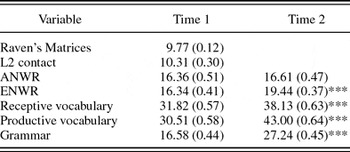
Means and standard errors of all seven variables (two NWR, three language measures, nonverbal ability, and L2 contact) for the entire cohort at Time 1 and Time 2 are presented in Table 1, except for nonverbal ability and L2 contact for which only one measure was obtained. A priori paired t tests, conducted to test whether participants differed on the measures between Time 1 and Time 2, showed that, overall, the participants did improve on ENWR, t (103) = 14.292, p < .001, receptive vocabulary, t (103) = 16.112, p < .001, productive vocabulary, t (103) = 53.411, p < .001, and grammar, t (103) = 25.245, p < .001, but they did not improve on ANWR, t (103) = 1.832, ns).
Means and standard errors for all measures at Time 1 and Time 2

Note: L2 contact, hours per week of reported second language (L2) contact; ANWR, Arabic nonword repetition; ENWR, English nonword repetition.
***p < .001.
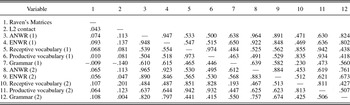
Table 2 shows the Pearson intercorrelation coefficients between nonword repetition scores and vocabulary and grammar measures for Times 1 and 2. Time 1 ANWR and ENWR (below the diagonal) were significantly correlated with Time 1 receptive and productive vocabulary (rs between .504 and .554) and grammar measures (r = .610 and .615, all ps < .001). More importantly, however, phonological memory (ANWR and ENWR) at Time 1 significantly predicted receptive and productive vocabulary (rs between .484 and .644) and grammar scores (r = .820 and .797) at Time 2, following 5 months of study (all ps < .001). These correlations remained unchanged after nonverbal ability and L2 contact were partialled out (Table 2, above the diagonal, all ps < .001). Thus, Time 1 nonword repetition scores made significant contributions to both Time 1 and Time 2 vocabulary and grammar scores.
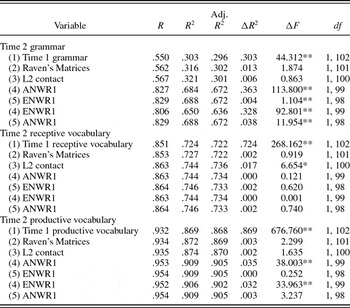
To see whether initial nonword repetition predicted gains in vocabulary and grammar skill, we performed a series of hierarchical multiple regression analyses. In all the regressions, the dependent variable was the Time 2 language score. The relevant Time 1 language score was entered in Step 1. To control for nonverbal intelligence and out of class language contact, Raven's Matrices was entered in Step 2 and language contact in Step 3. Finally, ANWR and ENWR at Time 1, our variables of interest, were entered in Steps 4 and 5. To test whether ANWR and ENWR at Time 1 contributed differently to the language outcome scores, we also performed additional regression analyses reversing the order in which ANWR1 and ENWR1 were entered. Table 3 shows that for all three Time 2 language measures, the respective Time 1 language measure explained a substantial amount of variance (grammar: R 2 = .303, p < .001; receptive vocabulary: R 2 = .724, p < .001; productive vocabulary: R 2 = .869, p < .001). L2 contact explained a small but significant amount of additional variance for receptive vocabulary only (R 2 = .017, p = .011). Finally, when ANWR1 was entered in Step 4, it explained a significant amount of variance for grammar and productive vocabulary only (grammar: R 2 = .363, p < .001; productive vocabulary: R 2 = .035, p < .001) and ENWR1, entered in Step 5, did not explain any variance. When ENWR1 was entered in Step 4, it explained a significant amount of variance for grammar and productive vocabulary scores (grammar: R 2= .328, p < .001; productive vocabulary: R 2= .032, p < .001). However, ANWR1, entered in Step 5, explained a further significant amount of variance in grammar scores only (R 2= .038, p = .001). Thus, ANWR1 made a significant contribution to grammar scores over and above the variance contributed by ENWR1. Nonverbal intelligence did not explain any variance for any of the language measures over and above the corresponding Time 1 measures.
Simple intercorrelations among all variables at Time 1 (1) and Time 2 (2)

Note: L2, second language; ANWR, Arabic nonword repetition; ENWR, English nonword repetition. Values above the diagonal reflect partial correlations (nonverbal intelligence and L2 contact partialed out). Correlations greater than .193 are significant.
Summary of hierarchical multiple regression analyses for variables predicting grammar and vocabulary scores at Time 2

Note: L2, second language; ANWR1, Arabic nonword repetition at Time 1; ENWR1, English nonword repetition at Time 1.
*p < .05. **p < .01.
To summarize, after controlling for Time 1 language measures, nonverbal ability, and L2 contact, ENWR1 significantly predicted Time 2 grammar (32.8% of variance explained) and productive vocabulary scores (3.2% of variance explained), with ANWR1 explaining a further 3.8% in grammar scores over and above the variance explained by ENWR1. With regard to productive vocabulary scores, ANWR1 did not explain a further amount of variance over and above ENWR1.
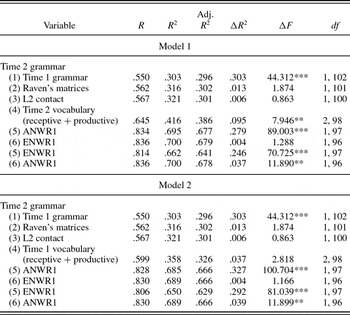
However, vocabulary and grammar scores were significantly correlated with each other (rs between .425 and .506) at both test times. Thus, we could not rule out the possibility that the relationship between nonword repetition and grammar scores was mediated by lexical knowledge. We therefore performed a hierarchical multiple regression analysis to test whether phonological memory at Time 1 accounted for a unique amount of variance in Time 2 grammar scores after taking into account Time 2 vocabulary scores. The dependent variable was the Time 2 grammar score and the Time 1 grammar score was entered in Step 1. To control for nonverbal intelligence and language contact, Raven's Matrices and L2 contact were entered in Steps 2 and 3, respectively. To see whether vocabulary knowledge contributed to grammar skill, Time 2 receptive and productive vocabulary was entered in Step 4. Finally, our variables of interest, ANWR1 and ENWR1, were entered in Steps 5 and 6, respectively. Again, to test whether ANWR1 and ENWR1 at Time 1 contributed differently to the grammar score, we also performed an additional regression analysis reversing the order in which ANWR1 and ENWR1 were entered. The results of the regression analysis shows that receptive and productive vocabulary, entered in Step 4, together accounted for 9.5% of the variance in Time 2 grammar scores. Separately, neither vocabulary measure explained a significant amount of variance (receptive vocabulary: β = .192, p = .066; productive vocabulary: β = −.205, p = .080). After controlling for vocabulary, ANWR1, entered in Step 5, still contributed a significant 27.9% of unique variance. ENWR1 did not account for a significant amount of additional variance. When ENWR1 was entered in Step 5, it explained a significant 24.6% of the variance, with ANWR1, entered in Step 6, contributing an additional 3.7%. Thus, although vocabulary knowledge explained a small but significant amount of unique variance in grammar knowledge, the relationship between phonological memory and grammar skill was not mediated by vocabulary knowledge: in total, phonological memory (ANWR1 and ENWR1) explained at least a further 27.9% of the variance after controlling for vocabulary knowledge.
But it may be that vocabulary knowledge at Time 1 was the mediator between nonword repetition and grammar development. We therefore repeated the multiple regression analysis, substituting Time 1 vocabulary scores for the Time 2 vocabulary scores (see Table 4, Model 2). In this model, after controlling for Time 1 grammar scores, nonverbal intelligence, and L2 contact, Time 1 vocabulary explained a nonsignificant 3.7% of variance (receptive vocabulary: β = −.148, ns; productive vocabulary: β = .127, ns). After controlling for vocabulary, ANWR1, entered in Step 5, still contributed a significant 32.7% of unique variance. ENWR1 did not account for a significant amount of additional variance. When ENWR1 was entered in Step 5, it explained a significant 29.2% of the variance, with ANWR1, entered in Step 6, contributing an additional 3.9%. Thus, the relationship between phonological memory and grammar skill was not mediated by Time 1 vocabulary knowledge: in total, phonological memory (ANWR1 and ENWR1) explained at least a further 29.2% of the variance after controlling for Time 1 vocabulary knowledge.
Summary of hierarchical multiple regression analysis for variables predicting grammar scores at Time 2

Note: L2, second language; ANWR1, Arabic nonword repetition at Time 1; ENWR1, English nonword repetition at Time 1.
**p < .01. ***p < .001.
To summarize, combined (ANWR1 and ENWR1) nonword repetition significantly predicted gains in L2 grammar scores made by participants over the course of the program, after controlling for initial grammar scores, and this relationship was not mediated by vocabulary knowledge at either Time 1 or Time 2. Furthermore, when ANWR 1 was entered before ENWR1, it explained at least 27.9% of unique variance in grammar scores at the end of the program, even after controlling for initial grammar and vocabulary knowledge. When ANWR1 was entered after ENWR1, it explained an additional 3.7 to 3.9% of variance in the grammar scores over and above the variance explained by ENWR1. Last, Time 2 vocabulary knowledge explained a small, but significant amount of variance in Time 2 grammar scores, but Time 1 vocabulary knowledge did not. With regard to vocabulary gains, the largest predictor of such gains was initial vocabulary knowledge. Nonword repetition made only a small, however significant, additional contribution to productive vocabulary gains, explaining 3.5% of the variance.
DISCUSSION
This study examined the role of phonological memory in young Francophone learners' L2 grammatical development over the course of a 5-month intensive study program. In particular, the study sought to answer the questions whether there was a relationship between phonological memory and learners' specific grammar gains, and whether the relationship was mediated by lexical knowledge. It was also asked whether phonological memory ability would improve as a result of L2 learning. The main findings were the following: (a) phonological memory was a significant predictor of grammar development and this relationship was not mediated by lexical knowledge; (b) there was a significant relationship between phonological memory and lexical knowledge on entry into the study, but its relationship to vocabulary development was minor, explaining only 3.5% of the variance in productive vocabulary development; and (3) although ENWR did improve over the course of the study, ANWR did not. We will address each of these findings in turn.
Phonological memory and grammatical development
Overall, the findings in the present study provide a replication of research reporting the existence of a relationship between phonological memory and different aspects of L2 learning. More importantly, though, the results from this study clearly show that phonological memory played an important role in grammar learning outside a laboratory context. Previous L2 research in this area has been, for the most part, laboratory based, and has generally reported a direct link between phonological memory and adults learning a new or artificial grammar. This study therefore provides new evidence that phonological memory is also closely related to children's L2 grammatical development in a school learning setting.
More specifically, the results in the present study showed that, following 5 months of study, phonological memory measured on entry into the study, accounted for at least 27.9% of significant variance in grammar skill after taking into account L2 contact, nonverbal ability, earlier grammar skill, and most importantly, vocabulary knowledge. This was true regardless of whether phonological memory was measured using ANWR or ENWR, and regardless of the order in which the scores were entered into the analysis. However, lexical knowledge also explained a significant 9.5% of variance in grammar knowledge when previous L2 contact and nonverbal ability were entered into the equation. Thus, the picture that emerges is that phonological memory made significant, unique contributions to learners' grammatical development over the course of the study in addition to the contribution made by lexical knowledge.
Connectionist approaches to language learning posit that grammar learning is very similar to vocabulary learning (Ellis, Reference Ellis1996, Reference Ellis1998; Ellis, Lee, & Reeber, Reference Ellis, Lee and Reber1999; Ellis & Sinclair, Reference Ellis and Sinclair1996). They propose that learning a word requires the accurate sequencing of phonemes within that word, whereas learning a grammatical or syntactic routine requires the accurate sequencing of morphemes within the specific routine. In both cases, the actual sequencing of phonemes (e.g., vocabulary) and morphemes (e.g., grammar) is believed to be processed in phonological short-term memory. Specifically, these approaches would predict that, as with vocabulary learning (Baddeley et al., Reference Baddeley, Gathercole and Papagno1998) when grammatical items (e.g., morphemes, grammatical phrases, etc.) are new or unfamiliar, learners depend heavily on phonological memory to establish long-term representations of the items. William and Lovatt (Reference Williams and Lovatt2003) further suggest that the generalization of new sequences of familiar grammar items (rule-based learning) may also be related to phonological memory.
From a connectionist perspective, then, given the presumably inextricable link between phonological memory skill, vocabulary learning, and grammar learning, it may seem somewhat counterintuitive in the present context that phonological memory strongly predicted grammatical development over and beyond the influence of lexical knowledge in the present study. However, we would argue that this finding is consistent with the nature of the relationship between phonological memory and grammar learning in an L2 developmental context. For example, in the present study, as a result of previously limited L2 exposure, all learners had minimal grammar knowledge of English at the onset of the intensive study program. As such, at this early stage of L2 development, the learning of new morphosyntactic structures (e.g., verb forms, morphological inflections, possessive determiners, question forms, negation, etc.) would be supported by phonological memory in very much the same way it would support the learning of new lexical phonological units (i.e., vocabulary). Toward the end of the program, however, as familiarity with these structures increased, it would be important for learners to use these accurately across multiple new contexts, as was evidenced by the significant gains in grammatical accuracy over the course the program. At this stage, phonological memory would then be called upon to support the accurate sequencing of familiar structures as well as their subsequent generalization. Thus, in this developmental context, whereas phonological memory would support both vocabulary and grammar learning in very much the same way at initial stages of L2 learning, it would play a larger role in grammar learning at later stages when previously learned structures would need to be generalized to a variety of new contexts. Consequently, it could be argued that any potential relationship between phonological memory and grammar learning should not be significantly mediated by vocabulary knowledge as learners reach later stages of L2 grammatical development.
Phonological memory and lexical development
One clear implication from the above developmental account is that because language contains numerous lexical and grammatical items that are largely unfamiliar at early stages of L2 learning, one would expect phonological memory to play a direct role in both grammar and vocabulary learning at initial stages of development. However, in the present context, phonological memory exerted little influence on vocabulary learning, accounting for only 3.5% of the variance in productive vocabulary development when previous vocabulary was taken into account. With regard to receptive vocabulary development, phonological memory did not explain any variance once initial vocabulary was controlled for. Although this finding was unexpected, vocabulary learning studies have not found that phonological memory contributes a large amount of variance to the acquisition of new words. Gathercole et al. (Reference Gathercole, Hitch, Service and Martin1997), for example, found that, once vocabulary knowledge was partialled out, phonological memory failed to explain a significant amount of variance in nonword learning. Similarly, Masoura and Gathercole (Reference Masoura and Gathercole2005) did not find that phonological memory was related to productive L2 word learning in their sample of 11-year-old children learning English as an L2. Rather, they found that new L2 vocabulary learning was related to previous L2 vocabulary knowledge: the children with higher L2 vocabulary scores took fewer trials to learn new L2 words than the children with lower L2 vocabulary scores. With regard to receptive vocabulary learning, once initial vocabulary is partialled out, phonological memory generally fails to explain a significant amount of variance (e.g., Gathercole & Baddeley, Reference Gathercole and Baddeley1989; Gathercole et al., Reference Gathercole, Willis, Emslie and Baddeley1992).
Following from our results, we suggest that, unlike productive vocabulary learning, receptive vocabulary learning can be qualified as a more passive process, one that does not require individuals to actively retrieve and then store lexical representations in short-term memory prior to actually learning them. Rather, productive vocabulary learning requires first the retrieval of a specific lexical item, and the subsequent storing of the item in short-term memory before production occurs. Productive vocabulary is therefore more effortful, which in turn places heavier demands on phonological memory than receptive vocabulary learning.
The results also showed that phonological memory strongly predicted both productive and receptive vocabulary scores at Time 1 and Time 2 (productive: rs between .504 and .644; receptive: rs between .484 and .554), pointing to a strong link between phonological memory skill and existing L2 vocabulary achievement. These relationships are consistent with those between phonological memory and existing L1 vocabulary knowledge reported in the literature (Baddeley et al., Reference Baddeley, Gathercole and Papagno1998, table 1; Masoura & Gathercole, Reference Masoura and Gathercole2005). Thus, what emerges is that, although phonological memory was related to individuals' overall vocabulary knowledge, its role in new vocabulary learning was considerably diminished.
A particularly important factor explaining most of the variance in productive and receptive vocabulary development was vocabulary knowledge at the beginning of the study; it was shown to be by far the largest predictor of vocabulary growth over the 5-month study period. This strongly suggests the possibility that at the onset of the study, vocabulary knowledge had already reached some critical threshold where it could be drawn upon to mediate subsequent vocabulary learning. This is not at all surprising, because English is a highly familiar language for children in Quebec, even those from predominantly Francophone communities. Although, on entry into the study, they had had only 100 hr of English language instruction, they already had considerable ambient exposure to English, primarily through English music, films, and television. Thus, although the children were still classed as beginner learners, they had already acquired significant passive knowledge or awareness of English vocabulary. By this account alone, then, it appears that the extent of initial vocabulary size may have been the catalyst for change in learners' reliance on phonological memory in L2 vocabulary learning. Rather than relying on phonological short-term memory as a mechanism to learn new L2 words, the children were able to take advantage of the more stable long-term representations afforded by words already in their lexicon to mediate the learning of new L2 words. This conclusion is in line with a growing body of evidence reporting that language proficiency or level of familiarity with language ultimately determines the extent of direct phonological memory contributions to new language learning (e.g., Cheung, Reference Cheung1996; French, Reference French2006; Masoura & Gathercole, Reference Masoura and Gathercole2005).
It could be argued that the observed relationship between nonword repetition and lexical and grammatical development described above was mediated by phonological awareness skills. It is recognized that good phonological awareness skills are necessarily required for successful language learning (Castles & Coltheart, Reference Castles and Coltheart2004). However, in this study, the children performed at ceiling on the two-syllable nonwords at both test times (Time 1: ANWR, M = 9.93, SE = 0.02, ENWR, M = 9.93, SE = 0.02; Time 2: ANWR, M = 9.95, SE = 0.02, ENWR, M = 9.95, SE = 0.02). The variation in nonword repetition skills was observed for lengthier nonwords only and not for the shortest nonwords. Consequently, a performance decrement at longer nonword lengths, as observed here, but not at short nonword lengths can reasonably be attributed to storage processes.
Lexical knowledge and grammatical development
Also of interest in the present context is that vocabulary knowledge, in addition to phonological memory and previous grammar knowledge, explained a small but significant proportion (9.5%) of variance in grammar skill at the end of the study. Although L1 research has generally reported a consistent relationship between vocabulary and syntactic development in a variety of different populations (e.g., Bates & Goodman, Reference Bates and Goodman1997, Reference Bates, Goodman and MacWhinney1999), little L2 research has examined the direct influence of vocabulary knowledge on classroom grammar development. However, recent L2 evidence suggests that lexical knowledge may ultimately impact different aspects of L2 learning. In a study of Greek children learning English, Masoura and Gathercole (Reference Masoura and Gathercole2005) reported that existing L2 vocabulary knowledge of students with greater L2 ability mediated new vocabulary acquisition. French (Reference French2006) investigated a subgroup of French-speaking children with high L2 proficiency and also found that initial L2 knowledge (defined as a composite measure of listening comprehension as well as receptive and productive vocabulary) positively influenced their subsequent composite measure of L2 proficiency, which included performance on grammar cloze tests, even after nonverbal ability and prior vocabulary knowledge were taken into account. In both these studies, the favored interpretation for these findings was that in situations where the size of learners' mental lexicon increases or contains a more sophisticated knowledge base (i.e., in terms of its lexical–phonological, semantic, and conceptual complexity), learners can deploy this knowledge to foster new L2 learning, lexical or otherwise. Cheung (Reference Cheung1996) also reached a similar conclusion, working with Chinese–English bilingual children in Hong Kong. Thus, according to these few accounts, there appears to be some direct evidence that knowledge at the lexical level promotes subsequent L2 learning, possibly even grammar learning, at least in more advanced language learners.
Does phonological memory improve with L2 learning?
Baddeley's phonological memory framework suggests that it is the quality of temporary phonological storage in short-term memory that determines individuals' phonological memory ability (Baddeley et al., Reference Baddeley, Gathercole and Papagno1998; Gathercole, Reference Gathercole2006). In addition, within this model, Gathercole and her colleagues (e.g., Gathercole, Reference Gathercole1995; Hulme et al., Reference Hulme, Maughan and Brown1991) maintain that existing knowledge about language can positively influence phonological memory ability by helping reconstruct incomplete lexical–phonological information in short-term memory (redintegration). However, Gathercole (Reference Gathercole2006) suggests that although permanent knowledge, either through the use of lexically mediated strategies or other language-based strategies, may ultimately enhance phonological memory function, it does not directly influence the quality of temporary phonological storage per se. Seen in these terms, the relative storage capacity underlying phonological memory ability might then be interpreted as a largely language-independent capacity.
The repetition results indicated that ENWR increased significantly over time, whereas ANWR did not, suggesting that ANWR, and not ENWR, provided a more sensitive, language-independent measure of phonological memory, because it was presumably less amenable to influences from existing L2 (English) knowledge. However, the repetition results also showed that both ANWR and ENWR were highly correlated within testing periods (Time 1: r = 0.94, p < .001; Time 2: r = 0.88, p < .001) as well as across testing periods (ANWR1 and ENWR2: r = 0.89, p < .001; ENWR1 and ANWR2: r = 0.92, p < .001), and both made similar predictions regarding L2 learning, suggesting that both were providing virtually the same measure of phonological memory.
Specifically, then, we would argue in the present study that the strong correlations between ANWR and ENWR resulted from tapping the language-independent capacity of phonological memory. In the case of ANWR, given the considerable lexical–phonological dissimilarities between the L2 (English) and Arabic nonwords, individuals were unable to make significant use of the English language to support Arabic nonwords in phonological memory at both Time 1 and Time 2. This, in turn, provided a very much language-free measure of phonological memory capacity. In contrast, ENWR, in addition to a language-independent component, was also sensitive to gains in L2 knowledge, increased knowledge about the lexical–phonological, prosodic (van der Lely & Gallon, Reference Van Der Lely and Gallon2006), and semantic features of English, which resulted in an emerging reliance on this knowledge to mediate phonological memory performance for English nonwords at Time 2. However, in this case, the resulting level of mediation with L2 knowledge did not improve the relative language-independent capacity of phonological memory.
What also emerges from the discussion above is that although performance improved on ENWR, the long-term knowledge-free phonological memory capacity tapped by ENWR and ANWR did not, even as L2 ability increased significantly. This suggests the possibility that this particular capacity remains unchanged over time, regardless of language proficiency. Our results confirm the findings of Ottem and colleagues (Reference Ottem, Lian and Karlsen2007), who found that, in a cross-section of children between 3 and 16 years of age, basic phonological memory capacity, which they called fluid or chunk span, did not improve with age. Instead, the increase in phonological memory usually observed with age was because of the growth in language abilities. They called this portion of the phonological memory measure the crystallized language factor (see also Case, Kurland, & Goldberg, Reference Case, Kurlan and Goldberg1982, who relate developmental increases in memory span to developmental increases in speed of word repetition). Some recent longitudinal evidence also points to this possibility. French (Reference French2006), as well as French and O'Brien (Reference French and O'Brien2007) found that, in French-speaking preadolescents, nonword repetition performance using Arabic nonwords remained unchanged over a 5-month study period, whereas their L2 (English) proficiency (vocabulary, grammar, and oral production skills) increased dramatically over the same time period. Similarly, O'Brien and colleagues (Reference O'Brien, Segalowitz, Collentine and Freed2006, Reference O'Brien, Segalowitz, Freed and Collentine2007) examined the role of phonological memory in English-speaking adults learning Spanish in a 3-month study abroad program and reported that phonological memory ability (as measured by serial nonword recognition using English nonwords) remained the same over the course of the program, whereas individuals' overall L2 oral fluency skills improved significantly. Together, these findings suggest that basic phonological memory capacity, even when referenced by different yet compatible tasks, does not appear to be directly influenced by increases in L2 ability per se, nor does it appear to improve regardless of age or L2 learning contexts.
Overall then, the findings from this study along with those from the recent longitudinal studies seem to suggest that the language-independent capacity of phonological memory remains unchanged as a result of L2 experience. As such, this raises the theoretically interesting possibility that the actual construct of phonological memory may represent an individual trait characteristic. Clearly, such a proposal has important implications for L2 theory, particularly models of aptitude in which phonological coding is a central factor. However, additional research is still needed to address whether the relative representational capacity of phonological memory can be enhanced through different forms of learning or explicit training, or whether it is simply impervious to any type of training conditions.
An additional issue that warrants further investigation concerns the developmental nature of phonological memory. The evidence from this study clearly supports the hypothesis that the ability to make accurate, language-independent representations in short-term memory does not improve, but rather remains constant over time, even in light of increasing L2 competence. However, although the present study used linguistically different measures of nonword repetition, and thus, implemented a control mechanism for observing potential increases in phonological memory function, it examined the development of preadolescents' phonological memory over a 5-month period only. As such, an interesting question is whether these learners' phonological memory skill will remain unchanged as their L2 competence continues to improve, both in terms of accuracy and fluency, throughout the high school years. Further longitudinal research of the type conducted by Service (Reference Service1992) tracking, in addition, both language-independent and language-dependent contributions of phonological memory to developing L2 skills over a period of several years is therefore clearly needed. Ultimately, findings in this area would also help to clarify outstanding questions in the memory literature, such as whether individuals with poor phonological memory are able to attain functional levels of L2 competence, and also not simply whether phonological memory is involved in L2 learning, but, rather, how it affects L2 learning.
CONCLUSION
The present research set out with two different but related goals in mind: to examine whether the relationship between phonological memory and grammar development was dependent on lexical development, and also whether phonological memory ability improved over the course of L2 development. With respect to the first goal, the data clearly point to the conclusion that children's learning of grammar in a naturalistic L2 context is indeed a complex process, one that relies overwhelmingly on independent contributions from phonological memory to foster the learning of novel grammatical items and/or unfamiliar grammar sequences, but also one that relies to some extent on an emerging ability to make associations between existing lexical knowledge and new grammar knowledge. As for the second goal, phonological memory, and, more specifically, its hypothesized language-independent capacity, showed no improvement as a result of vocabulary or grammar development, providing preliminary direct evidence that phonological memory ability remains unchanged over time.
APPENDIX A ENGLISH NONWORD REPETITION LIST
Two syllables
1. Ballop
2. Bannow
3. Diller
4. Glistow
5. Hampent
6. Pennel
7. Prindle
8. Rubid
9. Sladding
10. Tafflest
Three syllables
1. Bannifer
2. Barrazon
3. Brasterer
4. Commerine
5. Doppelate
6. Frescovent
7. Glistering
8. Skiticult
9. Thickery
10. Trumpetine
Four syllables
1. Blonterstaping
2. Commeecitate
3. Contramponist
4. Empliforvent
5. Fenneriser
6. Loddenapish
7. Pennerriful
8. Perplisteronk
9. Stopograttic
10. Woogalamic
Five syllables
1. Altupatory
2. Confrantually
3. Defermication
4. Detratapillic
5. Pristoractional
6. Reutterpation
7. Sepretennial
8. Underbrantuand
9. Versatrationist
10. Voltularity
APPENDIX B ARABIC REPETITION LIST
Two syllables
1. habba
2. kitton
3. hamma
4. thaljun
5. sa˒ra
6. a˒da
7. ma˒la
8. abi
9. ummun
10. wardun
Three syllables
1. wasala
2. alima
3. wathaba
4. kala˒mun
5. zahratun
6. hari˒kun
7. kataba
8. russumun
9. amta˒run
10. buyu˒tun
Four syllables
1. tahadatta
2. yuma˒riso
3. tarannama
4. yuja˒milo
5. sayyaratun
6. darrajatun
7. a˒amidatun
8. tassa˒ala
9. awssimatun
10. yurassilu
Five syllables
1. mutafa˒ilun
2. mutasha˒imum
3. yata_llamo
4. yutassa˒kato
5. yuma˒rissuna
6. assa˒tidatun
7. muhandissu˒na
8. mutaja˒nissun
9. yata_˒tafo
10. yahtassibu˒na
ACKNOWLEDGMENTS
Different aspects of the study were presented by L.F. and I.O'B. at the 2006 annual conference of the American Association for Applied Linguistics in Montreal. Parts of this research were funded by grants to LF from the Fonds québécois de la recherche sur la société et la culture (FQRSC) and from the Faculty Research Development Program, Faculty of Arts, and Science at Concordia University. Special thanks to the intensive English teachers (Steven Jansma, Jean-Jacques Reigneau, and Manon Vigneault) and their students who took part in the study. The authors also thank Marilyne Bédard, Imad Fahmi, Micheline Gagné, Randall Halter, and Faten Mohammed, who helped during the data collection phase of the project. Finally, the authors thank Elisabet Service, Pavel Trofimovich, and three anonymous reviewers for their helpful remarks on this paper.