Introduction
Heart rate variability (HRV) analysis is a widely used method for studying cardiac autonomic modulation (Malik et al. Reference Malik, Bigger, Camm, Kleiger, Malliani, Moss and Schwartz1996). Impaired autonomic nervous system control of heart rate is a strong independent predictor of long-term mortality in post-myocardial infarction (MI) patients (Bigger et al. Reference Bigger, Fleiss, Rolnitzky and Steinman1993; Zuanetti et al. Reference Zuanetti, Neilson, Latini, Santoro, Maggioni and Ewing1996; Dekker et al. Reference Dekker, Crow, Folsom, Hannan, Liao, Swenne and Schouten2000; Huikuri et al. Reference Huikuri, Tapanainen, Lindgren, Raatikainen, Makikallio, Juhani Airaksinen and Myerburg2003; Stein et al. Reference Stein, Domitrovich, Huikuri and Kleiger2005). In turn, depression has been associated with a twofold increased risk of mortality, and increased morbidity and rehospitalization post-MI (Ladwig et al. Reference Ladwig, Roll and Breithardt1994; Frasure-Smith et al. Reference Frasure-Smith, Lespérance and Talajic1995a; Barefoot et al. Reference Barefoot, Helms and Mark1996; Lespérance et al. Reference Lespérance, Frasure-Smith, Talajic and Bourassa2002). Some studies have also reported symptoms of anxiety to be predictive of subsequent cardiac events and mortality post-MI, independent of established biomedical risk factors (Frasure-Smith et al. Reference Frasure-Smith, Lespérance and Talajic1995b; Moser & Dracup, Reference Moser and Dracup1996; Strik et al. Reference Strik, Denollet, Lousberg and Honig2003), while others found no association (Mayou et al. Reference Mayou, Gill, Thompson, Day, Hicks, Volmink and Neil2000; Lane et al. Reference Lane, Carroll, Ring, Beevers and Lip2001).
Alterations in cardiac autonomic tone, reflected by increased sympathetic or decreased parasympathetic nervous system activity, predisposes cardiac patients to ventricular fibrillation and tachycardia, and sudden cardiac death (Podrid et al. Reference Podrid, Fuchs and Candinas1990; Pruvot et al. Reference Pruvot, Thonet, Vesin, van-Melle, Seidl, Schmidinger, Brachmann, Jung, Hoffmann, Tavernier, Block, Podczeck and Fromer2000), and can be a mechanism linking depression and anxiety to increased mortality in cardiac patients (Sloan & Bigger, Reference Sloan and Bigger1991; Watkins et al. Reference Watkins, Grossman, Krishnan and Blumenthal1999). Several studies have demonstrated an association between depression and low 24-h HRV in post-MI patients (Carney et al. Reference Carney, Blumenthal, Stein, Watkins, Catellier, Berkman, Czajkowski, O'Connor, Stone and Freedland2001; Pitzalis et al. Reference Pitzalis, Iacoviello, Todarello, Fioretti, Guida, Massari, Mastropasqua, Russo and Rizzon2001; Vigo et al. Reference Vigo, Nicola Siri, Ladron De Guevara, Martinez-Martinez, Fahrer, Cardinali, Masoli and Guinjoan2004). A review on laboratory and ambulatory HRV in depressive and anxiety disorders indicated that patients with anxiety disorders exhibit chronically reduced HRV (Gorman & Sloan, Reference Gorman and Sloan2000), with panic disorder patients having reduced parasympathetic innervation to the heart compared with normal adults (Yeregani et al. Reference Yeragani, Pohl, Berger, Balon, Ramesh, Glitz, Srinivasan and Weinberg1993; Klein et al. Reference Klein, Cnaani, Harel, Braun and Ben-Haim1995). Consequently, low HRV may act as an intermediary between depression and anxiety and adverse outcomes in cardiac patients. However, negative findings have also been reported. In one study, depression but not anxiety was found to negatively influence autonomic control of heart rate in post-MI patients (Pitzalis et al. Reference Pitzalis, Iacoviello, Todarello, Fioretti, Guida, Massari, Mastropasqua, Russo and Rizzon2001), whereas another study found that anxiety but not depression was independently associated with reduced HRV post-MI (Watkins et al. Reference Watkins, Blumenthal and Carney2002). A cross-sectional study on 873 out-patients with stable coronary artery disease (CAD) found no association between depression and HRV, raising questions about the potential intermediate role of HRV (Gehi et al. Reference Gehi, Mangano, Pipkin, Browner and Whooley2005).
Given the relative lack of knowledge about the potentially deleterious effects of depression and, in particular, anxiety on HRV, the present study aimed to examine to what extent acute depressive and anxiety symptoms during hospitalization and a more chronic predisposition for depression and anxiety, indicated by lifetime diagnosis, differently predict 24-h time and frequency domain HRV indices post-MI.
Method
Study design and patient population
Ninety-three patients hospitalized for acute MI were recruited from the St Elisabeth Hospital, Tilburg, The Netherlands, between September 2003 and November 2005. MI was defined according to the following criteria: troponin I levels >1.0, with typical ischaemic symptoms (e.g. chest pain) lasting for more than 10 min or electrocardiogram (ECG) evidence of ST segment elevation or new pathological Q-waves. For patients without typical angina, the day of MI onset was identified as the day during hospitalization with peak levels of troponin I levels >1.0 and ECG evidence of ST segment elevation or new pathological Q-waves. Inclusion criteria were age >30 years and hospitalization due to acute MI. Exclusion criteria were significant cognitive impairments (e.g. dementia), severe co-morbidities (e.g. cancer), and insufficient command of the Dutch language.
Symptoms of depression and anxiety were assessed at the time of MI, using two self-report measures, and demographic and medical characteristics were obtained. Two months post-MI (56±17 days), patients were evaluated carefully in the cardiology department by a trained psychologist using the Composite International Diagnostic Interview (CIDI; WHO, 1990) for diagnoses of depression and anxiety. At this visit, patients were asked to participate in an additional study, concerning digital 24-h ECG recordings (Holter). This Holter recording took place on average 78 days (s.d.=42) post-MI for logistic reasons. The research protocol was approved by the medical ethics committee of the participating hospital, and the study was conducted in accordance with the Helsinki Declaration. Written informed consent was obtained from every patient before entering the study.
Measures
Demographic and clinical characteristics
Age, sex and smoking status were determined by questionnaire. Medical variables obtained from the medical records included co-morbidity (defined as arthritis, renal insufficiency or chronic obstructive pulmonary disease), cardiac history [defined as MI, angina or percutaneous coronary intervention (PCI) prior to the MI], left ventricular ejection fraction, multi-vessel disease, anterior MI location, blood pressure, high density lipoprotein (HDL) and low density lipoprotein (LDL) cholesterol levels, LDL/HDL ratio, cardiac rehabilitation, medications [beta-blockers, angiotensin-converting enzyme (ACE) inhibitors, statins, vasodilators, aspirin, and psychotropics], diabetes mellitus and obesity [body mass index (BMI) ⩾30].
Clinical diagnoses of depression and anxiety disorder
The World Health Organization (WHO)-authorized Dutch version of the CIDI (WHO, 1990; Smeets & Dingemans, Reference Smeets and Dingemans1993) was used to assess lifetime diagnoses of major depressive disorder and anxiety disorder (consisting of panic disorder, social phobia and/or generalized anxiety disorder) based on the diagnostic criteria of the DSM-IV (APA, 1994). The CIDI had acceptable inter-rater and test–retest reliability for most non-psychotic diagnoses, including major depressive disorder (Wittchen et al. Reference Wittchen, Robins, Cotter, Sartorius, Burke and Regier1991; Wittchen, Reference Wittchen1994).
Self-reported symptoms of depression and anxiety
Symptoms of depression and anxiety were assessed using two self-report questionnaires: the Beck Depression Inventory (BDI) and the State Trait Anxiety Inventory (STAI). The BDI is a 21-item self-report measure developed to assess the presence and severity of depressive symptoms (Beck et al. Reference Beck, Steer and Garbin1988; Beck & Steer, Reference Beck and Steer1993); it is a reliable and well-validated measure of depressive symptomatology and is widely used as a self-report measure of depression. BDI scores ⩾10 are indicative of at least mild to moderate symptoms of depression and have been associated with poor prognosis in MI patients (Frasure-Smith et al. Reference Frasure-Smith, Lespérance and Talajic1995b, Reference Frasure-Smith, Lespérance, Juneau, Talajic and Bourassa1999; Lespérance et al. Reference Lespérance, Frasure-Smith, Talajic and Bourassa2002). The STAI is a self-report measure consisting of two 20-item scales developed to measure the level of general state and trait anxiety (Spielberger et al. Reference Spielberger, Gorsuch, Lushene, Vagg and Jacobs1983). In the current study, we included the state scale of the STAI. Elevated scores on the STAI have been associated with poor prognosis in MI patients (Frasure-Smith et al. Reference Frasure-Smith, Lespérance and Talajic1995b). The STAI has been demonstrated to have adequate validity and reliability (Knight et al. Reference Knight, Waal-Manning and Spears1983). Both the BDI and STAI have been used in previous studies on HRV in post-MI patients (Carney et al. Reference Carney, Blumenthal, Stein, Watkins, Catellier, Berkman, Czajkowski, O'Connor, Stone and Freedland2001; Watkins et al. Reference Watkins, Blumenthal and Carney2002).
Heart rate variability (HRV)
All patients received a digital, 24-h ECG Holter recording from a three-lead configuration. ECG data were digitized at a sampling rate of 125 Hz. Computer software (Mars® 6.5; General Electrics Medical Systems Information Technologies, Freiburg, Germany) was used to scan for rhythm disturbances (of both ventricular and atrial origin) and detect and label each QRS complex. A qualified Holter analyst, who was not otherwise involved in the study, processed all ECG recordings. If premature ventricular contractions (PVCs) reached >100/h, the recording was excluded from the analysis (n=8). Rhythm disturbances were discarded automatically by the computer program. On average, 99.4% of the recordings contained normal sinus rhythm that was used to calculate the HRV measures.
The following time domain measures of HRV were assessed: the standard deviation of all normal-to-normal (NN) intervals (SDNN) as a measure of total variance in heart rate; the standard deviation of all 5-min mean NN intervals (SDANN), reflecting long-term or irregular modulation of HRV; and the root mean square of successive differences (RMSSD), reflecting parasympathetic modulation of heart rate. Frequency domain measures were also extracted from the ECG data using standardized fast Fourier transformation, and included the very low frequency spectral power (VLF; 0.003–0.04 Hz) reflecting long-term trends in HRV, the low frequency spectral power (LF; 0.04–0.15 Hz) as a measure of sympathetic modulation of heart rate, and the high frequency spectral power (HF; 0.15-0–40 Hz) reflecting parasympathetic modulation of heart rate. The LF/HF ratio was computed as a measure of autonomic balance (Malik et al. Reference Malik, Bigger, Camm, Kleiger, Malliani, Moss and Schwartz1996).
Statistical analysis
The HRV distributions were tested for outliers. HRV values more than 3 standard deviations (s.d.) from the mean were excluded from the analysis. After correction for outliers, HRV distributions were near normal (skewness <1.4). Therefore, it was not necessary to normalize the data. Pearson correlations were used to determine whether the demographic and medical variables that have been associated with HRV in previous studies (Stein et al. Reference Stein, Carney, Freedland, Skala, Jaffe, Kleiger and Rottman2000b) were significantly associated with HRV in this study. Variables that emerged from these analyses as potential confounders were then entered into separate multiple regression analyses to remove redundant covariates (if any). All retained variables where then used as covariates in the adjusted models. The bivariate relationship between depression/anxiety and HRV was examined using regression analysis. Separate multiple linear regression analyses were used to examine the independent impact of depression/anxiety on HRV indices. In a subsequent step, we adjusted for depressive and anxiety symptoms respectively to examine the impact of depression/anxiety above and beyond the impact of symptoms on HRV. A p value of <0.05 was considered significant in all tests. p values <0.10 are reported in the results tables. All statistical analyses were performed using SPSS 12.0.1 for Windows (SPSS Inc., Chicago, IL, USA).
Results
Patient characteristics
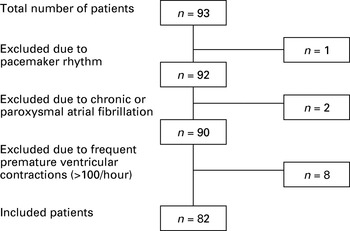
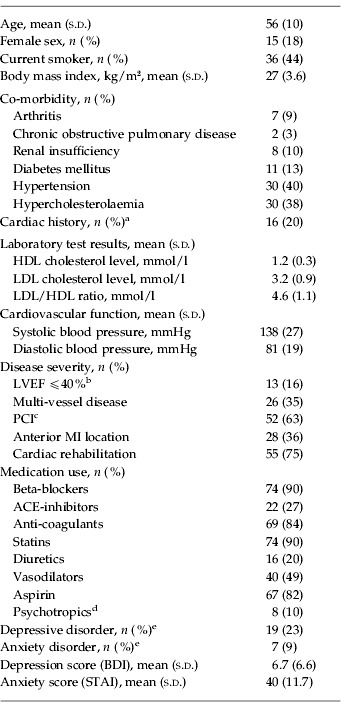
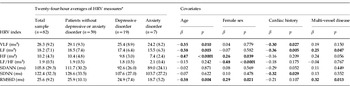
Of the 93 post-MI patients, 82 patients were included in the final analyses (Fig. 1). Nineteen (23%) patients had lifetime diagnoses of major depressive disorder and seven (9%) of anxiety disorder prior to the MI. Only three (4%) patients had diagnoses of both depressive disorder and anxiety disorder. Table 1 shows demographic and clinical characteristics of the 82 study participants. The valid ambulatory recording time was on average 2347 h (s.d.=0.51 min). Table 2 presents the means and standard deviations for all HRV indices, stratified by diagnoses.
Flowchart of patient selection.

Characteristics of 82 patients with acute MI

MI, Myocardial infarction; s.d., standard deviation; HDL, high density lipoprotein; LDL, low density lipoprotein; LVEF, left ventricular ejection fraction; PCI, percutaneous coronary intervention; ACE, angiotensin-converting enzyme; BDI, Beck Depression Inventory; STAI, State Trait Anxiety Inventory.
a MI, angina or PCI prior to the MI.
b Information on LVEF was available for only 64 patients (78%), in whom an echocardiogram (ECG) was performed.
c Reference group: conservatively treated.
d Selective serotonin reuptake inhibitors, benzodiazepines.
e According to the Composite International Diagnostic Interview (CIDI).
Twenty-four-hour averages of heart rate variability (HRV) measures and the influence of age, sex, cardiac history and multi-vessel disease

VLF, Very low frequency spectral power; LF, low frequency; HF, high frequency; SDANN, standard deviation of all 5-min mean normal-to-normal (NN) intervals; SDNN, standard deviation of all NN intervals; RMSSD, root mean square of successive differences.
Three patients had co-morbid depression and anxiety and were included in both the depression and anxiety columns. Bold indicates significant values.
a Values are expressed as mean (standard deviation).
Unadjusted analyses
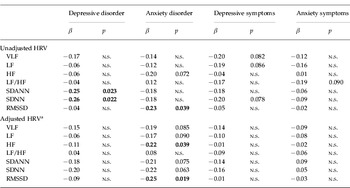
In unadjusted analyses, depressive disorder was a significant predictor of both lower SDANN and SDNN post-MI. Anxiety disorder was found to be predictive of lower RMSSD and a trend was observed for reduced HF power. Depressive and anxiety symptoms were not significantly predictive of HRV indices, although trends were observed for depressive symptoms and reduced VLF power, LF power and SDNN, and for anxiety symptoms and reduced LF/HF ratio (Table 3).
Unadjusted and adjusted HRV in post-MI patients with depression and anxiety

HRV, Heart rate variability; MI, myocardial infarction; VLF, very low frequency spectral power; LF, low frequency; HF, high frequency; SDANN, standard deviation of all 5-min mean normal-to-normal (NN) intervals; SDNN, standard deviation of all NN intervals; RMSSD, root mean square of successive differences; n.s., not significant.
Bold indicates significant values.
a Age, sex, cardiac history, and multi-vessel disease were entered into the adjusted models.
Adjusted analyses
Consistent with findings from previous studies, age, sex, beta-blockers, aspirin, cardiac history, anterior MI location and multi-vessel disease were related to one or more HRV indices in univariate analyses. Age, sex, cardiac history and multi-vessel disease were retained in the multiple regression analyses and were therefore entered as covariates into the adjusted models (Table 2). After adjustment for these covariates, depressive disorder was no longer predictive of HRV indices. Anxiety disorder was found to significantly predict reduced HF power and RMSSD, and trends were observed for lower VLF power, LF power, SDANN and SDNN. Depressive and anxiety symptoms were not predictive of HRV indices and no trends were observed (Table 3).
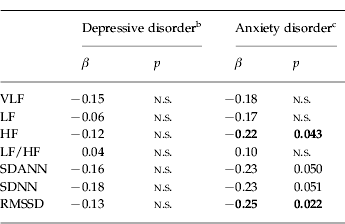
After additional adjustment for depressive symptoms, depressive disorder remained non-predictive of all HRV indices. However, when adjusting for anxiety symptoms, anxiety disorder remained predictive of reduced HF power and RMSSD, and strong trends were observed for reduced SDANN and SDNN with p values of 0.050 and 0.051 respectively (Table 4).
Major depressive disorder and anxiety disorder as multivariate predictors of HRVFootnote a

HRV, Heart rate variability; VLF, very low frequency spectral power; LF, low frequency; HF, high frequency; SDANN, standard deviation of all 5-min mean normal-to-normal (NN) intervals; SDNN, standard deviation of all NN intervals; RMSSD, root mean square of successive differences; n.s., not significant; BDI, Beck Depression Inventory; STAI, State Trait Anxiety Inventory.
Bold indicates significant values.
a Age, sex, cardiac history, and multi-vessel disease were entered into both multivariate models.
b Depression score (BDI) was entered into the multivariable model.
c Anxiety score (STAI) was entered into the multivariate model.
Discussion
The present study estimated the predictive power of lifetime depressive disorder, anxiety disorder and self-reported symptoms of depression and anxiety on 24-h HRV, assessed in both the time and frequency domain, post-MI. After adjustment for significant demographic and clinical confounders, depressive disorder was no longer predictive of HRV indices, while anxiety disorder predicted reduced HF power and RMSSD. Further analyses revealed that after additional adjustment for current anxiety symptoms, lifetime anxiety disorder remained predictive of reduced HF power and RMSSD, suggesting a chronically reduced activity of the parasympathetic nervous system (Malik et al. Reference Malik, Bigger, Camm, Kleiger, Malliani, Moss and Schwartz1996). In addition, strong trends were observed for reduced SDANN and SDNN, indicating a potentially altered function of more long-term influences on HRV, which might reflect a smaller range of physical activity engaged in by these patients (Thayer et al. Reference Thayer, Wang and Snieder2006).
To date, only a few studies have examined the predictive value of anxiety on HRV measures in patients with CAD, and these have shown mixed results. In the present study, we found no relationship between self-reported current depressive and anxiety symptoms and HRV. Watkins and colleagues reported that levels of anxiety symptoms, but not depression, were associated with reduced vagal control in patients with recent MI (Watkins et al. Reference Watkins, Blumenthal and Carney2002) and in non-cardiac patients with depressive disorder (Watkins et al. Reference Watkins, Grossman, Krishnan and Blumenthal1999) . However, other studies have shown that depressive but not anxiety symptoms negatively influence autonomic control of heart rate in hospitalized MI patients (Pitzalis et al. Reference Pitzalis, Iacoviello, Todarello, Fioretti, Guida, Massari, Mastropasqua, Russo and Rizzon2001) and CABG patients (Hallas et al. Reference Hallas, Thornton, Fabri, Fox and Jackson2003).
Regarding the clinical diagnosis of anxiety, our study provides evidence that anxiety disorder is an independent predictor of reduced vagal control of the heart in post-MI patients. This is consistent with the conclusion of a recent review incorporating over 20 studies indicating that anxiety disorder is associated with autonomic nervous system dysregulation, and that patients with heart disease and anxiety are at increased risk for morbidity and mortality (Cohen & Benjamin, Reference Cohen and Benjamin2006). One exception is a study in CAD patients with panic disorder that showed unchanged parasympathetic activity, while sympathetic modulation of HRV was reduced compared to CAD patients without panic disorder (Lavoie et al. Reference Lavoie, Fleet, Laurin, Arsenault, Miller and Bacon2004).
In adjusted analyses we found no association between depressive disorder or depressive symptoms and indices of HRV. Some studies have reported reduced HRV in relation to depressive disorder and depressive symptoms in CAD patients (Carney et al. Reference Carney, Blumenthal, Stein, Watkins, Catellier, Berkman, Czajkowski, O'Connor, Stone and Freedland2001; Pitzalis et al. Reference Pitzalis, Iacoviello, Todarello, Fioretti, Guida, Massari, Mastropasqua, Russo and Rizzon2001; Vigo et al. Reference Vigo, Nicola Siri, Ladron De Guevara, Martinez-Martinez, Fahrer, Cardinali, Masoli and Guinjoan2004), but others have found only a small or no relationship (Carney et al. Reference Carney, Saunders, Freedland, Stein, Rich and Jaffe1995, Reference Carney, Freedland, Stein, Watkins, Catellier, Jaffe and Yeragani2003; Gehi et al. Reference Gehi, Mangano, Pipkin, Browner and Whooley2005). In line with our results, the Heart and Soul Study (Gehi et al. Reference Gehi, Mangano, Pipkin, Browner and Whooley2005) reported no association between depressive disorder and both time and frequency domain indices of HRV in 873 CAD patients. In contrast to this study, Birkhofer et al. (Reference Birkhofer, Schmidt and Förstl2006) recently proposed that the age difference between depressed and non-depressed patients could be an alternative explanation for the absence of differences in HRV. In their reply, Gehi & Whooley (Reference Gehi and Whooley2006) showed that this was not the case, as in our study. In two studies of CAD patients by Carney and colleagues, depressive disorder was only associated with SDANN and not with SDNN index, RMSSD and pNN50 (Carney et al. Reference Carney, Saunders, Freedland, Stein, Rich and Jaffe1995), and no relationship was found between depressive disorder and an HRV measure equivalent to SDNN (Carney et al. Reference Carney, Freedland, Stein, Watkins, Catellier, Jaffe and Yeragani2003). Conversely, these authors also reported in some other studies that depressive disorder was associated with reduced HRV in both the frequency and time domain (Stein et al. Reference Stein, Carney, Freedland, Skala, Jaffe, Kleiger and Rottman2000a; Carney et al. Reference Carney, Blumenthal, Stein, Watkins, Catellier, Berkman, Czajkowski, O'Connor, Stone and Freedland2001, Reference Carney, Blumenthal, Freedland, Stein, Howells, Berkman, Watkins, Czajkowski, Hayano, Domitrovich and Jaffe2005), and with decreased survival (Carney et al. Reference Carney, Blumenthal, Freedland, Stein, Howells, Berkman, Watkins, Czajkowski, Hayano, Domitrovich and Jaffe2005). The effect of depression on survival in this latter study was only partially mediated by low HRV. Another recent study indicated that patients with post-MI depressive disorder showed lower SDNN but that this autonomic dysfunction was not a mediator of increased mortality observed in these patients during a 5-year follow-up (Drago et al. Reference Drago, Bergerone, Anselmino, Varalda, Cascio, Palumbo, Angelini and Trevi2007). Hence, it is still unclear whether autonomic nervous system dysfunction is a plausible mechanism linking depression to adverse outcomes in post-MI patients.
There are several possible explanations for the inconsistent findings and differences between our results and those of prior studies. Variation in assessment of the physiological and psychological measures, patient population, time of assessment, and study design may account for the inconsistent findings. In addition, the use of self-report measures or of clinical diagnosis of depression and anxiety yields different results regarding HRV. Studies are very heterogeneous in nature, which makes it difficult to compare our results with the literature. The only fairly consistent finding in the literature that is in line with our results is that anxiety disorder is associated with impaired HRV (Gorman & Sloan, Reference Gorman and Sloan2000). However, it should be noted that these studies were conducted in non-cardiac patients. In unadjusted analyses, our results regarding depression are similar to the adjusted results of Carney et al. (Reference Carney, Blumenthal, Stein, Watkins, Catellier, Berkman, Czajkowski, O'Connor, Stone and Freedland2001). The fact that depression was not predictive of HRV in our adjusted analyses may be explained by the relatively small sample size. To obtain a comprehensible and inclusive picture of the relationship between depression and anxiety and HRV, it is important for future studies to assess both diagnosis and symptoms of depression and anxiety, and to assess a variety of HRV indices in both the time and frequency domain in post-MI patients. In addition, it might be interesting to take a look at specific symptoms of depression or anxiety and their association with HRV.
The results of this study have implications for research and clinical practice. Screening for symptoms of depression and anxiety may not be sufficient because our results indicate that we need a clinical diagnosis to detect post-MI patients who are at risk of reduced HRV. The predictive value of anxiety disorder with reference to low values of the parameters reflecting parasympathetic cardiac modulation of heart rate may help to identify patients at high risk of cardiac events. A recent study in post-MI patients indicated that anxious patients were at increased risk of 8-year cardiac mortality and that reduced HF power increased this risk (Carpeggiani et al. Reference Carpeggiani, Emdin, Bonaguidi, Landi, Michelassi, Trivella, Macerata and L'Abbate2005). However, to date only a few studies have been performed on the mechanisms underlying the link between anxiety and prognosis, and therefore the findings of the current study need to be replicated, preferably in a larger sample, with anxiety disorder, HRV and mortality assessed prospectively. This is in line with a recent call for further studies including patients with co-existing anxiety disorders and heart disease, incorporating assessment of indices of HRV (Cohen & Benjamin, Reference Cohen and Benjamin2006).
A limitation of this study may be the fact that we used lifetime diagnosis instead of current diagnosis of depressive and anxiety disorder, as a result of the limited number of current diagnoses in this sample. However, the use of lifetime diagnosis would in fact lead to a conservative estimation of the effect on HRV. Moreover, the inclusion of a lifetime diagnosis may indicate more long-term influences on HRV. Several studies have shown depression and CAD to have genetic communalities (Scherrer et al. Reference Scherrer, Xian, Bucholz, Eisen, Lyons, Goldberg, Tsuang and True2003). Similarly, as lifetime diagnosis seems to have a chronic influence on HRV, this might be caused by a shared, underlying genetic predisposition (Scherrer et al. Reference Scherrer, Xian, Bucholz, Eisen, Lyons, Goldberg, Tsuang and True2003; McCaffery et al. Reference McCaffery, Frasure-Smith, Dube, Theroux, Rouleau, Duan and Lesperance2006). Shared genes may underlie both depressive and anxiety disorder (Middeldorp et al. Reference Middeldorp, Cath, Van Dyck and Boomsma2005) and HRV in cardiac patients. In addition, the delay between the psychiatric interview and HRV assessment prevents this study from determining the direct effects of depression or anxiety on HRV. However, because we assessed lifetime instead of current diagnoses of depression and anxiety, this time gap is of less importance. Furthermore, the sample size is limited, especially for evaluating the independent impact of anxiety disorder on HRV, and those findings should be interpreted with caution. We also had no data on physical activity levels during the day, which can be an important confounding variable. Despite these limitations, the present study has several strengths. We included both the clinical diagnosis and symptoms of depression and anxiety, all assessed by standardized, validated measures. The design of our study was also prospective in nature, resulting in the opportunity to draw conclusions beyond the correlational level.
In conclusion, the results of this preliminary study indicate that anxiety disorder, but not depressive disorder, was an independent predictor of reduced parasympathetic cardiac modulation in post-MI patients. These findings indicate the potentially important role of anxiety in determining individual differences in HRV and cardiac risk in post-MI patients. Whether these anxiety-related alterations in HRV do indeed explain increased morbidity and mortality in post-MI patients is a subject for further study.
Declaration of Interest
None.