INTRODUCTION
Although gastric cancer is the fourth most common cancer worldwide, it remains the second most common cause of cancer-related death, second only to lung cancer, with 700,000 deaths annually (Dicken et al., Reference Dicken, Bigam and Cass2005; Parkin et al., Reference Parkin, Bray and Ferlay2005). In 2010, global estimates suggest that 1.1 million new cases of stomach cancer will be diagnosed (Parkin et al., Reference Parkin, Bray and Ferlay2005). There is a wide geographical discrepancy in prevalence rates with 44.1 out of every 100,000 individuals receiving a diagnosis of gastric cancer in Japan compared to 5.4 out of every 100,000 individuals in North America (Parkin et al., Reference Parkin, Bray and Ferlay2005). Much of this difference is speculated to be related to environmental risk factors, including exposure to Helicobacter pylori infection, diet, tobacco smoke, and genetics (Parkin et al., Reference Parkin, Bray and Ferlay2005). High risk countries, such as Japan, have introduced screening programs allowing for early diagnosis and the possibility of improved outcomes (Mizoue et al., Reference Mizoue, Yoshimura and Tokui2003). Unfortunately, in areas of low prevalence, as in the United States, stomach cancer is often not detected until an advanced stage and 5-year relative survival rates remain low at 25% (Jemal et al., Reference Jemal, Siegel and Ward2009). As such, stomach cancer remains a serious threat to life for a significant minority of individuals in North America.
Patients presenting with advanced cancer can expect a median survival of 24 months with surgical resection, 8.1 months with palliative procedures, and 5.4 months with no intervention (Dicken et al., Reference Dicken, Bigam and Cass2005). Long-term survival following resection requires the removal of all gross and microscopic disease, and this may entail removal of the entire stomach: total gastrectomy (TG). The most common postsurgical consequences of total gastrectomy are changes in eating patterns as well as a number of gastrointestinal effects, such as maldigestion, malabsorption, anorexia, and weight loss, with most individuals reporting a permanent 10–15% decrease in body weight (Cisco et al., Reference Cisco, Ford and Norton2008).
The geographical disparity in gastric cancer prevalence between Eastern and Western countries also contributes to the overall paucity of information and lack of understanding of patient experience by psychosocial service providers. Only recently have researchers begun to attend to the under-studied psychological and social consequences of the disease, expanding the previous biological focus. This has to do in part with the only recent validation of specific instruments designed to measure quality of life (QL) in individuals with stomach cancer (Vickery et al., Reference Vickery, Blazeby and Conroy2001; Garland et al., 2011). QL has been described as the subjective evaluation of one's physical, emotional, social, and functional well-being and perceived symptom burden (Conroy et al., Reference Conroy, Marchal and Blazeby2006) A recent study investigated QL in the 2 years following surgery for stomach cancer in 58 individuals (Avery et al., Reference Avery, Hughes and McNair2010). Patients completed the European Organization for Research and Treatment of Cancer 30 item QL questionnaire (EOTRC-QLQ (30)) and a validated 22 item stomach specific QL instrument before surgery, 6 weeks after surgery, every 3 months in the postoperative year and at 18 and 24 months. Of these patients, 28 died within 2 years of their diagnosis. There were no differences between those who survived and those who did not with regards to type of surgical procedure (TG vs. subtotal gastrectomy or laparotomy), stage/grade, lymph node involvement, or postsurgical complications. Individuals who survived past 2 years following the surgery rated their presurgical health-related QL to be higher than did those who died. The largest decrease in QL (~20% reduction) was demonstrated in the 6 months following surgery, with survivors' QL almost returning to baseline after 2 years (Avery et al., Reference Avery, Hughes and McNair2010). This confirms previous research on postsurgical recovery trends (Cisco et al., Reference Cisco, Ford and Norton2008). We also know very little about long-term (5 years +) QL after total gastrectomy in patients with gastric carcinoma. The only available study to examine this did so using a general QL instrument with a sample of 25 individuals who had had a total gastrectomy for gastric adenocarcinoma between the years 1987 and 1999; the results of which were compared to a normative subsample of the Finnish population (Tyrvainen et al., Reference Tyrvainen, Sand and Sintonen2008). No significant differences in overall QL were found; however, gastrectomy patients reported poorer sleep, greater bladder/bowel dysfunction, and higher distress than the normative group.
Recently, it has been recognized that carriers of the CDH1 mutation have a lifetime risk of up to 70% of developing gastric cancer (Cisco et al., Reference Cisco, Ford and Norton2008). Given the low likelihood of cure with resection of an established gastric cancer, it has been recommended that patients with this mutation undergo prophylactic TG, although this remains controversial (Schwarz, Reference Schwarz2003; Norton et al., Reference Norton, Ham and Van Dam2007; Lynch et al., Reference Lynch, Silva and Wirtzfeld2008; Hebbard et al., Reference Hebbard, Macmillan and Huntsman2009). Young healthy patients who undergo a TG can expect surgical mortality rates as low as 1% (Blair et al., Reference Blair, Martin and Shaw2006), but serious consideration of the disease risk must be weighed against the known physical and psychological effects the procedure has on QL. Very little is known about the types of factors that impact the decision of an individual who carries a high-risk genetic mutation to undergo a TG for prophylaxis. The role of prophylactic TG in patients with a strong family history of gastric cancer and no identifiable genetic predisposition is even less well-defined. However, there are several potential analogies with other hereditary cancers. For example, there is evidence to support the use of prophylactic mastectomies for the prevention of breast cancer in BRCA1 and BRCA2 mutation carriers (Spear et al., Reference Spear, Carter and Schwarz2005; Hoover et al., Reference Hoover, Paragi and Santoro2010; Kaas et al., Reference Kaas, Verhoef and Wesseling2010) whereas the survival benefit of prophylactic oophorectomies in patients at risk for ovarian cancer remains undecided (Rebbeck, Reference Rebbeck2000; Rosen et al., Reference Rosen, Kwon and Fung Kee Fung2004). The amount of literature available on the decision making process of women considering these procedures is beginning to grow (Briasoulis et al., Reference Briasoulis, Ziogas and Fatouros2008; McQuirter et al., Reference McQuirter, Castiglia and Loiselle2010). Women with a high degree of cancer-related worry and anxiety are more likely to undergo prophylactic mastectomy than are those women who have less cancer-related anxiety and worry (Schwartz et al., Reference Schwartz, Peshkin and Tercyak2005). In addition, perceived risk, objective risk, and cancer worry are significant predictors of prophylactic oophorectomy (Schwartz et al., Reference Schwartz, Peshkin and Tercyak2005). This is probably the case with gastrectomy as well, with patients at higher perceived or actual risk seeking to reduce their worry about future occurrence or recurrence of cancer.
Those faced with a gastric cancer diagnosis or the knowledge that they may face this lethal disease in their future, must make some very important decisions about whether or not to take treatment and if so, what treatments to take. In a sample of 432 Korean patients with stage I-III gastric cancer, involvement in decision making was significantly associated with treatment satisfaction and limited decisional regret (Kim et al., Reference Kim, Bae and Kim2008). Patients involved in decision making also reported better overall QL, and less post-treatment depression and fatigue. The decision to undergo an aggressive treatment, such as a total gastrectomy, can vary considerably depending upon the individual's life circumstances. In a heterogeneous convenience sample of 296 individuals with cancer, having high levels of social support and well-being and having children at home was predictive of patient acceptance of aggressive treatment (Yellen & Cella, Reference Yellen and Cella1995). Additional research is required to determine what the differences are, if any, between treatment decision making for cure, palliation, or prophylaxis.
Considering the impact that a TG may have on QL and gastrointestinal function, very little is known about the factors that influence an individual's decision to undergo a TG, how an individual adapts to the immediate and more latent changes produced by the treatment, or what effects TG has on long-term psychosocial adjustment. This research attempts to fill a gap between what is known about the disease outcomes of TG and the patients' lived experience of the procedure in this under-studied population, and to contextualize this in regards to current research.
RATIONALE/OBJECTIVE
This study presents the results from semi-structured interviews with three individuals who underwent a TG. It is intended to increase understanding of the differences among, and commonalities within, three separate cases with regard to decision making, treatment impact and QL. These patients were chosen because of their commonalities (age, sex) and differences (family history, genetic risk, diagnosis).
METHOD
The study was reviewed and approved by the Conjoint Health Research Ethics Board of the University of Calgary and all patients provided informed consent. Three patients were identified through the practice of one of the investigators (O.B.). A member of the research team contacted the patients by telephone to explain the research in more detail. Once patients had orally agreed to participate, they were mailed a consent form, which they signed and returned in a postage-paid envelope. Disease and treatment information was obtained from their medical file and verified by their surgical oncologist.
Individual semi-structured interviews based on the Decisional Processing Questionnaire (DPQ) (Petersen et al., Reference Petersen, Heesacker and Schwartz2000) were conducted. The open-ended questions focused on how the patient made the decision to have a TG and how that decision impacted their life. Interviews were transcribed verbatim. Content analysis was conducted as a means to make replicable and valid inferences from data to their context (Krippendorff, Reference Krippendorff1980). Patient names were changed in order to maintain confidentiality.
Data Analysis
Qualitative content analysis followed the recommendations of Hickey and Kipping (Reference Hickey and Kipping1996) and began with repeated and reflective reading of each interview transcript in order to gain a sense of the total experience of each patient. The responses were then re-read systematically and significant text segments, or meaning units, were identified. Similarities in experience among the patients were highlighted and clustered together into a preliminary coding scheme. When readers were unsure of where a particular response fit, it was placed in an “other” category and re-examined each time the transcript was coded. The themes arising from the analysis were discussed and verified by the co-authors. The authors mutually agreed upon any changes to the coding scheme including category names, the creation of new categories, and the division and placement of subcategories. The coding process was repeated until no new categories emerged. In order to ensure accurate understanding of patient experience, manuscript drafts were sent to each of the patients (and/or family members) and their feedback was incorporated in the manuscript.
Medical Case History
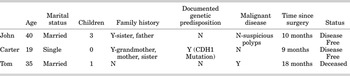
The surgical procedures for all three patients were performed by O.B. and took place within 8 months of each other. Interviews were conducted an average of 12.6 months postsurgery. A description of each case is detailed below and is summarized in Table 1.
Qualitative themes and sub-themes.

Patient characteristics

John — Family History
John, a 37-year old man, was initially referred for a surgical consultation and presented with multiple fundic gland polyps. His father and sister had both died of gastric adenocarcinoma (ages 50 years and 35 years, respectively) associated with gastric polyps. John had been seen by a genetic counselor, but no identifiable predisposing genetic factor was identified. John was initially reluctant to undergo a prophylactic TG and opted for gastroscopic and endoscopic ultrasound surveillance. Moderate-to-severe dysplasia was consistently identifiable in semi-annual biopsies during the 5 years of surveillance. At age 40, John underwent a TG. His procedure was uncomplicated and he was discharged on the 8th postoperative day.
Carter — E-Cadherin Mutation Carrier
Carter, an 18-year old man, is a documented carrier of the CDH1 mutation. Both his mother and sister had died of gastric adenocarcinoma (at ages 26 years and 20 years, respectively). Given the strong family history, Carter was very well educated regarding the significance of the CDH1 mutation. Although it was controversial given his young age, Carter had decided prior to the surgical consultation that he would undergo a prophylactic TG. He presented with no immediate postoperative complications and was discharged on the 7th postoperative day. Approximately 30 days later, however, an anastomotic stricture appeared causing significant dysphasia. A number of dilatations were required until finally his swallowing function normalized 6 months after surgery.
Tom — Metastatic Disease
Tom, a 33-year old man, was found to have gastric adenocarcinoma metastatic to the liver. He presented with no symptoms of bleeding or obstruction and was otherwise healthy. Palliative chemotherapy consisting of epirubicin, cyclophosphamide, and 5-fluorouracil (ECF) was administered. Three months later, all metastases disappeared on CT, although residual tumor was still evident at the gastric cardia. Four months after his diagnosis, Tom underwent a TG and intraperitoneal chemotherapy. It was made clear to Tom that cure was not the primary surgical objective. Rather, the surgery would provide local control and would negate the necessity of chemotherapy for a period of time. No residual liver disease or peritoneal metastases were seen at the time of operation. There were no postoperative complications and he was discharged on the 10th postoperative day. Following surgery, Tom received an additional course of ECF chemotherapy for 3 months. Eight months after surgery, a solitary liver metastasis was seen, and ECF chemotherapy was reinitiated. Thirteen months following TG, the liver lesion was enlarging and Tom was therefore treated by percutaneous radiofrequency ablation. In addition, a local recurrence appeared at the distal esophagus, which was treated by external beam radiotherapy. Tom died of recurrent disease 22 months following TG.
Qualitative Findings
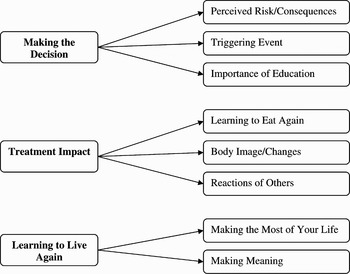
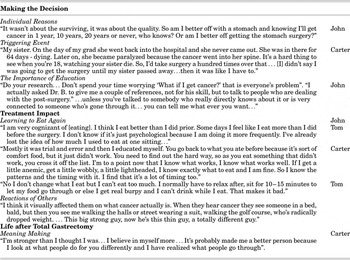
Data from the qualitative interviews are summarized in the following sections. Content analysis was able to define three main categories: (1) making the decision, (2) treatment impact, and (3) life after total gastrectomy, with each category having relevant subcategories contained within (Fig. 1). For additional patient quotes, refer to Table 2.
Patient themes and representative quotes

Making the Decision
Perceived risk/consequences. Although all three patients used a cost/benefit style to come to their decision, there were marked differences in the topics considered. For John, the surgery was a necessary precaution and he carefully weighed the opinions of the doctors as to the appropriate course of action against the long-term QL postsurgery.
Proof is a strong word… and has that kind of black and white type of connotation, but it is stronger than people's guess, right? But fundamentally in the situation that's all I had. Don't talk to me about the 3-month mark… Talk to me about what it is like at 6 months, 8 months, 12 months… The real question in the context of making a decision is not the short term recovery, it's the long term.
Whereas John weighed the long-term QL postsurgery against the opinions of his doctors, Carter weighed survival against the high likelihood of getting cancer. The family history and a documented CDH1 mutation played the key role in Carter's decision to undergo the prophylactic TG. Carter suggested that the constant worry about getting cancer would be much more burdensome than not having a stomach.
I wanted to get it over with so I could start my life …Why would I want to go and get tested every three months and always have in the back of your head, “Oh what if my cancer is starting to develop?” Just get it out and get it over with!
Tom, who was determined to do all he could to fight the disease, reported feeling that he was left with only one choice.
If you're afraid to make the wrong decision, you're not going to make a decision at all. So, make a decision, stick with it … if I know there's something I could've done, but didn't do, I'd be pissed off. I'd be really pissed off. And right now, I'm not, so I know I'm doing everything I possibly can.
Triggering event. The decision to undergo TG was highly personal and not taken lightly. All three patients described a particular event that strengthened their resolve to pursue the treatment.
John, who had decided to wait for conclusive proof, finally decided to undergo the surgery when it was confirmed that his stomach lining was getting thicker. The unfortunate impetus for Carter was his sister's death: undergoing the procedure was thereafter a foregone conclusion. Despite the palliative nature of his resection, Tom did not hesitate in taking all possible treatments, “With the baby and stuff, I didn't want to sit there and ponder and think about stuff. You just look at [the baby] and let's go, I'm wasting time here.”
The importance of education. All three patients spoke of the need to be informed about treatment options and potential concomitant sequelae. Although each patient received information from their surgeon, there was great variability in the extent to which they sought other sources of information. As stated previously, John felt strongly about knowing what to expect postsurgery, to the point at which external sources of information were as important as that provided by his surgeon. Much of Carter's education before the treatment came from his experience with his sister's cancer. He chose not to seek any information besides that provided by his surgeon because he already knew what to expect. However, following the procedure, Carter utilized many indirect sources of information. “There was a lady who came to visit me … she had a gastrectomy.” Carter's father and stepmother also chose to seek information on his behalf, “I've never been on [the website] but my parents are always checking it out.” Like Carter, having the procedure was a foregone conclusion for Tom, but when asked if he would have done anything differently, Tom said “I would have consulted a lifestyle sort of nutritionist before … I found there wasn't really a lot of [nutritional] information …” When Tom was speaking about his metastatic disease, “Too much information is good information … write to as many people that you can and listen to them. They've all got crazy ideas: they've all got thoughts on what could work or what might work.”
Treatment Impact
Learning to eat again. Learning to eat again was by far the largest theme in the interviews. All three patients reported that the TG resulted in significant changes in eating patterns and their relationship with food. It was an adjustment having to plan snacks and meals in order to avoid digestive problems and physical symptoms, and to maintain adequate caloric intake. In the absence of hunger signals that would normally be produced by the stomach, the patients were able to use other signs to indicate the need to eat, such as feeling shaky or lightheaded. This increased awareness was an important tool for the patients in the management of their symptoms. Tom states, “I get a little twinge. I know exactly what's going to happen. Whatever I'm doing or whatever I'm eating, I stop.”
As was to be expected, all patients lost weight following the surgery. However, the maintenance of body mass became an indicator of health. John describes, “My biggest concern is my ability to gain [weight]. My ability to gain indicates that I'm consuming enough and I'm absorbing enough”. Although all three patients described adjusting well to their new eating habits, it was always an important consideration in their daily living. Not having a stomach not only changes when you eat but also how you eat. Carter describes it as learning to eat again, “Now I have to make sure I chew my food like super good or else I get sick. That's one of my biggest issues, is slowing down”. Similarly, Tom states, “I believe it's all mental. It's like learning to ride a bike again, but this bike has three wheels. You just have to relearn how to work it.” All patients described learning through experimentation. Overall, the patients agreed that the work they put into adjusting their eating patterns and their different relationship to food was a rather small price to pay for more time with their families or a decreased chance of getting stomach cancer. John sums it up as, “…adjusting what I eat, when I eat is not significant in the big picture of things that can happen… I have the perspective that it could've been worse!”
Body image/changes. A TG inevitably comes with irrevocable physical changes in your appearance. Carter states, “My weight is my biggest issue. I wish that I weighed more. I wish I wasn't so skinny… You do have a loss of appetite and you're just eating little bits, you never feel hungry.” For Tom, who lost close to 60 lbs. the impact was a bit more complicated:
This is what I looked like in Grades 10 and 11. It's weird, you pass yourself in the mall and you're like, “who is that? Oh, it's me”. You're used to seeing yourself a certain way for so long and literally in a year you're a totally different person.
The postsurgery differences in body size and shape can also have practical complications as well. As Tom reports, “The part that pissed me off was having to buy a whole new wardrobe. Everything! Like the weirdest stuff, my socks were too big.”
Reactions of others. Stomach cancer and its treatment are not well publicized: having one's stomach removed is not a commonplace occurrence in North America, whereas mastectomy, for example, is relatively common. As such, these patients routinely had to educate others about TG. Carter states, “…people always ask, ‘How do you eat?’ People say, ‘How do you live without a stomach?’” As much as it is helpful to increase awareness, being thrust into the role of educator can become taxing. For Tom, who had a metastatic cancer diagnosis, the reactions of other people were quite different and he described the difficulty explaining his terminal diagnosis to others, considering his age and appearance.
Life after TG
Making the most of your life. Despite a slow recovery and continued challenges, all patients were adamant that they must make the most of their lives. For Carter, it was important to enjoy his health and to resume the activities that he had engaged in before the surgery, “I feel like I could do whatever. I just started playing hockey again about a month ago. I feel… other than I'm out of shape… I feel normal.” Tom described the importance of looking toward the future and not spending time looking for answers to “why” questions, “…that's the past. I don't think like that. It's a new day. If someone wants to remember what happened the day before, so be it. But I'm not going to. I remember the important stuff, not the down stuff.”
Making meaning. After experiencing a life-changing event, it is common to change one's perspective on what is important (Lee, Reference Lee2008). Carter reported that his sister's death, combined with his surgery and recovery experience, resulted in increased maturity. “I'd say this has made me grow up and think about things more…” Often, individuals also report personal growth or a strengthening of priorities following serious life events. This occurred particularly for Tom. “It's definitely changed my energy levels in terms of directing it to certain areas of my life. Definitely family. Family is number one. It has always been number one, but now it is truly number one.”
DISCUSSION
This currently represents the only study to qualitatively investigate the lived experience of TG. The purposive sample included one patient with no measurable genetic risk, one patient with a documented genetic risk factor, and one patient with confirmed metastatic gastric cancer. This design allowed the exploration of similarities and differences and shed important light on the psychosocial and survivorship issues of deciding to undergo a TG for prophylaxis or palliation, dealing with treatment effects, and learning to live again.
The factors leading to the decision to have a TG were different for each patient. The decision was primarily influenced by perceived risk, consequences, and unique circumstance. When the risk of developing gastric cancer was great (as with Carter) or the short-term consequences of untreated metastatic disease were dire (as with Tom), the decision to have a gastrectomy was relatively immediate. For John, who perceived his risk to be lower, the consequences of the surgery were an important consideration. Therefore, the decision was more difficult and took longer to make.
Although each patient had their own unique thematic experience, there were also commonalities in the process. Specifically, all three patients emphasized the importance of: (1) being informed about the potential impact of gastrectomy; (2) learning how to adjust to new eating patterns postsurgery; and (3) re-evaluating one's priorities and goals as a result of self-reflection and growth. Understanding this process will allow surgical oncologists, other members of the care team, and the patients themselves to better understand the factors involved in decision making and postoperative adjustment. At present, there is a dearth of information to guide physicians and patients considering TG. The experience of these three patients provides valuable information that can be used to direct further research and improve patient outcomes.
This research has some important features, which contribute to its foundational nature and relevance. Considering that genetic markers for gastric cancer have only recently been discovered, the ability to compare and contrast those patients undergoing TG for prophylaxis to those patients with confirmed gastric cancer is a significant advancement. The recent development of validated instruments to measure QL can assist in the measurement of the effect of treatments such as TG on QL (Vickery et al., Reference Vickery, Blazeby and Conroy2001; Garland et al., 2011). One of the challenges in conducting future research would be to accrue sample sizes large enough for meaningful quantitative analysis in a Western population in whom the prevalence of stomach cancer is low. As such, multi-site collaborations will be essential. Even more difficult would be the recruitment of individuals opting for a prophylactic gastrectomy and, to date, we were unable to find any published documentation of the frequency of this procedure.
It would be quite informative to compare the experience of TG in Eastern populations with high prevalence to the experience of TG in Western populations with low prevalence. Unfamiliarity with this disease in North America may relate to being faced with the question of “How do you live without a stomach?” and a patient's perception of isolation. An important area of future work is the determination of how feelings of isolation relate to overall levels of distress in this group of individuals. Similarly, it is unknown whether gender alters perception of negative and positive treatment consequences. For example, one of the primary concerns of this all-male sample was the maintenance of weight and avoiding being ‘too skinny’. It is possible that women might not find this side effect of treatment as problematic as men, but this is yet to be demonstrated (Green et al., Reference Green, Cameron and Polivy1997; Lemon et al., Reference Lemon, Rosal and Zapka2009).
Even with the use of validated QL measurement tools, the patient's lived experience of TG, described in their own words, is an invaluable contribution to the literature. Although written for a medical audience, these case studies could be presented to patients in order to fulfill their request to understand the lived experience of the procedure, something that may not be available to them otherwise. With these strengths in mind, one must also be aware that even a multiple case design and an in-depth analysis of the experiences of these three patients will probably not capture the journey of every patient faced with the decision of TG and as such, the generalizability of these results may be limited. Despite this, the value of understanding for future knowledge generation and the potential for this research to impact subsequent inquiry and practice is considerable.
ACKNOWLEDGMENTS
This work is dedicated to Tom, who died during the writing of this article. We also recognize the invaluable contributions of John and Carter, without whom this work would never have been possible. We also acknowledge Lloyd Mack, Jay Easaw, and R.A. Malik for referring these patients and for participating in their care