In 1860, the Lancet sounded a dire alarm about the seemingly insalubrious and disease-breeding interior of London carriages: “It is not very agreeable to suspect that the previous occupant (and not ten minutes ago) of the cab we have just got into had small-pox or typhus, scarlatina, scabies, favus, or choleraic diarrhœa; that all the windows were of course carefully closed by the sick man's ignorant but naturally anxious relatives; or that the patient spat about or vomited amongst the straw beneath our feet. We might draw an even more repulsive picture, which yet a Londoner would know to be not untruthful.”Footnote 1 This curious piece of hand-wringing could easily be dismissed today as a bit of urban hypochondria, had it not been voiced by one of the leading mouthpieces of the medical profession. Actually, it is only one graphic expression of widespread assumptions about the infectious ambiance of the mid-Victorian metropolis. Newspapers, social investigations, and sanitary reports carried a stream of warnings about infectious hired vehicles to the reading public, frightening many Londoners already convinced that the ever-growing fleet of public conveyances constituted a new realm for the clandestine admixture of bodies and filth, respectable and poor, healthy and sick. The Lancet editorial typifies the epidemiological reputation that ordinary street vehicles had gained, while also describing the impetus behind the first municipal ambulance systems. However, many Victorian Londoners, as we shall see, found it equally “not very agreeable to suspect” the dangers emanating from these more conspicuous devices of mobile sickness. The first ambulances repeatedly surfaced in similar proportions as spectacular vehicles of fascination and terror. Cabs, omnibuses, and ambulances thus typify the acute Victorian attention to suspected hazards of the urban environment: the random, unpredictable, and unregulated admixture of bodies, classes, and substances.Footnote 2 That “even more repulsive picture” that the Lancet editorialist withholds from polite discussion speaks directly to the ambivalent desire to visualize a frustratingly invisible contamination (of a doubly physical and moral sense) that polluted the arteries of urban circulation. The Lancet's warning exemplifies the place of itinerant infection in the Victorian urban landscape. Street vehicles of all sorts had to navigate their way through a highly contested metropolitan culture of mobility and visuality.
Urban transport has been examined as an important historical factor in the production of new social spaces, particularly with regard to suburbanization, urban sprawl, and the removal and revival of slums.Footnote 3 More recently, attention has shifted to “cultures of transport, traffic and mobility” that have contributed to the emergence of consumer cultures and the reordering of the public sphere.Footnote 4 A well-trod literature, one might say, has sprouted from Walter Benjamin's writings on the perambulatory culture of mid-nineteenth-century Paris, that symbolic “capital of the nineteenth century.” London's streets have exerted a similar fascination as sites for the performance of a particular society of spectatorship, ordered by urban subjects pursuing pleasure, commodities, knowledge, filth, transgression, or redemption.Footnote 5 Feminist scholars have drawn attention to the gendered and sexualized spaces of the Victorian city, where movement was always inscribed in terms of tensions between private and public.Footnote 6 Public vehicles have been described as lending a new level of transience to social contact and contributing to an era of “polite estrangement,” blasé alienation, or traumatic shock, but also liberating adventure.Footnote 7
Surface streets and underground sewers clearly factored heavily in the grand nineteenth-century projects of metropolitan sanitary reconstruction and, ultimately, in urban experience and perception. But the technical similarity between controlling the flow of human waste and the movement of bodies has seldom been explored by historians as a complementary public health dynamic, despite the broad Victorian fascination with “movement” in relation to hygienic engineering. With Edwin Chadwick famously preaching the essential principle of “continuous circulation,” sanitarians drew upon deeply established connections between stagnation, putridity, and epidemic disease.Footnote 8 They lavished attention upon sites of aggregation and immobility, seeking to free up routes of dispersion and to facilitate the circulation of air and clean water in houses, people in streets, and waste in sewers. The palpable discomfort displayed by the Victorian state toward quarantine measures at national borders was another expression of this desire to liberalize the “law of intercourse.”Footnote 9 But urban sanitary reconstructions also specifically created possibilities for viewing the metropolis anew and fashioning a novel visual culture. Modernized sanitary conduits required incessant mapping of the city's rough networks of effluvia, while also facilitating safe and clean middle-class rituals of personal exhibition and commercial spectacle.Footnote 10 Historians and theorists of governmentality place particular emphasis on the possibilities provided for the shaping of hygienic conduct and respectable deportment. The material underpinnings of late nineteenth-century liberalism can be found in the various programs to create normalized conditions by which individuals could govern themselves in ways conducive to the goals of free subjects. Open movement and circulation actually belie a more grounded concern in ordering the choices appropriate to enable productive mobility in the “bourgeois visual environment.”Footnote 11
In this article I seek to ground this historiographical and theoretical context in an examination of peculiarly Victorian concerns about the dangerousness of public vehicles after hire by the infectious sick. Periodically gripping Victorian Londoners from the 1850s to 1870s, this vehicular infection anxiety led directly to the introduction of the first municipal ambulance service but not before generating a wrenching debate about the contradictory aims and effects of mobility in the modern metropolis. The discursive appearance of “infectious conveyances” can be mapped across two important and related cultural registers: class contaminations and corrupting influences (always near and dear to the Victorian imagination) and legibility and spectatorship on the urban landscape. That infected cabs and omnibuses haunted a generation of Londoners should be read as a cultural event in which Victorians attempted to sort out contradictory desires regarding mobility, circulation, and visuality with regard to the profuse but ultimately also diffuse notion of contamination.
Long before the Victorians made a habit of it, Londoners had occasionally worried about specific threats attaching to the interiors of hired conveyances. During the Great Plague of 1665 city commissioners prohibited hackney coaches taking fares for at least five days after depositing infected persons at the pesthouses, and indeed Samuel Pepys expressed his great uneasiness about accidentally employing such “pest coaches” during that epidemic.Footnote 12 The suspicion that cabs furtively conveyed corpses was voiced during the “Burking” mania of the early 1830s, corresponding to the first cholera epidemic in Britain. The Monthly Magazine sneered that the “hackney-coach conveys alike the living and the dead. It carries the dying man to the hospital, and when doctors and tax-gatherers can tantalize him no more, it carries him to Surgeon's Hall, and qualifies him to assist the ‘march of mind’ by the section of body.”Footnote 13 Such scenarios of bodily violence and contamination may have existed primarily in the imaginations of certain Londoners, but they nonetheless grew in prevalence once cabs and omnibuses increasingly “democratized” the use of public transport in the middle decades of the century. Londoners excelled in grumbling about the poor quality of hired vehicles, as did a leader in The Times in 1831, carping that “there is certainly in no town in Great Britain, or on the continent, so dirty and rickety a vehicle as a London hackney coach.”Footnote 14 The four-wheeled Clarence cab (or “growler,” introduced in the 1820s) was consistently disparaged as “abominably noisy, and very rough in motion, uneasy and uncomfortable.”Footnote 15 The hansom “safety” cab (patented in 1834) was a trim, two-wheeled conveyance enjoying a more genteel reputation for speed and convenience. The ephemeral nature of coach and cab engagement, however, created little incentive for the proprietors to maintain high standards for comfort or cleanliness. The competition of cabs undoubtedly contributed to the decline in numbers and quality of growlers and added to a well-understood social ranking of public vehicles—all the while maintaining a relatively low standard for both.Footnote 16
The social distinction conferred by vehicles marked the entire century, during which closeness to “the people” continued to be an ambiguous source of both veneration and vexation. A common early critique of cabs arose from snobbish imputations of sham gentility harbored by persons who aimed at a status above their station, together with requisite condemnations of inconvenient detritus and residue of previous occupants. An 1823 letter to the London Magazine cataloged the variety of faults repulsive to proper tastes: “A hackney-coach—fogh! Who can be a gentleman and visit in a hackney-coach? Who can, indeed? to predicate nothing of the stinking wet straw and broken windows, and cushions on which the last dandy has cleaned his shoes, and of the last fever it has carried to Guy's [Hospital], or the last load of convicts transported to the hulks.”Footnote 17 The mildly aristocratic tone of this warning carried another hint: that this was a dangerously democratic mode of intermingling high with low. Hirable coaches, in fact, allowed for a range of possibilities in marking social distinction—ones that were becoming more complicatedly tiered than ever. Anthony Trollope was only stating the obvious when he wrote that “the lady who uses a street cab must encounter mud and dust which her richer neighbour, who has a private carriage, will escape.” At the same time, however, hiring a coach gradually became a conspicuous sign of easy mobility that enabled aspiring persons to separate themselves from the lower orders, who could likely only afford cabs for special indulgences or in emergencies. Charles Dickens amusingly mocked middle-class ambition in noticing that “many vast vague reputations have been made, solely by taking cabs and going about.”Footnote 18 So, despite all its early associations with commonness, aspiring sorts had good reasons to temporarily put out of mind the potential inconveniences and dangers of the hired vehicle, or at least put up with an occasional offensive odor or deposit. By about 1850 it was estimated that the London public spent £860,000 per year in cab hire—a figure doubtlessly continuously proliferating as the increasingly clogged streets prompted well-off Londoners to quit maintaining private carriages and rely upon hackney coaches.Footnote 19
Cabmen, for their part, were consistently burdened by a less ambiguous and undeniably unenviable reputation. J. Ewing Ritchie condemned them as “misanthropic individuals” who were constantly aggravated—by weather, horses, police, traffic, bosses, their own fares—and who understandably fell into the contaminating habit of employing “bad language in a truly distressing manner.” This was partly the fault of an unsympathetic and penny-pinching public, which drove the cabbie to his desperation: “Cabby so often drives rogues that we cannot wonder if in time he becomes a bit of a rogue himself,” Ritchie admitted.Footnote 20 Despite registration by the Home Office, the hired driver remained thoroughly anonymous to the London public—which perhaps helps explain the interest given to him by a whole raft of mid-Victorian social investigators of “hidden London.” For Dickens and James Greenwood, the cabbie was an inscrutable figure of urban society: highly mobile in a physical sense, yet socially trapped in his itinerant device. According to Henry Mayhew, beneath the respectable licensed drivers existed a significant semicriminal substratum of intermittently drunken thieves and extortionists.Footnote 21 Even in more sympathetic sketches, the cabbie remained the unsavory functionary of the city's circulatory system, absorbing the characteristics of the street itself and presenting a caricatured manner of unfeeling and uncaring transience. A correspondent to The Times during an 1863 smallpox epidemic drew upon the image of the callous cabman as a general type. He was one who knowingly accepts dangerously infectious cargo and, pocketing his fare, “keeps to the windward of the inside of the vehicle,” while he “trusts that the next riders will take the disease favourably, and soothes his own conscience with the fact that he is a poor man and can’t help it.”Footnote 22
The introduction of omnibuses in the late 1820s represented one of the most significant innovations in London's intra-urban mass transport. Based upon the design of the old-fashioned post coach, the horse-bus interior was cozy (or cramped, depending upon the season and the corpulence of the individual passengers). By 1849 seats were being added to roofs, making the omnibus a popular means to carry upward of thirty persons across town at a speed of eight miles per hour. Dickens praised the shared space of the omnibus as an observatory of human nature, noting that the “passengers change as often in the course of one journey as the figures in a kaleidoscope, and though not so glittering, are far more amusing.”Footnote 23 Entertaining spectacles aside, omnibuses were attractive to commuters for their efficiency and practicality, while still occupying an uncomfortable place in middle-class sensibilities. Omnibuses emerged as a common metaphor for the collapsing distances within the metropolis but also for the reduction of distance between fellow travelers. This confined carriage, depicted in certain emblematic paintings from the period, could incubate a “state of collective discomfort” replete with anxious “body language and territoriality.”Footnote 24 That indefatigable London flaneur, George Sala, cautioned comparable men to “never ride inside an omnibus”; even if one were to evade the plague of pickpockets, babies, or fleas, he slyly hinted, “you are very probably the next neighbour to persons suffering under vexatious ailments, such as asthma, simple cold in the head, or St. Vitus's dance.” For Sala, “the interior of one of these vehicles [is] a place of terror and discomfort; whereas outside [i.e., on the roof] all is peace.”Footnote 25 Common health advice dispensed during epidemics frequently arrived at similar warnings about social lowering and the tactile and atmospheric dangers of shared enclosures. This was the case with a reverend who warned his flock during a smallpox epidemic “to be very particular never to touch another person in passing along the street; never to go inside an omnibus or a four-wheel cab; and always, in a railway train, to get into a smoking compartment.”Footnote 26
Despite these concerns, middle-class Londoners generally praised public vehicles as escapes from promiscuous intermingling in the streets, which had long been eyed as the stagnant milieu of epidemics. Orderly street cleaning and new paving technologies in the middle decades of the century superseded scavengers in many locales, reducing previously omnipresent (and charmingly euphemistic) “dust.”Footnote 27 Nonetheless, the improvement of streets probably also contributed to the burgeoning suspicions of hired conveyances. Vehicles that once lifted respectable passengers above (literally and figuratively) the sources of contamination could now themselves become the roving breeding grounds of infection or vessels of contagion—as dangerous as rubbing up against strange pedestrians or splashing through puddles of house and industrial sewage. Middle-class Victorians frequently deployed “the street” as an anxiety-laden metaphor for the concourse of society, and vehicles plying those streets could not help but absorb this ambiguity. Peter Bailey has noted that Victorian train compartments sought to reconstitute the safety and comfort of the private realm, while at the same time a host of social behaviors threatened to disrupt and dissolve the sanctity of this tenuously privatized space. In a similar vein, abstruse moral and physical contaminations risked making public conveyances of the street disturbingly congruous to “public conveniences” (toilets).Footnote 28 Cabs and omnibuses increasingly provided spaces where persons of different social classes occupied the same seat for the same fare. While it may at one time have represented a refuge for those who wished not to engage in the transgressive mobility of the flaneur, in the end, hired transport emerged as another reminder of how disease treats all as equals.
Just as crowds from across Europe flocked to the Crystal Palace in 1851 to view the works of industry of all nations, the London Fever Hospital (LFH) colored the tenor of this sightseeing with a dramatic warning: at least half of its patients arrived in ordinary hired cabs.Footnote 29 As this was well before the term “ambulance” was understood outside its original military definition of “mobile surgery,” the LFH Committee merely publicized its desire for a specialized conveyance to prevent the general contamination of public transport. At this time the LFH's buildings in Islington constituted the only dedicated receptacle for Londoners (mostly paupers) infected with such fearsome diseases as typhus, typhoid fever, scarlet fever, and measles. It also occasionally received misdiagnosed cases of smallpox that were supposed to arrive at the London Smallpox Hospital located at the foot of Highgate Hill. Pleas for funds for an ambulance went unmet for a decade, though, during which time it was assumably customary for “the pestilence-diffusing sick [to be] sent from their polluted homes” in cabs.Footnote 30 The “carriage fund” appeal was finally met in 1861 only after Punch magazine queried its readership: “Reader, are you afraid of fever, and do you ride in cabs?” Those answering in the affirmative were requested to subscribe liberally, as each donation “will lessen [Mr. Punch’s] chances of infection when he takes a cab.” Shortly afterward, the LFH proudly announced that a vehicle was now kept for the exclusive use of its patients. However, the fund was not self-supporting, and, as a result, the hospital's applicants had to hire a horse to pull the carriage (a situation that pleased few).Footnote 31
Seeking again to publicize the threat of hired vehicles becoming permeated with infectious matter, the medical officer of the LFH wrote to The Times a few years later about the ubiquity of these “perambulating fever nests of our London streets.” He estimated that seven hundred to eight hundred street cabs deposited patients at the fever hospital each year and feared that not one in a hundred infectious cases arrived at any metropolitan hospital differently.Footnote 32 In contrast to the vantage point of a hospital physician, the imperceptibility and opacity of disease's silent circulation through the medium of public vehicles caused no uncommon amount of distress to middle-class taste and tranquility. Another correspondent to The Times had wondered if street cabs were not “the most effectual contrivance which could be devised for … endanger[ing] the lives most especially valuable to society—traveling and mercantile adults,” also noting that perhaps “a large proportion of the unaccountable cases [of deadly infection] arise through the medium of public vehicles.”Footnote 33 As it required rare deductive perception to trace infection's movement, a popular epistemology arose to confirm the fact. One often-repeated account told the unlucky tale of a cabman who drives a physician to the house of a person suffering from smallpox. The physician learns that his patient had just died, after which the cabman informs him that about three weeks earlier he had deposited a fare at the London Smallpox Hospital and had immediately been hired to drive the doctor's newly deceased patient to the house outside of which they stand.Footnote 34 Numerous advice givers speculated about the amount of stealthy infection this and similar coincidences represented. J. Ewing Ritchie's About London (1860) complained that the insidious aspect of this hazard was a traveler's obliviousness to danger: “Now as you dash merrily along, with a civil driver, a luxurious equipage, and not a bad sort of horse, little do you think that you may be driving further than you intended, to a dangerous illness and an early grave.”Footnote 35
A host of related concerns were also raised about the clandestine circulation of the infectious dead in cabs and the infectious living in funeral carriages. On the first point, a correspondent to the Lancet reflected in 1864 upon the frequent use of coaches as makeshift hearses, conveying corpses imbued with fever or smallpox (often in a fetid state), the drivers then simply queuing for their next passengers. In the opinion of the Camberwell medical officer, it was “no uncommon practice” to remove the bodies of children to cemeteries in this way, despite the high mortality from childhood diseases such as scarlet fever, making this “abominable” custom a serious threat to the public's health.Footnote 36 Conversely, Victorian funeral directors sometimes supplemented their business by offering their long coaches to patients requiring recumbent transport. Private sick transport, however, could never likely have been very popular while linked to mortuary science. For the middle classes at least, such invalid carriages most likely retained an indelibly morbid association between the ride to hospital in such a vehicle and one's final journey in a hearse. One doctor who endeavored to secure a suitable vehicle for his son suffering from diphtheria was mortified to find that the only one he could procure filled all with dismay: “The landlady and the whole square [were] deeply shocked at the sight of the conveyance. I can only describe it as a cross between a hearse and dirty linen cart, painted black, and with funereal side glass; a black horse, with dismal harness, and a driver of the woeful aspect, also in deep black. It was surely enough to put the finish to any sensitive patient, dangerously ill, as my son then was.”Footnote 37
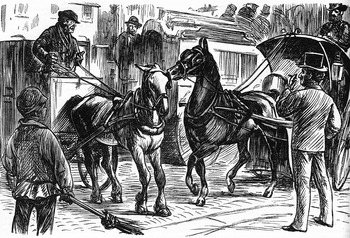
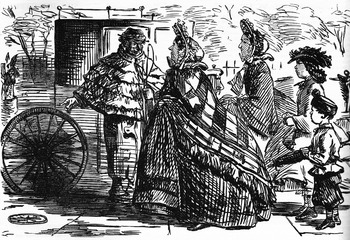
A pair of Punch cartoons alludes to the widely held apprehensions of all hired vehicles (figs. 1–2). The contest of “Four-Wheeler versus Hansom” (an omnibus significantly passing in the background) is ultimately neither between cleanliness and infection nor safety and danger but rather over which conveyance presents the least chance of conveying disease. The dismissive epithet of “fever box” is illustrative of differences in social status between cabs and growlers, but the cartoon also insinuates something middle-class commuters probably loathed to admit: that either vehicle likely presented equally perilous traveling options. In “Prevention Better than Cure” (by the eminent cartoonist John Leech), we are left to assume
—“Four-Wheeler versus Hansom.
Gentleman: ‘Now, then Crawler, I didn't hail you! I hailed the hansom. So take that “Fever-Box” of yours out of the way!’
Four-Wheeler: ‘Fever-Box, indeed! Ah! That's just your mistake! I takes the patients to the 'orspital when the disease is only just beginning, and there ain't yet no infection. He takes 'em out for a hairing just when they begins to get conwalescent’” (Punch, 20 August 1870).

that public reports had already influenced the elderly matron's notion of the shabby hackney coach as a harbor of smallpox material. Her nervous inquiry is punctuated by the cabbie entreating his reluctant fare (in the most agreeable Cockney dialect) not to worry: he has “waccinated” the vehicle (vaccination apparently took place everywhere except upon the humans for whom it was intended). Her trepidation, one must think, would not be assuaged by such spurious precautions because it originates from the dangerous promiscuity implied in sharing a space in succession to a previous occupant of unidentified social station and cleanliness. Both cartoons highlight this sense of the imperceptibility of latent contamination. In the absence of telltale signs, cabs and coaches (in degraded conditions and opportunistic postures) and cabbies (spewing corrupted language) stand in as disease's infernal agents. Despairing of infection's invisibility, the public obsessed upon these clearly identifiable and already dubious machines of circulation. The hackney coach had become the symbol for bourgeois mobility, but it could also supply a visual marker for the undetectable transfers of contamination presumed to plague this class.
Amid the slow-simmering panic over infected transport, more reflective travelers began to cast a cautious eye upon omnibus and train carriages, where the immediately shared space provided opportunities for hidden contagions to burst into frightful exposure. Newspapers regularly featured stories of servants sent home from London on the rails and schoolboys sent back to London directly after showing the symptoms of infectious disease (rarely too soon for those eager to
—“Prevention Better than Cure.
Old Lady: ‘But, going out in four wheel cabs! I'm so afraid of small pox.’
Cabby: ‘You've got no call to be afeard o’ my cab, Mum, for I've 'ad the hind wheel waccinated, and it took beautiful!’” (Punch, 30 May 1863).

get rid of them).Footnote 38 Always a handy barometer of social anxieties for its middle-class readership, Punch quipped that “We all of us occasionally run to catch the train; now, if we catch that, some of us will probably catch something more.” With all seriousness, the eminent early bacteriologist William Budd claimed that “a great many people” brazenly traveled by rail (often to seaside convalescence) with the eruption of scarlet fever upon them, to the mortal danger of their fellow passengers.Footnote 39 Such trespasses did not always go unnoticed. A correspondent to The Times complained in 1863 that his traveling party had unpleasantly discovered themselves sharing a compartment with a heavily veiled lady who inadvertently revealed the fresh marks of smallpox upon her face. Similar circumstances prompted another shocked commuter to write in 1871, “I cannot describe to you the uneasiness felt, not only myself, but others by being thus closely brought in contact with this loathsome disease.”Footnote 40 All common cars increasingly seemed to possess the risk of patients making terrifying disclosures to panicked passengers having no means of immediate escape. Survival stories from public carriages traded in judgments about secretive passengers: by the inclusion of furtive devices concealing their true condition, the unmistakably marked sick (as in smallpox and scarlet fever) implicitly acknowledged that they wronged their fellow travelers. An editorial in The Echo claimed that the “heinousness of the offense is manifest” and condemned the infectious person who knowingly mixed with the world in omnibuses as “a public poisoner … an unconscious murderer or homicide.”Footnote 41 Reckless behavior of this sort underlined a palpable fear of class vulnerability, puncturing delusions of privacy on public vehicles (so difficult to maintain in the first place) and leading to bizarre equivalences with other presumed rights. The Daily Telegraph assured its readers that there was “no more justification for allowing persons who suffer from contagious diseases to travel by those conveyances than for thrusting an uncoffined corpse in at the window of a gentleman's brougham.”Footnote 42 Middle-class commuters might not command a private carriage, but they demanded an identical amount of sympathy and protection from coarse indiscretions.
The London press periodically aired startling anecdotes about the arcane activities of infected vehicles. These tales took on all the characteristics of bourgeois urban legends, yet the Medical Times and Gazette insisted, “we are not painting from imagination.”Footnote 43 A Highgate surgeon writing to Public Opinion in 1867 related that he and his party narrowly avoided hiring a cab only because they happened to see it emerge from the London Smallpox Hospital. The cabbie unabashedly admitted he had just deposited a patient and went on his way, leaving the writer to suppose that the infection of less fortunate commuters was “not a daily, but an hourly event.”Footnote 44 The Pall Mall Gazette broadcast the story of a man who happened to witness an invalid bearing the eruption of smallpox on his face exit a house and enter a hack cab. The witness followed the vehicle as quickly as he could, just in time to see the passenger disembark at a smallpox hospital. Trying to ascertain the cab's number, the Good Samaritan continued to follow but to his horror saw the cab hailed by a gentleman and lady. His frantic shouts to them not to enter the cab were in vain, but he again followed the cab to its destination, where he saw the pair enter a house on one of the most fashionable squares in London. The pursuer now gave up the chase but returned a few weeks later hoping to explain his actions to the startled passengers. He found the blinds of the house down: the man had died of smallpox the day before, and his wife was not expected to recover from the same disease.Footnote 45
The cache of similar narratives of serendipitous encounters seemed to be endless, forming a web of anecdotes regarding the tenuous lines of connection in the city linking nameless inhabitants from unrelated classes. The consequences of this infectious traffic remained at a similar level of conjecture. Cognizant of the large default from vaccination precautions, a correspondent to The Times presumed that public vehicles were “the best mode of increasing cases of smallpox, as practiced by the inhabitants of London in the 19th century.” Extending this reasoning to other infectious diseases, a prominent commentator on public health supposed that London street cabs were “the chief, if not the sole causes of those occasional cases of typhus among persons in the better ranks of life.” Meanwhile, the Lancet mused that the danger of infection from public vehicles could not be adequately measured for its immensity, adding that “the present state of things is enough to drive all of the world from the use of cabs, if they had any reflective habit, which people generally have not.”Footnote 46
The “misuse” of public vehicles and the perceived contamination of transport arose as a particular concern during periods of epidemic, when legislation aimed at policing the practice most often appeared. The 1860s saw the criminalization of “public exposure” by infectious persons and the emergence of municipal systems of mass isolation in hospitals. Both also served to underline the ambiguous and uneven implementation of continental-style “medical police” in Victorian British public health.Footnote 47 Indeed, attempts to amend cardinal principles of free open movement by prohibiting behavior and imposing limitations had unexpected consequences. Not the least of these was that exposés of concealment and exposure by street vehicle passengers further solidified uncomfortable associations between urban mobility and the randomness of social transgression. Significantly, epidemic flare-ups helped concentrate attention on the cab and omnibus danger and created the groundswell for alternate vehicles, out of which emerged some of the first municipal “ambulances” (as they came to be known). Infectious panic was certainly the most powerful contributing factor to the initial deployment of London's purpose-built civilian ambulance systems. However, this new vehicle on the urban landscape could not but also become enmeshed in the same contradictory themes of urban mobility and visibility. In its turn, the ambulance for infectious patients became the next popular object of epidemic consternation: an identifiable and spectacular agent of itinerant infection.
Parliament's first considerations of infection by vehicles came with discussions of the 1853 Hackney Carriage Bill. Ultimately, a proposed clause (based on a Corporation of Liverpool bylaw) forbidding the hire of vehicles by the sick was dropped amid disputes over enforcement and questions about whether it would be practical to expect the public to discern which diseases were “contagious.”Footnote 48 In 1863 another attempt to restrict infectious and contagious passengers came about while “the public mind was greatly alarmed on the subject.” Explicit parliamentary prohibitions again collapsed, this time under the opposition of the medical profession, which feared that responsibility for diagnosing passengers would “[convert] the cabman into a pathologist.” Some MPs agreed that this would open the door to presumptuousness from and extortion by cabbies (“an insufferable act of tyranny”), while others wondered whether legislation would simply deter people from using public conveyances altogether. “Besides,” the British Medical Journal snarled, “where are the delicate-minded cabmen to be found, who would, for a due consideration, object to take the most virulent of diseases into their cabs?” Tepid encouragements for local authorities to provide gratis fever carts were reissued instead.Footnote 49 The anticipated visitation of cholera in 1866 nevertheless prompted Parliament to overcome objections and to pass a sweeping new Sanitary Act. Drawing upon kindred statutes restricting poisons and food adulteration, the act for the first time criminalized the use of public conveyances by infectious and contagious passengers and punished drivers who knowingly failed to disinfect their vehicle after transporting them. Either action could result in a fine of up to £5 or a month's imprisonment.Footnote 50
The punitive provisions of the 1866 Sanitary Act regarding “infectious exposure” fit within a trend of framing sanitary administration as a question of the direct government of individuals. Building upon previous environmental reforms in the interest of public health, the Sanitary Act broke new ground amid a wave of calls to restrain the liberty of the corporeal subject (most remarkably in the Contagious Diseases Acts, which mandated the compulsory medical inspection of prostitutes in garrison towns—1864 and 1866). The Sanitary Act directed local authorities to provide hospitals for infectious patients and provided the legal framework for the removal of recalcitrant persons from their homes. The next year saw the passage of what could be considered companion legislation specifically for London. The 1867 Metropolitan Poor Act created the Metropolitan Asylums Board (MAB) and charged it with maintaining hospitals for London paupers infected with dangerous diseases. Isolation began to surpass vaccination as the primary response to smallpox outbreaks, and especially in London and large towns, hospitalization became a front line in the sanitary defense against the various epidemic fevers.Footnote 51
The infectious hospitals and, later, infectious ambulances emerged as responses to perceived fever nests and their roaming proxies on wheels, respectively. Like most aspects of public health administration at this time, these tools were conceived almost exclusively for containing the poorer classes and restraining their ability to export disease into respectable society. The British Medical Journal, for instance, remarked in 1863 (in an evident spirit of wild conjecture) that 95 percent of the persons who contaminated public vehicles with their infections “belong to a class of society which seeks refuge in hospitals and workhouses in times of sickness.” Only rarely did middle- or upper-class persons “require the use of conveyances when sick of infectious disorders. When they fall sick, there [i.e., in their homes] they lie until they recover or die.”Footnote 52 The poor were dangerously mobile, while those in respectable stations of life knew when to stay put for the good of their fellow creatures. As for the hospitals of the Metropolitan Asylums Board, they originated as an important victory in mid-Victorian Poor Law reform, with Parliament initially only intending to provide special hospitalization for the “officially destitute” sick: paupers who would otherwise contaminate entire workhouses. But, crucially, as no analogous agency was created for nonpauper patients (Whitehall preferring to manage the general public health through the destitution authorities), the MAB became the de facto isolation source for many classes of Londoners. By 1877 five permanent hospitals had been established in the metropolis, providing beds for nearly fifteen hundred fever and smallpox victims. In theory, the poorest of the poor were legally destined for transportation to the MAB isolation hospitals; in practice, the whole of the working class and even persons of higher social station were liable to be swept up during periods of epidemic panic.Footnote 53 Frequently complaining of the not-quite-legal circumstances into which they were placed, the MAB managers voiced additional sources of worry: paupers arrived in official parochial conveyances from all over London, but other patients in a “flowering state of disease traveled to the hospitals in cabs, in railway trains, and in omnibuses.”Footnote 54 Paradoxically, mass isolation of epidemic sufferers reintroduced and amplified the perceived mobility of dangerous bodies (implicitly regardless of class status, although this was rarely acknowledged).
Prosecutions under the Sanitary Act for vehicular “exposure” did little to allay persistent fears of widespread contamination of public vehicles. In all probability the penalties were either unknown by many Londoners or routinely flouted under immediate emergencies. During the height of the devastating 1871 smallpox outbreak, the Pall Mall Gazette noted that “hardly a day now elapses” without someone being summoned before a magistrate to answer the charge. The Echo believed that it was a topic about which “no one who reads the newspaper or talks to his friends … can be ignorant”—doubtlessly confirming the impression of an epidemic of careless contagious commuters.Footnote 55 In one widely reported case, charges were brought in Clerkenwell against Michael Turner, a boot maker and saddler, for placing his two daughters in a street cab while they were suffering from smallpox. At the trial, in which he was fined 40s., it was revealed that Turner had hired the cab to take his daughters a short distance from their home, whereupon they were transferred into an appropriate ambulance (apparently to prevent the parish carriage from frightening away his patrons). The magistrate found his subterfuge particularly egregious, since police had recently been stationed at isolation hospital gates in order to guard against cabs arriving with patients. This dragnet led to the prosecution of Elizabeth Lester later that year. A police inspector observed Lester, a young needlewoman, depositing a heavily veiled fellow female servant at one of the MAB's hospitals. When the inspector asked if the cab brought smallpox patients, Lester answered that they were only there to inquire about someone inside, but she emerged alone and was then apprehended by the police. Despite Lester's protestations that she did not know about special conveyances, the magistrate decided to make an example of her by assessing a fine of 40s. and an additional 30s. for the cab's disinfection—a significant sum for a common servant. According to The Times reporter in the courtroom, Lester burst into tears because she could not pay and, in lieu of her default, was sentenced to fourteen days imprisonment. Other cases found cabbies equally liable and subjected to harsh fines.Footnote 56
Reviewing these cases, the Daily Telegraph fumed that to “employ public carriages for such a purpose is to commit treason against the community.”Footnote 57 But as these and other trials illustrate, the circumstances of metropolitan circulation were not as clear-cut as desired nor did the heavy hand of the law fall with equal force upon all. Servants were routinely cut loose “with indecent haste” after catching dangerous diseases and forced to find shelter on their own, often through the public thoroughfares.Footnote 58 For example, Emily Burge, a nurse to a household in Camden Town, was arraigned in 1874 for conducting a fellow servant sick with scarlet fever onto a tramcar at the Red Cap, thence to Nag's Head, Holloway, and another tram to the LFH in Islington, where she was apprehended by police. At trial, Burge pleaded that she only did what her master instructed her to do—hire a cab or, if no cabs were available, take a tram—but was still fined 40s.Footnote 59 The fact that the employer was not brought up on charges suggests that the court was unwilling to pry into the decisions made in a private house. A number of defendants pleaded that they knew nothing of special conveyances but were heavily fined nonetheless.Footnote 60 It could not have been only the ignorant poor who misused public vehicles (as many London commentators would have had it), because magistrates occasionally made a demonstration of “bad cases”: those in a position to have known better but who infringed the law nonetheless. J. Blackwood of Knightsbridge, who tipped a surprised cabbie an additional 10s. after depositing his sick daughter at the LFH, was fined the full £5 and also 17s. in court costs.Footnote 61 Finally, the supposedly glib use of cabs in this manner must be assessed in light of complaints about the difficulties of quickly admitting patients to hospital or even finding a hospital with vacancies during a severe epidemic.Footnote 62 A merchant writing to The Times related his immense frustration over expending several hours attempting to navigate the forms and permissions needed to secure a proper ambulance to take his servant to an isolation hospital, adding that he could “quite understand the poor man giving the case up in despair, and preferring to take all risk of the spreading of the evil.”Footnote 63
As prosecutions for vehicular exposure accumulated, it became increasingly doubtful that penal responses alone would be effective in removing infected persons from public circulation.Footnote 64 If anything, trials for the novel crime of “infectious exposure” accentuated the muddled and confused nature of metropolitan transportation and the supremely unbounded nature of everyday traffic. The variety of vehicles, infrastructures, agencies, routes, destinations, and permissions lent an impression of chaotic mobility interspersed by emergency circumstances. A crisis of movement seemed to be the motif for the modern urban environment itself—one that, for many observers, called for an adjunct system of transport for contaminated subjects. Reviewing reports of vehicular abuse, the Daily Telegraph issued a panicked call in 1871 for the number of special vehicles for the infected to be doubled or, if need be, quadrupled.Footnote 65 This type of response foreshadowed the emerging role of urban ambulances in that continuing problematic—the visibility of infectious circulation across a feverish urban landscape.
There existed practically no purpose-built “hospital ambulances” for civilian use until the 1860s. For decades (probably centuries) hospital conveyances were of an ad hoc nature, each large institution usually procuring some sort of litter, wagon, or van to retrieve necessary items (and sometimes patients).Footnote 66 Separately, specialization in the nineteenth-century carriage-building industry introduced a variety of appliances for non-hospital-bound patients, such as invalid carriages and wheeled chairs. Devoted to the safety and comfort of the patient, these exceptional devices catered to privileged sufferers and their private activities. Most histories of the purpose-built “ambulance” trace its origin to the military sphere, where the term evolved different meanings: anything used to transport the wounded, a surgical field hospital, or a mobile first-aid station.Footnote 67 The Crimean War certainly ignited interest after the 1850s in new subspecialties of battlefield treatment and vehicles for the injured, yet slowly in civilian life did there arise the recognition of a legitimate sphere of “medical transport” that went beyond the improvised carts of individual hospitals, the wagons of military field surgeons, or the fancy wheeled furniture of wealthy invalids. Only during the height of the infected cabs and omnibuses scare did nebulous charitable and governmental attempts to institutionalize urban medical vehicles finally congeal in London. The genealogy of the ambulance, therefore, is closely tied to the history of ordinary street vehicles and their perceived dangers.Footnote 68
Between 1860 and 1880, the meaning of “ambulance” changed dramatically, finally coming close to the modern usage. In London, this evolution was driven by the experience of disease epidemics, with local authorities providing distinct and separate vehicles meant to safeguard the purity of public carriages. Still, during these two decades organized medical conveyance in London remained radically decentralized. The 1860 Nuisances Removal Act explicitly enabled local sanitary boards to furnish proper vehicles for infected persons (the term “ambulance” was not yet used in this context) and so divert patients from the misuse of cabs. The Lancet praised the act's attempt to prevent a practice “at once dangerous, disgusting, and cruel.”Footnote 69 But as with so much of nineteenth-century public health law, permissive legislation amounted only to suggestions. An 1863 report to the House of Commons found only thirty-eight carriages or litters owned by London vestries, Poor Law Unions, and the City of London for a metropolitan population of approximately three million, and this did not even distinguish vehicles set aside for exclusive infectious duty.Footnote 70 While the parish of St. Mary, Islington (containing the London Fever Hospital within its borders) proudly touted its new “invalid carriage,” the district's medical officer of health was more realistic. He complained bitterly that since other parishes had failed to act, not a day passed that his parishioners were not endangered by hiring a hansom from one of the cabstands near the Fever Hospital.Footnote 71
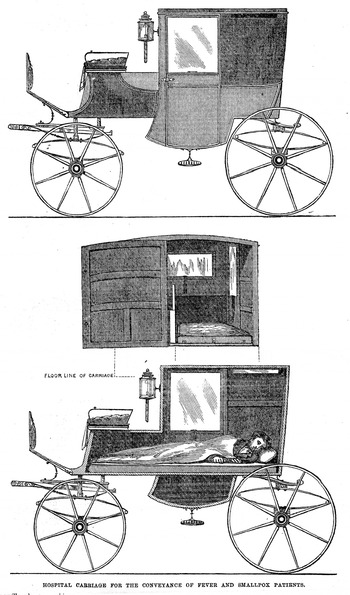
Voluntary action sought to augment laggard municipal provision of infectious-sick vehicles. The Hospitals Carriage Fund, a charity formed in 1864 during a London typhus fever epidemic, solicited donations and eventually placed seven purpose-built conveyances at various London hospitals as a means of eradicating those “fever dens on wheels” that masqueraded as ordinary coaches and omnibuses.Footnote 72 The innovative design was touted as comfortable for patients and, perhaps more important, as allowing for the carriage to pass for an ordinary brougham “so that when drawn up at the houses of even the wealthier classes, it may not attract attention as an undoubted fever conveyance” (fig. 3).Footnote 73 The British Medical Journal joyfully anticipated that these “fever ambulances” would render unnecessary “the use of street-cabs as pest-vehicles.” The Lancet likewise lauded that a “more practical piece of philanthropy has not often been attempted,” although it also warned that the “evil pointed out is so great, and the temptations to the use of the ubiquitous cab must be so universal in London,” that the legislature must necessarily supplement private actions.Footnote 74 This was manifestly true; the activities of
—Illustrated London News, 23 February 1867

the Hospitals Carriage Fund ceased after it had donated its ambulances (total sum £911 12s. 11d.), and its supposedly middle-class clients still had to pay the cost of horse hire (about double cab fare—not exactly an inducement not to hire a public coach). Just a few years later, while reporting another case of a smallpox patient found on an omnibus, the British Medical Journal stated that the fund's superior ambulances were very little used.Footnote 75
The number of parochial fever conveyances certainly increased after passage of the 1866 Sanitary Act, but their availability and quality remained anything but uniform. Some parishes and Poor Law Unions freely allowed any parishioner to use the parochial carriage; others charged a fee, while still others restricted its use to workhouse paupers. Predictably, the notorious parsimony of local politicians dictated that they seek out cheap and nearly unroadworthy vehicles (believed to eventually become so saturated with “diseased matter” as to warrant complete burning, anyway). Any old conveyance would do. Most were disused street cabs in which patients could not lie down, jostling the sick and aggravating their misery and mortality.Footnote 76 Some districts used the same vehicle for fever and smallpox patients or simply had a large van capable of holding several patients at once (both practices deemed unadvisable by public health officials). While ambulance nurses were almost unknown, friends or workhouse inmates were frequently encouraged to ride along (to control the patient as much as to offer moral support but also likely to return from hospital by rail or omnibus). A south London Poor Law Union was alleged to have carted smallpox patients in the same vehicle used to distribute out relief in the form of bread and wood to paupers. At least one parish contracted with an undertaker to provide a “hearse-like vehicle with the usual long-tailed horse” to collect hospital-bound patients—no doubt contributing to the generally unwanted association between internment and interment.Footnote 77 Moreover, and quite understandably, the parochial fever ambulance could not stand clear of the pauperizing stigma, a factor that (alongside similarities to the parish funeral cart) doubtlessly impeded its popularity. For any respectable person, “the very fact of their being contagious-disease conveyances would be enough to stamp them with a bad character.” In short, metropolitan local government shared a loose definition of “ambulance.” The prevalence of barely functioning flies, coaches, and carts commissioned to lug vulnerable patients compelled the Lancet in 1875 to condemn London's ambulance provision as “an utter farce.”Footnote 78
The easily imagined hazards of transporting infectious patients in these tumbledown vehicles were compounded by the predominantly coarse image of early ambulance drivers, who unhappily achieved an even lower reputation than the stereotypically malevolent cabbies. The Lancet typified the perception of these conductors of “sick freight” by sardonically remarking that “as the job is disagreeable or risky, it is necessary to fortify the spirits within by the exhibition of spirits from without.”Footnote 79 Indeed, one of the most pervasive rumors about ambulance men involved their inclination toward alcohol as a preferred and pleasant means of disinfection. The stereotype was aided by a remarkable consistency in reports: that drivers repaired to public houses after depositing patients or, as seems to have been more often the case, visited the bars en route to hospitals and on the return trip. Despite a general circular in 1871 from the government to metropolitan parishes deploring such rest stops, the Metropolitan Asylums Board continued to voice concerns over the inebriated state of ambulance attendants arriving at isolation hospitals. It documented one case in 1877 of a parish driver and attendant transporting a patient from Plumstead to the Stockwell Fever Hospital who stopped at least three times at public houses and arrived in a state of intoxication after ten hours for a journey that should not have taken more than two.Footnote 80 In another instance, a government inspector received complaints from the neighborhood of the Homerton Hospital that ambulance drivers were in the habit of parking in front of The Lamb and Flag pub on the High Street, leaving their vehicle windows open, where bystanders conversed with the patients and encouraged them with pints.Footnote 81 The sheer wealth and assortment of similar stories explain why pub crawling and drunken driving long formed the core lore of vehicles carrying infectious cargo.Footnote 82
Given the wide publicity afforded to dodgy patients and their infectious chariots, it is not surprising that ambulances also came under repeated scrutiny. Sentries posted at the isolation hospitals starting in 1871 reported that relatively few public cabs were arriving with patients. However, another problem presented itself: ambulances employed by the parishes often resembled cabs and gave the public the impression of a widespread contagious circulation.Footnote 83 In response, the Poor Law Board invited the local metropolitan authorities to clearly mark their vehicles with ambulance in “conspicuous letters” so as to display to the public the difference between ordinary cabs plying for hire and official conveyances for the dangerously sick. Other commentators reasoned that “conspicuously plain” signification would give fair warning and help deter reasonable persons from approaching the hazardous conveyance.Footnote 84 By and large, however, reaction to such proposals fell flat. The Hackney Guardians, for example, suggested that eye-catching identification “would probably spread fear throughout the district.”Footnote 85 This was confirmed by upper-middle-class residents near the Hampstead Hospital, who grumbled that a notorious vehicle with flaring red letters reading “Ambulance St. Mary Islington” caused “a shudder to nervous people.”Footnote 86 The Guardians of St. Savior, Lambeth, and Shoreditch Unions decided against giving too much publicity to their infectious vehicles by saddling them with identifiable markings. The last board replied (without irony) that “the remedy would be worse than the disease.”Footnote 87 At least some Londoners believed this to be almost literally true. A minister in Hackney complained that his neighbors were terrified by the “black death cart … constantly gliding through our streets. … One of my parishioners, a fine young fellow, … fainted with sudden alarm the sight of the ambulance caused, and … was himself removed in it smitten with smallpox the following day.”Footnote 88
This last point raises a host of questions about the place of early ambulances in the visual environment of the city. They were definitely received by at least a portion of the population as new emblems advertising the volatility of the diseases they supposedly contained. For instance, a private physician residing near the Hampstead Smallpox Hospital decried that “with their faces all scabby, [patients] would look out at the window of the ambulances sometimes; … many persons who had the small-pox attributed it to seeing those people.” He added pathetically, “If we had any friends from the country, we were forced to keep the blinds down, because the nuisance was so great.”Footnote 89 The Hampstead Vestry issued complaints to the several ambulance-operating boards of London, suggesting they take measures to avoid “the natural alarm of the public by the painful spectacle of persons suffering from Smallpox being visible whilst being conveyed in the ambulances to the Hospital.” Some vestrymen suggested the windows of the ambulances be made of ground or frosted glass instead of ordinary clear glass, adding that it would be valuable to the patients as well as the public. A few weeks later the vestry was pleased to report that frosted windows had been installed on most ambulances entering the area. Nevertheless, another member of the vestry complained that he had again spotted an ambulance with the patient inside plainly visible to bystanders: “Some young ladies saw it and appeared quite alarmed. It was a serious matter.”Footnote 90 A letter to the Hampstead and Highgate Express related the similar experience of a tradesman on the High Street: “ladies would run into my counting house, and remain there until the hearse had passed out of sight, and nursemaids would come-in with perambulators, stand there, and shudder for some time before they could go out.”Footnote 91 Given the fact that physicians of the day still devoted grave consideration to subjective states of the mind as “predisposing causes” in low fevers and other ailments normally considered contagious, the amount of attention in the popular press about the ability of this type of shock and horror to precipitate illness is not surprising.Footnote 92 For delicate bourgeois temperaments, especially among women, such “sickening sights” could communicate disorders as serious as the object of repulsion. While ambulances were still uncommon novelties, their public health impact remained entangled with the visual sphere, especially since the chilling sight of one could be construed as an infectious event. Perhaps more than anything else, this theme illustrates how the epidemiological environment was conceived as one interwoven with a classed and gendered visual environment.
Whereas the spectacle of the ambulance could spark panic and flight among respectable persons (such as in posh Hampstead), many also worried that the reverse would hold true among other populations: ambulances could attract dangerous crowds. Testimony from a variety of sources speaks of the morbid fascination aroused in whisking patients off to hospital—especially among street-playing children, some of whom apparently made a game of riding the outside of ambulances, peering through their windows, and counting the pocks on the patients’ faces.Footnote 93 Newspapers regularly circulated alarming stories about throngs of bystanders. For instance, the Islington Gazette printed a letter criticizing the typical scene surrounding the parish fever cart: only one man attended it, and while he entered the house to fetch the patient, a crowd promptly examined the vehicle and climbed upon it. The clerk to the Islington Board of Guardians admitted that “unfortunately, people run after the ambulance as if it were a raree show.”Footnote 94 This eventuality was more or less recognized by exasperated health officials. The medical officer for Bethnal Green (far from a “desirable” locale) observed that upon the arrival of an ambulance, “a mob of idle persons speedily collects, and the patient is frequently carried across the pavement between a double row of spectators.”Footnote 95 Not surprisingly, parishes were hesitant to foster fear or attention by emblazoning vehicles with signs of their use and thereby announcing to everyone the terrifying—or, perhaps worse, interesting—contents.
That ambulances could be seen as the mobile machines of reckless popular entertainment intersected with Victorian anxiety over the dangerous spectacularity of metropolitan streets. For many observers, the greater publicity of ambulatory patients provided opportunities for bystanders to inculcate unhealthy morbid interests. While curiosity and genuine concern for patients must have been present in many cases, the same activity was easily interpreted by some as gleeful indifference or sport. Whatever may have been the actual popular dynamics at the scene of patient removal, the idea that ambulances instantly converted bystanders into thrilled spectators owed something to middle-class apprehension of popular amusements, in which sensational penny papers, theater, and music hall attractions supposedly cultivated an unhealthy “lowering” taste for melodramatic formulas and shocking or obscene excitements.Footnote 96 The urban crowd had long figured not only as a trope for the dangerous collective disorder of the working class (containing its own potential for emotional infection) but also as a theme in the contested meaning of public space and activities.Footnote 97 An ambulance carnivalesque that engendered careless attitudes toward infection and an indifference to moral contamination (a viewpoint constantly expressed about the poor regardless of their state of amusement) elicited calls for vigorous policing of the scenes of patient removal. But it remained uncertain whether telling the crowd to move on, as the Westminster Vestry suggested in 1890, would not just heighten attention to the dangerous spectacle.Footnote 98
Infectious ambulances inspired suspicion and hostility in some neighborhoods, terror and flight in others, but curiosity in practically all. The difference separating these reactions was framed in classed and gendered terms that reflect the metropolitan geography and performance of respectability. This ordering of the attention and amusement hierarchy, however, had to be constantly reestablished and confirmed.Footnote 99 In one infamous incident of ambulance spectacle, a Hampstead lady (wife of the Ruskinian artist Alfred D. Fripp) supposedly caught smallpox after examining an empty parish ambulance that waited outside a pub adjacent to the smallpox hospital—an event that educed the usual commentaries about feminine irresponsibility and the dangers of middle-class women's unaccompanied movement in the city. The Times concluded derisively that Mrs. Fripp “had been induced by the love of knowledge so often displayed by her sex to go and peep into an ambulance as it stood in the road.” For her part, she maintained (or, rather, her husband testified for her) that she had “inadvertently” looked into the carriage while passing along. Foolish nosiness perhaps, Hampstead residents admitted, but certainly no exhilaration here.Footnote 100 For commentators in upscale Hampstead, the ambulance was both an obstacle to the free optical enjoyment of the neighborhood and also an intruding object luring respectable women toward corruption and sickness. In another case, a strolling “gentleman” presumably caught smallpox as he passed along the road in front of the Stockwell Smallpox Hospital and politely paused to look into an ambulance waiting to pass through the hospital gates. Even more explicit here, the man is represented as disinterested, individualized, not partaking in an amusing spectacle but rather blandly enjoying the optical prerogative of the bourgeois stroller.Footnote 101 In the story's telling, it is as if the ambulance intercepted the man and compelled his fateful glance. Whether Londoners were drawn to ambulances or repelled by them was often refracted as a measure of social rank. Among middle-class commentators, one can quickly detect a tension around the “attraction of repulsion”—a dominant narrative mode for nineteenth-century sanitary investigations and narratives about the steamy London underworld.Footnote 102
Not surprisingly, the most common local reactions to isolation hospitals were overwhelmingly hostile and often centered on fears of unrestricted movement. Nearby residents worried that collecting the sick in central depots would not only assemble infected cabs in their midst but also clog their streets with morally degrading, disease-spreading, property-depressing ambulances: “The transit of patients was in itself a source of contagion anywhere and everywhere, but all the evils were centralised at the hospitals themselves.” Instead, some proposed, patients of all classes should be confined to their own homes, and thereby the “evils of transit would be minimised, and there would be less parade of the disease in the streets.”Footnote 103 Aggregation of the infected required their dispersal; mass hospitalization virtually assured exposure in transit. To be clear, returning to the medieval practice of “shutting up” houses was not a serious option at this point, but frustrated citizens at their extremity nonetheless suggested a public health model of inhibiting infected movement that owed its inspiration to another era. At the very least, it was an impractical prayer for everyone to imitate the luxury of middle-class London: when stricken with infectious illness, stay at home until recovered or dead.
The public turmoil over infectious hospitals and ambulances eventually reached a climax in 1881, when a Royal Commission was convened to inquire into metropolitan fever and smallpox isolation. Surprisingly, the commission concluded that smallpox hospitals constituted a measurable danger to nearby residents; they also found ambulances to be a likely source of the mischief, given the lengthy testimony they received regarding the generally “slovenly and ignorant modes of transport” adopted by the London parishes.Footnote 104 All of this simply confirmed what hospital neighbors had said for years, but with official recognition, now even some district medical officers started to openly condemn street ambulances as “moving hospitals, freely distributing small-pox infection.”Footnote 105 This approach was no doubt aided by the fact that public health officials found it preferable to blame errant ambulances rather than indict the whole system of isolation hospitals. In any case, over the next few years the Metropolitan Asylums Board quietly removed its smallpox hospitals to a new location on the banks of the Thames eighteen miles downstream from London and inaugurated a unique river ambulance service. Smallpox at least (that most visually terrifying of diseases) would be remapped onto routes that avoided the spectacle-laden, mobile density of the urban core.
London's first public ambulances clearly generated as much anxiety as infected cabs and omnibuses and to a degree that would not be solved by the relocation of hospitals. A new opportunity to craft a revised image for the epidemic reputation of London transport came with the Poor Law Act of 1879, which permitted the Metropolitan Asylums Board to centralize metropolitan ambulance operations under its auspices. By the mid 1880s this service had nearly supplanted the local boards’ responsibilities for getting patients to isolation hospitals and by 1890 was regularly carrying up to 15,000 patients and logging over a quarter of a million miles per year.Footnote 106 It was certainly one of the largest municipal fleets in the world and represents the first large-scale civilian ambulance service anywhere. This next era in London ambulances carefully institutionalized the priorities of managing infectious visibility and mobility: making ambulances highly traceable and predictable but publicly discreet. Swift response and calculated mobility were the MAB's touted innovations: within five minutes after an order was received at headquarters, a call would be placed via telephone to an ambulance station, and a uniformed crew including special nurses would be dispatched to retrieve its patient. The martial hierarchy of the whole operation allowed officials to record the comings and goings of ambulances down to the minute (all dutifully logged into huge record books) and create the distinct impression of regulating the circulation of contagious matter. Under the MAB's supervision, London ambulances would strive to counteract the anonymity and impunity that hospital-bound patients had enjoyed among the cabs, omnibuses, and poorly managed parish fever carts. In contrast to those borrowed and ad hoc devices, the MAB employed the latest communication technologies and purpose-built gadgetry to make the ambulance a truly specialized service. The “patent safety fever van,” for example, made obeisance to public anxieties by featuring ventilation shafts treated with “germicide solution.”Footnote 107
The MAB's generation of ambulances prioritized the principles of speed, efficiency, safety, and discipline, but placed these in the service of the preeminent need to maintain a deliberately low profile. Recognizing that its activities were “of necessity as stealthy as those of the Fire Brigade are sensationally dramatic,” the ambulance service deployed numerous technologies to police the minute elements of visibility.Footnote 108 Carriages were evidently marked but not overtly conspicuous; a few resembled ordinary broughams and could be sent to “good” neighborhoods without much objection, while others were equipped with one-way glass to prevent the public from viewing patients.Footnote 109 A range of similar interventions in street-level views supported the underlying goal of managing a latent spectacularity. The number of ambulances multiplied, but with an emphasis on rapid response and limited exposure to the public gaze, they apparently became less noticeable. It was remarked at the turn of the century that the modern ambulances of the MAB contained no resemblance to “the gloomy-looking death-traps” recalled by those old enough to remember the defunct parish conveyances. In place of the infectious pageants of the 1860s and 1870s, the consolidated ambulance system operated as the near-covert machinery of public health, more likely to be described as an integral adjunct to the MAB's “great system of municipal watchfulness.”Footnote 110 The reigning conceptual model became “seeing without being seen,” effectively orienting away from a disruptive exhibitionism toward a closed regime of surveillance. Perhaps one medical commentator was correct in predicting in 1867 that “the feeling in the public mind with regard to contagion would wear off as people became accustomed to seeing ambulances in use.” Or maybe the now-infrequent sighting of the infectious ambulance yet preserved a muted pang in community consciousness, as demonstrated in the neighborly interwar dialogue overheard by an ambulance nurse during a “run” to an East End address: “Oh, Lor, Liza, here's a fever cart. ’Old yer nose and spit.”Footnote 111
The fear of itinerant infection in cabs and omnibuses largely faded toward the end of the century, in no small measure owing to changing impressions of urban circulation. Although it is of course impossible to adequately assess the validity of such phobias in the first place, the likelihood of catching a disease through riding in hired vehicles was almost certainly overstressed. But this is beside the point; conjecture about “fever dens on wheels” is most valuable for what it reveals about this crucial period in urban perception. Discourse of vehicular contamination marks out an era of transition in the metropolis's culture of mobility, where unease about admixture of commuters merged with perennial worries about the leveling of established hierarchies. These were joined by new qualms about a diminished sense of fixity that accompanied the collapse of distances. As with most other aspects of public health reform, this was a topic thoroughly saturated by middle-class anxieties regarding the fragility of those culturally important behaviors of social distancing. The gravity with which some Londoners regarded the threat of mobile infection underscores their struggles to remap the relationship between increasingly itinerant bodies and socially promiscuous spaces. Though the ambulance proved itself an initially problematic device for regulating movement, this material technology of urban governance was eventually successful in shifting the discussion of urban bodily hazards from one dominated by dangerousness to one primarily involving calculable risk.Footnote 112 By the end of the century, the public health hazards of urban movement were subjugated under the dual objectives of the healthy subject's free circulation and contamination's rigid containment. For most commentators, the manageability of the vehicular realm replaced its ephemeral randomness.
The appearance of ambulances—literally, the most tangible visualization of these earlier anxieties—must also be judged against an evolving urban visual culture that promoted a popular drama of concealment, detection, and exhibition. The relentlessly reconstituting fabric of the Victorian metropolis had blurred the publicly understood cipher of moral and physical transgression. Confident identification of threats was lost amid the proliferation of anecdotes, urban legends, partial sightings, and scenes that both compelled and repelled observation. Still, London's respectable classes were torturously conflicted about the deployment of new devices of containment like ambulances—worried especially about making visible the normally invisible circulation of corruption. In this environment, just as the contamination of transport presented new challenges for the material management of sights and circulation, ambulances served to demonstrate the uncomfortable contradictions of the metropolis's cultural landscape of vision and mobility. Kate Flint instructively reminds us that the fascination within Victorian visual culture for sight and legibility also implies a problematization of the visual, wherein “imaginative conjecture” demonstrates that “the unseen may be more powerful than the seen.”Footnote 113 While it served to help clarify the murky representational realm of cabs and omnibuses, the ambulance was instrumental in generating new debates about the all-too-easy “sighting” of contamination—its disconcerting propensity for “imaging the unseen.”Footnote 114 London ambulances could cease to generate significant controversy on the late Victorian urban landscape only once they had been fairly removed from the practically concomitant tension between spectacle, mobility, and contamination.