It was the view of the sixteenth-century reformers that the Church was in need of a return to its ancient traditions and customs.Footnote 1 For Jean Calvin, leader of the Genevan reforms from 1541 to 1564, this meant regulating services of divine worship in such a way that scriptural texts in the vernacular should prevail, rather than, for example, the Latin text of the Roman Mass, or devotion to the saints, both of which he regarded to be idolatrous worship spoken in a tongue understood only by a privileged few. From the outset of his activities as theologian and reformer, Calvin took a special interest in the Psalms of David. This led eventually to the publication in 1562 of all 150 psalms, set to melodies and translated into French metre by Clément Marot and Théodore de Bèze, which came to be popularly known as the Genevan or Huguenot Psalter.Footnote 2 Each psalm was divided into stanzas of equal length which could then be sung to the same melody (much like a modern-day congregational hymn). The Genevan Psalter took over twenty years to reach its complete form, having undergone many revisions along the way.
In the preface to his Commentary on the Psalms (1557–58), Calvin explains his preference of the psalms over the rest of the Bible:
The other scriptures contain the commands which God enjoined his servants to bear to us. But here [in the psalms] prophets themselves conversing with God, because they lay bare all their inmost thoughts, invite or hale every one of us to examine himself in particular, lest aught of the many infirmities to which we are liable, or of the many vices with which we are beset should remain undetected.Footnote 3
The psalms are, in other words, perfect examples of how Christians should speak with God. Two of the main charges against the Roman Church at this time were that the faithful understood nothing of godly praise if it was sung or spoken unintelligibly (i.e. in Latin and often below an audible level for much of the congregation),Footnote 4 and that they had been misled into believing that the Church and clergy were the only mediums through which they could have spiritual contact with God. It was therefore essential for Calvin, as a reformer, to provide examples of the true and correct nature of prayer from within the Scriptures themselves. Of the psalms, he declared that ‘nowhere is the method of praising God delivered more fully, or are we stimulated more powerfully to render to him this office of godliness’.Footnote 5 The psalms were also seen by Calvin as a true reflection of human nature. For this reason, he refers to the Book of Psalms as ‘“The Anatomy of all the parts of the soul”, for not an affection will anyone find in himself, an image of which is not reflected in this mirror’.Footnote 6 Furthermore, the practice of singing psalms had existed in the early Church, and Calvin sought to emulate the liturgical practices of early Christendom. In short, their engaging, unifying potential made them suited to act as a ‘vehicle’ for Christian worship.Footnote 7 Everyone – not just the clergy and choir (as was the medieval custom) – should participate in divine worship, a purpose best served by scriptural texts of the Psalter.
Calvin was evidently proactive with regard to his love of the psalms. Barbara Pitkin notes that, during his time as a senior minister at the cathedral, Calvin usually preached on the Old Testament during the week and on the New Testament on Sundays, but occasionally devoted his Sunday afternoon sermon to the psalms. This, she says, demonstrates the high theological value that he attributed to them.Footnote 8 Calvin also gave regular lectures on the psalms between 1552 and 1556. Moreover, the psalms were a topic of discussion between 1555 and 1559 during the weekly Congrégations, discussion groups of the Scriptures for ministers and others.Footnote 9
Calvin's views on the psalms are concordant with fifteenth- and sixteenth-century images of David. The biblical figure had long been imitated by kings – especially those of France – who admired his qualities as a warrior and a musician, as well as providing an exemplary model of worship: the psalms.Footnote 10 He is often portrayed in Renaissance paintings singing and playing his harp, in order, it is said, to ward off evil spirits that were visiting Saul (1 Samuel: 16:14–19:10).Footnote 11 The notion of praising God through song was evidently close to Calvin's heart, and the depiction of David as a king and as a fighter evidently made him a suitable role model for later generations of Huguenots. David reflected their desire for freedom and for an end to the discrimination they experienced at the hands of French regimes. He also features prominently in ‘Calvinist’ musical drama, anti-papal tales with plots based on Bible stories that appeared in Geneva during and following the Reformation. One such example is Joachim de Coignac's La desconfiture de Goliath (1551), which sees a ‘Catholic’ Goliath defeated by a ‘Protestant’ David.Footnote 12 Edward Gosselin has observed that the ‘appreciative glances’ given to David as a historical and biblical figure by the reformers is unsurprising, given their perception of the Church having undergone a decline and then rebirth.Footnote 13
A comparison with Ulrich Zwingli and Martin Luther, the two other major Protestant reformers, leads to a better understanding of the reason behind Calvin's decision for a musical setting of the psalms as unaccompanied unison melodies for use in the new reformed liturgy. Notably, none of these reformers, Calvin included, specifically condemned music; on the contrary, each viewed it, in his own way, as a manifestation of God's kindness towards men.Footnote 14 It is well known that Zwingli, albeit a musician himself, found music wholly unsuitable for the Church, however, and banned it from worship. His eventual successor in the Swiss Reformed Church, Calvin, who was considerably less of a musician than Zwingli, favoured it under certain conditions. According to Paul-André Gaillard, Zwingli's thinking rested on two biblical passages in particular: Matthew 6:1–13 advises inward, private prayer, as opposed to the hypocrites who like to be seen to pray; Colossians 3:16,Footnote 15 in Zwingli's reading, signifies that praise should be sung with gratitude, but strictly inwardly.Footnote 16 That is, despite the mentions of singing, playing and praising, Zwingli took the phrase ‘in your hearts’ as an instruction to praise God in silence. Walter Blankenberg has also suggested that Zwingli intended to reintroduce music into worship at a later point, after the Reformation had been better established, and after the congregational song had been ‘tested’ in other parts of Europe,Footnote 17 for example in Strasbourg.Footnote 18 If he did wish to introduce music at a later point, his initial banning of all liturgical music was possibly just another way to distance the Church in Zurich from practices associated with the Church of Rome.
On the other hand, to Luther, the texts of St Paul (specifically 1 Corinthians 14 and, again, Colossians 3:16) were indicative of the need for music in church. The first of these texts makes references both to musical instruments and to intelligibility of speech. The second of these texts, interpreted by Zwingli to be a reference to inward prayer, was to Luther but another indication that praises should be sung (outwardly) to God.Footnote 19
Gaillard traces the differences behind the three reformers back to the seminal understanding of a key word: the Greek term πνε µα (or, in Latin, spiritus) was interpreted by both Luther and Zwingli as Geist (spirit), whereas Calvin consistently took it to possess a more physical meaning, therefore rendering it in French as either voix (voice) or bouche (mouth).Footnote 20 This translation immediately links it to notions of song, as well as speech. A reading of Calvin's writings on music with this in mind provides us with valuable insights. For example, he mentions the words bouche and voix several times in his preface to the psalms. The preface is, among other things, a justification for the use of the vernacular, but one gains a sense that the reformer is alluding to vernacular song as well as speech in his writing (and understandably so,
since the psalms of David were texts intended to be sung), even when it is not expressly mentioned. Of consecration conducted in the Latin rite, he writes: ‘quand on a soufflé & prononcé de bouche les parolles, que les creatures insensibles en sentent la vertu; encore que les hommes n’y entendent rien'Footnote 21 (‘when these words have been breathed and pronounced from the mouth [in Latin], insensitive creatures feel its virtue even when men understand nothing of it’). As Calvin diagnoses the muttering of unintelligible words as the root of magical superstition, he maintains that a genuine consecration occurs only when the ceremony can be understood by the people.Footnote 22 In the same way, scripture and prayers are of use only insofar as they are from the heart (not just the lips)Footnote 23 and as they can be understood both by those listening and by those speaking. Further on in the preface, Calvin writes, ‘Et mesmes sainct Paul ne parle pas seulement de prier de bouche, mais aussi de chanter’ (‘And even Saint Paul speaks not only of praying from the mouth, but also of singing’).Footnote 24 In Calvin's interpretation of St Paul, which recognises prayer from the mouth as well as prayer from song, bouche and voix are not interchangeable; accordingly, bouche refers solely to speech, isolated from song. This separation is supported in Calvin's acknowledgement of two sorts of public prayer: ‘Les unes se font par simple parolle: les aultres auecque chant’Footnote 25 (‘One sort is made through speech, the other with song’).Footnote 26
In any case, the fact remains that Calvin saw fit, through the example of the Scriptures, to use music as a means of improving prayer and worship. Calvin recognised that congregations needed to be encouraged in their religion, something that David himself had demonstrated by reminding his people of their faith through the use of music. In the New Testament, Jesus sang with his disciples,Footnote 27 and the angels sang of the glory of God.Footnote 28 Above all, as the psalms were themselves written as songs, they contain numerous references to singing and music-making.
In the process of compiling the Psalter, Calvin was not willing to let the responsibility of making all aesthetic decisions fall to someone else. He insisted that the translations of the psalms be clear, comprehensible and, above all, faithful to the Hebrew originals. Recognising the immense power of music ‘to move and enflame the hearts of men’ (‘d’esmouvoir et enflamber le coeur des hommes'),Footnote 29 Calvin spoke of the need to be ‘diligent’ in regulating music, so that it be useful rather than pernicious.Footnote 30 This involved the use of music that would not distract attention from the words. Unison melodies, he felt, were most suitable and were therefore put to use in this context. In Calvin's view, the musical practices of the Roman Church, being corrupted, complicated and over-ornamented, fell foul of all these requirements: ‘the songs and melodies that are composed only for the pleasure of the ear, as are all the fringots [jolly tunes] and fredons [sounds of string instruments] of Papism, and all that they call broken music [measured music] and such things, and songs in four parts, do not in the least suit the majesty of the Church, and can only greatly displease God’.Footnote 31
In his restoration of ‘true’ church music, Calvin did not opt simply for the setting of vernacular texts to existing plainchant melodies. Instead, the practice in Geneva (as in Strasbourg and elsewhere) gave preference to melodies that could be taught, memorised and sung with ease. To aid this process, the melodies were almost always written in a one-syllable-per-note fashion. People were encouraged also to sing the psalms while going about their day-to-day activities,Footnote 32 not just to reserve their use for church services.
The use of musical instruments in worship was clearly out of the question, so as not to cause a distraction from the meaning of the texts. The numerous biblical references to instrumental music-making were readily explained away by the allegation that the Jews, in their undeveloped spiritual state, required an external stimulus to prompt their devotion.Footnote 33 In a sermon, Calvin complained: ‘As today in the Papist churches the organs play on one side, four-part singing occurs on the other, there will be such banter [badinages] that the people will be delighted, but will have gained nothing.’Footnote 34 The organs of Geneva had mostly been demolished in 1535, although that of the cathedral of St Pierre survived until 1562, when the Council decided to melt its metal pipes, giving one portion to the hospital and selling the remainder.Footnote 35
In the light of all these radical policies, it is worth pointing out that Calvin did not wish to ban instrumental music and part singing altogether. Musical instruments could be rejected because they had no other immediate use than that of producing pleasure. Calvin did not believe that pleasure as such was reprehensible, but was clear that it had no place in church.Footnote 36 Nevertheless, the melodies of the Psalter came to be arranged in four-part harmony, and instruments were in use in Genevan secular life.Footnote 37 Calvin's views are further clarified by the distinction he made between ‘la musique sacrée’ and ‘la musique profane’.Footnote 38
To summarise so far, then, Calvin appears to be a church leader who had a clear vision of a form of sung worship employing unison, a cappella melodies, to which the words of the psalms of David should be sung, most importantly, in the vernacular. Combining the importance of the psalms as a form of prayer with the power of music, he aimed to enhance prayer and move the Reformed congregations. According to Joel Beeke, the melodies of the Genevan Psalter reflect Calvin's view that text should be prioritised over music, while acknowledging that the psalms should be set to music. Such music, in Calvin's words, should be ‘modest’, and have ‘weight and majesty’,Footnote 39 and be used in such a way that helps the congregation understand the Word of God.Footnote 40
While Calvin's reform ideas were clear-cut,Footnote 41 their implementation turned out to be much less straightforward. The Mass had been abolished by the Genevans in 1536, along with the Gregorian chant sung by the choir in St Pierre cathedral.Footnote 42 On 16 January 1537, Calvin, together with Guillaume Farel, the leader of the Genevan Church at the time, presented the city council of Geneva with a proposal for the introduction of sung psalms into the service (see the Appendix). It recommended that ‘some children … sing loudly and distinctly, the people listening with full attention and following with the heart what is sung with the mouth, until little by little everyone becomes accustomed to singing together’.Footnote 43 Soon afterwards, however, owing to various disagreements with the city council, Calvin was expelled from the city,Footnote 44 making it impossible for him to implement his plans for psalm-singing. In 1538 he arrived in Strasbourg, where he was welcomed by Martin Bucer, church leader in Strasbourg. Soon Calvin became the pastor of the French refugee community in the city. It was in Strasbourg that he encountered the local tradition of singing the psalms in the vernacular, which Bucer and his colleagues had been developing since 1524.Footnote 45 Gérard Roussel, a canon of Meaux, wrote to the Bishop of Meaux in 1525, describing the habit of psalm-singing in Strasbourg:
From five o'clock in the morning, preaching takes place in the different churches of the city, and communal prayers are said. At seven o'clock, the same happens; at eight o'clock there is a sermon in the cathedral, accompanied by the singing of the psalms in the vernacular; the singing of the women mixing with that of the men produces a beautiful effect.Footnote 46
As this statement makes evident, vernacular psalm-singing was by no means a new concept at the time of Calvin's arrival in Strasbourg, a city which provided, as Stanford Reid put it, a ‘favourable atmosphere’ for Calvin's pursuit of French-language Psalms.Footnote 47 Considering that the first French-language psalter was published there in 1539,Footnote 48 one can hardly doubt Calvin's enthusiasm. The volume contained eighteen of the psalms, the Nunc Dimittis, the Ten Commandments and the Credo, all of which were set to music. Most of the psalms selected for this editionFootnote 49 carry either a message of resistance, deliverance or salvation – themes that struck a chord with French Protestants at this time. Some of the translations were by Calvin himself, others by Marot.
Upon the election of a new council in Geneva one year later, Calvin was promptly asked to assume the role of church leader there. After the exchange of many letters between the Strasbourg reformers and the Genevan council, Calvin returned to Geneva in 1541 on condition that he would be given absolute power over ecclesiastical matters. After the Ordonnances Ecclésiastiques, based on Calvin's Articles, had been approved by the council,Footnote 50 he immediately created a consistory of five pastors, three coadjutors and twelve elders, and appointed himself as president for life. The consistory had control over both public and private aspects of people's lives in Geneva. They even appointed inspectors to interrogate each family and to report suspicious behaviour.Footnote 51 From this position of ecclesiastical sovereignty, Calvin at last had the chance to introduce metrical psalms into the liturgy.
Among the earliest steps towards this goal was the provision of musical education for the children of the city. As in Strasbourg, music became an important part of the Genevan school curriculum, with music lessons occurring four times per week, specifically in order to familiarise the children with the psalm melodies.Footnote 52 The Registres du Conseil of 17 June 1541 authorised Guillaume Franc to run a music school in Geneva.Footnote 53 He was the first of about ten cantors (chantres) of the church during Calvin's reign. The role of the cantor is difficult to define in detail, although it seems clear that one of the post-holder's primary responsibilities consisted of teaching the psalm melodies to the children of Geneva, who would lead the congregational singing in church. Some cantors also taught privately, such as Pierre Dubuisson, who asked the council for a building so that he might have ‘better means of teaching many of the little children in his care’ (‘meilleur moien de enseigner beaucoup de petits enfants qu’il a en charge').Footnote 54 Some cantors evidently played a much larger role than others in the musical life of the city and the church. Many were responsible for overseeing various editions of the Psalter. Some, such as Louis Bourgeois and Pierre Vallette, made concerted efforts to improve singing by making musical notation more accessible to members of the congregation. It seems that the cantor also played a visible role in the church itself, helping with the organisation of the service. Cantors were known to sing (entonner) at the churches: Antoine Linotte, for example, was said to sing at St Pierre during the ‘illness’ of Guillaume de la Moeulle.Footnote 55 In May 1546 a table of psalms, drawn up by Bourgeois and the clergy, was attached to the door of the churches. One may conclude from this that Bourgeois worked closely with the preachers under the aegis of Calvin.Footnote 56 Crucially, Bourgeois was the only cantor to have made any real impact on church music of our own time. His name appears numerous times in modern French Protestant hymn booksFootnote 57 as well as in Anglican hymnals, such as the New English Hymnal, in which he is recognised as having ‘contributed’, ‘supplied’, ‘adapted’ and composed melodies for various editions of the Genevan Psalter and in which six different melodies are assigned to his name.Footnote 58 Fétis recognised Bourgeois's music manual Le Droict Chemin de Musique Footnote 59 as the first treatise to advocate the abandonment of the widely used Guidonian hand in musical education.Footnote 60
While the Genevan psalms had their base within the liturgy, their influence reached into the lives of people outside the church. Calvin left no doubt in the preface to the Psalter that he was not averse to music-making in the everyday lives of his people:Footnote 61 ‘the use of singing extends further. Even in houses and in fields it incites us, like an organ to praise God and to lift up our hearts to him’.Footnote 62 It should not be a surprise then, that the music of Joachim de Coignac's play, La desconfiture de Goliath, is very similar to that of the psalms and ‘could hardly be simpler or more symmetrical’.Footnote 63 In reference to one melody, Frank Dobbins suggests that, like many of those adapted for the Genevan Psalter, it may have been rhythmically adapted from an existing tune.Footnote 64 What is more, a number of plays were published in Geneva with music by those who also composed the melodies to the Genevan psalms.Footnote 65 This implies that the music for many such plays was surely composed and adapted by some of the local cantors. The Genevan cantor therefore appears to have been a musician of the city as much as of the church: a music editor, arranger and composer, a church musician, a town musician, a music tutor and a schoolmaster.
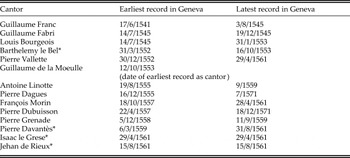
For want of historical information on the lives and work of Genevan cantors, an accurate definition of their professional status seems unobtainable. Each is likely to have viewed their role in a slightly different way, and not all of them would have been as engaged in their work as others. There were times when several cantors were working in Geneva simultaneously (see Table 1). Critically, not all of these roles would have been subsumed under the title of ‘chantre’, since some duties were assigned when the council decided to delegate them. The benefits received by the cantor were certainly not fixed, and the council records give numerous examples of requests for pay rises, accommodation and other benefits, not all of which were granted. Two intriguing examples are provided by Pierre Dagues, who was refused a pay rise on the grounds of poor teaching,Footnote 66 and Guillaume Franc, who was provided with a small cellar in which to store his wine.Footnote 67
As a general observation within ecclesiastical history, we may note that the cantor's function in Geneva appears to have been much more wide-ranging than that of their counterparts in the Roman Church and certainly much more music-based than in Jewish and early Christian traditions.Footnote 68 On the whole, it is clear that without the Genevan cantor, Calvin's vision of congregational psalm-singing might never have been realised. Conversely, the role of cantor might not have survived the Reformation in Geneva had it not been for Calvin's insistence on maintaining music's role in the liturgy.
The Genevan cantors, with information taken from Pidoux, Psautier Huguenot, 2: 171–5 (intended to give a rough indication of which musicians were active in the city at any particular time; NB: these musicians were not necessarily employed as cantors for the whole period shown)

* Pidoux isolates these musicians, noting that they are sometimes assumed to be cantors, although there is no evidence to show that they were officially employed as cantors in Geneva.
There is no precise knowledge surrounding the population of Geneva during and after the Reformation, owing to the incomplete and inconsistently kept immigration records. It is conservatively estimated that over 25,000 people were living in Geneva by 1560, compared to between 12,000 and 13,000 in 1550.Footnote 69 Men outnumbered women between 1550 and 1580.Footnote 70 At the same time, the number of major parishes in the city was reduced from seven to three (St Pierre, St Gervais and La Madeleine). Additionally, Franc was employed as cantor at St Michel in 1542,Footnote 71 and the parish of St Germain was periodically active between 1557 and 1570. Two foreign refugee churches also existed: the English (1550–60) and the Italian (1554 until the nineteenth century).Footnote 72 A hospital chapel is confirmed by records relating to the cantors.Footnote 73
Genevan authorities enforced church attendance among their citizens. Psalm-singing occurred in all the parishes, during the Sunday morning and afternoon services as well as on Wednesdays. To begin with, one psalm was sung per service, but this had increased to three by 1562.Footnote 74 Considering the circumstances in which psalm-singing took place, it is not surprising that the congregations had difficulty adapting to this new practice. The religious and musical leaders of the city were faced with the task of persuading vast numbers of ordinary people to participate in the liturgy, singing what were often unfamiliar tunes, unaccompanied.
Moreover, it is far from clear what form such performances would have taken. If the cantor, directing the children, began the singing, the rest of the congregation would have joined in gradually. It is hard to see how the children would have been able to lead the singing otherwise. It is not documented where the children would have sung from; it is unlikely that they would have been separated from the rest of the congregation, as the pre-Reformation choir would have been, given the Reformed Church's general attitude towards the separation of choir and clergy.Footnote 75 Furthermore, it is doubtful that several hundred adults would sing at a dynamic level which would also allow them to hear (and imitate) the singing of the children: adult voices in such large numbers would have drowned out the less powerful voices of the children. Furthermore, without an organ accompanimentFootnote 76 to provide a framework for pitch or rhythm, untrained musicians must have found it difficult to keep time.Footnote 77
The evidence for the existence of problems comes in the form of various contemporary commentaries. Although there is no description of psalm-singing in Geneva during the Reformation, the singing of the Huguenots in Paris during the 1560s has been documented. One Catholic complained that the singing was ‘music without music [which was] not only ridiculous, but unpleasant and almost brutal, without law, without order, without harmony. … The disorder in this psalm-singing was such that one verse would be sung at one end of the church while another verse would be sung at the other’.Footnote 78
While this account by a spirited critic of Calvinism is no doubt exaggerated, the fact that psalm-singing is ridiculed in such a way nonetheless suggests that it was a problematic aspect of Huguenot church practice. It seems that people were not always as willing to learn or sing the psalms as has often been thought. Nor was the problem confined to Paris. In the 1551 edition of the Genevan Psalter, Louis Bourgeois requested that those members of the congregation ‘who understand nothing in music and who nevertheless wish to be heard above all others … be content to listen to the others and learn in silence, until they can sing in tune with those who sing well’.Footnote 79 Presuming Geneva had followed Strasbourg's example of mixed-voice singing, lay women would have been using their voices in church for the first time. Not only were the congregations in the early years of the Reformation largely unacquainted with the idea of singing in church, many of the melodies themselves were unfamiliar.Footnote 80 These factors were especially critical each time a new edition of the Psalter was published (at least twenty-seven different editions appeared in Geneva alone, between 1542 and 1561Footnote 81), containing new melodies that were included either to replace older melodies or for use with newly translated psalms by Marot or Bèze.Footnote 82
Furthermore, Martin Luther's own congregation in Wittenberg was equally, if not more, resistant to the idea of singing communally, despite having a designated choir of boys present in church to teach them the melodies.Footnote 83 At the end of an Advent sermon given in 1526, Luther complained to his congregation:
The songs have been composed and are sung for your sake so that you can sing them here and at home, but you sit here like blocks of wood. Therefore I beg you, learn these songs from the children and sing them yourselves at the same time, as Paul teaches [in Ephesians 5:18–19].Footnote 84
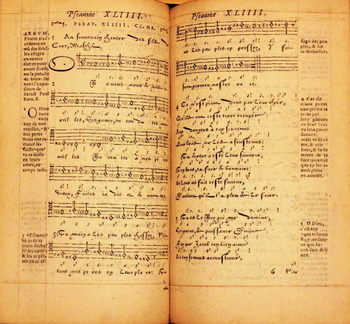
Louis Bourgeois's complaint about the ignorant singing too loudly highlights widespread musical illiteracy among the congregation. Referring back to the second paragraph of the extract of the Articles, the question is raised as to whether Calvin intended the Psalter melodies to be read by the majority, or whether his original idea was that they be memorised by the people, through careful attention to the singing of the children. The fact that people were reading (or at least attempting to read) the printed melodies, though, is confirmed by the writings of Bourgeois and two other Genevan musicians of the period – Pierre Vallette and Pierre Davantès. Vallette is believed to be the first to have introduced solmisation into the Genevan psalm melodies, in 1556,Footnote 85 helping people to read the melodies by printing note names next to the notes themselves. He acknowledged that many people gave up learning to sing the psalms because of the sheer duration it took to learn to read musical notation. With his new teaching technique, Vallete promised, new melodies could be learnt within weeks rather than months.Footnote 86 Davantès, while retaining traditional solmisation, went one stage further by introducing a whole new system of musical notation. It consisted of a set of symbols representing musical notes and rests that were placed underneath the words of each stanza of the psalm. This approach intended to remove the obstacles congregations encountered in remembering the melody, when singing the later stanzas of the psalm that were not printed with music (see Fig. 1).
(colour online) Psalm 46 from Pierre Davantès's Pseaumes de David (Geneva: 1560), BL classmark K.8.a.15. Solmisation syllables are placed next to the notes in the score and Davantès's complex system of letters, numbers, lines and dots (under every syllable of text) was supposed to enable the music-illiterate to sing along to all stanzas. Image reproduced with the permission of the British Library Board. All rights reserved.

By discussing congregational singing merely in terms of musical quality, one is at risk of missing the point of psalm-singing. The fact that many churches today strive for a high quality of music-making (congregational and otherwise), does not necessarily imply that this also formed the driving principle in the sixteenth century. For Calvin, at the very least, a more important issue was at stake: ‘we know by experience that song has great force and vigour to move and enflame the hearts of men, to invoke and praise God with a more vehement and ardent zeal’.Footnote 87 Nowhere in this phrase, or in Calvin's other writings on music, does he refer to the quality of musical performance. And while Calvin (in spite of his frequent portrayal as a veritable enemy of music and of the arts)Footnote 88 was evidently very committed to music, it is equally clear from his frequent stipulation of text intelligibility that music was secondary to the text.Footnote 89 Quintessentially for Calvin, it was the action of singing that moved the hearts of men to true religion and improved prayer beyond the merely spoken word. Moreover, the unifying power of communal singing was deemed sufficient to provide each member of the congregation with a spiritual experience and significance. One might compare this with some nineteenth-century performances of Handel's Messiah and other oratorios, in which several thousand people would attempt to sing choruses originally intended for much smaller numbers of participants. The success of these events could not have been based on the quality of the music, but rather on the idea of hearing, seeing or indeed participating in a performance of such works. In other words, a more significant power was in place. As Charles Garside has commented, Calvin's ‘point of view was never that of the aesthetician; it was, to the contrary, always that of the theologian’.Footnote 90
If the issue of quality of performance is absent from Calvin's writings, one might ask why Bourgeois, Vallette and Davantès felt it at all necessary to ask or encourage congregations to improve their singing. Were such tasks carried out with the intention of improving the religious experience of those who found singing exasperating, or were they attempts by frustrated musicians to gain some satisfaction from hearing the psalms being sung? Both are possibilities: Davantès, in his preface to his 1560 edition of the Psalter, writes: ‘Those who learn to sing the psalms by themselves with no help other than the musical score … know how slow and difficult it is to apply the notes of the first stanza to the singing of all the other stanzas of that psalm.’Footnote 91 He declares that he has taken it upon himself to ‘unburden those who find themselves unable to sing the psalms’, because nobody had been successful in doing so beforehand.Footnote 92 These statements clearly imply that Davantès felt obliged to do something about not only the quality of singing, but also people's ability to participate in the singing. He promises that his new method will enable new and old psalms to be memorised, eliminating the current ‘confusion and obscurity’ of the existing melodies and the difficulty of learning the new ones.Footnote 93
Memorisation was immensely important to Calvin. As he wrote in the ‘Epistre’, his preface to the Psalter, ‘understanding must be followed by the heart and affection, which cannot happen unless we have the song imprinted in our memory so as never to stop singing’.Footnote 94 However, the variety of line lengths, stanza lengths, rhyming patterns and musical modes in use in the Psalter posed considerable difficulties for the public, many of whom would not have been used to committing poetry of this sort to memory.
Four-part arrangements of the psalms, usually with the melody in the tenor part, appeared as early as the 1540s. Such publications may at first have been a reaction by frustrated cantors to the Genevan Church's rejection of anything other than unison in worship, nevertheless aware that such settings were not permitted in church. It has been speculated that Bourgeois's departure from Geneva in 1561 was due, to some extent, to Calvin's refusal to allow harmonised psalms to be used in the liturgy.Footnote 95 Although there is no firm evidence to support this view, Robert Weeda remarks nonetheless that Bourgeois distances himself from Calvin's prohibition of instrumental accompaniment in the psalmsFootnote 96 by claiming that his four-part settings of the psalms are ‘well suited to instruments’ (‘bien convenable[s] aux instruments’).Footnote 97 This speculation, however, would have to be reconciled with the fact that, as already mentioned above, Calvin was not opposed to the use of instruments per se.
In conclusion, it seems that Calvin did not foresee the success of the Psalter to be as widespread or as varied in its forms as was actually the case, let alone the fact that the Marot-Bèze psalms would eventually be translated into over twenty languages.Footnote 98 One is nevertheless led to believe that he should have anticipated at least some of the problems that arose under his strict regime of unaccompanied singing. Four-part writing of the psalm melodies flourished for many decades, for domestic use and possibly for use as battle songs during the wars that followed the Reformation.Footnote 99 Although polyphonic singing did not appear in the liturgy during Calvin's time (or indeed for a long time afterwards), it was certainly still tolerated by the Genevan council in secular contexts.
One should bear in mind that the problems encountered in congregational singing are not at all unique to the sixteenth century. The case of seventeenth-century Puritan settlers in New England is outlined by E. Brooks Holifield:
[A] coterie of musical reformers argued that when worshippers sang without regard to the time and pitch of their neighbours the result was chaos. They urged the New Englanders to sing by note and harmony. But rural congregations liked to make their own decisions about pitch and timing, and when urban congregations adopted the new style, critics decried their formalism … Reformers decried their critics as ‘rustick’ or ‘country’ people; conservatives complained of ‘popery’.Footnote 100
If Calvin and his colleagues and successors did prove anything, it is the merit of perseverance. Jean-Michel Noailly has remarked that it is perhaps not by chance that solmisation occurs more frequently in the earlier editions of the Psalter.Footnote 101 From 1562, the congregations had apparently familiarised themselves with the melodies, as no new psalm tunes were introduced for many generations thereafter. Intentionally or unintentionally, Calvin's psalms had succeeded in giving the Genevan Protestants a sense of identity, a factor that turned out to be enormously beneficial, if not essential to their lasting prosperity. The tradition of singing metrical psalms continues in many Protestant (and some Catholic) churches today. Although numerous changes have been implemented over the centuries, many of the original melodies may still be heard. That modern Protestants feel indebted to the work of sixteenth-century reformers is witnessed in the French Protestant hymnal, Louange et Prière, which reproduces excerpts of prefaces by LutherFootnote 102 and Calvin.Footnote 103 The foreword to the second edition reports that, during the wars of the early twentieth century, such ‘songs manifested the unity of our faith, enlivened our services, upheld the piety of the isolated, made the beauty of Christian art shine in camps, comforted prisoners, consoled the exiled’.Footnote 104 Hence, in introducing the singing of metrical psalms, Calvin started a tradition that is still firmly in the grasp of the Protestant Church, and one that is likely to remain so for centuries to come.
Appendix: Archives d'Etat de Genève: Pièces Historiques (PH) 1170, Articles proposés par les Ministres, particulièrement au sujet de la Sainte-Cène, 12
The transcription is diplomatic, apart from the addition of full stops.
Laultre part est des pseaulmes que nous desirons estre chantes en lesglise com[m]e nous en auons lexe[m]ple en lesglise ancienne et mesme le tesmoginage de S Paul qui dict estre bon de chanter en la [con]gregation de bouche et de cuer Nous ne pouons concepuoyr laduanceme[n]t et edification qui en procedera sinon apres lauoyr experime[n]te. Certes com[m]e nous faysons les oraysons des fidelles sont si froides / que cela nous doyt tourner a grand honte et [con]fusion. Les pseaulmes nous pourront inciter a esleuer noz cueurs a dieu et nous esmouoyr a vng ardeur tant de linuocquer que de exalter p[ar] louanges la gloyre de son nom. Oultre par cela on pourra cognoistre de quel bien et de quelle [con]solation le pape et les siens ont priue lesglise quant il ont appliques les pseaulmes qui doibuent estre vrays champs [chants] spirituels a murmurer entre eux sa[ns] aulcune intellige[n]ce. La maniere de y proceder nous a sembles aduis bonne si aulcungs enfans auxquelz on ayt au p[ar]auant recorde vng chant modeste et eccl[es]iastiq[ue] chantent a aulte voyx et distincte le peuple escoutant en toute attention et suyua[n]t de cuer ce qui est chante de bouche iusque a ce que petit a petit vng chascun se accoustumera a chanter [com]muneme[n]t / Mays affin de euiter toute [con]fusion / il seroit besoing que vous ne permettes que aulcun par son insole[n]ce po[ur] auoyr en irrision la saincte [con]gregation vie[n]ne a troubler lordre qui y sera mis.
Modern facsimiles of the Genevan Psalter
Aulcuns pseaulmes et cantiques mys en chant (Strasbourg, 1539), in Calvin's First Psalter [1539], ed. Richard R. Terry (London, 1932).
La forme des prieres et chantz ecclesiastiques… (Geneva, 1542), in La forme des prières et chants ecclésiastiques, ed. Pierre Pidoux (Kassel, 1959).
Pseaumes octantetrois de David (Geneva, 1551), in Pseaumes octantetrois de David, mis en rime Françoise par Clément Marot et Théodore de Bèze (New Brunswick, NJ, 1973).
Les pseaumes mis en rime francoise, Par Clement Marot, & Theodore de Beze (Geneva, 1562), in Les Psaumes en Vers Français avec leurs mélodies, ed. Pierre Pidoux (Geneva, 1986).
Selection of modern editions of the Genevan psalms
Louis Bourgeois, Vingt-quatre psaumes à 4 voix, ed. Paul-André Gaillard (Basel, 1960).
Claude Goudimel, Oeuvres Complètes, ed. Luther A. Dittmer and Pierre Pidoux, 14 vols. (New York, 1967–83), vols. 1, 2, 9 and 10.
Claude Le Jeune, Dodecacorde – comprising twelve psalms of David set to music according to the twelve modes, ed. Anne Harrington Heider (Madison, c.1989).
Pierre Pidoux, Le Psautier huguenot du XVIe siècle, 2 vols. (Basel, 1962), vol. 1: Les mélodies.