1. Introduction
Syn-orogenic flysch-type deposits derived from the hinterland of the orogen are a characteristic of the Variscan belt, where they are widely referred to as culm (Suess, Reference Suess1888), and are frequently involved in thrust sheets (Franke & Engel, Reference Franke and Engel1986). In the Iberian Massif, flysch deposits of Carboniferous age are preserved in stripes in the internal zones, corresponding to late Variscan synforms. In the external zones flanking the Iberian Massif, both flysch and molasse-type sediments occur in large areas, and were deposited during late Namurian to early Westphalian times in the Cantabrian Zone (Marcos & Pulgar, Reference Marcos and Pulgar1982; Pérez-Estaún et al. Reference Pérez-Estaún, Bastida, Alonso, Marquínez, Aller, Álvarez-Marrón, Marcos and Pulgar1988), and late Visean to early Westphalian times in the South Portuguese Zone (Schermerhorn, Reference Schermerhorn1971; Oliveira, Reference Oliveira, Dallmeyer and García1990).
The Iberian Massif also shares with other massifs of the Variscan belt the presence of remnants of a large nappe stack formed by peri-Gondwanan terranes and ophiolitic units. Referred to as the Allochthon, the stack includes the suture of an ocean opened around the Cambro-Ordovician boundary. It could be that of the Rheic Ocean or of a narrower peri-Gondwanan ocean, but in any case with a living time span similar to that of the Rheic (Martínez Catalán et al. Reference Martínez Catalán, Arenas, Abati, Sánchez Martínez, Díaz García, Fernández-Suárez, González Cuadra, Castiñeiras, Gómez Barreiro, Díez Montes, González Clavijo, Rubio Pascual, Andonaegui, Jeffries, Alcock, Díez Fernández and López Carmona2009; Ballèvre et al. Reference Ballèvre, Martínez Catalán, López-Carmona, Pitra, Abati, Díez Fernández, Ducassou, Arenas, Bosse, Castiñeiras, Fernández-Suárez, Gómez Barreiro, Paquette, Peucat, Poujol, Ruffet, Sánchez Martínez, Schulmann, Catalán, Lardeaux, Janousek and Oggiano2014).
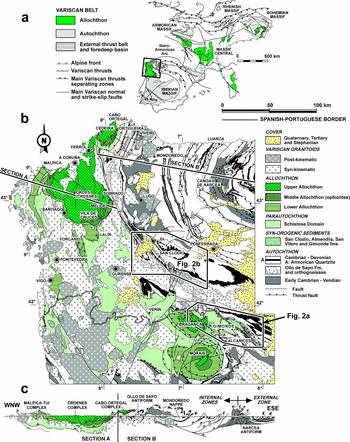
In NW Iberia, syn-orogenic flysch-type deposits appear in close relation to a set of allochthonous terranes, and are mostly preserved in the Parautochthon, an imbricated thrust sheet separating the Allochthon and the Autochthon (Fig. 1).
(a) Location of the study area in the Variscan belt. (b) Geological sketch map of the NW Iberian Massif showing the analysed syn-orogenic deposits and the domains discussed in the text (Allochthon, Parautochthon and Autochthon). The location of the maps in Figure 2 is shown. (c) Schematic composite cross-section.

To establish the relationships between sedimentation and nappe emplacement would require the dating of the syn-orogenic deposits, but this is hindered by the poor preservation of plant debris (Teixeira & Pais, Reference Teixeira and Pais1973) and the scarcity of palynomorphs, which have been recycled in many cases (Pereira, Meireles & Pereira, Reference Pereira, Meireles, Pereira, Vintaned, Eguíluz and Palacios1999). Dating of detrital zircons would help to constrain the timing of deformation by establishing the maximum depositional ages of the sedimentary units. Furthermore, the age clusters can be compared with those of the pre-orogenic sequence in the Autochthon and Parautochthon, representing the Gondwanan passive margin, and with the Allochthon, thus providing new insights into the orogenic evolution of this part of the belt.
In this study, we report new results of U–Pb zircon dating of five syn-orogenic metagreywackes imbricated in the Parautochthon and at the boundary with the Autochthon. Another two samples of pre-orogenic sedimentary rocks collected in the Parautochthon were dated to improve our knowledge about the possible sources and help to determine the provenance of the syn-orogenic sediments. The new age populations are considered together with previously published data in an attempt to (i) constrain the age of thrusting, (ii) evaluate its diachronism and that of the syn-orogenic sequences, (iii) establish the probable source areas, and (iv) show the relationship with the earlier Variscan structures.
2. Geological setting
The Autochthon of NW Iberia consists of a thick Neoproterozoic siliciclastic sequence overlain by pre-orogenic Palaeozoic clastic rocks, carbonates and volcanic rocks. During late Proterozoic time, it formed part of the Gondwanan continental active margin involved in the Cadomian–Avalonian–Pan-African orogeny (Murphy & Nance, Reference Murphy and Nance1991). Magmatism related to the Cadomian event was voluminous and scattered in the Autochthon (Bea et al. Reference Bea, Montero, Talavera and Zinger2006; Rubio-Ordóñez et al. Reference Rubio-Ordóñez, Gutiérrez-Alonso, Valverde-Vaquero, Cuesta, Gallastegui, Gerdes and Cárdenes2015). In Cambro-Ordovician times, that continental margin experienced rifting followed by the opening of the Rheic Ocean, which implied the splitting of the Avalon microcontinent and other peri-Gondwanan terranes (Fortey & Cocks, Reference Fortey, Cocks, Harris and Fettes1988; Soper, Reference Soper, Harris and Fettes1988). The resulting passive margin was stable until Early Devonian time, although the occurrence of minor amounts of basic and acid volcanic rocks indicates moderate extensional processes during Silurian and Devonian times (Ancochea et al. Reference Ancochea, Arenas, Brandle, Peinado and Sagredo1988; González Clavijo & Martínez Catalán, Reference González Clavijo, Martínez Catalán, Martínez Catalán, Hatcher, Arenas and García2002; Gutiérrez-Alonso et al. Reference Gutiérrez-Alonso, Fernández-Suárez, Jeffries, Jenner, Tubrett, Cox and Jackson2003, Reference Gutiérrez-Alonso, Murphy, Fernández-Suárez and Hamilton2008).
The Allochthon is exposed as klippen in five large synformal structures in NW Iberia, both in Spain and Portugal (Fig. 1). It is formed by a stack of structural units which from top to bottom includes pieces of a peri-Gondwanan continental magmatic arc of Cambro-Ordovician age (Upper Allochthon or Continental Allochthonous Terrane), units of oceanic affinity, including supra-subduction type ophiolites of Cambro-Ordovician and Early Devonian age (Middle Allochthon or Northern Ophiolitic Terrane), and parts of the thinned, outer margin of northern Gondwana (Lower Allochthon or Allochthonous Thrust Complex; Marques, Ribeiro & Pereira, 1991–Reference Marques, Ribeiro and Pereira1992; Marques, Ribeiro & Munhá, Reference Marques, Ribeiro and Munhá1996; Ballèvre et al. Reference Ballèvre, Martínez Catalán, López-Carmona, Pitra, Abati, Díez Fernández, Ducassou, Arenas, Bosse, Castiñeiras, Fernández-Suárez, Gómez Barreiro, Paquette, Peucat, Poujol, Ruffet, Sánchez Martínez, Schulmann, Catalán, Lardeaux, Janousek and Oggiano2014). The Cambro-Ordovician magmatic arc developed by subduction of the Iapetus Ocean under Gondwana, according to Martínez Catalán et al. (Reference Martínez Catalán, Arenas, Díaz García, González Cuadra, Gómez-Barreiro, Abati, Castiñeiras, Fernández-Suárez, Sánchez-Martínez, Andonaegui, González Clavijo, Díez Montes, Rubio Pascual, Valle Aguado, Hatcher, Carlson, McBride and Catalán2007, Reference Martínez Catalán, Arenas, Abati, Sánchez Martínez, Díaz García, Fernández-Suárez, González Cuadra, Castiñeiras, Gómez Barreiro, Díez Montes, González Clavijo, Rubio Pascual, Andonaegui, Jeffries, Alcock, Díez Fernández and López Carmona2009). The back-arc basin opened behind it is thought to have widened giving rise to the Cambro-Ordovician ophiolites and the extended continental margin presently forming the Lower Allochthon.
The Allochthon is separated from the Autochthon by a thrust sheet several kilometres thick called the Parautochthon (Ribeiro, Pereira & Dias, Reference Ribeiro, Pereira, Dias, Dallmeyer and García1990; Ribeiro et al. Reference Ribeiro, Munhá, Dias, Mateus, Pereira, Ribeiro, Fonseca, Araújo, Oliveira, Romão, Chaminé, Coke and Pedro2007) or Schistose Domain (Marquínez García, Reference Marquínez García1984; Farias et al. Reference Farias, Gallastegui, González-Lodeiro, Marquínez, Martín Parra, Martínez Catalán, Pablo Maciá and Rodríguez Fernández1987; Farias & Marcos, Reference Farias, Marcos and Vera2004; Valverde-Vaquero et al. Reference Valverde-Vaquero, Marcos, Farias and Gallastegui2005). Its sequence is comparable to that of the underlying Autochthon, although showing a more distal character, and consists of pre-orogenic Cambrian to Lower Devonian metasedimentary rocks and volcanic rocks, and of younger syn-orogenic flysch deposits (Farias et al. Reference Farias, Gallastegui, González-Lodeiro, Marquínez, Martín Parra, Martínez Catalán, Pablo Maciá and Rodríguez Fernández1987; Gallastegui et al. Reference Gallastegui, Martín Parra, Pablo Maciá and Rodríguez Fernández1988; Pereira, Meireles & Pereira, Reference Pereira, Meireles, Pereira, Vintaned, Eguíluz and Palacios1999; González Clavijo & Martínez Catalán, Reference González Clavijo, Martínez Catalán, Martínez Catalán, Hatcher, Arenas and García2002; Piçarra et al. Reference Piçarra, Gutiérrez-Marco, Sá, Meireles and González-Clavijo2006 a,b; Dias da Silva, Reference Dias da Silva2014). The Parautochthon represents a palaeogeographic domain of northern Gondwana situated between the Autochthon and the Lower Allochthon (Díez Fernández et al. Reference Díez Fernández, Castiñeiras and Gómez Barreiro2012 a).
Several units of the Allochthon underwent an early Variscan pre-collisional evolution characterized by subduction and related high-pressure metamorphism, not seen in the Parautochthon or Autochthon. The three groups of allochthonous units were stacked following a piggy-back sequence of thrusting. First, the more distal Upper Allochthon formed the upper part of an accretionary wedge. Subsequently, the Middle and Lower allochthons were incorporated into the wedge during and after the closure of the intervening ocean (Martínez Catalán et al. Reference Martínez Catalán, Arenas, Díaz García, González Cuadra, Gómez-Barreiro, Abati, Castiñeiras, Fernández-Suárez, Sánchez-Martínez, Andonaegui, González Clavijo, Díez Montes, Rubio Pascual, Valle Aguado, Hatcher, Carlson, McBride and Catalán2007, Reference Martínez Catalán, Arenas, Abati, Sánchez Martínez, Díaz García, Fernández-Suárez, González Cuadra, Castiñeiras, Gómez Barreiro, Díez Montes, González Clavijo, Rubio Pascual, Andonaegui, Jeffries, Alcock, Díez Fernández and López Carmona2009; Ballèvre et al. Reference Ballèvre, Martínez Catalán, López-Carmona, Pitra, Abati, Díez Fernández, Ducassou, Arenas, Bosse, Castiñeiras, Fernández-Suárez, Gómez Barreiro, Paquette, Peucat, Poujol, Ruffet, Sánchez Martínez, Schulmann, Catalán, Lardeaux, Janousek and Oggiano2014).
Accretion took place during Devonian time, accommodating plate convergence essentially by subduction. But at the transition to the Carboniferous, and after limited subduction of the continental margin of Gondwana, the regime changed to continental collision. This marked the transition from early Variscan to Variscan shortening, and during Carboniferous time, deformation propagated into the inner parts of the continental margin. The accretionary wedge built previously was emplaced above the future Parautochthon, and then, above the Autochthon carrying the Allochthon piggy-back. The whole allochthonous wedge reached a thickness of up to c. 30 km, as estimated from the maximum thickness preserved in allochthonous units and by the pressure registered in the Autochthon underneath (Rubio Pascual et al. Reference Rubio Pascual, Arenas, Martínez Catalán, Rodríguez Fernández and Wijbrans2013; Martínez Catalán et al. Reference Martínez Catalán, Rubio Pascual, Díez Montes, Díez Fernández, Gómez Barreiro, Dias da Silva, González Clavijo, Ayarza, Alcock, Schulmann, Catalán, Lardeaux, Janousek and Oggiano2014).
In the Autochthon, Variscan deformation involved several tectonic events that gave rise to characteristic macrostructures and associated cleavages. Compressional stresses related to plate convergence produced recumbent folds (C1, S1) in the Autochthon, followed by the emplacement of large thrust sheets (C2, S2; Figs 2, 3). The Parautochthon was emplaced along a detachment developed in Silurian carbonaceous slates which acted as a weak layer favouring slip (Farias Arquer, Reference Farias Arquer1990; González Clavijo & Martínez Catalán, Reference González Clavijo, Martínez Catalán, Martínez Catalán, Hatcher, Arenas and García2002).
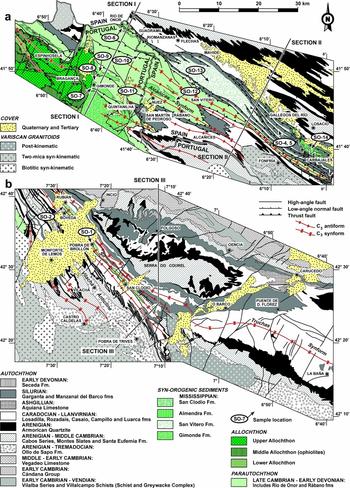
(a) Geological map of the Alcañices synform showing the Gimonde, San Vitero and Almendra syn-orogenic formations and their relationship with the large Variscan structures. (b) Geological map of the Serra do Courel and the Truchas and Sil synforms, showing the occurrence of the syn-orogenic San Clodio Fm. Also shown are the localities where the new and previously dated samples were collected, as well as the locations of the sections shown in Figure 3.

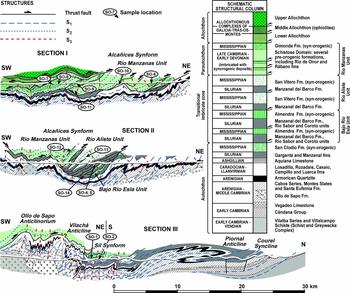
Geological sections across the Alcañices and Sil synforms. For location, see Figure 2. The structural column is simplified and depicts the main units of the different domains, although there are more imbricates, as shown in the cross-sections. The sampling localities have been projected onto the closest section to show their structural position. Recumbent folds (C1) are cut by thrusts (C2) and both are folded by later upright folds (C3). Dashed lines represent the cleavages associated with each deformation event.

Events C1 and C2 were diachronous, and progressively younger towards the external zones of the belt, situated to the east or northeast in present coordinates (Pérez-Estaún, Martínez Catalán & Bastida, Reference Pérez-Estaún, Martínez Catalán and Bastida1991; Dallmeyer et al. Reference Dallmeyer, Martínez Catalán, Arenas, Gil Ibarguchi, Gutiérrez Alonso, Farias, Aller and Bastida1997; Martínez Catalán et al. Reference Martínez Catalán, Fernández-Suárez, Meireles, González Clavijo, Belousova and Saeed2008). The recumbent folds and thrusts produced significant crustal thickening during early Carboniferous time, which was followed by thermal relaxation, weakening of the orogenic crust and collapse. Crustal extension took place during middle and late Carboniferous times, and is recorded in the internal zones of the orogen by the development of gneiss domes and extensional detachments (Escuder Viruete, Arenas & Martínez Catalán, Reference Escuder Viruete, Arenas and Martínez Catalán1994; Arenas & Martínez Catalán, Reference Arenas and Martínez Catalán2003; Díez Fernández et al. Reference Díez Fernández, Castiñeiras and Gómez Barreiro2012 b). Afterwards, a new compressional event (C3, S3) of late Carboniferous age generated upright folds that overprinted the previous recumbent folds and thrusts, the extensional domes and detachments, and the isograds of regional metamorphism (Martínez Catalán et al. Reference Martínez Catalán, Arenas, Díaz García, González Cuadra, Gómez-Barreiro, Abati, Castiñeiras, Fernández-Suárez, Sánchez-Martínez, Andonaegui, González Clavijo, Díez Montes, Rubio Pascual, Valle Aguado, Hatcher, Carlson, McBride and Catalán2007).
3. Outline of the formations sampled
Sampling for this study was carried out in the core of the Alcañices synform, a C3 structure which straddles the Spanish–Portuguese border and in Portugal is replaced en échelon by another synform that hosts at its core the allochthonous Bragança Complex (Figs 1, 2a). For detailed information on the geology of the Alcañices synform, see González Clavijo & Martínez Catalán (Reference González Clavijo, Martínez Catalán, Martínez Catalán, Hatcher, Arenas and García2002), González Clavijo (Reference González Clavijo2006) and Meireles (Reference Meireles2013).
In previous works, we also sampled and dated syn-orogenic deposits in the Alcañices synform (Martínez Catalán et al. Reference Martínez Catalán, Fernández-Suárez, Meireles, González Clavijo, Belousova and Saeed2008) as well as in the Sil synform (Martínez Catalán et al. Reference Martínez Catalán, Fernández-Suárez, Jenner, Belousova and Díez Montes2004), situated to the north and shown with its regional context in Figures 1 and 2b.
The Alcañices synform folds several imbricates bounded by a sole thrust or detachment developed in Silurian carbonaceous slates. From top to bottom, three main imbricate units are recognized in Spain: Río Manzanas, Río Aliste and Bajo Río Esla (Fig. 3; González Clavijo & Martínez Catalán, Reference González Clavijo, Martínez Catalán, Martínez Catalán, Hatcher, Arenas and García2002). The latter includes the Portuguese subautochthonous units of Rio Sabor and Coroto, which represent the Silurian slates (Meireles, Reference Meireles2013). The following sections describe the formations and domains where the samples were collected.
3.a. Parautochthon
The Río Manzanas Unit belongs to the Parautochthon, and directly underlies the Allochthon of the Bragança Complex (Figs 2a, 3, Section I). Most of it consists of low-grade metasedimentary rocks including slates, carbonaceous slates, quartzites, greywackes, lydites and limestones. Mafic and felsic volcanic rocks are common, generally as thin lenses.
Several formations have been defined inside this unit, interpreted as pre-orogenic and of Silurian–Early Devonian age (Fig. 3). But these alternate with olistostromes formed by fragments of quartzites, lydites and limestones embedded in a slaty or sandy matrix. These olistostromes are lens shaped, a few to hundreds of metres thick, and show limited lateral continuity, although they may reach up to 3 km in length. They are syn-orogenic deposits interpreted as channel infillings. Large and small olistoliths are also found, and one olistolith of massive meta-rhyolites and metatuffs, 4 km long and dated as late Cambrian, has been reported near Nuez (Dias da Silva et al. Reference Dias da Silva, González Clavijo, Gutiérrez Alonso, Gómez Barreiro, Pankhurst, Castiñeiras and Martínez2014 a). These deposits indicate basin instability, and herald Variscan deformation in nearby areas.
Sample SO-10 is a siltstone of the Vale Andrês Member of the Rio de Onor Fm, stratigraphically on top of dated Silurian slates and of probable Silurian age, as indicated by acritarchs of that age occurring together with reworked Cambrian and Ordovician acritarchs (Meireles, Reference Meireles2013). SO-11 is from a folded lens of quartzite 2 km long, surrounded by the Rábano Fm, defined in Spain by González Clavijo (Reference González Clavijo2006), and partially equivalent to the Rio de Onor Fm defined in Portugal. Its age is imprecise. Conodonts and spores in nearby slates are Silurian–Early Devonian in age, but the quartzite might represent a large olistolith.
3.b. Gimonde Formation
The syn-orogenic sediments of the Gimonde Fm may occur as lenses tectonically sandwiched among the lithologies described in the Parautochthon, but are massively represented towards the top of the Río Manzanas Unit, where the Gimonde Fm has been defined and mapped (Pereira, Meireles & Pereira, Reference Pereira, Meireles, Pereira, Vintaned, Eguíluz and Palacios1999; Meireles, Reference Meireles2013). Based on the vergence to the northeast of the thrust faults, the structurally upper occurrences are interpreted as more internal than those tectonically imbricated in the middle and lower parts of the Parautochthon of the Alcañices synform.
The formation is a flysch-like, rhythmic sequence made of alternating slates, siltites and greywackes, which may include pebbles of various sizes and locally grade into microconglomerates and conglomerates containing fragments of metamorphic rocks, or even to large olistostromes. The conglomerates include meso- and catazonal gneisses, derived from the Allochthon, and low-grade metasandstones, metacherts, metatuffs, phyllites and quartzites possibly derived from the surrounding pre-orogenic Parautochthon (Ribeiro & Ribeiro, Reference Ribeiro and Ribeiro1974; Meireles, Reference Meireles2000).
The Gimonde Fm overlies unconformably the pre-orogenic sequence of the Parautochthon, and both were affected by post-C1 recumbent folds with NE vergence related to C2 thrusting and imbrication (Fig. 3, Section I). In the metapelites, a fine-grained slaty cleavage (the first, although equivalent to S2 in pre-orogenic formations) developed, associated with the folds and thrusts, and was in turn overprinted by a steeply dipping crenulation cleavage (S3) axial planar in relation to late folding (C3).
The age was considered Late Devonian by Teixeira & Pais (Reference Teixeira and Pais1973) based on poorly preserved plant debris. Palynological studies point to a Givetian–Frasnian age in the south (around Gimonde) and slightly younger (Frasnian) to the north (Pereira, Meireles & Pereira, Reference Pereira, Meireles, Pereira, Vintaned, Eguíluz and Palacios1999). However, all these seem to correspond to reworked populations, as shown by detrital zircons dated in the present study.
Previously dated samples SO-6 and SO-7 were collected close to the sole and in the upper part of the Río Manzanas Unit, respectively (Figs 2a, 3, Section I), and the results were presented by Martínez Catalán et al. (Reference Martínez Catalán, Fernández-Suárez, Meireles, González Clavijo, Belousova and Saeed2008). Sample SO-6, representing the external part of the Gimonde Fm, yielded nine early Variscan zircons ranging in age from 404 to 378 Ma.
New samples SO-8 and SO-9 come from the upper imbricates in Portugal. The first was collected in a normal position in one of the upper thrust sheets, and the second in the reverse limb of a major recumbent syncline facing NE in the underlying imbricate. The new sample SO-12 was collected in the Spanish part of the Parautochthon, at the contact of a map-scale olistostrome that probably overlies unconformably the Rábano Fm but is also imbricated with it (González Clavijo & Martínez Catalán, Reference González Clavijo, Martínez Catalán, Martínez Catalán, Hatcher, Arenas and García2002). It is ascribed to the Gimonde Fm by correlation with the Portuguese Parautochthon, where such imbricates are common (Meireles, Reference Meireles2013).
3.c. San Vitero Formation
The Río Aliste Unit is the imbricate stack occupying an intermediate position in the northern limb of the Alcañices synform (Figs 2a, 3, Section II). It overlies tectonically the Bajo Río Esla Unit in the southeast, but in the northwest it lies directly above the Autochthon, where it cuts across overturned C1 folds.
The unit is formed by two contrasting sequences separated by an unconformity, the syn-orogenic San Vitero Fm and a pre-orogenic Silurian sequence formed by slates, carbonaceous slates and lydites, similar to the Manzanal del Barco Fm described by Vacas & Martínez Catalán (Reference Vacas and Martínez Catalán1987) in the underlying Bajo Río Esla Unit and in the Autochthon. The Silurian fossil associations are comparable and shared a similar palaeogeographic location (Piçarra et al. Reference Piçarra, Gutiérrez-Marco, Sá, Meireles and González-Clavijo2006 a,b), and for that reason, the Río Aliste and Bajo Río Esla units are considered transitional to the Autochthon and relatively little displaced in relation to it.
The San Vitero Fm is a syn-orogenic deposit with many characteristics of the culm facies of the Variscan belt, such as a turbiditic character and the existence of plant debris and pebbles of metamorphic rocks. It consists of terrigenous turbidites with decimetre- to metre-thick alternations of greywackes and slates. Microconglomerates occur at the base of some coarse greywacke levels. Scarce and thin alternations of carbonaceous cherts have been observed near the base, which is an erosive surface underlying the first turbiditic cycle (Martínez García, Reference Martínez García1972; Antona & Martínez Catalán, Reference Antona and Martínez Catalán1990; González Clavijo & Martínez Catalán, Reference González Clavijo, Martínez Catalán, Martínez Catalán, Hatcher, Arenas and García2002). Although the top of the formation is not seen, its thickness is at least several hundred metres.
Recumbent folds with an axial planar slaty cleavage are common in the San Vitero Fm, and appear in close relation to thrust faults. Both are folded by upright folds with a fine axial planar crenulation cleavage (S3). The imbricated character of the Río Aliste Unit is highlighted by several repetitions of its two formations. The unit is possibly a duplex, or forms part of a large duplex which encompasses the three units being described, but the map does not prove that it is bounded by a roof thrust. The metamorphic grade of the San Vitero Fm corresponds to the lower epizone, near the anchizone, according to a study on illite crystallinity (Antona & Martínez Catalán, Reference Antona and Martínez Catalán1990).
The age of the San Vitero Fm remains uncertain because only unclassifiable plant debris has been found. Based on the stratigraphic position and correlation, several ages were proposed: Silurian (Martínez García, Reference Martínez García1973), Devonian (J. L. Quiroga de la Vega, unpub. Ph.D. thesis, Univ. Oviedo, 1981) and uppermost Silurian – Middle Devonian (González Clavijo & Martínez Catalán, Reference González Clavijo, Martínez Catalán, Martínez Catalán, Hatcher, Arenas and García2002). However, U–Pb detrital zircon dating in two samples (SO-4 and SO-5; Martínez Catalán et al. Reference Martínez Catalán, Fernández-Suárez, Meireles, González Clavijo, Belousova and Saeed2008; location in Figs 2a, 3, Section II), yielded two ages of 355±8 and 360±6 Ma, thus pointing to a Carboniferous age.
A new sample, SO-13, was collected in a microconglomeratic greywacke in the core of the Río Aliste Unit (Figs 2a, 3, Section II), to the north of San Vitero, in a position structurally higher than that of samples SO-4 and SO-5.
3.d. Almendra Formation
The lowermost imbricate preserved at the core of the Alcañices synform forms the Bajo Río Esla Unit, a duplex that occupies the more external part of the synform, resting directly above the Autochthon (Fig. 3, Section II). Together with the Río Aliste Unit, it traces the imbricate zone transitional between the Parautochthon and the Autochthon.
The imbricates share a Silurian condensed sequence at their base, the Manzanal del Barco Fm, consisting of slates, carbonaceous slates and lydites. Graptolites record the whole Silurian with the exception of the Pridoli (González Clavijo, Reference González Clavijo2006). Locally towards the top, small lenses of dark limestones yielding Pridolian–Lockhovian fauna occur in Portugal (Sarmiento et al. Reference Sarmiento, Piçarra, Rebelo, Robardet, Gutíerrez-Marco, Storch and Rábano1999).
Overlying the Manzanal del Barco Fm is the Almendra Fm (Vacas & Martínez Catalán, Reference Vacas and Martínez Catalán1987), an alternation of calcarenites and grey slates at least 200 m thick, whose top is always cut by thrust faults. Discontinuous beds of calcarenite contain abundant bioclasts of corals, Scyphocrinus, bivalves, gastropods and calcarenite autoclasts up to 10 cm in size. The slates include clasts of diverse size (up to metric) of several lithologies, mainly belonging to the Manzanal del Barco Fm, and sometimes calcarenites of the Almendra Fm itself.
Some thin, discontinuous levels of conglomerate also exist that strongly resemble those described in the San Vitero Fm. They contain abundant pebbles, generally small but reaching up to 6 cm occasionally, of white quartz, quartzite, lydite, greywacke, slate displaying one or two tectonic foliations, strongly foliated orthogneiss and fragments of microconglomerate. The metamorphic clasts were interpreted as evidence of pre-Variscan events (Aldaya et al. Reference Aldaya, Arribas, González Lodeiro, Iglesias, Martínez Catalán and Martínez-García1973, Reference Aldaya, Carls, Martínez-García and Quiroga1976), but lately the Almendra Fm has been considered a deposit formed at the continental slope (González Clavijo & Martínez Catalán, Reference González Clavijo, Martínez Catalán, Martínez Catalán, Hatcher, Arenas and García2002). The ages obtained from conodonts range from Pridoli to Emsian (Sarmiento, Calvo & González Clavijo, Reference Sarmiento, Calvo, González Clavijo, D'Anglade, Gutiérrez-Marco and Fidalgo1997), but the nature of the rocks and the presence of bioclasts strongly suggest they are inherited specimens. On the other hand, the metamorphic pebbles, including relatively soft slates, suggest a source area undergoing deformation nearby. Consequently, the Almendra Fm is interpreted as a syn-orogenic deposit, probably distal in relation to the source area, and derived mostly from erosion of the upper part of the Autochthon and/or Parautochthon weakly metamorphosed sequence, but yet with some participation of metamorphic rocks of higher grade derived from the Allochthon.
The new sample SO-14 was collected for this study from a level of conglomerates less than 3 m thick close to the upper part of the formation, inside one of the lower imbricated horses of the Bajo Río Esla Unit (Figs 2a, 3, Section II).
3.e. San Clodio Formation
Syn-orogenic turbidites consisting of pelites and greywackes identical to those of the San Vitero Fm crop out in the core of the Sil synform, a C3 structure that folds the Autochthon to the east of the present front of the Allochthon. The synform is a narrow NW–SE structure, bounded to the west by a high-angle reverse fault, situated between the Ollo de Sapo anticlinorium (C3) and the C1 recumbent folds of the Serra do Courel (Figs 2b, 3, Section III). The San Clodio Fm was first studied by Riemer (Reference Riemer1963, Reference Floor1966), who described carbonaceous cherts at the base of the formation, thin coal veins, poorly preserved plant debris, and pebbles of quartzite, slate, gneiss and granite. He suggested a Carboniferous pre-Stephanian age, based on the fact that deposits were folded, but noticed that deformation was weaker than in the underlying Ordovician slates. Matte (Reference Matte1968) discussed the deformation, and found no appreciable differences in metamorphism and cleavage development between the San Clodio Fm and older strata. He did not conclude whether or not the turbidites post-dated the first Variscan recumbent folds and cleavage. Pérez-Estaún (Reference Pérez-Estaún1974) described typical turbiditic sedimentary structures such as groove and flute casts, and prod marks, as well as trace fossils in the pelites, and established that the formation is not older than Late Devonian in age on the basis of plant debris content.
Samples SO-1 and SO-2 were collected for U–Pb detrital zircon dating at two localities, Pobra de Brollón and Bóveda (Fig. 2b), and the results published by Martínez Catalán et al. (Reference Martínez Catalán, Fernández-Suárez, Jenner, Belousova and Díez Montes2004). No new samples have been dated, but a detailed structural study has been carried out to establish the relationships between the syn-orogenic deposits and the Variscan structures.
The region to the east of the Sil synform is characterized by large C1 recumbent folds, and a couple of such folds, the Piornal anticline and the Courel syncline (Matte, Reference Matte1968), occur not far from the syn-orogenic deposits (Fig. 3, Section III). These folds form part of the larger Mondoñedo fold nappe, a huge recumbent structure with a reverse limb reaching between 15 and 30 km in length (Martínez Catalán, Arenas & Díez Balda, Reference Martínez Catalán, Arenas and Díez Balda2003).
To the west, the structure is complicated by overprinting of large C3 upright folds. The San Clodio Fm rests usually on middle to upper Ordovician slates, but below them, a strip of Silurian rocks up to 1000 m thick forms the core of a recumbent syncline with a reverse limb of c. 10 km (Fig. 3, Section III). The C1 syncline is re-folded by C3, and the synform hosting at its core the syn-orogenic deposits delineates on the map a hook-type fold interference to the southeast of San Clodio (Fig. 2b).
The San Clodio Fm was deposited unconformably over the reverse limb of a C1 recumbent fold. Later, the syn-orogenic deposits were affected by small recumbent folds associated with thrust faults directed to the NE attributed to late stages of C2, and folded by steep C3 folds. The unconformity was locally reactivated by thrusting, but not systematically. Where this happened, a few metres of carbonaceous slates and cherts between the turbidites and the underlying Ordovician slates were sheared and phyllonitized.
4. Description of new samples
Sample SO-08 (UTM: Datum ED 50, zone 29T, E691908, N4631397), from the Gimonde Fm, is a microconglomeratic low-grade metagreywacke formed by angular to poorly rounded grains. Detrital grains are of all sizes with a population of large clasts (1–3 mm) embedded in a fine-grained mass of quartz, plagioclase, muscovite, minor chlorite and opaques, and a micaceous matrix. The larger grains are rock fragments of slate, quartzitic schist, quartz mylonite, polycrystalline aggregates of quartz derived from quartzite and deformed quartz veins, carbonaceous chert and carbonate. A crenulation cleavage folding a previous low-grade tectonic foliation is often preserved in the metamorphic clasts. The whole rock is deformed, with a rough cleavage marked by the statistically preferred orientation of the elongated grains, and dark, irregular pressure-solution seams.
Sample SO-09 (E692833, N4633617), from the Gimonde Fm, is a low-grade metagreywacke formed by angular to poorly rounded grains of quartz, plagioclase, muscovite, rare biotite and opaques. Grains are of all sizes up to a maximum of 0.6 mm, embedded in a fine-grained matrix of white mica and chlorite, with some porphyroblastic grains of the latter. A rough cleavage is marked by the statistically preferred orientation of the elongate grains, pressure-solution seams and the orientation of the new grains in the matrix.
Sample SO-10 (E701239, N4639620), from the pre-orogenic Parautochthon (Rio de Onor Fm), is a siltstone formed by angular to sub-rounded detrital grains, up to 0.4 mm long. Quartz is the main detrital component, but white mica, and a few grains of greenish biotite and tourmaline also occur. The grains are elongated parallel to a low-temperature, anastomosing cleavage, probably formed by pressure solution, where opaque minerals concentrate. Tiny, apparently new white mica also occurs statistically oriented parallel to the cleavage seams, pointing to recrystallization of the very scarce pelitic matrix.
Sample SO-11 (E704003, N4628578), from the pre-orogenic Parautochthon near Nuez (Rábano Fm), probably a glided block, is a fine-grained, rather equigranular quartzite consisting of grains of 0.1 to 0.2 mm long quartz. Opaque minerals are present in a limited amount, as well as detrital muscovite, and a few grains of plagioclase and zircon have been recognized. The matrix is almost inexistent. A rough cleavage is defined by the weak to moderately elongated quartz and opaque grains, and by poorly developed and anastomosing seams of phyllitic material. Growth of pyrite in polycrystalline aggregates occurred in a post-kinematic stage.
Sample SO-12 (E712015, N4627466), from the Gimonde Fm, is a medium-grained lithic-wacke containing some clasts up to 3 mm, and includes scarce quartz grains displaying volcanic embayments. The clasts are subangular to sub-rounded and predominantly of monomineralic quartz. A previous tectonic foliation was identified inside some rock fragments, clearly bearing different attitudes, and in some cases crenulated. Deformation of the greywacke is very weak, only indicated by scarce narrow pressure-solution seams, and no tectonic foliation is developed. The matrix is formed by fine-grained detritals and tiny white mica and chlorite crystals distributed in narrow and irregular seams among the monomineralic and rock fragments. The metamorphic grade is very low, displaying scarce muscovite and new chlorite crystals. Growth of idiomorphic pyrite post-dates deformation.
Sample SO-13 (E720718, N4632658), from the San Vitero Fm, is a microconglomeratic greywacke consisting of subangular to rounded clasts less than 2 mm long of quartz, plagioclase, microcline, muscovite, carbonate, as well as of polymineralic quartz grains and low-grade metapelites. Scarce volcanic quartz crystals have been identified, and some cryptocrystalline grains possibly represent vitric fragments of pyroclastic rocks. Several clasts display a tectonic foliation, which may appear crenulated by a later deformation. Both occurred previously to the weak deformation shown by the whole rock, indicated by the poor statistically preferred orientation of grains without pressure-solution seams.
Sample SO-14 (E745723, N4616813), from the Almendra Fm, can be classified as a coarse-grained microconglomerate or lithic-wacke. Rock fragments are of all sizes with a population of large clasts up to 20 mm long, embedded in a fine-grained mass of small grains of quartz, plagioclase, muscovite, tourmaline, chlorite, opaques and a micaceous matrix. Large fragments consist of single grains of quartz, or of rock fragments. The latter include low-grade metapelites and quartzitic schists, polycrystalline aggregates of quartz derived from quartzite and deformed quartz veins, and very fine-grained foliated rocks that probably represent vitric volcanic fragments (shards). Very few quartz grains show corrosion embayments. No carbonates have been found although the microconglomerate is intercalated in limestones. A crenulation cleavage folds a previous low-grade tectonic foliation in some clasts of metamorphic rock, but in other cases, crenulation cleavage in the clasts is parallel to cleavage in the matrix, suggesting contemporaneity. The whole rock is strongly deformed, with a cleavage marked by the preferred orientation of the elongated detrital grains and the small recrystallized phyllosilicates of the matrix. Also, dark, irregular but rather continuous pressure-solution seams occur. The metamorphic grade is low, anchizone–epizone, according to the colour alteration index in conodonts (Sarmiento, Calvo & González Clavijo, Reference Sarmiento, Calvo, González Clavijo, D'Anglade, Gutiérrez-Marco and Fidalgo1997). This fact is consistent with the microscopic observations of quartz grains showing undulatory extinction, recovery, serrate grain boundaries, subgrains and Boehm lamellae. Single crystals or aggregates of pyrite grew after deformation, partially replacing the detrital grains and the foliated matrix.
5. Zircon geochronology
5.a. Dating procedure
Mineral separation was carried out at the Universidad Complutense (Madrid) following conventional techniques. Zircons were hand-picked in alcohol under a binocular microscope and chosen to represent all types found in the samples in terms of size, length to breadth ratio, roundness, colour and other salient morphological features.
Zircon dating was done at GEMOC, Department of Earth and Planetary Sciences, Macquarie University, Sydney, Australia. The grains selected for U–Pb, laser ablation, inductively coupled plasma mass spectrometry (LA-ICP-MS) dating were mounted in epoxy discs and polished. Of the seven samples, 60 analyses were performed on single grains from six samples, while one sample (SO-11) was limited to 20 analyses owing to insufficient zircon recovery.
U–Pb dating was performed using an Agilent 7500 quadrupole ICP-MS system, attached to a New Wave UP213 laser ablation system (λ = 213 nm). The analyses were carried out with a beam diameter of c. 30–50 μm with a 5 Hz repetition rate. The analytical procedures for the U–Pb dating have been described in detail previously (Belousova et al. Reference Belousova, Griffin, Shee, Jackson and O'Reilly2001; Griffin et al. Reference Griffin, Belousova, Shee, Pearson and O'Reilly2004; Jackson et al. Reference Jackson, Pearson, Griffin and Belousova2004). A very fast scanning data acquisition protocol was employed to minimize signal noise. Data acquisition for each analysis took 3 min (1 min on background, 2 min on signal). Ablation was carried out in He to improve sample transport efficiency, provide more stable signals and give more reproducible Pb/U fractionation. Provided that constant ablation conditions are maintained, accurate correction for U/Pb fractionation can then be achieved using an isotopically homogeneous zircon standard.
Samples were analysed in runs of 16 analyses, which included 12 unknown points, bracketed beginning and end by pairs of analyses of the GEMOC GJ-1 zircon standard. This standard is slightly discordant, and has yielded an isotope dilution thermal ionization mass spectrometry 207Pb–206Pb age of 608.5 Ma (Jackson et al. Reference Jackson, Pearson, Griffin and Belousova2004). Two other well-characterized zircons, 91500 (Wiedenbeck et al. Reference Wiedenbeck, Alle, Corfu, Griffin, Meier, Oberli, Von Quart, Roddick and Spiegel1995) and Mud Tank (Black & Gulson, Reference Black and Gulson1978), were analysed within each run as an independent control on reproducibility and instrument stability.
U–Pb ages were calculated from the raw signal data using the online software package GLITTER (www.mq.edu.au/GEMOC; van Achterbergh, Ryan & Griffin, Reference van Achterbergh, Ryan and Griffin1999; van Achterbergh et al. Reference van Achterbergh, Ryan, Jackson, Griffin and Sylvester2001). GLITTER calculates the relevant isotopic ratios for each mass sweep and displays them as time-resolved data. This allows isotopically homogeneous segments of the signal to be selected for integration. GLITTER then corrects the integrated ratios for ablation-related fractionation and instrumental mass bias by calibration of each selected time segment against the identical time segments for the standard zircon analyses.
The common-Pb correction procedure of Andersen (Reference Andersen2002) was used assuming recent lead loss. A common lead composition corresponding to present-day average orogenic lead is given by the second-stage growth curve of Stacey & Kramers (Reference Stacey and Kramers1975) for 238U/204Pb=9.74. No correction has been applied to analyses that are concordant within 2σ of analytical error, or that have less than 0.2% common lead. Only 19 analyses needed to be corrected for common lead. Concordia diagrams and probability density distribution plots were generated using the Isoplot software, version 3.0 (Ludwig, Reference Ludwig2003).
5.b. Dating results
Data from LA-ICP-MS of detrital zircon grains for U, Pb and Th can be seen in Tables S1 to S7 in the online Supplementary Material available at http://journals.cambridge.org/geo.
The concordia plots of syn-orogenic samples are shown in Figure 4, with insets representing the Palaeozoic and Neoproterozoic zircons. Figure 5 shows the probability density distribution of ages together with the percentage of significant age populations of detrital zircon grains for concordant or subconcordant analyses.
U–Pb concordia diagrams with the results of LA-ICP-MS zircon dating of new samples from the Gimonde, Alcañices and Almendra fms. Error ellipses represent 2σ uncertainties. The enlarged regions show the Palaeozoic, Neoproterozoic and Stenian zircons.

Probability density distribution (curves) and frequency (bars) of ages and percentage of significant age populations of detrital zircon grains for the samples whose ages are shown in Figure 4. Only concordant or subconcordant analyses (<10% discordant) have been plotted. n – number of analyses with <10%.discordance.

The samples are characterized by one or more Archaean populations up to 3.4 Ga old (11–25% of the age spectra), a Palaeoproterozoic population concentrated between 1.7 and 2.3 Ga (27–44%), a small representation of Mesoproterozoic zircons (2–5%, absent in SO-8), and a representative Neoproterozoic group mostly younger than 0.7 Ga (20–39%). Palaeozoic zircons are absent in SO-8 and variably represented in the other samples, and have been divided into pre-Variscan (older than 400 Ma; 12–20%), and early Variscan and Variscan (4–15%).
Figure 6 depicts the concordia plots and the probability density distribution of ages and percentage of significant age populations for the two samples of the pre-orogenic Parautochthon. SO-10, from the Rio de Onor Fm, includes a representation of all ages present in the syn-orogenic samples except Variscan, with zircons of Neoproterozoic age representing 51% and Palaeozoic zircons 17%. Sample SO-15, from the quartzite, has a higher percentage of Neoproterozoic zircons and lacks the Archaean and Palaeozoic populations, but it is little representative as it has supplied only 15 concordant ages.
Above: U–Pb concordia diagrams with the results of LA-ICP-MS zircon dating of new samples in the Rio de Onor and Rábano fms. Error ellipses represent 2σ uncertainties. The enlarged regions show the Palaeozoic, Neoproterozoic and Stenian zircons. Below: Probability density distribution (curves) and frequency (bars) of ages, and percentage of significant age populations of detrital zircon grains. Only concordant or subconcordant analyses (<10% discordant) have been plotted. n – number of analyses with <10% discordance.

6. Age summary and geological interpretation
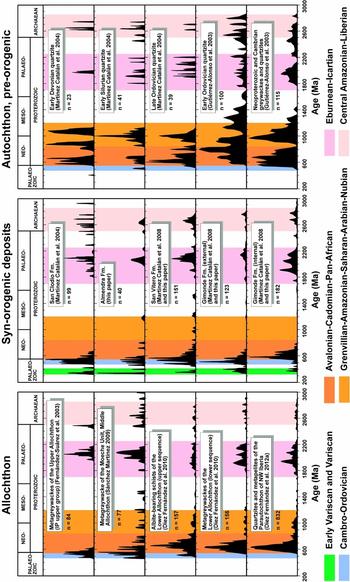
In order to establish the sources of syn-orogenic sediments, Figure 7 shows a synthesis of published zircon age data as probability density plots, together with time intervals representing significant events of crustal accretion or rifting.
Synthesis of several published zircon age data as probability density plots, together with time intervals representing significant events of crustal growth or recycling. New data from the San Vitero and Gimonde fms have been combined with previous data on the same formations, and are shown in the central column together with age spectra of the Almendra and San Clodio fms. The right column shows probability density plots from published data of the pre-orogenic Autochthon, and the left column depicts populations of representative units of the Allochthon.

The results of samples from the syn-orogenic San Vitero and Gimonde fms have been combined with previous data on the same formations, and are shown in the central part of Figure 7 together with those of the Almendra and San Clodio fms. For the Gimonde Fm, samples from the upper imbricates in the Parautochthon of the Alcañices synform, corresponding to internal parts of the sedimentary basin, have been separated from samples collected lower in the section and representing more external parts.
The right part of Figure 7 shows probability density plots from published data of the pre-orogenic Autochthon, obtained in greywacke and quartzite samples of Neoproterozoic, Cambrian, Ordovician, Silurian and Early Devonian ages (Gutiérrez-Alonso et al. Reference Gutiérrez-Alonso, Fernández-Suárez, Jeffries, Jenner, Tubrett, Cox and Jackson2003; Martínez Catalán et al. Reference Martínez Catalán, Fernández-Suárez, Jenner, Belousova and Díez Montes2004). New data from Ediacaran and early Cambrian samples (Fernández-Suárez et al. Reference Fernández-Suárez, Gutiérrez-Alonso, Pastor-Galán, Hofmann, Murphy and Linnemann2014) and from early Ordovician quartzites (Shaw et al. Reference Shaw, Gutiérrez-Alonso, Johnston and Pastor-Galán2014) of NW and Central Iberia confirm the patterns of zircon age populations in the Autochthon. The left part of Figure 7 depicts zircon age populations of representative units of the Allochthon.
6.a. Precambrian populations
In the Autochthon, the age spectra include Archaean zircons, Palaeoproterozoic ages in the range 2.25–1.7 Ga (Orosirian–Rhyacian), Mesoproterozoic–Neoproterozoic ages covering the interval 1.2–0.85 Ga (Tonian–Stenian) and Neoproterozoic ages younger than 850 Ma (Cryogenian–Ediacaran). These populations are compatible with a palaeoposition of the Iberian Autochthon close to present northern Africa, with the Orosirian–Rhyacian population being characteristic of the West African craton and the Cryogenian–Ediacaran zircons derived from northern Gondwana.
The Mesoproterozoic population was first related to NE African sources by Gómez Barreiro et al. (Reference Gómez-Barreiro, Martínez Catalán, Arenas, Castiñeiras, Abati, Díaz García, Wijbrans, Linnemann, Nance, Kraft and Zulauf2007) and later by Bea et al. (Reference Bea, Montero, Talavera, Abu Anbar, Scarrow, Molina and Moreno2010). Current views support that near sources for the Tonian–Stenian population are the Saharan craton, the Arabian–Nubian shield, the Hoggar megasuture or Trans-Saharan fold belt, and the East African orogen (Bea et al. Reference Bea, Montero, Talavera, Abu Anbar, Scarrow, Molina and Moreno2010; Díez Fernández et al. Reference Díez Fernández, Martínez Catalán, Gerdes, Abati, Arenas and Fernández-Suárez2010; Dias da Silva et al. Reference Dias da Silva, Linnemann, Hofmann, González Clavijo, Díez-Montes and Martínez Catalán2014 b; Fernández-Suárez et al. Reference Fernández-Suárez, Gutiérrez-Alonso, Pastor-Galán, Hofmann, Murphy and Linnemann2014). Far sources related to far-travelled clastic sediments include terranes exposed to the south of the Saharan craton and the Arabian–Nubian shield (Shaw et al. Reference Shaw, Gutiérrez-Alonso, Johnston and Pastor-Galán2014).
The Palaeoproterozoic and Archaean populations are common to the three domains represented in Figure 7, although the Archaean seems better represented in the Autochthon. The Mesoproterozoic population is clearly more abundant in the Autochthon, but it also exists in the Middle and Lower allochthons (Sánchez Martínez, Reference Sánchez Martínez2009; Díez Fernández et al. Reference Díez Fernández, Martínez Catalán, Gerdes, Abati, Arenas and Fernández-Suárez2010, Reference Díez Fernández, Martínez Catalán, Arenas, Abati, Gerdes and Fernández-Suárez2012 a) and is absent or nearly so in the Upper Allochthon (Fernández-Suárez et al. Reference Fernández-Suárez, Díaz García, Jeffries, Arenas and Abati2003; Albert et al. Reference Albert, Arenas, Gerdes, Sánchez Martínez, Fernández-Suárez and Fuenlabrada2015). The decreasing amount of Mesoproterozoic zircons upwards in the nappe pile has been related to the palaeoposition of the peri-Gondwanan allochthons to the west of the Autochthon, closer to present NW Africa (Díez Fernández et al. Reference Díez Fernández, Martínez Catalán, Gerdes, Abati, Arenas and Fernández-Suárez2010, Reference Díez Fernández, Martínez Catalán, Arenas, Abati, Gerdes and Fernández-Suárez2012 a). There, they would have registered a progressively larger influence from the West African craton and a minor to zero influence from central and eastern sources of the northern margin of Gondwana.
The Neoproterozoic populations of the three domains are similar, reflecting the overwhelming influence of pan-African sources in both the Autochthon and the Allochthon.
For the syn-orogenic deposits, sources are probably local as creation of relief is etymologically and by definition a consequence of orogenesis. The scarcity or absence of the Mesoproterozoic population in the syn-orogenic sediments suggests a derivation from the Allochthon, where that population is small to inexistent.
6.b. Palaeozoic pre-Variscan population
Pre-Variscan, Palaeozoic zircons reflect the magmatic activity related to the Cambro-Ordovician rifting, which in turn has been related to the pulling apart of some peri-Gondwanan terrane driven by subduction of the Iapetus oceanic lithosphere beneath Gondwana (Fernández et al. Reference Fernández, Becchio, Castro, Viramonte, Moreno-Ventas and Corretgé2008; Martínez Catalán et al. Reference Martínez Catalán, Arenas, Abati, Sánchez Martínez, Díaz García, Fernández-Suárez, González Cuadra, Castiñeiras, Gómez Barreiro, Díez Montes, González Clavijo, Rubio Pascual, Andonaegui, Jeffries, Alcock, Díez Fernández and López Carmona2009; Díez Montes, Martínez Catalán & Bellido Mulas, Reference Díez Montes, Martínez Catalán and Bellido Mulas2010).
Significant to voluminous late Cambrian to early Ordovician magmatism characterizes the different domains, although its signature differs from one domain to the other. In the Autochthon and Parautochthon, the magmatism is mostly felsic, includes volcanic rocks and intrusive granitoids, and is coeval with shallow-water, platform-facies clastic deposits (Gutiérrez Marco, de San José & Pieren, Reference Gutiérrez Marco, de San José, Pieren, Dallmeyer and García1990; Pérez-Estaún et al. Reference Pérez-Estaún, Bastida, Martínez Catalán, Gutierrez Marco, Marcos, Pulgar, Dallmeyer and García1990). Magmatism there was related to extension of the northern Gondwanan passive margin, and its calc-alkaline and ferrosilicic signature is interpreted as being derived from its source rocks, the Cadomian arc-related magmatism or lower crustal equivalents (Fernández et al. Reference Fernández, Becchio, Castro, Viramonte, Moreno-Ventas and Corretgé2008; Díez Montes, Martínez Catalán & Bellido Mulas, Reference Díez Montes, Martínez Catalán and Bellido Mulas2010; Ballèvre et al. Reference Ballèvre, Fourcade, Capdevila, Peucat, Cocherie and Fanning2012; Dias da Silva et al. Reference Dias da Silva, Valverde-Vaquero, González-Clavijo, Díez-Montes, Martínez Catalán, Schulmann, Catalán, Lardeaux, Janousek and Oggiano2014 c).
In the Lower Allochthon, magmatism is bimodal, although the felsic rocks dominate. Rocks similar to those of the underlying domains coexist with alkaline and peralkaline magmatism (Floor, Reference Floor1966; Montero et al. Reference Montero, Bea, Corretgé, Floor and Whitehouse2009 a; Rodríguez Aller, Reference Rodríguez Aller2005; Díez Fernández, Castiñeiras & Gómez Barreiro, Reference Díez Fernández, Castiñeiras and Gómez Barreiro2012). The latter points to a continental rift, related to the opening of the oceanic domain represented in the ophiolitic Middle Allochthon (Arenas et al. Reference Arenas, Martínez Catalán, Sánchez Martínez, Díaz García, Abati, Fernández-Suárez, Andonaegui, Gómez-Barreiro, Hatcher, Carlson, McBride and Martínez Catalán2007 a,b; Sánchez Martínez et al. Reference Sánchez Martínez, Arenas, Andonaegui, Martínez Catalán, Pearce, Hatcher, Carlson, McBride and Catalán2007 a,b).
In the Upper Allochthon, plutonism is bimodal, with large bodies of granitoids and gabbros, and with characteristics reflecting arc-type magmatism in the uppermost units of the group (Andonaegui et al. Reference Andonaegui, González del Tánago, Arenas, Abati, Martínez Catalán, Peinado, Díaz García, Catalán, Hatcher, Arenas and García2002, Reference Andonaegui, Castiñeiras, González Cuadra, Arenas, Sánchez Martínez, Abati, Díaz García and Martínez Catalán2012), and continental extension in the structurally lower units (Galán & Marcos, Reference Galán and Marcos1997).
Voluminous magmatism is somewhat older in the Upper Allochthon (510–490 Ma; Abati et al. Reference Abati, Dunning, Arenas, Díaz García, González Cuadra, Martínez Catalán and Andonaegui1999; Castiñeiras, Díaz García & Gómez Barreiro, Reference Castiñeiras, Díaz García and Gómez Barreiro2010; Andonaegui et al. Reference Andonaegui, Castiñeiras, González Cuadra, Arenas, Sánchez Martínez, Abati, Díaz García and Martínez Catalán2012) than in the Lower Allochthon (500–470 Ma; Abati et al. Reference Abati, Gerdes, Fernández-Suárez, Arenas, Whitehouse and Díez Fernández2010; Díez Fernández, Castiñeiras & Gómez Barreiro, Reference Díez Fernández, Castiñeiras and Gómez Barreiro2012), the Parautochthon (493–483 Ma; Dias da Silva et al. Reference Dias da Silva, Valverde-Vaquero, González-Clavijo, Díez-Montes, Martínez Catalán, Schulmann, Catalán, Lardeaux, Janousek and Oggiano2014 c) and the Autochthon (495–470 Ma; Bea et al. Reference Bea, Montero, Talavera and Zinger2006; Montero et al. Reference Montero, Bea, González-Lodeiro, Talavera and Whitehouse2007, Reference Montero, Talavera, Bea, Lodeiro and Whitehouse2009 b; Díez Montes, Martínez Catalán & Bellido Mulas, Reference Díez Montes, Martínez Catalán and Bellido Mulas2010), with alkaline and peralkaline magmatism in the Lower Allochthon having started slightly later (485–470 Ma; Díez Fernández & Martínez Catalán, Reference Díez Fernández and Martínez Catalán2009; Montero et al. Reference Montero, Bea, Corretgé, Floor and Whitehouse2009 a; Díez Fernández, Castiñeiras & Gómez Barreiro, Reference Díez Fernández, Castiñeiras and Gómez Barreiro2012). Massive basic volcanism related to the opening of the oceanic realm has been dated at c. 500–495 Ma (Arenas et al. Reference Arenas, Martínez Catalán, Sánchez Martinez, Fernández-Suárez, Andonaegui, Pearce and Corfu2007 b).
Palaeozoic zircons are very scarce in the sediments of the Autochthon, owing to the rather continuous sedimentation that buried the volcanic rocks and the intrusive character of granitoids. And the same holds for the Parautochthon. Comparing the new results (Fig. 6) with previous data on the Parautochthon of NW Iberia (Fig. 7), sample SO-10 shows a small population of pre-Variscan, Palaeozoic zircons covering the 500–460 Ma interval. But this is the exception, as the Palaeozoic population was neither found in samples dated by Díez Fernández et al. (Reference Díez Fernández, Castiñeiras and Gómez Barreiro2012 a), nor in sample SO-11.
Conversely, 540–400 Ma old zircons are well represented in some allochthonous units owing to deposition coeval with the activity and dismantling of a Cambro-Ordovician volcanic arc. As seen in Figure 7, this is the case for low-grade metagreywackes of the Upper Allochthon (Fernández-Suárez et al. Reference Fernández-Suárez, Díaz García, Jeffries, Arenas and Abati2003; Fuenlabrada et al. Reference Fuenlabrada, Arenas, Sánchez Martínez, Díaz García and Castiñeiras2010) and the upper sequence of the Lower Allochthon (Díez Fernández et al. Reference Díez Fernández, Martínez Catalán, Gerdes, Abati, Arenas and Fernández-Suárez2010). Moreover, early Palaeozoic zircons have been found in Early Devonian ophiolitic rocks of the Moeche Unit, in the Middle Allochthon (Sánchez Martínez, Reference Sánchez Martínez2009; Arenas et al. Reference Arenas, Sánchez Martínez, Gerdes, Albert, Díez Fernández and Andonaegui2014).
In addition to early Palaeozoic igneous rocks, some units of the Upper and Middle allochthons registered a Cambro-Ordovician, granulite-facies metamorphism at c. 495 Ma and 475 Ma, respectively (Abati et al. Reference Abati, Dunning, Arenas, Díaz García, González Cuadra, Martínez Catalán and Andonaegui1999; Martínez et al. Reference Martínez, Gerdes, Arenas and Abati2012).
Concerning the syn-orogenic deposits, the probability that their Palaeozoic zircons derive from the Autochthon are scarce, because neither massive volcanic rocks such as the Ollo de Sapo Fm nor the Cambro-Ordovician granitoids were apparently exposed to erosion during the emplacement of the Allochthon. Conversely, not only are Palaeozoic zircons more abundant in sediments of the Allochthon, but there is a high probability that its abundant Cambro-Ordovician igneous and high-grade metamorphic rocks were exposed during the emplacement. Again, this points to the Allochthon as the main source of detritals for the syn-orogenic basins.
A similar situation, with detritals and olistoliths derived from nearby, contemporaneous thrust sheets, has been described in the Montagne Noire (Engel, Feist & Franke, Reference Engel, Feist and Franke1982). But other, more external Variscan syn-orogenic deposits contain an important component of recycled passive margin components of the relative autochthon, as for instance, the Rhenish Massif (Engel, Flehmig & Franke, Reference Engel, Flehmig, Franke, Martin and Eder1983; Franke & Engel, Reference Franke and Engel1986).
In NW Iberia, lower and middle Pennsylvanian sediments in the external Cantabrian Zone have yielded detrital zircon populations that reflect the erosion of the recently formed Variscan edifice (Galán et al. Reference Galán, Gutiérrez-Alonso, Murphy, Fernández-Suárez, Hofmann and Linnemann2012). They include sources from both the Autochthon and the Allochthon, the latter indicated by late Ordovician, Silurian and Devonian zircons. These are, however, small populations, whereas for instance, the Tonian–Stenian population is always present and more significant, suggesting a larger contribution from the Autochthon.
In the South Portuguese Zone, far from the NW Iberian Allochthon, dominant syn-orogenic sediments are probably linked to the collision between Gondwana and Laurussia. There, zircon populations in middle Mississippian turbidites probably derived from a Devonian magmatic arc, as suggested by the almost total absence of pre-Devonian zircons (Pereira et al. Reference Pereira, Chichorro, Johnston, Gutiérrez-Alonso, Silva, Linnemann, Hofmann and Drost2012, Reference Pereira, Ribeiro, Vilallonga, Chichorro, Drost, Silva, Albardeiro, Hofmann and Linnemann2014). Younger turbidites, however, contain significant pre-Devonian populations. Those in upper Mississippian turbidites are derived from recycled Gondwanan basement whereas in middle Pennsylvanian turbidites, late Ordovician and Silurian detrital zircons suggest an additional Laurussian source (Pereira et al. Reference Pereira, Ribeiro, Vilallonga, Chichorro, Drost, Silva, Albardeiro, Hofmann and Linnemann2014).
6.c. Early Variscan and Variscan populations
Accretion of the units forming the Allochthon occurred progressively from the Upper to the Lower, following in each case a previous history of metamorphism and deformation. Early evidence of convergence related to the Variscan cycle is the generation of intraoceanic, supra-subduction zone ophiolites (upper units of the Middle Allochthon) at 405–395 Ma (Díaz García et al. Reference Díaz García, Arenas, Martínez Catalán, González del Tánago and Dunning1999; Pin et al. Reference Pin, Paquette, Santos Zalduegui, Gil Ibarguchi, Catalán, Hatcher, Arenas and García2002, Reference Pin, Paquette, Ábalos, Santos and Gil Ibarguchi2006).
More important from the point of view of zircon generation is the high-pressure and high-temperature metamorphism producing eclogites and granulites in the Upper Allochthon at 400–390 Ma (Santos Zalduegui et al. Reference Santos Zalduegui, Schärer, Gil Ibarguchi and Girardeau1996; Ordóñez Casado et al. Reference Ordóñez Casado, Gebauer, Schäfer, Gil Ibarguchi and Peucat2001; Fernández-Suárez et al. Reference Fernández-Suárez, Arenas, Abati, Martinez Catalán, Whitehouse, Jeffries, Hatcher, Carlson, McBride and Catalán2007). This Early–Middle Devonian metamorphic event implied subduction of part of the continental arc. For that reason, we consider 400 Ma as the time when early Variscan convergence began, or at least, zircons reflecting convergence grew. Subduction was followed by underthrusting and imbrication of the young supra-subduction zone ophiolites at 390–375 Ma. This produced decompression and partial melting of the overlying Upper Allochthon, followed by the development of an amphibolite-facies foliation dated at 390–370 Ma (Peucat et al. Reference Peucat, Bernard-Griffiths, Gil Ibarguchi, Dallmeyer, Menot, Cornichet and Iglesias Ponce de León1990; Dallmeyer, Ribeiro & Marques, Reference Dallmeyer, Ribeiro and Marques1991; Dallmeyer et al. Reference Dallmeyer, Martínez Catalán, Arenas, Gil Ibarguchi, Gutiérrez Alonso, Farias, Aller and Bastida1997; Díaz García et al. Reference Díaz García, Arenas, Martínez Catalán, González del Tánago and Dunning1999; Gómez Barreiro et al. Reference Gómez-Barreiro, Wijbrans, Castiñeiras, Martínez Catalán, Arenas, Díaz García and Abati2006).
Continuation of convergence accreted the Cambro-Ordovician ophiolites that had remained close to the margin of Gondwana, while extension and exhumation of the Upper Allochthon continued. Then, the Lower Allochthon underwent subduction and eclogitization at c. 375–365 Ma (Santos Zalduegui, Schärer & Gil Ibarguchi, Reference Santos Zalduegui, Schärer and Gil Ibarguchi1995; Rodríguez et al. Reference Rodríguez, Cosca, Gil Ibarguchi and Dallmeyer2003; Abati et al. Reference Abati, Gerdes, Fernández-Suárez, Arenas, Whitehouse and Díez Fernández2010).
Continental subduction, necessarily limited, gave way to continental collision, a change that took place roughly at the Devonian–Carboniferous boundary and marked the transition from early Variscan to Variscan convergence. The Parautochthon and Autochthon were involved in the deformation while the Allochthon kept undergoing deformation during its emplacement. According to 49Ar–39Ar dating of foliations (Dallmeyer et al. Reference Dallmeyer, Martínez Catalán, Arenas, Gil Ibarguchi, Gutiérrez Alonso, Farias, Aller and Bastida1997), recumbent folds (C1) developed between c. 360 and 335 Ma progressing from the hinterland outwards, whereas an age of c. 340 Ma was obtained for thrusting of the Parautochthon (C2). Retrogradation of the Allochthon started before. Rb–Sr ages of 355–345 Ma in the Upper Allochthon (Ordóñez Casado et al. Reference Ordóñez Casado, Gebauer, Schäfer, Gil Ibarguchi and Peucat2001) and 49Ar–39Ar ages ranging from c. 360–340 Ma in the Lower Allochthon (Rodríguez et al. Reference Rodríguez, Cosca, Gil Ibarguchi and Dallmeyer2003) reflect recumbent folding, thrusting and extension, all related to the emplacement of the allochthonous wedge. Partial melting occurred locally at 345 Ma in the Lower Allochthon (Abati & Dunning, Reference Abati and Dunning2002).
Crustal thickening was followed by a period of thermal relaxation and then by extensional collapse, reflected in a high-temperature and low-pressure metamorphic event whose main phase took place at 325–315 Ma (Martínez Catalán et al. Reference Martínez Catalán, Arenas, Abati, Sánchez Martínez, Díaz García, Fernández-Suárez, González Cuadra, Castiñeiras, Gómez Barreiro, Díez Montes, González Clavijo, Rubio Pascual, Andonaegui, Jeffries, Alcock, Díez Fernández and López Carmona2009, Reference Martínez Catalán, Rubio Pascual, Díez Montes, Díez Fernández, Gómez Barreiro, Dias da Silva, González Clavijo, Ayarza, Alcock, Schulmann, Catalán, Lardeaux, Janousek and Oggiano2014). Migmatization in extensional domes and anatectic granites have yielded ages between 330 and 315 Ma (Valverde-Vaquero et al. Reference Valverde-Vaquero, Díez Balda, Díez Montes, Dörr, Escuder Viruete, González Clavijo, Maluski, Rodríguez-Fernández, Rubio, Villar, Faure, Lardeaux, Ledru, Peschler and Schulmann2007). Syn-kinematic Variscan granitoids in NW Iberia crystallized between 325 and 305 Ma, and were deformed by C3, responsible also for steep folds and dated at c. 315–305 Ma (Capdevila & Vialette, Reference Capdevila and Vialette1970; Dallmeyer et al. Reference Dallmeyer, Martínez Catalán, Arenas, Gil Ibarguchi, Gutiérrez Alonso, Farias, Aller and Bastida1997). Late- to post-kinematic granitoids continued to be emplaced until 286 Ma (Fernández-Suárez et al. Reference Fernández-Suárez, Dunning, Jenner and Gutiérrez-Alonso2000; Valle Aguado et al. Reference Valle Aguado, Azevedo, Schaltegger, Martínez Catalán and Nolan2005; Gutiérrez-Alonso et al. Reference Gutiérrez-Alonso, Fernández-Suárez, Jeffries, Johnston, Pastor-Galán, Murphy, M. Franco and Gonzalo2011).
The Allochthon was the main source for syn-orogenic sediments around it during its emplacement and shortly after. However, in areas far from it, such as the two external zones of the Iberian Massif, the Autochthon was the main source of detritals. This is shown by the Gondwanan populations recycled several times, the last of which is Variscan, and by a possible Laurussian contribution in the South Portuguese Zone.
Proximity and the huge relief of the area covered by the Allochthon at the time of nappe emplacement explain its dominant role in feeding the surrounding syn-orogenic basins. But as extensional collapse proceeded, relief was considerably lowered in the hinterland, and the erosion of the domes and frontal parts of the Allochthon allowed the erosion of the Autochthon, which then contributed also to feeding the basins.
7. Nappe emplacement and syn-orogenic sedimentation
Early Variscan and Variscan zircons represent a small population, sometimes missing, in the syn-orogenic samples (Figs 4, 5, 7). Figure 8 depicts all dated zircons from the Sil and Alcañices synforms whose ages, including 2σ confidence bars, are 400 Ma or younger. They are grouped by the formations from where they have been collected, which in turn are ordered from top to bottom of the imbricated sequence. The bars to the right show time intervals of published ages corresponding to the main tectonic and metamorphic events that might produce zircon growth, as described in Section 6.
Early Variscan and Variscan zircon ages with bars of 2σ standard deviation from the Sil and Alcañices synforms, grouped by formations. These are ordered from top (left) to bottom (right) of the structural sequence. To the right, bars show ranges of published age data for the events registered in the different domains that are potential sources for syn-orogenic zircons. Their meaning is indicated in the legend, and a description of the ages and references can be read in the text.

In the Sil synform, where erosion removed the upper part of the pre-orogenic autochthonous sequence, only greenschist-facies metamorphic rocks, mainly slates, were uncovered. There is little possibility that these rocks developed new zircons during C1, and in any case they would be younger than 360 Ma. This can be generalized to the whole surrounding Autochthon, so that the presence of Variscan and early Variscan zircons points once again to the Allochthon as the main source of detritals.
For the youngest zircons in each formation, there is a tendency to be younger towards the lower imbricates in the Alcañices synform and the autochthonous San Clodio Fm of the Sil synform (Fig. 8). This suggests a progressively younger age of the syn-orogenic deposits towards the external zones. Additional support is provided by a syn-orogenic olistostrome sampled in the continuation to the south of the upper imbricates of the Gimonde Fm (Dias da Silva et al. Reference Dias da Silva, Linnemann, Hofmann, González Clavijo, Díez-Montes and Martínez Catalán2014 b). Its age populations are similar to those shown in Figures 5 and 7, and the youngest population is formed by four early Variscan zircons of 401–385 Ma.
As most syn-orogenic deposits were imbricated in the Parautochthon, or at the boundary with the Autochthon, a model based on the relationships found in the Sil synform is proposed (Fig. 9). According to it, sedimentation took place in depocentres developed in front of the allochthonous wedge during its emplacement. Subsidence of a foreland basin at the wedge front, caused by isostatic adjustments and lithosphere flexure, would explain the migration of the peripheral syn-orogenic basin with time. The forebulge created by the elastic behaviour of the lithosphere outwards from the depocentre would have been eroded, as in the Sil synform, and later occupied by the migrating depocentre. The new deposits were then progressively incorporated into the allochthonous wedge, together with slivers of the underlying pre-orogenic sequence.
Sketch showing the evolution of the studied syn-orogenic deposits as deduced from structural fieldwork and detrital zircon ages. The Parautochthon was built by progressive incorporation of the Autochthon into the allochthonous wedge. Sedimentation occurred in depocentres developed in front of the allochthonous wedge that migrated during its emplacement, and was followed by imbrication and incorporation into the wedge. In the younger deposits, deformation was probably coeval with extensional doming in more internal areas, which might have unroofed the Autochthon.

The youngest zircon in each imbricated formation would mark its maximum depositional age, but also that of thrusting. For the Gimonde and San Vitero fms their ages agree with the assumed 340 Ma age for the end of emplacement of the Parautochthon (Dallmeyer et al. Reference Dallmeyer, Martínez Catalán, Arenas, Gil Ibarguchi, Gutiérrez Alonso, Farias, Aller and Bastida1997). For the Almendra Fm, imbricated at the boundary between the Parautochthon and Autochthon, a somewhat younger age of thrusting (c. 335–330 Ma) is possible, and for the San Clodio Fm, sedimentation at c. 325 Ma is reasonable considering its youngest zircon. The latter is the most external of the preserved syn-orogenic formations, and its deformation was probably coeval with extension in more internal areas (Fig. 9c).
The reverse fault bounding the San Clodio Fm to the SW in the Sil synform (Figs 2, 3, Section III) is possibly inherited from the time of syn-orogenic sedimentation, when it might have moved as a normal fault developed at the currently active depocentre.
In the Almendra and San Clodio fms, a supply of Variscan zircons from the Autochthon is conceivable, as the younger of them may derive from the high-temperature event post-dating crustal thickening, which produced migmatization in the Autochthon and Parautochthon, and the intrusion of syn-kinematic granitoids.
8. Conclusions
Zircon age populations show that syn-orogenic culm deposits in NW Iberia are related to the Variscan emplacement of a thick and huge nappe stack formed by peri-Gondwanan and oceanic terranes. The Allochthon was the main source of detritals, as shown by the scarcity of Mesoproterozoic zircons, the relative abundance of Palaeozoic, pre-Variscan zircons, and the presence of early Variscan and Variscan zircons in the syn-orogenic sediments. The relationship with earlier Variscan structures shows that sedimentation was structurally related to thrusting via the formation of peripheral troughs where the flysch-type deposits accumulated.
According to the youngest zircons, all syn-orogenic formations are early Carboniferous (Mississippian) in age and reflect the collisional stage of Variscan convergence in the region. Younging of the Variscan populations downwards in the structural pile suggests progressive migration of the depocentre towards the foreland during nappe emplacement. Sedimentation was followed by imbrication of the syn-orogenic deposits and their incorporation into the allochthonous wedge, and by late Variscan folding.
Thrusting occurred during Mississippian time. A maximum Tournaisian–Visean age (355–350 Ma) is indicated by the youngest zircons in the internal imbricates of the Gimonde Fm, whereas those of the San Clodio Fm suggest that thrusting was active in the area until the end of Serpukhovian (323 Ma) time.
Acknowledgements
This contribution has been funded by the Sección de Cartografía of the Consejería de Fomento, Junta de Castilla y León, and by the research projects CGL2007–65338-C02–02/BTE and CGL2011–22728 of the Spanish Ministry of Science and Innovation, as part of the National Programme of Projects in Fundamental Research, in the frame of the National Plans of Scientific Research, Development and Technologic Innovation 2004–2007 and 2008–2011. W. Franke and an anonymous referee are kindly acknowledged for detailed reviews of the manuscript.