Introduction
Human activities are the main cause of disturbance of terrestrial natural environments. Generally, these activities lead to the reduction or extinction of biological populations or species. However, there are also taxa that benefit from human activities due to the emergence of new habitats, the extinction of natural consumers, the increased availability of resources or the destruction of natural barriers (Vitousek et al., Reference Vitousek, Mooney, Lubchenco and Melillo1997). One of the greatest human disturbances of terrestrial natural systems results from animal raising and agricultural activities. Recent studies have shown how communities and populations of different animal taxa rapidly respond to anthropic changes in agricultural environments (e.g. Fahrig et al., Reference Fahrig, Girard and Duro2015; Hodara & Poggio, Reference Hodara and Poggio2016). The communities of parasites of wild animals are also affected by the disturbances caused by agricultural practices. The effects of these practices on these communities are highly variable, either increasing richness and diversity on some occasions or leading to their reduction on others (e.g. King et al., Reference King, McLaughlin, Gendron, Pauli, Giroux, Rondeau, Boily, Juneau and Marcogliese2007; Chaisiri et al., Reference Chaisiri, Chaeychomsri, Siruntawineti, Ribas, Herbreteau and Morand2012; Froeschke & Matthee, Reference Froeschke and Matthee2014). Humidity and temperature are a couple of environmental variables that directly influence the survival of eggs and larvae of geohelminth parasites (Bundy & Cooper, Reference Bundy and Cooper1989; Robles, Reference Robles2008). Additionally, through vegetation changes, environmental variables can directly or indirectly influence the presence and abundance of intermediate hosts. Furthermore, agricultural activities generate periodic disturbances due to direct farming impacts, such as machinery and intensive use of agrochemicals. They also affect the vegetation composition and cover, promoting the decline of rodent population densities (Busch et al., Reference Busch, Miño, Dadon and Hodara2001; Hodara & Busch, Reference Hodara and Busch2006) as well as the decline of populations of arthropods, many of which can act as intermediate hosts. Changes in population densities of the definitive and intermediate hosts influence the opportunities for contact between parasites and hosts, and thus the possibility of infestation (Arneberg et al., Reference Arneberg, Skorping, Grenfell and Read1998). Besides, it has been theorized that rare species in a parasite community can also be established in high-density host populations (May & Anderson, Reference May and Anderson1979).
In the Pampa region in Argentina, farming activities carried out since the early 20th century have caused landscape fragmentation. Originally, this landscape was one of extensive grasslands, with high grasses and without trees. Due to farming activities, the landscape has been transformed into a matrix of cropped areas and grazing paddocks, limited and interconnected by networks of narrow vegetation corridors, associated with fencerows, roadsides and streams. The remaining native grasslands can grow spontaneously, bordering railways, roadsides, streams, fencerows and field margins (Poggio et al., Reference Poggio, Chaneton and Ghersa2010, Reference Poggio, Chaneton and Ghersa2013), as well as in abandoned fields or successional pastures (Tognetti et al., Reference Tognetti, Chaneton, Omacini and León2010), acting as shelter for certain animal species (Torretta & Poggio, Reference Torretta and Poggio2013; Molina et al., Reference Molina, Poggio and Ghersa2014). But since the 1990s, the patterns of land use have rapidly changed towards more intensive agriculture, adopting no-tillage and glyphosate-tolerant transgenic soybean varieties (Baudry et al., Reference Baudry, Poggio, Burel, Laurent, Primdahl and Swaffield2010). In order to extend cropped areas, many fences that separated adjacent fields have been removed, thus leading to habitat loss by landscape homogenization and promoting biodiversity decline (Medan et al., Reference Medan, Torreta, Hodara, de la Fuente and Montaldo2011; Poggio et al., Reference Poggio, Chaneton and Ghersa2013; Torretta & Poggio, Reference Torretta and Poggio2013; Hodara & Poggio, Reference Hodara and Poggio2016).
The sigmodontine Azara's grass mouse, Akodon azarae (Fischer, 1829), is widely distributed from southern Brazil to central Argentina (Wilson & Reeder, Reference Wilson and Reeder2005) and it is one of the most frequently captured rodent species in pampean agroecosystems (Mills et al., Reference Mills, Ellis, McKee, Maiztegui and Childs1991). This rodent species has seasonal population dynamics, with an abundance peak in autumn–early winter, and a declining trend towards spring and summer (Mills et al., Reference Mills, Ellis, McKee, Maiztegui and Childs1991; Ellis et al., Reference Ellis, Mills, Childs, Muzzini, McKee, Enria and Glass1997). Akodon azarae prefers either undisturbed habitats (semi-natural habitats, such as field margins, roadsides and fencerows), with abundant vegetation cover, or the few patches of pampean grassland relicts, with reduced direct farming impacts (Hodara & Busch, Reference Hodara and Busch2010). According to dietary habits, A. azarae is an omnivore, with a diet mainly consisting of annelids, insects, leaves and seeds, varying the proportion of consumed items according to their availability (Bilenca et al., Reference Bilenca, Kravetz and Zuleta1992; Bilenca & Kravetz, Reference Bilenca and Kravetz1998; Ellis et al., Reference Ellis, Mills, Glass, McKee, Enria and Childs1998). The community of helminth parasites of A. azarae has been described for natural environments (Navone et al., Reference Navone, Notarnicola, Nava, Robles, Galliari and Lareschi2009) and for poultry farms in central Argentina (Miño et al., Reference Miño, Rojas Herrera, Notarnicola, Robles and Navone2012). Among the species found, there were nematodes, cestodes and trematodes (Sutton, Reference Sutton1984; Durette-Desset & Sutton, Reference Durette-Desset and Sutton1985; Notarnicola, Reference Notarnicola2005; Robles & Navone, Reference Robles and Navone2006, Reference Robles and Navone2007; Miño, Reference Miño2008; Miño et al., Reference Miño, Rojas Herrera and Notarnicola2013). Despite the numerous papers describing the helminth fauna of A. azarae in the Pampa region, no comparative study of helminth communities of this rodent has been carried out among habitats with different land use or with different intensities of human disturbance. Hence, the goals of this study were: (1) to document the component communities from A. azarae from different areas of the Pampa region in Argentina; and (2) to compare the component communities from A. azarae among three habitat types with different land use (poultry farms, cultivated fields and abandoned fields). We hypothesized that habitats with high rodent abundance and available intermediate hosts will exhibit greater helminth richness and diversity than other habitat types. Thus, our prediction was to find greater helminth richness and diversity in mice living in abandoned fields (without farm activities) in relation to the cultivated fields and poultry farms.
Materials and methods
This study includes rodents collected in two independent investigations into rodent ecology. In both cases, seasonal removal of rodents was carried out during two consecutive years using multiple capture traps for small rodents located along transects (table 1). The sampled habitats were different according to the study: poultry farms in Exaltación de la Cruz (EC) during 1998–2000, and cultivated and abandoned fields in Carlos Casares (CC) during 2004–2005.
Parasitized individuals of Akodon azarae by habitat in each season. Numbers of A. azarae captured are given in parentheses.

Study sites
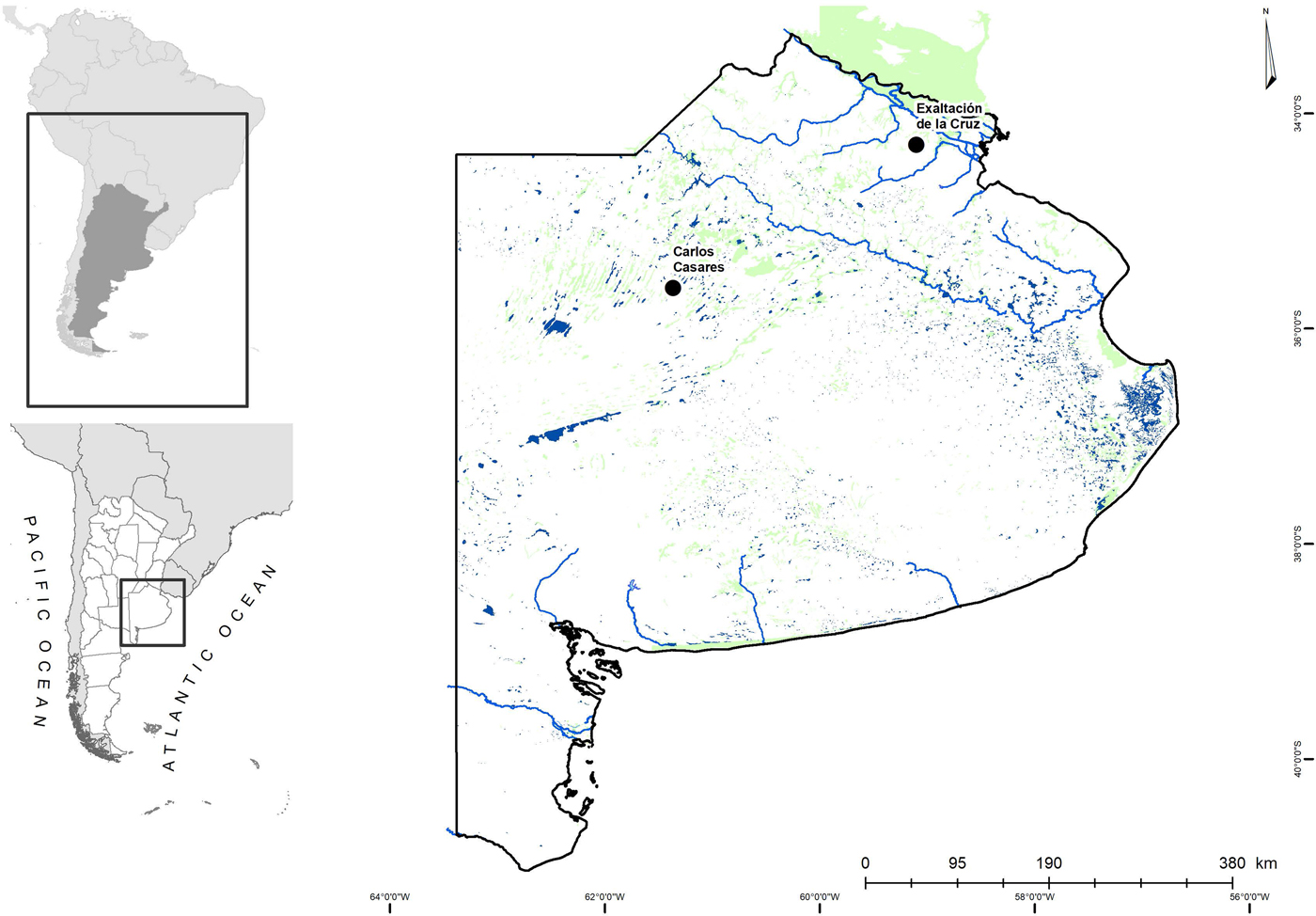
Both localities belong to the Pampa phytogeographical region of Buenos Aires province (Argentina). Therefore, although they are separated by approximately 300 km (EC: 34°18′S, 59°14′W and CC: 35°57′S, 61°12′W, fig. 1), they have very similar characteristics. Both are plains with less than 2° slopes and have humid temperate climates, with average monthly temperatures of 23°C in the warmest month and 8°C in the coldest. It rains homogeneously throughout the year in both areas, but the average annual rainfall is slightly higher in EC (1200 mm) than in CC (1090 mm) (Soriano, Reference Soriano, León, Sala, Lavado, Deregibus, Cauhépé, Scaglia, Velásquez, Lemcoff and Coupland1992). Additionally, the landscape of both localities is characterized by a matrix of crop fields (maize, soybean, sunflower, sorghum, wheat and linen) and animal raising (mainly cows, pigs and chickens) (Soriano et al., Reference Soriano, León, Sala, Lavado, Deregibus, Cauhépé, Scaglia, Velásquez, Lemcoff and Coupland1992. The use of agrochemicals is a frequent practice in both localities, although fences separating adjacent fields were removed to enlarge the cropland surface only in CC.
Map showing the two localities where samples were collected: Exaltación de la Cruz (34°18′S, 59°14′W) and Carlos Casares (35°57′S, 61°12′W) in Buenos Aires province, Argentina.

There are 130 farms devoted to industrial chicken farming spread throughout the 662 km2 of EC county. Each farm includes various poultry sheds and the farmhouse, and is limited by a wire fence, usually covered with semi-natural vegetation (about 0.5–1 m height). The fence separates the farm from surrounding fields, usually devoted to crops or cattle. When sheds are close to the fence (about 2 m), the semi-natural vegetation along the fences extends towards the sheds. Poultry farms are considerably disturbed habitats, since farmers walk around the sheds every day, to assess the condition of chickens, during the 50 breeding days, while, during the non-breeding periods, farmers clean and prepare the sheds for the next breeding period.
The rodent community of the poultry farms of EC consists of seven species: the wild native cricetids A. azarae, Calomys laucha (Fischer, 1874), Calomys musculinus (Thomas, 1913) and Oligoryzomys flavescens (Waterhouse, 1837), and the introduced commensal murids Mus musculus (Linnaeus, 1758), Rattus norvegicus (Berkenhout, 1769) and Rattus rattus (Linnaeus, 1758) (Gómez Villafañe et al., Reference Gómez Villafañe, Miñarro, Ribicich, Rossetti, Rossotti and Busch2004; Miño et al., Reference Miño, Cavia, Gómez Villafañe, Bilenca and Busch2007). Akodon azarae is the most abundant species at weedy fences, while C. laucha, M. musculus and R. norvegicus are more abundant within poultry breeding sheds. Calomys musculinus, O. flavescens and R. rattus are rare species on poultry farms (Gómez Villafañe et al., Reference Gómez Villafañe, Miñarro, Ribicich, Rossetti, Rossotti and Busch2004; Miño et al., Reference Miño, Cavia, Gómez Villafañe, Bilenca and Busch2007). On the other hand, in the rural area of CC, the rodent community consists of four cricetid species: A. azarae, the most abundant species in abandoned fields, C. laucha, the most abundant in cultivated fields, and C. musculinus and O. flavescens, with very low abundance (Hodara & Poggio, Reference Hodara and Poggio2016).
Rodent collection and identification of helminths
Thirty poultry farms out of 130 were chosen randomly in EC. If, by chance, there were farms very close to one another, they were raffled again to ensure that rodents would not move among them. In this habitat, traps were placed every 20 m in line-transects along the fences (usually eight traps) and around the poultry sheds (usually ten traps) and they were active for seven consecutive nights. In CC, 28 abandoned fields (successional pastures, without cattle or agricultural activities for more than 35 years) and 28 cultivated fields (with maize, wheat or soybean) were sampled. Since abandoned and cultivated fields were adjacent, transects located in each habitat were more than 500 m apart, to avoid confounding the effects of both habitats. In each field, one transect with nine traps was installed. They were active for 6–10 consecutive nights, depending on cultivation schedules and climatic conditions.
Rodents were killed in the field, separated in marked bags, and fixed in 10% formalin. Species, body measurements, sex and reproductive state of each individual were recorded in the laboratory. In this study, we included only individuals of A. azarae.
The complete digestive tract and associated organs of each rodent were examined for helminths. The collected helminths were preserved in 70% ethanol. Identifications were made to the species level (except adult cestodes, which could only be identified to the order level) by conventional microscopy, aided by original bibliographic descriptions. Host voucher specimens were deposited at the Colección Nacional de Mastozoología of the Museo Argentino de Ciencias Naturales Bernardino Rivadavia, Buenos Aires, Argentina (MACN-Ma 24022–24036), while helminth voucher specimens were deposited at the Helminthological Collection of the Museo de La Plata, Buenos Aires, Argentina (see Miño et al., Reference Miño, Rojas Herrera, Notarnicola, Robles and Navone2012) and the Colección Nacional de Parasitología of the Museo Argentino de Ciencias Naturales Bernardino Rivadavia (MACN-Pa 620–621).
Data analyses
Prevalence (P) and mean abundance were calculated according to Bush et al. (Reference Bush, Lafferty, Lotz and Shostak1997) for each locality (EC and CC) and habitat (poultry farms, cultivated fields and abandoned fields). In order to estimate the minimum number of hosts required to describe the parasite community, a parasite richness accumulation curve for the hosts captured in each habitat was generated (Magurran, Reference Magurran2004). The Shannon–Wiener index of helminth diversity (H′) was calculated for female and male rodent hosts in each habitat. In order to avoid confusing the zero values resulting from the absence of parasites with those from the presence of a single parasite species, the diversity index was transformed by applying the correction exp H′ (Magurran, Reference Magurran2004).
Mean richness and mean transformed diversity were compared between localities by a t-test for independent samples. The effects of habitats, host sex and season were assessed on the richness and diversity of helminths by generalized linear models (GLM with a Poisson distribution in richness and GLM with a Gamma distribution in diversity) by using the glm function (lme4 package; R Development Core Team, 2016). Both models included three fixed effects: habitat (poultry farms, cultivated fields and abandoned fields), season (considered as a season of high or low rodent abundance, based on previous information mentioned in the Introduction), and host sex. All GLM analysis included interaction terms among fixed factors. When the main effects or interaction terms were statistically significant, post-hoc pairwise comparisons were performed using Fisher's LSD. Following the parsimony criterion, the model with the lowest AIC (Akaike Information Criterion) was chosen as the best one (Burnham & Anderson, Reference Burnham and Anderson2002).
Correspondence analysis (CA) was applied to the abundance of helminth species matrix for all host individuals parasitized (Legendre & Legendre, Reference Legendre and Legendre1998). Finally, the two principal axes derived from CA were correlated with categorical variables (host sex, habitat and season) in order to describe patterns of relationships among the helminth community and those variables. This analysis was performed by using PC-ORD version 6 (McCune & Mefford, Reference McCune and Mefford1999).
Richness at infra-community level was compared between localities by using a chi-square test of homogeneity, under the null hypothesis that infra-communities are homogeneously distributed in both localities.
Pairwise co-occurrence of helminth species was tested separately by locality using null model analysis (Gotelli, Reference Gotelli2000). The V-ratio as co-occurrence index was selected based on the average covariance in association between all possible helminth species pairs. Program SIM2 was used as the co-occurrence randomization algorithm considered to be the most appropriate when comparing samples (hosts) collected in areas of homogeneous habitat. Helminth species co-ocurrence patterns in rodent hosts were evaluated using cooc_null_model () function (EcoSimR package; R Development Core Team, 2016) (Gotelli et al., Reference Gotelli, Hart and Ellison2015).
Results
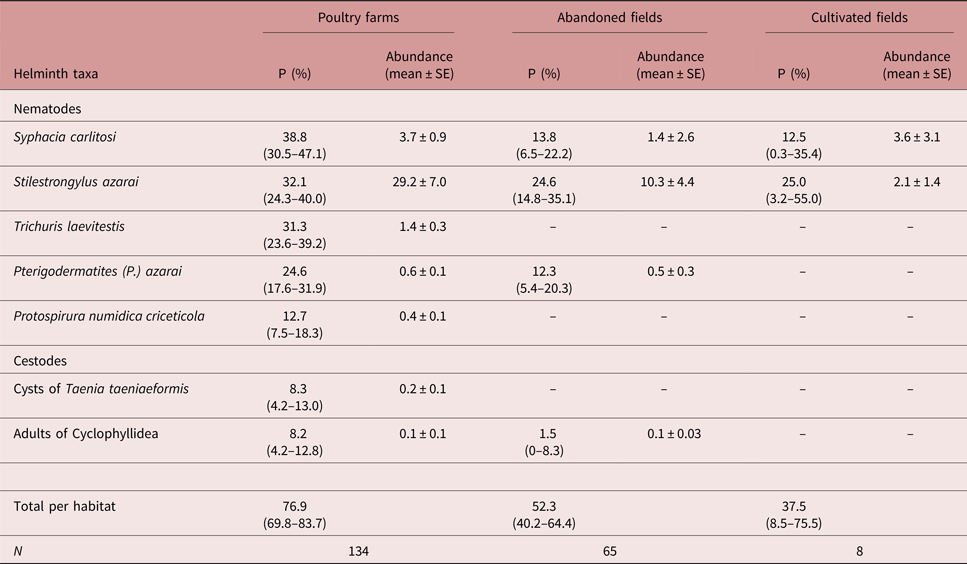
Considering both localities, a total of 207 specimens of A. azarae were captured, and 67.7% of them were parasitized. Out of the 207 A. azarae, 134 were trapped on the poultry farms (prevalence, P = 76.9%), 65 in the abandoned fields (P = 52.3%) and 8 in the cultivated fields (P = 37.5%) (table 2). These numbers of rodents were considered sufficient to describe each parasite community, since the minimum numbers of random hosts required to describe richness were 11, 10 and 3, respectively.
Prevalence (P) and mean abundance for the helminth taxa collected from Akodon azarae captured in three habitats with different land use in the Pampa region, Argentina. N indicates the sample size of hosts examined. The 0.95 binomial confidence intervals for prevalence are given in parentheses.

A total of seven helminth species were recovered, of which five were nematodes – Syphacia carlitosi Robles and Navone, 2007 (Oxyuridae), Stilestrongylus azarai Durette-Desset & Sutton, 1985 (Heligmonellidae), Trichuris laevitestis Suriano & Navone, 1994 (Trichuridae), Pterigodermatites (Paucipectines) azarai (Sutton, 1984) (Rictularoidea) and Protospirura numidica criceticola Quentin, Karimi & Rodriguez de Almeida, 1968 (Spiruroidea) – and two cestodes – strobilocerci of Taenia taeniaeformis (Batsch, 1786) (Taeniidae) and adults of an unidentified Cyclophyllidea (table 2). Rodents from poultry farms were parasitized by five species of nematodes and two cestodes. Those from the abandoned fields presented three species of nematodes and adults of Cyclophyllidea, while rodents captured in cultivated fields presented only two nematode species (table 2).
Although species pairs showed less co-occurrence in rodent hosts captured in CC than expected by chance (V-ratioobserved = 0.739), there was no statistical evidence to show that the co-occurrence of helminth species was non-random (CI95 = 0.67–1.43; P = 0.127). As for pairwise co-occurrence of helminth species parasitizing hosts captured on poultry farms (EC), the null model analysis resulted in a pattern of co-occurrences similar to those randomly expected (V-ratioobserved = 1.090). This result shows that there was considerable heterogeneity in helminth species richness per host (CI95 = 0.77–1.26; P = 0.785).
The mean helminth richness from rodents in EC (1.06) was significantly greater than that observed in hosts captured in CC (0.6) (independent t-test: t 205 = 4.73, P < 0.0001). Richness also differed significantly among habitats depending on the season (GLM Habitat–Season: χ2(2) = 8.68, P = 0.013). The helminth communities were statistically richer within fences of the poultry farms during the season of low density of rodents in relation to all other combinations of habitat and season (post-hoc Fisher's LSD: P < 0.05), but richness varied independently of host sex.
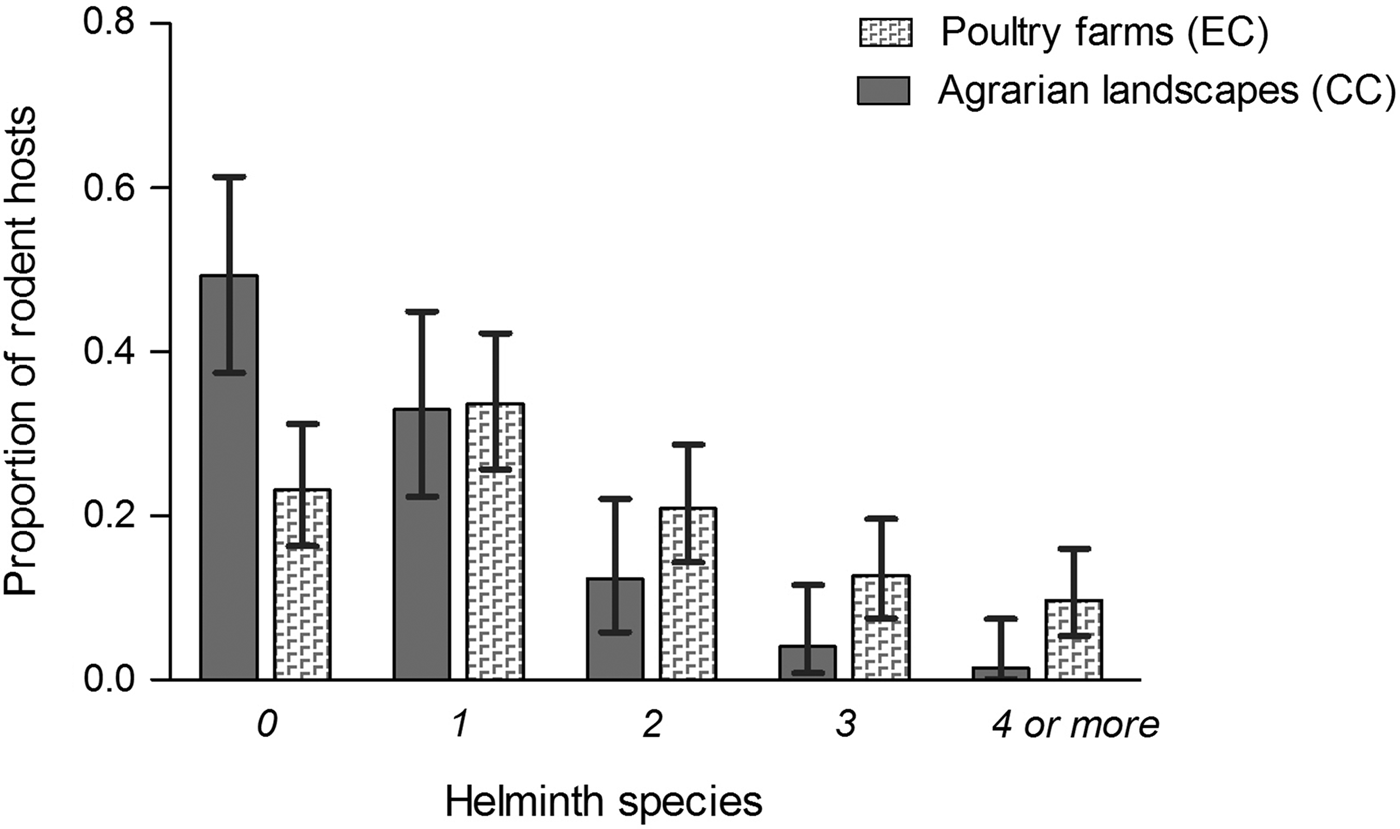
Infra-community richness was not homogeneously distributed between rodents of both localities (homogeneity chi-square test: χ2(4) = 20.4, P = 0.0004). There were more non-parasitized hosts than expected by chance in CC, while rodents captured in EC were more frequently parasitized with two, three, and four or more species of helminths than randomly expected (fig. 2).
Proportion of non-parasitized rodent hosts or those parasitized with one or more helminth species in the locations of Carlos Casares (CC, grey bars) and Exaltación de la Cruz (EC, shaded bars). Error bars represent 0.95 binomial confidence intervals.

The component community from A. azarae captured in EC was significantly more diverse (exp H′mean = 1.32) than that from CC (exp H′mean = 1.12; independent t-test: t 205 = 3.38, P = 0.0009). The best-fitting GLM model for the transformed diversity included only the habitat factor (χ2(2) = 9.84, P = 0.0072). Helminth diversity on the poultry farms was significantly greater than that observed in the cultivated fields and abandoned fields (post-hoc Fisher's LSD: P < 0.05), independent of season and host sex.
Ordination of individual hosts in relation to helminth community using CA showed that the first two axes explained 43.94% of total inertia. Helminth species were better correlated with categorical variables in axis 2 than in the other axes (r = 0.384). They were negatively associated with habitat type and host sex, while they were positively related to season. Male hosts in the abandoned fields were more parasitized with S. carlitosi during the season of low density of rodents, whereas female hosts at the poultry farms were highly parasitized with S. azarai in the season of high abundance of rodents. The remaining species, T. laevitestis, P. (P.) azarai, P. n. criceticola and the cestodes, parasitized A. azarae independently of sex, habitat and season.
Discussion
The component parasite communities from A. azarae in the Pampa region of central Argentina seem to respond to environmental changes caused by anthropogenically related activities. This observation agrees with the findings in rodents from other regions of the world (e.g. King et al., Reference King, McLaughlin, Gendron, Pauli, Giroux, Rondeau, Boily, Juneau and Marcogliese2007; Chaisiri et al., Reference Chaisiri, Chaeychomsri, Siruntawineti, Ribas, Herbreteau and Morand2012; Froeschke & Matthee, Reference Froeschke and Matthee2014). But contrary to our expectations, the greatest richness and diversity values were found on poultry farms, a habitat disturbed on a daily basis by human activities. Moreover, this habitat had a higher proportion of rodents parasitized with two or more helminth species, while the habitats in CC had a greater proportion of non-parasitized rodents. The highest richness and diversity indices on the poultry farms were due to the presence of T. laevitestis, a geohelminth with a direct life cycle, P. n. criceticola, a nematode with an indirect life cycle, and to the cysts of T. taeniaeformis, all of them absent in the rodents captured in the other two habitats.
Cysts of T. taeniaeformis were absent not only from the individuals of A. azarae captured in the fields of CC (cultivated and abandoned) but also from those of all natural environments in which this rodent species has been captured in the past (Navone et al., Reference Navone, Notarnicola, Nava, Robles, Galliari and Lareschi2009; J.N., pers. obs.). The prevalence value observed in this study for T. taeniaeformis (8.3%) is consistent with values documented for other sigmodontine rodents (Theis & Schwab, Reference Theis and Schwab1992; Jones & Pybus, Reference Jones, Pybus, Samuel, Kocan, Pybus and Davis2001), suggesting that its presence in A. azarae on poultry farms was not accidental. Rodents become infected by ingesting tapeworm eggs eliminated with the faeces of the definitive host, such as felids, viverrids and canids, including domestic cats and dogs (Miyasaki, Reference Miyasaki1991; Loos-Frank, Reference Loos-Frank2000). As stated by Miño et al. (Reference Miño, Rojas Herrera and Notarnicola2013) in EC, T. taeniaeformis may have a wild cycle between A. azarae and the feral cat Leopardus geoffroyi (d'Orbigny & Gervain, 1844) (Carnivora: Felidae). This is sustained by the findings of eggs of Taenia sp. (M.H.M., unpubl.) and bones of A. azarae (Guidobono et al., Reference Guidobono, Muñoz, Muschetto, Teta and Busch2016) in faeces of L. geoffroyi inhabiting small woodlands near the poultry farms studied. Moreover, the presence of domestic dogs and cats is frequent on the poultry farms of EC, while in CC we have never detected the presence and/or traces of feral cats, or of domestic cats and dogs. Probably, the vast extent of monoculture in CC, produced by the landscape homogenization process, does not provide shelters or suitable habitats for L. geoffroyi.
Both P. n. criceticola and P. (P.) azarai have arthropods as intermediate hosts (Anderson, Reference Anderson2000). The life cycle of P. n. criceticola in experimental conditions develops between dermapterans and cockroaches and the rodent Zygodontomys lasiurus (Quentin et al., Reference Quentin, Karimi and Rodriguez de Almeida1968). Meanwhile, Pterygodermatites peromysci Lichtenfels, 1970, a parasite from Peromyscus leucopus in North America, closely related to P. (P.) azarai, has three species of Ceuthophilus Scudder (camel crickets) as natural intermediate hosts (Luong & Hudson, Reference Luong and Hudson2012). In Argentina, the arthropod species that transmit these nematodes to A. azarae in wildlife conditions are unknown. Co-occurrence indices between all possible pairs of helminth species in the communities of both localities showed a random pattern of co-occurrence, indicating that there would be neither competitive interactions nor mutualism between either of the species pairs parasitizing A. azarae of both localities. This result reinforces the hypothesis that different intermediate hosts are involved in the transmission of the two nematodes with intermediate hosts. Poultry farming attracts some insects, such as flies, cockroaches or beetles, which become pests on farms (Axtell, Reference Axtell1999). On the other hand, in cultivated fields, the application of agrochemicals is a usual practice, both to stimulate crop growth and to prevent the development of weeds and arthropods considered as pests for crops. This practice may be the reason why several species of parasites with indirect life cycles are absent in cultivated fields while present in other habitats. Among these species, P. n. criceticola was absent in cultivated fields and in abandoned fields. However, its absence from CC could not be attributed to the lower annual rainfall in this locality in comparison with EC, since this parasite species has also been described in rodents from very arid areas, such as the Utah desert in North America (Grundmann, Reference Grundmann1957; Grundmann & Frandsen, Reference Grundmann and Frandsen1960).
The absence of T. laevitestis from CC could be due to the application of agrochemicals. Since this is a geohelmith, its eggs need specific soil conditions to develop. However, it was also absent in abandoned fields and not just in cultivated fields. The average annual rainfall is lower in CC than in EC. Although it is a slight difference (1090 mm in CC and 1200 mm in EC), T. laevitestis has always been recorded in humid areas near water bodies (Robles & Navone, Reference Robles and Navone2014), so it is possible that this species is absent in CC because this locality is not sufficiently humid. On the other hand, its prevalence in A. azarae from poultry farms of EC (31.3%) was as high as ever recorded in natural environments (9–37%) (Navone et al., Reference Navone, Notarnicola, Nava, Robles, Galliari and Lareschi2009; Robles & Navone, Reference Robles and Navone2014), showing that T. laevitestis can survive on farms devoted to poultry activity.
Stilestrongylus azarai was present in the three habitats, with low values of prevalence (25–32.1%) and mean abundance (2.1–29.2) compared with another study carried out in a natural environment (95% and 81.6, respectively, in A. azarae from marshlands; Navone et al., Reference Navone, Notarnicola, Nava, Robles, Galliari and Lareschi2009), and with other species of Stilestrongylus (100% and more than 69.4 for S. flavescens (Navone et al., Reference Navone, Notarnicola, Nava, Robles, Galliari and Lareschi2009); 100% for S. stilesi (Notarnicola et al., Reference Notarnicola, Digiani and López2010)). In the present study, both abundance and infection prevalence were higher on the poultry farms than in the other two habitats, and they were associated with A. azarae females on farms during the season of high abundance of rodents. At the highest peak of abundance, all age classes are represented in rodent populations, but reproductive activity has ended. At that time, females expand their home ranges (Priotto & Steinmann, Reference Priotto and Steinmann1999), overlapping them with those of males until sharing nests with them (Suárez & Kravetz, Reference Suárez and Kravetz1998). This female behaviour can increase contacts among individuals of the same species, while expanding the dispersion area of S. azarai.
Syphacia carlitosi, a nematode with a direct life cycle, is mainly transmitted by oral infection with larvated eggs contaminating the perianal region of mice. This mode of transmission is efficient for the parasite because it is not influenced by environmental conditions and it ensures transmission even in the season of low rodent abundance. Syphacia carlitosi was positively associated with the period of low rodent abundance and with males of A. azarae. This rodent species has a promiscuous polygynous behaviour (Suárez & Kravetz, Reference Suárez and Kravetz1998) and males have larger home ranges compared with females during the reproductive period (Priotto & Steinmann, Reference Priotto and Steinmann1999). This allows them to have more encounters with females, favouring the transmission of this nematode to males.
In this study, the number of A. azarae captured in cultivated fields was eight times lower than in abandoned fields and 17 times lower than on poultry farms. Although the trapping effort was not equal in the three habitats, we consider that capture differences are due to the preference of habitat of A. azarae. Previous studies showed that A. azarae avoids direct farming impacts (Busch et al., Reference Busch, Miño, Dadon and Hodara2001; Hodara & Busch, Reference Hodara and Busch2010; González Fischer et al., Reference González Fischer, Baldi, Codesido and Bilenca2011). This could explain its greater abundance in the abandoned fields, regardless of the use of agrochemicals. However, the intensive use of pesticide may indirectly influence its abundance, preventing it from finding food (annelids, arthropods, seeds and leaves). This is supported by our results on helminth composition and richness, since no parasite species with indirect life cycles were found in the habitat in which pesticides are applied (cultivated fields). The finding of the lowest richness in cultivated fields could also be due to the low number of rodents found there. However, as mentioned above, the number of rodents captured in this habitat would be sufficient to describe the helminth community in this rodent host. Besides, if more rodents had been caught and one more species had been found, increasing helminth richness, it would have been a rare species (not highly prevalent) in the component community of this habitat.
Poultry farms, which are disturbed every day by human activities, showed the greatest abundance of A. azarae. However, all rodent captures in this habitat occurred within vegetated fences, where rodents can find shelter (vegetation cover) and food. Thus, the great human disturbance produced in this habitat may be offset by the absence of agrochemicals and the presence of high vegetation and insects, many of which are attracted by poultry breeding. On the other hand, the high abundance of A. azarae in this habitat would favour the host–parasite encounter rate, which is supported by the highest value of richness, as well as by the greatest prevalence and mean abundance of all parasite species present in this habitat. This coincides with the results of previous studies, which have shown that host densities correlate positively with richness (Morand & Poulin, Reference Morand and Poulin1998), prevalence (Mbora & McPeek, Reference Mbora and McPeek2009) and mean abundance of parasites (Arneberg et al., Reference Arneberg, Skorping, Grenfell and Read1998). In addition, some parasite species found in this habitat could have colonized A. azarae due to its contact with synanthropic rodent species. Among the murids present on poultry farms of EC, only the helminth fauna of R. norvegicus has been studied. The component community of this rat included two nematode species not detected in A. azarae – Heterakis spumosa and Syphacia muris (Robles et al., Reference Robles, Navone and Gómez Villafañe2008) – and liver cysts, probably of T. taeniaeformis (Gómez Villafañe, pers. com.).
In conclusion, farming activities seem to influence the diversity and composition of the helminth fauna of A. azarae in agroecosystems of the Pampa region of Argentina. The vast extension of monocultures would prevent T. taeniaeformis from completing its life cycle, due to the absence of feral cats in these wide fields. On the other hand, poultry farming activity would attract insects, which are intermediate hosts for other parasites of A. azarae. Although we could not prove that agrochemicals influence the helminth community of A. azarae, we think they have some effect on some of its parasite species. This should be tested by future specific studies.
Acknowledgements
We are grateful to the staff at Estancia San Claudio for logistic assistance throughout this project, and to all the farmers of Exaltación de la Cruz who kindly let us work on their farms. We also thank Juan Ariel Insaurralde from IBS for helping with the map.
Financial support
This work was supported by the Universidad de Buenos Aires (grant codes UBACyT X098, 20020090200495), the Consejo Nacional de Investigaciones Científicas y Técnicas (grant code PIP 1410) and the Agencia Nacional de Promoción Científica y Tecnológica, Argentina (K.H., grant codes: BID 1728, OC-AR PICT 16/25591).
Conflict of interest
None.