There is no better preventive of nervous exhaustion than the regular, unhurried, muscular exercise. If we could moderate our hurry, lessen our worry, and increase our open-air exercise, a large portion of nervous disease would be abolished.
James Muir Howie (1888)Footnote 1The great development and wide diffusion and practice of athletic exercises among our people during the last quarter of a century (this diffusion taking place precisely among those classes where the need of it was greatest) has been a very distinct advantage to our national type.
Theodore Roosevelt (1893)Footnote 2Anything is better than the white-blooded deterioration to which we all tend.
Oliver Wendell Holmes Sr. (1899)Footnote 3Irish American cultural identity and United States athletics both grew powerfully in the late nineteenth century. As the Civil War's devastating loss of immigrant and early-generation Irish American lives gradually subsided into memory after 1865, Irish American people increased their political heft, religious confidence, class status, and educational capital.Footnote 4 Gilded Age prosperity had become a reality for the fortunate Irish few, and even recent immigrants understood that peacetime America in the later nineteenth century offered substantial new social and economic opportunities. To these ends, the talented and privileged among white American youth – and Irish Americans were accorded a degree of social privilege by both racial whiteness and English-language skill – increasingly enrolled in the growing number of public secondary schools and public universities, not only availing themselves of improved educational resources made available in nearly every state but also enjoying newly important extracurricular pursuits such as competitive athletics. Amateur and professional athletics across the United States entered a golden age that would persist for more than a century after, into the twenty-first century. Irish American enculturation and serious athletics were on similar trajectories by the later nineteenth century – ascendant as the Gilded Age arrived.Footnote 5
Members of Irish immigrant families, some of whom had arrived from famine-stricken Ireland during the late 1840s while others had delayed their arrival in America until the cessation of the war, were among those most attuned to the late nineteenth-century fitness and athletics craze. By the postbellum years, as Irish immigrants were gradually increasing their social, economic, and political status, sporting culture in America was no longer relegated merely to the shady provinces of horse racing or prizefighting, both of which had existed for centuries in unregulated contests. Popular among the masses, those sporting events would continue on the national scene, as did the uniquely American pastime of baseball. But expanded higher education and urban growth in the United States eventually brought a wider array of more closely regulated amateur athletics into the overlapping realms of advanced education, competitive recreation, and health consciousness.Footnote 6 The genteel and prosperous classes in the United States took to amateur athletics with enthusiasm, especially when sports were coupled with advanced educational credentialing. At first, however, not all sports were equally acceptable for participation by American elites. While competitive gymnastics, baseball, and football readily made permanent homes among enthusiasts from collegiate and upper-class backgrounds, combat sports like professional or amateur boxing – illegal in most American states before the 1920s and yet frequently associated with putative violent ethnic tendencies of the working classes and especially nineteenth-century Irish immigrants – had substantially more complex pathways to social acceptance. For example, Roman Catholic publications aimed at Irish Americans were frequently opposed to participation in violent athletics such as prizefighting, which tended to reinforce negative stereotypes of Irish immigrants.Footnote 7
In order to understand the ways in which late nineteenth-century amateur sport followed a trajectory related to both immigrant assimilation and cultural prestige, the following discussion will first outline changes afoot in Boston amateur athletics during the later nineteenth century. Drawing a tighter focus on Irish immigrant experience, the essay will follow the career path of John Boyle O'Reilly – military veteran, escaped convict, world traveler, poet and novelist, editor of a leading Catholic newspaper, boxing enthusiast, and luminary of the Boston literary world until his early death in 1890. O'Reilly's mercurial rise provides a rare nineteenth-century example of immigrant social and intellectual class mobility. In addition, we can observe through his experiences and writings how the development of upper-class amateur athletics in Boston and the popularity of boxing among its Irish working classes gave him exceptional influence among both groups. His expertise at both amateur boxing and poetry provided O'Reilly with powerful qualifications as a cultural mediator able to surmount obstacles such as social class, religious affiliation, and immigrant standing. As a serious writer and sportsman in Boston, he did so by endorsing and participating in that city's traditional upper-class embrace of intellectual culture while doing his part to encourage rugged athleticism for the well-educated elite. During his career, he also came to figure for the Irish community as a representative immigrant man possessed of authentically Irish bravado and athleticism, but also as a man gifted with refined literary talents usually associated with the most privileged Boston elites. This unusual combination of skills thus gave O'Reilly – a force to be reckoned with at the boxing club, on the lecture dais, or behind his writer's desk – a unique opportunity to negotiate working-class and elite anxieties about identities shaped in relation to both intellectual and physical pursuits. These negotiations, displaying both cultural ambition and sensitivity to embodied experience, can be glimpsed at various points in O'Reilly's career, but perhaps most explicitly in his Ethics of Boxing and Manly Sport (1888), a remarkable statement on pugilism, masculinity, and citizenship published when he was at the height of his literary fame. Above all, our binocular view of Boston's intellectual and physical cultures, observed from the standpoint of O'Reilly, a talented writer and a sort of literary counterpart of famed working-class pugilist John L. Sullivan (his friend, occasional sparring partner, and fellow celebrity among the Irish American community), sheds light on newly available pathways to social mobility made possible by traversing literary and athletic cultures.
Improved scientific understanding of health and physical education, among other factors, had begun by the late nineteenth century to transform amateur sporting participation into a complex masculine signifier of social elevation, finely honed skills, educational attainment, and conspicuous leisure. Much of the early development of American sporting culture was advanced through the influence of elite New England colleges, which in turn set the pace for physical education and amateur athletics for the larger national higher-education system. In relatively short order, and certainly by the dawn of the twentieth century, amateur athletics had burgeoned into new respectability in America. Regulated athletic competition, understood as a mostly healthy set of strenuous pursuits pursued by educated bodies following consistent rules of fair play, had within a few decades of the Civil War's conclusion become a mainstay of masculine bourgeois recreation, social belonging, and personal improvement. Yachting, rowing, equine sports, and tennis continued among the usual elite athletic pastimes, while gymnastics became a respected pursuit in many New England colleges. More obvious for the general public, male spectator sports such as baseball, football, and boxing (amateur and professional versions) grew in popularity nationwide. As the prestige of physical education and amateur athletics increased, however, so too did the broader meanings of American sport evolve, with implications moral, aesthetic, political, and cultural. The new wave of physical fitness and sporting activities signified in complex ways for this generation of Americans. Native-born and immigrant Americans were learning that athletic excellence and physical fitness could mean not merely practical success in industry, the military, or the corporate workplace but also a degree of prestige and status acquired in the pursuit of muscular competition, sociability, and physical fitness.Footnote 8
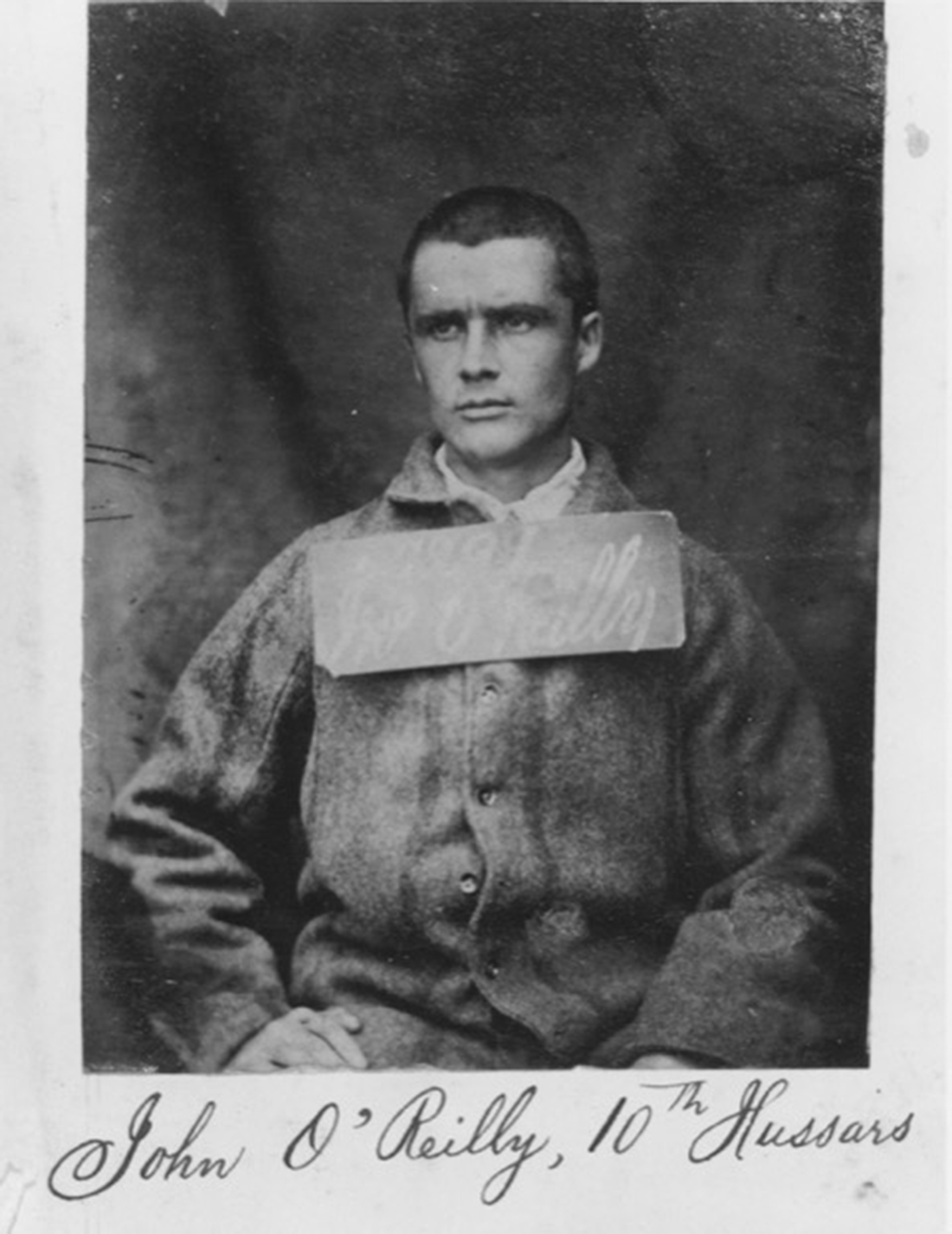
John Boyle O'Reilly, photographed in Mountjoy Prison, Dublin, 1866. New York Public Library.

As sport took on new meanings during the post-Civil War period, amateur athletics – often because of their association with elite educational programs – became indices to American masculine and racial identity and social refinement, even though (or because) some athletic competitions were, as always, physically hazardous. Ancient sports such as wrestling and especially prizefighting had always been physically risky and legally suspect, and they were restricted considerably in nineteenth-century America. Despite their popularity among the masses, bare-knuckle boxing matches, for example, had consistently been outlawed in most of the United States, but by the later nineteenth century even the newly popular sport of intercollegiate football had become notorious for its frequent serious injurious and occasional fatalities. Mayhem on the football gridiron became so common by 1905 that President Theodore Roosevelt, himself a sports enthusiast and advocate since his Harvard days, avoided banning football by using his political power to help introduce new college football rules aimed at reducing serious injuries during competition. Nevertheless, Roosevelt remained steadfast in his opinion that dangerous sports, so vital to masculine and national identity, in his opinion, were well worth their risk. More than a decade earlier, Roosevelt had concluded an essay on athletics for Harper's Weekly by insisting, “The sports especially dear to a vigorous and manly nation are always those in which there is a certain slight element of risk.”Footnote 9 American elites had begun gradually to see combat sports as beneficial, especially those in which risk and injury could be ameliorated but not prevented entirely.
Consensus about the place of athletics in university life remained elusive. At Harvard in 1889, for example, Dr. Dudley A. Sargent, a young professor of physical education and director of the Harvard gymnasium, had his promotion to full professor blocked by the Harvard Board of Overseers, who cited Sargent's stubborn medical opposition to Harvard football. Just a few years later, though, Sargent's personal enthusiasm for rough male sports had been obvious in his most notable publication, The Life and Reminiscences of a 19th Century Gladiator, by John L. Sullivan, Champion of the World (1892), a ghost-written autobiography of the great Irish bare-knuckle world champion.Footnote 10 Sargent, a rising star in Harvard physical education, had indeed expressed reservations about collegiate football's dangers, but his fascination with Sullivan was manifest. In Sargent's lengthy appended anatomical assessment and full-page nude photographs of Sullivan, the Harvard physical education don enthused over “the Boston Strongboy” and his burly physique. Supplementing the brawler's popular memoir in this way, Harvard science and academic prestige thus combined to bring serious consideration to the life and exploits of a professional athlete, whose bare-knuckle prizefights were still illegal in most of the United States. As the example of Dr. Sargent's ambivalence shows, the rise of sporting culture in late nineteenth-century America articulated both a robust enthusiasm for physical fitness and spectatorship as part of bourgeois sensibility, and also a host of lingering reservations about the moral and physical hazards of sport. Those reservations were focused mainly on violent sports, which had long been viewed as anathema to intellect, public safety, and right living. How could the obvious brutality of combat sports be reconciled with the higher aims of American society and the best enculturation of its melting pot of immigrant people? By the later nineteenth century, just as in the twenty-first century, boxing and other dangerous combat sports were strongly associated with working-class men, immigrant identities, and disruptive behaviors, but social mobilities and evolving attitudes about sport were poised to undergo substantial change both within and beyond the ivy walls of Harvard.
As just noted, American athletics (including boxing) grew toward new respectability for Boston elites during the later nineteenth century. Yet the complexities of Irish American participation in upper-class forms of amateur athletics, including amateur styles of boxing that had been introduced into elite college athletics during the later nineteenth century, have not fully been recognized. Previous to the Civil War and in the several decades just following, men of Irish ethnicity had already made a reputation as participants in baseball, track and field events, and, perhaps most notoriously, professional prizefighting; Irish American athleticism was well established, but their sporting success was admired mainly by the Boston working classes. College-educated men of Boston's elite literary world also fostered a subculture of semi-legal (though mostly unprosecuted) amateur boxing sponsored by upper-class male social clubs.Footnote 11 This fascinating athletic demimonde was a vibrant part of elite Boston masculinity during the later nineteenth century, and the cultural capital associated with this form of amateur boxing allowed a perfect opportunity for at least one Irish American immigrant to supplement his already promising career in the world of Boston literary culture.
How could a young Irish immigrant with only a primary-school education and a checkered career as an Australian criminal refugee become a dual force in the intertwined worlds of Boston's high literary circles and secretive fight clubs? A distinguished voice among immigrant Irish Americans across the secular and religious spheres, the editor, poet, and sportsman John Boyle O'Reilly (1844–90) defied odds stacked against many first-generation immigrants. He had first ascended to a position of social respectability and literary prestige thanks to his work with the influential and widely circulated Boston Pilot newspaper, a leading Roman Catholic periodical and “workingman's paper” where he was employed as reporter, editor, and eventually publisher.Footnote 12 At the Boston Pilot, O'Reilly guided a publication that had served as the dominant voice for the Irish community in America, a newspaper widely recognized as such by Catholic churchmen, Fenian nationalists, and (most important) the Yankee cultural establishment of Cambridge intellectuals and Boston's Back Bay elites. Although modest in scale at eight pages per issue, the Boston Pilot in those years was a major source for Irish political news and Roman Catholic culture, and the young prison escapee – perfectly suited to the work – ascended its ranks quickly.Footnote 13
O'Reilly's early background in Ireland had given little indication that he would become one of the preeminent American Catholic intellectuals of his generation, let alone a pioneer in upper-class athletics. Raised in County Meath, Ireland, O'Reilly was one of eight children born to schoolmaster William David O'Reilly and his wife Eliza Boyle. In order for the large family to make ends meet, eleven-year-old John was sent away from the family for several years of apprenticeship as a printer's assistant at the Drogheda Argus – a newspaper first made famous by publishing nationalist tracts by Irish politician Daniel O'Connell. It was a literary beginning destined to radicalize a poor Irish youth. O'Reilly's apprenticeship and journeyman's career in newspaper work led him even as a very young man through the complex and heated debates surrounding Irish emancipation from Great Britain.
After a decade in the newspaper business, O'Reilly was fully immersed in the discourse of Irish independence, but he had also become eligible for British military conscription, which he began to serve as noncommissioned officer in the 11th Lancashire Rifles.Footnote 14 Soon after he donned his military uniform at the age of nineteen in 1863, O'Reilly evidently took up the Irish nationalist cause for the Fenian Brotherhood and began to promote the Irish independence movement from within the British military ranks. Most daringly, his illegal activism took the form of “treasonable songs and ballads”:Footnote 15 rebellious drinking songs that he had composed and then performed among fellow Irish conscripts in the British Army's elite 10th Royal Hussars, a regiment then stationed in Dublin. Still in his teens, then, O'Reilly had been conscripted into the British Army, where he eventually earned local celebrity as the regimental boxing champion, and had begun working secretly to advance the Irish Republican (Fenian) cause. In short order, O'Reilly's alleged conspiracy to mutiny against the British earned him a court martial for high treason, a death sentence commuted to twenty years in jail, confinement in Dartmoor prison and other locations, chain gang labor, and eventually transportation with sixty-two Irish criminals to prison work camps in Fremantle, Western Australia.
Sailing on the Hougoumont (the last British convict ship ever sent to Australia), O'Reilly arrived at the penal colony in 1868. By the age of twenty-four, he had already spent several years as a prisoner, jailed for spreading Irish republican ideas within the military ranks. His incarceration and exile, which later formed the basis of his early celebrity in America, mirrored the experience of thousands of poor Irishmen of his generation who had been sent abroad as cheap labor in Australia or else set sail for America as immigrants. But the O'Reilly legend was soon to deepen with his dramatic escape from an Australian chain gang, days adrift on an open boat, rescue by and six months’ work aboard a New Bedford whaleship and other sailing vessels, and eventually migration as a deckhand to Philadelphia, penniless and unknown, on 23 November 1869.Footnote 16
O'Reilly soon moved to Boston, where he joined its community of Irish nationalists and set to work on a lecturing and writing career. His journalism caused a sensation when he covered the ill-fated Fenian invasion of Canada, as Irish Republican sympathizers there tried to use the Canadian conflict as leverage to force British withdrawal from Ireland. Soon after, though, O'Reilly's literary talents brought him additional attention. Narrative poetry recounting his nautical and travel adventures brought him notice almost immediately. “The Amber Whale” (1871), a notable example in this genre, was published in the New York Tribune and brought a lucrative (but rejected) job offer from the Tribune’s famous editor, Horace Greeley.Footnote 17 By 1875, rising to prominence on the Pilot, O'Reilly would be widely known in Boston as a talented editor, poet, and lecturer. By 1880, he had become the premier American political and poetical voice for the Irish independence campaign. Poetry constituted only a part of O'Reilly's early fame in Boston. His celebrity increased when the young Irishman took to the lecture circuit, describing his travails as a criminal prisoner sentenced to hard labor in Western Australia. It was a topic calculated to stir the hearts of the immigrant Irish, many of whom had experienced difficult voyages of their own while removing to their adopted country in the United States. Eloquent speeches on the national lecture circuit, featuring both his poetry and prose writing, soon brought him attention from the literary establishment both in America and in Ireland. Public lecture performances by O'Reilly, whose escape from Australia had already become legend among the Fenian community in Boston, were prelude to distinguished literary and editorial work. Editorial prominence at the Pilot, where he was hired in 1870, combined with his growing fame as a public speaker, eventually brought him praise not only from understandably sympathetic Irish Americans but also from stars in the Protestant literary firmament. Counting him as an important literary associate (he had become president of the Boston Press Club in 1879) were important activists and writers such as Oliver Wendell Holmes, George Washington Cable, Henry Wadsworth Longfellow, Wendell Phillips, Julia Ward Howe, Mark Twain, Walt Whitman, Oscar Wilde, and Thomas Wentworth Higginson. The highest literary reputation for O'Reilly grew mainly out of his accomplishments as a poet, but he also served as perhaps the most visible Irish American (and Catholic) editor of his generation. Ralph Waldo Emerson knew the Irish poet/editor and socialized occasionally with him, while Walt Whitman held O'Reilly in high esteem and described him in laudatory terms, regarding him as a personal friend whose life and work were “clean, clear, afire with ideals of justice.”Footnote 18
Firm in his religious faith and widely recognized for his talents as editor and poet, the dashing young Irish immigrant was eventually befriended and promoted by influential Catholic leaders including his contemporary, Archbishop (and later Cardinal) James Gibbons of Baltimore. Indeed, it was Cardinal Gibbons, himself a literary man of considerable talents and an influential political broker for Baltimore Catholics, who went on to write an admiring preface to a lavish edition of O'Reilly's biography after the latter's untimely death. Cardinal Gibbons, a sophisticated and well-traveled literary man in his own right who was already on his way to enormous influence among American Catholics, allowed that, in the modern age of industrial print media, poet–journalists such as O'Reilly were endowed with power akin to church leaders:
The vocation of the poet is close akin to that of the priest, and it is not to be wondered at that during most of his life our poet's nearest and dearest friends were clergymen.
In his career as a journalist, the magnanimity and self-control thus variously impressed upon him and infused into him were especially manifested. Constantly obliged to deal with burning questions, he usually handled them with a conservative prudence scarcely to be expected in one so vehement by nature.Footnote 19
O'Reilly's mercurial and prolific career in Boston letters thus advanced not only a Roman Catholic cultural hero whose writings were admired by church leaders and recognized by the broader intellectual establishment, but also (as we shall see) a man whose physical and athletic exploits and writings provided a new form of white ethnic confidence with a richly embodied and highly competitive sporting sensibility.Footnote 20
The success and prominence of his work as editor and poet brought O'Reilly recognition well beyond his own immigrant community. By mid-career, he had become one of the first Irish American immigrants of his generation to gain acceptance not only among his fellow Catholics but also in the insular Protestant world of Boston's literary establishment. His success in the literary and intellectual realms of Boston would be impressive by any measure for a man whose identity was bound up with the New England Irish – a minority ethnic group with growing political influence but still marginalized educationally and culturally. Only a few decades previously, Henry Thoreau in Walden; Or, Life in the Woods (1854) had described Irish immigrants not only as impoverished (Thoreau admired some styles of poverty) but also as notable examples of the “degraded poor.”Footnote 21 For Thoreau, who had built his Walden cabin from lumber reclaimed from an indigent Irish family living near the railroad tracks, the immigrant Irish of his day were a miserable and unhealthy lot:
Ireland … is marked as one of the white or enlightened spots on the map. [But] contrast the physical condition of the Irish with that of the North American Indian, or the South Sea Islander, or any other savage race before it was degraded by contact with the civilized man … Their condition only proves what squalidness may consist with civilization.Footnote 22
Thoreau, a Harvard man, disdained Irish immigrants as physically slovenly and hopelessly uncouth. And yet, as historian Jack Morgan has observed, by the 1870s O'Reilly, an
erstwhile Fenian exile … had assumed a conspicuous role in the city's political and cultural life and was treated pretty much as to-the-manor-born by literary Boston: elected an honorary member of Dartmouth's Phi Beta Kappa chapter in 1881 … and chosen in 1889 as well to write and deliver the dedication poem for the Pilgrim monument at Plymouth Rock. He served as an accomplished intermediary between the Irish and Yankee communities, and was part of the Boston circle of Thomas Bailey Aldridge, editor of the Atlantic Monthly.Footnote 23
Emblematic and exemplary of the Irish rise to social and political prominence in Boston, O'Reilly figured as a role model for his native people, a man much more celebrated than most Massachusetts intellectuals and with superior connections among the Boston media elite, setting out important terms of the working-class Irish embrace of mainstream culture along both intellectual and physical lines.
As he navigated the Boston literary and social scene, O'Reilly participated enthusiastically in a complex network of men's clubs and drinking establishments, several of which featured notable members drawn from the city's men of wealth and taste, including authors and artists. He deftly made his way onto the rolls of male literary clubs such as the Papyrus Club (aimed at journalists) and the St. Botolph Club (which he helped to cofound in 1880), both of which served the valuable function of connecting the young editor with a powerful Boston literary constituency. It was from relationships developed at the St. Botolph Club and the Papyrus Club – O'Reilly was president and one of only two Irish Catholic members of the latter clubFootnote 24 – that O'Reilly befriended Boston publishers including Henry Houghton and George Mifflin, the novelist and editor of the Atlantic Monthly William Dean Howells, and historian and future Senator Henry Cabot Lodge. The St. Botolph Club, noted for a membership drawn from literary and artistic circles, fostered more connections for O'Reilly during his literary career, most notably as his membership brought him to the attention of fellow poet Walt Whitman.Footnote 25 As O'Reilly the newspaperman navigated the Boston social and literary world, his work at the Boston Pilot gave him an Irish Nationalist editorial position that has been described as “guardian of the [Irish] national dignity.” In this role, according to historian Roger Lane, O'Reilly “had felt it his duty to maintain a steep standard of respectability, and had stood guard especially against the use of Irish dialect, and such stereotypes as the red-headed prize fighter.”Footnote 26
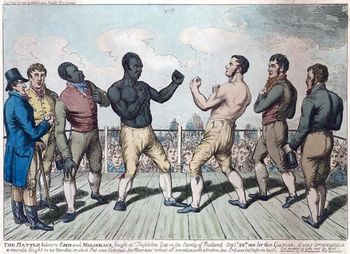
In 1880, though, as O'Reilly's career crested, he also had joined a new, edgier Boston men's organization – the Cribb Club – which coupled a stated allegiance to the literary arts with a more discreet focus on encouraging the manly art of boxing. John Boyle O'Reilly, an important Irish American journalist, a rags-to-riches editor, and a respected poet–moralist, was also a fitness enthusiast and keen sportsman – and he had joined an upper-class fight club in midtown Boston. The Cribb Club had received its name from an Englishman named Tom Cribb (1781–1848), a famed bareknuckle boxing champion whose reputation had been enhanced because of his high-profile victories in England over African American challengers. O'Reilly's newspaper colleague and biographer James Jeffrey Roche notes that while other Boston literary clubs of the day had hundreds of members,Footnote 27 the Cribb Club “was limited to twenty-five active and one hundred and twenty-five honorary or associate members. O'Reilly [a club officer] belonged to the former.”Footnote 28 Roche does not describe the Cribb Club's athletic pursuits in full detail, but from his commentary it seems that this elite Boston fight club existed mainly for the purpose of staging fierce boxing matches among its members, of whom O'Reilly was the acknowledged star athlete:
The Cribb Club, founded for the encouragement of the “manly art,” was one of the most exclusive in the exclusive city of Boston, numbering among its membership men distinguished in art, literature, and statesmanship. They were strong, brave, honorable men, who loved the natural virtue of courage as much as they hated the cowardly custom which has made the use of the knife and pistol a reproach to the American name. O'Reilly had all the qualifications to win him popularity in the company of courageous gentlemen.Footnote 29
The exclusivity of the Cribb Club's membership, provided not to ordinary “sporting men” but only to athletes from the literary classes, meant that O'Reilly could pursue his athletic hobbies while simultaneously ascending a cultural ladder that would have been foreclosed to less privileged members of Boston's immigrant communities. Membership in the Cribb Club for an Irish American man, because of Tom Cribb's notoriety for having defeated skilled African American boxers, also would have solidified perceptions of Irish athletic prowess in white racial terms.
Bareknuckle boxing match, 1811, between Tom Cribb (right, England) and former slave Tom Molineaux (Richmond, Virginia). George Cruikshank illustration, 1811. Wikipedia image, public domain.

That Cribb Club-style amateur boxing was considered an important marker of upper-class athleticism (by contrast with the well-known brutalities of working-class prizefighting) can be gleaned from Bacon's Dictionary of Boston (1886), a reference compendium aimed at Boston elites and compiled by Edwin Monroe Bacon, scion of an old Boston family and one of O'Reilly's fellow newspaper editors:
The most conspicuous of the boxing clubs [in Boston] is the Cribb Club … It has been in existence for several years. It has over 100 members; and, as good standing in society is an essential quality for membership, it numbers among its patrons journalists, lawyers, physicians, and business men. The admission of new members is confided to an election committee, and their nomination must be seconded by two members … The rooms are fitted with all the appliances for boxing, fencing, and wrestling; and are open to members from three to six o'clock every afternoon when a professor of sparring is in attendance to give lessons to such as may desire them.Footnote 30
For the working professional man, elite boxing clubs allowed enjoyment of intense fitness regimens, overnight accommodation, and afternoon homosocial activities separate from domestic life but also separate from the ethnically organized tavern culture so often associated with nineteenth- and twentieth-century Irish immigrant sociality. Upper-class Boston men thrilled to the bracing notion of adding physical fighting to their intellectual reputations. Joining the asthmatic and sickly Oliver Wendell Holmes Sr. in admiring the amateur boxing craze, Nathaniel Parker Willis, the Boston-bred New York poet and editor – a man who had suffered an embarrassing public beating at the hands of actor Edwin Forrest – also typified such views when he remarked that while America was ascendant as a global power, physical fitness “is the only attribute of power in which [we Americans] are losing power.”Footnote 31
Cribb Club membership marked O'Reilly as an exemplary immigrant, equally talented in the cultural and physical realms: “He is one of the brightest ornaments of the Irish race abroad,” wrote one of his admirers; “he lives in exile for his service to his country; he has enriched its national literature with exquisite prose and yet more exquisite verse.” Only a decade after his arrival from Australia, O'Reilly's literary prestige was well established. His celebrity even crossed traditional religious lines, as in spring 1881 when he received an honorary degree from the University of Notre Dame and was elected an honorary member of Phi Beta Kappa by Dartmouth College.Footnote 32 Although O'Reilly associated with fellow Cribb Club member and boxing superstar John L. Sullivan, as in 1883 when O'Reilly presided as emcee at a major Cribb Club-sponsored professional match featuring Sullivan and conducted before fifteen thousand spectators in Boston, he still managed to keep his high social position and enviable status among literary peers.Footnote 33
Perhaps equally important, fellow Bostonian fight club members not only vouched for the pure amateurism of O'Reilly's fighting, but at the same time attested to his exemplary status as model Irish American and “apostle of muscular Christianity,”Footnote 34 who combined a reverence for muscular bodies with sturdy, reassuringly heterosexual identity:
[O'Reilly] excels in all manly arts and accomplishments in a way that we are almost afraid to chronicle, so like the hero of romance the list would make him seem. Who among amateurs can ride better, row better, walk better? Above all, who can box better? If such a man is red-hot in his enthusiasm for the brawn and biceps of a famous pugilist, it is not with the sham enthusiasm of the dandies of old Rome who pinched the muscles of gladiators with slim feminine fingers.Footnote 35
It is clear that O'Reilly's literary contemporaries knew well about their favorite poet–editor's passion for club boxing. Reflecting on O'Reilly's temperament at work, his business associate and Cribb Club member Edward A. Moseley recalled that in the late 1880s, during a visit to the Pilot offices, O'Reilly challenged him to an impromptu boxing match:
“Dear old man,” cried O'Reilly to his friend, “I have been working so hard! Let us go down to the club and I will throw some of the blood out of my brain into my arms and fists”. They fought a tough contest until it became apparent that “one of the other of us must go down.” Another club member jumped into the ring to separate the two pugilists.Footnote 36
According to his good friend Moseley, O'Reilly even sparred on at least one occasion with the reigning world champion boxer and working-class hero John L. Sullivan, thanks to O'Reilly's connections at the Cribb Club. As for O'Reilly's talents as a boxer, Moseley wrote that the young Catholic poet–editor possessed a powerful punch “almost forcible enough to knock an ox down,” and that O'Reilly “did not have the slightest sympathy for a man in full vigour who could not take as well as give a blow.”Footnote 37 Athletic versatility also marked O'Reilly's physical interests and accomplishments. During his most active years as an amateur boxer, he supported and participated in numerous other sports, including fencing (learned during his service with the 10th Royal Hussars), rowing, canoeing, and Irish hurling. In 1879, O'Reilly became a cofounder of the Irish Athletic Club of Boston, which held annual hurling competitions.Footnote 38
Urban life in the latter part of the century had created a rough-and-tumble situation for the numerous young men who were populating the important eastern cities of the United States. Indeed, because of dramatically increased immigration to the United States in the years following the Civil War, perhaps as many as one-third of New York residents were foreign-born. Thus ethnicity had become an important element in the acculturation of the modern male in American cities, even as new careers in commerce and service sectors were replacing agricultural and industrial jobs. By the time O'Reilly reached full prominence as a writer and editor for the Boston Pilot in the 1880s,Footnote 39 he was both witness to and full participant in an era when masculine American identities for immigrants were under pressure.Footnote 40 For O'Reilly the immigrant poet–editor, as for the adult male population as a whole during the later nineteenth century, physical fitness and tests of athletic prowess and adventure had grown more valuable as markers of upper-class belonging.
While John L. Sullivan the immigrant laborer-turned-professional brawler would triumph in the prizefighting realm, his Irish friend and countryman John Boyle O'Reilly followed a parallel trajectory by prevailing in the homosocial world of Boston men's clubs, whose members were drawn to membership in various degrees by literary, artistic, and social concerns. A Boston social club featuring secret boxing matches during this period was indeed an expression of male bonding among cultural elites, but the Cribb Club was also a form of rebellion against the cultural hierarchies in which upper-class men were immersed.Footnote 41 In 1876, the Massachusetts State Supreme Court ruled that “prizefighting, boxing matches, and encounters of that kind, tend to breaches of the peace, and are unlawful even when entered into by agreement and without anger or will.”Footnote 42 It would be more than twenty years before England's most elite universities, Cambridge and Oxford, would bring amateur boxing fully into educational respectability for its male students with their first intercollegiate boxing match in 1897.Footnote 43 Nevertheless, by 1880, one mark of the established Boston professional man was his amateur athletic prowess, which O'Reilly, true to his pedigree as Irish immigrant, expressed through his activities in the Cribb Club, which allowed him to leverage his pugilistic skills for enhanced cultural capital and greater social status.
Bursting with enthusiasm for amateur boxing, O'Reilly used his newfound celebrity and prestige in publishing a remarkable illustrated history and defense of pugilism, Ethics of Boxing and Manly Sport (1888), which was brought out by the venerable Boston publishers Ticknor and Company. Given the cultural politics of late nineteenth-century Boston, it seems likely that O'Reilly's learned study of boxing was developed in large part because of the recent celebrity of the famed Irish American boxer John L. Sullivan, who the year before (1887) been awarded a world championship title to much fanfare. John L. Sullivan – nicknamed “the Boston Strongboy” – also stood in the eyes of many as an able representative of domineering male physicality as pathway to social triumph. During precisely the same years that O'Reilly (an amateur boxer) was ascending into the literary firmament, Sullivan drew on his fame as a bareknuckle fighter in order to establish himself in the emerging sport of gloved boxing. As late as 1889, however, Sullivan continued his dominance in bareknuckle prizefights, as evidenced by his seventy-five-round victory that year in a bareknuckle match held in Gulfport, Mississippi. During the 1890s, led by Sullivan's transition to Marquis of Queensbury boxing rules and his adoption of gloved boxing style, bareknuckle fighting declined in popularity.Footnote 44 Writing for The Nation, Irish countryman and fellow immigrant E. L. Godkin opined in 1883 that with the arrival of gloved boxing no longer was Sullivan's fighting prowess admired merely by the “coarse and uneducated and vicious class” but that his masculine celebrity “is fed by secret rills of sympathy from higher sources.”Footnote 45
Prominent American newspapers had established Sullivan as a celebrity by the later nineteenth century, whereas earlier media reports about prizefighting often reflected a blend of alarm at the rough world of Irish-dominated American sports. Sports historian George S. Hage, citing extensive newspaper coverage of a prizefight between two Irish American boxers, notes that “The [New York] Tribune gave six full columns to the fight between John C. Morrissey and John C. Heenan on October 22, 1858, even as it denounced the prize ring as sinking according to ‘its natural gravity of baseness. It is in the grog-shops and the brothels and the low gaming hells.’”Footnote 46 As such reports indicate, American news media of the later nineteenth century looked at the violent world of Irish immigrant sport with both fascination and alarm, even as the nation was only decades away from wholesale incorporation of organized athletics, including amateur boxing, into the American university. It is thus, perhaps, no accident that, with the fading of the bareknuckle fighting, interest grew among the general public in a new form of boxing that would suit a more refined audience while still serving as a rugged theater of violence in which to stage acceptable forms of competitive masculinity. Gloved boxing, according to Sullivan in his autobiography, allowed upper-class men to experience to some extent the primal benefits of the purer form of the sport: “gloved contests as I have referred to, under fitting conditions, will arouse the interest of classes who have sacrificed the benefits of boxing, as an exercise, on account of prejudice caused by the work of bared fists in the old-fashioned prize fighting.”Footnote 47 Thanks in part to Sullivan, the most famous Irish immigrant of his generation, and his endorsement of gloved fighting, and with help from O'Reilly, a literary man of high celebrity and advocate for manly athletic combat, upper-class American men had new license to indulge in the most primal of athletic pursuits: the fight.
O'Reilly's early writings for Irish American readers, soon after his escape from Australian prison and well before the years of his prominence as editor of the Boston Pilot, evidenced a strong commitment to physical culture and athletic training. For example, while his prose writings on Irish politics comprised his staple contributions, his newspaper poetry included titles such as “Bone and Sinew and Brain” (published in 1874 in the Boston Pilot), a lyric to nationalism that insists upon muscularity for social power: “For men of the future reign / Must have faithful souls and kindly hearts, / And bone and sinew and brain.”Footnote 48 O'Reilly's writings in prose and poetry give a consistent sense of a necessary relationship between fit bodies and virtuous citizenship, which he expresses most plainly in his unpublished note “Character in Muscle” (1891). In this O'Reilly text, lean athleticism, healthy spiritual enjoyment, and human virtue are knit together explicitly: “There is character as well as strength in muscle; and little of either in flabbiness or lard … Fatness and softness are merely sensuous expressions, or symptoms of disease. They are non-conductors of spiritual messages, stopping or deadening the finer currents of enjoyment, as an insulator stops electricity.”Footnote 49 From this perspective, shared with a community of Irish Catholic readers, physical fitness and sporting prowess would be understood as essential for tracing male ethnic achievement and competitiveness. Sport – vigorous and demanding forms of sport – thus could be reconciled as fruitful activities that mirrored industrial and commercial competition, while at the same time reinforcing a broader call to physical pleasure and social attainment for a rising generation of Irish American Catholics.Footnote 50
O'Reilly's prominence as a writer for a major Boston Catholic periodical would have made his voice especially effective in advancing the boxer Sullivan as a representative yet transitional figure with strong ethnic ties to the Irish community. As O'Reilly's career develops, along with his growing prominence in both politics and the literary arts, one can observe an evolution in his ideas concerning immigrant Irish identity. In some ways, O'Reilly's advocacy for Sullivan's boxing connected with his identity as Irish partisan. Likewise, O'Reilly's treatise on boxing, manly fitness, and the larger world of amateur sport would have provided encouragement for working-class and middle-class Irish American readers interested in the cultural capital and sheer entertainment value of elite athletics. In an unpublished comment on the subject, “Our Duty to the Future American” (1891), the Irish poet–pugilist struck a classical balance between the physical, religious, and intellectual aspects of the increasingly vital national education project encompassing compulsory education and the growth of universities. Here O'Reilly is unwavering in his devotion to American nationalism and the relationship (moral and aesthetic) between athletic culture, intellectual attainment, and political ascendancy:
To make the future American all he ought to be, physically, mentally and spiritually, we must build gymnasiums as well as schools and churches. We must honor the teaching of health and strength and beauty, as the Greeks did, as well as the teaching of books and the sciences. We must cover our incomparable rivers with canoes and light outrigged boats, as we are covering our bays with white-sailed yachts. We must see that every square fifty yards of clear ice in winter is covered with merry skaters.Footnote 51
At a cultural moment when rapidly expanding American universities were advancing their reputations in part by means of superior intercollegiate athletics, O'Reilly's Irish-centric boxing treatise would have been a useful means of showing both the legacy of military athleticism in Irish history, and the dovetailing of modern Irish identity with the more refined American principles of civilized, amateur sports such as modern boxing.
John L. Sullivan's boxing celebrity would seem reason enough for an Irish American intellectual such as O'Reilly to situate his writing in the realm of athleticism and physical fitness. Brawny and charismatic, Sullivan's career obviously spoke to the masculine identities of immigrant Irish men of O'Reilly's generation, many of whom had arrived after the Civil War without having tested themselves in that conflict, which had been traumatic for a previous generation of American men, including Irish American men. With the war over slavery ended amid battle deaths in the many hundreds of thousands, Irish American men in search of improved prosperity and status may have seen in competitive athletics an attractive way forward. Sullivan's rough-hewn boxing style of the late 1880s, which grew directly out of the earlier, brutal world of bareknuckle prizefights, may have offered for some in the Irish American community a pathway toward the growing esteem for male physical fitness in nineteenth-century Anglo-American culture. As an Irish American intellectual like O'Reilly looked to boxing and athletics for recreation and self-making, he also figured as a more elite example of the larger demographic shifts involving young immigrant men. Cultural historian John F. Kasson has shown that there are good reasons for calling the late nineteenth century a true “age of the bachelor” in America: “In 1890 an estimated two-thirds of all men aged fifteen to thirty-four were unmarried, a proportion that changed little through the first two decades of the twentieth century. In cities the proportion was higher still, forming the basis for a flourishing immigrant/bachelor subculture that included a growing gay subculture.”Footnote 52 Moreover, Christian evangelism in the late nineteenth century accelerated the trajectory of upwardly mobile immigrant men toward athletic participation. Fitness historian Harvey Green has demonstrated that the
postwar fitness crusade gained more followers as physical education and body building were linked with the continued strength of evangelical Christianity. Religious revivals of the late 1850s and after were strongest in the cities of the northern states, and Americans seemed especially taken with “Muscular Christianity”, a movement that originated in England in the first half of the nineteenth century.Footnote 53
When the young Chicago sculptor John Talbott Donoghue brought several of his nude bronze works to Boston in 1887, including a life-sized statue modeled on John L. Sullivan himself, O'Reilly wrote of the statue rapturously in an exhibition review for the Pilot, calling The Boxer “an ambitious modernism” and “profoundly great”:
[the Boxer sculpture] is, as all noble art must be, a symbol that is higher than a mere fact, or any thousand facts. It is absurd to say that this is a statue of Sullivan, the boxer, even though he posed for it. It is a hundred Sullivans in one. It is the essential meaning and expression of all such men as Sullivan. It is just what the great sculptor who conceived it calls it: “The Boxer,” a personification of the power, will, grace, beauty, brutality, and majesty of the perfect pugilist of modern times.Footnote 54
Remarks such as these suggest that heterosexual manhood is O'Reilly's default terrain for both immigrant success and sporting accomplishment, which he associates with health and masculinity but also with nationalism rightly understood. In Ethics of Manly Sport, he criticizes one prominent critic who objected to the high prestige of sport by writing that “Sydney Smith, who liked almost everything that was good, by some queer mental perversion, despised and detested manly exercise.” Muscular citizenship tied to normative masculine identity thus forms the foundation of O'Reilly's commitments to boxing culture:
it is of very great importance … that, in case he were called on, for personal or patriotic duty, to swim or climb for a life, to fight for a child or a woman, to defend his country in the field, he should be ready with a strong body, a stout heart, and a trained hand and mind to raise him over difficulty and danger.Footnote 55
Similar calls for reinforcement of masculinity via the emergent manly sports can be heard from a variety of contemporary voices, including some at the higher reaches of New England intellectual life. Writing for Boston's venerable North American Review, just as John L. Sullivan's fame in American sport was reaching its apogee, the attorney, novelist, classical historian, and boxing enthusiast Duffield Osborne delivered his essay “A Defense of Pugilism” (1888). While admitting that boxing sometimes attracted criminal and otherwise malicious elements to its ranks, Osborne makes several valuable points, including the roots of combat sports in classical literature, the dangers inherent in other athletic pursuits such as football or riding, and the sheer freedom of competition enjoyed by competitive athletes in combat sports like boxing. More than these factors, though, Osborne emphasized the importance of strengthening “the race” and the manhood of its members, who ran the risk of sentimental over-feminization if prevented from expressing themselves through dangerous sport:
Impress it upon the boy that physical pain is the greatest evil, that he must carefully avoid every amusement in which he is apt to get hurt, and you are in a fair way to develop a nation of contemptible sybarites. Yet there is no mistaking the tendency. The same hue and cry is raised by the same people whenever a man is hurt at football, and the colleges are besieged with advice to abolish that “brutal pastime”. Can any sane and unprejudiced man believe that the promulgation of such a doctrine will improve a race?
Admiring the fair-play ethos of prizefighting as a character-building endeavor far superior to brute savagery or mere brawling, but also fearing a decline into masculinity-sapping weakness, Osborne sketches his anxiety plainly in the language of gender panic:
Has mawkish sentimentality become the shibboleth of the progress of civilization and refinement of this vaunted age? If so, then in Heaven's name leave us a saving touch of honest, old-fashioned barbarism! that when we come to die, we shall die, leaving men behind us, and not a race of eminently respectable female saints!Footnote 56
O'Reilly's history of pugilism takes the further step of aligning combat sports with both democracy and the common man's dignity.
In all countries and times where the common man was ready and able to fight, singly and combined, freedom was at its highest. The ability of the common man to assert himself is everywhere and always the measure of popular liberty … knowing how to fight makes common men self-reliant and independent. A people are preparing for their own subjection to a class, or a tyranny, where a generation is allowed to grow up without physical training and emulation … Every boy in a free country ought to be instructed in boxing, wrestling, and the use of weapons.Footnote 57
No sport or game captures O'Reilly's reverence nearly so much as boxing, however. Sports based merely on endurance lack the combative vitality and urgent appeal of boxing: “It is not the big, evenly disposed opposition of nature he has to overcome, like the swimmer or the runner, but the keen and precise cunning of an excited brain, that is watching him with eyes as bright as a hawk's.”Footnote 58 Ever sensitive to genteel values, O'Reilly is careful to differentiate the newer, refined art of gloved boxing from its more brutal earlier forms of bareknuckle fighting:
All that is worth seeing in good boxing can be witnessed in a contest with soft gloves. Every value is called out, quickness, force, precision, foresight, readiness, pluck, and endurance. With these the rowdy and “rough” are not satisfied. To please their taste, they must be smeared with blood, served up with furious temper, mashed features, and surrounded by a reeking and sanguinary crowd. The prize fight with bare hands … is only fit for brutalized men. We trust that the [championship] fight in New Orleans will be the last ever seen in America without gloves. It is highly to the credit of the winning man, John L. Sullivan, that he wished to fight with gloves.Footnote 59
There is a moral dimension to boxing, according to O'Reilly, that differentiates it from other strenuous pursuits: “The elements of character which boxing, better than all other exercises, develops, are fairness of personal judgment and an acceptance of give-and-take … if boxing were taught in every American school, as it ought to be, there would be fewer bullies and cowards sent out unpunished and uncorrected.”Footnote 60
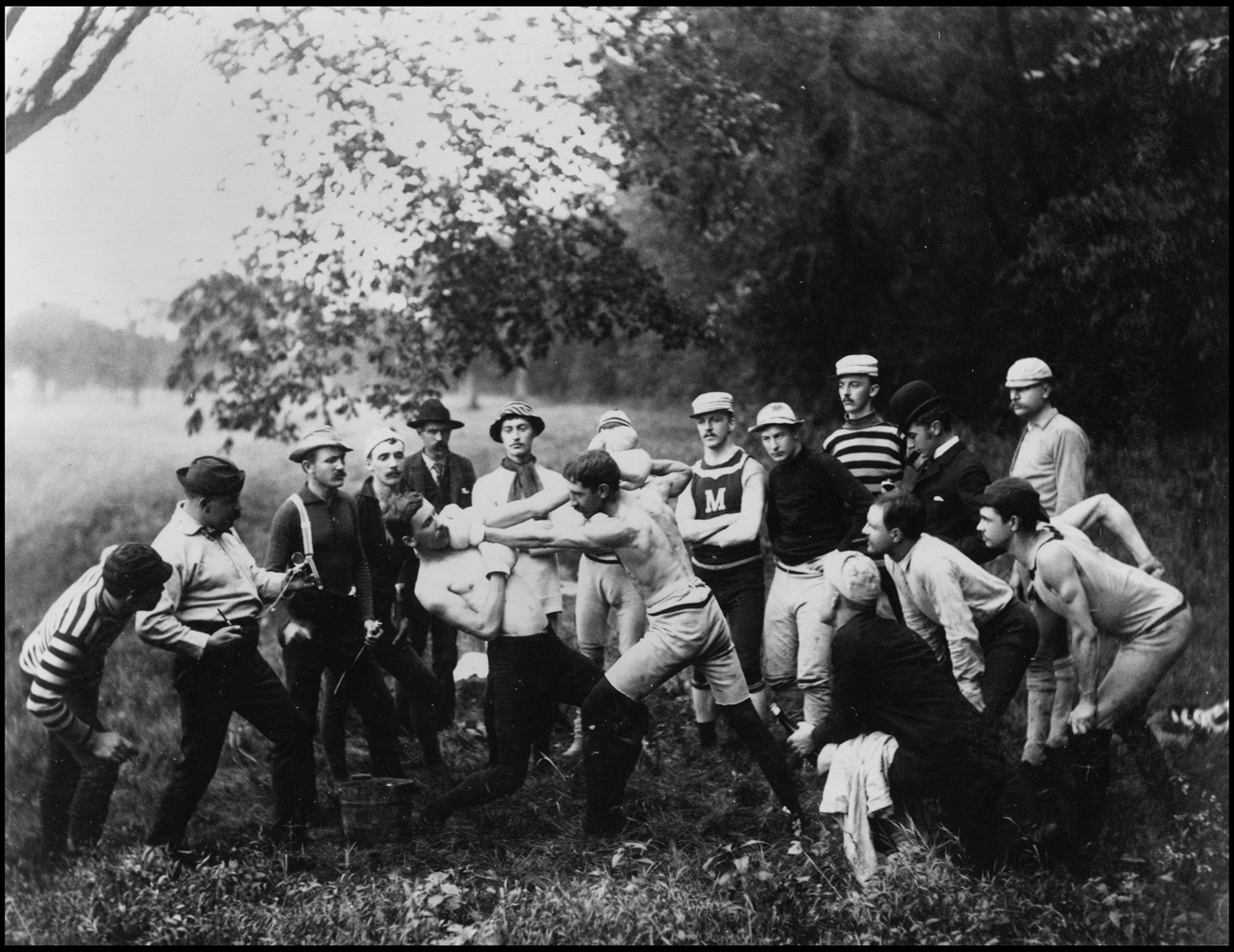
University men's amateur boxing at Crosby, Minnesota, 1883. Permission of Minnesota Historical Society.

The Boston context for O'Reilly's dual position in literary and boxing culture is crucial, and not only because boxing in that city had often been associated with the Irish saloon demimonde, with its ties to gambling and political corruption. For some years before O'Reilly arrived on the scene, Boston had been host to a highly elite boxing scene at Harvard College itself. Prominent in Harvard's physical education curriculum from about 1860 to 1871, its lead boxing instructor had been the retired prizefighter Aaron “Molineaux” Hewlett – an African American–Native American mixed-race athlete and an early black member of Harvard's instructional staff who specialized in gymnastics and boxing.Footnote 61 Movers and shakers among O'Reilly's Boston boxing friends would surely have been exposed to amateur boxing, and given more legitimacy to boxing itself, via Harvard's physical education program. Since “it is no longer deplorable for a youth to aspire to be an athlete,” wrote O'Reilly, pointing to the celebrity of college athletes such as football stars, the moment would seem ripe for a boxing revival: “[we] are in a fair way to rescue boxing from the boxers, and to restore in its proper place in the training of youth the exercise that leads all others in fitting them to be fair-minded, confident, courageous, peaceful, and patriotic citizens.”Footnote 62
Physical education for schoolchildren is the focus of many of O'Reilly's comments in Ethics of Boxing and Manly Sport, which point to the alarming lack of physical fitness among youth: “Children in school, growing narrow-chested and round-shouldered stooping over desks and books, ought to be taught to breathe as well as to read, and they ought to be kept at it constantly.” Citing an 1887 report by the Boston School Board that found children to have experienced vision loss due to excessive schoolwork, O'Reilly concludes that vigorous exercise and athletics might be the only solution:
Not only are we to be (unless we turn to athletics for the cure) a race of bald-headed, round-shouldered, spectacle-wearers, but a race of ugly dyspeptics, divided between lank-sides and pot-bellies. What, with our horse-cars, crowded on bright days, when every one should walk, with our corseted women and girls crushing their hearts into their lungs; with our narrow-chested weaklings with quavering stomachs, depending on the deadly revival of the cocktail – may the Lord have pity on our descendants!
By stark contrast, the athletic men and women supplement the moral strength of church (O'Reilly frequently cites the famed Brooklyn evangelist Rev. Henry Ward Beecher) with the muscular power unique to the sporting body: “Your big-chested, bright-eyed, large-shouldered athlete is never a vile sensualist … To make the future American all he ought to be, physically, mentally, and spiritually, we must build gymnasiums as well as schools and churches.”Footnote 63
Connecting national origin and athletic potential in Ethics of Boxing and Manly Sport, O'Reilly documents media accounts expressing admiration of physiques displayed by contemporary Irish and English boxers. Irish prizefighter Dan Donnelly, for example, was admired in one 1819 English sporting report as both beautiful and fierce in his contest against an English champion: “Donnelly, on stripping … exhibited as fine a picture of the human frame as can well be imagined; indeed, if a sculptor had wished a living model to display the action of the muscles, a finer subject than Donnelly could not have been found.”Footnote 64 Indeed, according to O'Reilly, Donnelly figured as an exemplary athlete in part because of national origin and ethnicity, for “Only six races or nations have produced natural boxers, – the Greeks, the Jews, the Negroes, the English, the Irish, and the Americans.”Footnote 65 Donnelly anticipates the great immigrant champion John L. Sullivan, whose skill and muscularity O'Reilly admires lavishly:
See the ponderous fist and the massive wrist; and the legs and feet – ah! there you see the limbs of a perfect boxer – light as a dancer, firm as a tower. And then, look up to the buttressed, Samson neck, springing beautifully from the great shoulders; look at the head – large, round as a Greek's, broad-browed, wide-chinned, with a deep dimple, showing the good-nature, and a mouth and lips that ought to be cut in granite, so full are they of doomful power and purpose.Footnote 66
When describing a particularly brutal English prizefight from 1862, O'Reilly highlights the human urge to see manhood on display at its most physically stressed moments, which in the sporting arena are analogous to moments of physical and moral courage during wartime, in which “readiness to fight doubles the strength”:
Under every contest, whether of men or game animals, this is the fascinating secret, this is the line to look for, – this unbroken golden thread of pluck, of manly fortitude, of secret, heart-whispering confidence.
We must regret and deplore the bruises and the scars and the blood; but they are the price of a precious and beautiful thing, – the sight of manly qualities under the severest strain.
Where else in one compressed hour can be witnessed the supreme test and tension of such precious living qualities as courage, temper, endurance, bodily strength, clear-mindedness in excited action, and above all, that heroic spirit that puts aside the cloak of defeat though it fall anew a hundred and a thousand times, and in the end reaches out and grasps the silvered mantle of success?Footnote 67
After outlining the reasons and method for modern exercise, including specific dietary recommendations for the new American athlete, O'Reilly reviews the history of sport among the Irish and highlights the accomplishments of Irish athletes in popular sports such as boxing, race-walking, cricket, rowing, soccer, and baseball. Surveying these achievements, O'Reilly opines confidently, “There is, in fact, no branch of athletics in which Irishmen, or the sons of Irishmen, do not hold the first places against all the world.”Footnote 68 Conclusions about Irish sporting excellence thus established, the book proceeds to trace in detail the rich and lengthy history of Irish sports, a history that O'Reilly's research into Gaelic poetry and chronicles connects with ancient Irish weaponry and military sports. Citing his translation of the Book of Leinster, O'Reilly alludes to “the monarch Lughaidh Laighné, of the line of Eber,” whom he calls “the first that made bronze and bronze spears in Erinn,” dating the development of these artifacts to about 854 BCE.Footnote 69 In this historical survey of Irish sport, O'Reilly draws upon his perception of the close relationship between military prowess and sporting excellence, locating in their synthesis a noble figure that he calls the “military athletes” who served as Ireland's national guard during an earlier generation. These ancient Irish military forebears of the Bronze Age, according to O'Reilly, held military sporting competitions using “edged weapons … such as knives, swords, and sharp-edged shields” as precursor sports that paved the way for modern Irish proficiency in quasi-military sports such as hurling, horse racing, swimming, hunting, wrestling, boxing, and gymnastics.Footnote 70
The discussion of Irish sporting history and combat sports in Ethics of Boxing and Manly Sport is followed by a section on the sport of long-distance canoeing (and kayaking), another of O'Reilly's athletic avocations. In these supplemental pages, we see O'Reilly's broader interest in athleticism and its potential relationship to loftier cultural and personal goals, without the narrower focus on combat sports such as boxing. For O'Reilly, himself a talented boxer and a close student of the combat sport tradition, less violent sports could serve important aims, such as refined and pleasurable enjoyment of the American landscape. In one of his final newspaper articles, “Canoes and Boats” (1890), published for his immigrant Irish Catholic readers in the Boston Pilot, O'Reilly sounds an enthusiasm for a genteel natural experience that diverges considerably from the brutalities recounted in his history of combat sports:
there is no rest so complete and no play so refreshing as that which brings us face to face with primitive nature. It is good to get away from the customs and conventionalities of city life to the sound of running water and rustling leaves and birds; to be free again as a boy, enjoying what the boy loves; to depend on one's self for all that is needed to make the day delightful.Footnote 71
Expedition paddling in this section of Ethics of Boxing and Manly Sport is described first on the Connecticut river from Boston through Massachusetts and Connecticut. One is perhaps unsurprised to learn that O'Reilly and his fellow canoe travelers also manage to bring boxing gloves on the weeks-long canoe voyage, in order to add the occasional boxing workout to their activities along with more leisurely paddling. The paddling travelogue, however, contains less in the way of Irish nationalism and has more literary interest, as O'Reilly's writing recalls important examples of American river travel such as Henry Thoreau's A Week on the Concord and Merrimack Rivers (1849). O'Reilly knew Emerson personally, and although he does not mention Thoreau, as a member of the elite Boston literary scene he would likely have read Thoreau's classic works. Like Thoreau's writing about New England rivers, O'Reilly's boating travelogue evokes classic pastoral themes, suggested by his citations of Robert Herrick's lyric poetry and hints at the unrealized plans made by English poets Robert Southey and Samuel Taylor Coleridge for using Pennsylvania's Susquehanna river as an ideal location for a utopian community.Footnote 72 American poets make appearances too, as with William Cullen Bryant's poetry on the subject of rivers:
Countering the elite Boston prejudice against the unlettered Irish working classes, O'Reilly's Ethics of Boxing and Manly Sport presents its author as fully assimilated into Boston high culture, as a human bridge across divergent social classes, and as a man well in command of high literary arts, even as he voices enthusiasm for combat sports.
Alongside the extensive history he provides of boxing as “manly sport,” O'Reilly's inclusion in Ethics of Boxing and Manly Sport of pastoral canoeing scenes and riverine poetic language may at first seem haphazard. But in fact, his juxtaposition of boxing and canoeing as sporting activities suitable for well-heeled travelers, published as O'Reilly's prestige in Boston was at its height, also proposes a fresh model for elite masculine sport. In O'Reilly's published treatise on male athleticism (as with his elite fighting club in Boston), the unsavory reputation of combat sports like boxing, previously linked to rough Irish immigrants from the working classes, is elevated and refashioned as suitable recreation for well-educated literary men. Himself a remarkable hybrid example of immigrant, athlete, scholar, and poet, O'Reilly makes clear his ability to discern both fine writing and fine bodies. For example, true to the pastoral literary tradition and its elite Yankee avatars such as Emerson and Thoreau, O'Reilly pays vivid tribute to a handsome farmer whom his party meets during his Delaware canoeing/boxing travels: “a roughly-clad man, with laughing bright eyes and a brown, good-humored face.” The canoeing trekkers are then delighted by the farmer, who suddenly
pulled his gray woolen shirt over his head, and stood naked beside the horse, preparing to jump on his back. We fairly shouted with admiration, the man was so superbly handsome, and so superbly muscular … [none] of us had ever seen the equal of this man. He swam his horses out in the deep water for a quarter of an hour, riding like a Centaur, every muscle in his lithe body sinking, gathering, contracting, disappearing, in the most astonishing way. He was not a tall or heavy man. When dressed, he was almost common looking. But never a Greek or Roman gladiator, in life or marble, was more beautiful or more powerful than that young Jersey farmer.Footnote 74
As with O'Reilly's rapturous admiration for John Talbott Donoghue's nude bronze of the great working-class boxer John L. Sullivan, this handsome farmer's rustic athleticism, expressed by his lithe male figure and framed by O'Reilly's literary language and keen scholarship, hints at a new possibility for American masculinity and sporting life. Paradoxically, and yet following on his boxing treatise and enthusiasm for rough manly sport, O'Reilly's musings about a laboring man's non-combat athleticism – attached to a classically Greek physique and yet removed from the realm of battle – may even hint at an aging Irish boxer's incipient dreams of physical repose and cultural assimilation: full citizenship, literary accomplishment, leisurely enjoyment of landscape, and the vigor of bodies construed erotically, aesthetically, and without risk of harm.