

DISCUSSION POINTS
• Around forty years ago, Norway started major efforts into research and development on carbon capture and storage technologies. After a mix of successes and failures, a renewed commitment to transport and storage of CO2—especially offshore—promises to make Norway a unique laboratory for decarbonization, despite continuing exploitation of oil and gas.
• The Norwegian government and collective consciousness of its citizens suggest that a game-changing strategy can foster innovative research and technology breakthroughs. Norwegian environmental organizations take intensively prominence into the national debate and play important roles in the developments.
• The changes toward a green and sustainable economy are becoming important to Norwegian industry, as demonstrated by the recent increase in support of innovation in advanced energy materials, for instance, in proton-conducting membranes for electrochemical energy conversion and thermoelectrics for waste heat recovery.
Introduction
Norway is the third largest exporter of natural gas in the world and, in addition, exports around 2% of the world’s oil trade. This amounts to around 54% of Norway’s total income from exports in 2017, with an increase to 57% in 2018.1 This seems a paradox, considering that Norway aims at reducing its greenhouse gas (GHG) emissions by at least 40% by 2030.2
Blessed by beautiful mountains, almost 98% of Norway’s electricity is produced from hydropower.3 Nevertheless, electricity makes up only about one-third of the total energy consumption in the country, the remaining mainly covered in equal measure from oil and gas. Therefore, in the international landscape, also Norway is a relatively large emitter of GHG, coming from offshore petroleum industry (28%), industry and mining (24%), and road traffic, aviation, navigation, fishing, etc. (30%). The total emissions from Norway are 52.7 million tonnes CO2 equivalent, where 43.8 million tonnes is pure CO2 emissions.4
Norwegians will go a long way for a clean environment and undisturbed nature. We know we live well on our fossil exports and we should pay back by doing our share to help the world save the climate. Not unexpected, however, the efforts and effects of our actions are most noticeable where it hurts the least. Hence, we are world-leading in electrifying cars thanks to a successful incentive program; we can afford it, and electricity is cheap and green. We insulate our houses well and stay cozy by the same cheap and green electricity, with oil-based heating of houses banned from 2020 without too much resistance. Compared with our modest country’s size and economy, we are among the only three European countries that have afforded continued and significant research and development on carbon capture and storage (CCS) technologies, including functional and structural materials.
But what does Norway do that hurts and which will hurt more if it is going to reach its present and future sharpened emission reduction goals, and make a difference globally? To stop exploiting offshore gas resources threatens jobs and wealth along coastal Norway. To make industry run on renewable sources instead of natural gas will make it uncompetitive, shutting down jobs and communities. The same goes for CCS on offshore exploitation and industry—it adds cost and makes a high-cost country even less competitive. To run Norway on renewables is possible, but the hydroelectric reservoirs are considered fully exploited, we do not have much sun, and so a coast and ocean line scarred by windmills seems unavoidable. In sum, while there are possibilities, they are politically and economically not straightforward, even in “easy” Norway.
But there are ways—there have to be. Let us have a closer look at the situation and how, and how sincerely, Norway goes about it.
CCS, are we serious about it?
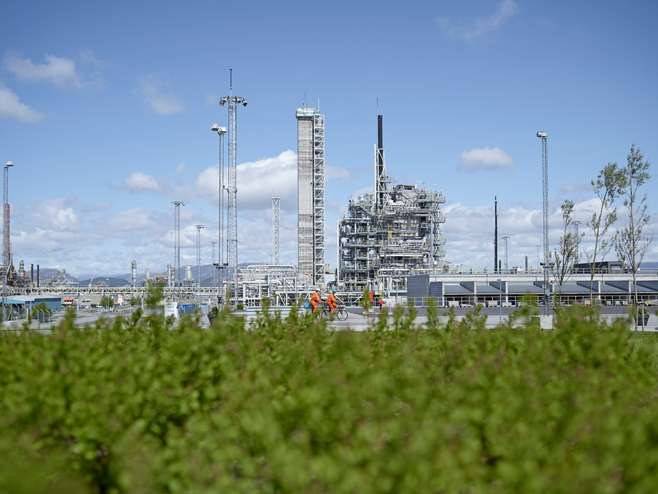
Norway has in fact spent more than its share on development of CCS. The moral obligation, the drive to make Norwegian industry green and become a technological leader and supplier, and the vast capacity for storage of CO2 offshore have paved the way politically. It started in the late 1980s with the introduction of “The Brundtland Report”5 and the idea to capture and store CO2 proposed by Erik Lindeberg and Torleif Holt6: Norway decided to be a major actor and contributor to CCS from fossil power plants despite having next to none ourselves. There were plans, however, to build large gas-fueled power plants, and along the way there were political decisions to not allow them to be built without CCS. The Mongstad and KårstøReference Stokland7 plants were built, but CCS had to be abandoned mostly because it was technically and economically premature. Later on, retrofits were planned, but again given up because at the same time the need and markets for gas-fueled power turned out smaller than anticipated in Norway. Hence, both Mongstad and Kårstø were taken down as power plants and remain today as petroleum industry sites and transport terminals. What also remains at Mongstad is the Technology Centre Mongstad—the world’s largest research site for CCS technologies at realistic scale (Fig. 1). The fossil-based thermal production of electricity remaining at around 2% of the country’s total is distributed among various industries. When another Norwegian government today heads for full-scale CO2 capture in the 2020s, the target is downsized to industries like cement factories and waste-combustion power generation.8
The Technology Centre Mongstad.9

The economic and political costs along the way have been painful. The failure of the “Moon-landing” project, as it was dubbed for its ambitions, for a full-scale CCS at Mongstad, and the hilarious currency of 1 Mong being 4 billion NOK—around 400 million USD—the first warned budget exceedance for the power plant with CCS at no use (the exceedance ended up even higher, at 6 billion NOK) says it all. But in the long run, it may still turn out to have been a worthwhile effort and investment on behalf of the planet’s climate. The scientific progress, the new and improved essential materials, and the number of technologies developed and optimized are massive, and Norway did its share and is still on it.
Most important is maybe the Aker Kværner amine scrubbing postcombustion process, which has been patiently developed and optimizedReference Arachige, Mohsin and Melaaen10–Reference Wang, Hovland and Jens12 and ready for full-scale installations. Parallel research on the environmental consequences of the method shows that the limited amounts of emitted amines have negligible effects.Reference Nielsen, Herrmann and Weller13 Membranes selectively permeable to oxygen, hydrogen, or CO2 are believed by many to be key to future more efficient oxy-fuel and precombustion as well as postcombustion carbon capture. Norway conducts world-leading research in porous polymer membranes,Reference Nafisi and Hagg14,Reference Nafisi and Hagg15 dense Pd hydrogen separation membranes,Reference Vicinanza, Svenum, Peters, Bredesen and Venvik16,Reference Løvvik, Zhao, Li, Bredesen and Peters17 and dense mixed conducting ceramic membranes.Reference Fontaine, Larring, Norby, Grande and Bredesen18 The handling of CO2 requires transport of it, and Norway developed world-leading expertise on corrosion of CO2 pipeline steel due to traces of water, NOx, and SOx in the stream.Reference Morland, Dugstad and Svenningsen19 In 2008, the Norwegian government granted permissions to inject CO2 separated from produced natural gas into saline aquifers in Snøhvit.20 This has been going on at Sleipner West since 1996,21 promoting R&D that enables routine CO2 injection to enhance production of existing fields as well as storage of CO2 from combustion. In 2019, new and extended permissions and interest from petroleum companies turning to greener technology—like Equinor (the biggest Norwegian oil producer, previously called Statoil)—seem to be the start of a major expansion into what may become large-scale storage of CO2 on the Norwegian shelf from national and foreign industries and possibly from power plants. All the excellence built up in previous years in mathematics, informatics, physics, and geosciences for exploration and exploitation of oil and gas reserves is now helping develop the technologies needed for transport and storage of CO2 offshore. This could help the country to successfully transition into a deep decarbonized era.
Tapping from world-leading expertise in Norway, a collaboration between Norwegian authorities, research institutions, and the petroleum industry was established in 2001 as a national strategy for the petroleum sector (OG21)22 to “identify technology priorities for efficient and environmentally responsible petroleum activities on the Norwegian continental shelf,” while at the same time supporting efficient and environment friendly technologies. Currently, Gassnova23 and Petromaks224 are two running research funding programs for value creation of Norwegian natural gas and petroleum sector, respectively.
Gassnova is a state enterprise that “will contribute to finding solutions to ensure that technology for capture and storage of CO2 can be implemented and become an effective climate measure.” It acts as CCS advisor for the authorities, runs the CLIMIT program funding CCS research, and the Technology Centre Mongstad, the Norwegian Full Scale Project on CCS.25 As part of the latter, in early 2019, Equinor was granted permissions for storage of CO2 in the Troll offshore field structure, with a prestudy of the feasibility undergoing.
Among the Petromaks2 projects, “Clean Highly Efficient Offshore Power (CHEOP)”Reference Wærnhus26 and its follow-up with CO2 capture (CHEOP-CC) run since 2015, aiming at efficient and sustainable electricity production for offshore installations. The system is based on steam reforming of natural gas, membrane gas separation, and fueling polymer and solid-oxide fuel cells (SOFCs) with the hydrogen and remaining carbon-rich parts, respectively. The SOFC provides heat for the reforming. Oxygen permeable filters are used for the air supply, so as to reject nitrogen and end up with only easily condensable water and CO2 for back-injection.27
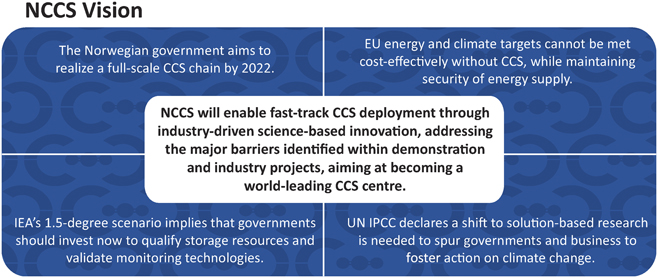
The Research Council of Norway funds a number of Centers for Environment-friendly Energy Research (FMEs) within CCS—emphasizing different parts of the chain—in addition to the ones on renewable energy. One example has been the BIGCCS,28 where a large number of national and international participants collaborated in a concerted action involving 26 PhD and 52 MSc projects, with research and innovations in capture spanning new solvent systems and processes, membranes for separation of hydrogen, and new concepts to enable combustion of hydrogen-rich fuels in gas turbines with controlled nitrous oxide emissions, in addition to larger and more application-near developments in transport and storage. The knowledge acquired with BIGCCS paved the way to the new FME called Norwegian CCS Research Centre,29 which has the even more ambitious goal of realizing a full-scale CCS project, transforming the North Sea into a European sink of CO2 (Fig. 2).
The vision of the Norwegian CCS Research Centre (FME).Reference Mølnvik30

Industry is a major contributor to CO2 emissions. Replacing all that energy with renewables is unrealistic on the short term—it would require a doubling of Norway’s renewable energy production, which means windmills would have to become of the same capacity as today’s hydroelectric generators. Again, CCS may then be a solution. It was found that it is technologically feasible to implement CCS technologies on old plants. However, the current cost of USD 161–210/tonne CO2 is too high, and research is needed to lower this.Reference Jordal31 As the petroleum sector may be seeing the beginning of decline with the increased focus on renewables and electrification, it may never be financially viable to install CCS here.
The Norwegian aluminum industry contributes substantially to the country’s CO2 release. The emissions are primarily coming from the consumption of graphite anodes and the use of fossil-based reductants for ferroalloys, although new technologies are being considered, such as the development of inert anodes. Furthermore, Norway has a large world-leading fertilizer industry, currently emitting high amounts of CO2 from its use of natural gas as the source of hydrogen and energy. While CCS is possible, this is an industry where the long-term solution is obviously to revert to the production of hydrogen by electrolysis with renewable electricity. In contrast, the cement industry has emissions stemming from both fossil-fueled heating of kilns and calcination of carbonates. One option could be to use biofuels; otherwise, CCS seems well suited for this industry, maybe even on a long-term basis.Reference Enova32
Renewables, electrification, and hydrogen
A carbon-neutral society can be achieved by a progressive shift of energy production to renewable energy sources. Though still at the initial stages, Norway is committing to introduce an increasing share of renewables in its energy landscape. An important tool for the development of renewable energy technology, Energi21 is the Norwegian national strategy for research, development, demonstration, and commercialization of new energy technology. It is the Ministry of Petroleum and Energy’s permanent strategic body for research, development, and demonstration in the energy sector. The ENERGIX program is a key instrument in the implementation of Energi21, as well as for achieving other energy policy objectives. It provides funding for research on renewable energy, efficient use of energy, energy systems, and energy policy.
Norway’s hydroelectric capacity—supplying the majority of its electricity—is considered fully exploited in terms of large rivers and dams, but the production is growing steadily due to the increase in efficiency and addition of small and microsized plants.
Norway was among the pioneers in exploring the potentials of wave and tidal energy. Indeed, plants are in operation but seem to be insignificant now that wind is finally taking the stage. Initially, Norway was reluctant to invest in wind farms because its coastline and mountains are hard to reach by large trucks, are characterized by variable winds, and should preferably remain untouched. Now, offshore windmill farms are being explored and may become a major specialized industry as well as provide Norway with a major—and maybe the required—increase in its renewable energy, provided sufficient integration with capacity-balancing hydroelectric power and large-scale storage.
In addition to electrification of its fertilizer and other industries, Norway can electrify its transportation. It will not make a big impact on global CO2 emissions but may be a good arena for the introduction of technologies and will provide good examples to be followed. The Norwegian government introduced great incentives for electric cars: exemption of value-added tax, reduced taxes, ability to drive in the bus lane, no road toll charges, and free parking in many places, and the electricity is already cheap and green. It has been a fast success—a major share of new cars sold are fully battery driven, and small delivery vans are following. The cars are reliable and perform well, with the exception of a disappointing reduction of range compared to nominal, as much as 50% in the cold Norwegian winter, showing that batteries—like other electrochemical cells—cannot escape from ohmic and kinetic overpotential losses. Along with fully electric battery cars, chargeable (plug-in) hybrids are popular. Electrification of trucks is on its way, and the same goes for the maritime sector. The first battery ferries are in use, and Norway hopes to regain some of its ship building status via various types of electrification of ships. For all these reasons, there is hence good interest in and funding for battery materials research in Norway.
Norway has a long history of hydrogen production for the synthesis of ammonia and fertilizers through Norsk Hydro, first by electrolysis and later from reforming natural gas. The alkaline electrolyzer technology of Norsk Hydro survived in Norsk Hydro Electrolyzers through difficult times and restructurings to today’s NEL, which now sees consistent growth (for instance, contracting 100 electrolyzers for filling stations for Nikola hydrogen fuel cell trucks in the United States). In Hexagon at Raufoss, Norway has also a world-class manufacturer of high-pressure tanks for gases including hydrogen.
Since about 20 years back, Norway along with other Nordic countries attempted a head start on hydrogen, through tests of autonomous systems,33 building and using hydrogen-fueled forklifts and some boats, filling stations along a hydrogen road (HyNor,34 planned to run from Stavanger on the western cost, via Oslo, into Sweden and into Europe), and research on metal hydrides for storage. A small fleet of cars custom rebuilt at the factories was ordered and operated, comprising Think electrical vehicles with fuel cell range extender and Toyota Prius and Mazda RX8 combustion engine cars equipped with 350 bar hydrogen tanks and adjusted to run on hydrogen. Little of this was of any success, and it took several years before the hydrogen road was replaced by a more functional hub (in Oslo) with a few filling stations. Hydrogen fuel cell cars with competitive comfort and range became available first as pilot tests from Mercedes and Hyundai, and now commercial from Toyota and Hyundai (benefitting from the same incentives as battery electric cars have, except for the price of hydrogen matching that of gasoline rather than that of electricity). These cars have longer range than the battery cars and tackle winter much better due to the higher energy content carried and the higher heat value from cooling the fuel cell instead of a battery. Yet, hydrogen is still challenged by people’s skepticism to safety and efficiency and the current successes of battery electric cars. Therefore, hydrogen for the transport sector in Norway is at present more focused on near-future implementation for heavier trucks and the maritime sector, where wharfs and shipping companies plan hybrid hydrogen-fueled speedboats, ferries, and cruise ships,35–37 mainly using compressed hydrogen gas, some considering liquid hydrogen filling at bay.
Indeed, if many ferries in Norway are being converted to run on electricity, many routes are too long to be run on batteries. Therefore, hydrogen-based technologies appear to be an appropriate alternative, as stressed by a major effort from the FME MoZEES, which focuses on zero-emission (battery and hydrogen) transportation.
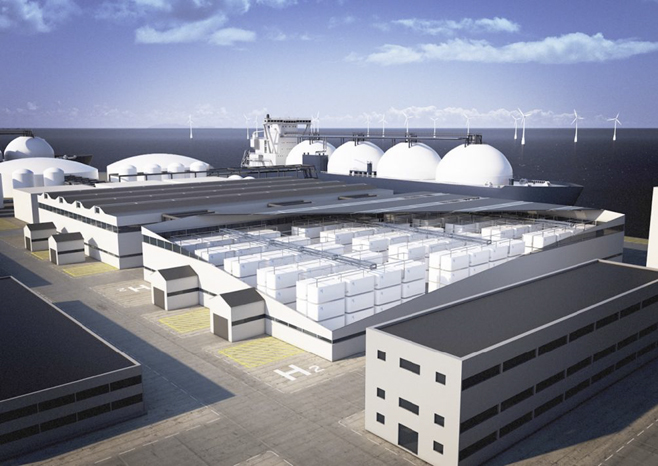
As an example of new materials developments that can lead to new game-changing solutions, we mention a recent innovation from CoorsTek Membrane Sciences in Oslo, which is exploiting proton ceramic electrochemical cells: By integrating steam reforming of natural gas with electrochemical pumping and compression, perfect thermal balance is obtained on a microscopic scale enabling high current densities. In markets with available natural gas and favorably priced renewable-based electricity, as in Norway, the process produces directly separated streams of CO2 and compressed hydrogen at efficiencies as high as 90%.Reference Malerød-Fjeld, Clark, Yuste-Tirados, Zanón, Catalán-Martinez, Beeaff, Morejudo, Vestre, Norby, Haugsrud, Serra and Kjølseth38 It may in principle offer large-scale production and export of hydrogen from Norwegian natural gas with CCS directly back in the reservoirs to enhance production (Fig. 3).
Decarbonization of natural gas, according to the CoorsTek vision. Illustration by Minoko Design for CoorsTek Membrane Sciences.

Hydrogen technologies are increasingly considered for storage connected to wind power production. An interesting project in this direction is called “Innovative hybrid energy system for stable power and heat supply in offshore oil and gas installation,”39 which aims to combine offshore wind power and hydrogen storage technology. The project started in 2018 and is scheduled to run until 2022. The fuel cell system acts as a backup for when there is not enough energy being produced from the wind, and it will be possible to burn the hydrogen in the gas turbines instead of the natural gas, thereby lowering the GHG emissions. The study combines mathematical modeling, development of software, and experimental testing.39 A similar project is the “Deep Purple” project,40 in which hydrogen storage technology is planned to be implemented in the offshore platforms and the maritime sector, which account for 6% of the total emissions from Norway.
Finally, among other FMEs on renewable energy, the Norwegian Research Centre for Solar Cell Technology41 supports research for Norway’s strong industry in solar silicon and panels. Alongside renewables and hydrogen, one must not forget all the initiatives on biofuels. The public transport company Ruter, serving Oslo and its surrounding Akershus county, aims to power all their buses with electricity, or biodiesel, biogas, and bioethanol by 2020.42
Energy saving and efficiency
Many innovations and actions contribute to energy saving in Norway as elsewhere: energy efficiency labeling of products, light-emitting diode lights everywhere (incandescent lamps can already no longer be sold), and efficient buildings. The Zero Emission Buildings43 FME center aims to ensure that new buildings harvest enough renewable energy to compensate for the GHG emitted by their construction, operation, and demolition/recycling. Pilot projects underway include Heimdal VGS,44 Campus Evenstad,45 and Powerhouse Brattørkaia.46 In the future, also retrofits for older buildings will be emphasized more.
We have mentioned Energi21 as a strategy and toolbox for renewable energy. Another Norwegian program is Enova,47 which has large so-called green climate and energy funds and aims to contribute to the green shift by reduced GHG emissions, strengthened energy supply reliability, and technology development. Within this broad mandate, it finances the implementation of new and more efficient and sustainable technology in all sectors, including industry.
Energy saving in industry can take many forms. Norwegian industries consuming large amounts of energy in high-temperature smelters, electrolyzers, and chemical processing are looking into the use of thermoelectrics for recuperation of some heat back into electricity, enabling an overall energy saving and reduced CO2 footprint. The Norwegian materials research community supports this with studies and innovation in both efficient metallic thermoelectrics for intermediate temperatures and air-stable, temperature-resistant, but so far less-efficient, oxide thermoelectrics.48 Startups in materials production and module fabrication are aiming to bridge these materials to the user industries.
The way ahead
It is predicted that a global temperature increase of over 2 °C would lead to serious and irreversible climate changes and damage to our planet and its life including humanity. To avoid this, the world’s emissions of GHG will have to be reduced by at least 60% by 2050 compared to the 2010 levels according to the European Commission,49 and the United Nations’ Intergovernmental Panel on Climate Change (IPCC) in its latest reports requires even a much more rigorous program: carbon neutrality by 2050, followed by negative carbon emissions—actively removing CO2 from the atmosphere.50 Norway aims at contributing to reach this goal by reducing its emission levels by at least 85% by 2050.51 Considering that Norway continues to be one of the largest exporters of oil and gas, this will not be easy and is certainly considered by many a paradox. To this point, the major Norwegian oil and gas company Statoil rebranded itself by changing name to Equinor and is now quite aggressively advertising its efforts in renewable energy.
On the heels of increased consensus, Oslo city has, if possible, even grander goals, such as reducing GHG emissions by 50% in 2020 and by 95% in 2030, compared to the 1990 levels. The city economic plan has been accompanied by the institution of the Agency of Climate, which stresses that the climate is a shared responsibility across citizens, businesses, agencies, and others with the aim to develop Oslo into a leading environmental city. The world noticed the efforts, and the European Commission awarded Oslo the prestigious European Green Capital title for 2019.52
Norway is home of several idealist organizations fighting to preserve nature and the climate, including Zero53 and Bellona54 who early challenged society, authorities, and industries in Norway and abroad in their business-as-usual attitude. Today, Bellona develops and promotes negative CO2 footprint scenarios like Ocean Forest55 and Sahara Forest Project.56
Will the current initiatives and strategies be enough? To replace fossil energy consumption, Norway will need to double renewable energy production. Can the country rely on renewable energy only? Will the hydroelectric power be enough to balance the novel variable renewable sources, notably wind? Time will tell. In the meantime, we believe Norway can and will make its most important impact to saving the world’s climate by its CCS technology efforts, by leading the introduction of hydrogen as an energy carrier, by increasing electrification, and by developing the novel and improved functional and structural materials needed.
While all this is good, the elephant in the room is still that Norway’s current economy is driven by the 57% of exports being oil and gas. Is there a will and plan to restructure significantly away from this, or must we expect business as usual? To the best of our observation, the simple answer is that the democratic majority is heading for the latter, like it or not.