1. Introduction
The Central Asian Orogenic Belt (CAOB), one of the largest accretionary orogens in the world, is bounded by the Eastern European Craton to the east, the Tarim Craton and North China Craton to the south and the Siberia Craton to the north (Fig. 1a, Şengör et al. Reference Şengör, Natal’in and Burtman1993; Windley et al. Reference Windley, Dmitriy, Xiao, Kröner and Badarch2007; Wilhem et al. Reference Wilhem, Windley and Stampfli2012; Xiao et al. Reference Xiao, Windley, Allen and Han2013). The complicated accretionary processes and considerable continental crustal growth of the CAOB from ca. 1000 to 250 Ma were associated with the consumption of the Palaeo-Asian Ocean (PAO) (Hong et al. Reference Hong, Zhang, Wang, Wang and Xie2004; Jahn et al. Reference Jahn, Windley, Natal’in and Dobretsov2004; Xu et al. Reference Xu, Charvet, Chen, Zhao and Shi2013; Eizenhöfer et al. Reference Eizenhöfer, Zhao, Zhang and Sun2014; Xiao et al. Reference Xiao, Windley, Han, Liu, Wan, Zhang, Ao, Zhang and Song2018). The northern Alxa area plays a significant role to constrain the tectonic and crustal evolution of the southern CAOB (Fig. 1a). The northern Alxa area is characterized by the widespread development of late Palaeozoic plutons (Zhang et al. Reference Zhang, Pease, Meng, Zheng, Wu, Chen and Gan2016, Reference Zhang, Pease, Meng, Zheng, Wu and Chen2017; Liu et al. Reference Liu, Zhao, Han, Li, Zhu, Eizenhöfer, Zhang, Wang and Tsui2018a, b; Fei et al. Reference Fei, Pan, Xie, Wang and Zhao2019; Li et al. Reference Li, Zhang, Shi, Chen, An, Huang, Liu and Wang2020; Shi et al. Reference Shi, Zhang, Zhang, Zhang, Ding, Zhang, Bao and Zhou2020; Song et al. Reference Song, Xiao, Windley and Han2020; Zhao et al. Reference Zhao, Liu, Wang, Zhang and Guan2020). However, its tectonic setting during the late Palaeozoic is still debated. Previous researchers argued that the central PAO closed before the early Permian (Fei et al. Reference Fei, Pan, Xie, Wang and Zhao2019; Li et al. Reference Li, Zhang, Shi, Chen, An, Huang, Liu and Wang2020), and the northern Alxa area underwent post-collisional extension during the late Palaeozoic, while other scholars suggested that ocean subduction was still active during the late Palaeozoic, and the central PAO closed in the early Triassic (Song et al. Reference Song, Xiao, Windley and Han2020; Xie et al. Reference Xie, Wu, Sun, Wang, Wu and Jia2021).
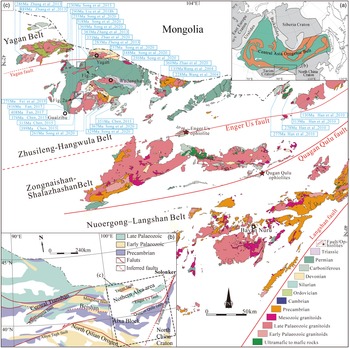
(a) The Location of the northern Alxa area in the simplified tectonic sketch map of the Central Asian Orogenic Belt (CAOB) (Modified after Eizenhöfer et al. Reference Eizenhöfer, Zhao, Zhang and Sun2014). (b) Tectonic outline of the southern CAOB in north China (after Chen et al. Reference Chen, Wu, Gan, Zhang and Fu2019). (c) Geological map of the northern Alxa area and adjacent tectonic units (modified after Liu et al. Reference Liu, Zhao, Han, Li, Zhu, Eizenhöfer, Zhang, Wang and Tsui2018a).

The northern Alxa area, as the southernmost part of the central segment of the CAOB, is located at a crucial junction between the Solonker Suture and the Central Tianshan Arc and the Beishan Orogenic Belt (Fig. 1b). In this study, we present new geochronological, geochemical and zircon Hf isotopic data for the early Permian gabbro and diorites from the Zhusileng–Hangwula Belt in the northern Alxa area. These results, combined with published data, are used to discuss the petrogenesis of the igneous rocks and tectonic setting and to reconstruct the geological evolutionary history of the central part of the southern CAOB during the late Palaeozoic.
2. Geological setting and samples
The northern Alxa area, the southernmost segment of the CAOB, is divided into two parts by the Yagan fault: from north to south, the Yagan Belt and the Zhusileng–Hangwula Belt (Fig. 1a). Two important faults, the Enger Us fault and the Quagan Qulu fault, are characterized by ophiolitic mélanges (Fig. 1b; BGMRIM, 1991; Wu & He, Reference Wu and He1993; Wu et al. Reference Wu, He and Zhang1998).
The Quagan Qulu fault separates the Zongnaishan–Shalazhashan Belt and the Nuoergong–Langshan Belt (Fig. 1b). The Nuoergong–Langshan Belt is mainly composed of Precambrian basement rocks and late Palaeozoic magmatic rocks (321–265 Ma). As shown in recent studies (Geng & Zhou, Reference Geng and Zhou2012; Wang et al. Reference Wang, Han, Feng, Liu, Zheng and Kong2016, Reference Wang, Han, Feng, Liu, Zheng, Kong and Qi2021; Zheng et al. Reference Zheng, Li, Xiao and Wang2018; Zheng et al. Reference Zheng, Zhang and Xiao2019), the Precambrian rocks comprise Palaeoproterozoic gneisses and amphibolites, with small amounts of Neoproterozoic granites (970–880 Ma), and the Phanerozoic rocks are mainly composed of granites, diorites and minor gabbro (321–265 Ma). By comparison, 301–247 Ma magmatic rocks and late Palaeozoic sediments, with some Mesozoic granites, dominate in the Zongnaishan–Shalazhashan Belt (Shi et al. Reference Shi, Wang, Zhang, Castro, Xiao, Tong, Zhang, Guo and Yang2014; Zheng et al. Reference Zheng, Wu, Zhang, Xu, Meng and Zhang2014; Song et al. Reference Song, Xiao, Collins, Glorie, Han and Li2017). A few Precambrian metamorphic rocks with ages of 1.5–1.4 Ga have also been reported (Qing, Reference Qing2010; Song, Reference Song2014; Shi et al. Reference Shi, Zhang, Wang, Zhang, Liu, Zhou and Yan2016; Wang et al. Reference Wang, Zhang, Huo, Shi and Liu2019), indicating that the tectonic affinity of the Zongnaishan–Shalazhashan Belt, which was treated as a part of the Alxa Block, was uncertain given the occurrence of Mesoproterozoic rocks in the Zongnaishan area.
The Yagan Belt mainly contains Palaeozoic volcano-sedimentary strata (Wu & He, Reference Wu and He1993) and plutons (397–220 Ma; Zheng et al. Reference Zheng, Wu, Zhang, Feng, Xu, Meng and Zhang2013; Liu et al. Reference Liu, Zhao, Han, Li, Zhu, Eizenhöfer, Zhang, Wang and Tsui2018a), with some Neoproterozoic granite (Zhang et al. Reference Zhang, Pease, Meng, Zheng, Wu, Chen and Gan2016). Based on litho-tectonic comparisons, the Yagan and Zhusileng–Hangwula Belts have been generally considered the eastern extension of the Beishan Orogenic Belt (Wu et al. Reference Wu, He and Zhang1998).
The Zhusileng–Hangwula Belt is characterized by widespread Palaeozoic to Mesozoic volcano-sedimentary formations and magmatic rocks as well as minor Precambrian rocks (BGMRIR, 1991; Wu & He, Reference Wu and He1993; Yin et al. Reference Yin, Zhou, Cheng, Zhang, Zheng, Yang, Li and Wang2015). The Mesoproterozoic–early Neoproterozoic rocks (1400–916 Ma) are sporadically exposed in the region (Wang et al. Reference Wang, Zheng, Liu, Li and Ma2002; Zhou et al. Reference Zhou, Han, Xu, Ren and Su2013; Deng et al. Reference Deng, Shao, Xu, Yi, Xu and Zhang2022a; Yu et al. Reference Yu, Shao, Niu and Su2022). The early Palaeozoic strata only include Cambrian limestone, late Ordovician limestone and early Silurian siliceous rocks. Late Palaeozoic strata are composed of clastic rocks, limestone and minor volcanic rocks, which are unconformably overlain by late Triassic and Cretaceous continental clastic sediments (Chen et al. Reference Chen, Wu, Gan, Zhang and Fu2019). The Phanerozoic intrusions in the Zhusileng–Hangwula Belt were generated during the middle–late Devonian (399–373 Ma), late Carboniferous–middle Permian (325–263 Ma) and middle–late Triassic (250–216 Ma), including gabbro, diorite, granodiorite, granite and monzogranite (Fig. 1c; Wang et al. Reference Wang, Zheng, Liu, Li and Ma2002; Li, Reference Li2006; Han et al. Reference Han, Zhang, Zhao, Xu, Chen, Zhang, Zhou and Song2010; Dang et al. Reference Dang, Zhao, Lin, Wu, Kang, Ge, Wu and Liu2011; Chen, Reference Chen2015; Zhang et al. Reference Zhang, Pease, Meng, Zheng, Wu and Chen2017; Liu et al. Reference Liu, Zhao, Han, Li, Zhu, Eizenhöfer, Zhang, Wang and Tsui2018a; Shi et al. Reference Shi, Lu, Wei, Niu, Jiang, Han and Xu2018; Chen et al. Reference Chen, Wu, Gan, Zhang and Fu2019; Li et al. Reference Li, Zhang, Shi, Chen, An, Huang, Liu and Wang2020; Song et al. Reference Song, Xiao, Windley and Han2020; Deng et al. Reference Deng, Shao, Wang, Chen, Yi and Xu2022b, Reference Deng, Shao, Xu and Chen2023, b; Fei et al. Reference Fei, Pan, Xie, Wang and Zhao2019; Zhao et al. Reference Zhao, Liu, Wang, Zhang and Guan2020).
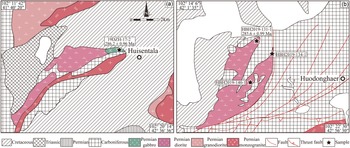
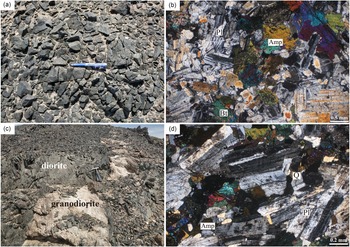
For this study, samples of gabbro and diorites were examined, and sample locations can be found in Fig. 2. The Huisentala gabbro (19DZH-17-2) is black and grey-coloured, moderate- to coarse-grained and is mainly composed of plagioclase (∼60%), hornblende (∼20%), biotite (∼15%) and minor quartz (∼5%) (Fig. 3a). The Huodonghaer diorites, intruded by granodiorite, show dark green colour and moderate to coarse-grained texture (Fig. 3b). They are strongly weathered and mainly consist of plagioclase (∼75%), hornblende (∼10%), biotite (∼10%) and minor quartz (∼5%) (Fig. 3c).

Representative outcrops and microphotographs of investigated gabbro and diorites from the Zhusileng–Hangwula Belt. (a) and (b) Gabbro (sample 19DZH-017-2). (c) and (d) Diorite (sample HBH2019-131-1). Amp, Amphibole; Bt, Biotite; Pl, Plagioclase; Qtz, quartz.

3. Analytical methods
3.a. Zircon U–Pb dating
After crushing, zircon crystals were extracted using heavy liquid and magnetic techniques. Zircons were hand-picked and mounted in epoxy resin and polished to about half of their size to expose the core of the grain. The detailed procedure can be found in Song et al. (Reference Song, Zhang, Wan and Jian2002). The cathodoluminescence (CL) images of zircon were obtained using a scanning electron microscope (IT-500, Japan) at Beijing Geoanalysis Co., Ltd (Beijing, China). Analytical spots for U–Pb dating were chosen after combined studies of transmitted and reflected light microscope and CL images. Laser ablation inductively coupled plasma-mass spectrometry (LA-ICP-MS) zircon U–Pb analyses were carried out using an Agilent 7900 ICP-MS equipped with a 193-nm laser ablation system at the Institute of Geology, Chinese Academy of Geological Sciences in Beijing, China. The detailed procedure is the same as described by Hou et al. (Reference Hou, Li, Zou, Qu, Shi and Xie2007). Zircon 91500 and GJ-1 were used as primary and secondary standards for U-Pb dating, respectively (Jackson et al. Reference Jackson, Pearson, Griffin and Belousova2004). ISOPLOT 3.0 was used to plot the concordia diagrams and perform the weighted mean calculations (Ludwig, Reference Ludwig2003). Uncertainties are quoted at 2σ level for individual analysis, and the weighted mean ages are given at the 95% confidence level.
3.b. Zircon Lu–Hf isotopic analyses
Zircon Hf isotope analyses were conducted using a multiple collector inductively coupled plasma-mass spectrometer (MC-ICP-MS, Neptune Plus, Thermo Fisher Scientific, Germany) equipped with a femtosecond (λ = 343 nm) laser-ablation system (J-200, Applied Spectra, USA) at the National Research Center for Geoanalysis in Beijing. To evaluate the quality of the data, Temora and Plesovice zircon were used as the standards and exhibited 176Hf/177Hf ratios of 0.282692 ± 0.000018 (2σ, n = 15) and 0.282480 ± 0.000021 (2σ, n = 49), respectively. The analytical details and interference correction method of 176Yb on 176Hf can be found in Zhou et al. (Reference Zhou, Wang, Hou, Li, Li and Qu2018) and Wu et al. (2006), respectively. The 176Lu decay constant of 1.865 × 10⁻¹¹ yr−1 (Scherer et al. Reference Scherer, Whitehouse and Muenker2007) was used to calculate the initial 176Hf/177Hf ratios. The chondritic values of 0.0336 and 0.282785 for 176Lu/177Hf and 176Hf/177Hf, respectively, reported by Bouvier et al. (Reference Bouvier, Vervoort and Patchett2008), were used for the calculation of the ϵHf values. The depleted mantle Hf model ages (TDM) were calculated using the measured 176Lu/177Hf ratios based on the assumption that the depleted mantle reservoir has a linear isotopic growth from 176Hf/177Hf = 0.279718 at 4.55 Ga to 176Hf/177Hf = 0.283250 at present, with 176Lu/177Hf ratio of 0.0384 (Griffin et al. Reference Griffin, Pearson, Belousova, Jackson, Van Achterberg, O’Reilly and Shee2000). Two-stage model ages (TDM2) were also calculated, assuming that the parental magma was produced from an average continental crust (176Lu/177Hf = 0.015; Griffin et al. Reference Griffin, Wang, Jackson, Pearson, O’Reilly, Xu and Zhou2002).
3.c. Major and trace element analyses
The samples were crushed and ground to 200 mesh. Whole-rock major and trace element analyses were obtained at ALS Chemex Co., Ltd (Guangzhou, China) using X-ray fluorescence spectrometer (XRF), ICP-MS and inductively coupled plasma-atomic emission spectrometry (ICP-AES). Details of the analytical procedure can be found in Zhou et al. (Reference Zhou, Sun, Zhang and Chen2002) and Liu et al. (Reference Liu, Zong, Kelemen and Gao2008). One pulp sample was fused with lithium metaborate-lithium tetraborate flux, including an oxidizing agent (lithium nitrate), and then poured into a platinum mold. The resultant disc was then analysed by XRF spectrometry. The XRF analysis was determined in conjunction with a loss-on-ignition at 1000 °C. The resulting data from both analyses were combined to produce a ‘total’. One prepared sample was added to lithium metaborate/lithium tetraborate flux, mixed well and fused in a furnace at 1025 °C. The resulting melt was then dissolved and cooled in an acid mixture containing nitric, hydrochloric and hydrofluoric acids. This solution was then analysed by ICP-MS. Another prepared sample was digested with perchloric, nitric and hydrofluoric acids. The residue was leached with dilute hydrochloric acid and diluted to volume. The solution was then analysed using ICP-MS for ultratrace level elements. The same solution was also analysed using ICP-AES for trace level elements. Results were corrected for spectral inter-element interferences. The analytical accuracy and precision for the trace elements and major elements were found to be better than 5% and 10%, respectively.
4. Results
The U–Pb zircon isotopic data are listed in Supplementary Table 1, the Lu–Hf isotopic analyses in Supplementary Table 2 and major and trace element data are presented in Supplementary Table 3.
4.a. Zircon U–Pb ages
4.a.1. Gabbro
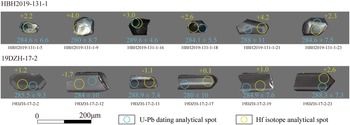
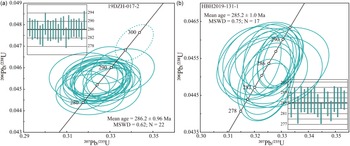
Zircon grains are euhedral and stubby, 50–100 × 100–200 μm in size and exhibit concentric oscillatory zoning (Fig. 4). Except for the older spot 9, 22 concordant spots for sample 19DZH-17-2 yield a weighted mean 206Pb/238U age of 286.2 ± 0.96 Ma (MSWD = 0.62, Th/U = 0.52–1.07; Fig. 5a).
Cathodoluminescence (CL) images of representative zircons from studied gabbro and diorites. The blue line circle represents the spot of LA-ICP-MS analysis for U–Pb dating. The yellow line circle represents the spot of LA-MC-ICP-MS analysis for Lu-Hf isotope compositions. Apparent ages (in blue) and ϵHf(t) values (in yellow) are denoted.

Concordia diagrams of LA-ICP-MS zircon U–Pb data from investigated gabbro and diorites in the Zhusileng–Hangwula Belt.

4.a.2. Diorite
Zircon from the investigated diorite is all euhedral, prismatic and stubby. They have well-preserved oscillatory zoning and 30–80 × 60–180 μm in size (Fig. 4). Twenty-three spots were analysed for sample HBH2019-131-1, except for 6 older and younger spots, 17 concordant spots yield a weighted mean 206Pb/238U age of 285.2 ± 1.0 Ma (MSWD = 0.75; Fig. 5b), with Th/U ratios of 0.52–1.55.
4.b. Zircon Hf isotopic compositions
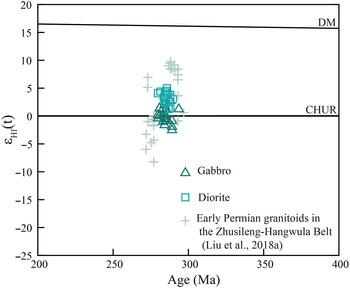
Twenty zircon grains from sample 19DZH-17-2 have variable ϵHf(t) values between −2.5 and +2.6 (Fig. 6), two-stage model ages (TDM2) of 1.96–1.49 Ma and initial 176Hf/177Hf ratios of 0.282908–0.282971. Seventeen zircons from sample HBH2019-131-1 yield positive ϵHf(t) values between +1.2 and +4.9 (Fig. 6), two-stage model ages (TDM2) of 1.62–1.29 Ga and initial 176Hf/177Hf ratios of 0.282627–0.282733.
Zircon Hf isotopic compositions of the early Permian gabbro and diorites from the Zhusileng–Hangwula Belt. The ϵHf(t) values of the early Permian granitoids are from Liu et al. (Reference Liu, Zhao, Han, Li, Zhu, Eizenhöfer, Zhang, Wang and Tsui2018a).

4.c. Whole-rock major and trace elements
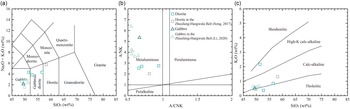
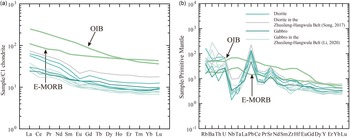
The gabbro sample exhibits low contents of SiO2 (49.36 wt%) and K2O (0.52 wt%), and high contents of Fe2O3 T (7.98 wt%), CaO (12.45 wt%) and Mg# [67.49, Mg# = Mg/(Mg + Fe2+)], which place the gabbro in the metaluminous field in the A/CNK [(molecular ratio of Al2O3/(CaO + Na2O + K2O)] versus A/NK [(molecular ratio of Al2O3/(Na2O + K2O)] diagram (Fig. 7b; Frost et al. Reference Frost, Barners, Collins, Arculus, Ellis and Frost2001). The gabbro is transitional between calc-alkaline and tholeiitic (Fig. 7c) and exhibits total rare-earth elements (REEs) concentrations of 61.94 and slightly enriched light rare-earth elements (LREEs) [(La/Yb) N = 1.18], with almost no Eu anomalies [δEu = 1.05, δEu = EuN/(EuN × GdN)1/2] (Fig. 8a). The gabbro exhibits enrichments in Rb, U and Sr, and depletions in Nb, Ta and Zr (Fig. 8d).
Diagrams showing major element features of the studied gabbro and diorites.

(a) Chondrite-normalized rare earth element patterns and (b) primitive mantle-normalized trace element spider diagrams for the investigated gabbro and diorites from the Zhusileng–Hangwula Belt. Compositions of chondrite and primitive mantle refer to Sun and McDonough (Reference Sun and McDonough1989).

The diorites have low SiO2 (51.40–56.54 wt%), high Al2O3 (15.02–18.42 wt%), MgO (3.46–6.42 wt%), Mg# (49.37–58.33) and Fe2O3 T (7.03–10.55 wt%), as well as low K2O + Na2O (3.87–4.33 wt%). They are metaluminous (A/CNK = 0.66–0.94; Fig. 7b) and belong to the tholeiitic to high calc-alkaline series (Fig. 7c). These diorites have total REE concentrations of 47.75–88.75 and enrichments in LREEs [(La/Yb) N = 3.44–6.37], with almost no Eu anomalies (δEu = 0.71–1.02) (Fig. 8a). Furthermore, they show enrichments in Rb, U, Pb and Sr, and depletions in Nb and Ta (Fig. 8b).
5. Discussion
The weighted mean 206Pb/238U ages of 286.2 ± 0.96 Ma and 285.2 ± 1.0 Ma are interpreted as crystallization ages of gabbro and diorite, respectively.
5.a. Petrogenesis
5.a.1. Gabbro
The early Permian gabbro in the Zhusileng–Hangwula Belt yielded variable zircon ϵHf(t) values (−2.5 to +2.6) and old TDM2 ages (1.96–1.49 Ga, average 1.68 Ga). The heterogeneous zircon ϵHf(t) values can be attributed either to melts derived from an asthenospheric mantle with crustal contamination or to those from an enriched lithospheric mantle (Wu et al. Reference Wu, Li, Zheng and Gao2007). The gabbro sample exhibits high Al, Ca and Fe, and low Si, K and P, indicating a parental mantle source instead of crustal materials (e.g., Rundick & Gao, Reference Rundick, Gao, Heinrich and Turekian2003). Furthermore, the content of Mg# (67.49) of this gabbro is close to the primary mantle-derived magma (Mg# = 68–73, Hess & Wiebe, Reference Hess and Wiebe1989), ruling out crustal assimilation by primary mantle-derived magma. Therefore, we suggest that the Huisentala gabbro was likely derived from an enriched lithospheric mantle.
On the chondrite-normalized REE diagram (Fig. 8a), the gabbros are characterized by enrichments in LREEs. As shown in the primitive mantle-normalized trace-element spider diagram (Fig. 8b), the gabbro is characterized by relative enrichment in large ion lithophile elements (LILEs) and U, and depletion in high field strength elements (HFSEs) (e.g., Ti, Nb and Ta), indicative of arc geochemical affinities. Crustal contamination or magma source metasomatization by subduction-related materials may result in the negative Nb–Ta–Ti anomalies (Sun & McDonough, Reference Sun and McDonough1989; Chen et al. Reference Chen, Li, Shi, Li and Zhao2011; Tang et al. Reference Tang, Chung, Wang, Wyman, Dan, Chen and Zhao2014; Xia, Reference Xia2014). However, crustal contamination can be ruled out in the generations of the Huisentala gabbro due to its high content of Mg#. Moreover, the gabbro displays high Ba/Th ratio (43.73) and relatively low Hf/Sm ratio (0.73), indicating the contribution of subduction-related fluids in its generations (La Flèche Camire & Genner, 1998; Pearce & Stern, Reference Pearce, Stern, Christie, Fisher, Lee and Givens2006). Xia et al. (Reference Xia, Xia, Xu, Li and Ma2007) suggested that magmatic rocks influenced by subduction fluids/melts usually present low Zr contents (<130 ppm) and Zr/Y ratios (<4). The Huisentala gabbro has low content of Zr (64 ppm) and Zr/Y ratio (3.66). Therefore, we proposed that the Huisentala gabbro was derived from an enriched lithospheric mantle metasomatized by subduction-related fluids.
5.a.2. Diorite
The Huodonghaer diorites have high MgO (3.46–6.32 wt%), Cr (average 73.33 ppm) and Ni (average 23.10 ppm), as well as low FeOT/MgO (1.27–1.83) ratios, TiO2 (0.48–0.90 wt%) and (La/Yb) N (3.44–6.37) ratios, indicating high-Mg andesite compositions (Kelemen et al. Reference Kelemen, Hanghøj and Greene2003; Tatsumi, Reference Tatsumi2006; Zhao et al. Reference Zhao, Wang, Xiong, Niu, Zhang and Qiao2009). The Huodonghaer diorites have a higher Mg# range (49.37–58.33) than pure crustal melts (Patiño Douce & Beard, Reference Patiño Douce and Beard1995; Rundick & Gao, Reference Rundick, Gao, Heinrich and Turekian2003), so they most likely formed from mantle melts that were influenced by crustal materials rather than from a crustal source (Jiang et al. Reference Jiang, Jiang, Dai, Liao, Zhao and Ling2009; Dong et al. Reference Dong, Liu, Zhang, Chen, Zhang, Li and Yang2012).
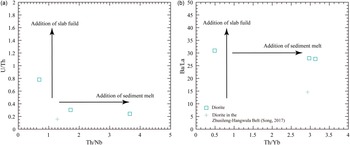
Partial melting of mantle peridotite that is metasomatized by the slab melts or subducted sediment-related melts has been regarded as the most likely petrogenetic model for high-Mg diorite (Martin et al. Reference Martin, Smithies, Rapp, Moyen and Champion2005; Moyen, Reference Moyen2009; Dong et al. Reference Dong, Liu, Zhang, Chen, Zhang, Li and Yang2012). High-Mg diorite derived from the reaction between mantle peridotite and slab melts usually exhibits adakite-like geochemical characteristics, such as high ϵNd(t) values, high Sr contents, low Y and Yb contents, high Sr/Y and (La/Yb) N ratios (Yin et al. Reference Yin, Zhou, Cheng, Zhang, Zheng, Yang, Li and Wang2015). However, the Huodonghaer diorites display positive zircon ϵHf(t) values (+1.2 to +4.9), high Y (13.20–19.30) and Yb (1.41–2.07), and low Sr/Y (21.14–45.61) and (La/Yb) N ratios (3.44–6.37). In addition, they have consistently low U/Th (0.12–0.33) and high Th/Nb (0.37–0.77) ratios, similar to the marine sediments (Fig. 9a). Furthermore, the Huodonghaer diorites have high and variable Th/Yb ratios, inconsistent with Ba/La ratios, which also support the involvement of a sediment-derived melts rather than of slab-derived fluids (Tatsumi, Reference Tatsumi2006; Fig. 9b). Because Ba is more soluble in aqueous fluids than La (Hanyu et al. Reference Hanyu, Tatsumi, Nakai, Chang, Miyazaki, Sato, Tani, Shibata and Yoshida2006), the Ba/Th ratios should be markedly increased if oceanic crust-derived melts are involved in the production of magmas. Therefore, we suggest that the Huodonghaer diorites were derived from the partial melting of mantle peridotite that was metasomatized by the subducted sediment-derived melts.
(a) Th/Nb versus U/Th and (b) Th/Yb versus Ba/La discrimination diagrams (modified after Tatsumi, Reference Tatsumi2006 and Hanyu et al. Reference Hanyu, Tatsumi, Nakai, Chang, Miyazaki, Sato, Tani, Shibata and Yoshida2006).

5.b. Tectonic implications
The Zhusileng–Hangwula Belt, located in the southernmost segment of the CAOB, is a pivotal region for determining the tectonic evolutionary history of the PAO. The Zhusileng–Hangwula Belt experienced multiple magmatic activities from the end of the early Palaeozoic to the late Palaeozoic, including four stages of ca. 399–373, 325–310, 296–263 and 250–216 Ma (Dang et al. Reference Dang, Zhao, Lin, Wu, Kang, Ge, Wu and Liu2011; Liu et al. Reference Liu, Zhao, Han, Li, Zhu, Eizenhöfer, Zhang, Wang and Tsui2018a, b; Shi et al. Reference Shi, Lu, Wei, Niu, Jiang, Han and Xu2018; Chen et al. Reference Chen, Wu, Gan, Zhang and Fu2019; Fei et al. Reference Fei, Pan, Xie, Wang and Zhao2019; Li, Reference Li2020; Song et al. Reference Song, Xiao, Windley and Han2020; Zhao et al. Reference Zhao, Liu, Wang, Zhang and Guan2020). However, as we mentioned in the introduction, the tectonic setting of the northern Alxa Block during the late Carboniferous–Permian is still ambiguous.
Fei et al. (Reference Fei, Pan, Xie, Wang and Zhao2019) proposed that the late Carboniferous to early Permian intrusions in the Zhusileng–Hangwula Belt formed in a post-collision setting, which indicates that the PAO had closed before the early Permian (Li et al. Reference Li, Zhang, Shi, Chen, An, Huang, Liu and Wang2020), and then evolved into an extensional setting to form a rift along the north Alxa Block. However, the Palaeozoic strata in the Zhusileng area formed an NW-SE-trending anticline, which was intruded by late Palaeozoic granite (Zhang et al. Reference Zhang, Zhang, Zheng, Qu, Hui, Zhao, Zhao, Niu, Zhang and Yun2022). The youngest strata involved in this fold are early Permian, and they are unconformably covered by late Permian strata (Liu et al. Reference Liu, Zhao, Han, Zhu, Wang, Eizenhöfer, Zhang and Tsui2019). The formation of this anticline reflected horizontal compression that occurred during the early to late Permian, probably as a result from the closure of the PAO. The report of radiolarians fossil (Xie et al. Reference Xie, Yin, Zhou and Zhang2014) and late Carboniferous normal mid-ocean ridge basalts exposed in the Enger Us ophiolite (∼302 Ma, Zheng et al. Reference Zheng, Wu, Zhang, Xu, Meng and Zhang2014) imply that the PAO still existed during the late Carboniferous–early Permian. Liu et al. (Reference Liu, Zhao, Han, Eizenhöfer, Zhu, Hou, Zhang and Wang2017) suggested that a switch of the tectonic settings, which was attributed to the final closure of the PAO, occurred at 280–265 Ma, according to the marked shift of zircon ϵHf(t) values and whole-rock ϵNd(t) values of the granitoids from the northern Alxa Block. Therefore, a post-collisional setting is not consistent with the derivation of the early Permian intrusions from the Zhusileng–Hangwula Belt.
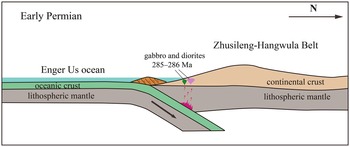
The gabbro exhibits enrichment in LREE and U, and depletion in HFSE (e.g., Ti, Nb and Ta), indicative of arc-like geochemical affinities (Fig. 8), and we suggest that the gabbro was derived from an enriched lithospheric mantle metasomatized by subduction-related fluids. Furthermore, we identified that almost coeval high-Mg diorites occur in the Zhusileng–Hangwula Belt. High-Mg diorites are generally related to the subduction of a young and/or hot oceanic slab (e.g., ridge subduction) (Rogers & Saunders, Reference Rogers, Saunders and Crawford1989; Furukawa & Tatsumi, Reference Furukawa and Tatsumi1999). Sedimentological and palaeocurrents analyses on early Permian strata in the Zhusileng area also supported a subduction setting (Chen et al. Reference Chen, Shu and Santosh2011; Jiang et al. Reference Jiang, Han, Shi, Chen, Wei and Zhang2012; Shi et al. Reference Shi, Chen, Jiang, Niu and Han2013; Zhang et al. Reference Zhang, Zhang, Zheng, Qu, Hui, Zhao, Zhao, Niu, Zhang and Yun2022). Moreover, Li (Reference Li2020) proposed that the gabbros in the Yagan metamorphic core complex have been strongly deformed and formed dykes, most of which are cut by normal faults resulting from the extensional deformation of the crust in this region. That implies that the formation of the gabbro was prior to the extensional event occurring after the closure of the PAO. Furthermore, coeval granitoid displaying volcanic arc affinities have also been verified in the Zhusileng–Hangwula Belt (Li et al. Reference Li, Zhang, Shi, Chen, An, Huang, Liu and Wang2020; Song et al. Reference Song, Xiao, Windley and Han2020; Zhao et al. Reference Zhao, Liu, Wang, Zhang and Guan2020; Deng et al. Reference Deng, Shao, Wang, Chen, Yi and Xu2022b). For instance, the 298–290 Ma granitoids in the Zhusileng–Hangwula Belt were generated by magma mixing and formed in a subduction setting (Liu et al. Reference Liu, Zhao, Han, Li, Zhu, Eizenhöfer, Zhang, Wang and Tsui2018a). Therefore, we propose that the early Permian gabbro and coeval high-Mg diorites in the Zhusileng–Hangwula Belt are formed in an ocean slab subduction environment (Fig. 10).
Schematic cartoon showing the early Permian tectonic model of the Zhusileng–Hangwula Belt.

We believe that the PAO in the middle part of the southern CAOB closed during the middle-late Permian for the following reasons: (1) middle–late Permian A-type and bimodal volcanic rocks found in this unit (Song et al. Reference Song, Xiao, Collins, Glorie, Han and Li2018, Reference Song, Xiao, Collins, Glorie, Han and Li2019, Reference Song, Xiao, Windley and Han2020; Li, Reference Li2019) indicate a post-collisional tectonic setting in the Zhusileng–Hangwula Belt after the early Permian; (2) late Permian sandstones (256–254 Ma) are interpreted to have formed in a post-collision setting, as suggested by geochemical characteristics (Liu et al. Reference Liu, Zhao, Han, Zhu, Wang, Eizenhöfer, Zhang and Tsui2019; Shi et al. Reference Shi, Zhang, Zhang, Zhang, Ding, Zhang, Bao and Zhou2020) and (3) heavy mineral features of the Permian strata in Zhusileng and adjacent areas reveal that the detritus was sourced from both the northern and southern Alxa Block, which support that the PAO closed between the early and late Permian (Chen et al. Reference Chen, Wu, Gan, Zhang and Fu2019; Zhang et al. Reference Zhang, Zhang, Zheng, Qu, Hui, Zhao, Zhao, Niu, Zhang and Yun2022). Thus, the Zhusileng–Hangwula Belt was an ocean subduction setting during the early Permian, then transitioned from subduction to collision and then to post-collision in the middle–late Permian probably due to the closure of the PAO along the Enger Us suture.
6. Conclusions
Based on the geochronological, geochemical and zircon Hf isotopic data for the gabbro and diorites in the Zhusileng–Hangwula Belt and previous studies, the following conclusions can be drawn:
-
(1) Zircon LA-ICP MS U-Pb age data show that the monzogranites, Huisentala gabbro and Huodonghaer diorites from the Zhusileng–Hangwula Bel were formed during the early Permian (291–285 Ma).
-
(2) The Huisentala gabbro yielded variable zircon ϵHf(t) values (−2.5 to +2.6) and old TDM2 ages (1.96–1.49 Ga, average 1.68 Ga). The gabbro sample exhibits high Al, Ca, Fe, Mg# and LREE, and low Si, K, P and HFSE, with slightly negative Eu anomalies, and was likely derived from an enriched lithospheric mantle metasomatized by subduction-related fluids. The Huodonghaer diorites exhibit high-Mg diorite-like geochemical compositions, such as high MgO, Sr and Cr contents, and low FeO/MgO ratios. They show moderate zircon ϵHf(t) values (+1.2 to +4.9) and Mesoproterozoic two-stage model ages (1.62–1.29 Ga), indicating that the diorites are derived from partial melting of mantle peridotite that was metasomatized the subducted sediment-derived melts.
-
(3) Combined with other geological evidence, we propose that the early Permian gabbro and coeval high-Mg diorites from the Zhusileng–Hangwula Belt formed in an ocean subduction setting and probably are associated with the tectonic evolution of the PAO along the Enger Us suture.
Supplementary material
The supplementary material for this article can be found at https://doi.org/10.1017/S0016756823000444
Data availability statement
The data that support the findings of this study are available in the supplementary material of this article.
Acknowledgements
This work was financially supported by the China Geological Survey (DD20221768, DD20190011, DD20221643). We are grateful to anonymous reviewers for their constructive comments. We are also grateful to Liming Zhou (National Research Center for Geoanalysis, Chinese Academic of Science, Beijing) for his help in zircon Lu–Hf isotopic analysis, Dr. Zengzheng Wang for reviewing the manuscript and offering valuable advice, Dr. Shenglin Xu for helpful discussions in U–Pb geochronological analysis and Dr. Yongchao Wang, Wei Yu, He Su, Yiping Zhang and Bing Li for assistance in our field work.
Competing interests
The authors declare that they have no known competing financial interests or personal relationships that could have appeared to influence the work reported in this paper.