




No CrossRef data available.
Article contents
Everyday action in dementia: Evidence for differential deficits in Alzheimer's disease versus subcortical vascular dementia
Published online by Cambridge University Press: 23 January 2006
Abstract
The relationship between dementia diagnosis and everyday action (e.g., meal preparation, grooming) is not well understood. This study examines differences between individuals diagnosed with vascular dementia (VaD; n = 25) versus Alzheimer's disease (AD; n = 23) on the Naturalistic Action Test (NAT; Schwartz et al., 2003), a performance-based measure that includes three tasks of increasing complexity. The percentage of task steps accomplished, number of errors, and performance times were recorded for each task. While the groups did not differ in dementia severity or overall impairment on the NAT, the VaD group committed more errors (3.3 vs. 1.6, p = 02). The VaD group also accomplished significantly fewer steps when salient distractor objects were present (74.0% vs. 91.3%, p < .01). Correlations between NAT variables and neuropsychological tests suggest the executive control deficits associated with VaD may contribute to specific action difficulties, such as distractor interference and inefficient, error-prone action on complex tasks. In AD, everyday action may be negatively influenced by episodic memory failures. Thus, dementia diagnosis has relevance to everyday function. (JINS, 2006, 12, 45–53.)
Keywords
Information
- Type
- Research Article
- Information
- Journal of the International Neuropsychological Society , Volume 12 , Issue 1 , January 2006 , pp. 45 - 53
- Copyright
- © 2006 The International Neuropsychological Society
INTRODUCTION
Everyday action impairment is a hallmark of dementia (American Psychiatric Association, 2000) and is associated with serious consequences, including caregiver burden (DeBettignies et al., 1990), institutionalization (Knopman et al., 1988; Mast et al., 2004), depression (Adam et al., 2000; Hargrave et al., 2000), and death (Knopman et al., 1988; Noale et al., 2003). Nevertheless, relative to other neuropsychological operations, such as memory and language, few studies have compared everyday action across dementia subgroups. Thus, the relevance of diagnosis (e.g., AD vs. VaD) to everyday functioning has gone largely unexplored.
AD and VaD are associated with distinct neuropathology and neuropsychological deficits. AD is characterized by amyloid plaques and neurofibrillary tangles distributed in the entorhinal cortex, hippocampus, and association cortex (Murayama & Saito, 2004). This pathology has been linked to deficits in declarative systems, particularly episodic memory (Libon et al., 1996) and semantic knowledge (Giovannetti et al., 1997, 2001; Saffran & Schwartz, 1994). Executive deficits are often present, but are not considered the primary impairment (Knopman & Selnes, 2003). Diffuse neuropathological changes and widespread cognitive deficits, including marked executive dysfunction, occur as the disease progresses. In contrast, subcortical VaD is characterized by small lacunar infarcts and deep white matter alterations. This neuropathology is associated with psychomotor slowing and bradyphrenia (Lamar et al., 2002). Also, relative to AD, VaD patients show less impairment in episodic and semantic memory, but greater impairment in executive control (Lamar et al., 1997, 2002; Libon et al., 1998; see Libon et al., 2004 for a review).
There are reasons the unique neurocognitive profiles associated with AD versus VaD may differentially influence everyday functioning. Episodic memory is critical for tasks that require the recall of numerous details (e.g., grocery shopping for a recipe), and investigators have demonstrated a link between memory deficits and everyday action difficulties in AD (Teri et al., 1989). Thus, AD patients may be more likely to omit task segments (episodic memory failures) than individuals with VaD, whose declarative systems are relatively spared. On the other hand, numerous theories emphasize the role of executive functions, such as cognitive control and working memory, for goal-directed, efficient everyday action (Buxbaum et al., 1997; Duncan, 1986; Fuster, 1989; Luria, 1966; Norman & Shallice, 1980; Sirigu et al., 1995). These accounts imply executive deficits in VaD may cause greater derailment (off-task actions) and inefficient actions (e.g., commission errors) relative to AD.
The recent resource theory of naturalistic/everyday action impairment predicts no observable differences in everyday action between AD versus VaD patients of equal dementia severity. The theory states action requires attentional resources and is sensitive to reduction in general cognitive functioning from any source (i.e., episodic/semantic impairment, executive dysfunction, or both). The overall severity of neuropsychological dysfunction, not the specific pattern of deficits, best predicts the degree of everyday action impairment. Qualitative aspects of performance (e.g., error patterns) are dictated by the environmental context, not specific deficits. That is, all individuals, regardless of their specific neuropsychological profile, will commit off-task actions in the presence of distractor objects, omissions when tasks are complex and lengthy, and so on. There is evidence from acute brain injury and stroke populations to support this account (Buxbaum et al., 1998; Schwartz et al., 1998, 1999).
Previous work from our group has shown support for the resource theory in a heterogeneous sample of dementia participants (Giovannetti et al., 2002a). A few studies have compared AD and VaD patients and have found no significant differences; thus, indirectly supporting the resource account. However, several methodological factors may have influenced the results. For example, several studies have relied on caregiver ratings (DeBettignies et al., 1990; Shen-shan & Le-hua, 2004), which may be influenced by rater characteristics and/or by variability in the complexity of individuals' daily routines (Argüelles et al., 2001; DeBettignies et al., 1993; Mangone et al., 1993; Zanetti et al., 1999), and fail to provide information regarding the nature of deficits (e.g., rate of error vs. proportion accomplished, effect of context, etc.). Two studies have used performance-based measures (DeBettignies et al., 1993; Zimmer et al., 1994); however, the tasks were quite simple (e.g., buttoning a shirt, etc.) and performance of critical steps was coded as only correct or incorrect. Thus, it is possible that the procedures were insufficiently challenging and the coding scheme too coarse to uncover meaningful group differences.
The present study explored differences in the breakdown of everyday action performance on complex tasks between AD and VaD groups of comparable dementia severity. The Naturalistic Action Test (Schwartz et al., 2002, 2003), a standardized measure that requires completion of everyday tasks in the laboratory with little guidance from the examiner, was administered to all participants. The NAT is composed of three multiple-step tasks of increasing complexity, and it yields detailed performance variables reflecting the percent of steps accomplished, number of key errors committed, and time to completion. We hypothesize that although the groups may not differ in their overall level of action impairment (i.e., coarse grain analysis), differences on detailed performance variables will be observed, which will reflect the neuropsychological deficits that differentiate AD versus VaD. More specifically, we hypothesize episodic memory deficits in AD will preclude recall of task requirements and manifest as omissions of large task segments. Thus, relative to VaD patients, we predict AD patients will demonstrate lower accomplishment scores on the NAT. According to accounts that emphasize the role of executive functions in efficient and accurate everyday action (Buxbaum et al., 1997; Duncan, 1986; Fuster, 1989; Luria, 1966; Norman & Shallice, 1980; Sirigu et al., 1995), we predict VaD patients will demonstrate higher error rates and longer completion times than AD patients on the NAT. The design of the NAT also allowed us to explore whether the two groups would perform differently depending on the task context. We predicted group differences would be most pronounced on more complex everyday tasks (e.g., NAT Items 2 & 3), as basic everyday tasks (e.g., NAT Item 1) may not sufficiently challenge participants.
Methods
Participants
The sample included 48 outpatients (23 AD & 25 VaD) recruited from a dementia evaluation program (Crozer Chester Medical Center, Upland, PA or UMDNJ-SOM, Stratford, NJ) that included examination by a neurologist, a neuropsychologist, a psychiatrist, a geriatrician, and a social worker. Neuroimaging and appropriate diagnostic laboratory studies were obtained to evaluate for reversible causes of dementia. Only patients who exhibited mild-moderate dementia (MMSE = 12-26; Folstein et al., 1975) and met NINCDS-ADRDA criteria for probable AD (McKhann et al., 1984) or the California Criteria (Chui et al., 1992) for probable/possible ischemic vascular dementia were recruited. The clinical diagnosis was made at an interdisciplinary team conference. Exclusion criteria included evidence of cortical stroke on neuroimaging/neurologic exam, insufficient arousal/attention to tolerate testing, motor/sensory deficits precluding object grasping, and/or history of head injury, epilepsy, premorbid neurological illness, or long-standing psychiatric illness.
According to the Chui et al. (1992) criteria, all VaD patients had record of vascular risk factors, including hypertension (100%), diabetes (21%), high cholesterol (50%), and/or heart disease (43%), and extensive periventricular and deep white matter alterations on neuroimaging. Patients diagnosed with probable VaD (n = 16) had evidence of two or more subcortical ischemic strokes on the basis of their history, neurological examination, and/or neuroimaging. Patients diagnosed with possible VaD (n=9) presented with Binswanger's disease, which involves 1) incontinence or gait disturbance, 2) vascular risk factors, and 3) extensive white matter changes on neuroimaging (see Chui et al.,1992). AD participants had no history of cortical or subcortical stroke on neuroimaging/neurologic examination or systemic disorders/diseases that could affect cognitive functioning. AD participants demonstrated cortical atrophy on neuroimaging and presented with marked episodic memory deficits upon examination (see Table 1).
Means and standard deviations for demographic and neuropsychological variables across the groups

In an effort to support the clinical diagnosis of VaD versus AD, the severity of subcortical white matter alterations on T-2-weighted MRI was quantified using a 40-point scale (0 = no alterations; Junque et al., 1990) for a subset of participants (55%) for whom scans were available for coding. The ratings confirmed that VaD (n = 12) patients showed more severe white matter changes than AD (n = 14) participants (13.2 vs. 4.1, z = 3.7, p < .001).
Procedure
This project was approved by the IRBs (Institutional Review Boards) overseeing the outpatient programs. All participants gave informed consent and performed the Naturalistic Action Test (NAT; Schwartz et al., 2003), a standardized measure that requires completion of three everyday tasks in the laboratory. The NAT has been validated on individuals undergoing inpatient rehabilitation for closed head injury (Schwartz et al., 1998, 2002) or stroke (Buxbaum et al., 1998; Schwartz et al., 1999), as well as patients with degenerative dementia (Giovannetti et al., 2002a, 2002b). Normative data are reported in the manual (Schwartz et al., 2003) and elsewhere (Schwartz et al., 2002; Sestito et al., 2005). Prior studies have shown NAT variables are not affected by education, gender, or motor difficulties (e.g., hemiparesis; Buxbaum et al., 1998; Giovannetti et al., 2002a; Schwartz et al., 1998, 1999, 2002; Sestito et al., 2005). Among dementia patients, NAT scores have been shown to correlate significantly with performance of ADL/IADL in the home (Giovannetti et al., 2002a).
NAT instructions, object placement, cueing procedures, and scoring are standardized and described in the test manual. Participants are asked to perform three tasks (Items) with little guidance. All necessary objects are available on the testing table; on Items 2 and 3 additional distractor objects are also presented. On Item 2 the distractors are matched to target objects (e.g., target—scissors, distractor—gardening shears; target—scotch tape, distractor—stapler, etc.) and are visible on the tabletop throughout the task, but on Item 3 distractors are not directly relevant to the task at hand and are kept in a drawer. The Items include: (1) prepare toast with butter and jelly and prepare coffee with cream and sugar; (2) wrap a gift while semantically/visually salient distractor objects are included on the tabletop; and (3) pack a lunchbox with a sandwich, snack, and a drink and pack a schoolbag with supplies for school while several necessary objects (e.g., thermos lids) are stored out of view in a drawer containing potentially distracting objects (e.g., spatula, thread, etc.). The NAT Items are ordered from least to most complex/difficult according to prior studies of controls and neurologically impaired patients (Schwartz et al., 2002, 2003). Each item was originally designed to assess the impact of multiple factors, including two task goals (i.e., dual-task; Items 1 & 3), salient distractors (Item 2), and extended search for objects out of view (Item 3), on everyday action (Schwartz et al., 1998).
Scoring procedures closely followed the manual instructions (Schwartz et al., 2003). All NAT variables were scored online, while the participant performed the tasks. The Accomplishment Score, which reflects the percentage of critical steps completed with or without error, was computed for the entire NAT (Total NAT) as well as each NAT Item (range = 0–100). The NAT manual provides a list of key errors for each item. These errors have been shown to occur frequently in neurologically-impaired patients, and they reliably distinguish patient from healthy populations (e.g., Item 1—substitute sugar for jelly and/or butter; Item 2—use garden shears for scissors, etc.). The Error Score reflects the number of key commission errors committed on each item. A Total Error Score, which is the sum of errors from all items, was also collected. Inter-rater reliability rates above 95% have been reported for Accomplishment and Error Scores (Schwartz et al., 2002, 2003).
Procedures for collecting time data are not described in the manual. We collected time data with a manual stopwatch. Timing began when the participant initiated the first task step and ended at the point she/he indicated she/he was finished. Time Scores reflect the amount of time (in seconds) the participant spent working on each NAT Item and the entire NAT (Total Time).
A Total NAT Score, reflecting overall impairment/performance, was computed as described in the manual. Accomplishment and Error Scores for each Item were converted to a 7-point scale (NAT Score), ranging from 0 (Accomplishment Score < 50%) to 6 (Accomplishment Score = 100% and Error Score < 2) and then summed (i.e., possible scores range from 0 to 18). The NAT Score is the primary variable described in the test manual (Schwartz et al., 2003) and related studies (Schwartz et al., 2002) for discriminating neurologically impaired patients from controls and detecting impairment. Based on normative data from older adults, a Total NAT Score below 14 indicates impairment (Sestito et al., 2005). The test manual does not provide normative data for Accomplishment and Error Scores separately.
Neuropsychological Assessment
A neuropsychological protocol was administered to all participants as part of their clinical evaluation. The Boston Revision of the Wechsler Memory Scale Mental Control subtest (MC; Lamar et al., 2002), phonemic fluency (FAS; Spreen & Strauss, 1991), and Graphical Sequence Test-Dementia Version (Lamar et al., 1997) were administered to assess executive functions. These tests measure sustained attention, working memory, and the ability to inhibit automatic behavior, which are purportedly critical for everyday action (Duncan, 1986; Fuster, 1989; Luria, 1966; Norman & Shallice, 1980). Several studies have shown patients diagnosed with syndromes associated with fronto-striatal neuropathology (e.g., Parkinson's disease & VaD) are significantly more impaired on these tests than patients with AD (Giovannetti et al., 1997; Lamar et al., 1997, 2002; Libon et al., 2001). Finally, when factor analyzed with tests of visuocontruction, memory, and concept formation, these three executive tests load on a single, separate factor (Lamar et al., 2004).
Language was assessed with the Boston Naming Test (BNT; Kaplan et al., 1983) and ‘animal’ Word List Generation test (Animal WLG; Giovannetti et al., 1997). While Animal WLG and FAS appear quite similar on the surface, neuroimaging research has shown each task recruits distinct brain regions, with FAS involving left prefrontal regions and Animal WLG left temporal cortex (Gourovitch et al., 2000; see also Giovannetti et al., 1997). Episodic memory was tested using the delayed recognition subtest of the Philadelphia (repeatable) Verbal Learning Test (PVLT; Libon et al., 2005), a nine-word list learning task administered in the same manner as the California Verbal Learning Test (Delis et al., 1987). The recognition discriminability index was used because it minimizes the retrieval demands inherent to free recall and distinguishes patients with AD from those with less severe episodic encoding deficits (e.g., VaD & Parkinson's disease; Graham et al., 2004; Kramer et al., 1988; Libon et al., 1996; Massman et al., 1990).
Data Analysis
Analyses were performed with SPSS 11 for Mac OS X (2003). Between-group analyses for overall NAT variables were performed with Mann-Whitney Tests for ordinal level variables (Total NAT Score) and interval level variables that were not normally distributed and unable to be transformed (Total Accomplishment & Total Error Scores). Fisher's Exact Tests were used with frequency data (number of women & number of “impaired” participants), and t-tests were used with normally distributed data (age, education, MMSE; GDS, and neuropsychological variables).
Three mixed-model analyses of variance (ANOVA), with NAT Item (1 vs. 2 vs. 3) as the within-subject factor and group (AD vs. VaD) as the between-subject factor were performed for the NAT performance scores (Accomplishment & Errors). The required statistical assumptions of ANOVA were not met, because the raw dependent variables were not normally distributed and were unable to be transformed. Therefore, each of the NAT variables were ranked across all 48 participants and 3 NAT Items (a range of 1–144 possible ranks; Akritas & Arnold, 1994). Post-hoc testing of between-subject effects was done using Mann-Whitney Tests; the Wilcoxon Signed Ranks Tests was used for within-group analyses.
For small samples, the power efficiency of the Mann-Whitney and Wilcoxon are nearly 95 percent of the t-test (Siegel & Castellan, 1988). Therefore, effect sizes for all NAT analyses were estimated by Cohen's d calculations (.2 = small; .5 = medium; .8 = large; Cohen, 1988). Finally, Spearman rank order correlation analyses were performed between neuropsychological test scores and NAT variables that differed across the groups to explore relationships between specific aspects of everyday action performance and neuropsychological processes.
RESULTS
Demographic and Neuropsychological Variables
The AD and VaD groups were comparable in age, dementia severity, and GDS score (within normal limits; Yesavage, 1986; p > .278 for all, see Table 1). On average, the VaD group had fewer years of education (p = .062) and a slightly higher proportion of women (n = 22; 88%) than the AD group (n = 15; 66%; Fisher's Exact p = .091), but these differences were not statistically significant. Furthermore, consistent with prior studies (Buxbaum et al., 1998; Giovannetti et al., 2002a; Schwartz et al., 1999; Sestito et al., 2005), correlations between education and NAT variables were nonsignificant (NAT Score r = .12; Total Accomplishment r = .07; Total Errors r = −.15; p > .328 for all) and there was no difference between men and women (NAT Score z = −.65; Total Accomplishment z = −1.0; Total Errors z = −.14; p > .318 for all). Therefore, the slight, nonsignificant between-group differences in education and sex were inconsequential for subsequent analyses.
Results from clinical neuropsychological assessment also are shown in Table 1. For all tests, except the Graphical Sequence Test, for which the total score is a measure of errors, a higher score reflects better performance than a lower score. Consistent with prior studies (Giovannetti et al., 1997; Lamar et al., 1997, 2002; Libon et al., 1996, 1997, 1998, 2001; see Libon et al., 2004 for a review), the VaD group scored significantly worse than the AD group on all tests of executive functioning, and AD patients obtained lower episodic memory scores. There was no significant difference on language tests.
Overall NAT Scores
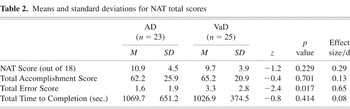
The Total NAT Score did not differ between the AD and the VaD groups (see Table 2). The majority of participants in both groups fell within the impaired range on the NAT [cut-off <14 (Sestito et al., 2005)]; there was no difference in the percent of AD (n = 16, 70%) versus VaD (n = 20, 80%) participants in the impaired range (Fisher's Exact p = .511). Between-group differences for Total Accomplishment, Total Error and Total Time are also shown in Table 2. As predicted, the VaD group committed significantly more errors than the AD group. However, the groups attained comparable overall Accomplishment and Time Scores. Thus, the predictions that the AD group would obtain lower Accomplishment Scores and VaD group higher Time Scores were not supported.
Means and standard deviations for NAT total scores

Accomplishment Scores
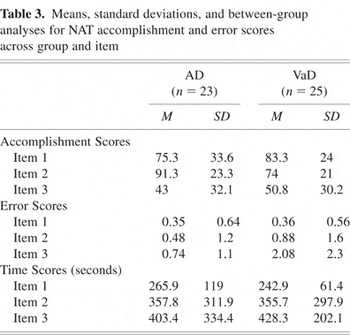
The average Accomplishment Scores across group and item are shown in Table 3. An ANOVA showed a significant main effect of item [F(2,45)= 44.7, p < .001] as well as a significant Item × Group interaction [F(2,45) = 8.3, p = .001]. The effect of group was not significant [F(1,45) = .68, p = .412]. Contrary to prediction, VaD participants obtained significantly lower Accomplishment Scores on Item 2 (gift-wrapping with distractors; M Ranks-VaD = 18.5; AD = 31; see Table 3). VaD and AD participants obtained comparable Accomplishment Scores on Item 1 and Item 3. Within-group analyses showed VaD participants accomplished significantly fewer steps on each consecutive NAT Item (z > 2.2, p < .026 for all). Effect sizes ranged from small (Item 1 vs. Item 2, d = .32) to large (Item 1 vs. Item 3, d = 1.12). For AD participants, the Accomplishment Score for Item 2 was significantly higher than Item 1 and Item 3 (z > 2.4, p < .015 for both), and Item 1 was significantly higher than Item 3 (z = 3.6, p < .001). Effect sizes ranged from medium (Item 1 vs. Item 2, d = .57) to large (Item 2 vs. Item 3, d = 1.5)
Means, standard deviations, and between-group analyses for NAT accomplishment and error scores across group and item

Error Scores
The mean Total Errors across group and Item are shown in Table 3. The Item × Group ANOVA revealed significant main effects of item [F(2,45) = 8.4, p = .001] and group [F(1,45) = 5.5, p = .023], but the Item × Group interaction was not statistically significant [F(2,45) = 2.4, p = .108].
As predicted, Error Scores were higher for the VaD group than the AD group (see Table 2). Within-group analyses (including both groups combined) showed error rates were significantly higher on Item 3 than both Item 1 (z = 3.4, p = .001; d = .51) and Item 2 (z = 1.9, p = .050; d = .31). There was no difference between Item 1 and Item 2 (z = 1.1, p = .256; d =.20).
Time Scores
The Group × Item ANOVA showed a significant effect of item [F(2,43) = 9.4, p < .001]. There was no significant effect of group [F(1,43) = .20, p = .654] and no Item × Group interaction [F(2,43)= 1.6, p = .217]. Mean Times by item and group are shown in Table 3.
Within–group analyses (for both groups combined) revealed shorter Time Scores on Item 1 than both Item 2 (z = 2.0, p = .046; d = .36) and Item 3 (z = 3.8, p < .001; d = .59). The difference between Item 2 and Item 3 was small (d = .18) and just missed statistical significance (z = 1.9, p = .052).
Correlation Analyses
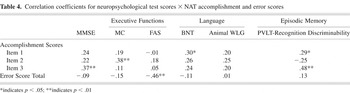
Correlations were performed to explore relationships between neuropsychological processes and NAT variables. To limit the number of correlations, only variables that differed significantly between the groups (i.e., Item Accomplishment Scores & Total Error Score) were analyzed. The Graphical Sequences Test was not included, because too few participants completed this test. As shown in Table 4, all significant correlations were in the expected direction; better performance on neuropsychological tests was associated with better performance on the NAT (i.e., higher accomplishment & lower errors). More specifically, Accomplishment Scores for Items 1 and 3 correlated with dementia severity (Item 3), language (Item 1) and episodic memory (Item 1 & Item 3). Item 2, however, showed a different pattern of results; it was the only accomplishment variable to correlate significantly with an executive measure (WMS-Mental Control). Similarly, the Total Error Score correlated with only a measure of executive control (FAS). There were no significant relationships between Total Errors and tests of dementia severity, episodic memory, or language.
Correlation coefficients for neuropsychological test scores × NAT accomplishment and error scores

DISCUSSION
Performance on a series of complex, everyday tasks was examined between participants with mild-moderate AD versus those with mild-moderate VaD. The groups did not differ in overall action impairment as indicated by the Total NAT Score. However, two differences emerged on finer measures of performance. First, as predicted, the VaD group committed a higher rate of errors. Second, and contrary to prediction, VaD participants accomplished fewer steps in the presence of distractor objects that were semantically and visually similar to target objects (NAT Item 2). These results indicate that the differential diagnosis of AD versus VaD is relevant to everyday functioning and suggest specific neuropsychological impairments may be linked to specific everyday action difficulties.
We interpret the high error rate in VaD as evidence for a link between executive deficits and inefficient, error-prone everyday action. Post-hoc correlations showing a significant relationship between NAT Total Errors and a measure of executive function (but not dementia severity, memory or language) support this conclusion. This finding is consistent with accounts that stress the role of executive functions, such as cognitive control and working memory, in efficient, goal-directed action (Duncan, 1986; Fuster, 1989; Luria, 1966; Norman & Shallice, 1980; Sirigu et al., 1995).
Contrary to prediction, the AD group did not attain lower Accomplishment Scores. Instead, VaD participants accomplished significantly fewer steps when semantically and visually salient distractor objects were present. Unlike the distractors on Item 3, which are dissimilar to target objects and visible only when (and if) participants search a drawer containing two target objects, the distractors on Item 2 are semantically and visually similar to the target objects and are visible throughout the task. Although we might have expected AD patients to experience greater difficulty on Item 2 because of their purported semantic knowledge deficits, our finding suggests deficits in executive functions may make dementia patients vulnerable to interference and derailment from compelling distractor objects. This interpretation is bolstered by the significant correlations between Item 2 Accomplishment (but not Items 1 and 3 Accomplishment) and a measure of executive function.
It is important to note that while the VaD group performed more poorly on several NAT measures, both groups were markedly impaired on the NAT relative to normative samples (Sestito et al., 2005). Even on the simplest NAT task (Item 1), for which there were no between-group differences, both the VaD and AD groups performed almost two standard deviations below the control mean Accomplishment Score (M = 97.83, SD = 7.6; Sestito et al., 2005). Thus, while qualitative differences in action performance were observed between the groups, overall everyday action impairment may be best explained by general dementia severity. Although caution must be taken when interpreting negative results, this conclusion is generally consistent with the resource theory of naturalistic action impairment (Buxbaum et al., 1998; Giovannetti et al., 2002a; Schwartz et al., 1998, 1999).
We predicted the AD group would omit more task segments because of marked episodic memory deficits; however, AD and VaD participants obtained comparable Accomplishment Scores. In our experience, we observed participants with dense amnesia often appeared to forget the NAT instructions, particularly on Item 3. Consequentially, they produced relatively little action, which is evident from their low Accomplishment and Error Scores. VaD participants, on the other hand, were more likely to attempt steps and fail to accomplish them (i.e., high Error Score & low Accomplishment). We suggest the possibility that AD participants may have terminated the task prematurely because of memory failures and may have completed more steps if able to recall the instructions. However, this interpretation is speculative and further investigation is necessary to explicate the source of action impairment in AD patients.
Our findings have implications for the methodologies used in future everyday action research. First, future studies should assess everyday action using tasks that vary in complexity and contexts (e.g., with and without distractors). Similar to prior studies (DeBettignies et al., 1993; Zimmer et al., 1994), we found no between-group differences on the most basic NAT task (Item 1). Differences emerged on more complex tasks and in the presence of distractor objects. Second, future studies should include dependent variables that capture the quality of performance. Most caregiver questionnaires are not designed to capture such nuances (Lawton, 1988), and many performance-based measures do not distinguish accomplishment from errors (DeBettignies et al., 1993; Zimmer et al., 1994). Our results suggest fine-grained analyses may uncover meaningful group difference.
It is important to mention that while individuals with VaD exhibit psychomotor slowing relative to AD, between-group differences cannot be attributed to differences in motor skills. The NAT was designed to assess the cognitive aspects of everyday action; participants are not penalized for physical limitations (Schwartz et al., 2003). Prior research shows accomplishment and error scores do not correlate with measures of motor aspects of everyday functioning (Schwartz et al., 2002).
We acknowledge that our sample size was small; the power to detect small effects (d = .20) between the AD and VaD groups was markedly lower than the suggested .80 (power = .10). Therefore, significant group differences may have been missed. However, it is likely that small between-group effects have little clinical significance with respect to everyday action performance. Our sample size provided adequate power (.60) to detect medium to large group differences (d = .65), which are more likely to have clinical relevance.
In conclusion, the results indicate that dementia diagnosis is relevant to everyday functioning. We acknowledge that our results do not conclusively indicate the mechanisms underlying performance differences between the groups. The link between executive functions/episodic memory and qualitative aspects of everyday action (i.e., distractor interference & omissions) is speculative. Further research is essential to fully appreciate the relationship between neuropsychological deficits and everyday action in dementia subgroups. Nevertheless, our study is the first to demonstrate differences in everyday action performance between AD and VaD groups of equal dementia severity. Contrary to the resource theory, these differences imply that each group's distinct neurocognitive profile differentially impacted qualitative aspects of everyday action performance. Furthermore, they suggest dementia diagnosis should be considered when developing recommendations and interventions for everyday action impairment. For example, VaD patients may be more negatively affected by the presence of multiple, similar objects and may benefit more than other patients from a clutter-free workspace. AD patients might perform best when task instructions are simplified or supported by explicit external cues (e.g., written directions).
ACKNOWLEDGMENTS
This research was funded, in part, by a New Investigator Research grant from the Alzheimer's Association awarded to T. Giovannetti. A portion of this paper was presented at the 2nd Congress of the International Society for Vascular Behavioral and Cognitive Disorders (June, 2005) in Florence, Italy. The authors thank Dr. Kathleen Haaland and two anonymous reviewers for their helpful comments on an earlier version of this manuscript.
References
REFERENCES
Adam, S.,
van der Linden, M.,
Jullerat, A.-C., &
Salmon, E.
(2000).
The cognitive management of daily life activities in patients with
mild to moderate Alzheimer's disease in a day care center: A case
report.
Neuropsychological Rehabilitation,
10,
485–509.CrossRefGoogle Scholar
Akritas, M.G. &
Arnold, S.F.
(1994).
Fully non-parametric hypotheses for factorial designs. Part I:
multivariate repeated measures designs.
Journal of the American Statistical Association,
89,
336–343Google Scholar
Argüelles, S.,
Loewenstein, D.,
Eisdorfer, C., &
Argüelles, T.
(2001).
Caregivers' judgments of the functional abilities of the
Alzheimer's disease patient: Impact of caregivers' depression
and perceived burden.
Journal of Geriatric Psychiatry & Neurology,
14,
91–98.Google Scholar
American Psychiatric Association
(2000).
Diagnostic and Statistical Manual of Mental Disorders
(Fourth Edition Text Revision).
Arlington:
American Psychiatric Association.
Buxbaum, L.J.,
Schwartz, M.F., &
Carew, T.G.
(1997).
The role of semantic memory in object use.
Cognitive Neuropsychology,
14,
219–254.Google Scholar
Buxbaum, L.J.,
Schwartz, M.F., &
Montgomery, M.
(1998).
Ideational apraxia and naturalistic action.
Cognitive Neuropsychology,
15,
617–643.Google Scholar
Chui, H.C.,
Victoroff, J.I.,
Margolin, D.,
Jagust, W.,
Shankle, R., &
Katzman, R.
(1992).
Criteria for the diagnosis of ischemic vascular dementia proposed by
the state of California Alzheimer's disease diagnostic and treatment
centers.
Neurology,
42,
473–480.CrossRefGoogle Scholar
Cohen, J.
(1988).
Statistical power analysis for the behavioral sciences
(2nd ed.).
Hillsdale, NJ:
Lawrence Earlbaum.
DeBettignies, B.H.,
Mahurin, R.K., &
Pirozzolo, F.J.
(1990).
Insight for impairment in independent living skills in
Alzheimer's disease and multi-infarct dementia.
Journal of Clinical & Experimental Neuropsychology,
12,
355–363.Google Scholar
DeBettignies, B.H.,
Mahurin, R.K., &
Pirozzolo, F.J.
(1993).
Functional status in Alzheimer's disease and multi-infarct
dementia: A comparison of patient performance and caregiver report.
Clinical Gerontologist,
12,
31–49.Google Scholar
Delis, D.C.,
Kramer, J.,
Kaplan, E., &
Ober, B.A.
(1987).
California Verbal Learning Test (CVLT) research edition-adult
version.
New York:
Psychological Corporation.
Duncan, J.
(1986).
Disorganization of behaviour after frontal lobe damage.
Cognitive Neuropsychology,
3,
271–290.Google Scholar
Folstein, M.F.,
Folstein, S.E., &
McHugh, P.R.
(1975).
Mini-mental state a practical method for grading the cognitive state
of patients for the clinician.
Journal of Psychiatric Research,
12,
189–198.Google Scholar
Fuster, J.M.
(1989).
The prefrontal cortex
(2nd ed.).
New York:
Raven Press.
Giovannetti, T.,
Lamar, M.,
Cloud, B.S.,
Grossman, M., &
Libon, D.J.
(1997).
Impairment in category fluency in ischemic vascular dementia.
Neuropsychology,
11,
400–412.Google Scholar
Giovannetti, T.,
Lamar, M.,
Cloud, B.S.,
Swenson, R.,
Fein, D.,
Kaplan, E., &
Libon, D.
(2001).
Different underlying mechanisms for deficits in concept formation in
dementia.
Archives of Clinical Neuropsychology,
16,
547–560.CrossRefGoogle Scholar
Giovannetti, T.,
Libon, D.J.,
Buxbaum, L.J., &
Schwartz, M.F.
(2002a).
Naturalistic action impairments in dementia.
Neuropsychologia,
40,
1220–1232.Google Scholar
Giovannetti, T.,
Libon, D.J., &
Hart, T.
(2002b).
Awareness of naturalistic action errors in dementia.
Journal of the International Neuropsychological Society,
8,
633–644.Google Scholar
Gourovitch, M.L.,
Kirkby, B.S.,
Goldberg, T.E.,
Weinberger, D.R.,
Gold, J.M.,
Esposito, G.,
Van Horn, J., &
Berman, K.F.
(2000).
A comparison of rCBF patterns during letter and semantic
fluency.
Neuropsychology,
14,
353–360.Google Scholar
Graham, N.L.,
Emery, T., &
Hodges, J.R.
(2004).
Distinctive cognitive profiles in Alzheimer's disease and
subcortical vascular dementia.
Journal of Neurology, Neurosurgery & Psychiatry,
75,
61–71.Google Scholar
Hargrave, R.,
Reed, B., &
Mungus, D.
(2000).
Depressive symptoms and functional ability in dementia.
Journal of Geriatric Psychiatry and Neurology,
13,
72–77.Google Scholar
Junque, C.,
Pujol, J.,
Vendrell, P.,
Brunn, O.,
Gadder, M.,
Ribs, J.C.,
Vias, J.,
Capdevila, A., &
Marti-Vialta, J.L.
(1990).
Leuko-araiosis on magnetic resonance imaging and speed of mental
processing.
Archives of Neurology,
47,
151–156.Google Scholar
Kaplan, E.,
Goodglass, H., &
Weintraub, S.
(1983).
The Boston Naming Test.
Philadelphia:
Lea and Febiger.
Knopman, D.S.,
Kitto, J.,
Deinard, S., &
Heiring, J.
(1988).
Longitudinal study of death and institutionalization in patients
with primary degenerative dementia.
Journal of American Geriatric Society,
36,
108–112.Google Scholar
Knopman, D.S. &
Selnes, O.
(2003).
Neuropsychology of Dementia. In
K. Heilman &
E. Valenstein (Eds.),
Clinical Neuropsychology (pp.
574–616).
NY:
Oxford.
Kramer, J.H.,
Delis, D.C.,
Blusewicz, M.J.,
Brandt, J.,
Ober, B.A., &
Strauss, M.
(1988).
Verbal memory errors in Alzheimer's and Huntington's
dementias.
Developmental Neuropsychology,
4,
1–5.Google Scholar
Lamar, M.,
Podell, K.,
Carew, T.G.,
Cloud, B.S.,
Resh, R.,
Kennedy, C.,
Goldberg, E., &
Kaplan, E.
(1997).
Perseverative behavior in Alzheimer's disease and subcortical
vascular dementia.
Neuropsychology,
11,
523–534.Google Scholar
Lamar, M.,
Price, C.C.,
Davis, K.L.,
Kaplan, E., &
Libon, D.J.
(2002).
Capacity to maintain mental set in dementia.
Neuropsychologia,
40,
435–445.Google Scholar
Lamar, M.,
Swenson, R.,
Kaplan, E., &
Libon, D.J.
(2004).
Characterizing alterations in executive functioning across distinct
subtypes of cortical and subcortical dementia.
The Clinical Neuropsychologist,
18,
22–31.Google Scholar
Lawton, P.
(1988).
Scales to measure competence in everyday activities.
Psychopharmacology Bulletin,
24,
609–614.Google Scholar
Libon, D.,
Schmidt, K.S.,
Gallo, J.L.,
Penney, D.L.,
Swenson, R.,
Giovannetti, T., &
Miller, J.A.
(2005).
The prototypicality of extra-list intrusion errors produced on a
serial list-learning task by patients with mild dementia.
[Abstract]
Journal of the International Neuropsychological Society,
11 (Suppl. 1),
92–93.Google Scholar
Libon, D.J.,
Bogdanoff, B.,
Bonavita, J., &
Skalina, S.
(1997).
Dementia associated with periventricular and deep white matter
alterations: A subtype of subcortical dementia.
Archives of Clinical Neuropsychology,
12,
239–250.Google Scholar
Libon, D.J.,
Bogdanoff, B.,
Cloud, B.S.,
Skalina, S.,
Giovannetti, T.,
Gitlin, H.L., &
Bonavita, J.
(1998).
Declarative and procedural learning, quantitative measures of
hippocampus, and subcortical white alterations in Alzheimer's disease
and ischaemic vascular dementia.
Journal of Clinical & Experimental Neuropsychology,
20,
30–41.Google Scholar
Libon, D.J.,
Bogdanoff, B.,
Swenson, R.,
Gitlin, H.L.,
Ball, S.,
Leopold, N.,
Hurka, R.,
Bonavita, J., &
Skalina, S.
(2001).
Neuropsychological profiles associated with subcortical white matter
alterations and Parkinson's disease: Implications for the diagnosis
of dementia.
Archives of Clinical Neuropsychology,
16,
19–32.Google Scholar
Libon, D.J.,
Mattson, R.E.,
Glosser, G., &
Kaplan, E.
(1996).
A nine-word dementia version of the California Verbal Learning
Test.
Clinical Neuropsychologist,
10,
237–244.Google Scholar
Libon, D.J.,
Price, C.C.,
Garrett, K.D., &
Giovannetti, T.
(2004).
From Binswanger's disease to leuokoaraiosis: What we have
learned about subcortical vascular dementia.
Clinical Neuropsychologist,
18,
83–100.Google Scholar
Luria, A.R.
(1966).
Higher cortical functions in man.
New York:
Basic Books.
Mangone, C.A.,
Sanguinetti, R.M., &
Bauman, P.D.
(1993).
Influence of feelings of burden on the caregivers' perception
of the patient's functional status.
Dementia,
4,
287–293.Google Scholar
Massman, P.J.,
Delis, D.C.,
Butters, N.,
Levin, B.E., &
Salmon, D.P.
(1990).
Are subcortical dementias alike?: Verbal learning and memory in
Parkinson's and Huntington's disease patients.
Journal of Clinical and Experimental Neuropsychology,
12,
729–744.Google Scholar
Mast, B.T.,
Azar, A.R.,
MacNeill, S.E., &
Lichtenberg, P.A.
(2004).
Depression and activities of daily living predict rehospitalization
within 6 months of discharge from geriatric rehabilitation.
Rehabilitation Psychology,
49,
219–223.Google Scholar
McKhann, G.,
Drachman, D.,
Folstein, M.,
Katzman, R.,
Price, D., &
Stadlan, E.M.
(1984).
Clinical diagnosis of Alzheimer's disease: Report of the
NINCDS-ADRDA work group under the auspices of department of health and
human services task force on Alzheimer's disease.
Neurology,
34,
939–944.Google Scholar
Murayama, S. &
Saito, Y.
(2004).
Neuropathological diagnostic criteria for Alzheimer's
disease.
Neuropathology,
24,
254–260.Google Scholar
Noale, M.,
Maggi, S.,
Minicuci, N.,
Marzari, C.,
Destro, C.,
Farchi, G.,
Scafato, E.,
Baldereschi, M.,
DiCarlo, A., &
Crepaldi, G.
(2003).
Dementia and disability: Impact on mortality.
Dementia & Geriatric Cognitive Disorders,
16,
7–14.Google Scholar
Norman, D.A. &
Shallice, T.
(1980).
Attention to action: Willed and automatic control of
behavior.
New York:
University of California.
Saffran, E. &
Schwartz, M.F.
(1994).
Of cabbages and things: Semantic memory from a neuropsychological
perspective—A tutorial review. In
C. Umilta &
M. Moscovitch (Eds.),
Attention and Performance XV: Conscious and Nonconscious Information
Processing (pp.
507–536).
Cambridge, MA:
Bradford.
Schwartz, M.F.,
Buxbaum, L.J.,
Ferraro, M.,
Veramonti, T., &
Segal, M.
(2003).
The Naturalistic Action Test.
Bury St. Edmunds:
Thames Valley Test Company.
Schwartz, M.F.,
Buxbaum, L.J.,
Montgomery, M.W.,
Fitzpatrick-DeSalme, E.,
Hart, T.,
Ferraro, M.,
Lee, S.L., &
Coslett, H.B.
(1999).
Naturalistic action production following right hemisphere
stroke.
Neuropsychologia,
37,
51–66.Google Scholar
Schwartz, M.F.,
Montgomery, M.W.,
Buxbaum, L.J.,
Lee, S.,
Carew, T.G.,
Coslett, B.,
Ferraro, M.,
Fitzpatrick-DeSalme, E.,
Hart, T., &
Mayer, N.H.
(1998).
Naturalistic action impairment in closed head injury.
Neuropsychology,
12,
13–27.Google Scholar
Schwartz, M.F.,
Segal, M.,
Veramonti, T.,
Ferraro, M., &
Buxbaum, L.J.
(2002).
The Naturalistic Action Test: A standardised assessment for everyday
action impairment.
Neuropsychological Rehabilitation,
12,
311–339.Google Scholar
Siegal, S. &
Castellan, N.J.
(1988).
Nonparametric Statistics for the Behavioral Sciences 2nd
Edition.
Boston:
McGraw–Hill.
Sestito, N.,
Schmidt, K.,
Gallo, J.,
Giovannetti, T., &
Libon, D.
(2005).
Using the Naturalistic Action Test (NAT) to assess everyday action
in healthy older adults and patients with dementia.
[Abstract]
Journal of the International Neuropsychological Society,
11 (Suppl. 1),
90–91.Google Scholar
Shen-shan, Z. &
Le-hua, L.
(2004).
Comparative study on cognitive function of Alzheimer's disease
and vascular dementia.
Chinese Journal of Clinical Psychology,
12,
272–273.Google Scholar
Sirigu, A.,
Zalla, T.,
Pillon, B.,
Grafman, J.,
Agid, Y., &
Dubois, B.
(1995).
Selective impairments in managerial knowledge following pre-frontal
cortex damage.
Cortex,
31,
301–316.Google Scholar
Spreen, O. &
Strauss, E.
(1991).
A Compendium of Neuropsychological Tests.
Oxford:
New York.
SPSS 11.0 for Mac OS X.
(2003).
SPSS Inc.
Teri, L.,
Borson, S.,
Kiyak, A., &
Yamagishi, M.
(1989).
Behavioral disturbance, cognitive dysfunction, and functional skill:
Prevalence and relationship in Alzheimer's disease.
Journal of the American Geriatrics Society,
37,
109–116.Google Scholar
Yesavage, J.
(1986).
The use of self-rating depression scales in the elderly. In
L.W. Poon (Ed.),
Handbook of clinical memory assessment of older adults (pp.
213–217).
Washington, DC:
American Psychological Association.
Zanetti, O.,
Geroldi, C.,
Frisoni, G.B.,
Bianchetti, A., &
Trabucchi, M.
(1999).
Contrasting results between caregivers' report and direct
assessment of activities of daily living in patients affected by mild and
very mild dementia: The contribution of the caregiver's personal
characteristics.
Journal of the American Geriatrics Society,
47,
196–202.Google Scholar
Zimmer, N.A.,
Hayden, S.,
Deidan, C., &
Loewenstein, D.A.
(1994).
Comparative performance of mildly impaired patients with
Alzheimer's disease and multiple cerebral infarctions on tests of
memory and functional capacity.
International Psychogeriatrics,
6,
143–154.Google Scholar

Means and standard deviations for demographic and neuropsychological variables across the groups
Means and standard deviations for NAT total scores
Means, standard deviations, and between-group analyses for NAT accomplishment and error scores across group and item
Correlation coefficients for neuropsychological test scores × NAT accomplishment and error scores
 You have
Access
- 52
- Cited by