I. INTRODUCTION
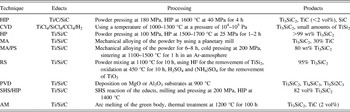
Titanium silicon carbide (Ti3SiC2) is a well-studied compound among the nanolaminated M n+1AX n ternary compounds and exhibits a unique combination of both ceramic and metallic properties. For instance, it has a good thermal shock resistance, high thermal and electrical conductivity, high chemical and oxidation resistance, easy machinability, low hardness, high stiffness, and high Young’s modulus. Reference Gao, Li, Zhang and Miyamoto1–Reference El-Raghy and Barsoum5 Therefore, it has often been considered as a promising material for high-temperature applications. The synthesis and fabrication of Ti3SiC2 materials have been achieved by a number of techniques. Reference Gao, Li, Zhang and Miyamoto1,Reference El-Raghy and Barsoum3,Reference Lis, Pampuch, Rudnik and Wegrzyn4,Reference Tong, Okano, Iseki and Yano6–Reference Carrijo, Lorenz, Filbert-Demut, Barra, Hotza, Yin, Greil and Travitzky8 The in situ preparation of Ti3SiC2 materials was carried out by hot isostatic pressing (HIP), Reference El-Raghy and Barsoum9 chemical vapor deposition (CVD), Reference Goto and Hirai10–Reference Racault, Langlais and Bernard12 hot pressing (HP), Reference Zhou, Sun, Chen and Zhang13,Reference Yongming, Wei, Shuqin, Jian, Ruigang and Jianqiang14 mechanical alloying (MA), Reference Li and Matsuki15,Reference Li and Zhai16 pressure less sintering (PS), Reference Li, Matsuki and Watanabe17 reactive sintering (RS), Reference Racault18 physical vapor deposition (PVD), Reference Emmerlich, Högberg, Sasvári, Persson, Hultman, Palmquist, Jansson, Molina-Aldareguia and Czigány19 self-propagating high-temperature synthesis (SHS), Reference Lis, Pampuch, Rudnik and Wegrzyn4 and arc melting (AM). Reference Arunajatesan and Carim20 Table I gives an overview of these techniques, the educts, a short description of the process, and the products. In many cases, secondary phases such as TiC or TiSi2 were observed in the final product.
Overview of the different techniques used for the synthesis of Ti3SiC2.

A novel preceramic paper method was successfully used for the fabrication of ceramics for a broad field of possible applications. Reference Schultheiß, Dermeik, Filbert-Demut, Hock, Yin, Greil and Travitzky21–Reference Lorenz, Bonet, Ayrikyan, Greil and Travitzky27 The preceramic paper method is a cost effective technique for the production of ceramic components with complex geometric shapes. The process consists of the initial preparation of an aqueous feed suspension and then the formation of the paper sheet by dewatering the feedstock in the paper machine. The feed suspension contains inorganic filler, cellulose fibers, or wood pulp in addition to other organic additives used to increase retention. The properties of the paper sheets are defined by the content of the additional organics, the filler content, and the subsequent processing technique such as calendering. Reference Schlordt, Dermeik, Beil, Freihart, Hofenauer, Travitzky and Greil28 The paper-derived ceramics are obtained by postheat treatments of the green bodies made of preceramic paper sheets. During heat treatment, the organic fraction is burned out or pyrolyzed leaving a porous ceramic product. Reference Dasgupta and Das29
Recently, Schultheiß et al. Reference Schultheiß, Dermeik, Filbert-Demut, Hock, Yin, Greil and Travitzky21 investigated the processing of paper-derived MAX phase based ceramics. In their study, Ti3SiC2 powder was used as a starting material. Their study covered the optimization of the paper chemistry as well as the characterization of microstructural and mechanical properties and the decomposition of Ti3SiC2 in the presence of carbon after pyrolysis. In this work, the formation of paper-derived Ti3SiC2 by the synthesis of the elemental powders of Ti, Si, TiC, and C is presented. The resulting phases after sintering were analyzed and the influence of the mixture of the raw materials on the final composition of the sintered specimens was investigated.
II. EXPERIMENTAL
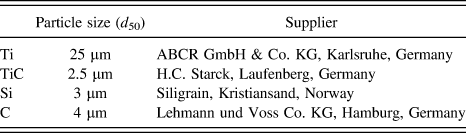
Mixtures of Ti, TiC, Si, and C powders were used to prepare an organic filler suspension. The particle size and supplier of the used materials are listed in Table II. Preceramic paper sheets containing 91 wt% of the filler mixture were generated by a laboratory handsheet former (HAAGE Blattbildungsanlage, System Rapid Köthen, Estanit GmbH, Mülheim a.d. Ruhr, Germany), according to the Rapid Köthen process (EN ISO 52692:2004). The aqueous suspension of a pulp mixture containing 1.2 wt% nonrefined softwood pulp was homogenized by vigorous stirring at pH = 7.6 for 1 h. The average lengths of the pulp fibers were 657 µm and 1665 µm, respectively. The weight ratio between short pulp fibers and long pulp fibers was 3:2. Aqueous solutions of gelatinized ionic starches at a concentration of 1 wt% (Fibraffin A5 and K72; Südstärke GmbH, Schrobenhausen, Germany) were used as organic binders in the papermaking feedstocks. An aqueous suspension containing 50 wt% of the ceramic filler was added to the papermaking feedstock. Furthermore, an aqueous dispersion containing 34 wt% polyacrylamide particles (Polymin 790A, BASF SE, Ludwigshafen, Germany) was used as a retention aid. The preceramic paper sheets were then processed on a paper sheet forming device. Circular sheets with a diameter of 200 mm were obtained after dewatering under vacuum (<104 Pa). The specimens were then dried at 93 °C for 15 min resulting in preceramic paper sheets.
Particle size and source of the raw materials.

The composition of the powder mixtures was determined so as to give stoichiometric equations resulting in the formation of Ti3SiC2. According to the literature and previous results, additional silicon was added in some cases. The residual carbon resulting from the organic materials used in the paper processing was determined by thermogravimetric (TG) analysis (951 Thermogravimetric Analyser, DuPont Instruments, Wilmington, Delaware) of the dried suspension of organic additives under Ar atmosphere up to 800 °C using a heating rate of 300 K/h.
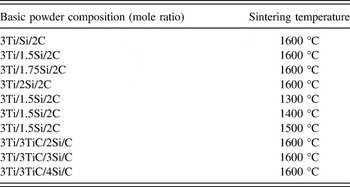
The green bodies of preceramic papers were placed in an alumina crucible and then sintered in an alumina tubular furnace (HTRH 1000-300/18 GERO, Neuhausen, Germany) using a flowing argon atmosphere. The heating and cooling rates were 180 K/h and the sintering temperature varied between 1300 °C, 1400 °C, 1500 °C, and 1600 °C, respectively. The dwell time at the sintering temperature was 1 h. The mole ratios of the various elements for the different preceramic paper compositions as well as the sintering temperature of the preceramic papers are given in Table III, respectively.
Composition of constituents used for the preceramic papers prepared in this study and the sintering temperature.

The microstructure of the samples was analyzed by scanning electron microscopy (SEM; Quanta 200, FEI, Prague, Czech Republic). For the analysis of the phase compositions of the sintered samples, powder X-ray diffraction (XRD) measurements (D500; Siemens AG, Karlsruhe, Germany) were carried out. The samples were ground into powder and exposed to monochromatic Cu Kα radiation, at a scanning rate of 0.02°/s over a 2θ-range of 15–75°.
III. RESULTS & DISCUSSION
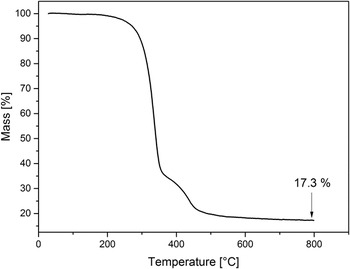
Initially, the as-prepared preceramic papers were analyzed. The gravimetric retention of the as-prepared preceramic papers was found to range from 95 to 98%. The average grammage of the preceramic papers range from 180 to 205 g/m2. The preceramic papers were comprised of 91 wt% inorganic filler and 9 wt% organic components. TG analysis of these organic additives showed that 17.3 wt% remained after heat treatment as can be seen in Fig. 1. Raman spectroscopy of the papers after the heat treatment demonstrated the presence of amorphous carbon. This residual carbon content was taken into account for the calculation of the compositions of the preceramic papers. This residual carbon (17.3%) of the organic additives increases the carbon content of the powder mixtures.
TG analysis of organic additives.

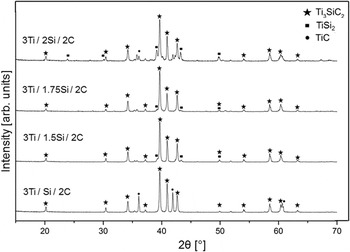
The first set of experiments was done by using the elementary powders of Ti, Si, and C. According to the results of Park et al., Reference Park, Zheng, Salamone and Bordia30 a loss of Si during heat treatment takes place. This loss of Si leads to a preferred formation of TiC during heat treatment. Reference Lis, Pampuch, Rudnik and Wegrzyn4,Reference Zhou, Sun, Chen and Zhang13 Therefore, an additional amount of Si in the basic powder mixture was used. Figure 2 shows the X-ray diffraction patterns of the prepared paper-derived specimens with different basic powder mixture component stoichiometries after sintering at 1600 °C for 1 h. The amount of Si was varied in a range from 1 mol in the composition 3Ti/Si/2C to 2 mol in the composition 3Ti/2Si/2C. It is evident that in the case of the composition 3Ti/Si/2C, Ti3SiC2 was synthesized in addition to a small amount of unreacted TiC. Using additional Si in the basic powder composition as in the case of the stoichiometries 3Ti/1.5Si/2C and 3Ti/1.75Si/2C reduced the amount of TiC and increased the amount of TiSi2. A further increase in the amount of Si in the starting composition (3Ti/2Si/2C) led to an increase of the secondary phase TiSi2 after sintering in comparison with more Si deficient starting compositions. Moreover, the secondary phase TiC was also detected after the sintering of the starting composition (3Ti/2Si/2C) which is in contrast to sintered products formed from the compositions 3Ti/1.5Si/2C and 3Ti/1.75Si/2C in which no TiC was detected. From the above analysis, it can be seen that the composition with 1.5 mol Si yields a relatively phase pure structure after heat treatment at 1600 °C. Previous works used lower quantities of additional Si when the basic powder compositions contained Ti, Si, and C. Radhakrishnan et al. Reference Radhakrishnan, Williams and Akinc31 used an amount of 1.2 mol Si to fabricate samples containing 98 vol% Ti3SiC2. These pressed samples were sintered at a maximum temperature of 1350 °C for 5 h. Yongming et al. Reference Yongming, Wei, Shuqin, Jian, Ruigang and Jianqiang14 fabricated very pure Ti3SiC2 with the initial powder composition 3Ti/1.2Si/2C by hot pressing and sintering at 1600 °C. Zhou et al. Reference Zhou, Sun, Chen and Zhang13 generated samples containing 93 wt% Ti3SiC2 by hot pressing with the composition 3Ti/1.6Si/2.5C. In their work, they sintered the samples at a temperature of 1550 °C for 1 h. The high quantity of additional Si (up to 2 mol) used in the present work results from the high sintering temperature of 1600 °C used. This sintering temperature leads to an increase of Si evaporation during the heat treatment. The sintering temperature in most of the compared works was in a lower range (from 1350 to 1550 °C), with the exception of the work of Yongming et al. Reference Yongming, Wei, Shuqin, Jian, Ruigang and Jianqiang14 Another reason for the higher quantity of Si used was the microstructure of the preceramic and paper-derived samples. The volume fraction of pores depends on the papermaking process and typically ranged from 35 to 55%. This also favors the evaporation of Si during heat treatment in comparison to the nearly dense pressed samples used in the compared studies. Reference Travitzky, Windsheimer, Fey and Greil24
X-ray diffraction patterns of the paper-derived samples formed from various basic powder mixtures after sintering at 1600 °C.

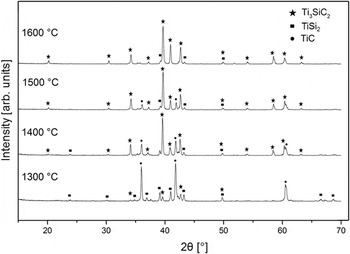
The temperature dependence on the composition of the paper-derived Ti3SiC2 in the range from 1300 to 1600 °C is presented in Fig. 3. For this analysis, the composition 3Ti/1.5Si/2C was chosen as it resulted in the lowest content of secondary phase after heating to 1600 °C (Fig. 2). The X-ray diffraction patterns presented in Fig. 3 show that with increasing sintering temperature the amount of Ti3SiC2 formed increased and the amount of TiC decreased. These results are in agreement with previous reports. Sato et al. Reference Sato, Li and Watanabe32 have shown that after sintering at 1300 °C mainly TiC was present and just a small amount of Ti3SiC2 could be detected. Increasing sintering temperature up to 1400 and 1500 °C led to a remarkable increase in the quantity of Ti3SiC2 formed. Of the possible reaction mechanisms the formation of TiC is favored as a first step due to the high reactivity of the Ti with carbon as follows:
 $${\rm{Ti\ }} + {\rm{\ C\ }} \to {\rm{\ TiC}}\quad .$$
X-ray diffraction patterns of the paper-derived samples with the basic powder composition 3Ti/1.5Si/2C sintered at various temperatures.

In the next step, Ti reacts with Si at the eutectic point of the Ti–Si-system at 1330 °C,
 $${\rm{Ti\ }} + {\rm{\ Si\ }} \to {\rm{\ Ti \!- \!Si\ }}({\rm{l}})\quad .$$
The last step consists of the formation of the MAX phase at the interface between the liquid Ti–Si-phase and TiC,
 $${\rm{TiC\ }} + {\rm{\ Ti\! -\! Si\ }}({\rm{l}}){\rm{\ }} \to {\rm{\ T}}{{\rm{i}}_3}{\rm{Si}}{{\rm{C}}_2}\quad .$$
Zhang et al. Reference Zhang, Wang, Jiang and Chen33 also presented the formation of Ti3SiC2 at temperatures higher than 1350 °C. The presented reaction mechanism is similar to the mechanism presented by Sato et al. Reference Sato, Li and Watanabe32 and can be written as follows:
 $${\rm{Ti\ }} + {\rm{\ C\ }} \to {\rm{\ TiC}}\quad ,$$
 $${\rm{Ti\ }} + {\rm{\ }}2{\rm{Si\ }} \to {\rm{\ TiS}}{{\rm{i}}_2}\quad ,$$
 $${\rm{TiS}}{{\rm{i}}_2}{\rm{\ }} + {\rm{\ }}4{\rm{TiC\ }} + {\rm{\ Ti\ }} \to {\rm{\ }}2{\rm{T}}{{\rm{i}}_3}{\rm{Si}}{{\rm{C}}_2}\quad .$$
The results of El-Raghy et al., Reference El-Raghy and Barsoum9 Zhou et al., Reference Zhou, Sun, Chen and Zhang13 and Yongming et al. Reference Yongming, Wei, Shuqin, Jian, Ruigang and Jianqiang14 show that in some cases temperatures up to 1600 °C are necessary for the synthesis of Ti3SiC2. Zhou et al. Reference Zhou, Sun, Chen and Zhang13 fabricated samples containing 85 wt% Ti3SiC2 with hot pressing and subsequent sintering at 1600 °C. The optimum yield of Ti3SiC2 obtained by Zhou et al. Reference Zhou, Sun, Chen and Zhang13 was at a synthesis temperature of 1550 °C, although it is notable that elevating the synthesis temperature to 1600 °C also resulted in a high yield of Ti3SiC2. El-Raghy et al. Reference El-Raghy and Barsoum9 generated Ti3SiC2 by HIP of the basic materials Ti, SiC, and C. After sintering at 1500 °C, a high amount of Ti3SiC2 was present in the samples, similar to that in the paper-derived Ti3SiC2. After sintering 1600 °C for 4 h, El-Raghy et al. Reference El-Raghy and Barsoum9 were not able to detect the secondary phase TiC by X-ray diffraction measurements. As a possible reaction mechanism, the formation of both TiC and Ti5Si3C takes place before the final formation of Ti3SiC2. Yongming et al. Reference Yongming, Wei, Shuqin, Jian, Ruigang and Jianqiang14 showed that the optimum temperature for the fabrication of Ti3SiC2 by hot pressing is in a range of 1500–1700 °C. In their study, the lowest amount of the secondary phase TiC was detected after sintering at 1600 °C.
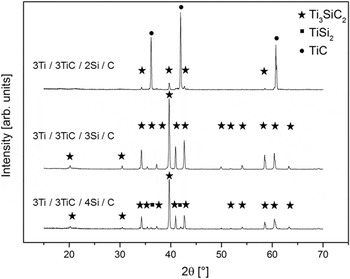
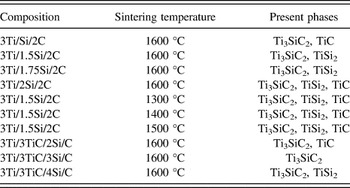
A further basic powder composition, in this case containing TiC powder, was examined by the preceramic paper technique and then sintered at 1600 °C. The amount of Si was varied similarly as with the results shown above, in this instance in a range of 2–4 mol. Figure 4 shows the X-ray diffraction patterns of the specimens after sintering at 1600 °C for 1 h. An increase in the quantity of Si in the initial components led to an increase in the amount of Ti3SiC2 and TiSi2 formed. In the case of the stoichiometry 3Ti/3TiC/4Si/C, the secondary phase TiSi2 was always formed regardless of the sintering temperature. The amount of TiC formed was decreased in comparison with the powder composition with the stoichiometry of 2 mol Si. Sintering of the composition 3Ti/3TiC/3Si/C at 1600 °C was found to lead to the formation of Ti3SiC2 without any detectable secondary phases. The additional amount of Si used in this composition led to the complete reaction of TiC with Si, there was consequently no surplus Si to allow for the formation of TiSi2. Table IV gives an overview of the compositions and the phases present after heat treatment at different sintering temperatures.
X-ray diffraction patterns of the paper-derived samples with the basic powder composition 3Ti/3TiC/2Si/C and various Si contents sintered at 1600 °C.

Overview of the phases formed from the different compositions after sintering at various temperatures.

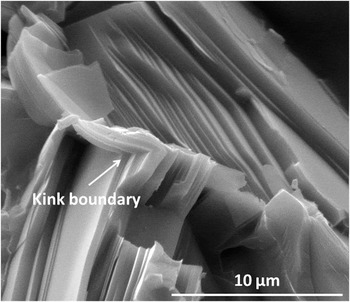
Figure 5 presents the microstructure of the paper-derived Ti3SiC2 from which it is clear that there is a homogeneous distribution of Ti3SiC2. The residual porosity of the obtained microstructure is characteristic for paper-derived samples. Reference Travitzky, Windsheimer, Fey and Greil24 Fig. 6 shows a representative fracture surface of the paper-derived Ti3SiC2 with characteristic lamellar structure. The kink boundaries in the fracture surface are also visible.
SEM micrograph of the microstructure of paper-derived Ti3SiC2.

SEM micrograph of the fracture surface of paper-derived Ti3SiC2. The arrow indicates the kink boundary.

IV. CONCLUSION
This work presents for the first time the in situ synthesis of paper-derived Ti3SiC2. By using a novel preceramic paper process and elementary powders like Si, Ti and TiC, the MAX phase Ti3SiC2 was generated. The temperature dependence and effect of excess Si in the basic powder mixture were presented. It was shown that a higher sintering temperature of up to 1600 °C led to an increase of Ti3SiC2 and an increase of TiC. Additional amounts (0.5 mol) of Si were necessary to minimize the TiC content. It was found that a further excess of Si in the initial composition led to increased formation of the secondary phase TiSi2. By adjusting the stoichiometry to 3Ti/3TiC/3Si/C, it was possible to generate paper-derived Ti3SiC2 without any detectable secondary phases after sintering at 1600 °C for 1 h. SEM analysis of the cross section demonstrates the homogeneity of the structure, and fracture surfaces showed the presence of the characteristic laminated structure of MAX phases.