INTRODUCTION
This article examines outcomes of revitalisation strategies in two historically interconnected but culturally disparate contexts. Scottish Gaelic (henceforward ‘Gaelic’) is a Celtic language currently undergoing revitalisation on both sides of the Atlantic. The language community thus presents an exceptional opportunity to evaluate policy outcomes in respect of a single minority language in two contrasting sociocultural settings. Language shift, loss, and revitalisation are matters of increasingly urgent political attention internationally (Nettle & Romaine Reference Nettle and Romaine2000; Romaine Reference Romaine2000, Reference Romaine, King, Schilling-Estes, Fogle, Lou and Soukup2008, Reference Romaine, Bhatia and Ritchie2013; Fishman & García Reference Fishman and García2010, Reference Fishman and García2011). Efforts to stem the decline of minoritised languages have turned increasingly to the generation of ‘new’ speakers via second language acquisition—especially bilingual, ‘revitalisation immersion education’ (García Reference García2009)—as a strategy for increasing numbers of endangered language users.
In part, this development, observed in such diverse contexts as Aotearoa New Zealand, the Basque Country, and Hawai'i (as well as throughout the Celtic speaking world), reflects a recognition by policymakers that once interrupted, the organic, intergenerational transmission of languages in the home domain is extremely hard for them to influence or to re-instate. As such, the creation of new speakers by other means has become increasingly important in the eyes of policymakers. The term new speaker has become increasingly prevalent in the sociolinguistics of European minority languages relatively recently, having initially been coined within the contexts of Galician and Catalan to refer to individuals who have acquired an additional language outside of the home setting and make use of it in their daily lives (O'Rourke & Ramallo Reference O'Rourke and Ramallo2013; Pujolar & Gonzàlez Reference Pujolar and Gonzàlez2013; O'Rourke, Pujolar, & Ramallo Reference O'Rourke, Pujolar and Ramallo2015).
Uniquely for an endangered minority language, new speakers of Gaelic have recently emerged as a crucial demographic for formal language maintenance efforts on both sides of the Atlantic Ocean. Gaelic-medium education (GME) is a core focus of policymakers’ strategies to revitalise Gaelic in Scotland, while in Nova Scotia, revitalisation efforts focus on language acquisition and socialisation outside the formal classroom. At the level of devolved (respectively, national and provincial) government, policymakers in both Scotland and Nova Scotia make frequent reference to the pivotal role that new speakers may play in the future of the Gaelic language (Bòrd na Gàidhlig 2014, 2018; Scottish Government 2014; Office of Gaelic Affairs 2018). In light of the disparate degree of governmental and academic attention these Transatlantic Gaelic communities have received to this juncture, a crucial objective of the wider project outlined in this article has been to assess the language learning and life experiences that have informed Scottish and Nova Scotian new speakers’ decision to learn and use Gaelic in their lives, and, relatedly, their cultural identifications with the language.
THEORETICAL FRAMEWORK: aCQUISITION, IDENTITY, AND fISHMANIAN VIEWS OF LANGUAGE REVITALISATION
Fishman (Reference Fishman1991:406) famously emphasised the importance of securing the minoritised variety as the language of the home—and minority communities’ inability to do so having contributed in large part to the failure of language revitalisation initiatives generally. Crucially, Fishman (Reference Fishman1972, Reference Fishman1991, Reference Fishman2010, Reference Fishman, Bhatia and Ritchie2013) consistently theorised that school-based language policy interventions would ultimately fail without adequate support outside the classroom, stating that minoritised languages at which RLS (‘reversing language shift’) efforts are directed require spaces for their habitual use outside of the classroom (Fishman Reference Fishman2001b:471).
With regard to bilingual schooling, Edwards (Reference Edwards2010:261) notes that in spite of their greater command in the target language, immersion pupils generally appear not to seek out opportunities to use their second language to a greater extent than, for instance, students studying it as a subject; as Baker (Reference Baker2011:265) phrases it, there is always a chance that ‘[p]otential does not necessarily lead to production’. Fishman's (Reference Fishman1991, Reference Fishman2001a,Reference Fishmanb) consistent recommendations vis-à-vis the re-attainment of diglossia and intergenerational interaction thus remain influential, at least among language policy scholars, if not policymakers attempting linguistic revitalisation of varying types in late modernity at large. Transmission within the home of the endangered ‘Xish’ language is foregrounded at the fundamental, lower level stages of his model for assessing and reversing language shift, the ‘graded intergenerational disruption scale’ (Fishman Reference Fishman1991:395).
Yet Fishman's (Reference Fishman1991, Reference Fishman2001a,Reference Fishmanb, Reference Fishman, Bhatia and Ritchie2013) RLS model and his recommendations on behalf of threatened minority languages rest to a large degree upon a conception of language and ethnic identity that many contemporary sociolinguists would regard as problematic. In particular, the (theoretical and practical) feasibility of his emphasis on the straightforward relationship of the minority language (‘Xish’) to its traditionally defined, ethnolinguistic speaker community (‘Xmen/Xians’) has been questioned at length by various authors (see Edwards Reference Edwards1984, Reference Edwards2010; Heller Reference Heller2006, Reference Heller2010; Romaine Reference Romaine2006, Reference Romaine, Bhatia and Ritchie2013; Jaffe Reference Jaffe2007a,Reference Jaffe and Hellerb). Jaffe (Reference Jaffe2007a:58), for instance, critiqued essentialist interpretations of the language-identity nexus, in which ‘both “language” and “identity” and their iconic relationships are seen as fixed, ascribed/natural and unproblematic’. Contemporary sociolinguists distance themselves from such essentialist positions, which tend to presume that members of a given identity category are ‘both fundamentally similar to one another and fundamentally different to members of other groups’ (Bucholtz & Hall Reference Bucholtz, Hall and Duranti2004:374).
Whilst his theoretical stance regarding the importance of the home context to intergenerational transmission remains influential in the contemporary literature on language revitalisation, Fishman's ideas do draw to a large extent on such an unproblematic, iconic conception of language and identity. Fishman's (Reference Fishman1991:394) model rests to a large degree on the ‘premises that Xmen are not Ymen and that Xish culture… is not Yish culture’. He states, furthermore, that ‘prior ideological clarification’ of these fundamental premises ‘must not be skipped over’ if revitalisation initiatives are to succeed (Fishman Reference Fishman1991:394). The limited practicability of ‘prior’ clarification of this kind in many contexts of language endangerment, or of such clearly defined ethnocultural differentiations in modern societies, leads us inexorably to a discussion of language ideologies and their role in the development of ethnolinguistic identities.
Silverstein (Reference Silverstein, Cline, Hanks and Hofbauer1979:193) defined linguistic ideologies as ‘sets of beliefs about language articulated by users as a rationalization or justification of perceived language structure or use’. In recent years scholars have frequently shown that ideologies of this kind are advanced in speakers’ discourse as attempted rationalisations for language practices, which may in turn reinforce those practices (Kroskrity Reference Kroskrity2000, Reference Kroskrity and Duranti2004; Bucholtz & Hall Reference Bucholtz, Hall and Duranti2004; Boudreau & Dubois Reference Boudreau and Dubois2007; Makihara Reference Makihara2010; Cavanaugh Reference Cavanaugh, Auer, Reina and Kaufmann2013). In particular, research on language ideologies has often addressed the relationship of speakers’ linguistic practices and perceptions to their sociocultural identities (Valdés, Gonzàlez, García, & Márquez Reference Valdés, Gonzàlez, García;, Márquez, Brinton, Kagan and Bauckus2008; García Reference García2009; Makihara Reference Makihara2010). Such considerations regarding the role of language ideologies and cultural identity in speakers’ linguistic practices are central to the analysis I present in this article.
A number of principles present in the second language acquisition (SLA) literature are also of particular relevance here, notably those pertaining to Gardner & Lambert's (Reference Gardner and Lambert1959, Reference Gardner and Lambert1972) ‘integrativeness’ model. Based on long-term examinations of French-English bilingualism in Canada, Gardner & Lambert (Reference Gardner and Lambert1959, Reference Gardner and Lambert1972) defined integrative motivation as reflecting the second language learner's sincere desire to adopt and integrate with culture of the L2 community. This desire was frequently observed in that context to exert an influence on learners’ successful acquisition of the L2. Yet there exist a number of questions as to this model's applicability to the context of heritage language learners of Gaelic in Scotland and Canada (however distant such heritage connections to the historic and contemporary language community may be).
A particularly relevant consideration in this connection concerns the various ways in which contemporary notions of emergent, performative, and nested linguistic identities may influence this model's applicability in contemporary society. Bucholtz & Hall's (Reference Bucholtz and Hall2005:605) principle of emergence conceives of identity as a product of unfolding conversation, which emerges through interaction. In such a view, identity arises habitually within interaction, as specific sociocultural identities are practiced and repeated in daily communication. This principle of practice is in turn inhibited by the concept of partialness, that an identity construction ‘may be in part deliberate and intentional, in part habitual’, and therefore below the level of consciousness (Bucholtz & Hall Reference Bucholtz and Hall2005:606). At the same time, and with crucial implications for the following analysis, Bucholtz & Hall (Reference Bucholtz, Hall and Duranti2004:380) view language as being creatively used to construct identities through performance, a ‘highly deliberate and self-aware social display’, whilst individuals’ positionality in identity constructions varies depending on their interlocutors’ own identities.
A possible solution to incorporating a motivational SLA approach within such theoretical developments in sociocultural linguistics (as well as in psychology) has been developed by Dörnyei (Reference Dörnyei2005) and Ushioda (Reference Ushioda2011; Dörnyei & Ushioda Reference Dörnyei and Ushioda2009). The concept of the ‘motivational self-system’ proposes that second language learners’ acquisition of an additional language is guided largely by their imagined identities in the language in question, conceived of in terms of the ‘ideal’ and ‘ought to’ L2 self. The distinction between these two notional ‘selves’ is characterised by, on the one hand, second language speakers’ internal conceptions of their desired identity in the target language, and, on the other, the identity they feel they ‘ought to’ enact externally while interacting with other speakers. Crucially for the present article, MacIntyre, Baker, & Sparling (Reference MacIntyre, Baker and Sparling2017) conceptualise Nova Scotian Gaelic learners’ motivations in terms of the ‘rooted L2 self’, distinguishing their heritage-focused orientations from L2 learners without such keenly felt identifications vis-à-vis the target variety.
Research context 1: Gaelic in Scotland
From the early sixth century, Gaels (Old Gaelic: Goídil; Latin Scotti) from northeastern Ireland began to settle the western seaboard of northern Britain (Ó Baoill Reference Baoill, Watson and Macleod2010; Clancy Reference Clancy2011). As the Gaels extended their political and cultural influence across the mainland of Alba over the next five hundred years, their language expanded over the majority of what became Scotland (Dumville Reference Dumville, Baoill and McGuire2002). Yet the foundations of the Gaelic Kingdom of Alba eroded rapidly from the early twelfth century, as its institutions were increasingly replaced by those of an ascendant Anglo-Norman nobility, and the social terrain of Gaelic became increasingly restricted to the mountainous Highlands and Islands (Barrow Reference Barrow and Gillies1989). After the mid-sixteenth-century Scottish reformation, hostility to Gaelic on the part of the Scots crown became connected to policy to extirpate resistant elements from the kingdom. Anti-Gaelic policies adopted throughout the seventeenth century are regarded by Withers (Reference Withers1984) as having constituted an early wave of government ‘improvement’, exacerbated by the association of many Gaels with Jacobite rebellions in the eighteenth century. This dynamic eventually culminated, during the nineteenth century, in landowners’ implementation of systematic processes of land reorganisation and mass displacement that became known as the Highland Clearances (Withers Reference Withers1984; Glaser Reference Glaser2007; Richards Reference Richards2007). As Scottish Gaels were increasingly compelled to emigrate, the minoritisation of Gaelic as a spoken vernacular accelerated rapidly.
57,602 people were reported as able to speak Gaelic in Scotland in the 2011 census, approximating to 1.1% of the total population (National Records of Scotland 2013). The census also showed growth, for the first time, in the proportion of Gaelic speakers under the age of twenty. Although the rate of this growth was just 0.1% compared to the percentage of speakers recorded for this age group in 2001, a great deal was made of its importance in demonstrating the growth of GME in Scotland, and its potential for creating new speakers of the language (cf. Bòrd na Gàidhlig 2014, 2018; Scottish Government 2014). The view that immersion education in this context may be relied upon for the creation of new generations of committed and ideologically supportive habitual speakers has recently been challenged, however (Dunmore Reference Dunmore2017, Reference Dunmore2019). New speakers of various language learning backgrounds have, nevertheless, become an increasingly important demographic in Gaelic communities throughout Scotland, and have previously been exmained in a series of seminal studies (McLeod, O'Rourke, & Dunmore Reference McLeod, O'Rourke and Dunmore2014; Nance Reference Nance2015; Nance, McLeod, O'Rouke, & Dunmore Reference Nance, McLeod, O'Rourke and Dunmore2016).
Crucially for the purposes of this article, these studies emphasised Scottish new Gaelic speakers’ association with the term Coimhearsnachd na Gàidhlig ‘Gaelic community’ in preference to the ethnonym Gàidheil ‘Gaels’, an ideology partly reflected in their production of word-final rhotics, which tended not to reflect a traditional three-way phonemic distinction (Nance et al. Reference Nance, McLeod, O'Rourke and Dunmore2016). Whilst on the one hand native speakers were widely viewed as the best model for new speakers’ pronunciation and blas ‘accent/taste’, native speakers’ greater use of English loan words and frequent code-switching tended to be something new speakers tried to avoid (McLeod et al. Reference McLeod, O'Rourke and Dunmore2014:39; Nance et al. Reference Nance, McLeod, O'Rourke and Dunmore2016:181).
Research context 2: Gaelic in Nova Scotia
The 2011 Canadian census recorded 1,275 self-reported speakers of ‘Gaelic languages’ in Nova Scotia, amounting to just over 0.1% of the total population of the province (Statistics Canada 2015). Of that number, only 300 individuals reported Gaelic as their ‘mother tongue’ (Statistics Canada 2017) with the remainder likely to have acquired the language in adolescence or adulthood. It seems probable that the majority of Gaelic language speakers in the province can communicate (to varying degrees) in Scottish Gaelic, as a result of historic mass migration from the Scottish Highlands, although some of those recorded may well be Irish or Manx speakers.
These rather cumbersome census data nevertheless demonstrate the increasing importance of new speaker networks, relative to declining native Gaelic communities in the province. The Nova Scotia Gaelic community is thus substantially smaller than that of Scotland relative to the total population, having declined from an estimated population of over 80,000 in the early twentieth century (Kennedy Reference Kennedy2002). As in Scotland, second language teaching has been prioritised by policymakers as a mechanism for revitalising Gaelic, and new speakers have consequently emerged as a significant element within the Nova Scotia Gaelic community, though accurate estimates of their number are hard to make at present.
The name Nova Scotia (‘New Scotland’) was first applied to the historic territories of the Indigenous Mi'kmaq people in 1621, when they were chartered for colonisation by James VI and I to William Alexander, first Earl of Stirling (Campbell & MacLean Reference Campbell and MacLean1974:35; Mertz Reference Mertz1982:36). The first Gaelic-speaking Scots to immigrate to Nova Scotia arrived as early as 1629, and while Alexander's attempts to establish a sizeable Scottish colony in the region proved unsuccessful, Highlanders continued to migrate in small numbers during the seventeenth and early eighteenth centuries (Ó hIfearnáin Reference Ó hIfearnáin2002:64). Kennedy (Reference Kennedy2002:25–27) even cites evidence that Scots constituted the largest minority group in the Acadian colony of ‘New France’ after the territory was ceded to the French in 1632 (Campbell & MacLean Reference Campbell and MacLean1974:35). Migration from the Scottish Highlands to eastern Nova Scotia accelerated in earnest, however, from the 1770s, as the middle class Gaelic ‘tacksmen’ sought a new life and livelihood in North America in response to declining living standards at home. Migration continued over the next fifty years, but by the 1840s Highland migrants increasingly comprised the displaced and largely homeless tenant classes left destitute as a result of the Clearances.
Peak emigration to Nova Scotia occurred between about 1770 and 1850, when over 50,000 Highland Scots are estimated to have arrived into eastern counties (MacKinnon Reference MacKinnon and Ureland2001:20; Kennedy Reference Kennedy2002:20–21; Ó hIfearnáin Reference Ó hIfearnáin2002:65). Kennedy (Reference Kennedy2002:277) remarks that the nature of such emigration ‘ensured that large, nearly homogeneous communities were established, dominating nearly a third of the province's area’. Gaelic speakers in Nova Scotia fared somewhat better than their contemporaries in Scotland; Kennedy (Reference Kennedy2002:277) argues that within this ‘richly Gaelic environment’, a unique, ‘truly Canadian and North American Gaelic community’ developed and flourished in the nineteenth century.
Shaw (Reference Shaw1977) has estimated that by 1880 over 80,000 Gaelic speakers were present in Nova Scotia. By the time of the 1871 census, Scots were the largest ethnic group in Nova Scotia, having overtaken English settlers. Edwards (Reference Edwards and Williams1991:273) has assessed evidence for the weakening of intergenerational transmission and resulting language shift to English in Gaelic communities even at this early stage, however. When state schools were established in 1864 no provision was made for any form of Gaelic education (MacKinnon Reference MacKinnon and Ureland2001:19; Edwards Reference Edwards2010:156–57).
As such, Kennedy (Reference Kennedy2002:51) argues, children of Gaelic speakers in the nineteenth century subsequently learned next to nothing of their language in schools, and internalised negative attitudes regarding the relative unimportance of Gaelic in Anglophone Canadian society (cf. Edwards Reference Edwards2010:156–57). MacKinnon (Reference MacKinnon and Ureland2001:19) observes that Cape Breton's Gaelic population had declined to just 24,000 by the 1931 census. Numbers of recorded Gaelic speakers in Nova Scotia continued to decline by around 50% in each subsequent census throughout the twentieth century, until just under 1,500 were recorded in 1971 (MacKinnon Reference MacKinnon and Ureland2001:19; cf. MacLean Reference MacLean and Campbell1978).
Mertz (Reference Mertz1982, Reference Mertz and Dorian1989) investigated Gaelic language shift in Nova Scotia in detail, identifying the ‘metapragmatic filter’ through which Gaels came to attribute relative values to their languages, and which in turn impacted on their willingness to speak and transmit the Gaelic language in the crucial domains of daily life. The 1920s and 30s transformed the prevailing socioeconomic circumstances in Nova Scotia, hastening and enhancing the ideological association of Gaelic with rurality, economic immobility, and low social cachet. Mertz (Reference Mertz1982:311–12) argues that the particular metapragmatic filter—that is, speakers’ language attitudes, ideologies and ‘folk theories’ concerning Gaelic—that had the greatest consequence for the future trajectory of the language in Nova Scotia was that prevailing at the time of the Great Depression.
The harsh economic climate of the 1920s and 30s essentially prompted Nova Scotia Gaels to re-evaluate their relationship with Gaelic, a language they increasingly viewed as a hindrance to their children's future success and wellbeing (Mertz Reference Mertz1982, Reference Mertz and Dorian1989). The linguistic tip was reached, and language shift to English subsequently accelerated as Gaelic speakers started to migrate in large numbers to urban centres in Halifax, New England, Ontario, or the prairies (Kennedy Reference Kennedy2002:73; Edwards Reference Edwards2010:154). Kennedy (Reference Kennedy2002: 75) states that the urban environments that were increasingly the destination for Gaels ‘proved particularly hostile to the socialization of children in Gaelic’, while rural populations continued rapidly to decline.
In spite of the small overall numbers of reported Gaelic speakers in Nova Scotia, the provincial Office of Gaelic Affairs (2018) has estimated that at least 230,000 Nova Scotians claim descent from families who spoke Gaelic historically. Contemporary policy to revitalise Gaelic can be traced to bottom-up, grassroots efforts to stem the decline of Gaelic that started in the 1970s (Dunbar Reference Dunbar2008; Edwards Reference Edwards2010). Such initiatives were joined at the start of this century by institutional supports for the language community, whether learners, native, or new speakers. Crucially in 2006, Rodney MacDonald, then Premier of Nova Scotia established Oifis Iomairtean na Gàidhlig (The Office of Gaelic Affairs) as a civil service unit within the provincial government, along with a ministerial portfolio for Gaelic Affairs and an estimated annual budget of C$68,000. Iomairtean na Gàidhlig exists, in its own words, for the purpose of helping ‘Nova Scotians [to] reclaim their Gaelic language and identity as a basis for cultural, spiritual, community and economic renewal… by creating awareness, working with partners and providing tools and opportunities to learn, share and experience Gaelic language and culture’ (Office of Gaelic Affairs 2018). These objectives are in turn to be achieved by:
• Creating awareness of Gaelic language, culture, and history and its contribution to Nova Scotia's diversity, community life, and economy.
• Providing language training, support materials, innovative programming, strategic advice, research, translations, and communications services to enable appreciation, acquisition, and use of Gaelic language and culture.
• Building partnerships within government to ensure investment in and stewardship of these language and cultural resources that are uniquely Nova Scotian. (Office of Gaelic Affairs 2018)
The aims of Nova Scotian policymakers with responsibility for Gaelic therefore go beyond generating new speakers, and the principle of promoting the language as an aspect of the province's distinct, collective identity is clearly discernible in the above extracts. Stimulating awareness and ownership of the language and its associated identity even among the estimated 230,000 Nova Scotians of Gaelic heritage is no small task for such a modestly funded unit, let alone among the rest of Nova Scotia's almost one million inhabitants. While the emphasis on language training, programming, and materials highlights the importance of new speakers to the future of the language in the province, very little is currently known about either the size or linguistic practices of the new speaker population. Watson & Ivey (Reference Watson, Ivey, McLeod, Gunderloch and Dunbar2016:184) summarised this deficiency in an influential conference paper, asking ‘Who are these speakers? Why are they learning Gaelic? How fluent are they? And how often do they use it?’ (my translation).
In Nova Scotia, the provincial government supports Gàidhlig aig Baile ‘Gaelic in the home’ and Bun is Bàrr ‘root and branch’ programmes, both of which regularly emphasise the importance of ongoing interaction between native Gaelic speakers and learners both for socialising new Gaelic speakers in the language and developing their identities as Gaels, to a degree rarely observed in contemporary Scotland.
Notably, however, Gaelic educational opportunities in Nova Scotia are limited by comparison with Scotland, where over 5,000 children are currently enrolled in GME. No such bilingual Gaelic education is currently available in the province, although immersion programmes have recently become available to Indigenous Mi'kmaq children in certain areas, and French-medium schools for Acadian children have operated since the 1990s. Such community schools often exist in close proximity to formerly predominantly Gaelic-speaking areas in Cape Breton; (bilingual) Gaelic education, by contrast, is limited to a small number of elementary and high schools, evening classes, residential courses, and university classes.
Given the absence of formal immersion education for (potential) new Gaelic speakers, ‘core Gaelic’ second language teaching in high schools, extra-curricular immersion programmes, and adult language acquisition initiatives have formed the basis of revitalisation efforts in recent decades (Dunbar Reference Dunbar2008; MacEachen Reference MacEachen2008; Watson & Ivey Reference Watson, Ivey, McLeod, Gunderloch and Dunbar2016). In that sense, the bottom-up and community-centred focus of current Gaelic revitalisation efforts in Nova Scotia may be seen, from a Fishmanian perspective, as theoretically more sustainable in the long term than school-focused initiatives in Scotland.
As I demonstrate in my analysis here, an emphasis on ethnolinguistic identity and discourses of cultural distinctiveness currently dominating in Nova Scotia's Gaelic community also closely parallel recommendations advocated by Fishman. In particular, Gàidhlig aig Baile and Bun is Bàrr programmes, which receive support from the provincial government, place heavy emphasis on encouraging meaningful and ongoing interaction between native Gaelic speakers and learners for socialising and creating new speakers of the language.
MacIntyre and colleagues (Reference MacIntyre, Baker and Sparling2017) have recently investigated language learning motivations and ‘ideal’ or ‘ought-to selves’ among a sample of (more or less advanced) Gaelic learners in Nova Scotia. They conceptualise Nova Scotian L2 Gaelic speakers’ motivations in terms of the ‘rooted L2 self’, distinguishing their orientations toward the language—which drew heavily on understandings of heritage, kinship, and ancestry—from L2 learners of languages with which identity associations may be more abstract, or less keenly felt. This notion of the ‘rooted’ self in second language acquisition is extremely useful and resonates closely with the analysis I outline below.
RESEARCH QUESTIONS
I have suggested in preceding sections that, as a response to rapid language shift in Scotland and Nova Scotia, Gaelic language teaching of various kinds has been prioritised by policymakers attempting to revitalise the language. The following analysis examines reflexes of this policy in the two countries, juxtaposing the ongoing fragility of Gaelic communities with new speaker discourses around heritage, identity, and language learning motivations. Specifically, my research questions are:
• What are the outcomes of language revitalisation initiatives in respect of new speaker identities in two divergent cultural contexts?
• What degree of salience continues to be attached to heritage-oriented, ethnolinguistic labels such as ‘Gael’ in the disparate settings under investigation?
Analytic methods
The interview corpora upon which I draw for the following analysis were collated over the course of seven years of research on various projects throughout Scotland, and three months’ ethnographic fieldwork in Nova Scotia. The wider study draws on sixty semistructured interviews with new speakers of Gaelic (thirty in each country), four focus groups (two in each), eighty questionnaire responses, and ongoing participation in Gaelic community life in the two countries; in the interests of space, the analysis developed in this article draws on interview extracts alone, with pseudonyms used for all interviewees discussed.
In Scotland, interviews were conducted in the cities of Edinburgh, Glasgow, and Inverness. In this context, seven of the thirty new speakers interviewed were educated through GME classes in the late 1980s and early 1990s, while the remaining twenty-three participants (and both interviewees discussed from the Scottish context in the following analysis) acquired Gaelic to fluency later in life. Fourteen speakers were female, and sixteen male. Participants’ ages ranged from eighteen to eighty-two. As discussed elsewhere (Dunmore Reference Dunmore2017, Reference Dunmore2019), Scottish new speakers’ identifications with the Gaelic language varied widely, but were never described in terms analogous to the ‘Xians-with-Xish’ ideal emphasised in Fishman's (Reference Fishman1991, Reference Fishman2001b) theoretical formulations.
In Nova Scotia, interviews were conducted with new Gaelic speakers between 2017 and 2018 in the provincial capital of Halifax, in Antigonish County on the eastern mainland of the province, and throughout Cape Breton Island. Most participants had grown up in Cape Breton, and varied in age from seventeen to seventy-three; nineteen were female and eleven male. Nova Scotian interviewees’ Gaelic learning trajectories and cultural identifications were somewhat different from those of most Scots participants; all thirty new speakers in this context acquired their Gaelic principally through a combination of extracurricular ‘community’ classes and immersion courses outside of the school system.
All sixty interviews were transcribed in full using the software package Elan, and all transcripts were subsequently coded thematically for the most salient categories of discourse that emerged in interviewees’ accounts of their linguistic and cultural learning experiences. The analysis presented below employs an ethnography of speaking methodological framework. A central premise of the ethnography of speaking is the conceptualisation of spoken interaction in terms of the speech situation, speech event, and, at the most minute level of analysis, the speech act (Hymes Reference Hymes1974:52). By focusing on these three levels of analysis, Hymes emphasised that language ought not to be separated from how and why it is used in practice. Saville-Troike (Reference Saville-Troike2003:120) explains this emphasis, noting that ‘message form and message content… often cannot be separated in description and analysis’.
In particular, my analysis foregrounds the notions or ‘act’ sequences, ‘keys’, or context-based clues that can be utilised in order to establish the ‘tone, manner, or spirit’ in which a speech act is intended (Hymes Reference Hymes1974:57), and the ‘instrumentalities’, or ‘channels and forms of speech’ that participants make use of within speech acts (Hymes Reference Hymes1974:60). The specific analytic focus of the ethnography of speaking outlined in this article is the sociocultural identities that interviewees convey while describing their association with Gaelic. As suggested above, social constructivist approaches in interactional sociolinguistics and anthropology have demonstrated consistently that identities are both projected and shaped by group members through language use, a conception that is further examined in my analysis (cf. Bucholtz & Hall Reference Bucholtz, Hall and Duranti2004, Reference Bucholtz and Hall2005).
In the remainder of this article I would like to draw attention to some of the language ideologies that Scottish, and particularly Nova Scotian speakers convey when describing their identifications with Gaelic. I argue that whilst the language clearly plays an important role in the lives of Scottish new speakers, the ideologies that they express tend to militate against their association with the traditionally defined, ethnolinguistic Gaelic community. By contrast, Nova Scotian new speakers seem substantially more enthusiastic to embrace their heritage identities as Gaels. A clear distinction is demonstrated between Scottish new speakers’ negative perceptions and lack of association with the term ‘Gael(s)’, and their Canadian counterparts’ relative ease in employing that term as an element of their cultural heritage.
Analysis: New speakers of Gaelic and ethnolinguistic identity
As with previous research on new Gaelic speakers in Scotland (cf. Oliver Reference Oliver2005, Reference Oliver and McLeod2006; McLeod et al. Reference McLeod, O'Rourke and Dunmore2014; Nance et al. Reference Nance, McLeod, O'Rourke and Dunmore2016), a sense of disaffection (and occasionally open hostility) was generally conveyed by Scottish based interviewees when discussing the term Gael. In the first extract below, ‘Anna’ rejects the label outright, partly as a consequence of her different experiences acquiring and using Irish in Ireland, and Gaelic in Scotland.Footnote 1
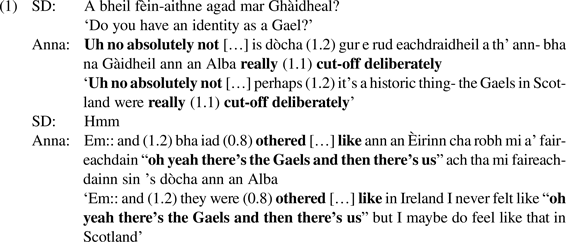
A sense of alienation from a distinctive ethnolinguistic Gaelic identity is clearly communicated in this extract, emphasised here in Hymes's (Reference Hymes1974) terms, by keys to the pragmatic sense of the speech acts revealed in Anna's use of hesitations, and code-switching to English as a particular instrumentality to disassociate herself from the label ‘Gael’. Possible reasons for this rejection of the term are discussed by ‘Iain’, a new speaker who has raised his entire family as Gaelic speakers, in the following dialogue.
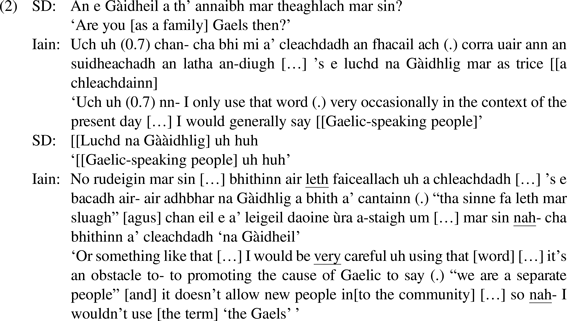
Discourses outlined in extracts (1) and (2) above neatly encapsulate the experience of most new speakers of Gaelic in Scotland (see also McLeod et al. Reference McLeod, O'Rourke and Dunmore2014; Dunmore Reference Dunmore2017, Reference Dunmore, Smith-Christmas, Murchu, Moriaty and Hornsby2018a,Reference Dunmoreb). Whilst such a clear rejection of a social identity as Gaels is by no means uniformly expressed by all members of this group, the ethnolinguistic category is overwhelmingly avoided or problematized by most Scottish new speakers in my research. By contrast, Nova Scotian new speakers’ Gaelic identities are frequently expressed in enthusiastic terms, and it is clear that most new speakers in Nova Scotia embrace the Gael(ic) label when describing their identification with the language and motivations for having learned it. In the following extended extract, the informant ‘Seonaid’ explains the varying ways in which contrasting Scottish and Gaelic identities are regarded in the province, both by herself and by other Nova Scotians of Highland extraction.
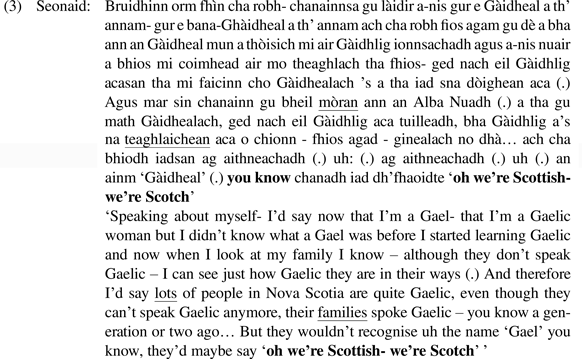
This extract highlights the speaker's changing awareness and appreciation of her Gaelic identity as her acquisition of and exposure to the language increased. By contrast, she identifies the (extralinguistic) cultural practices of the people she was surrounded by whilst growing up as being quintessentially ‘Gaelic’ in various ways. She notes that this sense of cultural distinctiveness, however, was understood by such individuals as reflective of their ‘Scottish’ (or ‘Scotch’) heritage, rather than of any distinctively Gaelic, ethnolinguistic identity. Yet for new speakers this quality of Gaelic distinctiveness among certain Nova Scotians forms a frequently occurring trope across the thirty interviews conducted in the province. Whereas the previous interviewee traces a fluctuating trajectory in her own identification with the term Gael, the following speaker ‘Mairead’, twenty years her junior, expresses absolute certainty in her own association with the word, perhaps reflecting the increased prevalence of the term since the turn of the twenty-first century.
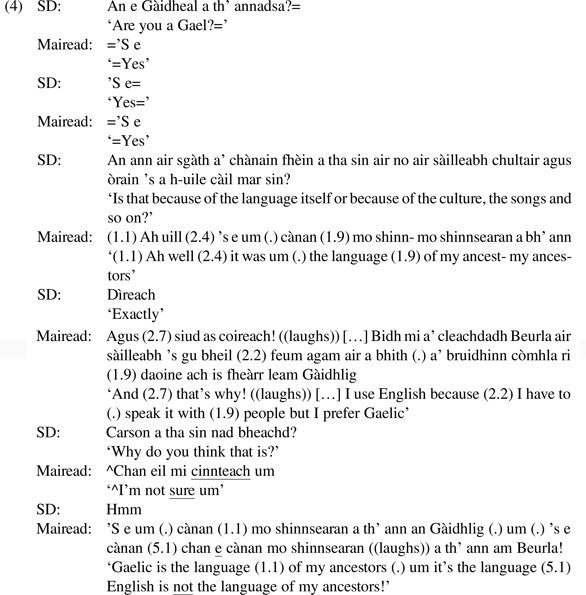
When questioned as to her own identity as a Gael, Mairead affirms without any hesitation that she is. A greater degree of hesitation is notable when in the following speech acts she explains the reasons for this, in which she regularly produces pauses of over two seconds duration when considering the basis of her Gaelic identity. The importance of heritage and ancestry for this speaker—and her perceived lack of any ancestral connection to the English language (in spite of having grown up with only English at home) is key to understanding her motivations for having learned Gaelic to fluency. This stands in stark contrast, as previously noted, to the majority of new speakers in Scotland. The realisation of this aspect of the second language learner's own identity in Gaelic is likened by ‘Joy’ in the following extract to a kind of epiphany, a moment of self-discovery on the road to fluency in the language.
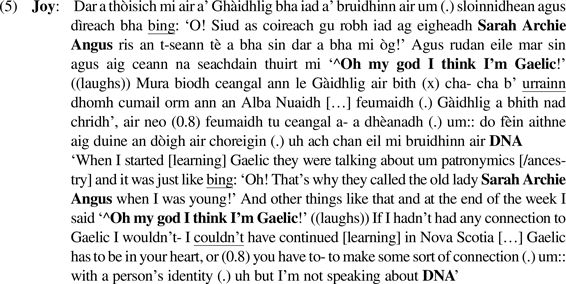
This interviewee's understanding of her Gaelic identity is therefore described as having occurred to her as suddenly as the flick of a switch. Without this sudden discovery of her own connection to the language, through the familiarity of distinctive naming practices and other characteristics of her community in childhood, she states that she wouldn't have been able to carry on learning Gaelic in the province. Motivation of this kind—connection to the language in one's ‘heart’, and ancestry (if not biologically in one's ‘DNA’)—is thus seen as key to understanding the decision to learn Gaelic to fluency.
Yet for the following speaker, ‘Mòrag’, a sense of identity as a Gael is problematised, and the necessity of possessing such an ancestral connection is rejected. In this way Mòrag avoids excessively relying, in her own words, on ‘purism’ in discussing her relationship to the Gaelic language.
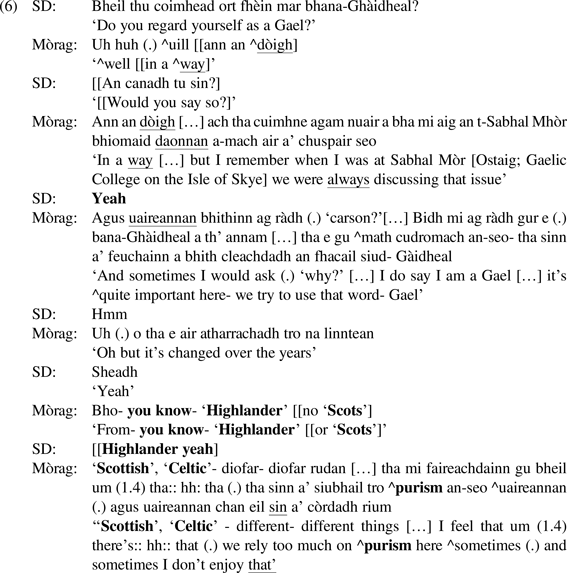
In the above extract, Mòòrag therefore qualifies her assertion of ethnocultural identity as a Gael with the phrase ‘in a way’ (ann an dòigh), producing rising intonation and heavy emphasis of the last word to convey this stance clearly. These paralinguistic keys in her speech—and later reference to excessive ‘purism’ in Nova Scotia's Gaelic community—indicate Mòrag's feeling that her possession of this identity may be viewed as potentially problematic. She recounts a sense of disillusionment at how prevalent discussion of the term seemed to her while studying at Sabhal Mòr Ostaig, Scotland's Gaelic college on the Isle of Skye.
Nevertheless, she goes on to explain that she habitually does in fact describe herself as a Gael (‘bidh mi ag ràdh gur e bana-Ghàidheal a th’ annam’) and, indeed, notes that language advocates in Nova Scotia consciously attempt to encourage the use of that term, where in the past Gaels in the province themselves might have identified to a greater degree as Highlanders, Scots, or perhaps less precisely, as ‘Celtic’. Mòrag's somewhat hesitant allusion to ‘purism’ at the end of extract (6) is noteworthy.
DISCUSSION: GAELS AND GAELIC IN TWENTY-FIRST CENTURY SCOTLAND AND NOVA SCOTIA
The foregoing analysis has sought to demonstrate that whilst the linkage envisaged between language and ethnolinguistic identity in Fishman's (Reference Fishman1991, Reference Fishman2001b, Reference Fishman, Bhatia and Ritchie2013) RLS model fails to mobilise in the case of most new Gaelic speakers in Scotland, the connection is viewed as straightforward (and necessary) among most new speakers in Nova Scotia. Limited identification with the label ‘Gael’ among GME pupils, as first reported over fifteen years ago by Oliver (Reference Oliver2002) has further implications for the applicability of Fishman's models of language and identity to Scotland. Conversely, however, Oliver (Reference Oliver2005:9, Reference Oliver and McLeod2006:162) also found that the language is more frequently perceived as a marker of a specifically Gaelic identity than of Scottish identity in a wider sense. In my own data, the traditional ‘Xian’ ethnolinguistic speaker community indexed by the term Gael(s) seems not to be one with which Scottish new speakers readily associate, or with which they would wish to integrate as part of their ‘ideal’ L2 selves (cf. Dörnyei Reference Dörnyei2005; Dörnyei & Ushioda Reference Dörnyei and Ushioda2009; MacIntyre et al. Reference MacIntyre, Baker and Sparling2017).
The relative ease with which Nova Scotian new speakers of Gaelic appear to construct and negotiate their ethnolinguistic identities as Gaels thus stands in stark distinction to Scottish speakers’ apparent disillusionment with the term. Whilst the evidence from Scotland I have discussed here tends to corroborate the view that essentialist conceptions envisaging a straightforward relationship between language and ethnolinguistic identity fail to adequately describe experiences of new speakers of minority languages, the evidence from Nova Scotia clearly challenges this hypothesis.
Thus, whilst the feasibility of positing a straightforward relationship between a minority language and its traditional speakers as a strategy for language revitalisation has been problematised by authors such as Jaffe (Reference Jaffe1999, Reference Jaffe2007a,Reference Jaffe and Hellerb), Edwards (Reference Edwards2010, Reference Edwards, Bhatia and Ritchie2013), and Duchêne & Heller (Reference Duchêne and Heller2007, Reference Duchêne and Heller2012), most Nova Scotian new speakers’ clear desire to embrace their ethnolinguistic identity as Gaels, and to privilege their ethnic heritage in negotiating this identity closely parallels Fishmanian conceptions of the language-identity nexus. Yet Fishman's models of language and ethnic identity sit uneasily with contemporary conceptions that problematise essentialist perspectives in social research (Jaffe Reference Jaffe1999, Reference Jaffe2007a; Bucholtz & Hall Reference Bucholtz, Hall and Duranti2004). Jaffe (Reference Jaffe2007a:70), for instance, advocated approaches to language and identity ‘that acknowledge the political and social character of all identity claims and that leave room for the multiple forms of language practice’, without positing any direct and necessary relationship between the two. Partly, this stance was informed by many years of research on language revitalisation in a context in which ‘an essential relationship between language, culture and identity is posited as a given’ by community members themselves (Jaffe Reference Jaffe2007a:74). In such cases, Bucholtz & Hall (Reference Bucholtz, Hall and Duranti2004:376) argue, essentialist perspectives should not be dismissed as long as they continue to possess salience and meaning for the speakers whom linguists study. Bourdieu (Reference Bourdieu, Raymond and Adamson1991:221) commented, for instance, that contested definitions of ethnic identity and the nature of its ‘reality’ can be understood ‘only if one includes in reality the representation of reality’.
Drawing on this conception, Joseph (Reference Joseph, Llamas and Watt2010:12) argues that whilst ethnic identity categories may essentialise arbitrary differences between groups, they become meaningful, and socially ‘real’, when speakers make use of them as ‘mental representations’ of reality. Similarly, Jaffe (Reference Jaffe2007a:57) advises against interpreting essentialist outlooks as entirely separable from meaningful representation; where an essentialist position is reflected in the language ideologies professed by researchers’ informants, it may be interpreted as a significant and socially meaningful construction. To appreciate the social reality of essentialist perspectives in various communities’ conception of language and identity does not necessarily mean assuming such a perspective in one's own theoretical approach (Bucholtz & Hall Reference Bucholtz, Hall and Duranti2004). Indeed, Dorian (Reference Dorian2010:89) cautions on the basis of her own meticulous fieldwork on East Sutherland Gaelic over more than forty years that the situated and contextual realities linking language and identity are in fact rarely as straightforward as essentialist conceptions would envisage.
From such a perspective, neither Nova Scotian speakers’ rather essentialist outlook on Gaelic, nor Scottish new speakers’ apparent lack of a clear identity as Gaels need necessarily to be viewed as problematic in and of themselves. For Nova Scotian new Gaelic speakers, ethnic identities are constructed in a way that a critical analyst may regard as essentialist. It is nonetheless important to bear in mind they do so within a wider North American context in which perceived heritage often tends to form the basis of cultural identity claims, and a Canadian context where Anglophone or Francophone ethnolinguistic heritage are frequently foregrounded in debate and discussion concerning (white) identities (Heller Reference Heller2006, Reference Heller2010; Magnan & Lamarre Reference Magnan and Lamarre2016).
Conversely, if Scottish new speakers’ principal identification with and use of the Gaelic language derives from their educational and professional lives, it is clear no such heritage-oriented ethnolinguistic identity should be expected to develop. Yet without a strong social identity in the language outside such formal spheres, it would similarly seem naive to expect such speakers to take the language forward as a vital aspect of their domestic and family lives, and to transmit it to children in future. By contrast, whilst Nova Scotian new speakers may well possess the requisite ethnolinguistic commitment to Gaelic to desire that their own children acquire the heritage and identity of Gaels, the relative paucity of support mechanisms for intergenerational transmission in the province, combined with the fast-dwindling network of native speakers provide clear challenges for the socialisation of young people in the language itself.
If it is hoped that such new Gaelic speakers in each country will progress to using the language in the home-community sphere, having developed strong identifications with the language, additional attention and resources should be focused on that specific objective in Scotland, as in Nova Scotia. If sufficient numbers of new Gaelic speakers are to be generated in the province, however, it is clear that official discourses privileging ancestry as a motivation for embracing and acquiring Gaelic (the ‘purism’ alluded to by Mòrag in (6) above) should be avoided. More civic views of Gaelic as a language and cultural tradition—alongside Acadian French and Mi'kmaq—that is open to all peoples of Nova Scotia would potentially find a wider, more receptive audience in the province.
Equally, whilst Nova Scotian Gaelic speakers often look enviously at current provision for GME in Scotland, it is clear policymakers in Edinburgh and Inverness would benefit from ongoing dialogue with language teachers and advocates in Halifax, Antigonish, and Cape Breton. Scottish children currently in GME schools and classes should clearly be encouraged to speak and socialise in the language outside of the formal domain of education as much as possible, to interact with remaining native speakers wherever possibilities for such socialisation exist, and to understand the importance of the Gaelic language to their (keenly felt) civic identities as Scots place in a modern, multicultural Scotland (see Dunmore Reference Dunmore2017, Reference Dunmore2018b, Reference Dunmore2019).
CONCLUSION
The findings presented in this article speak to observable outcomes of current language revitalisation initiatives in Scotland and Nova Scotia. In Scotland, most new speakers reject the label ‘Gael’ as an emic desciptor of their identities. These new Gaelic speakers’ lack of identification as Gaels is not problematic for language policy objectives as such, but as I have argued, their functional fluency appears not to be accompanied by a strong social identity in Gaelic. If, as contemporary policy statements suggest, new speakers with a strong ideological commitment both to the language and to passing it on to future generations are among the principal intended outcomes of current language policy in Scotland, additional resources should be directed specifically at encouraging Gaelic learners’ development of the necessary linguistic practices and identities.
In Nova Scotia, by contrast, the ethnolinguistic identity component of new speakers’ Gaelic language acquisition and socialisation appears to be foregrounded in efforts to secure a future for the language in the province. Consequently, heritage and ancestry appear from interviewees’ own accounts to form the principal motivation of Nova Scotian new speakers’ attempts to acquire and use the language in their daily lives. As a consequence, their emic expressions of identity as ‘Gaels’ is clearly and notably stronger than amongst the majority of their Scottish counterparts. Yet this specific emphasis on heritage and ancestry could be viewed as arguably alienating for other ethnolinguistic groups in Nova Scotia who might otherwise engage with Gaelic for reasons of civic participation. The clear contrast between the two settings reflects the divergent histories and social geographies of Gaelic communities in Scotland and Nova Scotia, of which ever greater numbers of new speakers are increasingly a part. It is nevertheless clear that language advocates and policymakers on both sides of the Atlantic have much to learn from one another.
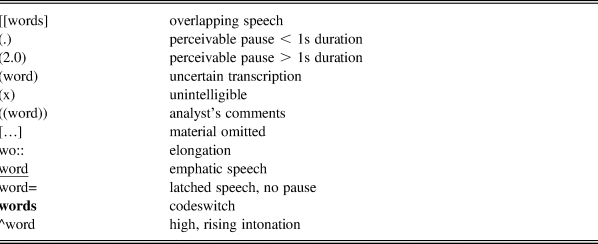
APPENDIX: TRANSCRIPTION CONVENTIONS