Introduction
After the close of the First Opium War in 1842, Westerners gained the right to reside and do business in a progressively larger number of Chinese treaty ports.Footnote 1 This paper covers the period from that date up to 1911, when the Qing dynasty was overthrown in a revolution supported by much of the emergent Chinese bourgeoisie.Footnote 2 The so-called treaty port system contributed to the rapid growth in Sino-Western commerce, which increased more than sevenfold from 1864 to 1911.Footnote 3 The growth of Sino-Western trade meant that Westerners had both more opportunities to observe Chinese entrepreneurs and a stronger incentive to think about Chinese entrepreneurship. Westerners during our period frequently debated the nature of Chinese entrepreneurship in books, articles, pamphlets, and other interventions in the public sphere. Those publications that have survived were the basis of the research presented in this paper.
The history of capitalism movement in the United States has developed our understanding of how the ideologies of race, “civilization,” and class have intersected in the United States and other countries around the North Atlantic.Footnote 4 Scholars who work on the business histories of colonial Africa and of twentieth-century India have published similar research.Footnote 5 Similar research themes as they relate to Japan have also been investigated. For instance, Susie Pak has examined how ideas about racial and ethnic difference influenced how New York bankers in the early twentieth century viewed Japan, a country that borrowed in Western capital markets.Footnote 6 More recently, Janet Hunter has used contemporary books and pamphlets to examine how imagined hierarchies of nations and races influenced how nineteenth-century Westerners perceived merchants from Japan, a nation then seen as being at an intermediate level of civilization.Footnote 7
On a theoretical level, much of this business-historical research draws on the work of postcolonial researchers who have studied the mental systems that imperialist cultures in the West created to justify their political, military, and economic interventions in countries in the non-Western world. Footnote 8 A common theme in colonialist discourses about non-Westerners was a tendency to “other” people in the so-called Orient, an imagined region that extended from Morocco to Japan.Footnote 9 Historians of capitalism have not hitherto applied this theory to the study of Western business in China in the same period. Our paper seeks to integrate the history of Sino-Western trade into our general understanding of the history of capitalism while also providing a nuanced interpretation of the roles of colonialism and Orientalism in this process.
The paper shows tremendous variation in how contemporary Westerners thought about Chinese entrepreneurs: some of their assessments of Chinese entrepreneurship were clearly informed by colonialist and racialist ideologies, but other Westerners discussed Chinese entrepreneurs in a fashion that was distinctly noncolonialist and non-Orientalist. We find that while some contemporary authors, particularly English-speaking missionaries and government officials, employed the standard Orientalist tropes of passivity and economic stagnation in the course of discussing Chinese entrepreneurship, other Western writers, including those from mercantile backgrounds, directly challenged such colonialist ideas and stressed that Chinese people, or at least some subsets of the Han Chinese populations, were actually extremely entrepreneurial. Such depictions of Chinese entrepreneurs undermined the Orientalist and racialist stereotype of the Chinese as essentially passive, tradition bound, and backward. This paper modifies our understanding of how colonialism shaped Western perceptions of China by showing that some Western writers rejected Orientalist ideas in the course of their discussions of Chinese entrepreneurship. The paper is thus a contribution toward a fuller and richer understanding of the cultural history of Sino-Western business.
Let us define our key terms. Following Schumpeter, we define “entrepreneurship” as the capacity and intention to plan and manage innovative profit-oriented business venturesFootnote 10 and as crucial agent that drives economic changes within business history.Footnote 11 An “Orientalist” discourse emphasizes the sheer difference between the so-called West, which was conceptualized as rational, progressive, and humane, and the so-called Orient, which was barbaric, irrational, stagnant, and ruled by cruel tyrants. Orientalist modes of thought were distinct from but frequently overlapped with ideas such as scientific racism that Westerners used to bolster the idea that they were superior to all non-white, non-Christian, and non-Western peoples.Footnote 12 Orientalism exaggerates differences between macrogeographic regions such as “the East” and “the West” while minimizing individual and microgeographic differences within such regions. Orientalism thus “essentializes” the differences between East and West. As used in postcolonial scholarship, the term “colonialism” has a broader definition than Orientalism, as it includes discourses that denigrated any non-Western cultures that were located outside the spatial imaginary of “the East.”Footnote 13
There can be no doubt that intense anti-Chinese prejudice was present in the Western expatriate communities in China throughout the seven decades covered by our paper. The extent of anti-Chinese prejudice in contemporaneous Western cultures has been well documented by Robert Bickers’s studies of the Western mercantile community in China,Footnote 14 by intellectual and cultural historians,Footnote 15 and by the many historians who have studied the experience of Chinese immigrant communities. Footnote 16 As James Hevia, David Scott, and others have shown, contempt for the Chinese also informed Western diplomatic, naval, and military action in China during and after the Opium Wars.Footnote 17 Postcolonial scholarship has demonstrated that the period covered by our paper also saw a reduction in the status of the Chinese in the global hierarchy of races that was part of the contemporary Western spatial imagination: the Chinese were reclassified as definitely non-white.Footnote 18 Simply put, many Westerners in this era harbored extremely racist attitudes toward the Chinese. The Chinese Communist Party’s ongoing “patriotic education” program, which emphasizes the sheer extent to which Westerners mistreated China during the so-called “century of humiliation,” is based on legitimate grievances about real historical events.Footnote 19
However, we hold that it would be a gross error to overgeneralize by arguing that anti-Chinese prejudice was universal among Westerners resident in China. The Western businessmen who lived in the treaty ports between 1842 and 1911 were not uniformly chauvinistic and parochial. This paper’s examination of what Westerners said in public about Chinese entrepreneurs will, in our view, help us to arrive at a nuanced understanding of how Western people in the Treaty Port period viewed Chinese businesspeople. Our position is that there needs to be balance in our depiction of how colonialist ideas influenced Western thinking about Chinese businesspeople. It is, therefore, helpful to draw on the recent cultural-historical research that is informed by the nuanced version of postcolonial theory that takes into account the diversity of Western attitudes during the era of colonialism. Our approach is, therefore, similar to an influential 2002 book by the historian Sir David Cannadine that showed that Victorian British people sometimes behaved in strikingly nonracist and nondiscriminatory ways when interacting with Asians and Africans, particularly those from princely or mercantile backgrounds.Footnote 20
Moreover, our argument is also congruent with that of Jürgen Osterhammel, who has recently demonstrated that Enlightenment depictions of Asians were far more diverse and were characterized by less Orientalist stereotyping of Asians than many postcolonialist scholars have allowed. Among postcolonialist historians and other scholars, it has long been common to assert that the Enlightenment changed how Westerners viewed Asians by promoting the view that Asians were backward, irrational, and bound by tradition. As Osterhammel notes, postcolonial scholars associate this “epistemological disaster” with white supremacy and Western chauvinism. Our research on Western depictions of Chinese entrepreneurship corroborates Osterhammel’s claim that the prevailing view is overly simplistic and ignores diversity.Footnote 21
Historians have found considerable diversity in how Westerners in the heyday of imperialism viewed non-Western peoples. Recent comparative colonial research suggests that the ideology of white superiority was much stronger in some of the colonial nations than others: racial barriers in the French and, a fortiori, the Portuguese colonial empires were less rigid than in the British Empire, let alone the United States.Footnote 22 Just as attitudes toward the Chinese varied from one Western culture to the next, there was tremendous individual variation within national populations. For instance, some of the Western businesspeople who lived in China displayed open-minded and respectful attitudes that contrast markedly with those of individuals who came from very similar national, occupational, and family backgrounds. Consider Samuel Greg Rathbone (1823–1903), who was dispatched by his family in 1843 to establish branches of their trading firm in Shanghai and Canton. These branches sold British goods to Chinese wholesalers and bought silk and tea for export to the West. Samuel Greg, who appears to have been a particularly earnest young Quaker, sent lengthy and thoughtful letters back to Liverpool that contained extensive evaluations of the morality of other Western merchants in China, as well as condemnations of their contemptuous attitudes to and actual mistreatment of Chinese merchants. For instance, he deplored how many of his fellow Westerners would dishonor financial commitments to Chinese business partners.Footnote 23
Further evidence of the diversity of Western attitudes toward the Chinese is seen when examining the statements made by and about Charles Addis, the Scottish banker who would later lead the Hong Kong and Shanghai Banking Corporation. Addis was unusually tolerant for a man of his generation and background, at least judging from the comments about the Chinese he made in his youth. As a young man, he took lessons in Chinese language and culture from a Confucian sage, which caused other Western expatriate businessmen to regard him as eccentric.Footnote 24 The cases of these two individuals show that it is difficult to generalize about how Western expatriates in China viewed their Chinese business partners. Addis himself noted that there were considerable tensions within the British expatriate population in China, with the missionaries being “generally disliked and shunned by European merchants and diplomatic personnel.”Footnote 25
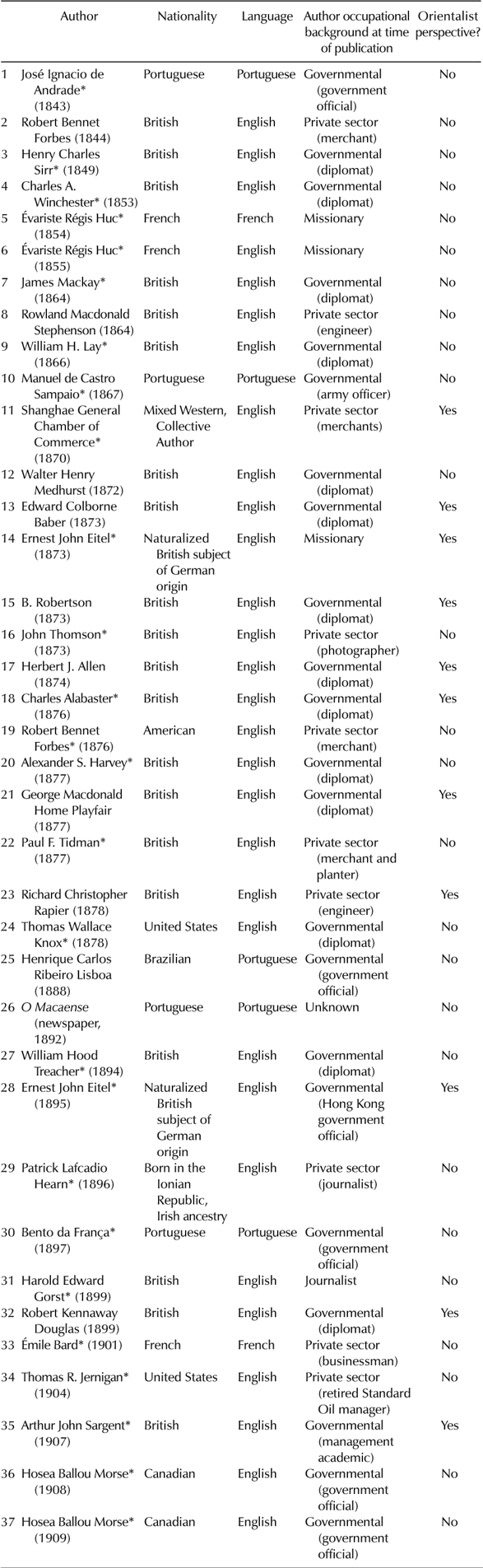
The fact that the merchants and the missionaries saw the world differently is not entirely surprising, given that they had traveled to China for very different reasons (i.e., to make money or to impose Western religious ideas). As we shall see in the following sections, the diversity in Western attitudes toward the Chinese was reflected in the texts about Chinese entrepreneurship they published. We would hasten to add that some missionaries who wrote about Chinese entrepreneurship were critical of Orientalist perspectives and some writers with business backgrounds used Orientalist ideas for understanding Chinese entrepreneurship (see Table 1).
Primary sources analyzed

Note: An asterisk (*) indicates the writer was quoted in the text of the article. Sources listed here and not cited elsewhere in the paper are: Allen, “Report of Foreign Trade in the Port of Tamsuy and Kelung”; Baber, “Report on Foreign Trade at Tamsuy (Including Kelung) for the Year 1872”; Douglas, China; Forbes, Remarks on China and the China Trade; Stephenson, Railways in China; Lisboa, A China e Os Chins; Medhurst, The Foreigner in Far Cathay; O Macaense (1892); Playfair, “Report of the Trade of Taiwan for 1876”; Rapier, Remunerative Railways for New Countries; Robertson, “Report on the Foreign Trade of Canton For the Year 1872.”
Source: Authors’ compilation
The Rise of Sino-Western Commerce
Our paper focuses on the ideas that Western authors used to make sense of the reality of Chinese entrepreneurial behavior rather than the actual behavior of contemporaneous Chinese entrepreneurs or the behavior of the Western businesspeople who interacted with their Chinese counterparts. It nevertheless builds on research about how Chinese business was transformed in this period. This research has demonstrated that the strategies and structures used by Chinese businessmen evolved rapidly in the treaty port period.Footnote 26 Chinese merchants enjoyed “a real rise in social status” that was due, in part, to the influence of Western ideas that legitimated capitalism and, in part, to an influx of men from official and gentry backgrounds into the merchant class.Footnote 27 At the same time, the Chinese state embarked on a program of “self-strengthening” that involved state subsidies for the adoption of Western technologies.Footnote 28 This modernization program involved a mixture of assistance to private entrepreneurs and the establishment of arsenals and other industrial enterprises directly managed by the state.Footnote 29 The result of all of these changes was what some historians have called a Chinese “commercial revolution.”Footnote 30
Chinese business and economic history is a rapidly growing field that covers many historical topics and research methods.Footnote 31 The recent research on Chinese business history has deepened our understanding of the aforementioned commercial revolution by showing how late Qing entrepreneurs selectively borrowed Western business practices. Elisabeth Koll, for instance, has shown how the conglomerate founded by Zhang Jian in 1895 adopted some Western businesses practices while retaining many Chinese characteristics.Footnote 32 Andrew Godley and Haiming Hang have examined how Chinese merchants learned to finance Western-style department stores.Footnote 33 Other scholars have shown that the business enterprises founded by Liu HongshengFootnote 34 blended Western and traditional Chinese business practices to form a another such hybridized organization.Footnote 35 Chinese accountancy was similarly hybridized.Footnote 36 The recent research on Chinese business history has also shown that relationships between Chinese and Western businesses were sometimes conflictual, sometimes cooperative. Eichi Motono discovered that while relations between Chinese and British merchants in Shanghai were occasionally marked by ethnic rivalry and a “lack of mutual trust,” British and Chinese businesspeople also cooperated, as when Chinese merchants invested in British-incorporated companies within the international settlement in Shanghai.Footnote 37 Sherman Cochran also found that relations between Chinese and foreign firms sometimes involved extensive cooperation across ethnic lines. Footnote 38 In other cases, such as in the cigarette industry, rivalry between firms acquired an ethnic and nationalist significance: the intense competition between British-American Tobacco Company and Chinese Nanyang Brothers Tobacco Company was interpreted by some contemporaries as a struggle between Chinese and Western capitalism.Footnote 39
The Lenses Westerners Used to Understand Entrepreneurship
Westerners who traveled to late Qing China brought a variety of lenses for thinking about entrepreneurship. Ideas about the Chinese that had emerged from the Enlightenment appear to have influenced how many observers thought about Chinese entrepreneurship. In the early Enlightenment period (1650–1770), Leibniz and Voltaire had praised China as a nation of rational government and commercial sophistication.Footnote 40 Late Enlightenment writers such as Montesquieu and Adam Smith then challenged the view that China was more advanced than Europe, which contributed to a growing profound belief among Westerners of their own superiority to the Chinese.Footnote 41 Smith, who wrote about China in the 1770s, supported Montesquieu’s view that China was an Oriental despotism much like Turkey and Russia, the “Eastern” regimes most familiar to Europeans.Footnote 42 Because Smith was widely read in the nineteenth century, such ideas about China became part of the intellectual tool kit of Western writers in the treaty port period.
The post-Smith classical political economists, who also were read widely in our period, contributed to the stock of ideas that Western observers applied in understanding Chinese entrepreneurs. They did so by helping to perpetuate the already established concept of “Oriental despotism,” the notion that governments in the vaguely defined “East” were arbitrary, predatory, and obstacles to commercial development.Footnote 43 For instance, John Stuart Mill’s 1848 Principles of Political Economy, which went through many British, French, and U.S. editions after 1848, shaped how Westerners thought about the environment for entrepreneurs in China and was part of the knowledge base of most educated Westerners. Mill taught that in “the extensive monarchies which from a time beyond historical record have occupied the plains of Asia,” the ruler “seldom leaves much to the cultivators beyond mere necessaries, and often strips them so bare even of these.” The result was that while “the bulk of the population are ill provided for,” the royal court is able to make the elaborate displays of riches that had tricked the first European explorers into regarding these societies as wealthy. In such societies, a few sycophantic merchants would amass great wealth due to favors bestowed by rulers. Mill taught that the rich merchants in Asia were, therefore, fundamentally different from the rich merchants in the West who had made their fortunes through their unaided efforts in the free market.Footnote 44
The concept of Oriental despotism disseminated by Smith, Mill, and other political economists would go on to inform Western views of the conditions faced by Chinese entrepreneurs. In an 1854 discussion of commercial morality in China, Father Évariste Régis Huc, a French missionary, noted that in Europe it was common to regard China as the “pays du despotisme et de la tyrannie” and “l’Asie comme la terre classique de l’arbitraire et de la servitude.” Huc also observed that most Europeans perceived this land of despotism as a backward nation in which commerce was underdeveloped relative to the vast population.Footnote 45
Ideas about race were also present in widely read texts about entrepreneurship. The Scottish writer Samuel Smiles also shaped how many contemporaries viewed entrepreneurship via his works on entrepreneurial heroes, which were published after the spectacular success of his 1859 best seller Self-Help.Footnote 46 Smiles devoted little attention to entrepreneurs who were active in fields such as finance, advertising, or retail, and instead focused on the heavy industries that were on the cutting edge of technological development. In effect, he presented the practical engineer as the highest form of entrepreneur. For the purposes of this paper, Smiles’s distinction between higher and lower entrepreneurship is relevant to understanding how Westerners thought about entrepreneurship in late Qing China, because Western authors who published in this period disagreed about the capacity of Chinese individuals to engage in various types of entrepreneurship ranging from the routine to the innovative. As we shall see later, some authors suggested that while Chinese merchants were capable of old-fashioned entrepreneurship through arbitrage, only Westerners were capable of higher entrepreneurial functions, which involved the introduction of new technologies.
For Smiles, the presence of the entrepreneurial spirit in a population was, in part, a function of the existence of a government that confined itself to the protection of “life, liberty, property and the fruits of accumulated industry.”Footnote 47 He also suggested that a degree of Nordic blood in a nation’s population helped to determine how entrepreneurial it was. Smiles declared that Britain’s rapid material progress was due to the unaided efforts of the individual “spirit of self-help, as exhibited in the energetic action of individuals, [and] has in all times been a marked feature in the English character.”Footnote 48 Smiles conceded that the spirit of self-improvement was not confined to Englishmen or Britons and could indeed be found in other Teutonic races. Smiles suggested that the economic individualism and entrepreneurial boldness demonstrated by members of these “Teuton” races might be traced back to their Norse ancestry.Footnote 49 Smiles was here insinuating that Viking ancestry may have made northern Europeans natural entrepreneurs. Smiles’s comment, which was admittedly made in passing, associated self-reliance, risk-taking, and entrepreneurship with northern European ancestry and related physical traits. Given that entrepreneurship had taken on racialist associations in the works of such an influential author, it is not surprising, therefore, that ideas about race influenced how many contemporary Westerners viewed entrepreneurship in China and, indeed, many other non-Western societies. However, as we show later, some Western observers stated that the Chinese could be just as entrepreneurial as any white European, which demonstrates that ideas of biological racial superiority were far from universal in China in this period.
We should also note that Western ideas about entrepreneurship did not remain constant over the period covered by this paper (1842 to 1911). Samuel Smiles’s book reflected the mid-Victorian British faith in the benefits of laissez-faire and free enterprise. Britain’s support for free enterprise weakened in the late nineteenth century, and the growing demands for the regulation of business seen in Britain had strong parallels in France, the United States, and other Western countries, even if few people in these nations came to favor outright socialism.Footnote 50 In our view, changing attitudes toward entrepreneurship in the West began to influence Western perceptions of Chinese entrepreneurship toward the end of our period. In this context, Smilesian hero worship of businessmen became less fashionable. The growing scepticism about the profit motive and entrepreneurship colored Western discussions of Chinese commerce by encouraging Western expatriates to focus on the issue of whether cartels and other mercantile agreements in restraint of trade were the main choke on China’s commercial development. As we show later, observers from the English-speaking countries began around 1890 to apply a sort of antitrust lens in thinking about entrepreneurship in China.
Western Debates About Chinese Entrepreneurship
In this section of the paper, we analyze the texts in which contemporary Westerners debated Chinese entrepreneurship. We show that while some authors adopted a strongly Orientalist pose that denied that the Chinese could ever be entrepreneurial, others argued that the Chinese were, in fact, an extremely entrepreneurial population. We also identify a third perspective, which held that some groups within the Chinese population, such as people from a particular locality or speakers of a certain dialect, were more entrepreneurial than other Han Chinese groups. In our view, this third perspective also challenged the Orientalist idea that the Chinese were a monolithically non-entrepreneurial group of individuals.
Westerners published about Chinese entrepreneurship in a variety of different venues. For instance, retired merchants wrote memoirs about their careers in China and diplomats filed reports on commercial conditions that were published by their home governments, some of which were then published. In preparing this paper, we identified a range of sources published between 1842 and 1911 in which Westerners discussed Chinese entrepreneurship. We searched for texts in English, French, and Portuguese, the languages of the researchers. Texts in these languages were particularly important for our study, because the British, American, French, and Portuguese entrepreneurs played a very important role in mediating trade between China and the West in this period, although at least a few merchants of every European nationality could be found living in China’s treaty ports at this time. British and American merchants were found throughout China in this period, with particularly large concentrations in Hong Kong and the International Settlement in Shanghai.Footnote 51 Shanghai had a separate French “concession” or sector: French commercial activity in the country was primarily in Shanghai and the southern regions immediately adjacent to Indo-China.Footnote 52 The Portuguese, who had had a colony in Macau since 1557, were particularly important in Guangdong and in Hong Kong.Footnote 53 German firms were also numerous and were found throughout China, not just in the German concessions.Footnote 54 A more detailed analysis would require an interdisciplinary approach, and we acknowledge from the outset the limited expertise we bring to this essay by focusing only on texts in the English, French, and Portuguese languages.
We began our research process by searching the catalog of the British Library, a library of legal deposit, for contemporary British and U.S. texts dealing with Chinese entrepreneurship. A parallel search for French-language sources was conducted at the Bibliothèque François-Mitterrand. We searched for Portuguese-language texts at research libraries in Macau and Hong Kong, former Portuguese and British colonies, respectively. We were aware that Westerners may have discussed Chinese entrepreneurship in texts from this period that have either failed to survive or did not appear when we searched through databases and catalogs using such terms as “Chinese merchant” and “Chin* commerce*.” Our initial keyword searches produced a long list of texts on commercial conditions in China, only some of which discussed Chinese entrepreneurs and other businesspeople. We discarded any sources, such as detailed reports of commodity prices, that did not seem relevant to the sociocultural themes at the core of our research question. At the end of this selection process, we found thirty-seven relevant books, pamphlets, and government reports, many of which are cited and quoted in this paper and all of which are listed in Table 1.
We evaluated each text to see whether its evaluation of Chinese entrepreneurs was informed by Orientalist and colonialist stereotypes such as passivity, irrational commitment to tradition, and lack of entrepreneurial drive (see final column in Table 1). We found that twenty-six of these texts represented Chinese entrepreneurs in a largely or exclusively non-Orientalist/noncolonialist fashion, while eleven depicted Chinese entrepreneurs in terms that were largely or entirely consistent with Orientalist stereotypes. We determined that all of these authors were male; despite our best efforts, we were unable to find any relevant female-authored texts in this period. We also identified the nationality and occupation of the writers to determine whether there was an obvious relationship between these author characteristics. We found that neither of the French and none of the five Portuguese-language texts used a colonialist-Orientalist lens to understand Chinese entrepreneurship, a pattern that is consistent with the aforementioned historiography that argues that racial barriers were less pronounced in Portuguese culture than they were in cultures of the English-speaking countries in this era. In examining the English-language texts, we found that colonialist-Orientalist ideas were used by authors from a wide range of occupational backgrounds that we place into three categories: missionary, governmental, and private sector. We are thus unable to associate more frequent use of Orientalist ideas with any particular occupational categories.Footnote 55
Our reading of these primary sources suggests that there was a consensus among Western observers of Chinese business that the Chinese national character included traits such as frugality and an ability to work hard. These traits were widely regarded as a necessary, but not sufficient, foundation for entrepreneurial success. In 1855, Évariste Régis Huc informed readers of Harper’s Magazine in the United States that “if the Chinese have any object in life, it is trade and money. They are born speculators. As soon as a boy can walk, he begins to traffic with his companions.” The Chinese, the article elaborated, were passionate about commerce, and it did not matter to them whether their business dealings were “legal or illegal, honest or dishonest.” Although not at all flattering to the Chinese, this description in an influential magazine reinforced the idea that the Chinese were entrepreneurial and constantly alert to possibilities for profit.Footnote 56 Similar statements about the eagerness of the Chinese to make money appeared in primary sources published throughout the period covered by this paper. However, the contemporary Western observers disagreed about the capacity of Chinese businessmen to engage in various types of entrepreneurship. Some of the texts we analyzed drew on Orientalist ideas and depicted the Chinese as utterly passive and conservative and implied that any economic change or entrepreneurial dynamism currently visible in China was solely the result of the presence of Westerners, who were uniquely capable of higher entrepreneurial functions.
Some Western observers of China doubted the capacity of the Chinese to engage in any entrepreneurial activity beyond simple arbitrage and routine commercial transactions. This idea was presented in 1870 in a memorandum by the Shanghai General Chamber of Commerce, which represented the interests of Western merchants in that city. While this memorandum conceded that Chinese political institutions were partially responsible for the commercial underdevelopment of the country, it cautioned against putting too much of the blame on China’s political system, noting that oppressive government was “only one obstacle” to the circulation of goods. “Much stress has justly been laid” on the role of the “exaction of the mandarins” in obstructing trade, it declared in a report on trading conditions in the Yangtze valley. The “greater” obstacle, it said, was “the passive and unconscious resistance of a people of stagnant ideas” and “of very limited enterprise.” The report noted that Chinese merchants were willing to adopt new technologies, such as steamers, but only if Westerners took the lead in introducing them: “In China, it is only the foreigner who is capable of pushing” commercial progress. They concluded that the Chinese merchants, while industrious and alert to the potential for profit, were “incapable of originating” novel ways of doing things: “The spirit of enterprise is all on the side of the foreigners and the onus of every forward movement in commerce must necessarily rest on them.” Footnote 57
The Orientalist idea of Chinese commercial passivity was perpetuated in an 1895 history of Hong Kong by Ernest John Eitel. Eitel, who had originally come from Germany as a Protestant missionary, was the colony’s inspector of schools when he wrote the book. He depicted the Chinese as essentially passive players in Hong Kong’s economic history. Eitel was, of course, aware that China had had commerce and a merchant class for generations, but he represented Chinese businesspeople as uncreative souls who worked in the same well-worn grooves their distant ancestors had formed. He remarked that from the days of the East India Company to the present, “it seems indisputable that… European merchants have ever been the leaders” and the “Chinese merchants the indispensable hangers-on.” The white man, not the yellow man, was the carrier of the mighty “spirit of free trade.”Footnote 58 He also remarked that the “destiny of the one race is to rule and the fate of the other is to be ruled,” the success of Hong Kong illustrating not the vigor of indigenous merchant class but rather what “Chinese labour and industry” could achieve under the direction of the British.Footnote 59
In keeping with his missionary background, Eitel advanced a religious rather than a biological explanation for why the Chinese entrepreneurs were passive and non-innovative. In his history of Hong Kong, he depicted the “Chinese merchants” as superstitious and primitive, a theme he elaborated upon in his books on feng shui.Footnote 60 He conceded that the Chinese merchants had attempted to imitate steamship companies and other businesses based on the advanced technology of the West, but that these schemes had failed miserably, despite being “well supplied with funds” and “strongly supported by Chinese officials.”Footnote 61 Eitel also reported that in 1881, some Chinese merchants had attempted to establish a trading house in London so as to deal directly with European firms, but this “attempt proved a conspicuous failure,” even though it had been graciously supported by Sir John Pope Hennessy, the governor. Eitel disparagingly described a Chinese-run dock company, calling it “even more short-lived ... [than] another project, which Sir John did his utmost to encourage.”Footnote 62 Eitel depicted the Chinese as essentially incompetent at business, especially its higher branches, even when living in the favorable legal and political environment of Hong Kong. Eitel’s view of Chinese businessmen was echoed in 1907, when Arthur John Sargent, one of the founders of business education at the London School of Economics, attributed the economic backwardness of China to the “intense conservatism of the Chinese people” and their aversion to new products, technologies, and business practices.Footnote 63 He wrote that “the Chinese are nothing if not conservative in the matter of foreign innovations.”Footnote 64 He also wrote that “the Chinese are suspicious of change, particularly when it is not due to a genuine native development.”Footnote 65
The negative depiction of Chinese entrepreneurship by authors like Eitel and Sargent did not go uncontested. Writing in 1867, Manuel de Castro Sampaio, a Portuguese army officer in Macau, praised the Chinese merchants for their hard work, intelligence, and dynamism.Footnote 66 He also challenged the trope of Oriental duplicity, noting that “Chinese [enterprises], with regard to trade, are conducted in general with honour and probity, because, knowing the great scope of these qualities when it comes to such rich source, are admirably circumspect in all your accounts.”Footnote 67 Other Portuguese authors based in Macau noted that the British had a tendency to make the Chinese appear as bad as possible: another government official in Asia (Portuguese India and Macau), José Ignacio de Andrade, wrote in 1843 that “the character of British is so averse regarding the Chinese that since Lord Anson to Lord Amherst, that is from 1741, a time when Anson entered the Tigris river until 1816, when Amherst arrived in Beijing, the Bretons [sic] have always been repelled: so as to take vengeance, they depict China in the darkest colours.”Footnote 68 It is likely that these Portuguese authors harbored attitudes to the Chinese that we today regard as prejudiced. However, their comments suggest that they perceived the British as excessively prejudiced against the Chinese.
Patrick Lafcadio Hearn challenged the stereotype of Chinese business conservatism in an article published in 1896 in which he distinguished the conservativism of the Chinese in politics and matters of dress from actual business activities. Hearn, a journalist of mixed Irish and Greek ancestry who had lived in France and the United States before his arrival in Asia, had a decidedly cosmopolitan outlook that challenged the prevailing colonialist and Orientalist views. Hearn said that “men who know China also know that Chinese conservatism does not extend to those activities which belong to trade, to industry, to commerce or speculation.” Even the Chinese who had ventured abroad, he conceded, had retained their traditional dress, ethical system, and religion: “Whether in Japan or in India, Canada or Australia, Cuba or Chili, Siberia or Burmah, the Chinaman remains a Chinaman.” Nevertheless, Chinese businessmen freely used “the modern inventions of industry, the modern facilities of communication, the new resources of commerce.” The Chinese merchant, he explained, sent coded telegrams, chartered steamers, operated modern factories and banks, launched joint-stock companies, and hired “steam or electricity to aid him in his manufacturing or speculating.”Footnote 69
Other Western observers joined with these authors in disputing the Orientalist view that the Chinese were non-entrepreneurial and argued that the Chinese were natural entrepreneurs and quick to take advantage of new technologies. Writing in 1875, just two years after Eitel had published a book arguing that the unwillingness of the Chinese to adopt modern technology was a function of their mindless faith in feng shui, Charles Alabaster dismissed the idea that religious beliefs were inhibiting Chinese entrepreneurship. He noted that the Chinese of Hankow (Hankou) were “already beginning to look on foreign appliances as sources of greater wealth” and that “feng shui as an excuse is scarcely heard” among the enterprising merchants of the city who were enthusiastically investing in “steamer companies, banking companies, insurance companies, and, last but not least in this province, mining companies.”Footnote 70
Other developments in Chinese commerce in the 1860s and 1870s likely reinforced the sense that the Chinese were actually quite entrepreneurial and dynamic, despite the claims of Eitel. For instance, increased competition from native merchants caused the failure of a number of British and American firms that began with a wave of bankruptcies in 1867, when Dent and Company, an old and established British house, failed due to Chinese competition. The 1875 bankruptcy of Augustine Heard and Company prompted Shen Pao, China’s first vernacular newspaper, to declare triumphantly that the foreign mercantile community as a whole was in trouble.Footnote 71 A major trend in this period was Chinese merchants bypassing the Western middlemen who had previously mediated trade between China and Western countries. John Thomson observed in 1873 that commerce was passing from Western hands to the Chinese merchants, “who have readily adopted the use of telegraphs and steamers in carrying on their business operations.”Footnote 72 At an 1877 meeting of the Royal Colonial Institute in London, Paul F. Tidman said that he had seen Chinese as colonists in Borneo, the Strait Settlements, and the Dutch East Indies in his capacity as a “magistrate, merchant, manufacturer, planter, and miner.” Drawing on his experiences in business, he concluded that they were “pre-eminent among Asiatics for frugality, enterprise, and indomitable energy.” Tidman made these remarks to account for Chinese migrants dominating many sectors of the economies of Southeast Asia, a region in which the indigenous Malay population was underrepresented in business.Footnote 73
Writing in 1878, the American diplomat Thomas Wallace Knox declared that the Chinese were superb entrepreneurs. Knox noted that the trade of Hong Kong and the treaty ports, which had initially been in the hands of European firms, had been taken over by the enterprising Chinese. The process had begun, he said, when the Western firms had hired native merchants, or compradors, to handle dealings with the local population. The typical comprador was “earnest, active, and frugal, and by strict attention to business and rigid economy he could save five or ten thousand dollars a year.”Footnote 74 The compradors used the capital they had amassed to go into business themselves and had now largely displaced their Western competitors, achieving a sort of revenge for the national humiliation of the Opium Wars. Knox reported that “the sugar trade of Amoy [Xiamen, Fujian] and Formosa [Taiwan] has gone into Chinese hands entirely” and that flour exports from “San Francisco to China” were now handled by combinations of Chinese merchants.”Footnote 75 Moreover, enterprising Chinese merchants were spreading throughout Southeast Asia and were in the process of taking over the trade of Singapore, Siam, and the Dutch East Indies, where they were “as keenly alive to industry and profit as anywhere else.”Footnote 76 Similarly, Bento da França, a Portuguese government official, attested in 1897 that the “Chinese, in general, lead business with honour and integrity, being very circumspect in all their duties. A cooperative nature highly prevails between them: they do not try business, except in rare occasions, through partnership” and concluded by saying that the Chinese are “hard-working, proactive, and skillful in business.”Footnote 77 In his memoirs of his career in China, which had involved complicated dealings with business partners of many nationalities, Boston’s Robert Bennet Forbes declared that “I cannot recall any acts of dishonesty on the part of the leading Chinese merchants, and I might cite several of great liberality.”Footnote 78
In 1899, Émile Bard, a businessman who had previously served as president of the municipal council in Shanghai’s French Concession, spoke of the “grandes aptitudes commerciales” of the Chinese population.Footnote 79 Bard, who described his book as the first French-language study of China by a businessman, presented the Chinese merchants in an even more positive light.Footnote 80 Bard’s work would have left the attentive reader with no doubt that the “esprit commercial” was alive and well in China. Indeed, Bard attacked those Western authors who denigrated the Chinese simply because their cultures were somewhat different from those of Europe. It was true, he wrote, that the Chinese write vertically while Europeans write from left to right, but these superficial differences did not make the Chinese inferior. Bard mocked the ethnocentrism displayed by many Westerners in China by referring to a comedy in which a Frenchman travels to England and is morally outraged to find that the English word for “bread” is different from that in French.Footnote 81
In 1908, Hosea Ballou Morse, a Canadian-born officer of the Imperial Maritime Customs Service, praised the “business capacity and foresight of the Chinese merchant” and used the ancient silk road route between Asia and Europe as proof of Chinese mercantile dynamism. Alluding to the historic Silk Road route that had once been the major thoroughfare between Asia and Europe, he remarked that “the same enterprise that built up the foreign trade by land” was also applied to the “development of internal trade between provinces the size of kingdoms.”Footnote 82 Morse stressed that Chinese entrepreneurs were quick to adopt new technologies the moment their rulers authorized them.Footnote 83 He commended the dynamism of the “enterprising merchants, foreign and native alike, of Tientsin,” who had overcome a poor natural harbor to build up a thriving commerce.Footnote 84 Similarly, writing in 1904, Thomas R. Jernigan who had recently retired from Standard Oil described the Chinese as “merchants by nature” in his book on business methods in China.Footnote 85 He also reminded his readers that there was “authentic evidence that the Chinese understood and practiced a system of banking long before the inhabitants of Western nations.”Footnote 86
As was noted earlier, the prevalence of pseudo-scientific racism in this period clearly affected how some Western policy makers and academics viewed the Chinese. However, there is little evidence that many Western businesspeople resident in China actually used these theories to understand Chinese entrepreneurship. Indeed, to the extent to which social Darwinist ideas influenced how Westerners living in the region thought about Chinese businesspeople, it was to underscore the economic superiority of the Chinese over other Asian groups. Such ideas were especially common in Malaya, which had seen an influx of Chinese settlers. In 1893, William Hood Treacher, the British Resident in Selangor, a nominally independent Malay sultanate, declared that the indigenous “Malays are unenterprising” and that they faced “the danger of their being pushed altogether aside in the struggle for existence by more enterprising and energetic peoples,” such as the Chinese who had already taken control of the local mining industry.Footnote 87
Another important way in which contemporary Western writers challenged Orientalism was to point to differences in the level of entrepreneurship within the Chinese population. Establishing that some Chinese regions or dialect groups were more entrepreneurial than others undermined the Orientalist view that the Chinese were a monolithic and non-entrepreneurial group. Throughout the period under consideration, Western observers singled out the Cantonese as a particularly enterprising subset of the Chinese population. In 1849, Henry Charles Sirr, an Irish-born diplomat, singled out Xiamen as a place that had produced a disproportionate number of China’s most “enterprising and wealthy merchants.” Men hailing from this region had spread themselves “all along the coast of China” and had established “commercial houses in many parts of the eastern archipelago.”Footnote 88 A few years later, the British trade superintendent in China also described the people of Xiamen as an “enterprising race” in which the typical “ordinary labourer” was “ambitious of elevating himself in the social scale.” He also remarked that the “transformation from the labourer to the artizan class take place with more rapidity” in this country than in any other in the world.”Footnote 89 In 1864, the diplomat James Mackay reported to Robert Hart that much of the trade of the Yangtze region had fallen into the hands of merchants from southern China, “where enterprise and capital seem to be combined in a manner unknown in the North.”Footnote 90 Another British diplomat reported that “the English merchants established in the northern ports” had suffered due to the “competition of the Cantonese and other southern merchants who have sprung into existence under the recent system.”Footnote 91
In 1877, the British diplomat Alexander S. Harvey said that while “the people in the neighbourhood of Kiungchow [Qiongzhou, Hainan] are well disposed and friendly,” they “[are] inferior in physique and enterprise” to the Cantonese, who “[have] supplied the principal merchants and best energy” in Hainan’s largest city. Footnote 92 Thomas Jernigan drew a sharp distinction between the northern and southern Chinese in his book on Chinese business. In his view, the southern Chinese were more enterprising than the northerners. Jernigan criticized other Western authors for having depicted the Chinese as homogeneous.Footnote 93 Jernigan’s comment thus served to undercut the Orientalist stereotype that all Chinese people were passive and non-entrepreneurial simply by virtue of being Asians. Although his distinction between northern and southern Chinese risked creating its own set of stereotypes that obscured variation between individual merchants, it did have the effect of undermining the Orientalist perspective evident in other contemporary Western accounts of Chinese entrepreneurship.
Toward the end of the period covered by this paper, a new element entered into Western depictions of Chinese entrepreneurship, namely, a growing concern about agreements designed to limit competition between Chinese businesspeople. We suspect that the growing tendency of Western observers of Chinese entrepreneurship to focus on anticompetitive practices was driven by events in their home societies rather than developments on the ground in China. Following the passage of the celebrated Sherman Anti-Trust Act by the U.S. Congress in 1890, Anglophone observers began to identify the prevalence of price-fixing arrangements and other agreements in restraint of trade as the major barrier to China’s commercial development. As historians such as Richard von Glahn and William T. Rowe have observed, the institutions Westerners labeled “guilds” (gongsuo or “public halls” in Chinese) had long regulated trade in many Chinese localities.Footnote 94 Guilds were thus nothing new in 1890. However, Western accounts of Chinese entrepreneurship did not begin to focus to the guilds’ efforts to limit competition until so-called agreements in restraints of trade had become a major political issue in the United States. These extended comparisons between U.S. trusts and Chinese guilds underscored the fundamental similarity between Chinese and Western businesspeople and thus challenged the Orientalist depiction of China as exotic. The anticompetitive practices explanation for the retardation of Chinese entrepreneurship undercut the aforementioned theories that the root causes of China’s economic problems were the nation’s failure to adopt Christianity, some other feature of Chinese culture, or the supposed biological inferiority of Asians. The anticompetitive practice paradigm suggested that what China really needed was a good strong dose of antitrust legislation.
The first application in print of the anticompetitive practices paradigm to understanding Chinese business was by Harold Edward Gorst, a British writer whose 1899 book explicitly compared the anticompetitive practices of the guilds of China with the oligopolistic trusts that had recently emerged in the United States, Britain, and other Western countries. Like the American trusts, China’s guilds crushed their competition without the benefit of statutory monopolies or other assistance from the state, using techniques such as boycotts of renegade members. Gorst wrote that it was common “nowadays for large companies” in the West “to systematically crush the smaller fry” in the same industry so as to gain control “of the market by the ruin of less powerful and wealthy competitors … But the Chinese guilds can strike swifter and more crushing blows than any of the millionaire syndicates floated here.”Footnote 95 Gorst complained that China’s excessively powerful merchants were generally “unhindered by the central government” and had captured local officials.Footnote 96 His explanation suggested that the dynamic in China was similar to that of the United States, where anticompetitive trusts such as Standard Oil were alleged to have captured entire state legislatures.
Gorst’s theory was repeated by Hosea Ballou Morse in his 1908 book on The Trade and Administration of China and his 1909 work on The Gilds of China, both of which documented the cartel-like and trust-like practices of the guilds. Footnote 97 The sinister efforts of the guilds to limit competition were also discussed in Anglo-Chinese Commerce, a 1907 book by Arthur John Sargent.Footnote 98 Thomas Jernigan declared that the anticompetitive practices enforced by guilds were impoverishing China as a whole. In his account, any Chinese merchant who displeased the guild by competing too vigorously risked painful social exclusion.Footnote 99 Jernigan called upon the Chinese government to “have the courage to remove” these obstructions to free competition, although he predicted that Chinese officials were unlikely to take action, because too many of them were on “friendly terms” with the guilds.Footnote 100
Jernigan appears to have been calling for the introduction of some form of antitrust legislation in China to break up mercantile cartels, which is somewhat ironic given that Standard Oil, his former employer, would soon be broken up by antitrust action by the U.S. government.Footnote 101 Jernigan’s book does not indicate what he thought about Standard Oil’s anticompetitive practices in the United States. What it does suggest is that Jernigan was among the Westerners who quickly applied new theories used for understanding business in their own societies to the analysis of Chinese entrepreneurship. In applying the anticompetitive practices paradigm in this way, Jernigan and others underscored the similarity between Chinese and Western businesspeople, thereby challenging the Orientalist tendency to exaggerate the differences between East and West.
Conclusion
This paper has argued that while some contemporary Western authors certainly described Chinese entrepreneurship in terms that were entirely consistent with Orientalist ideas about Chinese stagnation and passivity, other observers of Chinese business challenged Orientalism by stressing that Chinese people, or at least some regional or dialect groups in China, were actually extremely entrepreneurial. Our research, therefore, challenges the view that the hegemony of Orientalist ideas in contemporary discourses about Chinese entrepreneurship was uncontested. Simply put, not all Westerners who wrote about entrepreneurship in late Qing China looked at Chinese businesspeople through an Orientalist lens. Cannadine showed that there was tremendous heterogeneity in how Victorian and Edwardian Britons viewed individuals from the subject races of their colonial empire. We have shown that Westerners who discussed Chinese entrepreneurship in this period had similarly diverse attitudes.
This paper suggests directions for further historical research projects, both qualitative and quantitative. The first possible project would involve using historical big data research methods, such as text-mining the large number of digitized primary sources, to determine the extent to which the competing discourses identified here were widespread in Western cultures in this period. The research methods associated with historical big data are now providing fresh insights into older questions, and it is possible that they could be usefully applied.Footnote 102 As we noted in the “Introduction,” the thesis of this paper is that it would be wrong to think that all Western depictions of Chinese entrepreneurs from this period were informed by Orientalist, racist, and otherwise discriminatory ideas. Many of the texts discussed earlier actually challenged these discriminatory ideas. A critic of our paper might respond to our claim by saying that while we have demonstrated that some Western writers in this period viewed Chinese businesspeople in a nonracist and noncolonialist fashion, these individuals were statistically unrepresentative of either the societies from which they came or of the Western expatriate population in China. Such a critic might point out that many of the relevant writings from this period have not survived due to war and other hazards and that the texts we examined in research libraries thus represented only a small cross section of the texts from the treaty port era in which Westerners discussed Chinese entrepreneurs.
We will concede that it is possible that the non-Orientalist writers we have found were statistical outliers, but we suspect that liberal, non-Orientalist views were fairly common among Western businesspeople in late Qing China and that the texts we have found were tolerably representative. Our search in research libraries for primary sources in which Chinese entrepreneurs were discussed was reasonably comprehensive and turned up a significant number of non-Orientalist texts, as Table 1 indicates. No evidence of systemic bias in the survival of relevant texts has been discovered that would lead one to think that non-Orientalist texts would today be overrepresented in the holdings of the British Library, the Bibliothèque François-Mitterrand, and the other libraries we used. However, only historical big data research methods would allow to us to reach hard conclusion about the relative popularity of Orientalist and non-Orientalist viewpoints in this historical period. Such research could also allow us to test the hypothesis that English speakers in treaty port China were more likely to subscribe to Orientalist or racialist ideas than Portuguese or French speakers in the same period.
Our paper points to another avenue for future research. Now that we have a better understanding of the heterogeneity of ideas about Chinese entrepreneurship that were articulated by Western expatriates in this era, we are in a position to investigate how this heterogeneity influenced the actual business strategies of various Western firms in China and the subsequent performance of such firms. The performance of Western firms in treaty port China was highly heterogeneous. Some went bankrupt, while others became highly profitable multinational corporations that still survive. Some economists have theorized that market forces tend to penalize firms whose managers indulge in a taste for discrimination or who allow discriminatory attitudes to distort business judgment.Footnote 103 Psychologists who study business decision making use the concept of the “stereotype tax,” which is a penalty that individuals pay whenever they harbor prejudicial attitudes toward members of otherized groups. This stereotype tax is distinct from the costs that stereotyping imposes on the members of the otherized group.Footnote 104 We can apply the concept of the stereotype tax to thinking about the factors that influenced some Western firms in late Qing China being more successful than others. If we were to accept that embracing racist or Orientalist ideas would increase one’s liability to pay the stereotype tax, we could hypothesize that those Western businessmen in late Qing China whose thinking was influenced by Orientalism and racialism were less successful than those rival Western businessmen who did not to use these ideologies to understand the Chinese.
In other words, we would predict that Western businessmen whose views of the Chinese were characterized by the absence of colonialist and/or racist ideas outperformed those Western businessmen whose thinking was clouded by these ideologies. There may be sufficient surviving data either to test this hypothesis in a rigorous quantitative fashion or to investigate it using qualitative case studies. A quantitative test of this hypothesis might involve finding data about a set of Western businessmen resident in Chinese treaty ports, determining each individual’s attitude to the Chinese via signatures to anti-Chinese petitions, and then seeing whether there is a correlation between expressed anti-Chinese attitudes and firm survival and/or firm performance. The qualitative investigation of whether and how Orientalist ideas affected Western business practices in late Qing China might involve either the study of the structuring of contracts with Chinese business partners or the development of these firms’ marketing strategies. Such research would likely involve the archives of the Western firms that were active in China in this period, such as Jardine Matheson, Standard Oil, and HSBC. Although extensive work using these corporate archives has certainly been undertaken by historians using other theoretical frames,Footnote 105 nobody has approached this set of archival records seeking to answer the specific research question raised in the previous paragraph.
One the basis of our finding that the attitudes of nineteenth-century Westerners toward the Chinese were heterogeneous rather than monolithically Orientalist, we are inclined to venture a speculative explanation that links attitude diversity to firm performance and survival. Many of today’s multinational firms originated in the heyday of imperialism, but only some of the great multinationals of the pre-1914 period have survived to the present. Among historians of international business, there is considerable interest in trying to explain why some historic multinationals survived and others did not. As Robert Fitzgerald’s magisterial work of synthesis The Rise of the Global Company has made clear, a range of factors must be considered in accounting for why a given historic multinational firm made it to the present while a similarly situated competitor did not. Although Fitzgerald occasionally refers to racial ideologies, differences between firms in the degree to which their managers subscribed to ethnic stereotypes, and thus forced their shareholders to pay the “stereotype tax,” are not part of Fitzgerald’s interpretative framework.Footnote 106 If subsequent historical research finds that Western businessmen whose thinking was strongly influenced by ethnic stereotypes were outperformed by those Western businessmen whose attitudes were more liberal, Fitzgerald’s explanatory framework will have to be expanded to include work on the history of racial discrimination and the stereotype tax.
Another possible research agenda suggested by this paper would be the examination of how colonialist ideologies influenced Western depictions of entrepreneurship in other colonized societies in Asia and in Africa. For instance, we have shown that Westerners considered merchants from some regions of China to be more entrepreneurial and dynamic than those from other regions. Did Westerners draw similar distinctions between the business behavior of different African tribes or Indian castes? If so, how did Western businesspeople apply such distinctions in commercial decision making? We need research that can answer these two questions. We would then be able to see how such depictions influenced the strategies of Western firms and entrepreneurs in an era when the costs of moving goods, people, and ideas were falling dramatically.Footnote 107
Gender analysis may allow scholars to build on this paper, for as postcolonial scholars have observed, colonialist ideologies frequently “gendered” non-Western populations by associating stereotypically female traits with them.Footnote 108 While the traits that some Westerners associated with Chinese entrepreneurs, such as passivity and a lack of commercial drive and ambition, would certainly seem to correspond to stereotypical femininity, none of the primary sources we looked at directly addressed gender roles. Sadly, none of the texts listed in Table 1 discussed the role of female Chinese entrepreneurs.Footnote 109 We believe that there may be room for additional research that examines how gender and colonialism intersected in Western representations of female entrepreneurs from China and other non-Western cultures.
We close the paper by touching on the issue of social memory (i.e., how nonacademics in China today remember this period). After 1989, the Chinese government launched its Patriotic Education campaign. This well-funded operation teaches the Chinese people that their country was subjected to extreme oppression by essentially demonic Western business and military interests during the nineteenth century. The campaign serves to keep alive memories of the Opium Wars and the subsequent century of humiliation.Footnote 110 As Stephen Platt has noted, the Manichean view of history embodied in the patriotic education narrative ignores the evidence that some Western and Chinese individuals had cooperative and mutually respectful relations during the era of the Opium Wars.Footnote 111 The more nuanced view of Western attitudes toward the Chinese presented in our paper has implications for how nonacademics ought to view of the Sino-Western commercial relationship in this period. Our research findings, which show that Westerners in China were not monolithically Orientalist and racist, contribute to the development of a more balanced view of this important period in the history of capitalism.