Management Implications
Bromus tectorum (downy brome) is a winter annual grass native to Eurasia and invasive in sagebrush-steppe ecosystems of the Intermountain West of North America. Its dense seedbanks and early germination impede ecological restoration of native species. Soil solarization targets seedbanks without using chemicals. In this study, solarization reduced B. tectorum’s seedbank by approximately 20-fold, which facilitated establishment of native perennial bunchgrasses from seed. Nevertheless, a number of factors must be considered carefully before using solarization to restore sites infested by B. tectorum. (1) Solarization should be implemented for as long as possible, because B. tectorum suppression increases with treatment duration. Treatment can be lengthened by using a polyethylene material that does not disintegrate under prolonged exposure. (2) Although solarization reduced B. tectorum, it never eliminated it. Our study site (44.3230°N, 121.5191°W) is in the northern half of B. tectorum’s core invasive range. Bromus tectorum seedbanks at lower latitudes may experience higher maximum temperatures under solarization, and therefore greater mortality, and vice versa for populations at higher latitudes. (3) Although reduced, broadleaf weeds were less sensitive to solarization than B. tectorum, and they are likely to require follow-up treatment with broadleaf-specific herbicides. (4) Native grasses establish normally after solarization and thus may help to inhibit reinvasion. (5) Solarization is only practical over scales commensurate with the application of polyethylene or other suitable materials. (6) Land managers should seek to document solarization effects on B. tectorum at a variety of latitudes and site conditions to better understand its general utility.
Introduction
Exotic plant invasions cause ecosystem-wide impacts in North American native plant communities (Balch et al. Reference Balch, Bradley, D’Antonio and Gomez-Dans2013; Marushia and Allen Reference Marushia and Allen2011). Downy brome (Bromus tectorum L.), has invaded sagebrush-steppe and bunchgrass regions disturbed by grazing in western North America (Clements and Atwood Reference Clements, Atwood and Ali2012; Zouhar Reference Zouhar2003). As a winter annual, it depletes soil moisture and prevents perennial bunchgrasses from establishing (McGlone et al. Reference McGlone, Sieg and Kolb2011). Bromus tectorum also produces a prolific number of seeds that can disperse long distances via humans and animals (Mack and Pyke Reference Mack and Pyke1983), exacerbate the decline of native species, and increase fire frequencies (Balch et al. Reference Balch, Bradley, D’Antonio and Gomez-Dans2013; Zouhar Reference Zouhar2003).
Seeds of B. tectorum may persist in the seedbank for several years (Mack and Pyke Reference Mack and Pyke1983), impeding efforts to control this plant (Sebastian et al. Reference Sebastian, Nissen, Sebastian and Beck2017). Although herbicides reduce B. tectorum densities in the short term (Whitson and Koch Reference Whitson and Koch1998) and up to 2 to 3 yr after treatment (Morris et al. Reference Morris, Morris and Surface2016; Pyke et al. Reference Pyke, Shaff, Lindgren, Schupp, Doescher, Chambers, Burnham and Huso2014), herbicide efficacy eventually declines (Davison and Smith Reference Davison and Smith2007) or disappears (Morris et al. Reference Morris, Monaco and Rigby2009). Bromus tectorum can fully regenerate from its seedbank after as many as 3 consecutive years of herbicide applications (Sebastian et al. Reference Sebastian, Nissen, Sebastian and Beck2017), which may explain why long-term (>3 yr) reports of successful control are scant.
By specifically targeting seedbanks, solarization merits consideration for control of B. tectorum. Solarization was developed during the 1970s to control soil pathogens and weeds in agriculture (Katan and DeVay Reference Katan, DeVay, Katan and DeVay1991). It does not require chemicals, and it does not generally disrupt the biological balance of the soil (Katan and DeVay Reference Katan, DeVay, Katan and DeVay1991). During solarization, soil is tilled to remove vegetative material, moistened, and covered to reduce evaporation and trap solar radiation (Katan and DeVay Reference Katan, DeVay, Katan and DeVay1991). Polyethylene is the most common material used as a ground cover during solarization (Katan and DeVay Reference Katan, DeVay, Katan and DeVay1991); clear material heats the soil more than opaque material and is more effective in suppressing weeds (Horowitz et al. Reference Horowitz, Regev and Herzlinger1983). Solarization controls weeds by killing seeds with heat stress or by terminating dormancy and exposing germinated plants to lethal temperatures (Elmore Reference Elmore, Katan and DeVay1991; Katan and DeVay Reference Katan, DeVay, Katan and DeVay1991). In agriculture, solarization’s efficacy varies with treatment duration (Horowitz et al. Reference Horowitz, Regev and Herzlinger1983; Standifer et al. Reference Standifer, Wilson and Porche-Sorbet1984), with some authors reporting as few as 20 d needed at high temperatures (Katan and DeVay Reference Katan, DeVay, Katan and DeVay1991). Bainbridge (Reference Bainbridge1990) recommended 6 to 8 wk with maximum air temperatures above 30 C for restoration of nonagricultural sites, although solarization can be effective for restoration in cooler environments (Lambrecht and D’Amore Reference Lambrecht and D’Amore2010).
Solarization has been recommended (Bainbridge Reference Bainbridge1990) and adopted for small-scale ecological restoration of various locations, including abandoned agricultural fields (Marushia and Allen Reference Marushia and Allen2011), conservation easements (Lambrecht and D’Amore Reference Lambrecht and D’Amore2010), and native plant populations associated with specialized herbivores (Schultz Reference Schultz2001). In restoration settings, solarization controls a variety of weeds as well or better than herbicides (Marushia and Allen Reference Marushia and Allen2011; Pfeifer-Meister et al. Reference Pfeifer-Meister, Roy, Johnson, Krueger and Bridgham2012), soil amendments (Schultz Reference Schultz2001), mechanical treatments (Lambrecht and D’Amore Reference Lambrecht and D’Amore2010; Marushia and Allen Reference Marushia and Allen2011; Pfeifer-Meister et al. Reference Pfeifer-Meister, Roy, Johnson, Krueger and Bridgham2012; Schultz Reference Schultz2001), and hand pulling (Concilio Reference Concilio2013).
Solarization is not realistic for controlling B. tectorum over large spatial scales, but it has been proposed as a method to inhibit range expansion of founder populations under climate change (Concilio Reference Concilio2013). At the upper margins of B. tectorum’s elevational range, solarization reduced isolated patches by approximately two orders of magnitude (Concilio Reference Concilio2013). Solarization has not been studied, however, in long-established B. tectorum populations in its core range, which differ from recent founding populations in potentially important ways. Sites with a long history of B. tectorum establishment may have few remaining native individuals and are therefore a particularly appropriate target for solarization, because it cannot be implemented without removing all existing plants. In addition, the depth of B. tectorum’s seedbank may increase with establishment time, and seed depth can increase resistance to solarization (Katan and DeVay Reference Katan, DeVay, Katan and DeVay1991; Standifer et al. Reference Standifer, Wilson and Porche-Sorbet1984). Finally, at sites with a long history of disturbance, various weed species in addition to B. tectorum may be prevalent in the seedbank, and species competitively suppressed by B. tectorum have been found to germinate after its removal (Zouhar Reference Zouhar2003). Thus, treating for B. tectorum may favor the release of other weeds, especially because B. tectorum is a winter annual, and solarization is thought to be most effective against winter annuals—although many summer annual and perennial species are also susceptible (Elmore Reference Elmore, Katan and DeVay1991).
To be effective in ecological restoration, solarization must not jeopardize the establishment of native plants. In agricultural systems, solarization stimulates crop growth more often than it inhibits it, but can do both (Chen et al. Reference Chen, Gamliel, Stapleton, Aviad, Katan and DeVay1991). When used in restoration, solarization sometimes (Marushia and Allen Reference Marushia and Allen2011; Schultz Reference Schultz2001), although not always (Pfeifer-Meister et al. Reference Pfeifer-Meister, Roy, Johnson, Krueger and Bridgham2012), associates with better establishment of native species.
In this study we tested the following three hypotheses to better understand the efficacy of solarization for restoring small-scale, long-term infestations of B. tectorum. Hypothesis 1: Solarization will suppress B. tectorum in the core of its invasive range at a site where it has been a community dominant for decades, and extending treatment duration will improve control. Hypothesis 2: Solarization of B. tectorum will favor the release of other (broadleaf) weed species. Hypothesis 3: Solarization will improve establishment of a native perennial species seeded for restoration.
Materials and Methods
Study Site
We conducted our study at Hindman Springs, a 0.4-ha site situated within the 58.6-ha Camp Polk Meadow Preserve (44.3230°N, 121.5191°W), 4 km NE of the town of Sisters, OR, at 945-m elevation on the east side of the Cascade Range. The Deschutes Land Trust (www.deschuteslandtrust.org) obtained Camp Polk Meadow in 2000 from private owners to support restoration of steelhead runs in the Upper Deschutes River Basin. It averages 35 cm yr−1 of precipitation, has an average growing season of 75 to 85 d, and its monthly maximum/minimum mean June temperatures are 23.4 and 3.8 C, respectively. Soils are mapped as Omahaling fine sandy loam (Fluvaquentic Haploxerolls) on a 0% to 5% slope, with a depth to the water table of 60 to 90 cm (United States NRCS 2002), although at our study site the growing season water table does not occur within 100 cm. The site is in a transitional zone from ponderosa pine (Pinus ponderosa P. & C. Lawson) to sagebrush (Artemisia spp.) steppe and juniper (Juniperus occidentalis Hook) woodland (Winch Reference Winch2006). It was homesteaded in 1868, with subsequent severe disturbance from a barn, corrals, and cultivation. Livestock use ended in 2001 (Winch Reference Winch2006). The majority of Hindman Springs is upland habitat heavily and uniformly infested by B. tectorum. Ten baseline 0.25-m2 quadrats spanning our study area had an average density of 578 ± 308 SD B. tectorum stems m−2 and 32 ± 23 stems m−2 of all other plants combined, none of which were native. The management goal at Hindman Springs is to restore native vegetation to complement a nature trail, because it is the only portion of Camp Polk Meadow Preserve open to the public.
Solarization
On May 2, 2011 we created thirty 2.5 by 2.5 m plots across an area of uniform slope and aspect, assigned six plots as unsolarized controls using a random number generator, and solarized the remaining 24 plots. Plots were separated by at least 2.7 m and spanned a 40 by 55 m area (visible on 2012 Google Earth aerial imagery at 44.3230°N, 121.5191°W, along with the follow-up treatment and a relic barn). Solarized plots were prepared by rototilling and removing surface plant material, raked flat, and moistened completely using a gas-powered pump and water from a nearby pond. Each plot was covered with clear polyethylene sheeting, which was buried around the edges to seal in heat and moisture. Polyethylene was “4 mil” (0.004 inch, or 0.01 mm) Husky, a house brand of Home Depot (Poly-America, Grand Prairie, TX, USA). Occasional small holes caused by deer walking over the polyethylene were repaired with clear tape (as in Concilio Reference Concilio2013). As the polyethylene aged, it became susceptible to cracking, and was removed from each plot when it cracked after anywhere from 62 to 101 d (last date August 11, 2011). Immediately after polyethylene removal, we erected a 0.9-m-high silt fence (non-DOT, Hanes Geo Components, Winston-Salem, NC, USA) around each plot to inhibit colonization from adjacent weeds, most of which disperse by being windblown across the ground or transported by animals.
On November 11, 2011, we rototilled nonsolarized plots and seeded all 30 plots with squirreltail [Elymus elymoides (Raf.) Swezey] as follows: 8 solarized and 6 control (nonsolarized) plots with 14.96 kg ha−1 (538 seeds m−2) pure live seed obtained from the Deschutes Native Seedbank (DNS; Prineville, OR, USA) (“DNS low density”); 8 solarized plots with 34.2 kg ha−1 (1,227 seeds m−2) DNS seed (“DNS high density”); and 8 solarized plots with 31.05 kg ha−1 (538 seeds m−2) of variety not specified (VNS) seed obtained from Round Butte native seed nursery (Culver, OR, USA), which obtains its seed from commercial suppliers across the western United States. Seed quantities were based on mass/area recommendations from Sheley et al. (Reference Sheley, Mangold, Goodwin and Marks2008), with the recommended mass doubled and multiplied by 1.3 for unirrigated soil (Sheley et al. Reference Sheley, Mangold, Goodwin and Marks2008). The DNS seed sown at a lower mass per hectare matched VNS seed numerically. Different seed sources were used in order to test performance of local versus nonlocal seed in a separate experiment. Seeding treatments were assigned to plots randomly. Seed was sown using a broadcast spreader, and plots were raked lightly to bury seed to no more than 1.5-cm depth.
We monitored plots May to September in 2012 to 2014 by counting the number of emerging weed species inside a 1.2 by 1.2 m quadrat in the center of each plot and removing all weeds from the entire plot immediately after each count. If a plant was too small to be identified, we did not count or remove it until the subsequent visit. All E. elymoides that established in a plot were counted at the end of each year and left rooted.
We conducted a follow-up experiment to test whether a different polyethylene (“6 mil” [0.006 inch, or 0.015 mm] UV poly, Oregon Valley Greenhouses, Aurora, OR, USA) would have greater durability than the material used in the first experiment. On May 29, 2012, we implemented a completely randomized design featuring ten 1.8 by 1.8 m solarized plots and five 0.9 by 1.8 m unsolarized control plots. Plots were situated along two rows and shared a common border (no buffer). We rototilled control plots the same day that we solarized experimental plots, and weeded them monthly during the time that experimental plots were under polyethylene. Polyethylene was removed after 183 d. From May to September in 2013 and 2014, we placed a 40 by 130 cm quadrat in the center of each plot each month, counted the number of weeds within the quadrat, and then removed all weeds from the entire plot.
Soil Temperature
We measured soil temperature in the initial 2011 solarization trial by installing temperature probes (Onset Smart Sensor, Bourne, MA, USA) at 5- and 10-cm depths in each of 2 solarized and 2 unsolarized plots. Bromus tectorum germinates best in soil depths less than 4 cm (Hulbert Reference Hulbert1955), up to a limit of 10 cm (Young Reference Young, Bossard, Randall and Hoshovsky2000). We installed a solar pyranometer (Onset Silicon Pyranometer Smart Sensor) and shielded air-temperature probe adjacent to the plots. Temperatures were recorded every 15 min on an Onset U30 logger from May 5 to September 8, 2011. Plastic was removed from the two monitored solarized plots after it became damaged and no longer could be repaired (62 and 92 d).
We calculated a heating index (HI) similar to the concept of growing degree days (McMaster and Wilhelm Reference McMaster and Wilhelm1997), which measured heat accumulation as the amount of time the soil stayed above the approximate upper temperature (40 C) experienced by seeds in control plots. For a single reading, HI = (T d – T critical) * D, Where T d is the temperature for the period of measure, T critical is a lower threshold temperature (40 C), and D is the duration at T d, recorded every 15 min. HI was additive across the experimental period and expressed as degree-hours.
Statistical Analysis
To analyze results of the first experiment, we used simple linear regression to test the relationship between B. tectorum abundance (dependent variable) and solarization duration (independent variable, ranging from 0 to 101 d) across the 30 plots, and repeated the analysis using all broadleaf weed species as the dependent variable, and again with each of the most common broadleaf weeds analyzed separately. For B. tectorum and all broadleaf weeds together, regression analyses were conducted for each year of study separately in order to examine the specific nature of the relationship between weed emergence and solarization duration each year after treatment, and for summed totals across all 3 years. We also used multiple regression to test whether B. tectorum differed from broadleaf weeds in its response to solarization, with weed taxon (B. tectorum or broadleaf) as a categorical independent variable, solarization duration as a continuous independent variable, and numbers of emerging weeds as the dependent variable. The null hypothesis of no difference between B. tectorum and broadleaf weeds in response to solarization was tested using P-values for the categorical independent variable (weed taxon). Multiple regression also was used to test relationships between the three native grass seeding treatments (DNS high density, DNS low density, VNS) and solarization duration, with seeding treatment as a categorical independent variable, solarization duration as a continuous independent variable, and the number of native grasses established after 3 yr as the dependent variable. A null hypothesis of no effect of solarization on native seed establishment was assessed using the P-value for the continuous independent variable (solarization duration).
To assess weed responses to solarization in the follow-up study, we used a Mann-Whitney U-test to compare yearly differences in B. tectorum abundance between the solarized and control plots, and repeated the analysis for broadleaf weeds. All analyses were performed in IBM SPSS Statistics v. 24 (IBM 2016). Regression model assumptions were assessed following procedures described by Laerd Statistics (2015) for linearity, autocorrelation, homoscedasticity, multicollinearity, outliers, leverage points, influential points, and normality. In every analysis, the dependent variable was log transformed to meet model assumptions.
Results and Discussion
Bromus tectorum Response to Solarization
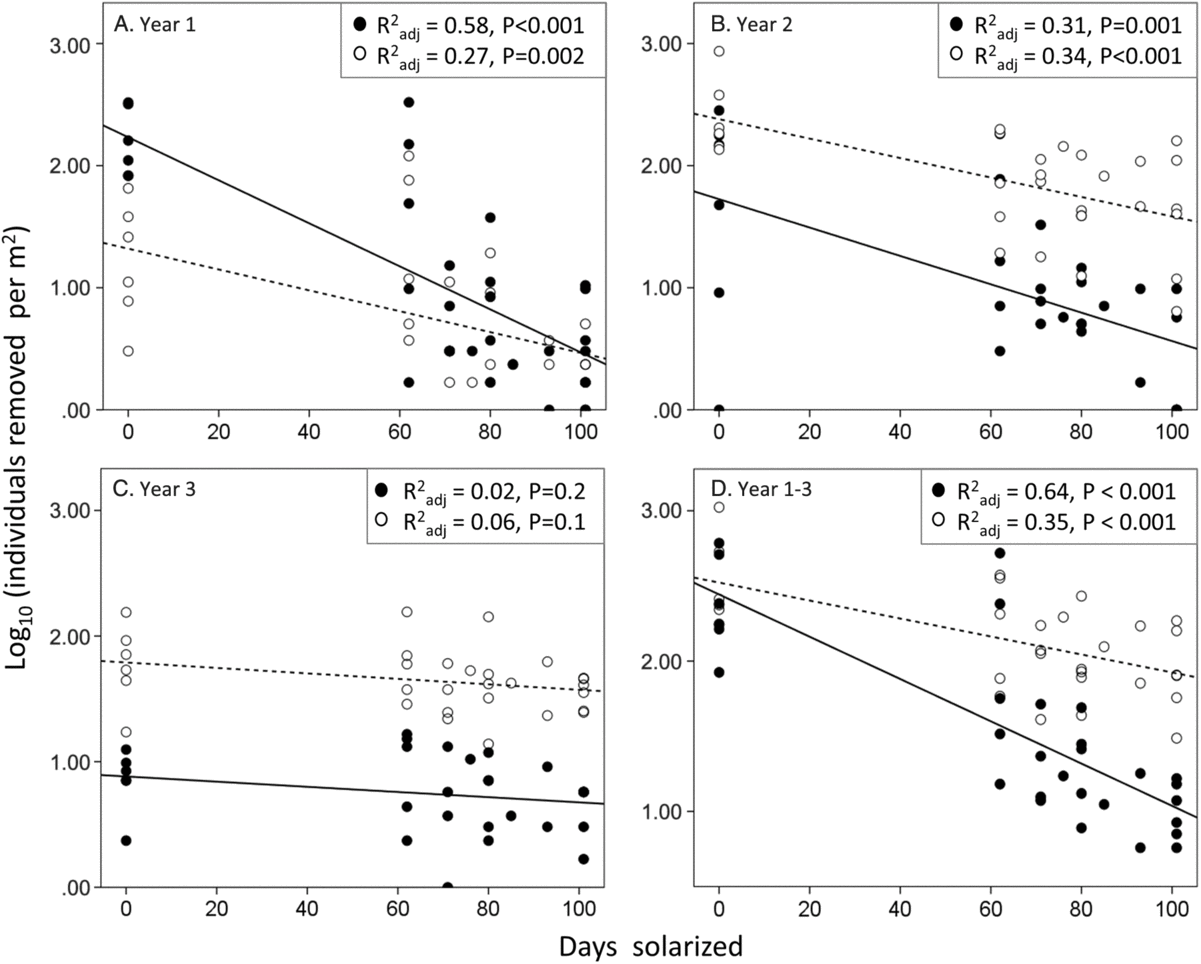
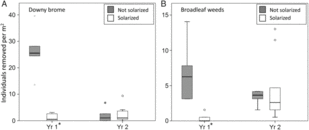
Bromus tectorum germinated in inverse abundance to solarization duration in Year 1 (F(1, 28) = 41.3, P < 0.0005; Figure 1A) and Year 2 (F(1, 28) = 14.2, P < 0.001; Figure 1B); in Year 3 B. tectorum germination was sparse across all treatments, possibly because its seedbank was depleted by then, and no effect of solarization was detectable (F(1, 28) = 1.7, P = 0.2; Figure 1C). Results of the follow-up experiment were similar to the first experiment: fewer B. tectorum emerged in solarized than unsolarized plots in Year 1 (N = 10, 5; Mann-Whitney U < 0.001; P < 0.001), and by Year 2 emergence was so sparse across all plots that there was no longer a difference between solarized and unsolarized treatments (N = 10, 5; Mann-Whitney U = 27; P = 0.86; Figure 2A), likely because most viable seed had germinated and been removed the first year. Together, the two studies were consistent in rejecting the null hypothesis of no effect of solarization on B. tectorum.
Abundance of Bromus tectorum (closed circles, solid line) and broadleaf weeds (open circles, dashed line) in response to different durations of solarization. Abundance is measured as the number of individual plants removed each year from 2012 to 2014, and the total of all years in D. Note log10 scale of y-axis.

(A) Abundance of Bromus tectorum and (B) broadleaf weeds, measured as number of individual plants removed, 1 and 2 yr after treatment in control (dark bars) and solarized (white bars) plots in a follow-up experiment using more durable polyethylene (2013–2014). An asterisk beside “Year” on the x-axis signifies a significant difference (P < 0.001) between solarized and control plots that year. Scale of y-axis differs in A and B.

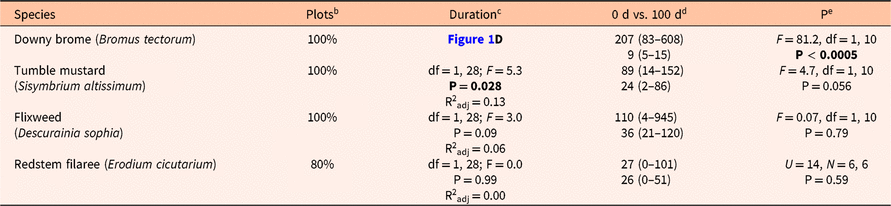
The median number of germinating B. tectorum per quare meter remaining in the seedbank after 100 d of solarization in the first experiment (Table 1) was greater than estimates obtained by extrapolating from soil cores used to subsample solarized plots in California (0 viable seed in 15 of 18 plots; Concilio Reference Concilio2013). However, our results are not comparable to those of Concilio (Reference Concilio2013), because we sampled 100% of plot areas, whereas Concilio’s (Reference Concilio2013) soil cores sampled only 1% of plot areas (99 cm2 of 1 m2), which would have produced a greater chance of missing viable seed present in low densities. Decreases in stem densities after solarization reported by Concilio (Reference Concilio2013) cannot be compared with those of our study, because individual B. tectorum plants produce variable numbers of stems, and we counted individuals, not stems.
Response to solarization of widespread weed species across all 3 yr of the first experiment (2012–2014).a

a All weed species that appeared in >20% of plots are shown. Significant responses are in bold.
b “Plots” is the percentage of the 30 plots where a species germinated.
c “Duration” used linear regression to test whether weed abundance diminished with solarization duration.
d “0 d vs. 100 d” is median (range in parentheses) number of individuals per square meter emerging in 6 controls solarized for 0 d, followed beneath by the 6 plots solarized for >100 d.
e P compares weed emergence between 0 d and >100 d solarized treatments using ANOVA on log-transformed data.
The polyethylene used in the follow-up study remained intact and reusable despite being deployed for two to three times as long as the polyethylene used in the first study. It produced a similar level of control of both B. tectorum and broadleaf weeds, both in terms of reducing weed levels and in terms of failing to eliminate all weeds from the seedbank (Figure 2). Therefore, at least at the elevation and latitude of our site, solarization does not appear to obviate the need for follow-up treatment of B. tectorum, especially because populations can regenerate from small numbers of individuals (Sebastian et al. Reference Sebastian, Nissen, Sebastian and Beck2017). Weed species tested under controlled conditions tend to become 100% inviable at some combination of temperature and exposure duration (Dahlquist et al. Reference Dahlquist, Prather and Stapleton2007). If the same holds for B. tectorum, then there may exist locations at lower latitudes than ours and/or lower elevations than those tested by Concilio (Reference Concilio2013) where higher, if not complete, mortality is achievable using solarization.
Broadleaf Weed Response to Solarization
Broadleaf weeds exhibited both similarities and differences to B. tectorum in their response to solarization. Like B. tectorum, their abundance was inversely related to solarization duration in the first experiment in Year 1 (F(1, 28) = 11.9, P < 0.002) and Year 2 (F(1, 28) = 16.1, P < 0.0005), but not in Year 3 (F(1, 28) = 2.7, P = 0.11; Figure 1). Likewise, in the follow-up experiment, they differed in abundance between the solarized and control plots in Year 1 (N = 10, 5; Mann-Whitney U < 0.0009; P < 0.001) but not Year 2 (N = 10, 5; Mann-Whitney U = 21.5; P = 0.67). Despite these similarities, broadleaf weeds did not respond as strongly to solarization as B. tectorum. Regression R-squared values explaining weed establishment as a function of solarization duration were generally lower for broadleaf weeds than B. tectorum (Figure 1A–D). In the multiple regression analyses, weed taxon was a significant categorical variable in each year (Year 1: P = 0.019; Year 2: P < 0.0005; Year 3: P < 0.0005; Figure 1A–C) and across all 3 yr combined (P < 0.0005; Figure 1D), meaning the slope of the relationship between treatment duration and weed emergence was significantly shallower for broadleaf weeds than B. tectorum (Figure 1D). In California, solarization did not significantly reduce cover of non-target forbs and grasses 1 yr after treatment, although results were trending in that direction, and tests may have lacked statistical power (Concilio Reference Concilio2013).
Broadleaf weeds varied among species in their response to solarization in the first study (Table 1), a pattern seen elsewhere (Bainbridge Reference Bainbridge1990; Clements and Atwood Reference Clements, Atwood and Ali2012; Dahlquist et al. Reference Dahlquist, Prather and Stapleton2007; Elmore Reference Elmore, Katan and DeVay1991; Standifer et al. Reference Standifer, Wilson and Porche-Sorbet1984). Solarization is thought to lose some of its effectiveness against perennial or biennial species (Clements and Atwood Reference Clements, Atwood and Ali2012). Of the broadleaf species in Table 1, tumble mustard (Sisymbrium altissimum L.) and flixweed [Descurainia sophia (L.) Webb ex Prantl] are winter or summer annuals or biennials (University of California, Agriculture and Natural Resources 2016), and redstem filaree [Erodium cicutarium (L.) L’Hér.] is a winter annual or biennial (Altland Reference Altland2018). Most (>90%) of the broadleaf weeds that emerged in the follow-up study also were S. altissimum and D. sophia. Neither species was likely to have entered the plots from outside. Sisymbrium altissimum disperses on the ground (tumbleweed style), and would have been intercepted by the silt fence. Descurainia sophia disperses via water, animals, and wind, but its seeds are 1-mm long, lack an adaptive mechanism for wind dispersal, and are notorious for accumulating in the seedbank (Invasive Species Compendium 2015).
Because of the greater resistance to solarization of broadleaf weeds than B. tectorum, solarization may be less effective against B. tectorum infestations when a variety of weed species inhabit the seedbank. Nevertheless, the overall abundance of broadleaf weeds was lower in solarized plots than in control tilled plots (Figures 1 and 2), and it may be easier to restore a community that has been shifted to relatively low densities of broadleaf weeds than to restore an untreated community dominated by high densities of B. tectorum. In grass communities being restored from seed, germinating broadleaf weeds can be readily distinguished from nascent native grasses, making it possible to identify and remove nonnative competitors before they grow large enough suppress restored species. Removing weeds early is especially important for restoration of B. tectorum–infested habitats, because early establishment often poses a bottleneck for restoration success in the sorts of arid environments dominated by B. tectorum (James et al. Reference James, Svejcar and Rinella2011). In addition, whereas imazapic, the herbicide of choice for B. tectorum, reduces the vigor of native perennial grasses (Kyser et al. Reference Kyser, DiTomaso, Doran, Orloff, Wilson, Lancaster, Lile and Porath2007), broadleaf weeds can be treated with taxon-specific herbicides that do not affect native grasses.
Soil Temperatures
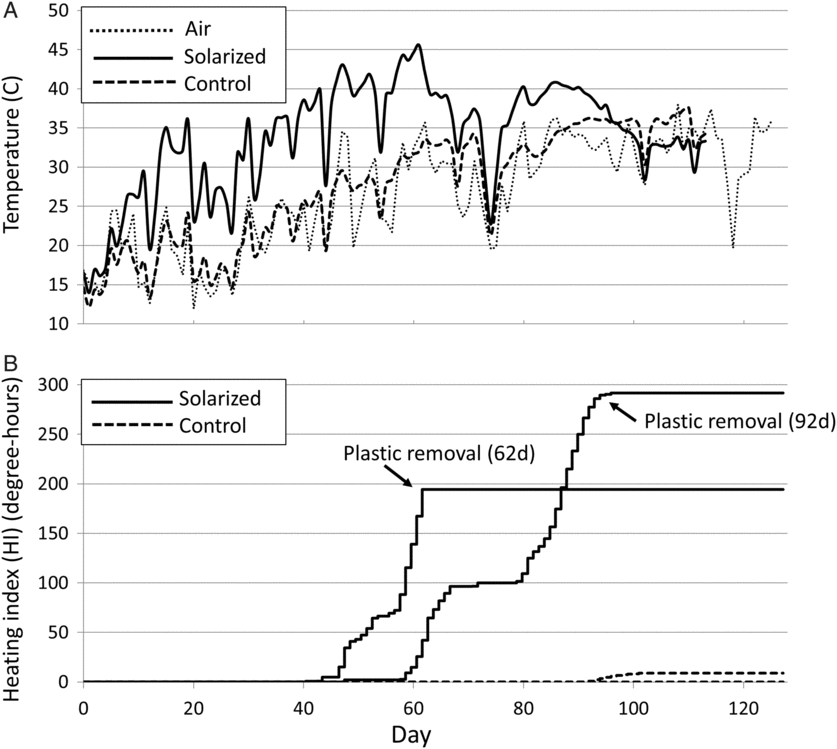
Bainbridge (Reference Bainbridge1990) states that solarization should be effective for ecological restoration with a single layer of plastic, plenty of sun, and average maximum air temperatures of 30 C for at least 6 to 8 wk. Our plots accumulated this threshold (6 wk of air temperatures >30 C) toward the end of treatment (around 90 d; Figure 3), which may help to explain why weed suppression increased over most or all of the treatment duration (Figure 1D). The approximately 10 C difference in temperature between control and solarization treatments (Figure 3A) exceeds differences between solarized and untreated soils in a cooler climate (Schultz Reference Schultz2001) and approximates differences documented in warm climates (Khan et al. Reference Khan, Marwat, Amin, Nawaz, Khan, Khan and Shah2012; Patel et al. Reference Patel, Patel, Patel, Patel, Patel and Bhatt2009). The maximum difference in temperature between our control and solarized plots corresponded with the four highest daily average solar radiation inputs, around 330 W m−2. In hindsight, it would have been informative to have measured soil moisture in addition to temperature, because moisture is important for heat transmission during solarization (Katan and DeVay Reference Katan, DeVay, Katan and DeVay1991).
(A) Daily maximum air temperature (dotted line) and soil temperatures at 5-cm depth averaged for each of 2 solarized plots (solid line) and 2 control plots (dashed line) in the first experiment. (B) Heating index (HI) for control (dashed line) and solarized (solid line) plots in the first experiment.

Solarization’s effectiveness varies by species, soil depth, and climate (Bainbridge Reference Bainbridge1990; Clements and Atwood Reference Clements, Atwood and Ali2012; Elmore Reference Elmore, Katan and DeVay1991; Katan and DeVay Reference Katan, DeVay, Katan and DeVay1991; Standifer et al. Reference Standifer, Wilson and Porche-Sorbet1984). Although solarization is most effective at high temperatures, there are at least three reasons to consider implementing it in the spring, before the hottest days of the year. First, if the site is prepared with a rototiller after B. tectorum starts to grow, stems become tangled in the rototiller and complicate site preparation. Second, solarization requires moisture to transmit heat (Katan and DeVay Reference Katan, DeVay, Katan and DeVay1991), and sites prepared after surface soils lose spring moisture may have desiccated, hydrophobic soil that is difficult to moisten. Third, high seed mortality in various weed species is achieved either by brief exposure to extreme temperatures or by prolonged exposure to more moderate temperatures (Dahlquist et al. Reference Dahlquist, Prather and Stapleton2007); therefore, solarizing earlier may contribute to seed mortality, even if peak temperatures happen later. Soil temperatures in the first experiment peaked at 62 d (Figure 3), but a significant effect of treatment duration was detectable even within the subset of plots solarized for ≥72 d (i.e., excluding 0- and 62-d plots; F(1, 17) = 6.1, R2adj = 0.21, P = 0.025), thus revealing a clear effect of exposure duration past peak temperatures.
Polyethylene should be chosen carefully, especially because it has been reported not only here but also elsewhere to disintegrate during solarization for restoration (Concilio Reference Concilio2013; Moyes et al. Reference Moyes, Witter and Gamon2005; Newton et al. Reference Newton, Nelson, Dewalt, Mikhailova, Post, Schlautman, Cox, Bridges and Hall2008). Whereas the brand of polyethylene used in the first experiment already had begun to fail at 62 d, the brand used in the follow-up experiment remained intact and reusable after being deployed two to three times as long, and it never required repair. One possibility for increasing temperatures that we did not test is to use thinner polyethylene. Greater thickness has been shown to reduce heat differences between control and experimental plots (Patel et al. Reference Patel, Patel, Patel, Patel, Patel and Bhatt2009), although the thinner material used by Patel et al. (Reference Patel, Patel, Patel, Patel, Patel and Bhatt2009) was almost twice as thick as our thicker material. We recommend the thinnest material that will remain reusable after at least one treatment period, and found “4 mil” polyethylene (made by the same manufacturer as the “6 mil” used in the follow-up experiment) to be durable over the course of an entire season, as discussed later. Polyethylene durability is relevant not only to solarization performance but also to environmental contamination (if material disintegrates in situ) and to waste disposal. At present, biodegradable plastics do not raise soil temperatures or control weeds as well as their nonbiodegradable counterparts (Bonanomi et al. Reference Bonanomi, Chiurazzi, Caporaso, Del Sorbo, Moschetti and Felice2008).
The HI reported here provides a general metric for standardizing thermal stress from solarization, because it accounts for both temperature and duration of exposure, and both of these affect mortality (Dahlquist et al. Reference Dahlquist, Prather and Stapleton2007). Although their x-intercepts differed, the slopes for heat index in the two solarized plots were similar (Figure 3). By the time the polyethylene was removed, the plot solarized for 62 d had 22 times the heat accumulation of unsolarized plots, and that of the plot solarized for 92 d was 31 times greater.
Native Plant Establishment
The multiple regression model testing effects of native seed source (VNS, DNS high density, DNS low density) and solarization duration explained a significant proportion of the variation in E. elymoides abundance in Year 2 (F(2, 27) = 12.5, P < 0.0005, R2adj = 0.44) and Year 3 (F(2, 27) = 6.6, P < 0.005, R2adj = 0.28), but not Year 1 (F(2, 27) = 1.7, P = 0.2, R2adj = 0.05). Effects of the categorical variable (seeding treatment) were significant in Year 2 (P < 0.0005) and Year 3 (P < 0.001), indicating differences in E. elymoides establishment between seed sources and/or planting densities. In contrast, however, the regression coefficient for the continuous variable (solarization duration) never approached statistical significance (Year 1 P = 0.41, Year 2 = 0.69, Year 3 = 0.79), indicating no effect of solarization duration on native grass establishment. In California, establishment of native plants from seed was not reported to differ between solarized and control plots, although the results were not presented numerically or analyzed statistically (Concilio Reference Concilio2013).
After poor results with herbicides at our study site, and a desire not to use more chemicals in a sensitive watershed, the Deschutes Land Trust solarized most of the area encompassed by the study plots in the first experiment (0.12 ha) from April 20 to September 13, 2018, using “4 mil” (0.01 mm) polyethylene from Oregon Valley Greenhouses, which was lighter and easier to work with than the “6 mil” (0.015 mm) Oregon Valley Greenhouses polyethylene used in our follow-up experiment and, like the “6 mil”, remained reusable after treatment. The treatment is visible on the July 2018 Google Earth aerial imagery at 44.3230°N, 121.5191°W. The area was planted with a variety of native plants, primarily grasses, with plans to manage weed species surviving solarization. Another portion to the west will be treated in 2019.
This study demonstrates the utility of small-scale test plots for restoration planning (Howe and Martinez-Garza Reference Howe and Martinez-Garza2014), because by the time it was implemented on a large scale, we knew (1) what polyethylene to use, (2) to solarize for as long a duration as possible, (3) to plan for follow-up control of remnant B. tectorum and emerging broadleaf weeds, and (4) that establishment of native plants was unlikely to be jeopardized by the method used to control B. tectorum. Overall, solarization appears to be a small-scale treatment option—although by no means a panacea—for facilitating establishment of restoration plantings in habitat infested by B. tectorum.
Author ORCIDs
Matthew R. Orr 0000-0002-2546-8625.
Acknowledgments
We thank the Deschutes Land Trust for allowing us to conduct research on their property and Seth Ganzhorn and two anonymous reviewers for helping to improve the article. This work was funded by a gift from Tom Montag to the University of Oregon Ecological Restoration and Environmental Education Initiative and by a Gaskins Fund gift to Oregon State University. No conflicts of interest have been declared.