Introduction
With a farm gate value of over $1 billion, fresh-market vegetable production has become a critical component of Georgia’s agricultural economy (Wolfe and Stubbs Reference Wolfe and Stubbs2017). During 2016, vegetables were planted to 166,730 ha of land in Georgia, with over half of those hectares utilizing plasticulture production systems. The crop diversity in these plastic-mulched systems accounts for over 33 high value crops (Wolfe and Stubbs Reference Wolfe and Stubbs2017). Common to all crops produced on mulch is the challenge of managing yellow and purple nutsedge. These weeds are unique in that they can penetrate plastic mulch (Johnson and Mullinix Reference Johnson and Mullinix2002; Webster Reference Webster2005). This characteristic, in conjunction with the ability to effectively reproduce in mulched systems, avoid fumigation by emerging from great depths, and tolerate most vegetable herbicides, consistently places nutsedges among the most common and troublesome weeds of Georgia vegetable production (Van Wychen Reference Van Wychen2016; Webster Reference Webster2005, Reference Webster2010, Reference Webster2014; Webster et al. Reference Webster, Csinos, Johnson, Dowler, Sumner and Fery2001).
Extensive research has been conducted to characterize the ability of nutsedge to compete with many vegetable crops such as cabbage, broccoli, squash, and watermelon (Keeley Reference Keeley1987; Morales-Payan et al. Reference Morales-Payan, Santos, Stall and Bewick1997; Motis et al. Reference Motis, Locascio, Gilreath and Stall2003; Santos et. al Reference Santos, Bewick, Stall and Shilling1997; William and Warren Reference William and Warren1975). Buker et al. (Reference Buker, Stall, Olson and Shilling2003) documented the high sensitivity of watermelon yield to interference by yellow nutsedge. Seeded watermelon yields were reduced 66% to 80% by yellow nutsedge at 37 to 74 plants m−2, with yield losses of 50% to 72% in transplanted watermelon at a yellow nutsedge density of 25 to 100 plants m−2. Investigations into the ability of different squash cultivars to compete with yellow nutsedge noted that severe (200 shoots m−2) infestations reduced yields up to 16% (Stilwell and Sweet Reference Stilwell and Sweet1974), whereas cabbage yields were reduced 35% when competing with dense populations (160 plants per 0.1 m2) of yellow nutsedge (William and Warren Reference William and Warren1975).
To control weeds and other pests in plasticulture systems, most growers fumigate before installing mulch. Due to recent government restrictions on the use of methyl bromide, higher populations of nutsedge penetrating through the plastic mulch have been noted with alternate fumigant systems, increasing the potential for crop loss from weed competition (Culpepper et al. Reference Culpepper, Grey and Webster2006; Locascio et al. Reference Locascio, Gilreath, Dickson, Kucharek, Jones and Noling1997; MacRae and Culpepper Reference MacRae and Culpepper2006; Webster et al. Reference Webster, Csinos, Johnson, Dowler, Sumner and Fery2001). Nutsedge that emerges through the mulch and fumigant system prior to planting could be managed with herbicides applied over the mulch; however, glyphosate and paraquat are the only labeled options that offer any level of control. Research has consistently shown that a single application of either paraquat or glyphosate will not provide lasting control of emerged nutsedge species (Corbett et al. Reference Corbett, Askew, Thomas and Wilcut2004; Pereira et al. Reference Pereira, Crabtree and William1987; Webster Reference Webster2002; Webster et al. Reference Webster, Grey, Davis and Culpepper2008). Once a crop such as broccoli, cabbage, squash, or watermelon is planted, there is no effective herbicide labeled to apply topically for control of nutsedge penetrating through the mulch. Thus, herbicide control options for most vegetable crops are extremely limited in these systems. Further challenging the situation, many growers will produce three to five crops on the mulch before replacement, eliminating the option for tillage for at least 18 to 36 mo following mulch installation.
Most herbicides effective in controlling nutsedge species, such as imazapic and other imidazolinones, cannot be used on sites where vegetables are produced (Majek Reference Majek1988; Richburg et al. Reference Richburg, Wilcut and Wehtje1994; Tickes and Umedak Reference Tickes and Umedak1991). Halosulfuron, a sulfonylurea herbicide, is one exception that provides effective control of nutsedge in crops such as tomato (Solanum lycopersicum L.), cantaloupe (Cucumis melo L.), and cucumber (Cucumis sativus L.) (Anonymous 2017; Haar et al. Reference Haar, Fennimore, McGiffen, Lanini and Bell2002; Johnson and Mullinix Reference Johnson and Mullinix2002; Vencill et al. Reference Vencill, Richburg, Wilcut and Hawf1995; Webster et al. Reference Webster, Culpepper and Johnson2003). However, halosulfuron poses severe risks to many crops such as broccoli or cabbage, where severe crop injury can be expected from foliar or residual uptake (Haar et al. Reference Haar, Fennimore, McGiffen, Lanini and Bell2002). Residual uptake is not of concern with squash and watermelon, but foliar contact can cause considerable yield losses (Anonymous 2017; Dittmar et al. Reference Dittmar, Monks, Schultheis and Jennings2008; Starke et al. Reference Starke, Monks, Mitchem and MacRae2006; Webster et al. Reference Webster, Culpepper and Johnson2003). The development of plasticulture production practices that allow the use of halosulfuron to control nutsedge, without injury to sensitive crops, would be immensely beneficial to producers.
One potential approach might be applying halosulfuron on top of mulched beds to control emerged nutsedge and then waiting an appropriate interval before planting, allowing the herbicide to degrade or be removed from the mulch by rainfall and/or overhead irrigation. Research by Grey et al. (Reference Grey, Vencill, Webster and Culpepper2009) documented the ability of halosulfuron to remain on the plastic mulch. However, it is unknown how long halosulfuron remains on the mulch, the amount of rain or overhead irrigation needed to remove the herbicide from the mulch, and what time interval should be observed between application and planting to avoid vulnerability of a sensitive crop. Thus, an experiment was conducted to determine the impact of halosulfuron applied over plastic mulch up to 21 d prior to transplanting, using two crops sensitive to both foliar and residual uptake (broccoli and cabbage), one crop moderately sensitive to foliar uptake (squash), and one crop with a low level of sensitivity to foliar uptake (watermelon) (Haar et al. Reference Haar, Fennimore, McGiffen, Lanini and Bell2002; MacRae et al. Reference MacRae, Culpepper, Batts and Lewis2008; Starke et al. Reference Starke, Monks, Mitchem and MacRae2006; Webster et al. Reference Webster, Culpepper and Johnson2003).
Materials and Methods
Site Selection and Experiment Establishment
Nine field experiments were conducted at the Ponder research farm (31.30’18°N, 83.39’03°W, elevation 109 m) in Ty Ty, GA, from the spring of 2013 through the fall of 2016 to determine if applying halosulfuron over plastic mulch prior to transplanting broccoli, cabbage, squash, and watermelon could be safely accomplished. Study crops, cultivars, and planting dates are shown in Table 1. Soils at the site consisted of a Tifton loamy sand (Fine-loamy, kaolinitic, thermic Plinthic Kandiudults) with 89% to 90% sand, 8% to 10% silt, 2% clay, and 0.6% to 0.7% organic matter, with a pH of 5.5 to 6.3. Soil within the experimental area was tilled to remove all plant debris, and within 2 wk, raised beds (0.9 m wide, 15 cm tall) were formed using a combination bedder shaper and plastic mulch layer (Kennco Manufacturing Inc., Ruskin, FL). Because weed control was not an objective of the experiment, broad-spectrum fumigation was implemented across the entire study so as to remove the confounding effects of weed presence. As the beds were formed, the area under the mulch was treated with 1,3-dichloropropene at 110 kg ha−1 plus chloropicrin at 179 kg ha−1 (TriCal Inc., Hollister, CA). These fumigants, standard in the production of the crops observed in the experiment, were injected 20 cm below the surface of the bed top using three evenly spaced knives. Within moments of (1) injecting metam sodium at 358 kg ha−1 (Amvac, Los Angeles, CA) 10 cm deep using eight knives spaced evenly across the bed and (2) laying drip tape in the center of each bed 2.5 cm below the surface, the raised bed was covered with low-density polyethylene mulch (Guardian Agro Plastics, Tampa, FL).
Broccoli, cabbage, squash, and watermelon cultivar and planting date for each of nine field experiments.a

a Broccoli, cabbage, squash, and watermelon studies were conducted at the Ponder research farm in Ty Ty, GA from 2013 through 2016.
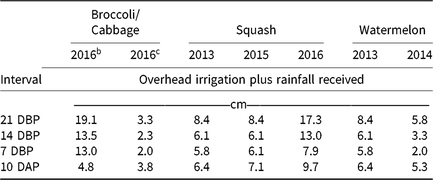
Herbicide treatments were initiated following fumigation and mulch installation. Experimental design was a randomized complete block including four replications, with halosulfuron applied at 80 g ai ha−1 21, 14, 7, and 1 d before planting (DBP) and 160 g ai ha−1 applied 21 DBP. A nontreated control was included for comparisons. All herbicide treatments included a nonionic surfactant (0.25% v/v). Halosulfuron rates used represent two and four times greater than potential labeled use rates to ensure adequate crop safety in large acreage, high-value commercial settings. Treatments were made using a CO2-pressurized backpack sprayer equipped with 11002 Teejet air induction nozzles or 110015 Turbo Teejet air induction, wide-angle spray nozzles (Teejet Technologies, Wheaton, IL), delivering 140 L ha−1 at 165 kPa. Applications were made over the top of the plastic mulch before punching transplant holes. At planting, transplant holes were formed in the plastic mulch and soil using a transplant hole punch wheel (Kennco Manufacturing, Inc., Ruskin, FL) for each crop being transplanted. For broccoli, cabbage, and squash, holes were 30 cm apart in a single row, whereas holes for watermelon transplants were formed in a single row spaced 76 cm apart. Plot length ranged from 8 m for broccoli, cabbage, and squash to 10 m for watermelon. Overhead irrigation plus rainfall totals, which occurred for each experiment between treatment initiation and planting, are provided in Table 2 (Knox Reference Knox2018). No overhead irrigation or rainfall occurred between halosulfuron applications made 1 DBP and time of planting. Table 2 also provides the amount of rainfall plus overhead irrigation that occurred the first 10 d after planting (DAP). With the exception of weed control, production of each crop included drip irrigation, fertilization, and pest management practices in accordance with university recommendations for the region (Boyhan et al. Reference Boyhan, Granberry and Kelley2014, Reference Boyhan, Granberry and Kelley2017; Coolong et al. Reference Coolong, Sparks and Dutta2016; Granberry et al. Reference Granberry, Kelley and Boyhan2017; Tyson and Harrison Reference Tyson and Harrison2017). The fumigant system provided complete weed control, with the exception of a few nutsedge plants that were hand removed within a week of emergence.
Overhead irrigation plus rainfall received 21, 14, and 7 DBP and from time of planting through 10 DAP for nine broccoli, cabbage, squash, and watermelon field experiments conducted at the Ponder research farm in Ty Ty, GA from 2013 through 2016.a

a Abbrevations: DAP, d after planting; DBP, d before planting.
b Field experiments were conducted during spring 2016.
c Field experiments were conducted during fall 2016.
Data Collection
Visual ratings for crop injury (chlorosis, leaf malformations, stunting, necrosis) were recorded throughout the season. Crop injury ratings were assessed using a 0 (no crop injury) to 100% (complete plant death) scale beginning 7 DAP and continuing weekly until harvest, with greatest injury observed 20 to 21 DAP for all crops. Growth reductions were quantified with plant heights, diameters, or vine runner lengths taken on 10 consecutive plants in each plot, beginning 14 DAP and continuing weekly until harvest for broccoli, cabbage, and squash. For watermelon, in an effort to prevent vine damage, height measurements continued through only fruit set. Broccoli heights were collected by measuring from the soil line to the highest growing point. Squash and cabbage growth reductions were quantified with measurements across the diameter of each plant. Watermelon vine runner lengths were collected by measuring the length of the longest tendril to the center of the growing point. Broccoli and squash were harvested 8 to 18 times until fruiting ceased, and watermelons were harvested once. Number of marketable broccoli, squash, and watermelon produced and their collective weight were collected for each harvest; results as influenced by treatments were identical for both of these variables, and thus only weight is provided as yield. Upon fruit harvest completion, squash and watermelon were subjected to a postharvest, fresh-weight biomass assessment by removing the aboveground plant material and collecting its weight.
Statistical Analysis
Data for injury, height/diameter/vine runner length, yield, and biomass were assessed for normality and subjected to ANOVA using a general linear model (SAS 9.4, SAS Institute, Cary, NC). Significant means were separated using Fisher’s Protected LSD test at a significance level of 0.05. Fixed effects included herbicide treatments (either application rate or timing), year, and the interaction between treatments and year. Replication nested within year was treated as a random effect. Because there were no significant treatment-by-year interactions, data across years were combined within each respective crop. All data, with the exception of injury, were converted to a percent loss or reduction when compared to the nontreated control to simplify discussion across a multitude of vegetable crops.
Results and Discussion
Broccoli and Cabbage
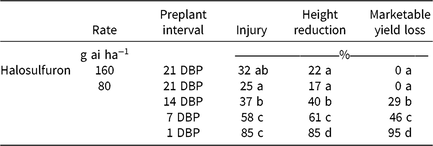
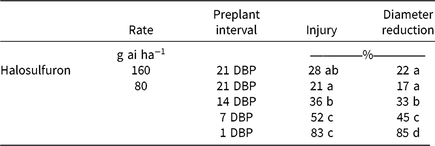
Broccoli and cabbage recorded maximum crop injury 21 DAP, with 36% to 85% injury noted when halosulfuron was applied between 1 and 14 DBP (Tables 3 and 4). Increasing the interval between applications and planting to 21 d reduced injury observed (21% to 32%), but this level of injury is unacceptable in a high-value vegetable crop. Detecting crop injury from applications made 21 DBP further supports research by Grey et al. (Reference Grey, Vencill, Webster and Culpepper2009), demonstrating that halosulfuron remains on the mulch over a substantial amount of time. This research also suggests that halosulfuron is released from the mulch during overhead irrigation or rainfall events and becomes available for foliar uptake from splash or leaf wiping of the mulch, as well as potentially from residual root uptake when the herbicide runs off the mulch into the transplant hole. Of great interest are the varying levels of overhead irrigation and rainfall that occurred during the broccoli and cabbage experiments. Over six times more overhead irrigation plus rainfall occurred at 21, 14, and 7 DBP in the spring when compared to the fall, yet broccoli and cabbage responses were similar across environments (Tables 2, 3, and 4). These results suggest that halosulfuron cannot be removed from the mulch by overhead irrigation and/or rainfall alone. The level of overhead irrigation plus rainfall received the first 10 d following planting were similar at both locations and may be an important influence on crop/herbicide contact.
Broccoli injury, height reduction, and marketable yield loss as influenced by preplant halosulfuron applications made 21, 14, 7, and 1 DBP.a, b

a Abbreviations: DBP, d before planting.
b Data were combined over two field experiments conducted during 2016. Treatment means followed by the same letter are not different according to Fisher’s Protected LSD test at P ≤ 0.05. Height and marketable vegetable weight loss reductions were determined by comparing results from a treatment to the nontreated control. Injury and height reductions were recorded 21 and 40 d after planting, respectively. Marketable vegetable weight losses were recorded as season total.
Cabbage injury and diameter reduction as influenced by preplant halosulfuron applications made 21, 14, 7, and 1 DBP.a, b

a Abbreviations: DBP, d before planting.
b Data combined over two field experiments conducted during 2016. Treatment means followed by the same letter are not different according to Fisher’s Protected LSD test at P ≤ 0.05. Diameter reductions are determined by comparing results from a treatment to the nontreated control. Injury and diameter reductions recorded 21 and 35 d after planting, respectively.
In addition to visual injury, halosulfuron applications affected plant height of broccoli and diameter of cabbage, with maximum differences in growth recorded 35 and 40 DAP (Tables 3 and 4). Halosulfuron at 80 g ha−1 applied 1, 7, or 14 DBP caused growth reductions of 85%, 45% to 61%, and 33% to 40%, respectively. At the same application rate, less impact on growth was noted with a 21-d interval, but reductions of 17% were still observed. Although broccoli was observed to undergo significant crop injury with applications made 21 DBP, no detectable differences were recorded in the total weight of marketable broccoli produced (Table 3). However, a yield reduction of 29% occurred for applications made 14 DBP, with a 95% loss in yield with applications made 1 DBP.
Summer Squash
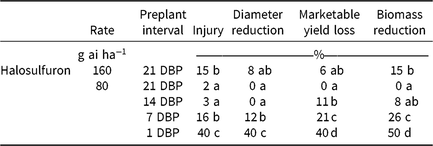
Halosulfuron labels currently allow row-middle applications in summer squash; however, research has shown squash to be more tolerant to halosulfuron than broccoli and cabbage (Anonymous 2017; Webster et al. Reference Webster, Culpepper and Johnson2003). Therefore, less crop injury is expected and was observed when compared to broccoli and cabbage. Squash injury was greatest 20 DAP, and when halosulfuron was applied 21 DBP at 80 g ha−1, injury was only 2%. Applications made 14, 7, and 1 DBP, however, caused visible injury of 3%, 16%, and 40%, respectively (Table 5). Doubling the halosulfuron rate at 21 DBP increased injury to 15%. Similar to the broccoli and cabbage studies, overhead irrigation plus rainfall varied greatly when comparing years within the squash study (Table 2). Nearly twice as much overhead irrigation plus rainfall occurred at 21 and 14 DBP during 2016 as compared to 2015 and 2013; again, overhead irrigation plus rainfall during the first 10 DAP were similar across all 3 yr.
Squash injury, diameter reduction, marketable fruit weight loss, and biomass reduction as influenced by preplant halosulfuron applications made 21, 14, 7, and 1 DBP.a, b

a Abbreviations: DBP, d before planting.
b Data were combined over three field experiments conducted during 2013, 2015, and 2016. Treatment means followed by the same letter are not different according to Fisher’s Protected LSD test at P ≤ 0.05. Diameter, marketable fruit weight loss, and biomass reductions are determined by comparing results from a treatment to the nontreated control. Injury and diameter reductions were recorded 20 d after planting. Marketable fruit weight losses were recorded as season total. Biomass reductions were recorded at harvest.
The greatest reduction in growth of summer squash was recorded 20 DAP. Halosulfuron applied at 80 g ha−1 did not reduce plant diameter at 21 or 14 DBP when compared to the nontreated control (Table 5). Plant diameters were 12% and 40% smaller when applying halosulfuron 7 or 1 DBP, respectively. Values of marketable fruit weight produced and fresh-weight biomass (collected at final harvest) followed similar trends. Only halosulfuron applied at 80 g ha−1 21 DBP did not negatively influence both marketable fruit weight produced and biomass. Marketable fruit weight losses of 11%, 21%, and 40% were noted when halosulfuron was applied 14, 7, and 1 DBP. Marketable fruit loss was not observed from applications of 160 g ha−1 21 DBP, but biomass was reduced 15%.
Watermelon
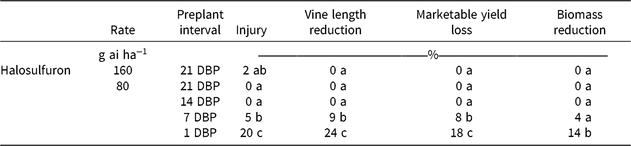
Maximum visual injury and growth reductions of watermelon from halosulfuron, noted 20 DAP, were minimal when compared to broccoli, cabbage, and squash (Tables 3 to 6). In watermelon, applications 21 and 14 DBP did not negatively influence visual crop injury, runner vine length, melon fruit weight, or postharvest plant biomass. Maximum injury was noted with the 1-DBP interval, which caused only 20% visible injury, and a 14% to 24% reduction in runner vine lengths, yield, and biomass. Although halosulfuron is not labeled for topical applications to watermelon, a significant amount of research has shown the crop has tolerance to residual halosulfuron activity as well as a low level of foliar tolerance (MacRae et al. Reference MacRae, Culpepper, Batts and Lewis2008).
Watermelon injury, vine length reduction, marketable yield loss, and biomass reduction as influenced by preplant halosulfuron applications made 21, 14, 7, and 1 DBP.a, b

a Abbreviations: DBP, d before planting.
b Data were combined over two field experiments conducted during 2013 and 2014. Treatment means followed by the same letter are not different according to Fisher’s Protected LSD test at P ≤ 0.05. Vine length, marketable fruit weight loss, and biomass reductions were determined by comparing results from a treatment to the nontreated control. Injury and vine length reductions recorded 20 d after planting. Marketable fruit weight losses were recorded as season total. Biomass reductions were recorded at harvest.
Collectively, crop responses in these field experiments confirm that halosulfuron binds to plastic mulch but remains active as it is slowly released from the mulch during overhead irrigation and/or rainfall events over a significant period of time. Increasing the interval between halosulfuron applications and planting to 21 d reduced injury for broccoli, cabbage, squash, and watermelon. Extending the plant-back interval to 21 d also overcame crop tolerance concerns for squash and watermelon but not for broccoli or cabbage. Thus, halosulfuron applied over mulch preplant to control emerged nutsedge before planting squash and watermelon would be beneficial so long as adequate overhead irrigation and/or rainfall and an appropriate interval between application and planting are implemented. Additional research is needed to confirm that the relationship of halosulfuron and low-density polyethylene mulch is consistent with other mulch types.
Acknowledgments
This research received no specific grant from any funding agency, commercial, or not-for-profit sectors. No conflicts of interest have been declared.