Introduction
The use of opioid analgesics is a growing concern, particularly in the USA where the ‘opioid epidemic’ led to an estimated 52 000 deaths in 2015.Reference Rudd, Seth, David and Scholl1 This ‘opioid epidemic’ has been driven by the over-prescription of opioid analgesics following surgery and subsequent stockpiling, which has the potential for abuse. In the UK, opioid analgesics are widely prescribed following surgery for the management of post-operative pain.
This study aimed to evaluate whether the quantity of opioid analgesics prescribed is justified following rhinological procedures, with a view to estimating the extent to which the over-prescription of opioids exists in a large teaching hospital in the UK. To our knowledge, research into opioid prescribing practices following rhinology surgery has not previously been undertaken in the UK. This research is pertinent as there are no national guidelines surrounding the use of post-operative opioids following rhinology surgery.
Purpose
This study aimed to evaluate whether the quantity of opioid analgesics prescribed is justified following rhinological surgery at a single site teaching hospital in a major UK city.
Materials and methods
Ethical considerations
As this is an audit of practice and did not involve any change in planned care, ethical approval was not required. All patients in our department are routinely contacted by telephone following their surgery to check on their post-operative recovery.
Study population
This was a prospective study carried out over four weeks (November to December 2017) at an ENT centre in a large teaching hospital in the UK. Patients who underwent elective rhinology procedures were identified from the departmental electronic database. The inclusion criteria included patients aged over 18 years old who were undergoing a rhinology procedure under the care of five different consultant surgeons. Patients undergoing surgery in the unit were not prescribed over-the-counter medications such as paracetamol and ibuprofen, but should have been given verbal advice to take them regularly in the post-operative period.
Pain evaluation
The numeric rating scale was used to evaluate post-operative pain. This is a numerical version of a visual analogue scale: the respondent selects a whole number (0–10 integers), with 0 representing no pain and 10 representing extreme pain (i.e. ‘pain as bad as you can imagine’).
Data
Patients were followed up via telephone a median of 7 days post-operatively and assessed using a questionnaire on pain management. Parameters recorded included current pain (determined using the numeric rating scale), the quantity of opioid tablets taken and how many tablets were remaining. We accessed the electronic patient records database to ascertain the type of operation performed and the opioid analgesics prescribed.
Statistical methods
Patient age is presented as age ± standard deviation. The number of tablets taken and current pain are presented as median ± interquartile range.
Results
Population
The study involved 41 patients who underwent rhinological procedures over a four-week period at a teaching hospital. Of the 41 patients, 35 patients were successfully contacted (23 males, 12 females); 6 were either unreachable or declined to comment. The mean patient age was 38.6 years (range, 19–61 years). The median follow-up time was 7 days post-surgery (range, 7–9 days).
Data analysis
Of the 35 patients contacted, 16 patients were prescribed opioids, in the form of dihydrocodeine (30 mg) four times daily, for a duration of 7 days post-operatively, whilst 19 patients were not. The median pain score at 7 days for all 35 patients contacted was 1 (interquartile range, 0–3). The median pain score was 1.5 (interquartile range, 0–4) for those prescribed opioid analgesics and 0 (interquartile range, 0–2) for those not prescribed opioids.
Patients prescribed opioids took a median of 8 (interquartile range, 0.8–10.5) tablets, out of the 28 tablets prescribed. When analysed by procedure (Table 1), there was variation between operations in terms of the median number of tablets taken. For example, turbinate-only surgery patients took a median of 0 tablets, whilst patients having other operations of the internal nose took a median of 13 tablets (interquartile range, 2–24 tablets). Additionally, the percentage of patients not taking simple analgesics (paracetamol and/or ibuprofen) was 31.3 per cent.
Comparison of various rhinological operations

*Simple analgesics refer to paracetamol or ibuprofen. †Other operations of the internal nose included: resection of thickened septum, intranasal antrostomy and vidian neurectomy. IQR = interquartile range; FESS = functional endoscopic sinus surgery
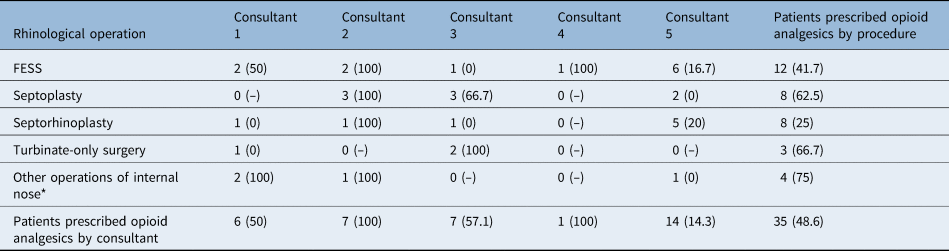
As shown in Table 2, 45.7 per cent of the 35 successfully contacted patients were prescribed opioid analgesics. Consultants 2 and 4 prescribed opioid analgesics to all of their patients. Whilst consultant 4 only saw one of the patients, a variation in prescribing habits was demonstrated by consultants 1, 3 and 5, who prescribed opioid analgesics to 50 per cent, 57.1 per cent and 14.3 per cent of their patients, respectively.
Comparison between rhinology consultants and their opioid prescription practice post-operatively

Data represent the number of patients undergoing each procedure performed by each consultant and the percentage (in parentheses) of patients prescribed opioid analgesics by each consultant, unless indicated otherwise. *Other operations of the internal nose included: resection of thickened septum, intranasal antrostomy and vidian neurectomy. FESS = functional endoscopic sinus surgery
Analysis by procedure (Table 2) shows that 25 per cent of the patients undergoing septorhinoplasty were prescribed opioid analgesics, and this represents the smallest proportion of patients prescribed opioid analgesics by procedure. This is followed by 41.7 per cent of patients undergoing functional endoscopic sinus surgery, 62.5 per cent undergoing septoplasty and 66.7 per cent undergoing turbinate-only surgery. Seventy-five per cent of the patients undergoing other operations of the internal nose were prescribed opioid analgesics.
Discussion
Our study demonstrated that the quantity of opioid analgesics used post-operatively in rhinology surgery did not correlate with the amount required to adequately manage pain in the majority of our patients. The median number of dihydrocodeine tablets remaining at the 7-day follow up was 20. This represents a considerable pool of opioid analgesics in the community, which has the potential to be abused, and could contribute to a potential opioid over-use epidemic.
Our findings are supported by other works in the literature. One study found the mean number of Percocet® (oxycodone and acetaminophen) pills taken in the first 3 days of sinonasal surgery to be 5.1.Reference Becker and Becker2 Ninety per cent of the patients had taken less than half of their prescribed number of Percocet tablets, and approximately 20 per cent had taken zero tablets. This indicated that the amount of post-operative medication prescribed was surplus to requirements, prompting the authors to alter their prescription of post-operative Percocet to a 15-day supply instead of 30.Reference Becker and Becker2
Post-operative pain scores following sinonasal surgery are generally low, with one study reporting a mean pain score of 3.61 out of 10 on day 1 post-operatively, which decreased to 1.72 on day 6 post-operatively.Reference Wise, Wise and DelGaudio3 Similarly, these authors commented that 31 of 63 patients were taking five or fewer hydrocodone-acetaminophen tablets by day 6 post-operatively.
A US study of opioid prescribing practices following functional endoscopic sinus surgery found that 73.1 per cent of patients reported taking none of their prescribed post-operative opioid medication at their first post-operative visit at a median of 8.1 days, and 89.6 per cent of patients reported taking fewer than five tablets.Reference Sethi, Miller, Bartholomew, Lehmann, Bergmark and Sedaghat4 Prescribing practices from this study differed significantly from ours, with 94 per cent of their patients having a prescription for post-operative opioid analgesics, compared to just 45.7 per cent of our patients.
From our study, it also became apparent that patients were not making effective use of simple analgesia, with a third of patients taking their prescribed opioid analgesics before considering paracetamol or ibuprofen. We feel this may be because these medications are no longer prescribed on the National Health Service; hence, patients feel that they are not to be taken. Nevertheless, findings from previous studies suggest that non-opioid analgesics are indeed a very effective option for analgesia following endoscopic sinus surgery.Reference Church, Stewart, O-Lee and Wallace5,Reference Kemppainen, Kokki, Tuomilehto, Seppä and Nuutinen6
Limitations
This study has a number of limitations. Data collection was undertaken at a single site and the study comprised only 35 patients. It is clear that our sample size is relatively small, which affects our ability to detect a difference, as our data may not be sufficiently powered to do so. However, as mentioned in our results, there is a clear trend occurring across all of our datasets highlighting that opioid analgesia prescriptions need to be reviewed. Furthermore, we concede that the small number of patients we surveyed may not be representative of the larger population.
We did question patients as to whether or not alternative simple analgesics were being used; however, we did not specifically document parameters such as dosage and length of time taken for. In retrospect, this would have been important to know, as it could have altered pain scores.
• At 7 days after rhinology surgery, the median average pain score was 1 on a 10-point Likert scale
• Thirty-one per cent of patients did not use simple analgesics (paracetamol and ibuprofen) prior to opioid analgesics for pain relief
• Patients took a median of 8 out of the total 28 dihydrocodeine (30 mg) tablets prescribed
• A surplus of opioid analgesics in the community has the potential to be abused
• The quantity of post-operative opioid analgesics prescribed does not correlate with the amount required for pain management
• This study will form part of a quality improvement project aiming to improve post-operative pain management following rhinological surgery
Conclusion
Given our findings and those reported in the literature, it is apparent that post-operative pain for rhinology patients is generally low; it does not necessitate the use of potentially dangerous opioid medication, and can instead be managed with simple analgesics. Based on these findings, we feel it appropriate to consider reducing the opioid analgesia prescription following rhinological procedures, from a 7-day to a 3-day supply. Furthermore, we plan to issue patient information leaflets that encourage the regular use of paracetamol and/or ibuprofen as first-line medication for pain management. We also plan to re-audit our prescribing practices and assess patient outcomes following this intervention as part of a quality improvement project.
Additionally, it was evident that there was no uniformity in prescribing practice (Table 2). This reflects a need for guidelines and an evidence-based approach to post-operative prescription in rhinology. However, it is important to consider those patients who may have higher analgesia requirements post-operatively, for whom opioid medication may be necessary. Identifying these patients remains a challenge, and requires further investigation to identify operative and patient factors that may predict higher post-operative analgesia requirements.
Competing interests
None declared