Introduction
Older adults are more likely to have an anxiety disorder compared to any other type of psychological disorder (Gum et al., Reference Gum, King-Kallimanis and Kohn2009). At any given point of time, approximately 10% of older adults have an anxiety disorder diagnosis (Ayers et al., Reference Ayers, Sorrell, Thorp and Wetherell2007). While prevalence of anxiety disorders is significantly lower (i.e. one-third the rate) among older adults compared to adults between ages 18 years and 44 years (Gum et al., Reference Gum, King-Kallimanis and Kohn2009), rates of anxiety disorders are particularly high among older adults with dementia. Approximately 5% to 21% of adults with dementia have an anxiety disorder (Seignourel et al., Reference Seignourel, Kunik, Snow, Wilson and Stanley2008), and between 8% and 75% experience clinically significant anxiety symptoms, with prevalence varying depending on dementia subtype (e.g. Alzheimer's vs. vascular dementia; Seignoural et al., Reference Seignourel, Kunik, Snow, Wilson and Stanley2008). In general, individuals with vascular dementia have higher prevalence rates of anxiety symptoms compared to individuals with Alzheimer's disease (Seignoural et al., Reference Seignourel, Kunik, Snow, Wilson and Stanley2008). Regardless of type of dementia, clinically significant anxiety is more common among people with dementia than those without dementia (Seignoural et al., Reference Seignourel, Kunik, Snow, Wilson and Stanley2008).
Relatively less is known about anxiety in individuals with MCI compared to individuals with dementia. Limited available data suggest that older adults with MCI are three times more likely to meet criteria for clinically significant anxiety based on a diagnostic questionnaire than non-cognitively impaired older adults (Geda et al., Reference Geda2008). In addition, MCI is associated with chronic high anxiety, as well as recent onset anxiety for those newly diagnosed with MCI (Andreescu et al., Reference Andreescu, Teverovsky, Fu, Hughes, Chang and Ganguli2014). Although additional research is needed to better understand the association between MCI and anxiety, current research suggests that those with MCI are at increased risk for anxiety, which is especially important given that individuals with MCI are also at increased risk for developing dementia (Petersen et al., Reference Petersen, Stevens, Ganguli, Tangalos, Cummings and DeKosky2001).
In the general older adult population, anxiety is associated with serious negative consequences, including greater social and functional impairment, sleep difficulties, and poorer quality of life (Wetherell et al., Reference Wetherell, Le Roux and Gatz2003; Brenes et al., Reference Brenes2005; Diefenbach et al., Reference Diefenbach2003). Moreover, these same negative consequences have been observed among older adults with sub-syndromal levels of anxiety and worry (Wetherell et al., Reference Wetherell, Le Roux and Gatz2003; Diefenbach et al., Reference Diefenbach2003). For individuals with cognitive impairment and dementia, anxiety may be even more burdensome. Consequences such as higher rates of conflict with caregivers, greater physical dependency on caregivers, and increases in stressful life events have been documented (Orrell and Bebbington, Reference Orrell and Bebbington1996). In residential care, higher levels of anxiety are associated with less daytime activity, greater psychological distress, and poorer social functioning, memory, and communication (Hancock et al., Reference Hancock, Woods, Challis and Orrell2006). Furthermore, evidence suggests that clinically significant anxiety symptoms may precipitate accelerated cognitive decline (Beaudreau and O’Hara, Reference Beaudreau and O’Hara2008). Given these negative outcomes, it is crucial to accurately assess for and treat anxiety in individuals with cognitive impairment and dementia to enhance quality of life and dampen the negative effect of anxiety on sleep, cognition, and social and physical functioning. In addition, improved assessment and treatment for anxiety will likely ease conflict with caregivers and possibly alleviate caregiver burden through improvements in individuals’ daily functioning.
Unfortunately, our understanding of anxiety in individuals with cognitive impairment and dementia is limited by a dearth of appropriate measures for this population. Given that many individuals with cognitive impairment and dementia have memory impairment, reliance on traditional self-report measures that probe symptoms over the past week or month is imprudent, at best, as respondents may under-report anxiety symptoms, which would lead to inadequate or potentially no treatment when treatment may in fact be warranted. Moreover, older adults with language-comprehension problems may require proxy reports of anxiety symptoms, if the content of the self-report measure is poorly understood. In response to some of these assessment challenges, Shankar and colleagues (Reference Shankar, Walker, Frost and Orrell1999) created the rating anxiety in dementia scale (RAID), which includes both caregiver and patient ratings of anxiety, designed with the specific aim of assessing anxiety in dementia. Despite evidence supporting the internal consistency and inter-rater reliability of the RAID (Shankar et al., Reference Shankar, Walker, Frost and Orrell1999), several limitations remain. First, the self-report component of the RAID assesses anxiety symptoms over the past two weeks, a time frame over which it would be difficult for individuals with memory impairment to reliably and accurately report (Shankar et al., Reference Shankar, Walker, Frost and Orrell1999). Second, the RAID exhibited only small correlations with other instruments used to measure anxiety in dementia, such as the participant anxiety scale (PAS) and the neuropsychiatric inventory (NPI) (see Gibbons et al., Reference Gibbons, Teri, Logsdon and McCurry2006), suggesting weak evidence for the construct validity of measurements obtained with the RAID. Third, Gibbons and colleagues (Reference Gibbons, Teri, Logsdon and McCurry2006) raised concerns regarding significant overlap in item content between the RAID and the Cornell scale for depression in dementia (CSDD; Alexopolous et al., Reference Alexopoulos, Abrams, Young and Shamoian1988), such that the relation between the RAID and CSDD (r = 0.66) was stronger than the relation between the RAID and clinician-reported anxiety (NPI-Anxiety; r = 0.44), indicating poor convergent validity evidence.
Snow and colleagues (Reference Snow, Cook, Lin, Morgan and Magaziner2012) developed a structured interview format of the RAID (RAID-SI) to standardize administration and scoring of the instrument. In addition, the authors of the RAID-SI provided rules for combining self- and proxy reports, as these rules were not well specified in the original version (Shankar et al., Reference Shankar, Walker, Frost and Orrell1999). The RAID-SI exhibited initial evidence of reliability and validity and correlated as expected with clinician- and self-reported anxiety and depression symptoms, indicating improved convergent and discriminant validity (Snow et al., Reference Snow2012). Despite improvements with the structured interview format, the RAID nevertheless appears to oversample symptoms of worry (25% of items are worry related). Thus, the total score may not represent a balance of content relevant symptoms and may be more sensitive to symptoms of generalized anxiety disorder (Seignourel et al., Reference Seignourel, Kunik, Snow, Wilson and Stanley2008). For example, oversampling worry symptoms could lead to individuals scoring high on the RAID-SI because they endorse greater worry relative to other anxiety symptoms, whereas individuals with comparable levels of anxiety may appear less anxious if they report anxiety symptoms other than worry.
Two additional assessment instruments have anxiety subscales that were designed for use with individuals with cognitive impairment/dementia. These include the behavioral pathology in Alzheimer´s disease scale (BEHAVE-AD; Reisberg et al., Reference Reisberg, Auer and Monteiro1996) and the neuropsychiatric inventory (NPI; Cummings et al., Reference Cummings, Mega, Gray, Rosenberg-Thompson, Carusi and Gornbein1994). Unfortunately, as with the RAID, significant limitations to these instruments have been identified (Seignourel et al., Reference Seignourel, Kunik, Snow, Wilson and Stanley2008). The primary weakness associated with each of these assessment instruments is the exclusive reliance on caregiver report. Because anxiety is largely a subjective experience, it is important to assess for and consider subjective experience of anxiety. Although one can argue that individuals with significant cognitive impairment may not be able to accurately report on their internal states (e.g. Bedard et al., Reference Bedard2003), it is important to note that individuals with mild to moderate cognitive impairment can provide useful information on psychiatric symptoms (Snow et al., Reference Snow, Cook, Lin, Morgan and Magaziner2005), supporting the utility of incorporating multiple sources of symptom endorsement.
According to the critical review of research on anxiety in dementia conducted by Seignourel et al. (Reference Seignourel, Kunik, Snow, Wilson and Stanley2008), none of the existing measures of anxiety in dementia are adequate. In addition to the individual limitations outlined previously, a problematic feature associated with all of the existing measures of anxiety in dementia surrounds the time frame. All three of the previously discussed measures inquire about symptoms ranging from the past two weeks (the RAID) to the past month (the NPI). For persons with significant cognitive impairment, it may be impossible to accurately recall symptoms over such lengthy time frames. In addition, there may be some settings or scenarios in which it is difficult to readily locate and/or interview a caregiver who has consistently observed the individual for weeks or a month, suggesting the practical importance of a shorter time frame. Finally, a shorter time frame may allow for an individual to be assessed repeatedly over several days to yield a more accurate pattern of symptoms rather than relying upon a single assessment that requires recall over a longer period of time.
To address the limitations associated with current measures for anxiety in cognitive impairment, we developed a new anxiety assessment instrument for use with a population characterized by varying levels of cognitive impairment: the ACID scales, which contain self-report (ACID-SR) and proxy-report (ACID-PR) versions. Specifically, we attempted to design a measure that included the perspectives of both caregiver and patients that sampled a comprehensive range of anxiety symptoms, and assessed symptoms over a brief time frame.
Methods
Stage 1: development of the ACID scales
The ACID-SR is a participant interview relying entirely on the participant's self-report. The ACID-PR is a structured proxy report of observed indicators of anxiety. Items were derived from a review of the literature on anxiety and cognitive impairment, consultation with experts in geropsychology and geropsychiatry, and a review of existing measures of anxiety that were developed or evaluated for use with older adults (e.g. RAID, Shankar et al., Reference Shankar, Walker, Frost and Orrell1999; structured interview guide for the Hamilton anxiety rating scale, Shear et al., Reference Shear2001; State-Trait Anxiety Inventory, Spielberger, Reference Spielberger, Gorsuch and Lushene1983). In developing the ACID scales, researchers were mindful of recommendations for assessment of anxiety in dementia outlined by Seignourel and colleagues (Reference Seignourel, Kunik, Snow, Wilson and Stanley2008). Specifically, the measures were designed to focus on the full range of anxiety symptoms (i.e. cognitive, behavioral, and somatic), omit items assessing symptoms strongly overlapping with symptoms of cognitive impairment (e.g. difficulty concentrating), and allow for collection of information from multiple sources if needed.
To reduce the impact of memory and recall difficulties, we opted to have the scales focus on the previous 24 hours. Moreover, a simple yes/no format was used for all items to increase item clarity for participants. Specific prompts, utilizing potential examples as cues, were also incorporated for clinicians to use if needed (e.g. “Were you worried when discussing your health in the past 24 hours? When thinking about your health? When receiving treatment such as medications? Have you felt worried that you may have an illness that has not yet been diagnosed?”). The proxy version of the ACID was designed to assess observable signs of anxiety symptoms. For example, “Did the person make anxious verbalizations in the past 24 hours? (e.g. ‘My nerves are shot!’ or ‘I feel jittery/ edgy/ hyped-up/ anxious’).”
Stage 2: initial psychometric validation of the ACID scales
participants
Forty-six LTC residents were recruited from one state-operated and two private LTC facilities. One resident began study measures, and subsequently declined to complete remaining questionnaires. Another resident agreed to allow a proxy informant to complete questionnaires on his behalf, but declined to complete his own measures. Thus, 44 residents completed self-report measures, and proxy informants completed measures on behalf of 45 residents. Proxy informants, who were LTC facility employees, could complete questionnaires on behalf of more than one participant. The present study included 38 unique proxy informants.
ltc residents
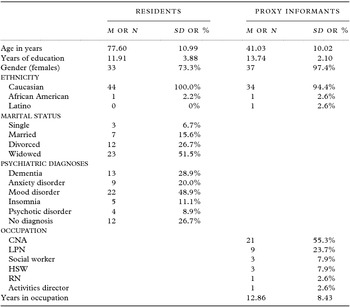
Demographic data were available for 45 residents of LTC facilities aged 60 years and above (M = 77.60, SD = 10.99, range = 60–97). The average participant was female (73.3%), Caucasian (97.8%), widowed (51.5%), and reported an average of 11.91 years of education (SD = 3.88, range 2–21 years). The most common psychiatric diagnosis was a mood disorder (48.9%), followed by dementia (28.9%). Eleven participants (24.4%) had two diagnoses and four (8.9%) participants carried three diagnoses. See Table 1 for additional descriptive data for LTC residents.
Descriptive data for participants and proxy informants

Notes: CNA = certified nursing assistant; LPN = licensed practicing nurse; HSW = health service worker; RN = registered nurse.
proxy informants
Thirty-eight proxy informants participated in the present study. The average proxy informant was female (97.4%), Caucasian (94.8%), and a certified nursing assistant (CNA; 55.3%) with 12.86 years of experience (SD = 8.43). Proxy informants reported a mean age of 41.03 (SD = 10.02, range 20–60), with a mean of 13.74 years of education (SD = 2.10, range 11–18). See Table 1 for additional descriptive data for proxy informants.
Proxy informants were also asked to rate their frequency of contact with the resident over the past 24 hours. Thirty-one (68.9%) informants reported frequent contact with the resident, eight (17.8%) reported occasional contact with the resident, and five (11.1%) reported minimal contact with the resident (one informant did not respond to this item). Finally, the assessor rated each informant regarding his or her level of motivation when answering questions. Twenty-six informants (57.8%) were rated as highly motivated, twelve (26.7%) were rated as moderately motivated, and one (2.2%) was rated as having low motivation; six informants were not rated on this item, likely due to administrator error.
Measures
Demographics Questionnaire
Participants completed a demographics questionnaire. Information regarding age, ethnicity, marital status, years of education, gender, former occupation, and psychiatric diagnoses was assessed via self-report and review of participants’ medical records. Proxy informants also completed a demographics questionnaire assessing age, gender, years of education, ethnicity, occupation, years in occupation, familiarity with the patient, and amount of contact with the patient over the past 24 hours.
anxiety in cognitive impairment and dementia (acid) scales
The ACID-SR and ACID-PR are two clinician-administered interviews assessing anxiety symptoms in people with cognitive impairment and dementia. Symptoms are assessed over a 24-hour time frame. Each interview consists of 13 items assessing for the presence of anxiety symptoms, including: worry, anxiety, exaggerated startle, insomnia, irritability, muscle tension, restlessness, fatigue, cardiovascular symptoms, respiratory symptoms, gastrointestinal symptoms, other somatic symptoms, and avoidance behavior. Most items have sub-descriptors to prompt the participant to consider specific experiences under the broader item domain. For example, under the broad “worry” item, the respondents are cued to consider worry about health, memory or cognitive functioning, friends and family, unusual experiences (e.g. delusional beliefs), and other self-generated worry targets.
The presence of each symptom is assessed in yes/no format. If at least one sub-descriptor in an item is endorsed, distress and interference are assessed (e.g. “Did (symptoms endorsed) bother (you/the person)?”). On the proxy-report interview, the interference prompts also assess whether symptoms increased caregiving burden.
Based on symptoms endorsed and presence of distress and interference, items are scored as 0 (symptoms were absent), 1 (at least one sub-descriptor was endorsed, but no sub-descriptors were associated with distress or interference), or 2 (at least one sub-descriptor was endorsed and was associated with distress and/or impairment). Total scores range from 0 to 26, with higher scores pointing to higher levels of anxiety.
montreal cognitive assessment (moca; Nasreddine et al., Reference Nasreddine2005)
The MoCA is a 30-point screening instrument for cognitive impairment in which higher scores indicate better cognitive functioning (i.e. less cognitive impairment). Items assess recall (immediate and delayed), working memory, executive functioning, visuospatial ability, attention, concentration, language, and orientation. The MoCA has been shown to have good internal consistency in a sample of participants with MCI, Alzheimer's disease, and healthy controls (Cronbach's α = 0.83; Nasreddine et al., Reference Nasreddine2005). Research also shows that the MoCA has good sensitivity and specificity in identifying cognitive impairment, including MCI, among older adults, with scores of 25 or below suggesting MCI or dementia (Nasreddine et al., Reference Nasreddine2005). Cronbach's α coefficient for the current study was 0.75.
geriatric anxiety inventory (gai; Pachana et al., Reference Pachana, Byrne, Siddle, Koloski, Harley and Arnold2007)
The GAI is a 20-item yes/no format self-report measure of anxiety in which higher scores suggest greater levels of anxiety. It was developed specifically for use with community-dwelling older adults and has been shown to have good internal consistency (Cronbach's α = 0.91) and concurrent validity, as evidenced by strong correlations with other measures of anxiety (Pachana et al., Reference Pachana, Byrne, Siddle, Koloski, Harley and Arnold2007). The GAI has been shown to have good internal consistency, along with strong concurrent and discriminant validity, in a sample of community-dwelling older adults (Gould et al., Reference Gould, Segal, Yochim, Pachana, Byrne and Beaudreau2014). Fisher's Exact tests revealed a strong association between GAI scores and scores on another measure of anxiety (Φ = 0.875, p < 0.001, Φ2 = 0.77) in a smaller sample of people with cognitive impairment (Boddice et al., Reference Boddice, Pachana and Byrne2008). Among nursing-home residents, the GAI demonstrates strong internal consistency (Cronbach's α = 0.92), and predictive validity for identifying the presence of an anxiety disorder (OR = 1.24, 95% CI = 1.06–1.44; Gerolimatos et al., Reference Gerolimatos, Gregg and Edelstein2013). In this sample, Cronbach's α was 0.94.
neuropsychiatric inventory – nursing home version, anxiety subscale (npi-nh; Wood et al., Reference Wood2000)
The neuropsychiatric inventory (NPI; Cummings, Reference Cummings1997) is a structured interview which assesses proxy report of symptoms of psychopathology among people with dementia. The NPI assesses disturbances in 12 areas, though only the anxiety subscale was administered in the current study. The total subscale score is determined by multiplying a measure of the frequency of symptoms by the severity of the symptoms; thus, higher scores suggest more severe anxiety. The NPI has demonstrated convergent validity, as evidenced by significant correlations with other measures of depression. It has strong between rater-reliability (93.6% and 100% concordance between raters across subscales) and test–retest reliability (r = 0.79 and 0.86 for the frequency and severity of symptoms, respectively; Cummings, Reference Cummings1997). The NPI-NH utilizes the same questions as the NPI, but an item assessing caregiver distress (which is not factored into total NPI score) reflects occupational disruption on the NPI-NH. Cronbach's α was 0.66 in the present study.
cornell scale for depression in dementia (csdd; Alexopoulos et al., Reference Alexopoulos, Abrams, Young and Shamoian1988)
The CSDD is a 19-item clinician-administered interview with both participant (CSDD-Person) and proxy-report (CSDD-Proxy) components. Higher scores on the CSDD suggest significant depressive symptoms. Research has shown the CSDD to have high internal consistency (Cronbach's α = 0.84), sensitivity, and inter-rater reliability (κ = 0.67) among older adults with dementia (Alexopoulos et al., Reference Alexopoulos, Abrams, Young and Shamoian1988). In a sample of frail, nursing-home participants, the CSDD had adequate internal consistency (Cronbach's α = 0.76), but researchers have cautioned that symptoms of dementia, functional disability, and medical illness may confound scores (Kurlowicz et al., Reference Kurlowicz, Evans, Strumpf and Maislin2002). Internal consistency was good in the present study (Cronbach's α = 0.83 for both person and proxy interviews).
short-form health survey, 12-item version (sf-12; Ware et al., Reference Ware, Kosinski and Keller1996)
The SF-12 is a 12-item assessment of health status. It is comprised of physical component (PCS) and mental component (MCS) subscores. Higher scores indicate greater physical and mental well-being. Among older adults, the SF-12 is reliable (Cronbach's α = 0.79 and 0.89), and evidence of convergent validity (as shown by significant correlation with a number of physical and mental health conditions) has been observed (Resnick and Nahm, Reference Resnick and Nahm2001). The SF-12 was derived from a longer version, the SF-36 (Ware and Sherbourne, Reference Ware and Sherbourne1992). Researchers have examined the SF-36 in a sample with cognitive impairment and found it to be an adequate measure of health-related quality of life for people with mild to moderate cognitive impairment (Novella et al., Reference Novella, Jochum, Ankri, Morrone, Jolly and Blanchard2001). Cronbach's α coefficient for the SF-12 was 0.45, however, internal consistency measurements often underestimate reliability of this measure given its complex scoring algorithm and inconsistent scaling of items (e.g. some items are yes/no, others are Likert-type; see Ware et al., Reference Ware, Kosinski and Keller1998).
world health organization (who) disability assessment schedule 2.0 (whodas-2; Ustun et al., Reference Ustun2010)
The WHODAS 2.0 assesses general health status and functioning in seven domains: understanding and communication, getting along with others, self-care, getting around, participation in society, household activities, work/school activities, plus a global rating. The WHODAS 2.0 has good internal consistency across domains (Cronbach's α ranging from 0.77 to 0.98), and it was correlated with another measure of functioning and disability (Garin et al., Reference Garin2010). Higher scores indicate greater impairment in functioning. Internal consistency ranged from 0.04 for life work/school activities to 0.92 for self-care, with an average Cronbach's α coefficient of 0.45 with the current sample.
Procedure
Consent was obtained from all participants who were able to provide consent. For participants who lacked capacity to provide consent, assent was obtained from the participant and consent was obtained from his or her designated decision maker. Consent was obtained from the proxy informants directly. All measures were administered by a member of the research team, who were trained by independently rating a video-taped administration of the measure using actors. Researchers who subsequently joined the research team were trained by practicing with and observing an experienced member of the team. For the first ten interviews with study participants, one member of the team administered the ACID while another team member observed and independently rated that participant's responses to establish inter-rater reliability.
For both participants and proxy informants, the ACID was administered first, followed by the CSDD. The remaining measures were administered in random order across participants. The participants and proxy informants were each given $5 as compensation at the time the surveys were administered. At the completion of the survey, participants were asked to identify a staff member who could answer questions on their behalf, and that person was approached to complete the proxy interview. In cases in which the participant could not identify a person, or the identified person was unavailable, the head nurse was asked to nominate a person who could best answer the questions on behalf of the person.
The proxy interview was obtained on the same day as the participant interview. The total length of time to administer the battery varied. The participant battery ranged from 35 minutes to one hour, with the ACID-SR taking about five to ten minutes to administer. The proxy battery typically required about 10 to 15 minutes, with the ACID-PR requiring about five minutes to administer.
Data analysis
All analyses were completed with IBM SPSS Statistics Premium Grad Pack Version 20.0 (SPSS Inc., an IBM Company, Chicago, IL). Descriptive statistics were calculated to characterize the sample. Inter-rater reliability was calculated using Cohen's κ, and internal consistency was calculated using Cronbach's α. Pearson product–moment correlation analyses were computed to determine convergent and discriminant validity.
Results
Missing data
Data were examined for missing observations. One participant and three proxy informants did not complete their respective versions of the CSDD; these participants were dropped from any analyses involving the CSDD. There were seven missing observations for CSDD-Person and eight observations were rated as “unable to evaluate” on the CSDD-Proxy; these items were imputed to generate a total score. There were no missing observations for the CSDD-Proxy. Two observations were missing on the WHODAS. There were no missing data for the ACID-SR, ACID-PR, GAI, SF-12, MoCA, and NPI-Anxiety subscale. All missing observations were imputed using mean imputation. With so few missing observations, mean imputation is considered an appropriate data replacement strategy (Tabachnick and Fidell, Reference Tabachnick and Fidell2007).
Descriptive data
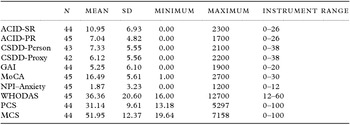
Each item was endorsed by at least one participant. Participants scored, on average, 10.95 (SD = 6.93) on the ACID-SR. Scores ranged from 0 to 23, out of a maximum total of 26. Scores on the ACID-PR were, on average, lower than scores on the ACID-SR, with a mean score of 7.04 (SD = 4.82) and range from 0 to 17. Descriptive data for all of the assessment measures are presented in Table 2. As the ACID is intended to assess anxiety among individuals with cognitive impairment, frequency data on MoCA scores are provided. Only one participant (2.2%) scored in the normal range (score of 26 or higher; Nasreddine et al., Reference Nasreddine2005). This participant was retained for analyses as results did not differ with the inclusion of this individual. Eighteen participants (40.0%) scored 16 or below; 16 was the average score among participants with Alzheimer's disease (see Nasreddine et al., Reference Nasreddine2005), suggesting more substantial cognitive impairment. The remaining 26 participants (57.8%) scored 17 to 25, consistent with more modest cognitive impairment.
Descriptive statistics for study measures

Notes: ACID = anxiety in cognitive impairment and dementia scales, SR = self-report, PR = proxy report; CSDD = Cornell scale for depression in dementia; GAI = geriatric anxiety inventory; MoCA = Montreal cognitive assessment; NPI–Anxiety = neuropsychiatric inventory–Anxiety subscale; WHODAS = world health organization disability assessment scale; PCS = physical component summary of the short-form health surevy-12 (SF-12); MCS = mental component summary of the SF-12.
ACID-SR and ACID-PR scores were weakly associated with one another (r = 0.14). Among participants who scored 16 or below on the MoCA, the ACID-SR and ACID-PR were weakly and negatively associated with one another (r = −0.12). The association between the ACID-SR and ACID-PR for those who scored above 16 on the MoCA was stronger (r = 0.34).
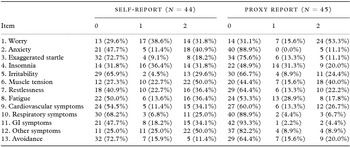
Rates of responses for each item of the ACID-SR and ACID-PR are presented in Table 3. The most commonly endorsed items (rated as either 1 or 2) among participants included other somatic symptoms (75.0%), muscle tension (72.7%), and worry (70.5%). Among proxy informants, the most commonly endorsed items were worry (68.9%), muscle tension (55.6%), and insomnia (51.1%). Participants endorsed each item at a higher frequency than proxy informants, with the exception of avoidance (endorsed by 35.6% of proxy informants, compared to 27.3% of participants). Paired samples t-tests were conducted on mean item scores to determine whether items were differentially endorsed by participants and proxies. Significant differences were found for items 2 (anxiety) t (43) = 4.29, p < 0.01, 7 (restlessness) t (43) = 2.28, p < 0.05, 10 (respiratory symptoms) t (43) = 2.37, p < 0.05, 11 (GI symptoms) t (43) = 4.90, p < 0.01, and 12 (other symptoms) t (43) = 6.20, p < 0.01, such that participants rated each of these items higher than proxy informants.
Rates of responses to each item of the ACID-SR and ACID-PR

Note: A score of 0 indicates that the respondent did not endorse the symptom. A score of 1 indicates that the respondent endorsed the symptom, but that the symptom does not cause distress or interference. A score of 2 indicates that the respondent endorsed the symptom and the symptom causes distress or interference.
Reliability analyses
For the first ten participants and caregivers, inter-rater reliability was calculated for the ACID-SR and ACID-PR items using Cohen's κ. Because we expected inter-rater reliability to be high, a sample size of ten was considered adequate to calculate Cohen's κ, as based on recommendations by Sim and Wright (Reference Sim and Wright2005). For both the ACID-SR and ACID-PR, Cohen's κ coefficient was 1.00.
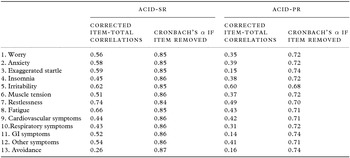
Cronbach's α coefficient for the ACID-SR scale was 0.87. Inter-item correlations ranged from −0.06 to 0.73, with an average inter-item correlation of 0.33 (see Table 4). This average inter-item correlation is considered an indicator of good internal consistency based on the criterion proposed by Clark and Watson (Reference Clark and Watson1995), which suggests an average inter-item correlation between 0.15 and 0.50. Corrected item-total correlations ranged from 0.26 to 0.74 with an average corrected item-total correlation of 0.53. Based on item-total analyses, Cronbach's α was expected to improve slightly (by 0.004) with the removal of item 13 (“avoidance”). The corrected item-total correlation for item 13 was 0.26, which is below the cut-off of 0.30 (Ferketich, Reference Ferketich1991), suggesting this item may be dropped from the scale. However, given that removal of this item would lead to only a slight improvement in Cronbach's α and that some researchers recommend item-total correlations as low as 0.20 (see Streiner and Norman, Reference Streiner and Norman1995), item 13 was consequently retained for analyses.
Corrected item-total correlations for each item of the ACID-SR and ACID-PR

Notes: Cronbach's α is 0.87 for the ACID-SR and 0.73 for the ACID-PR. ACID = anxiety in cognitive impairment and dementia scales, SR = self-report, PR = proxy report.
Cronbach's α coefficient for the ACID-PR scale was 0.73, which is considered adequate for newly developed assessment instruments (Nunnally and Bernstein, Reference Nunnally and Bernstein1994) and those designed to measure relatively broad constructs (Clark and Watson, Reference Clark and Watson1995), as in the present case. Inter-item correlations ranged from −0.19 to 0.53, with an average inter-item correlation of 0.17; this means inter-item correlation is also within the recommended range specified by Clark and Watson (Reference Clark and Watson1995). Corrected item-total correlations ranged from 0.15 to 0.60 with an average corrected item-total correlation of 0.35 (see Table 4). Based on item-total analyses, Cronbach's α was expected to improve by 0.005 with the removal of item 3 (“exaggerated startle”), by 0.003 with the removal of item 11 (“gastrointestinal symptoms”), and by 0.008 with the removal of item 13 (“avoidance”). Corrected item-total correlations were 0.15 for item 3, 0.14 for item 11, and 0.16 for item 13. The corrected item-total correlations for each of these items were below the recommended criterion of 0.20 (Streiner and Norman, Reference Streiner and Norman1995), suggesting these items may be dropped from the scale. Without each of these three items, Cronbach's α coefficient was 0.75. Given the small improvement in Cronbach's αcoefficient as well as the preliminary nature of these psychometric analyses, we decided to retain items 3, 11, and 13 for analyses. The retention of these three items also allows us to more fully capture the range of anxiety symptoms. Because item 13 was problematic for the ACID-PR and marginally problematic for the ACID-SR, analyses were completed with and without this item for both versions. There were no significant differences in results when item 13 was dropped; therefore, this item was retained.
Validity analyses
convergent validity
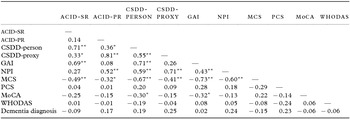
Pearson product–moment correlation analyses were used to examine the relations between ACID-SR scores and scores on measures of anxiety (GAI and NPI-Anxiety), depression (CSDD), and general mental health (MCS) to establish convergent validity. Results are presented in Table 5. Results indicated that ACID-SR scores were strongly associated with GAI scores (r = 0.69) and CSDD-Person scores (r = 0.71), and moderately associated with CSDD-Proxy scores (r = 0.33), NPI-Anxiety scores (r = 0.27), and the mental component summary (MCS) of the SF-12 (r = −0.49).
Pearson product–moment correlation analyses examining convergent and discriminant validities of ACID-SR and ACID-PR

Notes: ACID = anxiety in cognitive impairment and dementia scales, SR = self-report, PR = proxy report; CSDD = Cornell scale for depression in dementia; GAI = geriatric anxiety inventory; NPI = neuropsychiatric inventory–Anxiety subscale; MCS = mental component summary of the SF-12; PCS = physical component summary of the SF-12; MoCA = Montreal cognitive assessment; WHODAS = world health organization disability assessment scale; dementia diagnosis: 0 = no dementia diagnosis, 1 = diagnosed with dementia. **p < 0.01, *p < 0.05.
Similar analyses were conducted examining ACID-PR scores. ACID-PR scores were strongly associated with CSDD-Proxy scores (r = 0.81) and NPI-Anxiety scores (r = 0.52), and moderately associated with CSDD-Person scores (r = 0.36) and the MCS of the SF-12 (r = −0.32). ACID-PR scores were weakly associated with GAI scores (r = 0.08).
discriminant validity
To examine discriminant validity, Pearson product–moment correlation analyses were used to examine the relations between ACID-SR scores and measures of cognitive functioning (MoCA), functional ability (WHODAS), and general physical health (PCS). ACID-SR scores were weakly associated with MoCA scores (r = −0.25). ACID-SR scores were not associated with either the WHODAS (r = 0.01) or the PCS (r = 0.04). Pearson product–moment correlation analyses were also used to examine the relation between ACID-SR scores and whether a person was diagnosed with dementia, which yielded a very weak correlation (r = −0.09). ACID-PR scores were weakly associated with the MoCA (r = −0.15), and were not associated with the WHODAS (r = −0.01) and the PCS (r = 0.01). ACID-PR scores were weakly associated with a dementia diagnosis (r = 0.17). Results of the aforementioned correlation analyses are displayed in Table 5.
Discussion
The measurement of anxiety symptoms among individuals with cognitive impairment is challenged by the dearth of assessment instruments available and the methodological and psychometric limitations of these measures. The present study aimed to address limitations in the literature by developing and examining the psychometric properties of the ACID-SR and ACID-PR, two versions of a new measure of anxiety for older adults with cognitive impairment designed to assess a broad range of anxiety symptoms, collect information from both a self-report and informant perspective, and use a time frame appropriate for a population characterized by cognitive impairment. The results provide preliminary evidence of the reliability and validity of scores obtained on the ACID-SR and ACID-PR. Reliability estimates for the ACID-SR and ACID-PR are quite good, and within the bounds of acceptable values for both coefficient Cronbach's α (Nunnally and Bernstein, Reference Nunnally and Bernstein1994) and average inter-item correlations (Clark and Watson, Reference Clark and Watson1995).
The construct validity of scores obtained with the ACID-SR and PR is demonstrated on the basis of convergent and discriminant evidence. First, the relation between scores on the ACID-SR and GAI is strong which is particularly important as there is extensive psychometric support for the GAI with diverse older adult samples in a variety of settings (e.g. Pachana et al., Reference Pachana, Byrne, Siddle, Koloski, Harley and Arnold2007; Ribeiro et al., Reference Ribeiro, Paúl, Simões and Firmino2011; Gerolimatos et al., Reference Gerolimatos, Gregg and Edelstein2013). The relation between scores on the ACID-SR and NPI-Anxiety is weaker, however, which may be attributable in part to the use of different assessment methods (i.e. self-report and proxy report). One would expect weaker relations when different methods are employed (Campbell and Fiske, Reference Campbell and Fiske1959; Furr and Bacharach, Reference Furr and Bacharach2014). In addition, staff members may have been less aware of cognitive symptoms (e.g. worry), which were indexed by the ACID-SR and NPI. As expected, due to the fact that older adult depression and anxiety share considerable variance (e.g. Segal et al., Reference Segal, Qualls and Smyer2010), the relation between ACID-SR scores and self-reported depression symptoms (i.e. CSDD-Person scores) is quite strong, which was similar to findings with the RAID. Unlike the RAID, whose total score was a combination of self- and proxy report, the same method (i.e. self-report) was used with both the CSDD-Person and ACID-SR, which may explain the strong association in the current study. The relation between ACID-SR scores and proxy ratings of depression were somewhat weaker than those obtained with the CSDD-Person, as would be expected due to the different methods employed. Finally, the SF-12 MCS and the ACID-SR were moderately correlated, providing further convergent evidence.
Convergent evidence for the ACID-PR is provided through a strong correlation with both NPI-Anxiety scores and CSDD-Proxy scores (Cohen, Reference Cohen1988). Importantly, correlations between the ACID-PR and NPI-Anxiety were stronger than that reported for the RAID, which again may be attributable to use of the same method in our study (i.e. proxy report). Although the correlation between ACID-PR and CSDD-Person scores was not as strong as that between the ACID-PR and CSDD-Proxy scores, this is likely in part attributable to the differences in method. In addition, the proxy informants could have been less accurate or discriminating than the residents regarding the nature of the symptoms experienced. Consequently, various symptoms may have been scored as symptoms of depression. Finally, some of the proxy informants could have been biased toward reporting more symptoms of depression due to the common myth that older adults tend to be depressed (Edelstein et al., Reference Edelstein, Bamonti, Gregg, Gerolimatos, Lichtenberg, Mast, Carpenter and Wetherell2015).
In contrast to the ACID-SR, the relation between the ACID-PR and GAI scores is small and non-significant. In addition to the differences in method, the small correlation coefficient could have resulted from the considerable emphasis of the GAI on worry symptoms. Because worry is a cognitive construct, caregivers may not have been keenly sensitive to symptoms of worry. The relation between ACID-PR and SF-12 MCS scores is moderate and significant. This was expected, as the SF-12 MCS has been validated as a measure of general mental well-being and as a screener for depression and anxiety (Gill et al., Reference Gill, Freshman, Blender and Ravina2008).
To further establish validity, discriminant evidence of construct validity was investigated by examining the relations between the ACID-SR and the ACID-PR and measures of cognitive impairment, disability, and physical health. As the ACID scales were developed to measure anxiety among older adults with cognitive impairment, it was important to demonstrate that these scales were not strongly related to measures of cognitive impairment. Scores on the ACID-SR and ACID-PR and the MoCA were not significantly correlated, which provides discriminant evidence for construct validity and supports the goal of having ACID-SR and PR scores largely independent of cognitive impairment. As with cognitive impairment, it was important to demonstrate that scores on the ACID-SR and ACID-PR were not strongly related to measures of physical disability and physical health impairment. The correlations between scores on the ACID-SR and ACID-PR and the WHODAS, a measure of disability, were non-significant, providing further discriminant evidence. The relation between ACID-SR and ACID-PR scores and scores on a measure of physical health impairment (SF-12 PCS) were also examined. There were no significant correlations between the ACID-SR and ACID- PR and the SF-12 PCS, providing additional discriminant evidence for the construct validity of the ACID Scales.
Although the psychometric support for both the ACID-SR and PR is encouraging, the two measures are weakly correlated. The relatively weak correlation obtained between the proxy and self-report versions of the ACID is consistent with what one would expect when multiple methods are used (Campbell and Fiske, Reference Campbell and Fiske1959), and is consistent with other research demonstrating weak correlations between self-report and caregiver report (Towsley et al., Reference Towsley, Neradilek, Snow and Ersek2012). Towsley et al. (Reference Towsley, Neradilek, Snow and Ersek2012) found that nurses in nursing homes reported fewer depressive symptoms among residents as compared to residents’ self-report of depressive symptoms. One reason for this discrepancy, suggested by researchers, is that caregivers may be less aware of mood symptoms and may attribute symptoms of depression as typical of old age rather than depression symptomatology (Edelstein et al., Reference Edelstein, Bamonti, Gregg, Gerolimatos, Lichtenberg, Mast, Carpenter and Wetherell2015). In the present study, residents’ mean ratings of anxiety symptoms were higher than caregivers’ mean ratings of residents’ anxiety symptoms. The lower mean ratings of anxiety symptoms by caregivers may have occurred because caregivers were unable to recognize the level of anxiety experienced by the residents. Caregivers may under-report symptoms when rating non-observable symptoms (Snow et al., Reference Snow2005). For example, caregivers may be more accurate in reporting physical anxiety symptoms (i.e. racing heart, sweating, difficulty breathing) than in reporting cognitive anxiety symptoms (i.e. excessive worries, racing thoughts). In addition, caregivers may underestimate how impairing symptoms may be. As in the Towsley study, caregivers may regard behaviors as typical of aging rather than indicative of anxiety. Nevertheless, the fact remains that individuals with moderate to severe cognitive impairment may be unable to communicate symptoms adequately and provide accurate and reliable reports that also reflect sufficient self-awareness, which is supported by the finding that correlations between the SR and PR were stronger for those with higher MoCA scores than those with lower MoCA scores.
The most commonly endorsed symptoms (rated as either 1 or 2) on the ACID-SR were somatic symptoms, muscle tension, and worry. Interestingly, anxiety was not among the most endorsed symptoms. One can only speculate as to why that occurred. Anxiety is a more general, ill-defined construct that could be viewed as more dynamic than these other symptoms. One could argue that somatic symptoms, muscle tension, and worry are among the clearest or perhaps well-defined symptoms that are difficult to ignore. These may be more easily detected than other symptoms of anxiety.
Differential endorsement of specific symptoms by person versus proxy provides some clues as to why there were differences between SR and PR scores. Comparisons of self and proxy ratings for each item revealed significantly higher ratings by participants for anxiety, restlessness, respiratory symptoms, and GI symptoms. For all of these symptoms, participants may have been better judges of the phenomenological experience of these symptoms in general, and may be more attuned to acute and/or subtle changes in symptoms that may not have been evident by observation alone. This distinction may also help explain why symptoms like exaggerated startle, GI distress, and avoidance were problematic in reliability analyses.
There are several strengths of the present study. First, multiple measures were used to examine convergent and discriminant evidence of construct validity. Second, data were collected from several nursing homes, which increases the generalizability of the findings. Further development and research with this measure could strengthen our knowledge of the relation between anxiety and cognitive impairment. For example, the ACID could be used to identify anxiety symptoms that are common among individuals with cognitive impairment. In addition, with further scale development, including individual item content analysis and item response theory (IRT) analyses, a better understanding of the experience of anxiety among older adults with cognitive impairment may be possible. The ACID-SR and PR also have several strengths and unique characteristics as compared to other anxiety measures for older adults. One strength is the use of self- and proxy reports. The use of a proxy report provides additional information that is particularly important when working with individuals with cognitive impairment. An additional strength is that the ACID-SR and ACID-PR assess the full range of anxiety symptoms.
Though the GAI has strong support in the literature and its scores are correlated with those of the ACID scales, the ACID-SR and PR capture additional elements of anxiety (e.g. somatic, affective, and cognitive symptoms) than the GAI with less emphasis on worry. The ACID-SR and PR also measure anxiety over a shorter time frame (24 hours) as compared to the GAI (2 weeks). A shortened time frame likely enables more accurate and reliable recall among older adults with cognitive impairment.
Although this study has several strengths, there are also limitations. Despite recruiting participants from several nursing homes, the sample was relatively homogenous in regards to gender and ethnicity. In addition, despite attempts to limit the questions on the ACID-SR and ACID-PR, the scales may be too long, and potentially may result in fatigue for participants. Finally, the small sample size potentially limits the reliability of the findings. Additionally, the small sample size precludes the ability to examine differences across the nursing homes. Despite these limitations, the current study provides strong psychometric support for the ACID-SR and ACID-PR.
There are a number of directions for future research. Examination of the psychometric properties of the ACID-SR and ACID-PR in larger and more diverse samples is needed. Furthermore, future research could examine the psychometric properties across nursing homes as an index of generalizability. The time frame for reporting symptoms also could be varied to determine the optimal period for both self- and proxy reports. This is important not only because of the limitations imposed by cognitive impairment, but also in light of the limits of staff recall and age-related changes in recall. In the present version of the ACID scales, we chose a 24-hour period, in part because it represented a full day but, more importantly, because it was more likely to yield reliable ratings for both self- and proxy reports. The psychometric properties of these instruments could also be examined in a sample of patients diagnosed with anxiety disorders, which would be particularly important for exploring cut-off points that may be used to identify participants with symptoms of anxiety sufficient to impair functioning. In addition, a comparison of performance on the ACID scales by a sample of individuals diagnosed with anxiety disorders and another sample diagnosed with dementia would be informative. Shorter versions of the ACID-SR and ACID-PR might be developed, particularly for purposes of screening. This could easily be accomplished, for example, by pruning items that have the weakest inter-item correlations. Clinical prompts also could be shortened to reduce the length and burden of administering the measure. Finally, further research examining the conditions under which one employs one or both versions of the ACID is necessary. If one believes that the individual may have difficulty completing the self-report version of the ACID, an algorithm could be developed to determine when best to use each of these instruments. For example, reading and comprehension skills could first be briefly tested before any psychological assessment is attempted. If reading and comprehension skills are significantly impaired, the ACID-PR can be employed. Similarly, if it appears that the individual has diminished insight into his or her symptoms, the ACID-PR could be employed.
Overall, this study provides initial evidence for the validity and reliability of a new measure of anxiety in older adults. Scores derived from the ACID-SR and ACID-PR demonstrated validity and reliability, which provide clinicians a choice in assessing anxiety symptoms among older adults with cognitive impairment through self, proxy, or combined assessment methods.
Conflict of interest
None.
Description of authors’ roles
L. Gerolimatos designed the study, collected data, conducted analyses, and wrote portions of the paper. C. Ciliberti designed the study, collected data, and wrote portions of the paper. J. Gregg collected data and wrote portions of the paper. S. Nazem designed the study and collected data. P. Bamonti collected data and wrote portions of the paper. C. Cavanagh collected data and wrote portions of the paper. B. Edelstein designed the study, supervised the execution of the study, and wrote portions of the paper.
Acknowledgments
The authors thank Julie Wetherell and Eric Lenze for their thoughtful review of initial item content. We also express appreciation for Carol Goulet, Katie Hackney, Marissa Pifer, Jessica Schwaner, and Joshua Rairigh for their invaluable assistance with data collection.