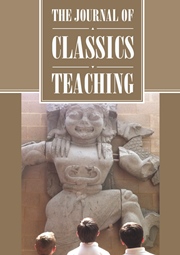


Mary Beard’s Talking Classics is, at its heart, a reflection on teaching: what it means to introduce young minds to the ancient world, and why that endeavour still matters. Drawn from her Berlin Family Lectures in Chicago in 2023 and the 2019 Gifford lecture series in Edinburgh, the book carries a transatlantic flavour in its references and framing, but its concerns are universal to anyone engaged in the classroom. Beard reflects on her own professional journey, from her early days as a fresh Cambridge academic – self-deprecatingly recalling a less-than-thrilling first article proposal – to her position as one of the most recognisable advocates for Classics today.
One of the book’s most compelling threads is its return to origins: not only of ancient civilisations, but of intellectual curiosity itself. A photograph of a youthful Mary, depicted at Wroxeter Roman City, not far from her childhood home, appears on the endpapers: her lengthy professional participation in scene-setting, scene-making, and scene-changing in Classics started, she says, from a chance encounter. Beard recounts her childhood visit to the British Museum, where an accommodating curator allowed her an unusually close encounter with a piece of Egyptian bread. It is a small, almost improbable moment, yet it becomes emblematic of something larger – the sense of thauma, or wonder, that can shape a life. Teachers will recognise this instinctively. The book argues that such moments, often accidental and sometimes slightly transgressive – outside or beyond the curriculum – can have lasting educational impact. They are the sparks that formal curricula cannot always manufacture but should strive to enable. Beard’s career has been spent lighting those sparks in children, teenagers, students and adults, and this book captures that spirit very well.
Beard’s prose is characteristically accessible and even chatty, but it is underpinned by her formidable scholarship. This combination gives the reader an unusual sense of proximity to her thinking: it feels, at times, as though one might step into her role, guiding students through the complexities of antiquity. For teachers, this tone is particularly effective. It models a way of speaking about difficult, sometimes contested material without either oversimplifying it or becoming too abstract.
Several themes recur throughout the book, chief among them the historical exclusivity of Classics. Beard addresses the discipline’s long-standing association with male, upper-middle-class, white privilege, drawing on both personal experience – being the only woman in a Cambridge Classics Faculty of thirty – and broader cultural examples, such as the erasure of sisters Marion and Julia Kennedy, who were responsible for the successful revision of their own father’s original Latin primer, and who made Kennedy’s Latin Primer the go-to grammar book for Latin. It is not a plea for sympathy. Rather, it is an examination of how the field has been shaped, and how it can be reshaped. Particularly striking is her critique of modern political movements that appropriate classical imagery and ideals to support exclusionary or supremacist narratives. Here, we find the contemporary issues of white supremacist borrowing and subversion of classical material to the fore, but also notification that such practices have a long history of their own. What are we to make now of the presence of the fasces on Abraham Lincoln’s throne in his memorial in Washington DC? Perhaps the quandary of what we should think is brought out by her telling of the story of the young Italian art historian Ranuccio Bianchi Bandinelli who found himself in 1938 compelled by Benito Mussolini to give Adolf Hitler a personal guided tour of the recently reconstructed Ara Pacis of that well-known fellow tyrant Augustus Caesar. Beard challenges educators to confront these misuses directly, asking, for example, why what she names ‘The Column Crowd’ (110) is so obsessed with Capitols and capitals. Instead, she goes behind the scenes and shows that there is often more to the eye than the easy headline: Classics to help as much as to harm.
The book is rich in vivid case studies, many of which would translate well into classroom discussion. Beard moves effortlessly between the high and the low: from the gilded statue of Marcus Aurelius to poo-graffiti in Pompeii. No one will be shocked to read that Beard is more interested in the ordinary and the mundane than in the high-flown and the elite. These examples are memorable not just for their novelty but for the questions they provoke. What did ancient audiences make of ambiguous artworks like the Sleeping Hermaphrodite? Was the Venus of Knidos really so sexy that a man wanted to make love to it? How should we interpret semi-comic encounters with figures such as the Emperor Commodus, whose theatrical brutality (wandering off the arena clutching the head of an ostrich he had recently decapitated) blurred the line between performance and power?
Most importantly, Beard resists the temptation to impose modern interpretations too neatly onto the ancient world. She reminds us that Greek and Roman societies operated with assumptions about slavery, gender and citizenship that are deeply uncomfortable to modern sensibilities. They were also uncomfortable for some of the ancients themselves. For teachers, this is an important corrective. The study of Classics, Beard suggests, is not primarily about finding ourselves in the past, but about encountering difference: understanding how others saw their world, even when that world resists our moral frameworks.
This idea is perhaps the book’s most valuable contribution to pedagogy. Beard shifts the emphasis away from monuments and canonical texts towards fragments of lived experience: a graffito scratched on a wall, a passing remark in a speech, or a minor artefact that hints at a larger story. She refutes the idea that the ancient world is some kind of polished narrative of greatness. Instead, she presents it as a mosaic of partial, sometimes contradictory evidence. It is, in her telling, a puzzle which invites students to think critically and also imaginatively. Without imagination, this reader agrees, the ancient world is a dull thing indeed.
In the chapter ‘The case for Classics’, Beard provides a brief discussion of the state of Classics in schools. She notes its historic dominance by elite institutions and expresses concern about declining uptake in schools. Some of her specific claims may be open to challenge (her figure of a mere 5,000 GCSE Latin entrants in 2024 (p.146) seems on the low side to me – the CUCD Bulletin for 2023–2024 says 8,388), and her focus on particular elements of the curriculum (such as Greek accents) may feel a little overplayed given the broader challenges facing the subject. It’s not that girls don’t get to learn Greek accents that is the problem, it’s the reduction in opportunities for learning Greek, full stop. And increasingly for Latin too. Bearing in mind Beard’s admirable even-handedness in the rest of the book, it’s a pity that she did not choose to mention some of the ways that the Classics Community is attempting to address the problem with new forms of examination, the development of better resources, and greater proactivity in the political and media spheres. Nonetheless, the underlying point remains: access to Classics is uneven, and its survival depends on how effectively it can be made relevant and inclusive. Perhaps not just learning about the ancient world, but what to do with that knowledge for the modern might be an answer – as the recent conference Rethinking Assessment in Classical Studies: A Symposium for Educational Practitioners held on 30th April 2026 has suggested.
Overall, Talking Classics is an engaging and thought-provoking work that speaks directly to the general public, and to teachers and also to school students. It is both a defence of the discipline and a practical demonstration of how it can be taught with energy and imagination.
The book is well-illustrated in black and white and helpfully indexed. Beard also provides a useful chapter-by-chapter section on further reading and explanatory notes for those who wish to follow up.
Teachers will find in it not only a wealth of anecdotes and examples, many of which could be adaptable for classroom use, but also a compelling argument for why the ancient world still deserves a place in modern education. Above all, it is a reminder that the goal is not simply to transmit knowledge, but to cultivate curiosity: to open doors, as that museum curator once did for Beard herself, and to allow students to take a step closer to the past in ways that might just shape their future.

 Open access

