1. Introduction
The Triassic Western Qinling Orogen (WQO) is one of the most important gold producing regions in China (Mao et al. Reference Mao, Qiu, Goldfarb, Zhang, Garwin and Ren2002; Zhou, Goldfarb & Phillips, Reference Zhou, Goldfarb and Phillips2002; Zeng et al. Reference Zeng, McCuaig, Hart, Jourdan, Muhling and Bagas2012). During the last three decades, many gold deposits have been discovered in the region, including the giant Yangshan (308 t Au), the world-class Baguamiao and Jinlongshan, the large Liba, Luerba, Zhaishang, Dongbeizhai, Dashui and Ma'anqiao, and numerous small gold deposits. The WQO is a tectonic-magmatic belt with abundant intermediate to felsic plutons (Sun et al. Reference Sun, Li, Chen and Li2002; Zhang et al. Reference Zhang, Zhang, Yan and Wang2005; Zhang, Wang & Wang, Reference Zhang, Wang and Wang2008; Gong et al. Reference Gong, Zhu, Sun, Li and Guo2009; Qin et al. Reference Qin, Lai, Rodney, Diwu, Ju and Li2009, Reference Qin, Lai, Diwu, Ju and Li2010; Jiang et al. Reference Jiang, Jin, Liao, Zhou and Zhao2010; Zhu et al. Reference Zhu, Zhang, Ding, Guo, Wang and Lee2011). The plutons are close to lode (orogenic) gold deposits in the region (Mao et al. Reference Mao, Qiu, Goldfarb, Zhang, Garwin and Ren2002; Chen et al. Reference Chen, Zhang, Zhang, Pirajno and Li2004; Yang et al. Reference Yang, Chen, Zhang, Li, Mao, Liu and Zhao2006; Zhu et al. Reference Zhu, Zhang, Lee, Guo, Gong, Kang and Lü2010). Zhang et al. (Reference Zhang, Yin, Yin, Jin, Wang and Zhao2009) and Yin & Yin (Reference Yin and Yin2009) proposed that these gold deposits should be grouped into the class of granite-related gold deposits (i.e. the gold mineralization is genetically related to the granite), but orogenic gold deposits are proximal to granites throughout the world (e.g. Groves et al. Reference Groves, Goldfarb, Robert and Hart2003; Goldfarb et al. Reference Goldfarb, Baker, Dube, Groves, Hart, Gosselin, Hedenquist, Thompson, Goldfarb and Richards2005; Duuring, Cassidy & Hagemann, Reference Duuring, Cassidy and Hagemann2007).
Feng et al. (Reference Feng, Wang, Wang, Shao and Li2002, Reference Feng, Wang, Wang and Shao2004) and Zhang & Mao (Reference Zhang and Mao2004) proposed that gold metallogenesis in the WQO is associated with magmatic-hydrothermal fluids based on the isotopic data of proposed ore-forming fluids carrying the metal. Other authors argued that the ore-forming fluids are dominated by metamorphic fluids produced by the orogenesis during the Qinling Orogen (Mao et al. Reference Mao, Qiu, Goldfarb, Zhang, Garwin and Ren2002; Chen et al. Reference Chen, Zhang, Zhang, Pirajno and Li2004; Li et al. Reference Li, Chen, Li, Mao, Qin, Guo, Nan and Yang2008; Zhu et al. Reference Zhu, Zhang, Li, Guo, Kang and Lü2009b; Zhou et al. Reference Zhou, Qin, Lin, Wang and Wang2011). Based on geochronological and geochemical studies, it has also been suggested that the granites pre-date, and hence did not contribute to, gold mineralization (Yang et al. Reference Yang, Chen, Zhang, Li, Mao, Liu and Zhao2006; Zhu et al. Reference Zhu, Zhang, Li, Guo, Kang and Lü2009b, Reference Zhu, Zhang, Lee, Guo, Gong, Kang and Lü2010), but it is also known that gold mineralization often follows the solidification of granites (Pirajno & Bagas, Reference Pirajno and Bagas2008).
The Liziyuan goldfield is located near the Jiancaowan Porphyry and Tianzishan Monzogranite along the northern margin of the WQO and is still in the exploration stage with an inferred resource of 30 t Au (Liu et al. Reference Liu, Liu, Gao, Li, Zhuang, Zhang, Zheng and Wei2011; Figs 1, 2). Hence, precise and accurate ages for the plutons can provide useful insights into the relationship between regional tectonic magmatism and gold mineralization in the orogen. In this paper, we present new whole-rock major and trace element geochemistry and in situ zircon U–Pb and Lu–Hf isotopic data for the Tianzishan Monzogranite and Jiancaowan Porphyry.
Regional geological map of the Liziyuan goldfield (modified after Pei et al. Reference Pei, Liu, Ding, Li, Hu, Sun and Hou2006). NCC – North China Craton; SCC – South China Craton; SGT – Songpan-Ganzi Terrane; QB – Qaidam Basin; QT – Qiangtang Terrane; LT – Lhasa Terrane; and QO – Qinling Orogen.

Simplified geological map of the Liziyuan goldfield (modified after Liu et al. Reference Liu, Liu, Gao, Li, Zhuang, Zhang, Zheng and Wei2011).

2. Regional geology
The Qinling Orogen, Qilian Orogen to the west and the Dabie–Sulu Ultra High Pressure (UHP) Zone to the east separate the North and South China cratons in central China (Fig. 1). The suturing of the cratons culminated during the Early Triassic Indosinian Orogeny with the northward subduction of the South China Craton beneath the North China Craton (e.g. Hacker et al. Reference Hacker, Ratschbacher, Webb, Ireland, Walker and Dong1998; Meng & Zhang, Reference Meng and Zhang1999; Zheng et al. Reference Zheng, Griffin, Sun, O'Reilly, Zhang, Zhou, Xiao, Tang and Zhang2010). This collisional event was protracted, starting in the east within the Dabie–Sulu UHP Zone and culminating in the west within the Qinling Orogen in a progressive process event called ‘scissor suturing’ (Zhu et al. Reference Zhu, Yang, Wu, Ma, Huang, Meng and Fang1998; Zhang et al. Reference Zhang, Dong, Lai, Guo, Meng, Liu, Chen, Yao, Zhang, Pei and Li2004; Chen et al. Reference Chen, Lu, Li, Li, Xiang, Zhou and Song2006).
Field studies of the Qinling Orogen have identified suture zones that divide the orogen into the North Qinling Terrane and South Qinling Terrane via the Shangdan Suture (Meng & Zhang, Reference Meng and Zhang1999; Zhang et al. Reference Zhang, Zhang, Yuan and Xiao2001; Dong et al. Reference Dong, Zhang, Neubauer, Liu, Genser and Hauzenberger2011). The South Qinling Terrane is further subdivided into the West and East Qinling domains approximately at the Baoji–Chengdu Railway along the Cenozoic Chengxian–Huixian Basin (Fig. 1; Zhang, Zhang & Dong, Reference Zhang, Zhang and Dong1995; Zhang et al. Reference Zhang, Zhang, Yuan and Xiao2001, Reference Zhang, Jin, Zhang, Harris, Zhou, Hu and Zhang2007; Zheng et al. Reference Zheng, Griffin, Sun, O'Reilly, Zhang, Zhou, Xiao, Tang and Zhang2010). The southern boundary of the Qinling Orogen is also a suture known as the Mianlue Suture that separates the orogen from the South China Craton (Meng & Zhang, Reference Meng and Zhang1999; Zhang et al. Reference Zhang, Zhang, Yuan and Xiao2001; Dong et al. Reference Dong, Zhang, Neubauer, Liu, Genser and Hauzenberger2011).
The Shangdan Suture is interpreted to have formed following subduction of the Shangdan Ocean during Early Silurian time (457–422 Ma; Qiu & Wijbrans, Reference Qiu and Wijbrans2006; Mao et al. Reference Mao, Xie, Bierlein, Qü, Du, Ye, Pirajno, Li, Guo, Li and Yang2008b; Dong et al. Reference Dong, Zhang, Neubauer, Liu, Genser and Hauzenberger2011). The suture is defined by a linear, patchy distribution of arc-related volcanic rocks and ophiolites, which crop out at Yuanyangzhen, Wushan, Guanzizhen, Tangzang, Yanwan, Heihe and Danfeng (Dong et al. Reference Dong, Zhang, Neubauer, Liu, Genser and Hauzenberger2011).
The Mianlue Suture is a younger structure that developed between the South and North China cratons following the northward subduction of the Palaeo-Mianlue Ocean during Late Triassic time between 254 and 220 Ma (Ames, Tilton & Zhou, Reference Ames, Tilton and Zhou1993; Li et al. Reference Li, Sun, Zhang, Chen and Yang1996). Ophiolites in the Mianlue Suture include strongly sheared metabasalt, gabbro, ultramafic rocks and radiolarian cherts (Meng & Zhang, Reference Meng and Zhang2000; Qin et al. Reference Qin, Lai, Rodney, Diwu, Ju and Li2009; Dong et al. Reference Dong, Zhang, Neubauer, Liu, Genser and Hauzenberger2011). The Late Triassic collisional orogenesis is associated with a widespread granitic magmatism and extensive fold-and-thrust deformation throughout the Qinling Orogen (Zhang et al. Reference Zhang, Zhang, Yuan and Xiao2001; Qin et al. Reference Qin, Lai, Rodney, Diwu, Ju and Li2009).
The WQO is bounded by the Linxia–Wushan–Tianshui Fault to the north and the Mianlue Suture to the south (Fig. 1; Zhu et al. Reference Zhu, Zhang, Li, Guo, Kang and Lü2009a, Reference Zhu, Zhang, Ding, Guo, Wang and Lee2011). The domain consists of Devonian–Cretaceous sedimentary units. Faults are well developed in the domain and their overall trend is consistent with regional tectonic trends marking the boundaries of major regional lithologies. The faults are structural sites that control the location of regional magmatism where Late Triassic granites are widespread. The granites comprise a ~ 400 km long granitic belt between the Shangdan and Mianlue sutures, and > 200 plutons crop out in an area totalling ~ 4000 km2 (Zhang et al. Reference Zhang, Yin, Yin, Jin, Wang and Zhao2009; Zhu et al. Reference Zhu, Ding, Yao, Zhang, Song, Qu, Guo and Lee2009a).
3. Geological features of the goldfield
The Liziyuan goldfield (approximately 34°12′31″N, 105°55′36″E) is situated on the northern margin of the WQO and located in Lizi Town, Gansu Province (Fig. 1). The mineralization is part of a cluster of > 30 mineral deposits containing Au, Ag, Cu, Pb, Zn and Mo (Fig. 2). The goldfield consists of five gold-only deposits, including the Jiancaowan, Kuangou, Yingfang, Liushagou and Yuzigou deposits, which are hosted in metavolcanic rocks, and the Suishizi Au–Ag–Pb polymetallic deposit hosted by the Tianzishan Monzogranite (Fig. 2). The metavolcanic host rocks can be subdivided into three formations (Ding et al. Reference Ding, Pei, Li, Hu, Zhao and Guo2004; Pei et al. Reference Pei, Liu, Ding, Li, Hu, Sun and Hou2006). The lower formation is dominated by greenish plagioclase-amphibole schist and biotite-plagioclase-amphibole schist. The overlying formation consists of greenish chlorite-plagioclase-amphibole schist, chlorite schist, chlorite-epidote schist, chlorite-epidote-plagioclase-amphibole schist and minor quartzite. The upper formation consists of light grey ankerite-bearing chlorite-plagioclase-quartz schist and sericite-chlorite-quartz schist, with minor interlayers of quartzite and marble. The orebodies are hosted by the middle and upper formations (Fig. 2).
The unit to the north of the Liziyuan goldfield is the Palaeoproterozoic Qinling Group and the units to the south are metasedimentary units assigned to the Lower Palaeozoic Taiyangsi Formation, Middle Devonian Shujiaba Group, Middle- to Upper Devonian Xihanshui Group and Upper Devonian Dacaotan Group (Fig. 1). The high degree of shear and compression strain imparted on the regional strata during the Early Silurian to Late Triassic subduction- and accretion-related deformation has disrupted the stratigraphic succession, resulting in discontinuous lenticular compositional domains (Fig. 1).
The formation of mineralization in the Liziyuan goldfield strongly involves a component of structural control. The NW-striking Niangniangba–Shujiaba Fault is a second-order fault that splays off the western part of the Shangdan Suture. The second-order structure has third-order faults that extend through the goldfield. Four phases of deformation (D1 to D4) have been recognized in the Liziyuan goldfield. These are: (1) D1 ductile and dextral NW-striking and SW-dipping (235–260°) steep (65–85°) strike-slip faults, rootless folds, and boudinage and S-C structures (Fig. 3a); (2) D2 ductile-brittle NW-striking transtensional faults (Fig. 3b); (3) D3 ductile-brittle thrust faults (that strike 260–285° and dip 45–65°) with compressive-shear structural planes, compressive schistosity, fracture cleavage, drag folding and lesser imbricate fault zones (Fig. 3c); and (4) D4 normal faults that strike northeast with straight fault planes and astatic angular-subangular fault breccia (Fig. 3d).
Photographs of tectonic deformation from the Liziyuan goldfield: (a) metamorphic quartz veins with rootless fold structures formed in D1; (b) ductile-brittle transtensional fault formed in D2 with straight fault plane and astatic angular-subangular fault breccias; (c) thrust fault in Tianzishan Monzogranite formed in D3; and (d) NE-striking normal fault formed in D4 that cuts through auriferous quartz vein.

Although D2 is younger than D1, both deformations may represent a progressive deformation event. The emplacement of the Jiancaowan Porphyry is controlled by these faults. Mineralization is hosted by the D2 transtensional faults that are disrupted by later D3 and D4 structures (Fig. 3d). It is likely the D2 ore-controlling faults provided vital conduits for the migration of ore-forming fluids, because these structures have 50 to 100 mm wide brown alteration zones with weak limonitization and Au grades between 0.4 and 0.9 g/t, which may be the remnants of ore-forming fluids (Kang & Han, Reference Kang and Han2003).
The orebodies in the Liziyuan goldfield form diagonal auriferous vein arrays or massive, lenticular and discrete auriferous quartz veins. These auriferous veins are commonly 13 to 265 m in length extending 10 to 260 m down dip, pinch and swell along strike, and are commonly accompanied by disseminated alteration selvages (Fig. 4). Ore in the goldfield has an average grade of 2.58 g/t Au, 12.70 g/t Ag, < 13.3 wt% Pb and ~ 0.15 wt% Cu (Liu & Ai, Reference Liu and Ai2009).
Geological cross-sections of lines 3 (a) and 32 (b) from the Suishizi Au–Ag–Pb polymetallic mineralized site (after Tianshui team of Gansu Bureau of Nonferrous Metal Geology).

The mineralogy of the auriferous veins is simple including pyrite, chalcopyrite and lesser amounts of galena, freibergite, tetrahedrite and native gold. However, the mineralogy of the Suishizi Au–Ag–Pb deposit is complex, including quartz veining containing about a third in volume of pyrite, galena, chalcopyrite, freibergite, tetrahedrite, zinckenite, argentite, sphalerite and native gold. Apart from quartz, gangue minerals include sericite, carbonate, chlorite, biotite and rutile, and supergene minerals include jarosite, azurite, limonite and malachite. The ore exhibits a subhedral–euhedral granular texture, replacement remnant texture, emulsion texture and cataclastic texture. Massive, veining, veinlet-like and brecciated are the principal structures of the ores. Wall rock alteration includes silication, sericitization, chloritization, epidotization and carbonation. Native gold is common and present in the fractures cutting pyrite and chalcopyrite, and in fractures and vugs in quartz.
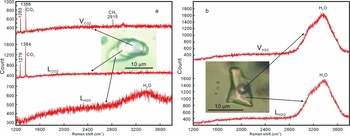
Three types of fluid inclusions were recognized in auriferous quartz veins, including the carbonic, mixed CO2–H2O and aqueous inclusions that are commonly coexistent (Figs 5, 6). Homogenization temperatures and salinities for the aqueous inclusions range from 173 to 453°C and 3.4 to 9.1 wt% NaCl equivalent, respectively (Table 1). The final homogenization temperatures for CO2–H2O inclusions including both vapour and liquid as homogenized species (Thtotal) range from 241 to 354°C (Table 1). The CO2 homogenization (Th, CO2) and clathrate melting temperatures (Tm, cla.) vary from 23.8 to 29.6°C and 6.0 to 8.9°C (Table 1). Salinities of CO2–H2O inclusions estimated according to clathrate melting temperatures range from 2.2 to 7.5 wt% NaCl equiv. (Table 1). In general, the Laser Raman spectroscopy analytical results show that CO2 and H2O are the main volatiles in all the measured inclusions, and some bubbles of CO2–H2O inclusions contains large quantities of CH4 (Fig. 6).
Photomicrographs of fluid inclusion types from gold-bearing quartz veins of the Liziyuan goldfield: (a) isolated two-phase aqueous inclusion; (b) CO2–H2O inclusion coexisting with two-phase aqueous inclusions; and (c) coexisting CO2–H2O and two-phase aqueous inclusions.

(a) Laser Raman spectra of CO2–H2O, and (b) two-phase aqueous inclusions.

Microthermometric data for fluid inclusions from the Liziyuan goldfield

Three samples of quartz from stage II were prepared as 100 μm thick doubly polished sections for fluid inclusion studies. Microthermometric measurements were conducted using a Linkam MDS600 heating–freezing stage at the State Key Laboratory of Geological Processes and Mineral Resources, China University of Geosciences, Wuhan. The heating–freezing rate is generally 0.2–5°C min−1, but reduced to less than 0.2°C min−1 near the phase transformation. The heating–freezing stage was calibrated using the synthetic fluid inclusion standard produced by Fluid Inc. The estimated temperature errors were ± 0.1°C at temperatures below 30°C and ± 1°C at temperatures above 30°C. Salinities of the two-phase aqueous and CO2–H2O inclusions were calculated using the equation of W = 0.00 + 1.78Tice − 0.0442Tice2 + 0.000557Tice3 (Bodnar, Reference Bodnar1993) and W = 15.52022 − 1.02342 Tclm − 0.05286 Tclm2 (Roedder, Reference Roedder and Ribbe1984), respectively.
Compositions of single fluid inclusions were analysed using a Renishaw MK1–1000 Laser Raman probe, also at the State Key Laboratory of Geological Processes and Mineral Resources, China University of Geosciences, Wuhan. The wavelength of Ar+ laser is 514.5 nm and the measured spectrum time is 30 s. Laser power is of 2 to 4 mw for a micrometre size and the size of laser beam spot is 2 μm. The spectrum diagram is taken from the wave band of 1200 to 3800 cm−1.
T-h – final homogenization temperature of fluid inclusion; T-ice – final melting temperature of ice; Tm-CO2 – final melting temperature of solid CO2; Th-CO2 – homogenization temperature of CO2; T-clm – dissolution temperature of CO2.
4. Petrography of the granitic pluton
Granitic plutons in the Liziyuan goldfield include the Tianzishan Monzogranite to the southwest, the Jiancaowan Porphyry in the central part and many dykes including lamprophyre, diorite and andesite throughout the area (Figs 2, 4). All of the mineralization appears to be spatially associated with the Jiancaowan Porphyry. In this study, we focus on the Tianzishan Monzogranite and Jiancaowan Porphyry, which are described below.
4.a. Tianzishan Monzogranite
The Tianzishan Monzogranite crops out over an area of 250 km2 and intrudes metavolcanic rocks on its northern margin and Palaeozoic strata on its southern margin. The Palaeozoic units include the Lower Palaeozoic Taiyangsi Formation, Middle Devonian Shujiaba, Middle- to Upper Devonian Xihanshui Group and Upper Devonian Dacaotan Group (Fig. 1). The northern margin of the monzogranite is intensively sheared and folded. The monzogranite is equigranular, generally massive and consists of plagioclase (35 to 40%), orthoclase (35 to 40%), quartz (20 to 25%) and biotite (2 to 4%), and accessory (2 to 4%) amounts of apatite, allanite, titanite and zircon. Common microtextures, such as undulose extinction of quartz grains and cataclastic plagioclase phenocrysts rotated along the rupture surface, indicate that the monzogranite has been deformed (Fig. 7a, b). E–W-striking foliation and rotated porphyroclasts indicate metamorphism and deformation are intense in the faults cutting the pluton. The Suishizi Au–Ag–Pb polymetallic deposit is predominantly hosted in the monzogranite with mineralization hosted by cataclastic zones that are hydrothermally altered with sulfide-quartz and pyrite-carbonate forming veinlets in fracture planes in quartz and along fractures in plagioclase grains (Fig. 7a, b).
Microphotographs of the Tianzishan Monzogranite and Jiancaowan Porphyry. All microphotographs were taken under polarized light. (a) Tianzishan Monzogranite: quartz with undulose extinction texture and hydrothermal pyrite-carbonate veinlets metasomatized and filled along fracture planes in quartz. (b) Tianzishan Monzogranite: cataclastic plagioclase phenocryst rotated and slipped along the rupture surface; hydrothermal sulphide-quartz and pyrite-carbonate veinlets metasomatized and filled along fractures in plagioclase grains. (c) The Jiancaowan Porphyry has a porphyritic texture; the subhedral-euhedral orthoclase phenocryst was replaced by epidote. Qtz – quartz; Cal – calcite; Pl – plagioclase; Py – pyrite; Ep – epidote; Or – orthoclase.

4.b. Jiancaowan quartz syenite porphyry
The Jiancaowan Porphyry is a quartz syenite covering ~ 200 × 300 m in area that intrudes the middle formation in the metavolcanic rocks described in Section 3 (Fig. 2). The location of the pluton is controlled by the D2 transtensional faults (Fig. 2). Porphyritic quartz syenite dykes also intrude transtensional faults in the Tianzishan Monzogranite and the metavolcanic rocks, providing a possible time relationship between the monzogranite and porphyry (Fig. 4). The Jiancaowan Porphyry is porphyritic with phenocrysts of orthoclase, quartz, biotite and amphibole in a matrix consisting of plagioclase laths and minor anhedral granular quartz, and accessory pyrite, apatite and zircon. Orthoclase phenocrysts have a subhedral–euhedral granular texture with carlsbad twinning and are commonly replaced by epidote (Fig. 7c). Quartz phenocrysts are embayed due to the partial melting of the phenocrysts. The biotite and amphibole are commonly altered to chlorite and epidote, and the plagioclase in the matrix is sericitized. Although the porphyry has minor amounts of pyrite, a few orebodies have been discovered in the pluton (Fig. 4).
5. Sampling and analytical methods
5.a. Major and trace element analyses
Least altered samples from the Tianzishan Monzogranite and Jiancaowan Porphyry were collected for whole-rock major and trace element analyses completed at the State Key Laboratory of Continental Dynamics of Northwest University in Xi'an, China. The samples were powdered to a 200 mesh size using a tungsten carbide ball mill. Major elements were analysed by X-ray fluorescence (XRF) (Rikagu RIX2100), using the BCR-2 and GBW07105 standards at an accuracy of ± 5%. For trace element analysis, sample powders were digested using an HF+HNO3 mixture in high-pressure Teflon bombs at 190°C for 48 hours. Trace elements were analysed using an inductively coupled plasma mass spectrometer (ICP-MS) (Agilent 7500a) produced by Perkin Elmer/SCICX, with Rh and BHVO-1 as reference materials, and the analytical precision was generally better that ± 10%.
5.b. LA-ICP-MS U–Pb dating and Hf isotopic analytical methods
Two samples (TZS-6 and TZS-7) from the Tianzishan Monzogranite and one (JCW-1) from the Jiancaowan Porphyry were chosen for in situ zircon U–Pb dating and Lu–Hf isotopic analyses. Zircons were extracted from the three samples using heavy liquid and magnetic separation methods. The zircons were then mounted in epoxy resin and polished until their interiors were exposed, cleaned and gold-coated for maximum surface conductivity. The interior morphology of the zircons was revealed using cathodoluminescence (CL) images before U–Pb dating using a Neptune multi-collector ICP-MS (MC-ICP-MS) equipped with a 193 nm Excimer laser at the State Key Laboratory of Continental Dynamics of Northwest University in Xi'an, China. The analyses adopted a laser spot size of 30 μm for ablation (Yuan et al. Reference Yuan, Gao, Liu, Li, Günther and Wu2004). During the dating, the Harvard zircon 91500 was used as an external standard to calibrate instrumental bias and isotopic fractionation, 29Si was used as the internal calibrant, and the NIST 610 standard for calibrating U, Th and Pb concentrations in zircons with unknown dates. Although common Pb has a minimal effect on the age results, corrections for common Pb were made using the method of Andersen (Reference Andersen2002). The age calculations and plotting of concordia diagrams were made using the Isoplot (ver. 3.0) program of Ludwig (Reference Ludwig2003). Errors for individual analyses are quoted at the 1σ level; weighted mean ages were calculated at the 2σ level.
In situ zircon Lu–Hf isotopic analyses were also conducted using a Neptune MC-ICP-MS equipped with a 193 nm laser, at the State Key Laboratory of Continental Dynamics. During the analyses, a laser repetition rate of 10 Hz at 100 mJ was used for ablation and laser spot sizes were 44 μm. Interference between 176Lu and 176Hf was eliminated by measuring the intensity of the interference-free 175Lu. The recommended 176Lu/175Lu ratio of 0.02669 (DeBievre & Taylor, Reference DeBievre and Taylor1993) was used to calculate 176Lu/177Hf. Similarly, the isobaric interference of 176Yb on 176Hf was corrected by using a recommended 176Yb/172Yb ratio of 0.5886 (Chu et al. Reference Chu, Taylor, Chavagnac, Nesbitt, Boella, Milton, Germain, Bayon and Burton2002) to calculate 176Hf/177Hf ratios. Zircon 91500 was used as the reference material for calibration and controlling the condition of the analytical instrumentation (Yuan et al. Reference Yuan, Gao, Dai, Zong, Günther, Fontaine, Liu and Diwu2008). During analyses, the 176Hf/177Hf ratios of 91500 and GJ-1 were 0.282307 ± 4 (2σ, n = 30) and 0.282015 ± 2 (2σ, n = 30), respectively, which is compatible with the recommended 176Hf/177Hf ratios of 0.2823075 ± 58 (2σ) for 91500 and 0.282015 ± 19 (2σ) for GJ-1 (Wu et al. Reference Wu, Zheng, Zhao, Gong, Liu and Wu2006; Elhlou et al. Reference Elhlou, Belousova, Griffin, Pearson and O'Reilly2006).
We have adopted a decay constant of 1.867 × 10⁻¹¹ yr−1 for 176Lu (Sǒderlund et al. Reference Sǒderlund, Patchett, Vervoort and Isachsen2004). Initial 176Hf/177Hf ratio (εHf(t)) is calculated relative to the chondritic reservoir with a 176Hf/177Hf ratio of 0.282772 and 176Lu/177Hf of 0.0332 (Blichert-Toft & Albarède, Reference Blichert-Toft and Albarède1997). Single-stage Hf model ages (T DM1) are calculated relative to the depleted mantle with a present-day 176Hf/177Hf ratio of 0.28325 and 176Lu/177Hf of 0.0384, and two-stage Hf model ages (T DM2) are calculated by assuming a mean 176Lu/177Hf value of 0.0093 for the average upper continental crust (Vervoort & Patchett, Reference Vervoort and Patchett1996; Vervoort & Blichert-Toft, Reference Vervoort and Blichert-Toft1999).
6. Analytical results
6.a. Major and trace elements
Major and trace element compositions of the Tianzishan Monzogranite samples are listed in Table 2. The monzogranite has a wide range in chemical composition and most of the samples have higher K2O contents (between 4.33 and 6.84 wt% with an average of 5.39%) than Na2O (between 2.14 and 4.24 wt% with an average of 3.05 wt%). The exception is Sample TZS-1 with Na2O = 7.56 wt%, K2O = 1.46 wt% and Na2O/K2O = 5.18. The Shands Index A/CNK (Al2O3/(CaO + K2O + Na2O)) values vary from 0.66 to 1.22 and indicate that the monzogranite is metaluminous to peraluminous (Fig. 8b). On a SiO2–K2O diagram, the monzogranite plots in the upper right corner of the high-K (calc-alkaline) field (Fig. 8a).
Major and trace element analyses of the Tianzishan Monzogranite and Jiancaowan Porphyry

Mg no. = (molecular MgO/(MgO + Fe2O3) × 100); A/CNK = (molecular Al2O3/(CaO + Na2O + K2O)); A/NK = (molecular Al2O3/(Na2O + K2O)); σ = ((SiO2 − 43)/(Na2O + K2O)); Eu/Eu* = ((Sm)N × (Gd)N)1/2; Chondrite data after McDonough & Sun (Reference McDonough and Sun1995).
SiO2 versus K2O (a) and A/CNK versus A/NK (b) plots for the Tianzishan Monzogranite and Jiancaowan Porphyry. A/CNK – molar ratio of Al2O3/(CaO + Na2O + K2O); A/NK – molar ratio of Al2O3/(Na2O + K2O).

The monzogranite has an enriched light rare earth element (LREE) and depleted heavy rare earth element (HREE) chondrite-normalized pattern (Fig. 9a), with (La/Yb)N between 5.48 and 53.4 (with an average of 24.4) and (Gd/Yb)N between 1.39 and 3.57 (with an average of 2.40). The monzogranite can be distinctly subdivided into two phases, one with positive Eu anomalies (Eu/Eu* = 1.04–1.65) and the other with negative Eu anomalies (Eu/Eu* = 0.58–0.89). Using primitive mantle-normalized spider diagrams, all samples show spikes in Rb, Th, U, K and troughs in Nb, Ta, Ti (Fig. 9b). The samples of the first phase are depleted in Ba and Sr, whereas the other phase is enriched in these elements (Fig. 9b).
(a) Chondrite-normalized REE patterns, and (b) and primitive mantle-normalized trace element patterns for the Tianzishan Monzogranite. Chondrite and primitive mantle data after McDonough & Sun (Reference McDonough and Sun1995).

Assays for the Jiancaowan Porphyry are listed in Table 2. Compared with normal crustal-derived felsic magmas, all samples of the Jiancaowan Porphyry have relatively higher contents of MgO between 0.85 and 2.08 wt% with Mg no. (Mg no. = Mg/(Mg + Fe) × 100) ranging from 43.4 to 58.2. The Jiancaowan Porphyry also has relatively higher Na2O contents of 2.57–4.12 wt%, K2O contents of 2.59–4.89 wt% and Na2O/K2O ratios of 0.53–1.59 (with an average of 1.10). The A/CNK is 0.92–1.08 with an average of 1.00, which indicates that these rocks are metaluminous to weakly peraluminous (Fig. 8b). On a SiO2 versus K2O diagram, most of the samples plot within the high-K (calc-alkaline) field (Fig. 8a).
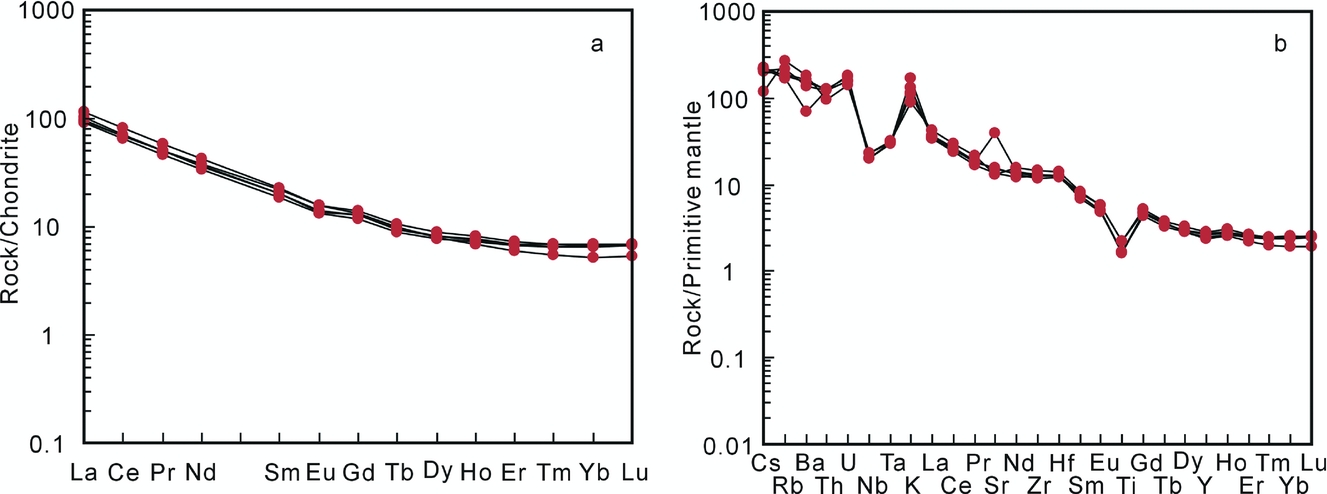
The quartz syenite porphyry samples have (La/Yb)N ratios of 14.1–18.0 (with an average of 15.7), (Gd/Yb)N ratios of 1.82–2.56 (with an average of 2.05) and weakly negative Eu anomalies (Eu/Eu* = 0.85–0.91). Chondrite-normalized REE patterns show that all samples are enriched in LREEs and depleted in HREEs (Fig. 10a). On the primitive mantle-normalized spider diagrams (Fig. 10b), the samples have spikes in Rb, Ba, U, K and Sr, and troughs in Nb, Ta and Ti. Their Nb/Ta ratios (11.7–13.4, with an average of 12.4) are compatible with the upper crust (~ 12, Taylor & Mclennan, Reference Taylor and Mclennan1995). They have Rb and Sr contents of 102–163 ppm and 258–781 ppm, respectively, with Rb/Sr ratios of 0.21–0.47. Compared with normal crustal-derived felsic magmas, they have a relatively high abundance of Cr (20.1–53.2 ppm) and Ni (10.1–33.1 ppm), with Cr/Ni ratios of 1.61–2.01.
(a) Chondrite-normalized REE patterns, and (b) primitive mantle-normalized trace element patterns for the Jiancaowan Porphyry. Chondrite and primitive mantle data after McDonough & Sun (Reference McDonough and Sun1995).
6.b. LA-ICP-MS U–Pb ages
Zircon CL images and U–Pb isotopic results of TZS-6 and TZS-7 sampled from the Tianzishan Monzogranite are presented in Figure 11 and the isotope data are listed in Table 3. Zircons from TZS-6 are euhedral crystals exhibiting oscillatory zoning and range from 100 to 150 μm in size. For TZS-6, a total of 13 analyses were carried out on 13 zircons. They have U contents of 536–2819 ppm and Th contents of 260–1510 ppm with Th/U ratios of 0.36–0.73, suggesting a magmatic origin. The 206Pb–238U ages vary from 250 ± 3 to 264 ± 3 Ma and have a weighted mean age of 260.0 ± 2.1 Ma (MSWD = 1.3, 2σ). Zircons from TZS-7 are mostly between 80 and 150 μm in size and have regular oscillatory magmatic zoning. They have variable U contents of 421–2398 ppm, Th contents of 56.0–806 ppm and Th/U ratios of 0.06–0.83. Ten U–Pb analyses plot in a group on the concordia curve giving a weighted mean 206Pb–238U age of 256.1 ± 3.7 Ma (MSWD = 0.53, 2σ). Therefore, the U–Pb ages of 256.1 ± 3.7 to 260.0 ± 2.1 Ma should be the best estimates for the crystallization age of the Tianzishan Monzogranite.
LA-ICP-MS zircon U–Pb data for the Tianzishan Monzogranite and Jiancaowan Porphyry

CL images and LA-ICP-MS U–Pb zircon concordia diagrams for the Tianzishan Monzogranite; ellipse dimensions are 2σ.

Zircon CL images and U–Pb isotopic results for Sample JCW-1 collected from the Jiancaowan Porphyry are presented in Figure 12 and the isotope data are listed in Table 3. Most zircons from the sample are euhedral, stubby to elongate prisms and range from 50 to 300 μm in size, with oscillatory zoning and core-mantle overgrowth relationships. A total of 29 analyses were carried out on 29 zircons, of which two analyses (34 and 38) gave Palaeoproterozoic 207Pb–206Pb ages of 1701 ± 38 Ma and 1867 ± 39 Ma; four analyses (10, 11, 21 and 35) gave 206Pb–238U ages of 799 ± 3 Ma, 767 ± 11 Ma, 727 ± 9 Ma and 796 ± 10 Ma. These six ages analysed on zircon cores are all concordant, and are interpreted as inherited or xenocrystic zircons. The remaining 23 analyses have contents of 55.0–2076 ppm U and 32.5–641 ppm Th, with Th/U ratios of 0.17–1.43 (indicative of a magmatic origin). The 206Pb–238U ages for the sample vary from 226 ± 3 to 232 ± 4 Ma and yield a weighted mean age of 229.2 ± 1.2 Ma (MSWD = 0.27, 2σ), which is interpreted as the crystallization age for the Jiancaowan Porphyry.
CL images and LA-ICP-MS U–Pb zircon concordia diagram for the Jiancaowan Porphyry; ellipse dimensions are 2σ.

6.c. Zircon Hf isotope compositions
The in situ zircon Hf isotopic data for Sample TZS-6 are shown in Table 4 and Figure 13a, b. Eleven analyses have 176Lu/177Hf ratios of 0.000501–0.001344, and 176Hf/177Hf ratios of 0.282216–0.282470. The calculated ε Hf(t) is between −14.1 and −5.1 (with a weighted mean of −9.3 ± 1.7), and the two-stage Hf model age (T DM2) ranges from 1345 to 1798 Ma (with a weighted mean of 1551 Ma).
LA-ICP-MS zircon Hf isotopic compositions for the Tianzishan Monzogranite and Jiancaowan Porphyry

The in situ zircon Hf isotopic data for Sample JCW-1 are shown in Table 4 and Figure 13c, d. A total of 15 analyses have 176Lu/177Hf ratios of 0.000725–0.002233, and 176Hf/177Hf ratios of 0.281859–0.282489. The calculated ε Hf(t) values vary between −27.5 and −5.2, and its two-stage Hf model age (T DM2) ranges from 1321 Ma to 2448 Ma. Except for the maximum and minimum, the remaining 13 grains vary in a relative narrow range, with 176Hf/177Hf ratios of 0.282043–0.282399, and ε Hf(t) values between −21.0 and −8.4 with a weighted mean of −15.1 ± 3.1. The calculated two-stage Hf model age (T DM2) ranges from 1484 to 2124 Ma with a weighted mean of 1828 Ma. Analyses of the inherited zircon ‘21’ gives a 176Hf/177Hf ratio of 0.282186, an ε Hf(t) value of −6.2 and a T DM2 of 1775 Ma.
7. Discussion
7.a. Petrogenesis of the Tianzishan Monzogranite
The Tianzishan Monzogranite has an unusual REE distribution relative to normal granites (Fig. 9a, b). As mentioned in Section 6.a, some samples have pronounced positive Eu anomalies, but the others have negative Eu anomalies. These features suggest that: (1) fractional crystallization processes took place during the ascent of magma (Wu et al. Reference Wu, Jahn, Wilder, Lo, Yui, Lin, Ge and Sun2003; He et al. Reference He, Li, Hoefs, Huang, Liu and Hou2011); or (2) the differences reflect the function of temperature and oxygen fugacity in natural silicate systems (Weill & Drake, Reference Weill and Drake1973; Drake & Weill, Reference Drake and Weill1975). Generally, the first option would produce strong correlation trends between some elements (Wu et al. Reference Wu, Jahn, Wilder, Lo, Yui, Lin, Ge and Sun2003; He et al. Reference He, Li, Hoefs, Huang, Liu and Hou2011). For the Tianzishan Monzogranite, the positive Eu anomalies and the absence of a correlation between Ba and Sr indicate that fractional crystallization of plagioclase is not significant. Also, there is no clear correlation between the REEs, Eu, Eu/Eu* and P2O5, suggesting that the fractionation of REE-enriched minerals (e.g. monazite and apatite) is negligible. Thus, we conclude that fractional crystallization may not account for the distinct positive Eu anomalies. On the other hand, because Eu2+ is significantly more compatible in plagioclase than Eu3+ (and other REEs), the partition of Eu between plagioclase and magmatic liquid is a function of the ratio of Eu2+ and Eu3+. A model equation shows that decreasing oxygen fugacity and temperature could result in a significantly positive Eu anomaly in natural plagioclase crystals (Weill & Drake, Reference Weill and Drake1973). Therefore, it is most likely that the positive Eu anomaly in the monzogranite may be a result of its low oxygen fugacity and crystallization temperature.
The Tianzishan Monzogranite plots in the upper right corner of the high-K (calc-alkaline) field on the SiO2–K2O diagram (Fig. 8a). Calc-alkaline granites of intermediate to felsic chemistry are usually generated by partial melting of mafic to intermediate igneous sources (Petford & Atherton, Reference Petford and Atherton1996; Petford & Gallagher, Reference Petford and Gallagher2001). However, the Tianzishan Monzogranite has high SiO2, Al2O3 and K2O contents and low MgO and Na2O contents with high K2O/Na2O ratios, which is different from the magmas derived directly from lower crustal mafic rocks that usually have high Na2O (> 4.3 wt%) contents rather than high K2O contents (Rapp & Watson, Reference Rapp and Watson1995). In contrast, the major element compositions of the monzogranite are similar to the melts derived from K-rich metasedimentary rocks in many ways (Patinõ-Douce & Harris, Reference Patinõ-Douce and Harris1998), indicating that the source of the monzogranite might comprise any K- and Al-rich and Ca-poor sedimentary rocks, which is also supported by the low CaO/Na2O and high Al2O3/TiO2 ratios of the monzogranite (Sylvester, Reference Sylvester1998). Thus, the felsic parental magma appears to be the result of the partial melting of mixed protoliths that are composed of mafic igneous and lesser K- and Al-rich and Ca-poor sedimentary sources. The monzogranite shows spikes in Rb, Th, U and K, and troughs in Nb, Ta and Ti, which are common features of the continental crust derived from chemical differentiation of arc-derived magmas (Taylor & Mclennan, Reference Taylor and Mclennan1995). Combined with the fact that the monzogranite has evolved zircon Hf isotopic compositions with ε Hf(t) of −14.1 to −5.1 (Fig. 13a, b) and two-stage Hf model ages (T DM2) of 1345 to 1798 Ma, we argue that the monzogranite is derived from the partial melting of Middle–Late Proterozoic crust that consists of mafic igneous and lesser sedimentary successions.
Zircon Hf isotopic compositions of the Tianzishan Monzogranite TZS-6 (a, b) and Jiancaowan quartz syenite porphyry JCW-1 (c, d). The ε Hf(t) of each zircon was calculated at its U–Pb age.

The Tianzishan Monzogranite has high Sr contents between 196 and 631 ppm, which can be attributed to the melting of a plagioclase-rich source, and the concave-upward REE patterns without significant Eu anomalies (average Eu/Eu* = 1.15) suggest the presence of amphibole restite (Tepper et al. Reference Tepper, Nelson, Bergantz and Irving1993). Furthermore, the depleted HREE patterns, and low Y (2.23–19.6 ppm) and Yb (0.20–2.01 ppm) contents with low Y/Yb (9.75–13.3) and (Ho/Yb)N (1.02–1.30) ratios, indicate that the melt-restite includes garnet and amphibole (Petford & Atherton, Reference Petford and Atherton1996; Moyen, Reference Moyen2009). Experimental studies proved that the garnet-in boundaries are 0.9 to 1.4 GPa corresponding to about ~ 45 km in depth, if the garnet-bearing granulite facies act as melt-restite for partial melting of different source rocks towards the base of a thickened crust (Vielzeuf & Schmidt, Reference Vielzeuf and Schmidt2001; Ge et al. Reference Ge, Li, Chen and Li2002). In the R1–R2 diagram of Batchelor & Bowden (Reference Batchelor and Bowden1985), which reflects a complete orogenic cycle, most samples of the monzogranite plot within the area of syn-collisional granite (Fig. 14). The monzogranite yields zircon U–Pb ages of 256.1 ± 3.7 to 260.0 ± 2.1 Ma. In this period, when the Palaeo-Shangdan Ocean and Erlangping back-arc basin were closing, terminating subduction, the collision of the North and South China cratons began (Meng & Zhang, Reference Meng and Zhang2000; Zhang et al. Reference Zhang, Zhang, Yuan and Xiao2001). Meanwhile, the northward subduction of the Palaeo-Mianlue Ocean located on the southern side of the Qinling Orogen was continuing (Zhang et al. Reference Zhang, Zhang, Yuan and Xiao2001, Reference Zhang, Dong, Lai, Guo, Meng, Liu, Chen, Yao, Zhang, Pei and Li2004; Ratschbacher et al. Reference Ratschbacher, Hacker, Calvert, Webb, Grimmer, McWilliams, Ireland, Dong and Hu2003; Lai et al. Reference Lai, Zhang, Dong, Pei and Chen2004). Therefore, the Qinling Orogen was located in a regionally compressive tectonic setting during 260 to 256 Ma (the age of the monzogranite).
R1 versus R2 diagrams for the Tianzishan Monzogranite and Jiancaowan Porphyry (base map after Batchelor & Bowden, Reference Batchelor and Bowden1985). R1 = 4Si − 11(Na + K) − 2(Fe + Ti); R2 = 6Ca + 2Mg + Al.

The Tianzishan Monzogranite is elongated parallel to the regional trend of the Shangdan Suture and its shape is coincident with the result of analogue experiments conducted to study the emplacement of granitic plutons during horizontal compression (Montanari et al. Reference Montanari, Corti, Sani, Ventisette, Bonini and Moratti2010). Hence, based on both the geological and geochemical characteristics mentioned above, we suggest that the Tianzishan Monzogranite is a syn-collisional granite and originated from the partial melting of a thickened crust formed during the collision of the North and South China cratons.
7.b. Petrogenesis of the Jiancaowan Porphyry
The Jiancaowan Porphyry has low SiO2 (64.62–67.37 wt %) and high MgO contents (0.85–2.08 wt %) with Mg no. ranging from 43.4 to 58.2, weakly negative Eu anomalies (Eu/Eu* = 0.85–0.91), and low Fe2O3/MgO (1.67–3.03) and Rb/Sr (0.21–0.47) ratios, which are characteristics indicative of an unremarkable assimilation-fractional crystallization (AFC) process during the quartz syenite's ascent (Li et al. Reference Li, Li, Li, Liu, Yuan, Wei and Qi2007). The A/CNK values for all of the samples have a narrow range between 0.92 and 1.08 (Fig. 8b), which indicates that the porphyry is metaluminous (e.g. Shand, Reference Shand1947). The composition of the quartz syenite porphyry, together with its hornblende content, suggests that it has a high-K calc-alkaline composition.
Geochemical (e.g. Petford & Atherton, Reference Petford and Atherton1996; Petford & Gallagher, Reference Petford and Gallagher2001) and experimental studies (e.g. Beard & Lofgren, Reference Beard and Lofgren1991; Wolf & Wyllie, Reference Wolf and Wyllie1994; Rapp & Watson, Reference Rapp and Watson1995; Sisson et al. Reference Sisson, Ratajeski, Hankins and Glazner2005) proved that calc-alkaline granites of intermediate to felsic composition are generally generated by partial melting of mafic or intermediate igneous rocks. The Jiancaowan Porphyry exhibits marked enrichment in large-ion lithophile elements (LILEs) (e.g. Rb, Th, U and K) and depletion in high-field-strength elements (HFSEs) (e.g. Nb, Ta and Ti), which is consistent with the involvement of crustal components (Taylor & Mclennan, Reference Taylor and Mclennan1995). In addition, the granite yields a zircon U–Pb age of 229.2 ± 1.2 Ma and has negative zircon ε Hf(t) values of −21.0 to −8.4 (T DM2 = 1484 to 2124 Ma) that fall within the range of typical crust (Fig. 13c, d). This indicates that the porphyry was mainly derived by partial melting of ancient mafic crust rather than juvenile basaltic underplate. The inherited zircons in the granite with Neoproterozoic (799 ± 3 Ma, 767 ± 11 Ma, 727 ± 9 Ma and 796 ± 10 Ma) and Palaeoproterozoic (1701 ± 38 Ma and 1867 ± 39 Ma) U–Pb ages provide further evidence for their magma sources. Generally, it is accepted that the South Qinling Terrane was rifted away from the South China Craton during the opening of the Palaeo-Mianlue Ocean (a branch of the Palaeo-Tethys Ocean) during Late Palaeozoic time (Meng & Zhang, Reference Meng and Zhang1999; Zhang et al. Reference Zhang, Zhang, Yuan and Xiao2001; Dong et al. Reference Dong, Zhang, Neubauer, Liu, Genser and Hauzenberger2011). Therefore, the basement (i.e. the source of the Jiancaowan Porphyry) in the WQO has an affinity with the South China Craton (Zhang et al. Reference Zhang, Jin, Zhang, Harris, Zhou, Hu and Zhang2007). Li et al. (Reference Li, Li, Kinny and Wang1999, Reference Li, Li, Kinny, Wang, Zhang and Zhou2003) suggested that Neoproterozoic igneous rocks in the periphery of the South China Craton resulted from pre-rift magmatism at c. 820 Ma and syn-rift magmatism at c. 740 to 780 Ma, in association with the break-up of the supercontinent Rodinia. The Palaeoproterozoic ages of inherited zircons are consistent with previous zircon U–Pb dates for Palaeoproterozoic metamorphic magmatic events on the northern edge of the South China Craton (Zhang et al. Reference Zhang, Zheng, Wu, Zhao, Gao and Wu2006; Zheng & Zhang, Reference Zheng and Zhang2007). Consequently, we argue that the parental magma for the porphyry mainly originated from partial melting of Neoproterozoic igneous rocks and Palaeoproterozoic metamorphic rocks.
However, the Jiancaowan Porphyry has MgO contents and Mg no. values that are higher than the values of experimental melts from metabasalts at given SiO2 contents (Rapp & Watson, Reference Rapp and Watson1995; Rapp et al. Reference Rapp, Shimizu, Norman and Applegate1999; Xiong, Adam & Green, Reference Xiong, Adam and Green2005). Therefore, high-Mg components (i.e. mantle-derived melts) must have been involved in its formation. In the WQO, many granites contain abundant mafic microgranular enclaves (MMEs) derived from partial melting of subcontinental lithospheric mantle (SCLM; Qin et al. Reference Qin, Lai, Rodney, Diwu, Ju and Li2009, Reference Qin, Lai, Diwu, Ju and Li2010; Zhu et al. Reference Zhu, Zhang, Ding, Guo, Wang and Lee2011). The addition of SCLM-derived melts can account for the high Mg no. values of the granites of the study area compared with experimental melts from metabasalts (e.g. Mishuling monzogranite with Mg no. = 47.6–50.7, Qin et al. Reference Qin, Lai, Rodney, Diwu, Ju and Li2009; Yangba monzogranite with Mg no. = 51–55, Qin et al. Reference Qin, Lai, Diwu, Ju and Li2010; Wenquan porphyritic monzogranite with Mg no. = 40.05–56.34, Zhu et al. Reference Zhu, Zhang, Ding, Guo, Wang and Lee2011). Considering the mixing/mingling process involving mafic and felsic magma was commonplace in the WQO (e.g. Qin et al. Reference Qin, Lai, Rodney, Diwu, Ju and Li2009, Reference Qin, Lai, Diwu, Ju and Li2010; Zhu et al. Reference Zhu, Zhang, Ding, Guo, Wang and Lee2011), it is likely that mixing of granitic and lesser SCLM-derived mafic magmas resulted in the high Mg no. of the porphyry. The mixing may be a factor that widened the variation in Hf isotope compositions. However, the zircon Hf model ages are all significantly older than the crystallization ages, precluding the SCLM-derived mafic magma from playing an important role in the granite origin.
On the R1–R2 diagram of Batchelor & Bowden (Reference Batchelor and Bowden1985; Fig. 14), the Jiancaowan Porphyry appears to plot in a transition zone between the syn-collisional and post-collisional granitic fields. Regionally, the Qinling Orogen formed during continent–continent collision between the South and North China cratons following the closure of the Mianlue Ocean during Late Triassic time (Meng & Zhang, Reference Meng and Zhang1999; Zhang et al. Reference Zhang, Zhang, Yuan and Xiao2001; Dong et al. Reference Dong, Zhang, Neubauer, Liu, Genser and Hauzenberger2011). With the closure of the Mianlue Ocean, the South China Craton was dragged beneath the North China Craton, resulting in UHP metamorphism forming the Dabie–Sulu UHP Zone to the east, which contains abundant diamond- and coesite-bearing eclogites (Ames, Tilton & Zhou, Reference Ames, Tilton and Zhou1993; Hacker et al. Reference Hacker, Ratschbacher, Webb, Ireland, Walker and Dong1998; Zheng, Reference Zheng2008). Based on a comprehensive overview of a large geochronological dataset, Zheng (Reference Zheng2008) proposed that the Dabie–Sulu UHP Zone was formed during Middle Triassic time (240 to 225 Ma), and the peak period of collision between the North and the South China cratons took place during 235–238 Ma.
The crystallization age for the Jiancaowan Porphyry is slightly younger than peak collision, and close to the zircon U–Pb 230–205 Ma age for post-collisional high-K calc-alkaline granitic plutons that are widely distributed in the WQO (Sun et al. Reference Sun, Li, Chen and Li2002; Zhang et al. Reference Zhang, Zhang, Yan and Wang2005; Zhang, Wang & Wang, Reference Zhang, Wang and Wang2008; Gong et al. Reference Gong, Zhu, Sun, Li and Guo2009; Qin et al. Reference Qin, Lai, Rodney, Diwu, Ju and Li2009, Reference Qin, Lai, Diwu, Ju and Li2010; Jiang et al. Reference Jiang, Jin, Liao, Zhou and Zhao2010; Zhu et al. Reference Zhu, Zhang, Ding, Guo, Wang and Lee2011). Thus, the Jiancaowan Porphyry is included with the post-collisional granites that formed during the post-collisional stage of the Qinling Orogen. In the period of tectonic transition from compression to extension, it has been postulated that local asthenosphere upwelling resulted from slab break-off (Davies & von Blankenburg, Reference Davies and von Blankenburg1995; Sun et al. Reference Sun, Li, Chen and Li2002; Qin et al. Reference Qin, Lai, Rodney, Diwu, Ju and Li2009, Reference Qin, Lai, Diwu, Ju and Li2010; Zhu et al. Reference Zhu, Zhang, Ding, Guo, Wang and Lee2011) or delamination of a thickened crust in the Qinling Orogen (Gao et al. Reference Gao, Zhang, Jin and Kern1999; Zhang et al. Reference Zhang, Zhang, Yan and Wang2005; Zhang, Wang & Wang, Reference Zhang, Wang and Wang2008). Such underplating would cause thermal pulses that may trigger the onset of the partial melting of crustal material forming the magma for the emplacement of the Jiancaowan Porphyry.
7.c. Genesis and geotectonic setting of the Liziyuan goldfield
Mineralization in the Liziyuan goldfield formed as an integral part of the evolution of the Qinling Orogen following collision of the North and South China cratons. The structural, metamorphic and mineralogical characteristics of the mineralization are consistent with those of orogenic gold deposits throughout the world (McCuaig & Kerrich, Reference McCuaig and Kerrich1998; Groves et al. Reference Groves, Goldfarb, Gebre-Mariam, Hagemann and Robert1998, Reference Groves, Goldfarb, Robert and Hart2003; Ridley & Diamond, Reference Ridley and Diamond2000; Goldfarb, Groves & Gardoll, Reference Goldfarb, Groves and Gardoll2001; Goldfarb et al. Reference Goldfarb, Baker, Dube, Groves, Hart, Gosselin, Hedenquist, Thompson, Goldfarb and Richards2005). In more detail: (1) the deposits are located in the Qinling Orogen that records two episodes of collision between the South and North China cratons (Fig. 1); (2) host rocks to the mineralization are a suite of metavolcanic rocks that are regionally deformed and metamorphosed to greenschist facies (Fig. 2); (3) the mineralization is hosted by reactivated ductile-brittle transtensional faults formed during the second deformation (D2) event (Fig. 4); and (4) there are three types of primary fluid inclusions in auriferous quartz veins in the goldfield, including carbonic, mixed CO2–H2O and aqueous inclusions (Figs 5, 6). The common coexistence of aqueous, CO2–H2O and carbonic inclusions suggests that the inclusions represent the heterogeneous trapping of immiscible fluids (Fig. 5). Furthermore, microthermometric data and Laser Raman analyses suggest that the mineralization was deposited from H2O–CO2–NaCl ± CH4 fluids at 240° to 280°C with a low salinity of 2.2 to 9.1 wt% NaCl equiv. (Fig. 6; Table 1).
These characteristics of the mineralization in the Liziyuan goldfield are similar to the majority of Archaean, Proterozoic and Phanerozoic orogenic gold deposits in greenschist-facies terranes throughout the world. Furthermore, like almost all orogenic deposits in the world, the deposits in the Liziyuan goldfield are proximal to granitic plutons (such as the Jiancaowan Porphyry), although a genetic relationship remains elusive (Pirajno & Bagas, Reference Pirajno and Bagas2008). Somewhat different are the locally high Pb (up to 13.3 wt %) and Cu (average 0.15 wt %) contents in the goldfield, and low Au/Ag ratios (mostly < 1). These features are similar to intrusion-related gold deposits that reflect that the gold mineralization is genetically linked to the associated granitoids (Lang & Baker, Reference Lang and Baker2001; Groves et al. Reference Groves, Goldfarb, Robert and Hart2003), although there is a continuum between orogenic and intrusion-related gold deposits, which Pirajno & Bagas (Reference Pirajno and Bagas2008) group as ‘orogenic and intrusion-related’ deposits. In addition, structurally controlled and hydrothermal deposits of Ag(–Pb–Zn), Pb–Zn(–Ag) and Cu have been recognized in the Qinling Orogen and classified as orogenic deposits (Chen, Pirajno & Sui, Reference Chen, Pirajno and Sui2004; Chen, Reference Chen2006; Zhang et al. Reference Zhang, Chen, Yang and Deng2011). Thus, these characteristics exhibited in the region are the products of metamorphic fluids developed during orogenic activity in the Qinling Orogen, and the mineralization in Liziyuan goldfield is best classified as an orogenic gold deposit.
The metallogenesis of the gold deposits in the WQO is controversial, but there was no doubt that the majority of the deposits were formed after the closure of the Palaeo-Tethys Qinling Ocean (Mao et al. Reference Mao, Qiu, Goldfarb, Zhang, Garwin and Ren2002; Chen et al. Reference Chen, Zhang, Zhang, Pirajno and Li2004). In this study, we dated the Tianzishan Monzogranite and the Jiancaowan Porphyry with zircon U–Pb ages of 256.1 ± 3.7 to 260.0 ± 2.1 Ma and 229.2 ± 1.2 Ma, respectively. There are clear differences in the crystallization ages, petrogenesis and tectonic setting of these two plutons. Although the Tianzishan Monzogranite is one of the important host rocks for the deposits in the Liziyuan goldfield, some orebodies cut the Jiancaowan Porphyry, which is 30 Ma younger than the Tianzishan Monzogranite (Fig. 4). This indicates that the monzogranite pre-dates gold mineralization. Similarly, other pre-ore plutons have already been identified at the Ma'anqiao, Yangshan and Liba gold deposits in the WQO (Yang et al. Reference Yang, Chen, Zhang, Li, Mao, Liu and Zhao2006; Zhu et al. Reference Zhu, Zhang, Li, Guo, Kang and Lü2009b, Reference Zhu, Zhang, Lee, Guo, Gong, Kang and Lü2010; Zeng et al. Reference Zeng, McCuaig, Hart, Jourdan, Muhling and Bagas2012). Besides, the Jiancaowan Porphyry and orebodies in the goldfield are controlled by the NW-striking transtensional faults, indicating that the mineralization age is coeval with or slightly post-dates the emplacement of the quartz syenite porphyry.
Orogenic gold deposits in many other regions have widely exposed granitic plutons, e.g. the Archaean Yilgarn Craton in Australia (Duuring, Cassidy & Hagemann, Reference Duuring, Cassidy and Hagemann2007), the Palaeoproterozoic North Australian Craton (Pirajno & Bagas, Reference Pirajno and Bagas2008), the Archaean Jiaodong Peninsula in China (Qiu et al. Reference Qiu, Groves, McNaughton, Wang and Zhou2002; Mao et al. Reference Mao, Wang, Li, Pirajno, Zhang and Wang2008a) and the Cretaceous Chugach Terrane of southern Alaska (Goldfarb et al. Reference Goldfarb, Baker, Dube, Groves, Hart, Gosselin, Hedenquist, Thompson, Goldfarb and Richards2005). The spatially and temporally associated relationship between granites and orogenic gold deposits is an important issue that remains unresolved (Groves et al. Reference Groves, Goldfarb, Robert and Hart2003; Goldfarb et al. Reference Goldfarb, Baker, Dube, Groves, Hart, Gosselin, Hedenquist, Thompson, Goldfarb and Richards2005; Duuring, Cassidy & Hagemann, Reference Duuring, Cassidy and Hagemann2007), but it appears that the emplacement of granites and mineralization are related to orogenic events operating at middle-crustal or shallower levels.
Hypothesized connections between hydrothermal gold deposits and Late Triassic granites have also been widely argued for the WQO (Mao et al. Reference Mao, Qiu, Goldfarb, Zhang, Garwin and Ren2002; Chen et al. Reference Chen, Zhang, Zhang, Pirajno and Li2004; Yang et al. Reference Yang, Chen, Zhang, Li, Mao, Liu and Zhao2006; Yin & Yin, Reference Yin and Yin2009; Zhang et al. Reference Zhang, Yin, Yin, Jin, Wang and Zhao2009; Zhu et al. Reference Zhu, Zhang, Lee, Guo, Gong, Kang and Lü2010). There are only a few reliable ages reported for gold deposits in this region until now, but gold mineralization partly overlaps the dominant 230 to 205 Ma period of magmatism within the region, such as the Liba gold deposit (quartz Ar–Ar age of 211 Ma; Feng et al. Reference Feng, Wang, Wang, Shao, Ma and Zhang2003), Xiaogouli gold deposit (Ar–Ar age on quartz of 197 Ma; Shao & Wang, Reference Shao and Wang2001), Baguamiao gold deposit (233 Ma Ar–Ar age on quartz; Feng et al. Reference Feng, Wang, Wang, Shao and Li2002), Yangshan gold deposit (where granite is present in the mining area and mineralization is associated with monazite Th–U–Pb ages of 220 Ma and 190 Ma; Yang et al. Reference Yang, Chen, Zhang, Li, Mao, Liu and Zhao2006), Yindonggou Ag–Au deposit (fluid inclusions in quartz with Rb–Sr isochron age of 205 Ma and muscovite K–Ar age of 216 Ma; Li et al. Reference Li, Chen, Fletcher and Zeng2011) and Xujiapo Au–Ag deposit (tremolite and biotite with K–Ar ages of 218 Ma and between 224 and 211 Ma; Li et al. Reference Li, Chen, Fletcher and Zeng2011). A recent geochronological study on the Liba gold deposit obtained similar ages. SHRIMP U–Pb zircon ages of the pre-mineralization granitic dykes from the Liba gold deposit are between 222 Ma and 217 Ma, the Ar–Ar age of post-mineralization lamprophyre dykes is 215 Ma and Ar–Ar dating on mica associated with gold mineralization yielded an age of 216 Ma (Zeng et al. Reference Zeng, McCuaig, Hart, Jourdan, Muhling and Bagas2012). All of these gold deposits are structurally controlled and were derived from low-salinity and CO2-rich fluids with enriched oxygen and sulfur isotopic compositions (Mao et al. Reference Mao, Qiu, Goldfarb, Zhang, Garwin and Ren2002; Chen et al. Reference Chen, Zhang, Zhang, Pirajno and Li2004). Moreover, there is no known granitic composition that is proven to be the source for gold mineralization, suggesting that magmatic-hydrothermal fluids do not fully account for the genesis of these gold deposits in the region. Hence, the metamorphic fluids produced by regional metamorphism related to collisional orogenesis of the WQO are here advocated for the gold metallogenesis (Mao et al. Reference Mao, Qiu, Goldfarb, Zhang, Garwin and Ren2002; Chen et al. Reference Chen, Zhang, Zhang, Pirajno and Li2004; Zhu et al. Reference Zhu, Zhang, Lee, Guo, Gong, Kang and Lü2010). Furthermore, in the WQO, the feldspar multiple diffusion domain (MDD) and apatite fission track methods revealed 230 to 210 Ma was a major period for regional rapid cooling (Zheng et al. Reference Zheng, Zhang, Wan, Li, Wang, Yuan and Zhang2004). It is suggested that the Late Triassic magmatism and gold mineralization are synchronous. Thus, it is possible that the spatial concomitance of plutons and gold deposits is largely due to their both being products of collisional processes (Groves et al. Reference Groves, Goldfarb, Gebre-Mariam, Hagemann and Robert1998; Goldfarb et al. Reference Goldfarb, Baker, Dube, Groves, Hart, Gosselin, Hedenquist, Thompson, Goldfarb and Richards2005; Duuring, Cassidy & Hagemann, Reference Duuring, Cassidy and Hagemann2007).
It has been suggested that during the initial collision of an orogenic wedge with a continent, major compressional stresses can be transmitted into the continent as a consequence of subduction resistance, giving rise to large-scale intraplate deformations and strike-slip shear zones (Ziegler, van Wees & Cloetingh, Reference Ziegler, van Wees and Cloetingh1998; Rezaei-Kahkhaei et al. Reference Rezaei-Kahkhaei, Kananian, Esmaeily and Asiabanha2010). Similarly, Triassic collisional orogenesis of the Qinling Orogen produced intensive brittle-ductile shearing deformation and greenschist-facies metamorphism in the WQO (Zhang et al. Reference Zhang, Zhang, Yuan and Xiao2001, Reference Zhang, Dong, Lai, Guo, Meng, Liu, Chen, Yao, Zhang, Pei and Li2004; Dong et al. Reference Dong, Zhang, Neubauer, Liu, Genser and Hauzenberger2011). The deformation and metamorphism is marked by the NW-striking ductile dextral strike-slip faults (D1) and greenschist-facies metavolcanic rocks in the Liziyuan goldfield in this study. Some Triassic metamorphic ages for different lithologies in the South Qinling Terrane have been reported in the literature (between 233 and 216 Ma for Mianlue Blueschist, Mattauer et al. Reference Mattauer, Matte, Malavieille, Tapponnier, Maluski, Xu, Lu and Tang1985, and 242 to 221 Ma for Mianlue Ophiolite, Li et al. Reference Li, Sun, Zhang, Chen and Yang1996). Recently, detailed thermochronology studies proposed the time of transpressive slip along the shear/fault zones (Lo-Nan, Shang-Xiang and Shangdan) of the Qinling Orogen was 240 to 200 Ma, with deformation temperatures reaching 100 to 300°C and locally higher but < 400°C (Ratschbacher et al. Reference Ratschbacher, Hacker, Calvert, Webb, Grimmer, McWilliams, Ireland, Dong and Hu2003). Owing to the relatively high geothermal gradients and regionally prograde metamorphism during convergent processes, water, silica and volatiles such as CO2 were liberated and likely mobilized during devolatilization processes forming metamorphic fluids characterized by being medium temperature, low salinity and CO2 rich, and enriched in oxygen and sulfur isotope compositions (Groves et al. Reference Groves, Goldfarb, Gebre-Mariam, Hagemann and Robert1998, Reference Groves, Goldfarb, Robert and Hart2003; Ridley & Diamond, Reference Ridley and Diamond2000). Therefore, collisional orogenesis of the Qinling Orogen may drive large-scale generation and transport of hydrothermal fluids that could have mobilized and extracted ore elements from the wall rocks along their flow pathways.
The Liziyuan goldfield is spatially and temporally associated with Late Triassic post-collisional quartz syenite assigned to the Jiancaowan Porphyry. Detailed mapping revealed that there is exposed a large amount of Jurassic red sandstone and conglomerate, which unconformably overlies pre-Jurassic strata, in normal fault controlled rift basins in the WQO (Zhang et al. Reference Zhang, Zhang, Yuan and Xiao2001; Dong et al. Reference Dong, Zhang, Neubauer, Liu, Genser and Hauzenberger2011). The occurrence of these rift basins suggests that the WQO had already evolved into extension or post-orogenic collapse after the collision. Therefore, considering this geological detail, it is reasonable to deduce that intensive geotectonic activity and relevant gold deposit formation took place in the transitional stage (i.e. change in tectonic regime from compression to extension) of the Qinling Orogen (Chen et al. Reference Chen, Zhang, Zhang, Pirajno and Li2004). According to the pressure–temperature (P–T) paths of collisional orogenesis, a complete collisional-orogenic cycle usually includes three stages: (1) an early stage of compression with increasing pressure and temperature; (2) a middle transition stage from compression to extension with decreasing pressure and increasing temperature; and (3) a late extension stage with decreasing pressure and temperature (Jamieson, Reference Jamieson1991; Chen et al. Reference Chen, Zhang, Zhang, Pirajno and Li2004, Reference Chen, Zhang, Pirajno and Qi2008; Zhu et al. Reference Zhu, Zhang, Lee, Guo, Gong, Kang and Lü2010). In the transition stage from compression to extension, the orogen is in the special tectonic situation involving decompression while pressure decreases and temperature increases, which would have facilitated partial melting, fluid generation and metallogeny in the orogenic belt (Chen et al. Reference Chen, Zhang, Pirajno and Qi2008). Such conditions together with asthenosphere upwelling provide sufficient heat for partial melting of the crust that formed the magma forming the Jiancaowan Porphyry, and hydrothermal fluid fluxes that are necessary for gold mineralization. At the same time, the faults in the Liziyuan goldfield would have dilated due to a regional decrease in pressure at the transition stage; these would have been extremely critical conduits and precipitation places for hydrothermal fluids (Kang & Han, Reference Kang and Han2003). When the ore-forming fluids migrated into the transtensional faults and microscopic fractures of the host rocks, the rapid change in physicochemical conditions would result in sulphide precipitation and the formation of economic mineralization.
8. Conclusions
Our studies of plutons and mineralization in the Qinling Orogen show:
(1) Multi-stage magmatism took place in the Liziyuan goldfield, which is represented by the Tianzishan Monzogranite and Jiancaowan Porphyry. Both plutons are enriched in LREEs and LILEs and depleted in HFSEs, with negative zircon ε Hf(t) values, suggesting that they are predominantly derived from the partial melting of ancient crust. The relatively high Mg no. and Cr and Ni contents for the Jiancaowan Porphyry may result from mixing with a small amount of subcontinental lithospheric mantle-derived mafic magma.
(2) The Tianzishan Monzogranite has LA-ICP-MS zircon U–Pb ages of 256.1 ± 3.7 to 260.0 ± 2.1 Ma, indicating that it belongs to the class of syn-collisional granites and formed in the regional compressive setting. In contrast, the Jiancaowan Porphyry has a LA-ICP-MS zircon U–Pb age of 229.2 ± 1.2 Ma, indicating that the granite formed in the post-collisional stage of the Qinling Orogen.
(3) The Liziyuan goldfield is contemporaneous with or slightly younger than the emplacement of the Jiancaowan Porphyry, suggesting it also formed in the post-collisional stage of the Qinling Orogen. The Late Triassic collisional orogenesis is responsible for the synchronous formation of the post-collisional magmatism and gold mineralization. In view of the geological characteristics and tectonic setting of the Liziyuan goldfield, we prefer to classify the mineralization as an orogenic gold deposit.
Acknowledgements
This study was jointly supported by the China Natural Sciences Foundation (Grant Nos. 41030423, 40872071 and 41072068), National Basic Research Programme of China (Grant No. 2006CB403502), Graduate Innovation and Creativity Funds of Northwest University, China (Grant Nos. 10DZSY06 and 10YZZ24) and MOST Special Fund from the State Key Laboratory of Continental Dynamics, Northwest University (Grant Nos. BJ11061 and BJ091349). We thank Guofen He, Mengning Dai, Kaiyun Chen and Chunrong Diwu of the State Key Laboratory of Continental Dynamics of Northwest University for their assistance in zircon U–Pb and Lu–Hf isotope analyses. Colleagues of the Liziyuan Gold Mining Company are thanked for their assistance in our field work. We are most grateful for thoughtful comments by two anonymous reviewers and Dr Phil Leat, which resulted in a significantly improved paper. Dr Leon Bagas from the Centre for Exploration Targeting, University of Western Australia, is greatly acknowledged for his critical reading, improvement and comments on the manuscript.