Introduction
Many studies have shown that a cochlear implant is superior to hearing aids for the remediation of bilateral profound or severe-to-profound hearing loss. In recent years, indication criteria for cochlear implantation have expanded significantly to individuals with residual hearing and those with asymmetric hearing loss.Reference Firszt, Reeder, Holden and Dwyer1,Reference Hoppe, Hocke and Digeser2
Patients with asymmetric hearing loss are a unique and challenging patient population. Asymmetric hearing loss can be defined as a condition of bilateral hearing loss with a substantial interaural hearing threshold difference, with the better hearing ear presenting good hearing residues and the worse hearing ear demonstrating severe-to-profound hearing loss. In patients with asymmetric hearing loss, the better hearing ear can benefit from traditional amplification, while the ear with the worse hearing can meet the indication criteria for a cochlear implant. Research shows that hearing asymmetry generally allows satisfactory speech perception in quiet conditions, but it can be associated with reduced sound quality and increased effort during real-life listening conditions that include noise, reverberation, multiple speakers and distance.Reference Noble and Gatehouse3–Reference Dwyer, Firszt and Reeder5 These issues primarily result from a lack of bilateral input, which leads to diminished or complete loss of binaural hearing advantages, such as binaural squelch to improve understanding in noise and binaural loudness summation to improve audibility.Reference Bronkhorst and Plomp6–Reference Colburn8
Other proposed treatment options for asymmetric hearing loss are traditional amplification, the contralateral routing of signals with a single or with bilateral microphones, or a bone-anchored hearing device. The amplification of the poorer ear is rarely a successful or viable solution because the degree of hearing loss precludes benefit from the adoption of traditional hearing aids. The contralateral routing of signals with a single microphone or bilateral microphones and the bone-anchored hearing device bypass the poorer ear, and attempt to improve communication abilities by routing sound from the side with poor hearing to the better hearing ear. In doing so, improved sound awareness may occur for sound originating on the poor hearing side, but speech understanding in noise and localisation benefits are limited, because these strategies do not restore the perception of binaural cues.Reference Arndt, Laszig, Aschendorff, Hassepass, Beck and Wesarg9
In patients with bilateral severe-to-profound hearing loss using a cochlear implant, the literature demonstrates that the use of a hearing aid in the non-implanted ear (i.e. bimodal hearing) improves speech perception in noise and localisation compared with the cochlear implant alone condition, and improvements in sound quality have been reported by recipients.Reference Tyler, Parkinson, Wilson, Witt, Preece and Noble10–Reference Potts, Skinner, Litovsky, Strube and Kuk12 Less common, but of growing interest, is the case of patients with asymmetric hearing loss; in these cases, ‘bimodal benefit’ means the improvement added by the cochlear implant in comparison to the pre-operative listening situation with a hearing aid alone.
This paper presents the results obtained in patients with asymmetric hearing loss who underwent cochlear implantation at our institution. The findings are discussed according to the prognostic factors affecting the post-implantation results and underlining the difference from other rehabilitative approaches in asymmetric hearing loss care. The current literature is also discussed.
Materials and methods
We considered the hearing loss to be asymmetric in patients where: the pure tone average (PTA) for 0.5, 1, 2 and 4 kHz was between 31 dB and 75 dB, and/or the open set word recognition score in noise was greater than or equal to 50 per cent in the better hearing ear; or the PTA was greater than 75 dB, and/or the disyllabic word recognition score in noise was lower than 50 per cent in the worse hearing ear. Patients with single-sided deafness, defined as those with a PTA lower than or equal to 30 dB in the better hearing ear and a severe-to-profound hearing loss in the worse hearing ear,Reference Vincent, Arndt, Firszt, Fraysse, Kitterick and Papsin13 were excluded from the sample, as they represent a different specific group of cochlear implant recipients.
Only patients with post-verbal onset of hearing loss, the absence of cochlear malformations or ossification, complete array insertion and the absence of neuropsychiatric disorders were included in the study. Furthermore, only patients with at least 12 months of follow up after implantation were enrolled in the study. According to these criteria, 19 adult patients implanted at our institution were enrolled.
Pre-operatively, all the patients were submitted to a comprehensive audiological evaluation, including a speech perception test without lipreading,Reference Burdo, Amigoni, Barbot, Bossi, Cornacchia and De Filippis14 in silence and with background noise conditions, and a speech reception threshold test. They also underwent a pre-operative neuroradiological evaluation with petrous bone high resolution computed tomography and brain and inner-ear magnetic resonance with gadolinium contrast agent.
Post-operatively, during the follow-up visits, all patients were assessed by means of pure tone audiometry in free field and a speech perception testReference Burdo, Amigoni, Barbot, Bossi, Cornacchia and De Filippis14 without lipreading, both in silence and with background noise. Patients were also evaluated using a speech reception threshold test.
Pure tone audiometry was performed using an Interacoustics® AC40 clinical audiometer. When measuring the hearing threshold both with and without a hearing aid, we assigned a value of 125 dB to any frequency threshold over the maximum output limit of the audiometer (105 dB for 0.25 kHz, and 120 dB for 0.5, 1 and 2 kHz). Any vibrotactile sensation was also excluded.
Speech perception was assessed in all patients using a speech perception test in Italian,Reference Burdo, Amigoni, Barbot, Bossi, Cornacchia and De Filippis14 both before and after implantation, in free field; this was conducted by the same speech therapist, with live voice and without lipreading. We evaluated the disyllabic word recognition score using lists of 20 Italian words at a level of 65 dB, administered both in silence and with background noise with a signal-to-noise ratio of +10 dB. When pre-operatively testing speech perception for the worse hearing ear, or the post-operative speech perception results with a cochlear implant only, the contralateral ear was masked with a 45 dB suprathreshold white noise.
Following the evaluation paradigm of Arndt and colleagues,Reference Arndt, Laszig, Aschendorff, Hassepass, Beck and Wesarg9,Reference Arndt, Laszig, Aschendorff, Beck, Schild and Hassepass15 we used the adapted Oldenburg Sentence Test to assess the speech reception threshold and squelch ability, both pre- and post-operatively. The starting speech level was set at 65 dB and the fixed noise level was set at 65 dB. We presented the stimuli in three different conditions: ‘S0N0’ (speech and noise from 1 m at the front), ‘S +45° N −45°’ (speech from 1 m at 45° at the right and noise from 1 m at 45° at the left of the patient's head), and ‘S −45° N +45°’ (speech from 1 m at 45° at the left, and noise from 1 m at 45° at the right of the patient's head). Then, we assigned ‘S0N0’ for the sound and the noise presented from a single speaker in front of the patient, ‘SbNw’ for the speech presented from the better side and the noise from the worse side, and ‘SwNb’ for the speech presented from the worse side and the noise from the better side.
The pre-operative evaluations for both the speech perception test and the speech reception threshold test were carried out in an everyday listening situation, which was with bilateral hearing aids in six patients (31.5 per cent), with unilateral hearing aid (in the better hearing ear) for nine patients (47.3 per cent), and without hearing aids for four patients (21 per cent), according to each patient's preference. The post-operative evaluations, including the pure tone audiometry in free field, the speech perception test and the speech reception threshold test, were both conducted in an everyday listening situation for each patient, which could be either with bimodal stimulation (15 patients, 78.9 per cent) or with a cochlear implant only (4 patients, 21 per cent), according to each patient's preference.
Post-operatively, we considered the better side as the ear with the better score at open set speech perception in silence in the everyday listening situation (whether aided or not). When the open set speech perception score was equal between the two sides, we considered the better hearing ear according to each patient's personal preference.
The impact of the cochlear implant procedure on quality of life (QoL) and the subjective benefits after implantation were assessed by means of the Speech, Spatial and Qualities of Hearing Scale. The questionnaire was administered by an ENT specialist or by a speech therapist to all the patients before and after implantation. The Speech, Spatial and Qualities of Hearing Scale is designed to measure a range of hearing disabilities across several domains; it covers speech perception in quiet conditions and in spatial hearing situations, localisation tasks, and rates the quality of speech perceived (naturalness, clarity, ability to differentiate speakers, and perception of music).Reference Noble and Gatehouse3 The Speech, Spatial and Qualities of Hearing Scale contains 49 questions using a scale from 0 to 10 for each answer, and is divided into three aspects, speech, spatial and quality aspects, each with an independent score.Reference Noble and Gatehouse3
Datalogging reports were extracted according to each cochlear implant manufacturer. With these data, we calculated the mean daily duration of implant use for each patient, averaging the daily hours of use from the time of the first fitting of the implant to the last follow-up visit, and we correlated this with the results in terms of speech perception and subjective benefits.
All enrolled patients gave their written informed consent to participate in the study.
For the statistical analysis, the Wilcoxon signed-rank non-parametric test was used to compare the average difference between paired quantitative variables (speech perception scores, speech reception threshold and questionnaire scores). Spearman's rank correlation coefficient was used to test the correlation between the variables. Significance was fixed at 0.05. All analyses were performed using SPSS® version 23 statistical software.
Results
Nineteen adult patients with asymmetric hearing loss, 12 males and 7 females, underwent cochlear implantation at our institution; the mean age at the time of surgery was 62.6 years (range, 49–78 years). Cochlear implantation was carried out in the worse hearing ear in all patients; this was the right ear in 9 patients and the left ear in 10 patients.
The cochlear implant devices used were: the Cochlear™ Nucleus® model ‘CI512’ in 16 cases and model CI24RE in 1 case, the Advanced Bionics HiRes 90K® in 1 case, and the Med-El® Mi1200 Synchrony in 1 case.
Sixteen cases had progressive hearing loss in the implanted ear, while three cases had sudden hearing loss. Among the cases with sudden hearing loss, the deficit had an iatrogenic origin due to complications of stapes surgery in two cases, while the other case represented idiopathic sudden hearing loss. In the patients with progressive hearing loss, the cause was idiopathic in 14 cases and related to Ménière's disease in 2 cases.
The mean duration of hearing deprivation in the worse hearing ear (implanted ear) was 120.2 months (range, 6 months to 35 years). We considered the hearing deprivation duration as the time during which the hearing loss was so severe that speech perception benefits with a hearing aid were no longer valid.
Before implantation, 15 of 19 patients (79 per cent) used a hearing aid in the better hearing ear. Of these, six patients (31.5 per cent of the whole sample) also used a hearing aid in the worse hearing ear; hence, six patients (31.5 per cent) used hearing aids bilaterally and nine patients (47.3 per cent) used hearing aids only in the better hearing ear. Four patients (21 per cent) had not used hearing aids prior to cochlear implantation.
After implantation, all the patients enrolled in the study used the cochlear implant; among them, 15 patients (78.9 per cent) also used a hearing aid in the non-implanted ear (bimodal stimulation), while 4 patients (21 per cent) used the cochlear implant only. One patient demonstrated a progression of the hearing loss in the non-implanted ear to a profound degree and stopped using the hearing aid for lack of benefit. In addition, three patients affected by Ménière's disease could not achieve proper amplification with hearing aids because of fluctuations of the hearing threshold in the non-implanted ear. For the patient who experienced a worsening of the hearing threshold to a profound degree, we reported the results obtained before the hearing deterioration in the better hearing ear. For the three patients with fluctuations in the non-implanted ear, the results were collected when the hearing thresholds in the non-implanted ear were at the best levels. The mean follow-up time was 44 months (range, 12–108 months).
The mean pre-operative PTA in the worse hearing ear (implanted ear) was 109.5 dB (range, 82.5–125 dB), while the mean pre-operative PTA in the better hearing ear was 67.4 dB (range, 30–85 dB).
The mean pre-operative speech perception score in the everyday listening situation (aided or unaided, according to each patient's preference) was 68.9 per cent (range, 50–100 per cent) in silence, and 35.5 per cent (range, 0–60 per cent) with background noise. The mean pre-operative speech perception score in the better hearing ear, with or without amplification according to the usual hearing situation of each patient, was 61.6 per cent (range, 30–80 per cent) in silence and 29.5 per cent (range, 0–50 per cent) with background noise. The mean pre-operative speech perception score in silence in the worse hearing ear, with or without amplification according to the usual hearing situation of each patient, was 0.1 per cent (range, 0–10 per cent) in silence and 0 per cent with background noise.
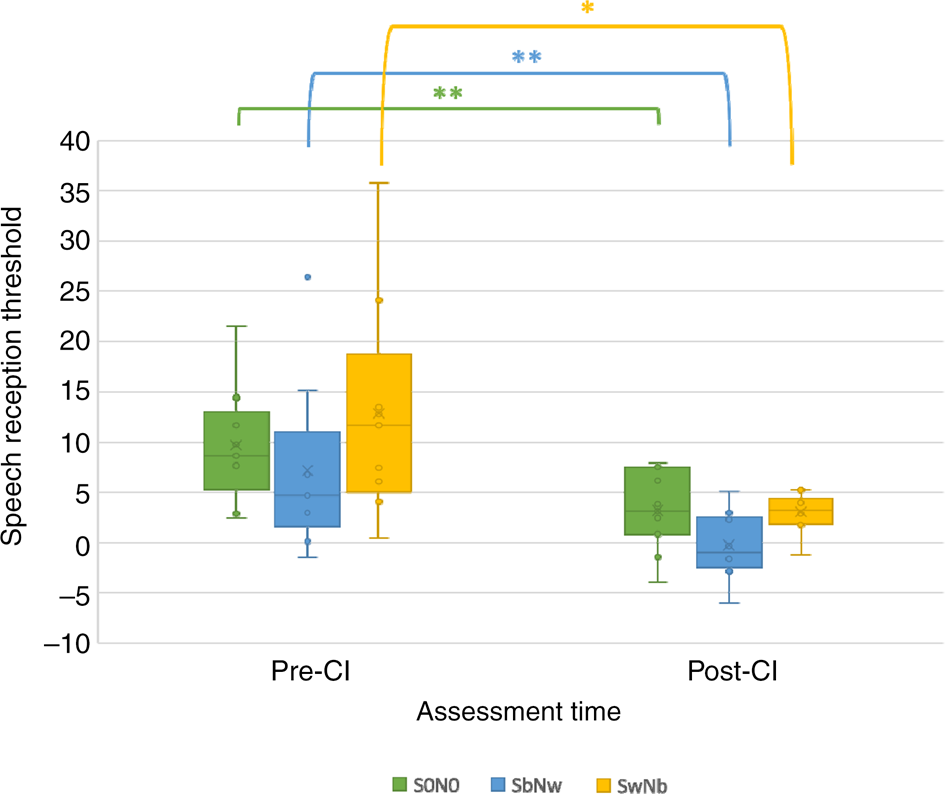
Pre-operatively, in the everyday listening situation, the mean speech reception threshold value was 8.7 dB (range, 0.9–21.5 dB) in the ‘S0N0’ (sound and noise presented from a single speaker in front of the patient) condition, 7.1 dB (range, −1.5 to 26.4 dB) in the ‘SbNw’ (speech presented from the better side and the noise from the worse side) condition, and 12.8 dB (range, 0.4–35.8 dB) in the ‘SwNb’ (speech presented from the worse side and the noise from the better side) condition.
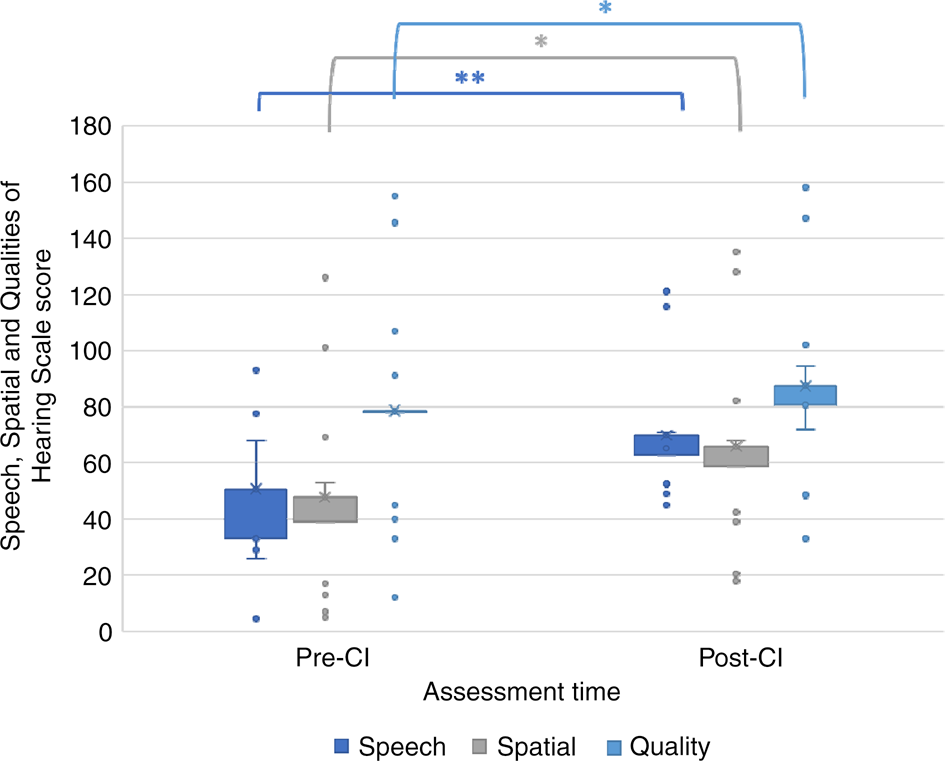
Pre-operatively, the mean scores on the Speech, Spatial and Qualities of Hearing Scale were 50.6 (range, 5–94) for the speech aspect, 47.7 (range, 5–126) for the spatial aspect and 78.5 (range, 12–155) for the quality aspect.
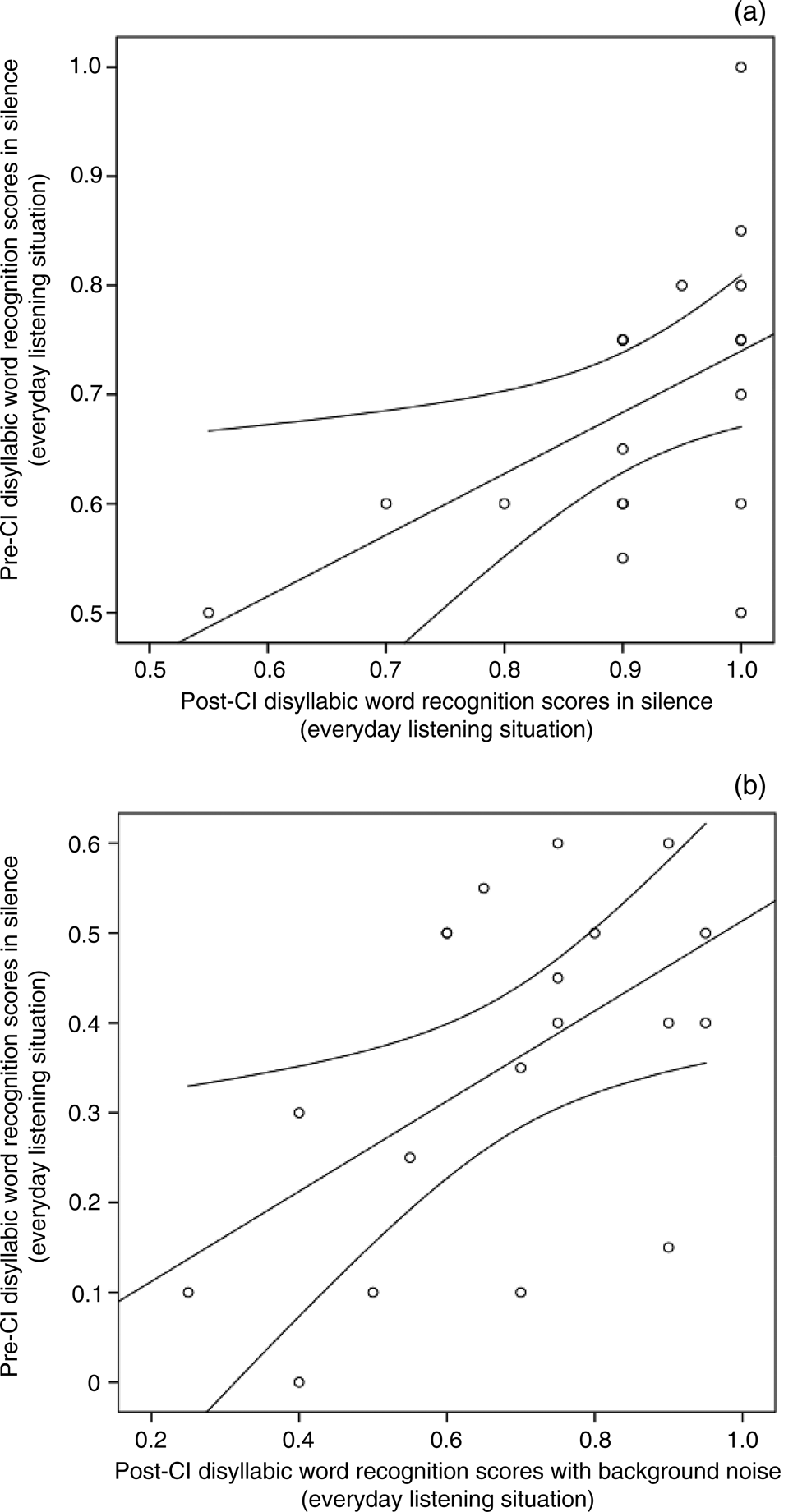
After implantation, in an everyday listening situation, the mean post-operative open set word recognition score was 91 per cent (range, 55–100 per cent) in silence and 68.4 per cent (range, 25–95 per cent) with background noise. The difference between pre-operative and post-operative disyllabic word recognition score in the preferred or usual hearing situation was statistically significant both in silence and with background noise (p < 0.001). With a cochlear implant only, the mean open set word recognition score was 70.8 per cent (range, 10–100 per cent) in silence and 45.2 per cent (range, 10–95 per cent) with background noise. We found a statistically significant correlation between pre- and post-operative disyllabic word recognition scores in an everyday listening situation both in silence (Spearman's ρ = 0.491; p < 0.05) (Figure 1a) and with background noise (Spearman's ρ = 0.484; p < 0.05) (Figure 1b). However, the post-operative disyllabic word recognition score in the everyday listening situation was not significantly correlated with: the post-operative disyllabic word recognition score when using the cochlear implant only, the better hearing ear pre-operative hearing threshold, patient age at the time of cochlear implantation or hearing deprivation duration.
Scatterplots displaying pre- and post-cochlear implantation (CI) disyllabic word recognition scores in silence (R2 linear = 0.268) (a), and with background noise (signal-to-noise ratio of + 10 dB) (R2 linear = 0.288) (b), in an everyday listening situation (i.e. aided or unaided, according to each patient's preference).

Post-operatively in the everyday listening situation, the mean speech reception threshold (detected using the Oldenburg Sentence Test) was 3.1 dB (range, −4.0 to 7.9 dB) in the ‘S0N0’ (sound and noise presented from a single speaker in front of the patient) condition, −0.3 dB (range, −6 to 5.1 dB) in the ‘SbNw’ (speech presented from the better side and the noise from the worse side) condition, and 2.9 dB (range, −1.2 to 5.2 dB) in the ‘SwNb’ (speech presented from the worse side and the noise from the better side) condition. The differences between pre- and post-implantation speech reception thresholds were statistically significant for: the ‘S0N0’ condition (p < 0.01), the ‘SbNw’ condition (p < 0.01) and the ‘SwNb’ condition (p < 0.05) (Figure 2). We also found a significant correlation between the post-operative speech reception thresholds in the ‘S0N0’ and ‘SbNw’ conditions and the pre-operative hearing threshold in the better (non-implanted) ear (Spearman's ρ = 0.716 and 0.689, respectively; p < 0.05).
Boxplot showing pre- and post-cochlear implantation (CI) speech reception threshold assessment with the Oldenburg Sentence Test, in ‘S0N0’ (sound and noise presented from single speaker in front of patient), ‘SbNw’ (speech presented from better side and noise from worse side) and ‘SwNb’ (speech presented from worse side and noise from better side) configurations. *p < 0.05; **p < 0.01.

Post-operatively, the mean Speech, Spatial and Qualities of Hearing Scale scores rose to 69.7 (range, 45–121) for the speech aspect, 65.7 (range, 18–135) for the spatial aspect and 87.2 (range, 33–158) for the quality aspect. The differences between the pre- and post-operative scores were statistically significant for the speech (p < 0.01), spatial (p < 0.05) and qualities (p < 0.05) aspects of the Speech, Spatial and Qualities of Hearing Scale (Figure 3). The post-operative scores on the Speech, Spatial and Qualities of Hearing Scale questionnaire were not correlated with the post-operative speech perception scores or speech reception threshold.
Boxplot showing pre- and post-cochlear implantation (CI) Speech, Spatial and Qualities of Hearing Scale scores. *p < 0.05; **p < 0.01.

All the patients except one (18 out of 19, 94 per cent) were using a cochlear implant compatible with a datalogging system. From the datalogging reports, we found that the mean daily use of cochlear implants in our study population was 9.25 hours per day (range, 3.34–14.51 hours per day). We found no significant correlations between the mean daily duration of cochlear implant use and post-operative speech perception scores, speech reception threshold, or Speech, Spatial and Qualities of Hearing Scale scores.
Discussion
Commonly, patients with asymmetric hearing loss have good hearing performance in terms of speech perception in quiet conditions and do not fall into the classical indications for cochlear implantation; however, this group of patients experiences problems while hearing in difficult situations, such as those with background noise, in reverberant spaces or while hearing from multiple speakers, because of the lack of binaural auditory input. Classically, in typical cochlear implant recipients using bimodal stimulation, we normally investigate whether some benefit is added by using a hearing aid in the non-implanted ear. In implanted patients with asymmetric hearing loss, we have to investigate whether a cochlear implant in the worse hearing ear adds some benefit in comparison to the pre-operative situation.Reference van Loon, Smits, Smit, Hensen and Merkus16
The recent literature has demonstrated that patients with asymmetric hearing loss benefit from cochlear implantation in the worse hearing ear.Reference Firszt, Reeder, Holden and Dwyer1,Reference van Loon, Smits, Smit, Hensen and Merkus16,Reference Sladen, Carlson, Dowling, Olund, DeJong and Breneman17 Benefits have been reported while hearing in quiet conditions, especially when listening to soft sounds and voices, but mostly while hearing in noise. In addition, gains in sound localisation, mainly in cases with a short hearing deprivation duration and with post-lingual hearing loss, have been demonstrated, as well as benefits to QoL.Reference Firszt, Reeder, Holden and Dwyer1,Reference van Loon, Smits, Smit, Hensen and Merkus16,Reference Sladen, Carlson, Dowling, Olund, DeJong and Breneman17
Our study confirms that asymmetric hearing loss patients with cochlear implants achieve statistically significant improvements in their speech perception abilities both in quiet conditions and with background noise. This is evident in the post-operative increase of disyllabic word recognition scores in silence and with background noise (p < 0.001), and in the improvement of the post-operative speech reception threshold values assessed with the Oldenburg Sentence Test. It is further noticeable that the benefits in speech reception thresholds are significant not only in the ‘S0N0’ (sound and noise presented from a single speaker in front of the patient) and ‘SbNw’ (speech presented from the better side and the noise from the worse side) configurations (p < 0.01 for both), but also in the ‘SwNb’ (speech presented from the worse side and the noise from the better side) condition (p < 0.05).
These results confirm how rehabilitation of the worse hearing ear with a cochlear implant in patients with asymmetric hearing loss can lead to an improvement of squelch abilities even when the speech signal derives from the worse hearing ear. These findings have also been reported for single-sided deafness.Reference Arndt, Laszig, Aschendorff, Hassepass, Beck and Wesarg9,Reference Ellsperman, Zwolan and Telian18 It is a remarkable outcome, especially when compared with the results achieved for the same configurations with the use of contralateral routing of signals with a single microphone or bilateral microphones or bone-anchored hearing device systems in asymmetric hearing loss or single-sided deafness patients. Indeed, with systems using contralateral routing of signals, even if some benefits are generally reported in speech perceptionReference Jakob, Speck, Rauch, Hassepass, Ketterer and Beck19 and speech reception threshold,Reference Deep, Spitzer, Shapiro, Waltzman, Roland and Friedmann20 patients can experience very limited benefit or lower speech perception performances than if unaided in an ‘SwNb’ (speech presented from the worse side and the noise from the better side) condition.
Despite the positive results, a wide variability in benefits from implantation in patients with asymmetric hearing loss is generally described, both among different studies and among patients belonging to the same sample. Some audiological features of the patients have been related to this variability, such as speech perception scores before implantation, the degree of hearing loss in the non-implanted ear, and the length of hearing deprivation in the implanted ear.
In our sample, we found a statistically significant correlation between the pre- and post-operative disyllabic word recognition scores in quiet conditions and with background noise. Our data seem to confirm the literature reports.Reference Firszt, Reeder, Holden and Dwyer1,Reference Plant and Babic21
It has been reported that, in adults with post-lingual asymmetric hearing loss, a long duration of sound deprivation in the ear to be implanted has little influence on speech recognition outcomes after cochlear implant.Reference Arndt, Laszig, Aschendorff, Hassepass, Beck and Wesarg9 In addition, Boisvert et al. obtained a similar outcome in patients with post-lingual deafness by implanting both ears with longer or shorter deprivation periods.Reference Boisvert, McMahon, Dowell and Lyxell22 This aspect seems to be different in the case of pre- and peri-lingual onset of deafness: a pre-verbal hearing loss, mainly if not rehabilitated with a hearing aid, is generally related to a poor outcome after implantation. In our sample, to avoid bias, only patients with a post-lingual hearing loss were included, and we did not find a statistically significant correlation between post-implant results in terms of speech perception and duration of deafness in the implanted ear.
The variability in the outcome between patients with asymmetric hearing loss can only partially be explained by the degree of hearing loss or by the length of hearing deprivation. Indeed, the integration process is highly listener-specific and based on individual features. Further studies in this field and more data are needed to better understand and predict the results.
When evaluating the post-cochlear implantation results in asymmetric hearing loss patients, we have to consider two aspects: the speech perception skills of the implanted ear (obtained by stimulating only the implanted ear with the processor switched on) and the speech perception abilities in the everyday listening situation (which is bimodal stimulation for most patients, but it may be only with the cochlear implant for some patients if they do not use the contralateral hearing aid). Only this latter factor reflects the real benefit after implantation. It has been further reported that patients with asymmetric hearing loss achieve lower performances with the cochlear implant only than implanted patients with bilateral severe-to-profound hearing loss, and that this is proportionate to the degree of hearing in the better hearing ear. This may be related to a ‘preference’ for hearing with the better hearing ear or to a ‘dominance’ of the better hearing ear that inhibits the central processing of information from the worse, implanted ear.Reference Firszt, Reeder, Holden and Dwyer1
In our sample, the results in terms of speech perception with a cochlear implant only were satisfactory, although there was wide variability: the post-operative mean disyllabic word recognition score with a cochlear implant only, in silence, was 70.8 per cent, ranging from 10 to 100, and was 45.2 per cent with background noise, ranging from 10 to 95. These results were not correlated with the pre-operative hearing threshold or with speech perception performances of the better hearing ear.
Particular attention must be given to the QoL results and the patient-reported measures. These measures may indeed reveal additional benefits from binaural hearing that are not quantified with traditional audiological tests. In this regard, recently, in a group of 20 cochlear implant recipients with asymmetric hearing loss, Thompson et al. reported early significant improvements in perceived abilities on the Speech, Spatial and Qualities of Hearing Scale questionnaire.Reference Thompson, Dillon, Buss, Rooth, King and Bucker23 In addition, Ketterer et al. found long-term benefit from binaural hearing rehabilitation in asymmetric hearing loss, regarding not only speech perception but also QoL, tinnitus distress and subjective hearing quality.Reference Ketterer, Knopke, Haussler, Hildenbrand, Becker and Grabel24 Indeed, van Loon et al. reported not a global gain in QoL after implantation, but a significant benefit in issues related to hearing and communication.Reference van Loon, Smits, Smit, Hensen and Merkus16
In our cohort, there were significant post-implantation improvements in subjectively perceived benefits, as measured using the Speech, Spatial and Qualities of Hearing Scale questionnaire, in terms of speech, spatial and quality (p < 0.01, p < 0.05 and p < 0.05, respectively) aspects. Nevertheless, questionnaire scores were not correlated with post-operative speech perception abilities. This suggests that bimodal stimulation in asymmetric hearing loss patients offers subjectively perceived benefits beyond the improvement achieved in the speech perception test. These benefits are mostly related to qualitative and subjective gains in terms of: listening with background noise and in complex auditive environments; the perception of voices, sounds and music; and the ease of listening in general speaking situations and the listening effort required. All these aspects have an important impact on patients’ QoL and on the subjectively perceived degree of disability.
Some authors have reported the non-use of cochlear implants among implant recipients with asymmetric hearing loss.Reference Tavora-Vieira, Acharya and Rajan25 Despite a variable mean daily duration of cochlear implant use in our sample, there were no cases of non-users. We used datalogging information as an objective measure of the benefit derived from the implant and to determine prognostic factors. We hypothesised that greater benefits after implantation would be associated with increased use of the implant. We also hypothesised that greater use of the implant would lead to better results. However, we did not find any such correlations between these variables.
We can conclude that, even if patients with asymmetric hearing loss generally perform well in quiet conditions, they can experience difficulties while hearing in noise and in other difficult situations because of the lack of binaural input. Historically, the proposed treatments for asymmetric hearing loss were amplification of the worse hearing ear, contralateral routing of signals with a single microphone or bilateral microphones, or a bone-anchored hearing device on the worse side. In recent years, however, asymmetric hearing loss has become a more frequent indication for cochlear implantation.
Our results support the literature findings indicating that patients with asymmetric hearing loss generally gain substantial benefit from cochlear implantation because of the binaural input, with significant improvements in: speech perception abilities in noise, speech reception threshold and squelch abilities. It is remarkable how the speech perception in noise benefit occurs after cochlear implantation even in an ‘SwNb’ (speech presented from the worse side and the noise from the better side) condition; in contrast, patients using a contralateral routing of signals system can experience lower speech perception performances than if unaided in this configuration.
• Hearing restoration in asymmetric hearing loss is a modern audiological challenge
• Treatments include traditional amplification, contralateral routing of signals with microphone(s), bone-anchored hearing device or cochlear implant in the worse ear
• Cochlear implantation of the poorer hearing ear can benefit speech perception, speech reception threshold and squelch abilities
• These benefits are greater than with traditional amplification of the poorer hearing ear and contralateral routing of signals
• Patient-reported measures indicated significant improvement after cochlear implantation of the poorer hearing ear
Better post-operative results in terms of speech perception seem to be related to a pre-operative lower degree of hearing loss in the better hearing ear. Furthermore, a cochlear implant in patients with asymmetric hearing loss offers a wide range of qualitative, subjectively perceived benefits, irrespective of speech perception gains. Our report provides support for considering a cochlear implant in patients with asymmetric hearing loss because of the additional benefit attained, in comparison to other treatments (contralateral routing of signals with a single microphone or bilateral microphones, or a bone-anchored hearing device).
Competing interests
None declared